
Atomic Structure and the Periodic Table
Every periodic trend traces back to one tug-of-war: nuclear charge vs shielding
Quick facts
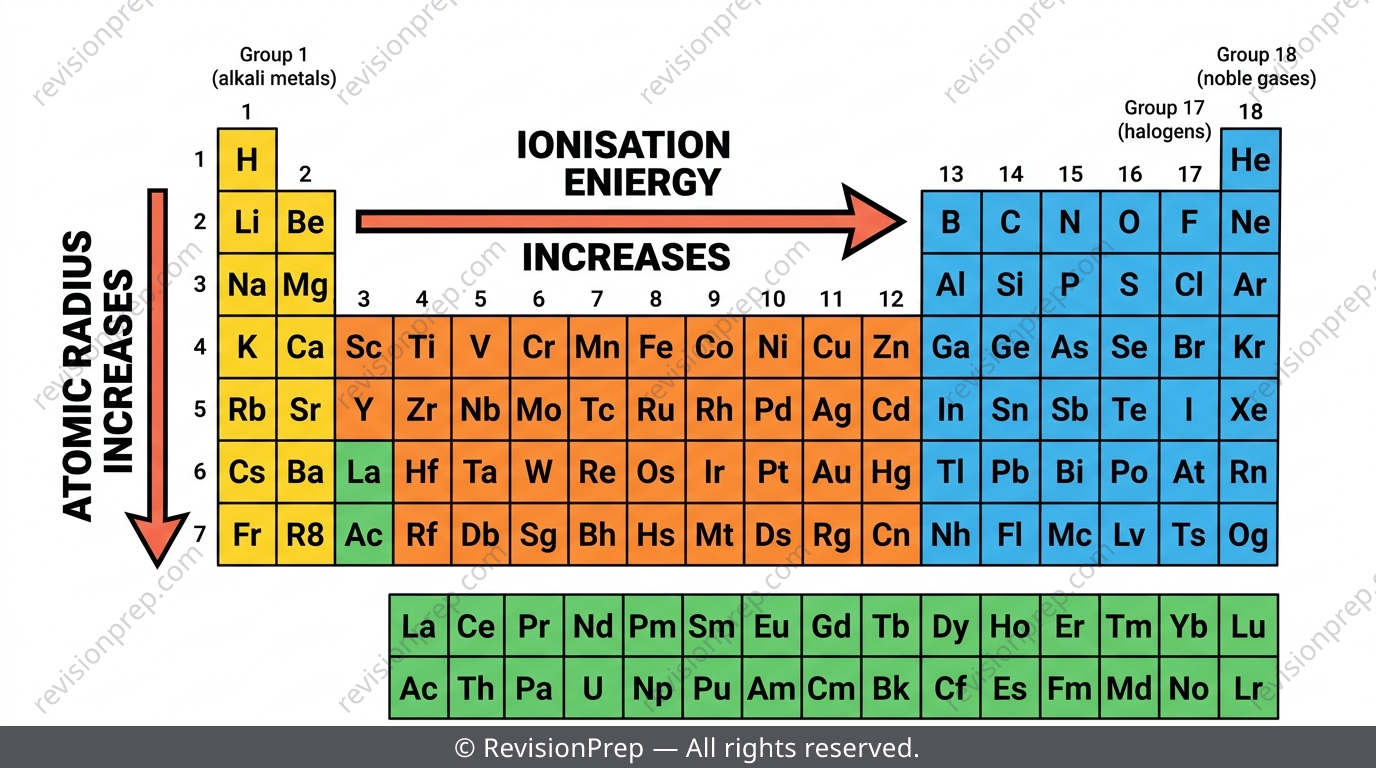
The periodic table isn't a list to memorise — it's a map of electron configuration, and IB MYP 5 Chemistry expects you to read that map, not just recite it. Every trend examiners ask about — atomic radius, ionisation energy, electronegativity, reactivity — comes down to a single balance: how hard the nucleus pulls on outer electrons versus how much inner shells shield that pull. Master that one idea and you can derive almost every trend in the table instead of memorising rows of arrows. This teaser walks through the five ideas that show up most often in MYP assessments: how groups, periods and blocks are organised; the nuclear charge vs shielding trend; why metal and nonmetal reactivity move in opposite directions; how successive ionisation energies expose an element's group; and why melting points across a period follow bonding type. For the full depth — worked examples, trap-proof explanations and every definition — head to the complete RevisionPrep notes.
What you’ll be able to do
Groups, Periods and Blocks: Reading the Map
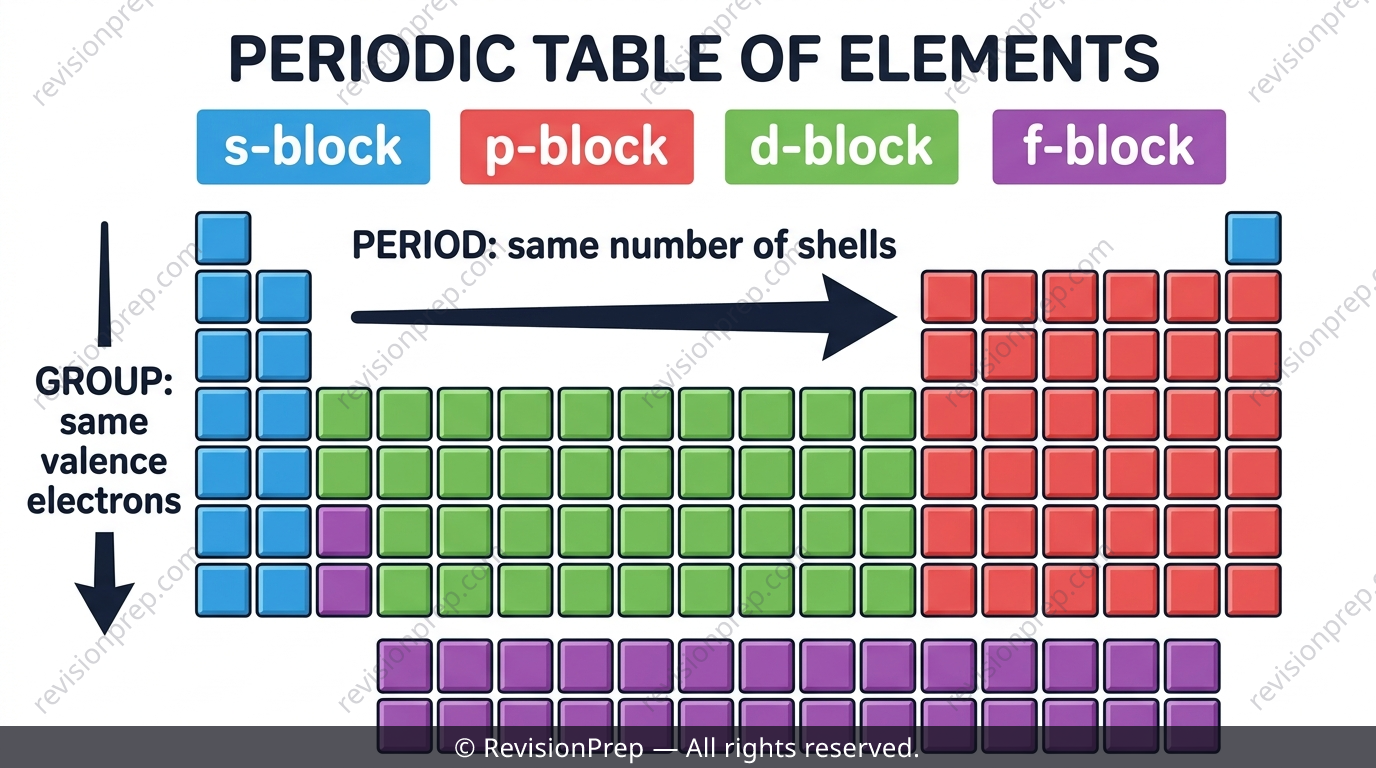
The modern table is ordered by atomic number (Z), following the Periodic Law — properties repeat periodically as Z increases. This fixes anomalies from Mendeleev's mass-based table, like tellurium (Z=52) sitting before the heavier iodine (Z=53). Groups (columns) share the same number of valence electrons and similar chemistry; periods (rows) share the same number of occupied shells; blocks (s, p, d, f) tell you which subshell the last electron entered.
| Feature | What it tells you |
|---|---|
| Group (1–18) | Number of valence electrons; similar chemical behaviour |
| Period (1–7) | Number of occupied electron shells |
| Block (s, p, d, f) | Which subshell the outermost electron occupies |
Exam tip
For p-block groups (13–18), subtract 10 from the group number to get valence electrons — Group 17 gives 17 − 10 = 7. This rule does not apply to d-block transition metals.
Common mistake
Assuming group number always equals valence electron count for every group — it only works directly for Groups 1, 2 and 13–18.
Mini summary
Atomic number (not mass) fixes the table; groups = valence electrons, periods = shells, blocks = subshell type.
The Master Trend: Nuclear Charge vs Shielding
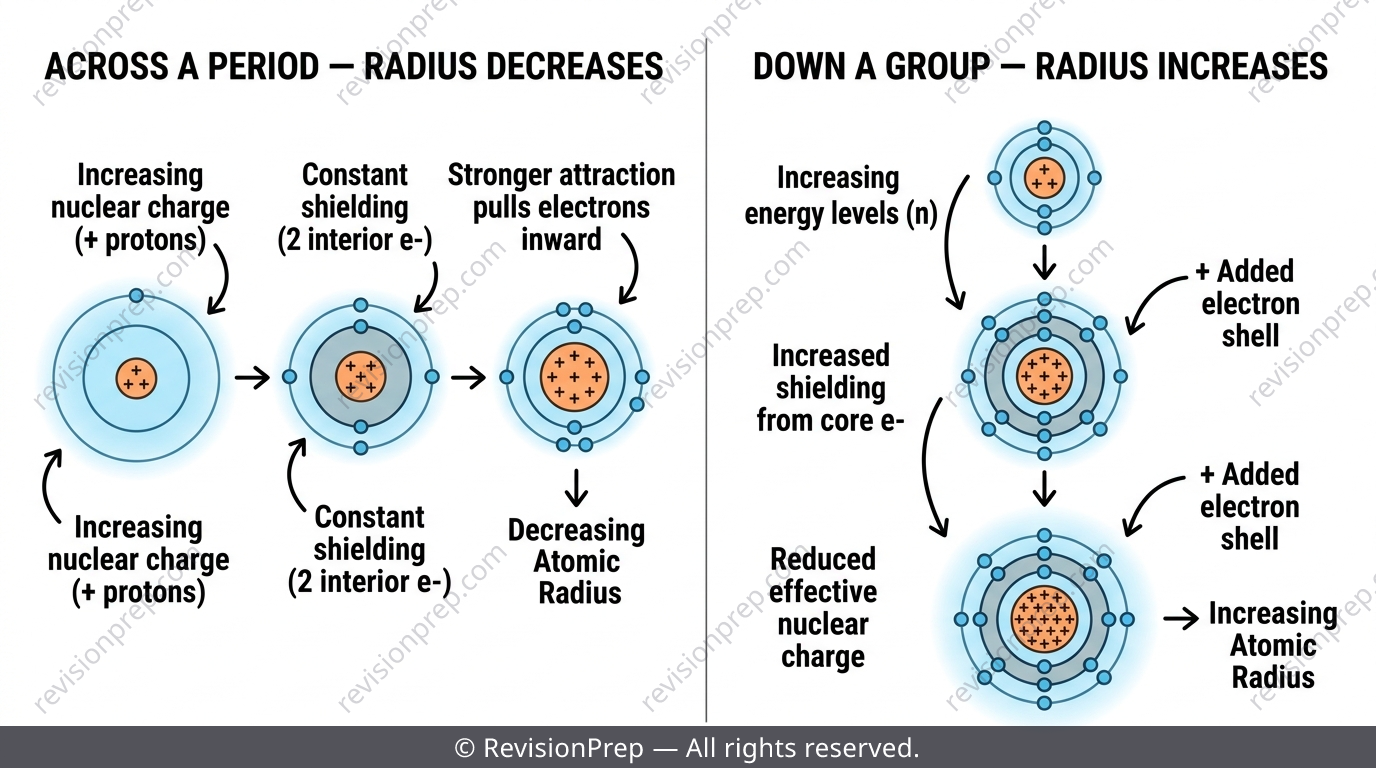
Across a period, protons increase while shielding stays roughly constant, so the nuclear pull on outer electrons strengthens — atomic radius shrinks, ionisation energy rises, electronegativity rises. Down a group, a whole new shell is added each time, so shielding grows faster than nuclear charge — radius grows, ionisation energy falls, electronegativity falls. Learn this one balance and you can reconstruct every row of the trends table under exam pressure.
Exam tip
If you forget which way electronegativity trends near the top-right, just remember F is the most electronegative element, full stop — use F > O > N > Cl as fixed reference points to sanity-check any comparison.
Mini summary
Across a period: more pull, smaller/tighter atoms. Down a group: more shielding, bigger/looser atoms.
Reactivity: Metals and Nonmetals Move in Opposite Directions
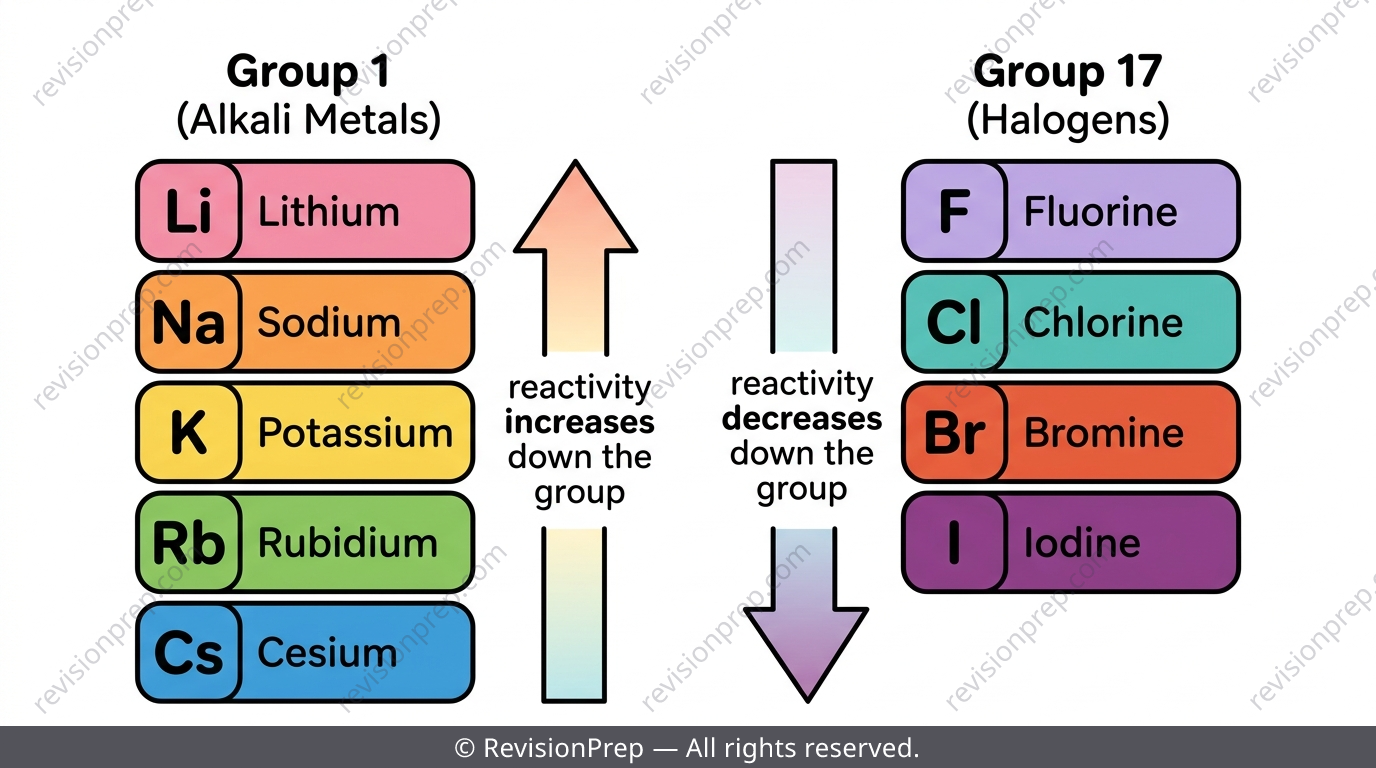
Reactive metals like Group 1 get MORE reactive down the group because it's easier to lose an increasingly shielded outer electron. Reactive nonmetals like Group 17 get LESS reactive down the group because extra shielding makes it harder to attract an additional electron. Metallic character follows the same logic as ionisation energy but mirrored — it increases down a group and decreases across a period.
Common mistake
Assuming all Period 3 metals react with water identically, or that water reactivity and oxygen reactivity rank the same way — state the pattern (Na > Mg > Al) and the reason (rising ionisation energy, plus Al's protective oxide layer as an extra specific factor).
Mini summary
Same cause (shielding), opposite outcome: metals lose electrons more easily down a group; nonmetals gain them less easily.
Successive Ionisation Energies: Finding the Group
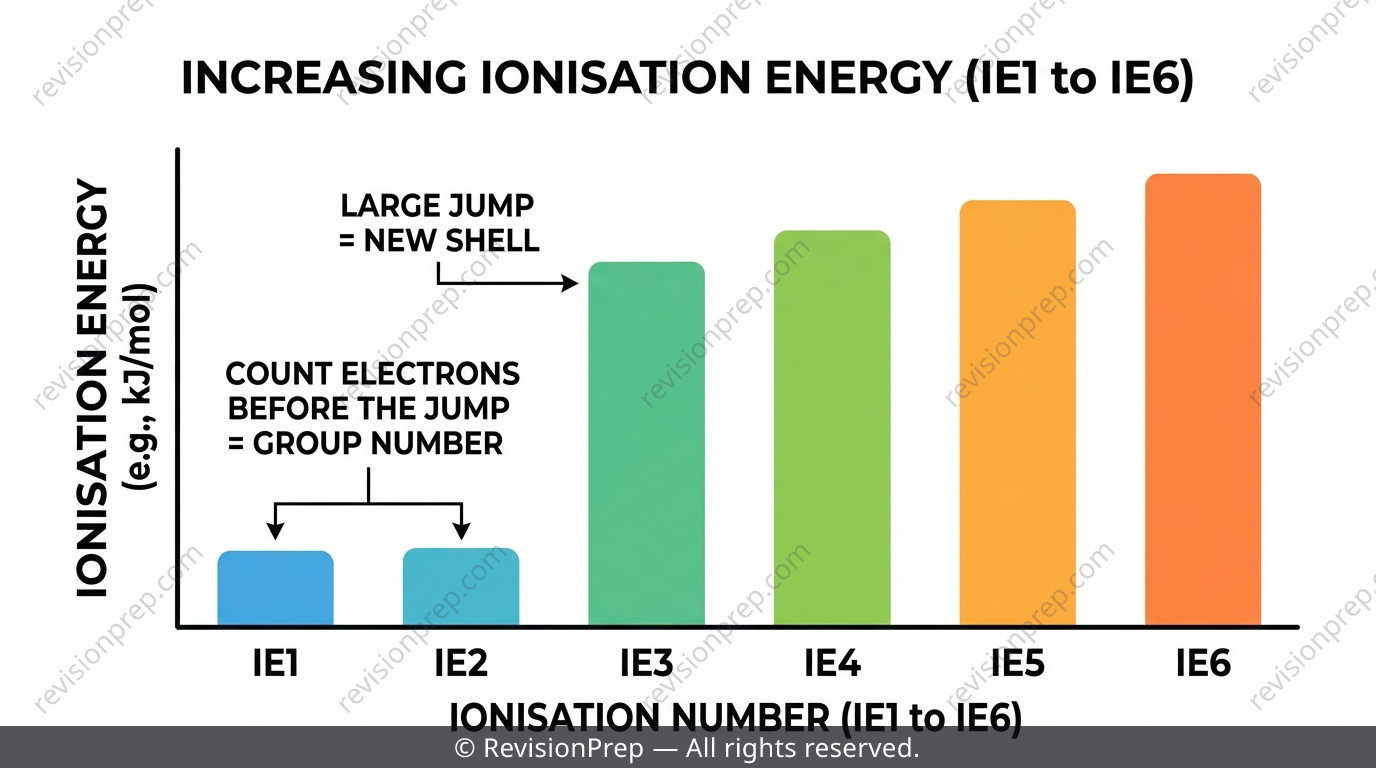
First ionisation energy removes one mole of electrons from one mole of gaseous atoms: . Every element's successive ionisation energies always increase, so rising numbers alone tell you nothing about group — the group is revealed only by locating a disproportionately large jump, which marks a new inner shell being broken into. Count the electrons removed before that jump to get the group number.
Exam tip
Don't conclude an element's group just because IE values keep rising — every element does that. Find the big jump, then count.
Mini summary
Successive IEs always rise; the size of the jump between them locates the element's group.
Melting Point Trends: It's About Bonding Type
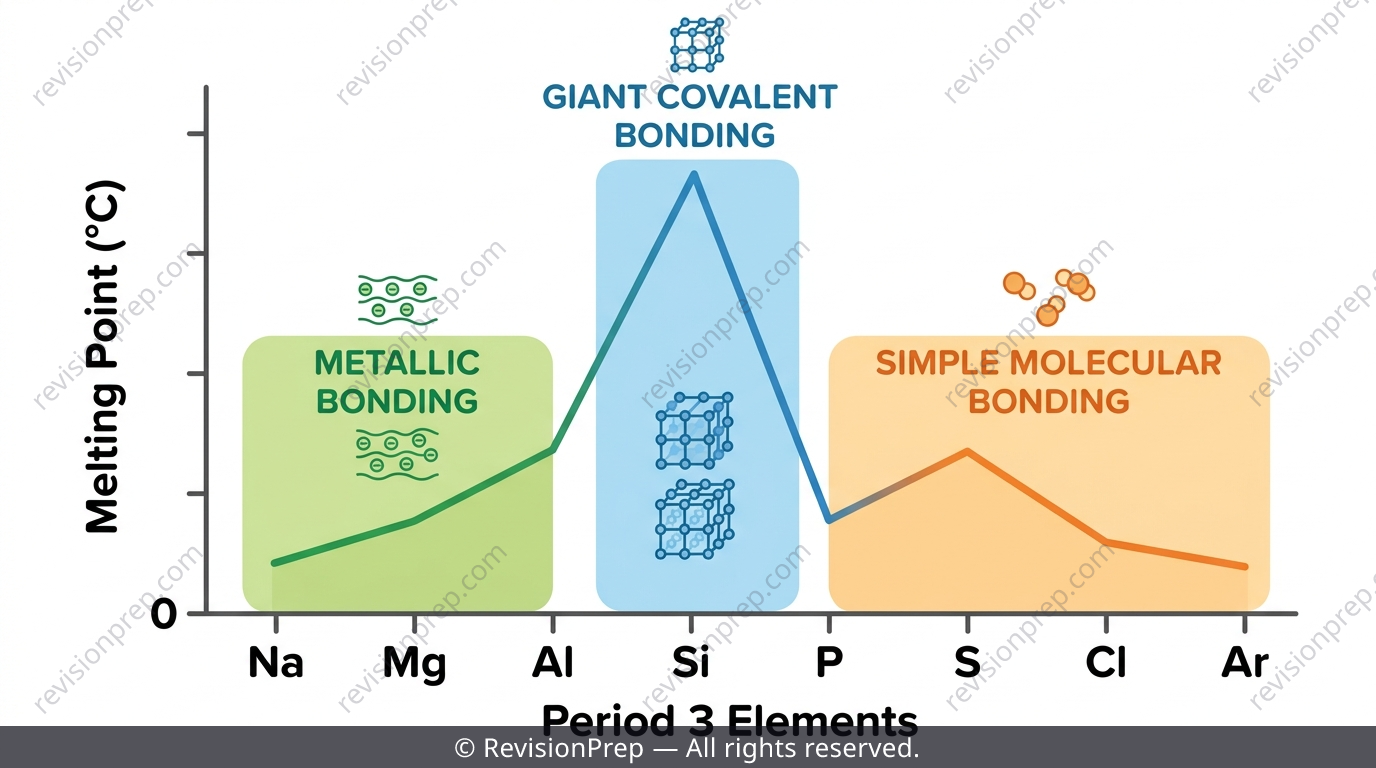
Across Period 3, melting point rises through the metallic elements (Na, Mg, Al), peaks at giant covalent silicon, then crashes for the simple molecular nonmetals (P, S, Cl, Ar). Sulfur's melting point is higher than both phosphorus's and chlorine's because it depends on intermolecular (London dispersion) forces governed by molecule size and electron count — not on ionisation energy or electronegativity.
Common mistake
Explaining sulfur's anomaly using ionisation energy or electronegativity — melting point of simple molecular substances depends on intermolecular forces, not periodic trend values.
Mini summary
Melting point across a period tracks bonding type: metallic → giant covalent → simple molecular; anomalies come from molecule size, not position.
Quick formula sheet
Practice questions
- State the number of valence electrons in an atom of chlorine (Group 17).
- Identify which block (s, p, d or f) contains the transition metals.
- State whether atomic radius increases or decreases across Period 3 from left to right.
- Explain why electronegativity increases across Period 3 from sodium to chlorine.
- Explain why Group 1 metals become more reactive down the group while Group 17 nonmetals become less reactive down the group.
- Explain why tellurium (Z=52) is placed before iodine (Z=53) in the modern periodic table despite being heavier.
- An element has successive ionisation energies (kJ/mol): 738, 1450, 7730, 10540, 13630, 18020. Deduce which group of the periodic table it belongs to, justifying your answer.
- Melting points across Period 3 show sulfur higher than both phosphorus and chlorine. Explain this anomaly.
- Evaluate one limitation of using periodic table position alone to select a material for a heat-shield application.
Frequently asked questions
What's the difference between a group and a period?+
A group is a vertical column where elements share the same number of valence electrons and similar chemistry. A period is a horizontal row where elements share the same number of occupied electron shells.
Why is the periodic table ordered by atomic number instead of atomic mass?+
Ordering by atomic number follows the Periodic Law and fixes anomalies from mass-based ordering — for example, tellurium (Z=52) sits before the heavier iodine (Z=53) because atomic number, not mass, determines the pattern of properties.
How do you find the number of valence electrons from the group number?+
For Groups 1, 2 and 13–18, the valence electron count matches a simple rule: for Groups 13–18, subtract 10 from the group number (Group 17 → 7 valence electrons). This shortcut doesn't work for d-block transition metals (Groups 3–12).
Why does ionisation energy increase across a period but decrease down a group?+
Across a period, protons increase while shielding stays constant, so nuclear pull on outer electrons strengthens, raising ionisation energy. Down a group, an extra shell adds shielding faster than nuclear charge increases, lowering ionisation energy.
How can successive ionisation energies tell you an element's group?+
Every element's successive ionisation energies rise, so that alone reveals nothing. A disproportionately large jump marks a new inner shell — counting the electrons removed before that jump gives the group number.
Why is sulfur's melting point higher than phosphorus's and chlorine's?+
Melting point in simple molecular substances depends on intermolecular (London dispersion) forces, which relate to molecule size and electron count — not on ionisation energy or electronegativity, which is why sulfur breaks the otherwise falling Period 3 trend.
Master every periodic trend with the full MYP 5 Chemistry notes
Related articles