
Work and Energy: Heat, Pressure & Efficiency Made Clear
The 5 concepts IB MYP 5 Physics examiners test most on conduction, pressure, hydraulics and energy conservation.
Quick facts
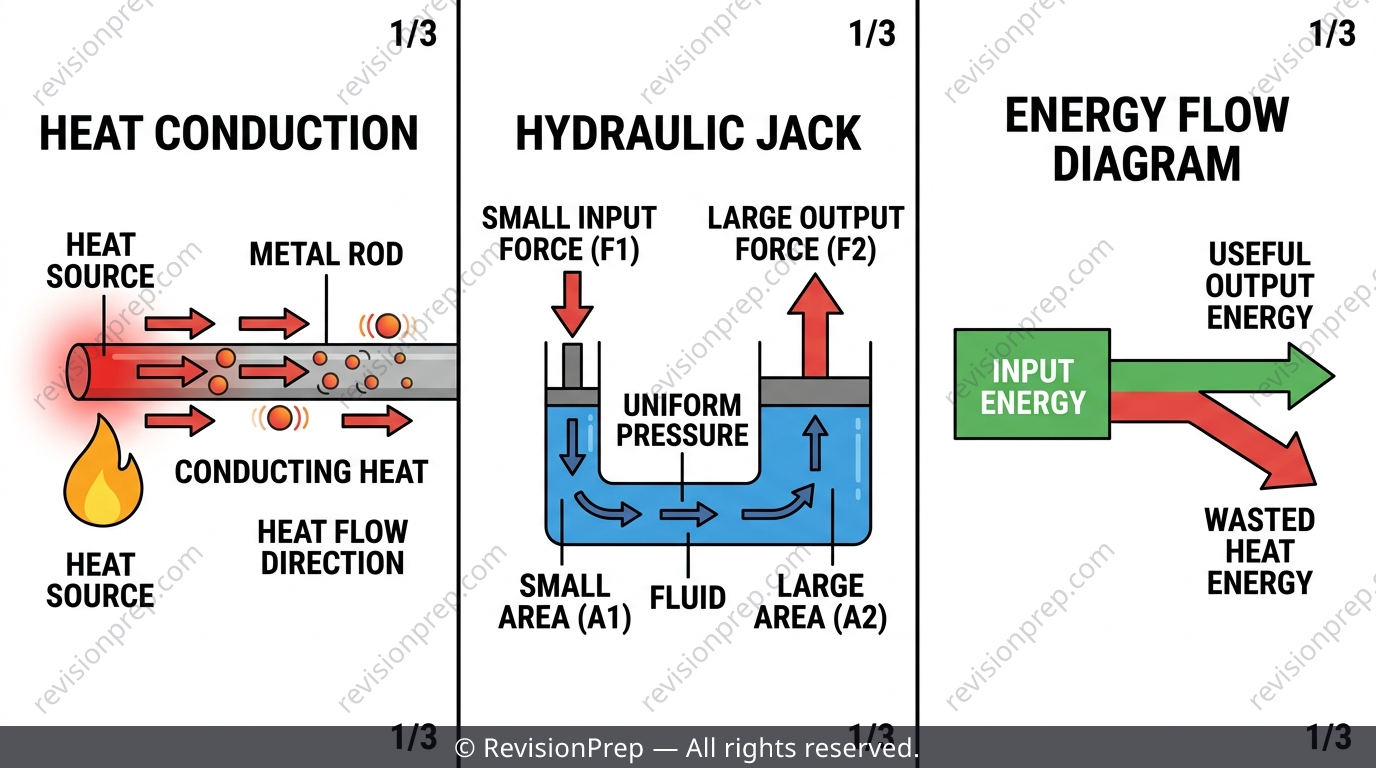
Work and Energy is one of the biggest units in IB MYP 5 Physics, stitching together heat transfer, pressure, hydraulics, energy conservation and real-world resources into one storyline: energy is never created or destroyed, only moved around or changed form. Examiners love testing whether you can explain the particle-level story behind conduction, convection and radiation, whether you can calculate pressure and force in hydraulic systems, and whether you understand why real machines always waste some energy as heat. This teaser walks through the five most exam-critical ideas — heat transfer, conduction calculations, pressure and Pascal's principle, energy conservation and efficiency, and renewable versus non-renewable resources — with the exact traps and command-term expectations examiners use to separate full marks from partial credit. For the complete worked examples, tables and step-by-step calculations, the full revision notes have you covered.
What you’ll be able to do
Conduction, Convection & Radiation: Three Different Stories
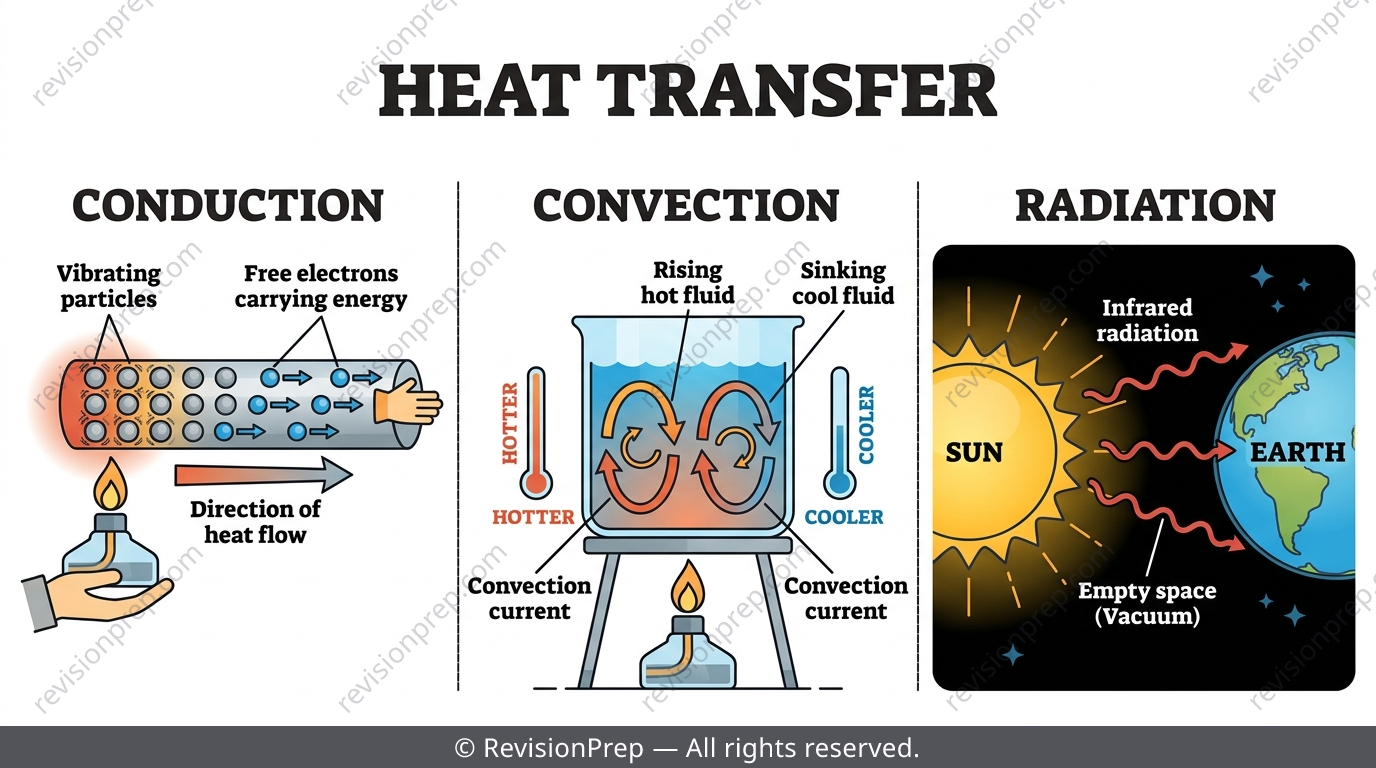
All three mechanisms move thermal energy from hot to cold, but examiners mark you on the correct particle-level story, not just the name. Conduction moves energy particle-to-particle by vibration and collision, with free electrons doing most of the work in metals. Convection only happens in fluids, where heated fluid rises and cooler, denser fluid sinks to replace it. Radiation travels as electromagnetic waves and needs no medium at all — it's the only mechanism that works through a vacuum, which is how the Sun's energy reaches Earth.
Exam tip
If a question gives you the key terms 'kinetic energy', 'vibration' and 'free electrons', your answer must chain all three together — leaving out free electrons in a metal-conduction explanation is the most common reason a 2-mark question only scores 1.
Common mistake
Describing a material with high thermal conductivity as 'hotter' — thermal conductivity is a fixed material property, so trends should always be described as a faster or slower rate of heat transfer.
Mini summary
Conduction = particle collisions + free electrons; convection = bulk fluid movement; radiation = EM waves needing no medium.
Calculating the Rate of Heat Conduction
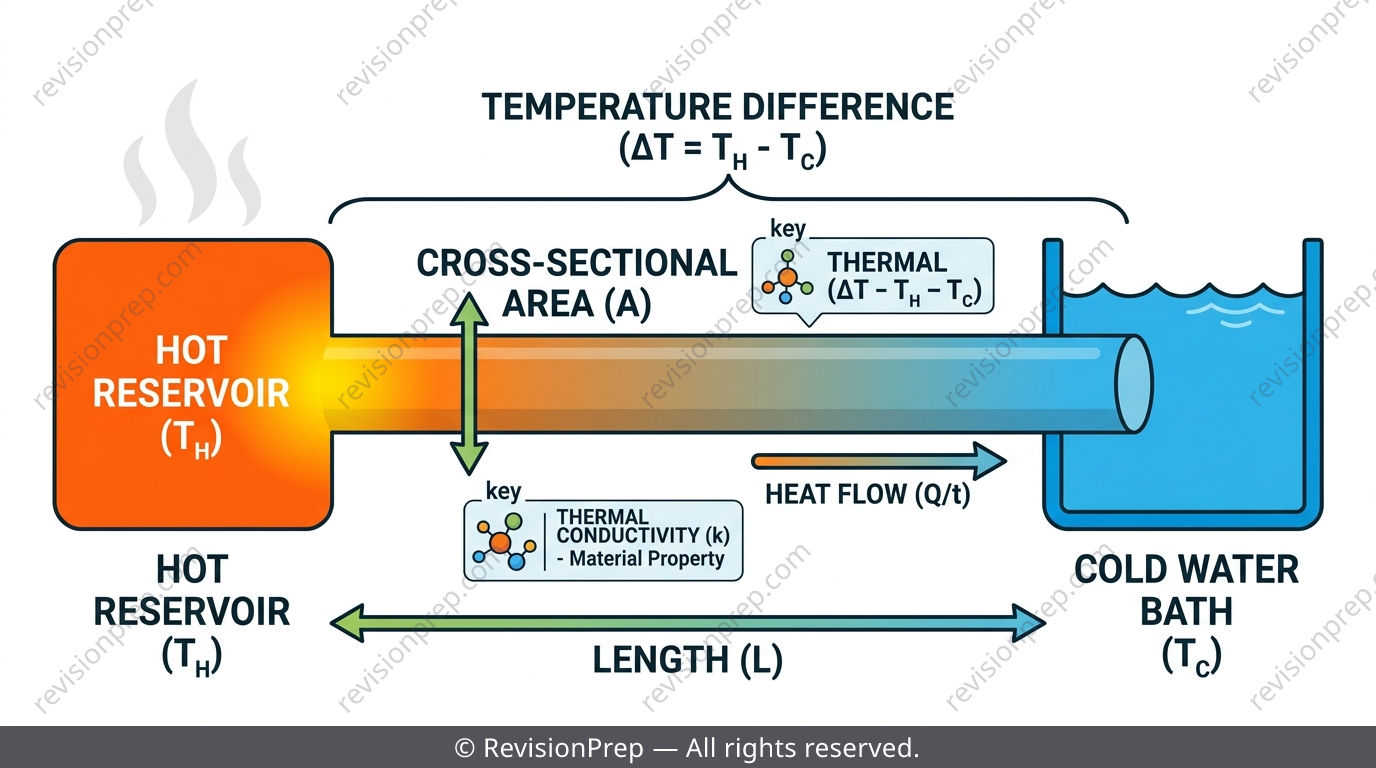
The rate at which a rod conducts heat depends on four things: thermal conductivity , cross-sectional area , temperature difference , and length . A bigger , or speeds up transfer, while a longer path slows it down. This relationship is captured in a single formula that lets you compare how fast different materials or shapes transfer heat.
| Mechanism | Medium required? | How energy moves |
|---|---|---|
| Conduction | Yes (solid, usually metal) | Particle vibration/collision + free electrons |
| Convection | Yes (fluid only) | Bulk movement of heated fluid rising, cool fluid sinking |
| Radiation | No | Electromagnetic (infrared) waves |
Exam tip
If a question gives you a rod's radius , calculate before substituting — using radius or diameter directly as the area is the most common slip and changes your answer by roughly a factor of 4.
Common mistake
Stopping at 'copper has a higher so it's faster' when a compare/calculate question wants actual computed rates or a ratio, not just a qualitative statement.
Mini summary
: bigger , , speed up transfer; bigger slows it down.
Pressure, Pascal's Principle & Hydraulics
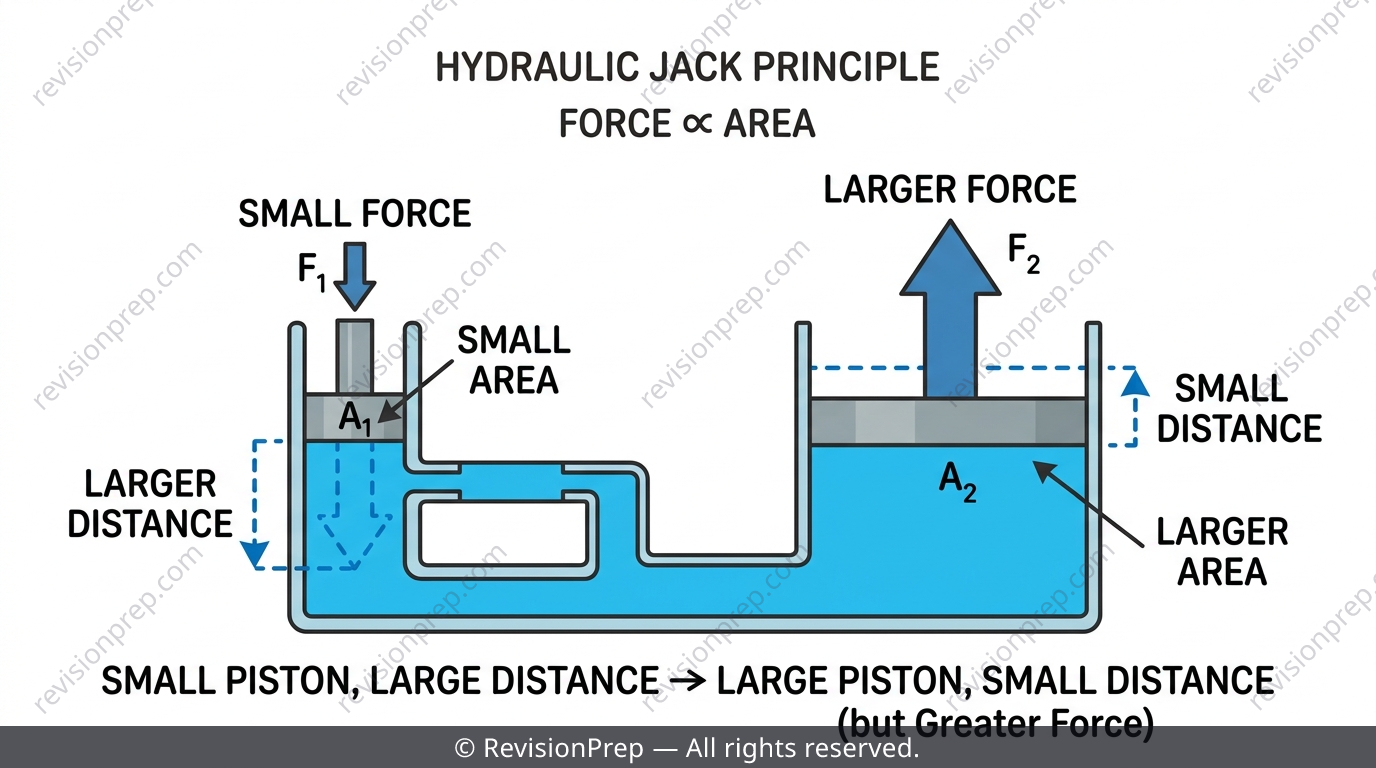
Pressure is force spread over area, so the same force concentrated on a smaller area produces much greater pressure — which is why a knife cuts and snowshoes don't sink. In liquids, pressure increases with depth because deeper points support the weight of more fluid stacked above them, and atmospheric pressure decreases with altitude for the same reason in reverse. Pascal's principle says a pressure change applied anywhere in an enclosed fluid transmits equally in all directions, which is exactly how hydraulic systems multiply force between two pistons.
Exam tip
Explain command terms about pressure and depth/altitude want the causal reasoning about weight of fluid or air above the point — don't just restate the observation.
Common mistake
Substituting an area given in cm² directly into without converting to m² first — always divide cm² values by 10,000 before substituting.
Mini summary
Hydraulics multiply force via Pascal's principle, but the larger piston always moves proportionally less distance — energy is conserved, never created.
Energy Conservation & Why No Machine Is 100% Efficient
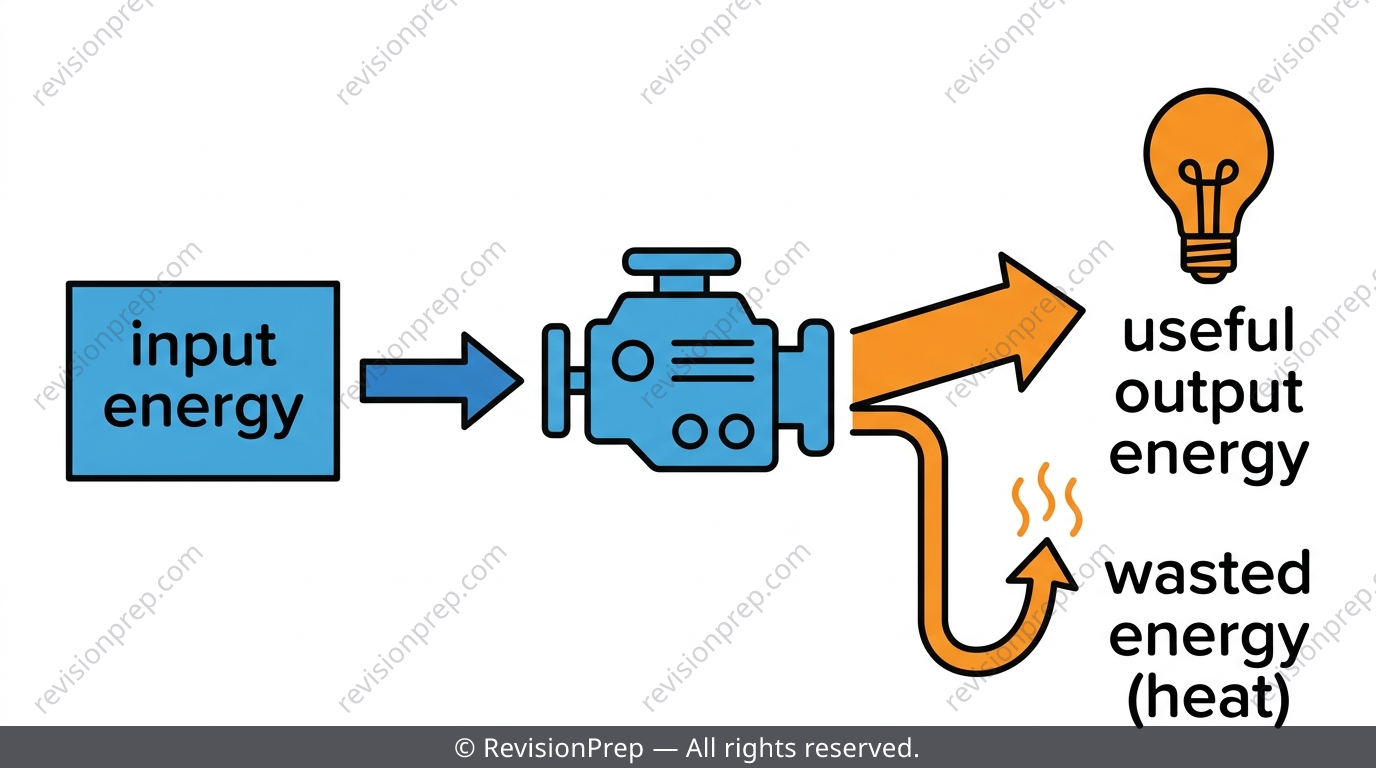
One law underpins this whole unit: energy is never created or destroyed, only transformed or transferred. Every real device converts input energy into useful output plus wasted energy, which doesn't disappear — it's just spread out as heat that's hard to reuse. Because wasted energy is unavoidable, real machines are never 100% efficient, so if a calculated efficiency comes out above 100%, that's a red flag that input and output values got swapped.
Exam tip
When a calculation gives efficiency over 100%, don't accept the number — go back and check whether input and output energy values were swapped in the formula.
Common mistake
Treating heat and temperature as the same physical quantity is the single most common conceptual error in written answers across this unit.
Mini summary
Total energy stays fixed; wasted energy still exists as spread-out heat, so real machines can never reach 100% efficiency.
Where Energy Comes From: Renewable vs Non-Renewable
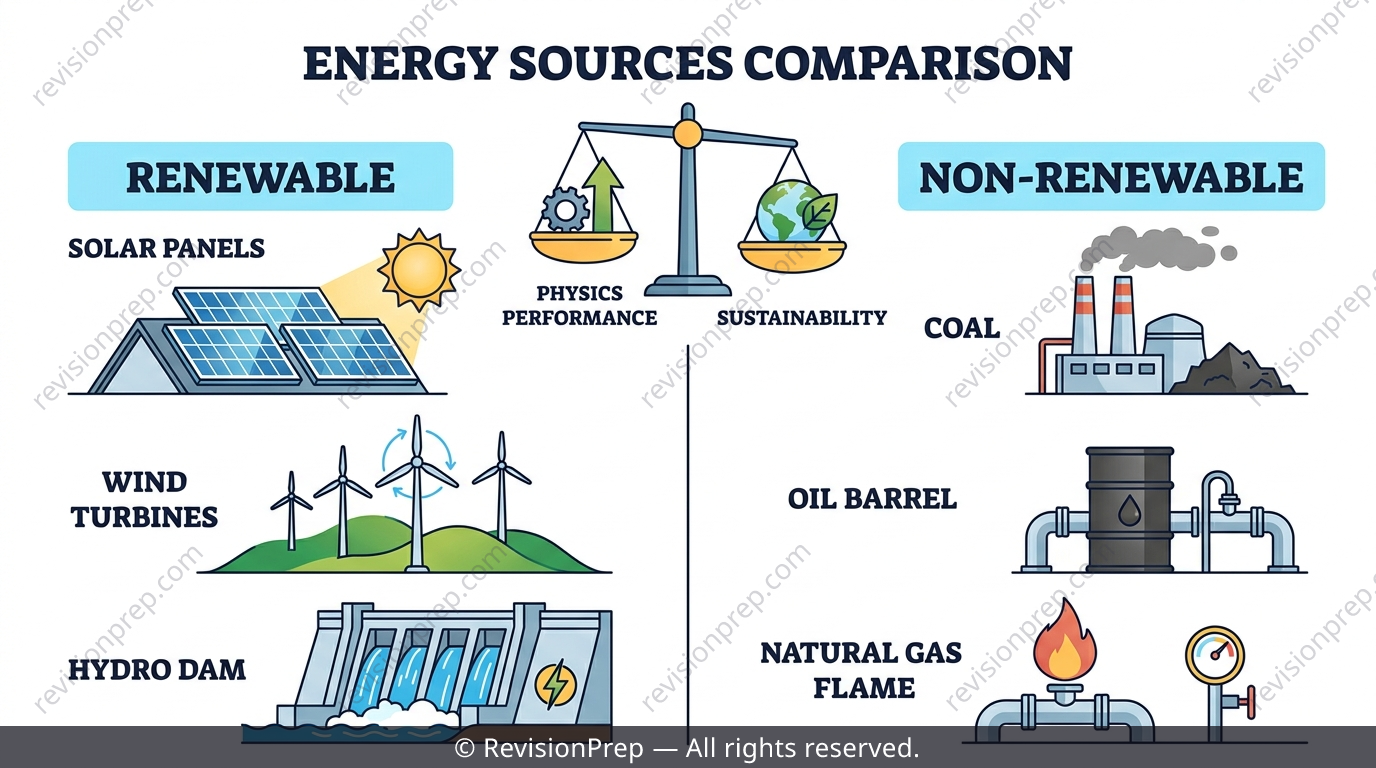
Resource questions blend physics with sustainability — you need to know how a fuel behaves physically and whether it will run out. Command terms like Discuss and Evaluate expect you to weigh both sides rather than just describe one resource in isolation. Understanding this connects directly back to efficiency and conservation of energy, since every resource is ultimately judged on how much useful energy it delivers versus how much is wasted or how sustainable the supply is.
Exam tip
For Discuss/Evaluate questions on energy resources, structure your answer around both physical performance (how the energy is released or transferred) and sustainability (renewable vs finite supply) — one-sided answers lose marks.
Common mistake
Describing only the physics of a resource (e.g. how it burns or generates heat) without addressing whether it is sustainable, when the command term explicitly asks for evaluation of both.
Mini summary
Energy resource questions require both physics reasoning and sustainability reasoning — never answer with only one side.
Quick formula sheet
Practice questions
- State the three heat transfer mechanisms and identify which one can travel through a vacuum.
- Write the formula for pressure and state the SI unit it produces.
- State the law of conservation of energy in your own words.
- A rod has radius 0.01 m. Explain the two steps needed before you can substitute into the conduction formula.
- A hydraulic system has a small piston of area 0.002 m² and a large piston of area 0.04 m². If 40 N is applied to the small piston, find the force on the large piston.
- Explain why atmospheric pressure decreases with altitude, using the idea of weight of air above a point.
- A student calculates a machine's efficiency as 115%. Explain what this result tells you and how you would investigate the error.
- Compare the expected conduction rate through two rods of identical dimensions, one copper and one wood, using the conduction formula and typical thermal conductivity values.
- Discuss one renewable and one non-renewable energy resource, addressing both their physical energy release and their long-term sustainability.
Frequently asked questions
What's the difference between heat and temperature?+
They are not the same physical quantity — mixing them up is the most common conceptual error in this unit. Temperature describes how hot something is, while heat describes the transfer of thermal energy between objects.
Why can't any real machine be 100% efficient?+
Energy is never destroyed, but every real device wastes some energy as heat spread into the surroundings, which is hard to reuse. If your calculation gives efficiency above 100%, you've likely swapped input and output values.
How does a hydraulic jack create more force without breaking energy conservation?+
Pascal's principle means pressure is transmitted equally, so a small force on a small piston can produce a large force on a large piston — but the large piston moves proportionally less distance, keeping work in equal to work out.
Why does thermal conductivity not change with how hot a material feels?+
Thermal conductivity is a fixed material property, like density. It only affects how fast heat transfers through the material, so describe trends as 'faster or slower rate', never as the material being 'hotter'.
Do I need to convert units before using the pressure formula?+
Yes — always convert any area given in cm² to m² by dividing by 10,000 before substituting into . This is the most common unit-error mark loss in this topic.
What do Discuss and Evaluate command terms expect in energy resource questions?+
They expect both the physics of how the resource releases energy and a sustainability judgement on whether the resource will run out — one-sided answers lose marks.
Get the Full Work and Energy Revision Notes
Related articles