
Astrophysics: Orbits, Kepler's Laws & the Big Bang
The MYP 5 Physics teaser covering gravity, orbits, and the expanding universe
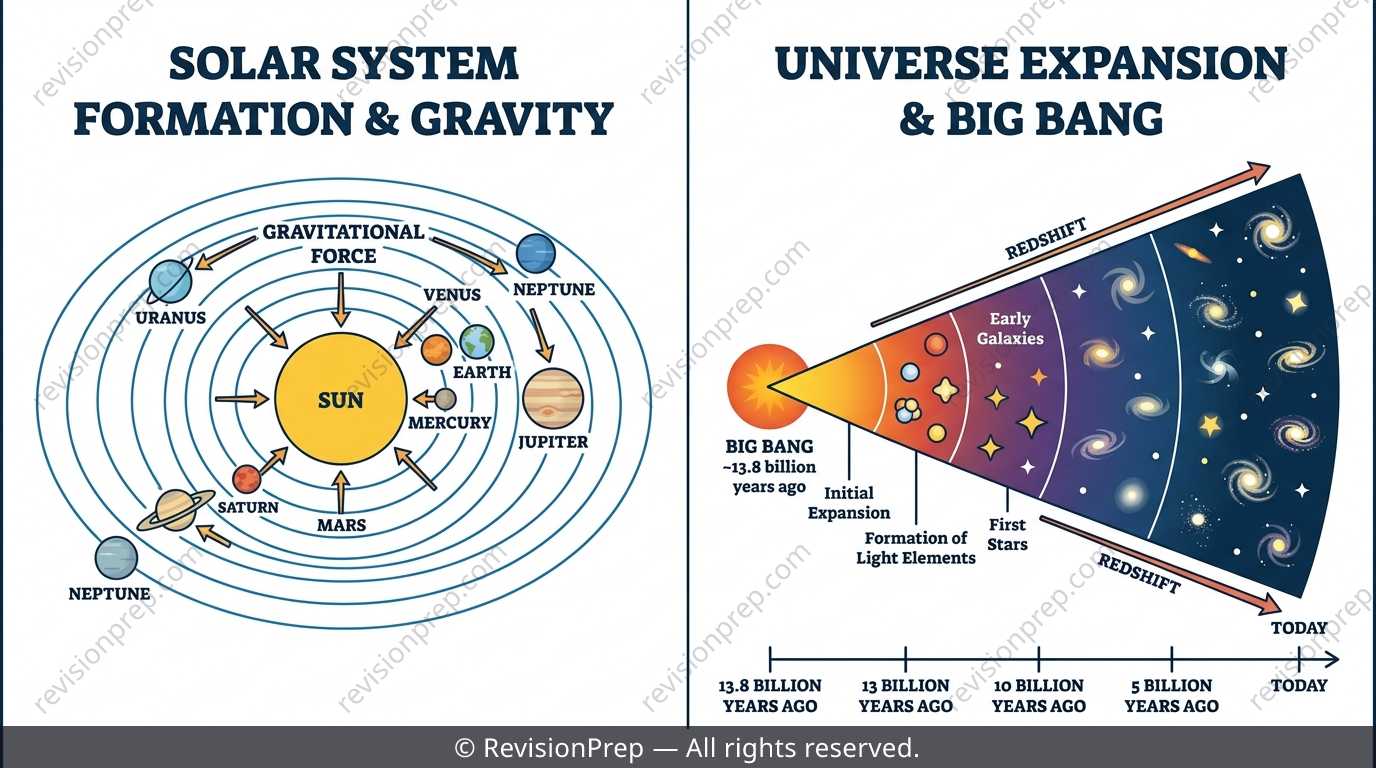
Quick facts
IB MYP 5 Astrophysics splits neatly into two halves: how gravity holds the Solar System together, and how the entire universe began and keeps expanding. On the 'nearby' side, you'll connect orbital radius and period through Kepler's Laws and see why satellites like the ISS and GPS obey the exact same physics as planets. On the 'whole universe' side, redshift and the Cosmic Microwave Background become your evidence for the Big Bang — and you'll need to explain why it's space itself stretching, not an explosion into empty space. Both halves lean heavily on MYP Criteria A (explaining concepts precisely) and Criteria C (reading graphs and data tables correctly), so exam success here is about naming forces with direction and quoting real numbers, not vague description. This teaser hits the five ideas examiners test most; the full revision notes on RevisionPrep go deeper with worked examples and the complete formula set.
What you’ll be able to do
Gravity: The Force Behind Every Orbit
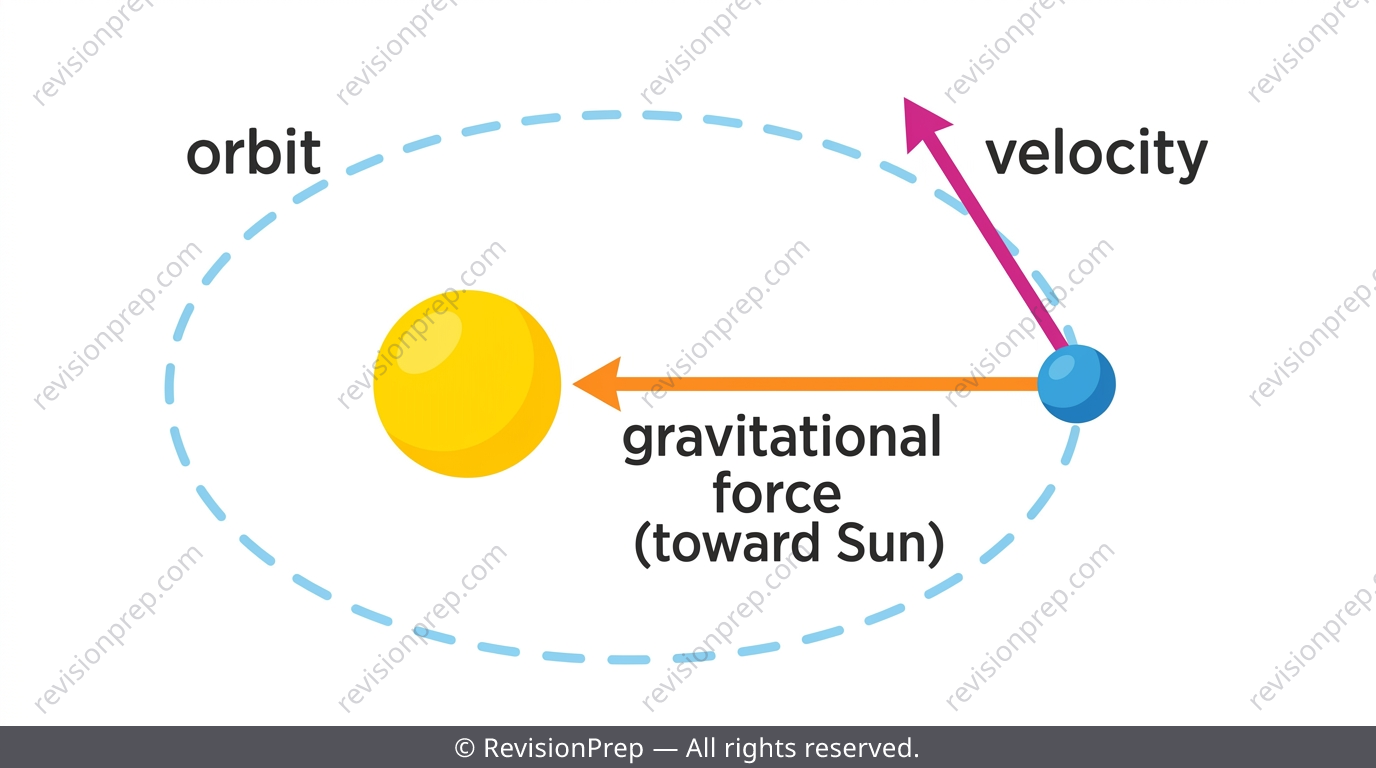
Every planet, moon and satellite is in free-fall around a more massive body — gravity supplies exactly the force needed to bend its path into a closed curve instead of a straight line. Because this force always points toward the central body, perpendicular to the direction of motion, it changes direction without changing speed. The Sun holds about 99.8% of the Solar System's mass, which is exactly why everything orbits it rather than the reverse.
Exam tip
If a question says 'identify the force,' name it AND state its direction (toward the central body) in the same sentence — mark schemes often award these as separate points.
Common mistake
Saying gravity 'stops Earth flying off into space' isn't wrong, but for an 'explain' question you must state that the force acts perpendicular to velocity and changes direction, not speed.
Kepler's Three Laws in Action
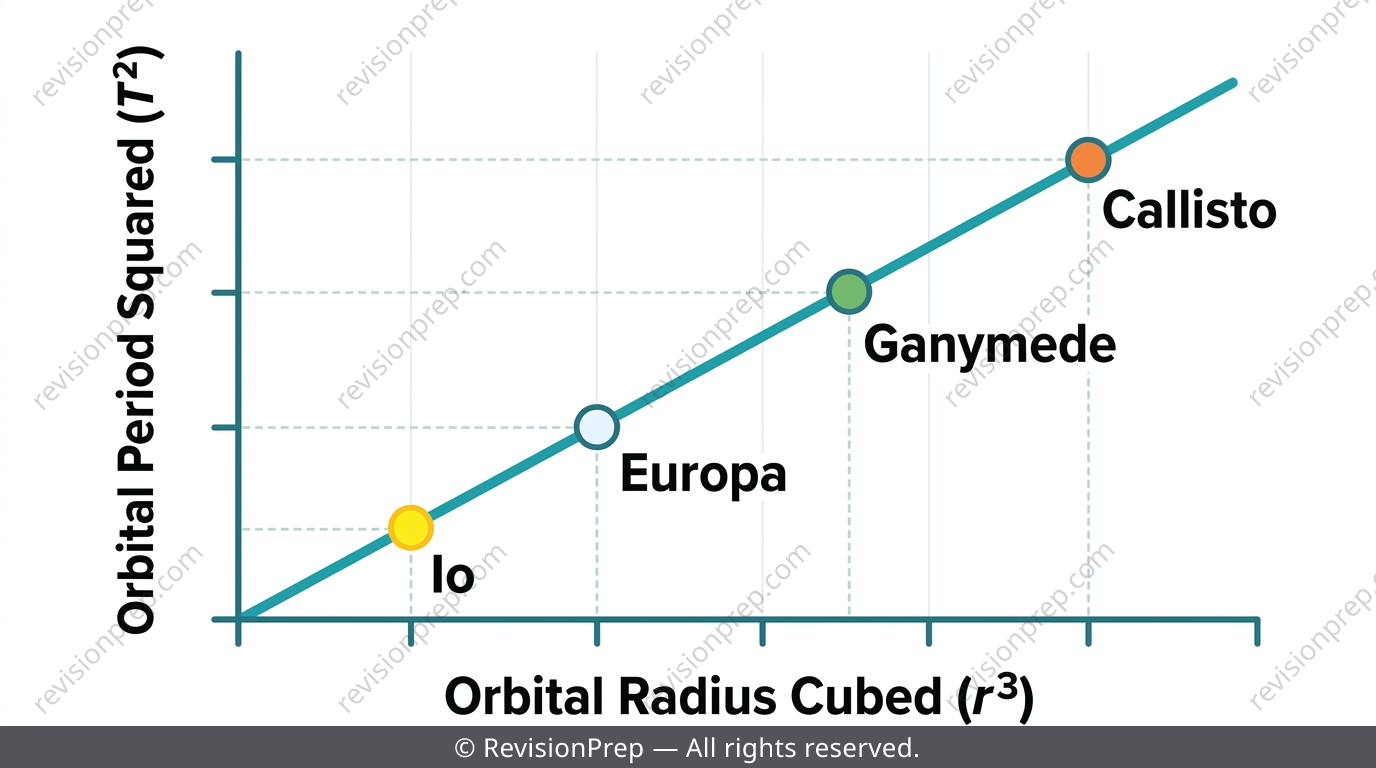
Kepler's First Law says orbits are ellipses with the Sun at one focus, not the centre. His Second Law explains why planets speed up near the Sun and slow down far away — they sweep out equal areas in equal times. The Third Law, , links period and distance for any bodies orbiting the same central mass, and using Earth's own numbers (1 AU, 1 year) makes the maths trivial.
Exam tip
Don't confuse with — plugging r = 2.0 AU straight into T = r gives the wrong answer of 2.0 years.
Common mistake
Answering 'period increases as radius increases' with no numbers only earns partial credit for 'analyse' questions — you must cite actual ratios from the data table.
Satellites: Same Physics, Different Uses
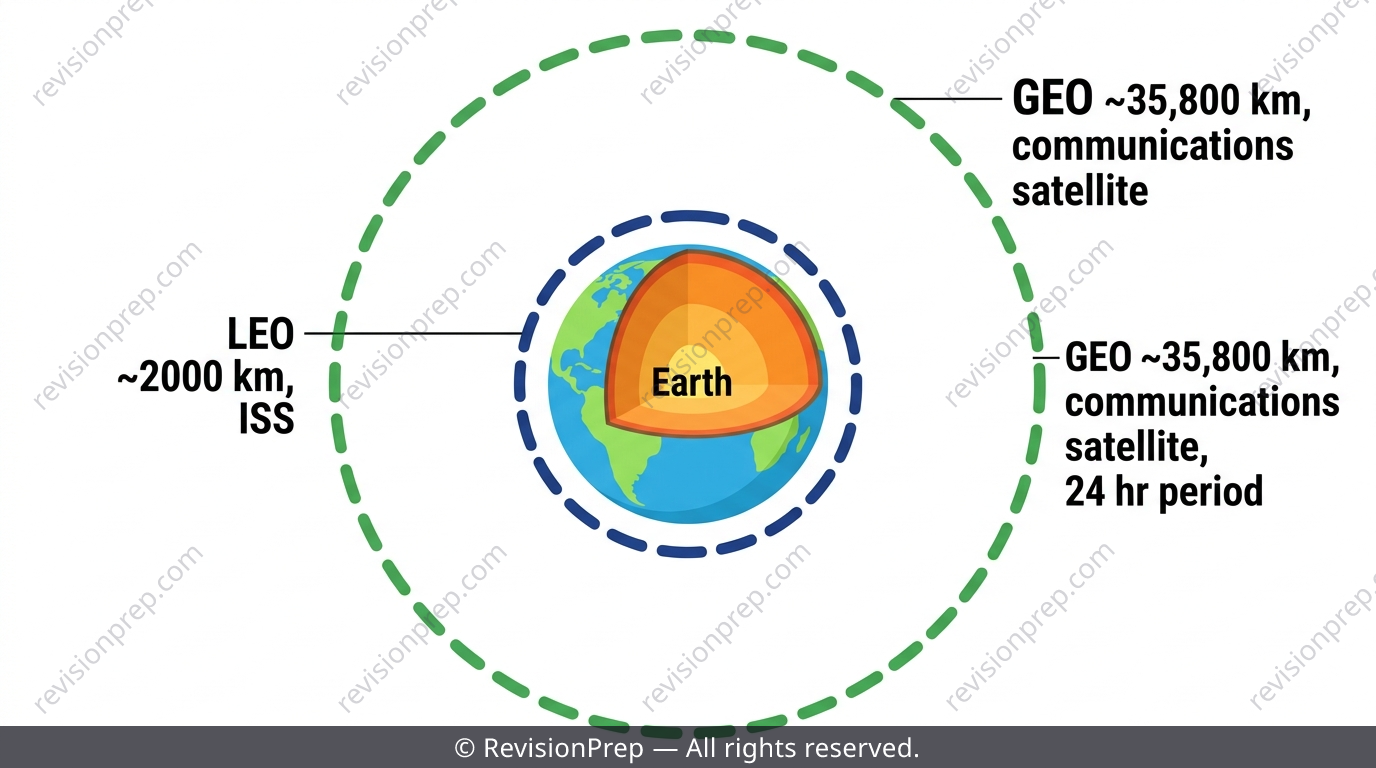
Natural satellites like the Moon and artificial ones like GPS or the ISS obey identical orbital physics — only the central body (Earth instead of the Sun) changes. Low Earth Orbit (LEO) sits at altitudes up to roughly 2000 km with short periods, ideal for the ISS and Earth observation. Geostationary Orbit (GEO) sits at about 35,800 km, with a 24-hour period matching Earth's rotation, perfect for communications satellites.
| Orbit type | Typical altitude | Period | Common use |
|---|---|---|---|
| LEO | up to ~2000 km | short (hours) | ISS, Earth observation |
| GEO | ~35,800 km | 24 hours | Communications satellites |
Common mistake
Mixing up 'rotation' and 'orbit' — Earth's rotation is 24 hours (day/night) but its orbit (revolution) around the Sun is 365.25 days (the year).
The Big Bang: Expanding Space, Not an Explosion
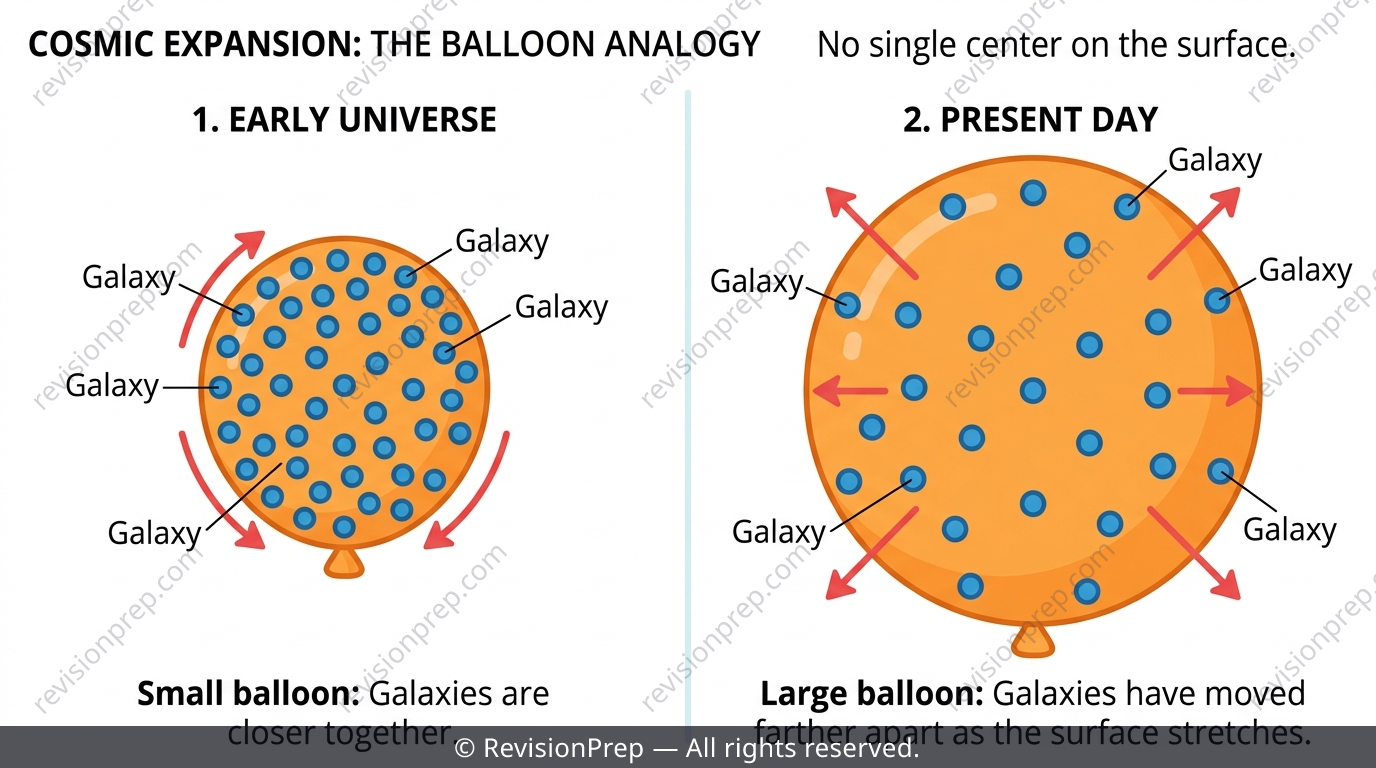
The Big Bang theory describes the universe originating roughly 13.8 billion years ago from an extremely hot, dense state, expanding and cooling ever since. Crucially, it's space itself that stretches — galaxies aren't flying through pre-existing empty space away from a central point, they're carried apart as space between them grows. There is no centre and no edge, just like dots painted on an inflating balloon all moving apart from each other equally.
Common mistake
Picturing the Big Bang as an explosion at one point inside already-existing empty space. Fix: state that space itself stretches, with no centre and no edge — asking what's 'outside' wrongly assumes a centre exists.
Evidence: Redshift, Hubble's Law & the CMB
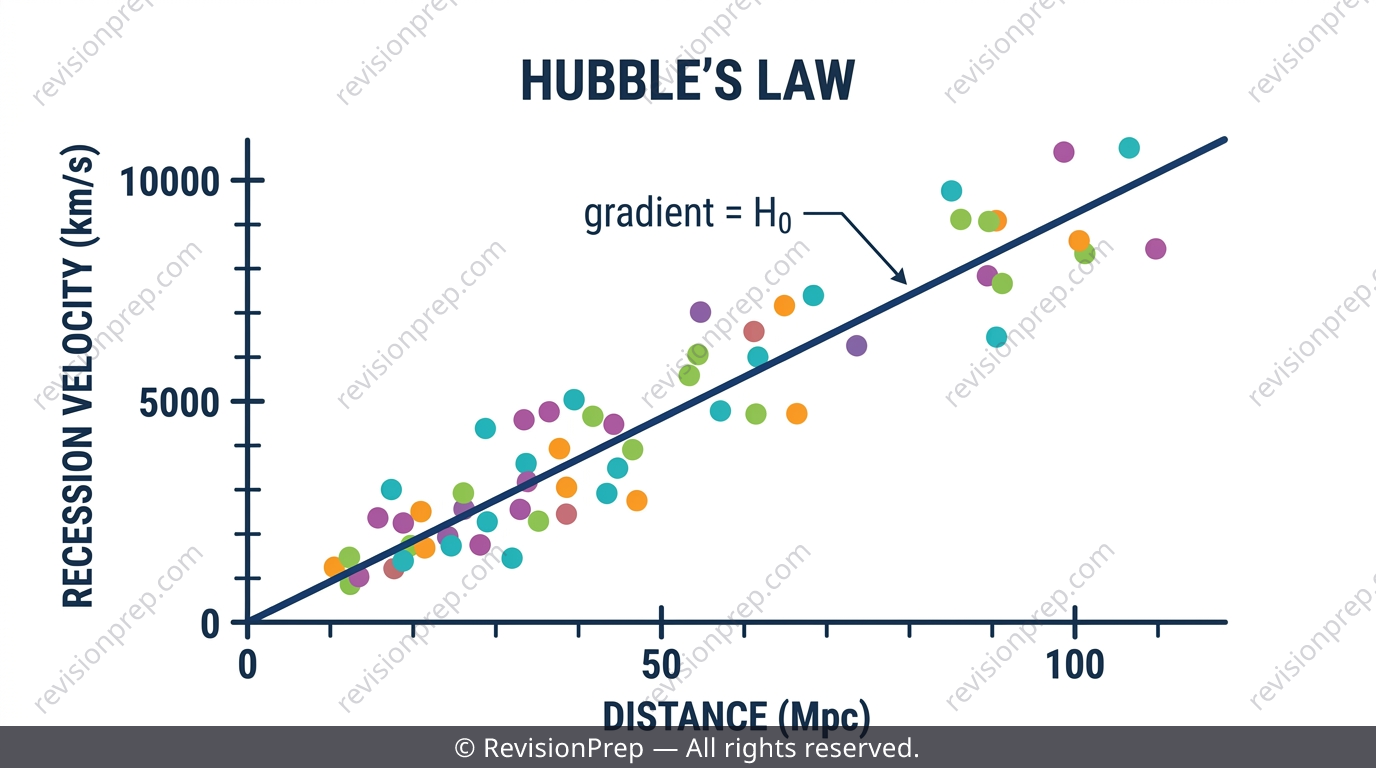
Almost all galaxies show redshifted light — spectral lines shifted toward longer wavelengths — showing they're receding from us. Hubble's Law states recession velocity is proportional to distance, , and the gradient of a velocity-distance graph gives Hubble's constant, which can roughly estimate the universe's age via . The Cosmic Microwave Background, at about 2.7 K, is the uniform cooled 'afterglow' released about 380,000 years after the Big Bang, and together with redshift it forms the two pillars of evidence examiners expect.
Exam tip
'Discuss the evidence for the Big Bang' always needs at least TWO independent pieces — redshift AND the CMB. Giving only one caps you at roughly half marks.
Common mistake
Reading the gradient off a single scattered data point instead of the best-fit line gives the wrong value of — always use the line through the points.
Quick formula sheet
Practice questions
- State the force responsible for keeping a moon in orbit around a planet, including its direction.
- Define the terms 'orbit' and 'satellite'.
- Explain the difference between rotation and revolution using Earth as an example.
- Using Kepler's Third Law, predict the orbital period of an object at 3.0 AU from the Sun given Earth's known values.
- Explain why gravitational force changes a planet's direction but not its speed.
- Describe two pieces of evidence that support the Big Bang theory.
- Using orbital radius and period data for four moons of a planet, analyse whether the relationship matches and suggest a reason for any deviation.
- A velocity-distance graph for galaxies shows scattered points with a best-fit line through the origin. Determine from the gradient and estimate the age of the universe.
- Explain why describing the Big Bang as 'an explosion in space' is scientifically inaccurate, referring to the concept of expanding space.
Frequently asked questions
What force keeps planets and satellites in orbit?+
Gravity, always acting toward the central body (e.g. the Sun or Earth), perpendicular to the object's velocity so it changes direction but not speed.
How is Kepler's Third Law used in exam questions?+
It links orbital period and radius for bodies around the same central mass via . Use known values (like Earth's 1 AU, 1 year) to find unknowns without needing full constants.
Was the Big Bang an explosion?+
No — it's the expansion of space itself. Every point moves away from every other point equally; there's no centre and no edge, unlike an explosion into existing space.
What is the difference between Low Earth Orbit and Geostationary Orbit?+
LEO sits up to ~2000 km altitude with short periods, used for the ISS and Earth observation. GEO sits at ~35,800 km with a 24-hour period matching Earth's rotation, used for communications satellites.
What two pieces of evidence support the Big Bang theory?+
Redshift of distant galaxies (showing recession) and the Cosmic Microwave Background (the cooled afterglow of the early hot universe). Exams expect both, not just one.
How do you estimate the age of the universe from Hubble's Law?+
Find Hubble's constant from the gradient of a velocity-distance graph's best-fit line, then use as a rough estimate.
Get the Full IB MYP 5 Astrophysics Revision Notes
Related articles