
Electricity and Magnetism
IB MYP 5 Physics: charge, fields, circuits and safety devices — the essentials before your next test
Quick facts
Electricity and Magnetism ties together almost every idea in IB MYP 5 Physics: charge sitting still, charge flowing round a circuit, and the magnetic fields that appear whenever charge moves. Once you see that a current-carrying coil behaves just like a bar magnet, topics like electromagnets, motors and MRI scanners stop feeling separate and start feeling like the same idea in different costumes. This teaser walks through the five concepts examiners return to again and again: magnetic field lines, electromagnets and everyday safety devices, static versus current electricity, and how series and parallel circuits actually behave. Each section flags the exact mistake students make under exam pressure and the phrasing that actually earns marks. For the full derivations, worked examples, and every formula with unit traps explained, the complete revision notes are linked at the end.
What you’ll be able to do
Magnetic Fields: Lines, Strength and Force
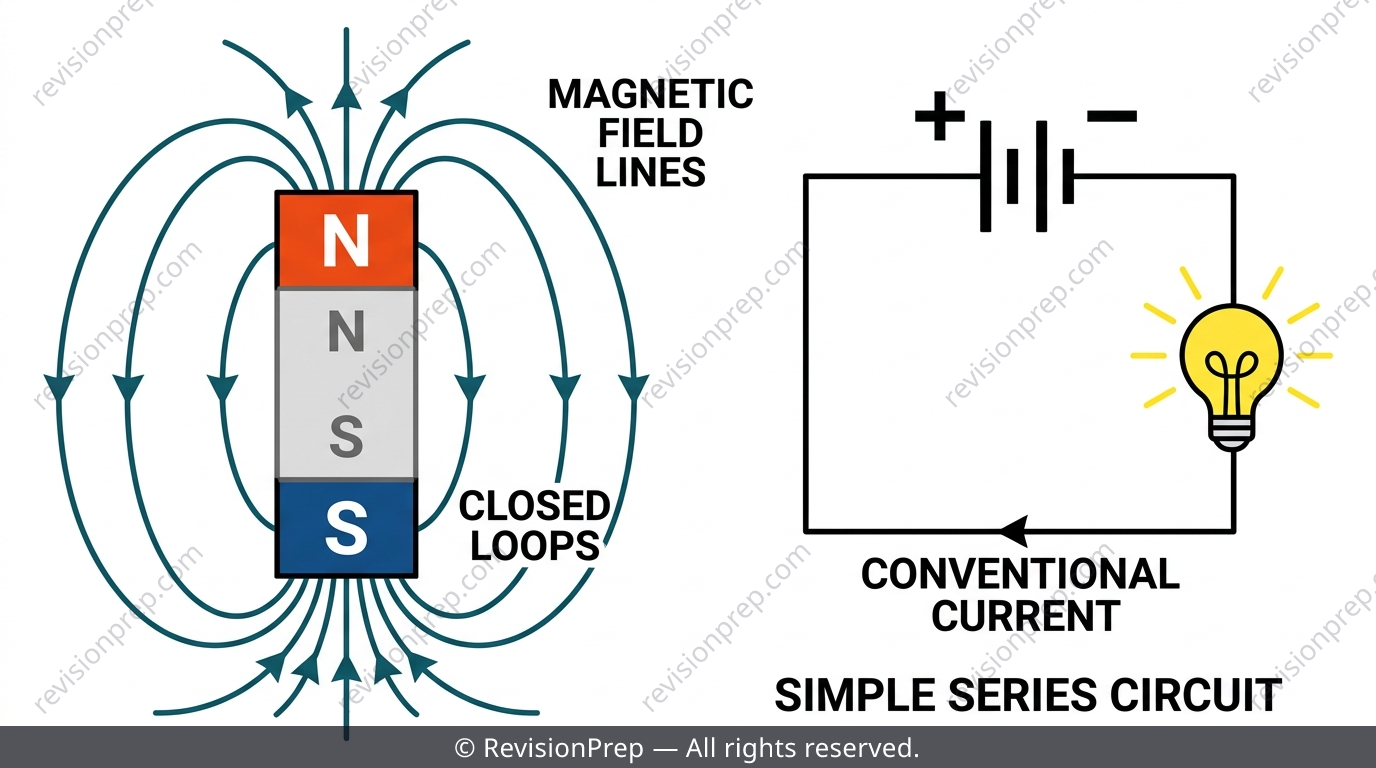
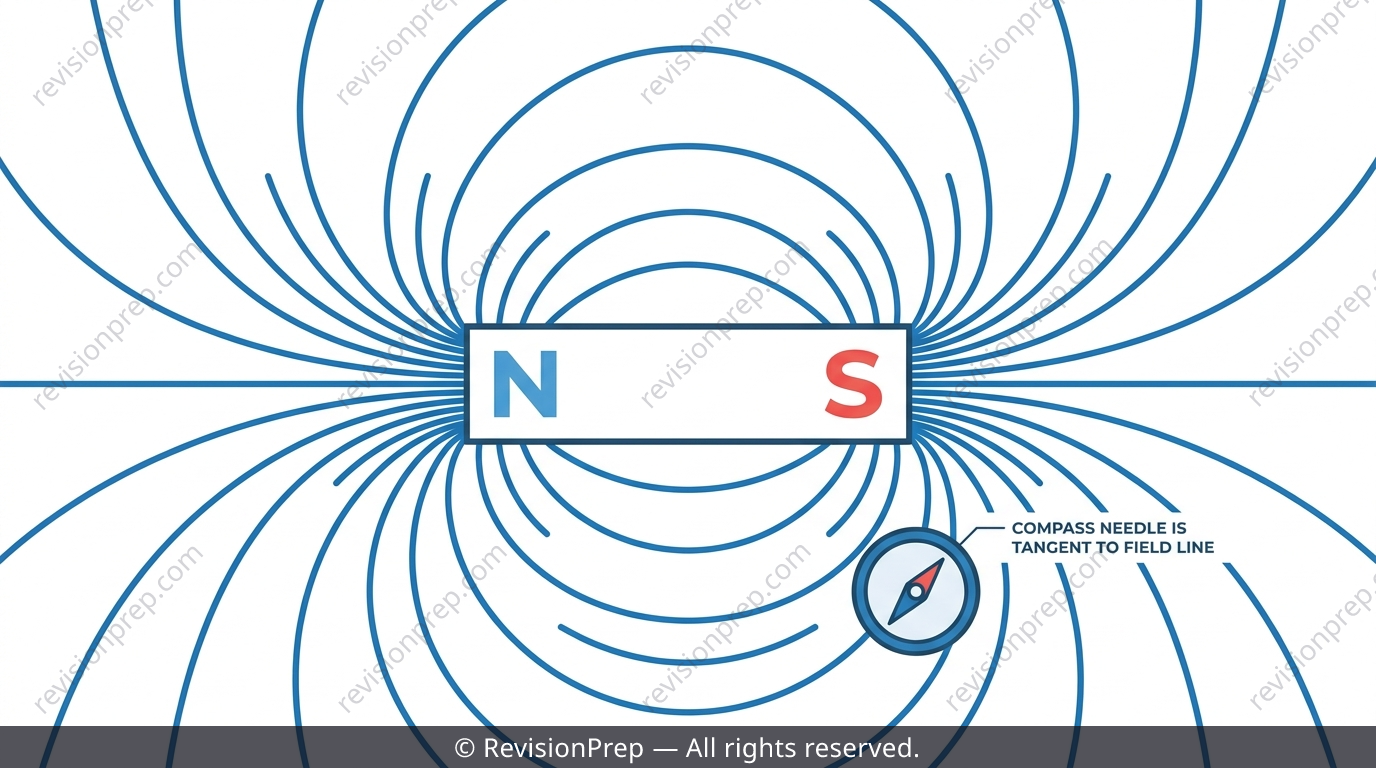
A magnetic field is the region where a magnetic force acts on a pole or a moving charge. Field lines run N to S outside a magnet but never stop at the poles — they continue S to N inside, always forming a closed loop. Line density shows field strength: lines bunch tightly at the poles and spread out at the sides, exactly matching iron-filing patterns. A compass anywhere in the field points along the tangent to the local field line, not straight at a pole.
| Quantity | Symbol | Formula |
|---|---|---|
| Force on a pole | F | F = Bm |
| Field strength vs distance | B | B ∝ 1/d |
Exam tip
If asked why a compass beside a magnet doesn't point directly at the pole, answer with 'tangent to the local field line' — never 'because it's far away'.
Common mistake
Drawing field lines that stop dead at the poles. Always sketch, even faintly, the internal S→N return path — a magnet's field is a closed loop.
Mini summary
Field lines are closed loops (N→S outside, S→N inside); line spacing = field strength; F = Bm links field to force on a pole.
Electromagnets, Motors and Safety Devices
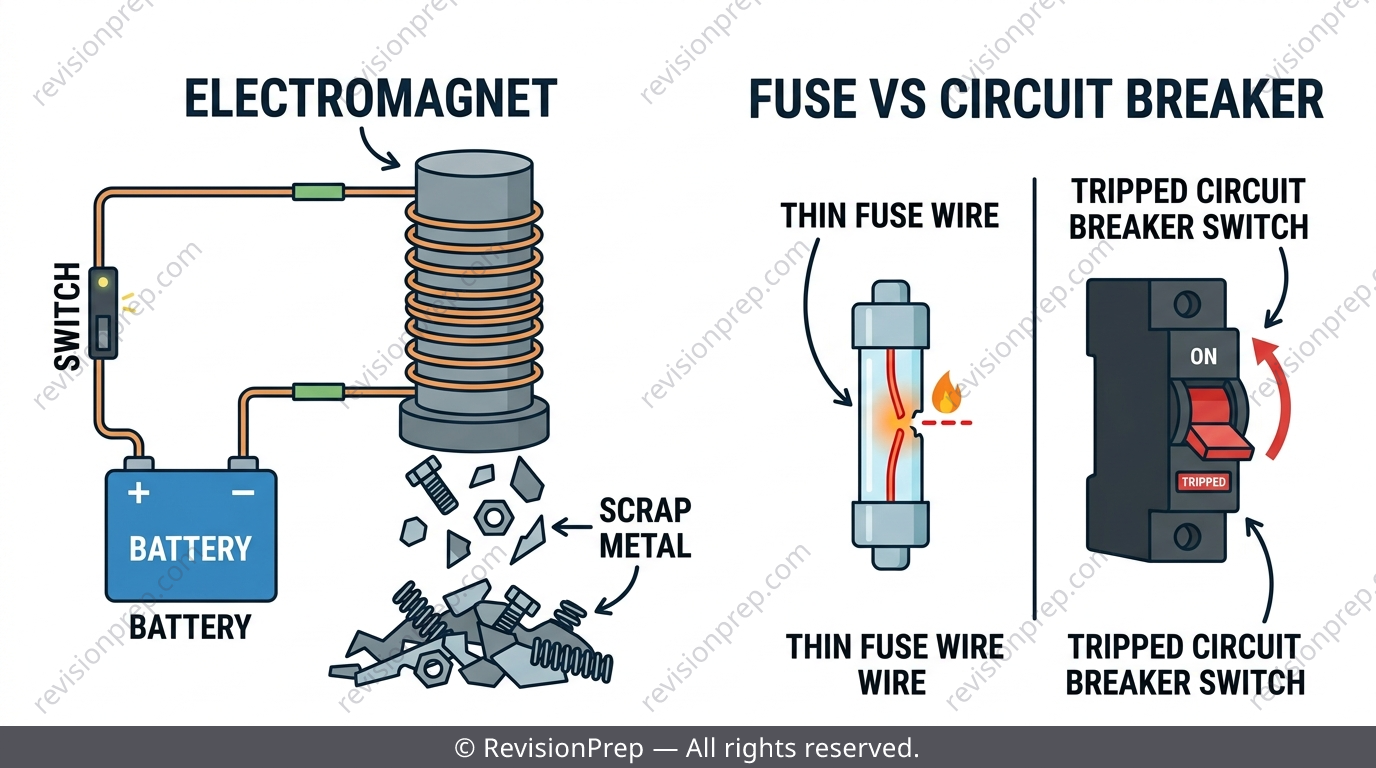
An electromagnet is a temporary magnet made by passing current through a coil, often around a soft iron core — its field vanishes the instant current stops, which is exactly why scrapyard cranes use them to drop loads on command. A current-carrying conductor in a magnetic field feels a force — this motor effect (current + field = force = movement) drives motors and loudspeakers. Fuses melt and circuit breakers trip when current exceeds a safe rating, protecting wires from overheating; earthing gives fault current a safe path to ground instead of through a person.
| Device | How it protects | Typical use |
|---|---|---|
| Fuse | Thin wire melts above rated current | Plugs, appliances |
| Circuit breaker | Switch trips above rated current, resettable | Household distribution boards |
| Earthing | Fault current routed to ground, not through a person | Metal-cased appliances |
Exam tip
In benefit/risk questions (e.g. permanent magnet vs electromagnet), give two genuinely separate ideas — repeating the same point in different words only earns credit once.
Common mistake
Describing a fuse as something that 'switches off the appliance' without naming the mechanism (melting wire) and the trigger (current exceeding rating).
Mini summary
Electromagnets can be switched on/off — permanent magnets can't; fuses and circuit breakers both interrupt overcurrent, but only breakers reset; earthing and double insulation both protect people from fault current.
Static Electricity vs Current Electricity
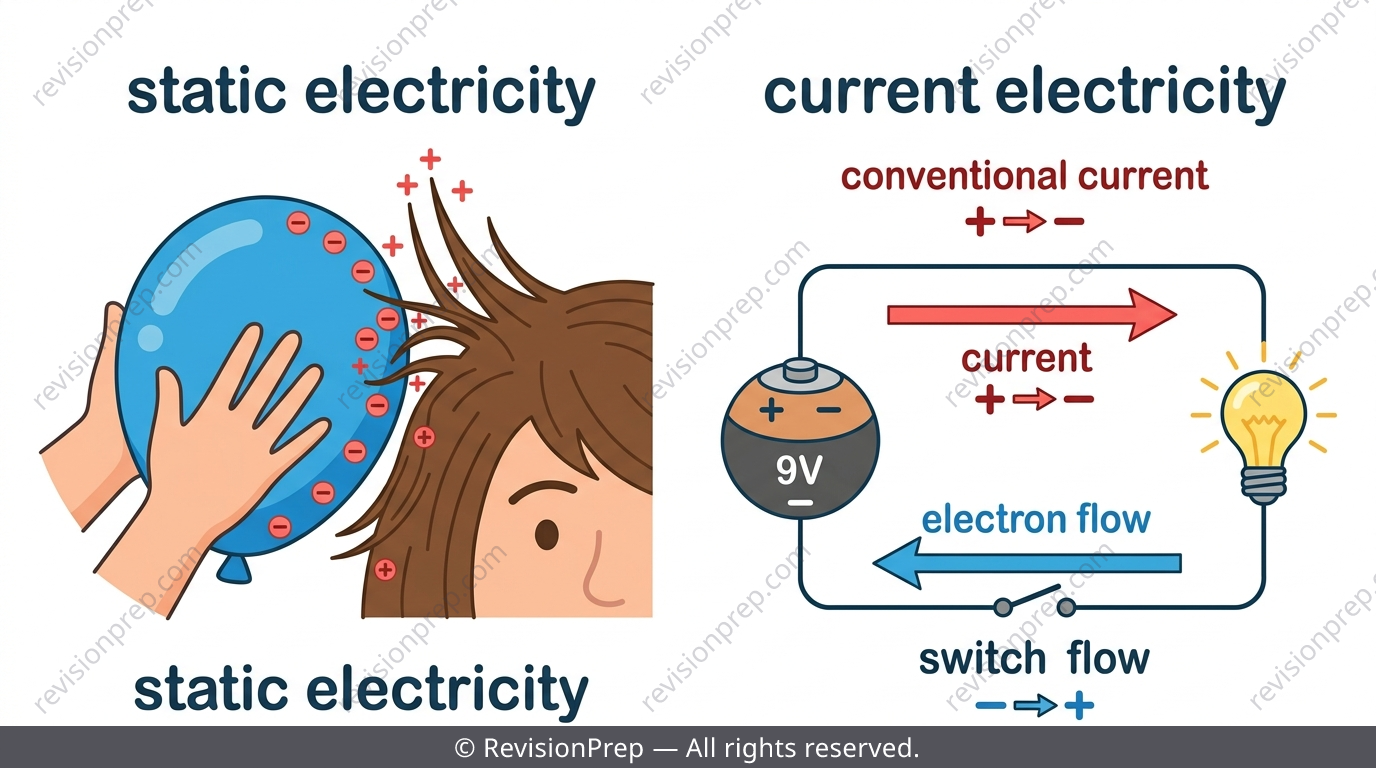
Static electricity is charge that has built up and stays put — usually by friction transferring electrons — until it discharges as a spark or lightning. Whichever material gains electrons becomes negative, whichever loses them becomes positive; charge is always conserved, never created from nothing. Current electricity is charge continuously flowing round a complete circuit, driven by an emf source. Conventional current flows + to − outside the source, while electrons (the actual moving charge in a wire) flow − to +.
Exam tip
Default to conventional current (+ → −) in any circuit diagram unless the question explicitly says 'electron flow'.
Common mistake
Substituting time in minutes directly into Q = It. Always convert to seconds first, or the charge comes out 60 times too small.
Mini summary
Static = charge sitting still; current = charge continuously flowing; Q = It bridges charge, current and time (convert to seconds first).
Series and Parallel Circuits
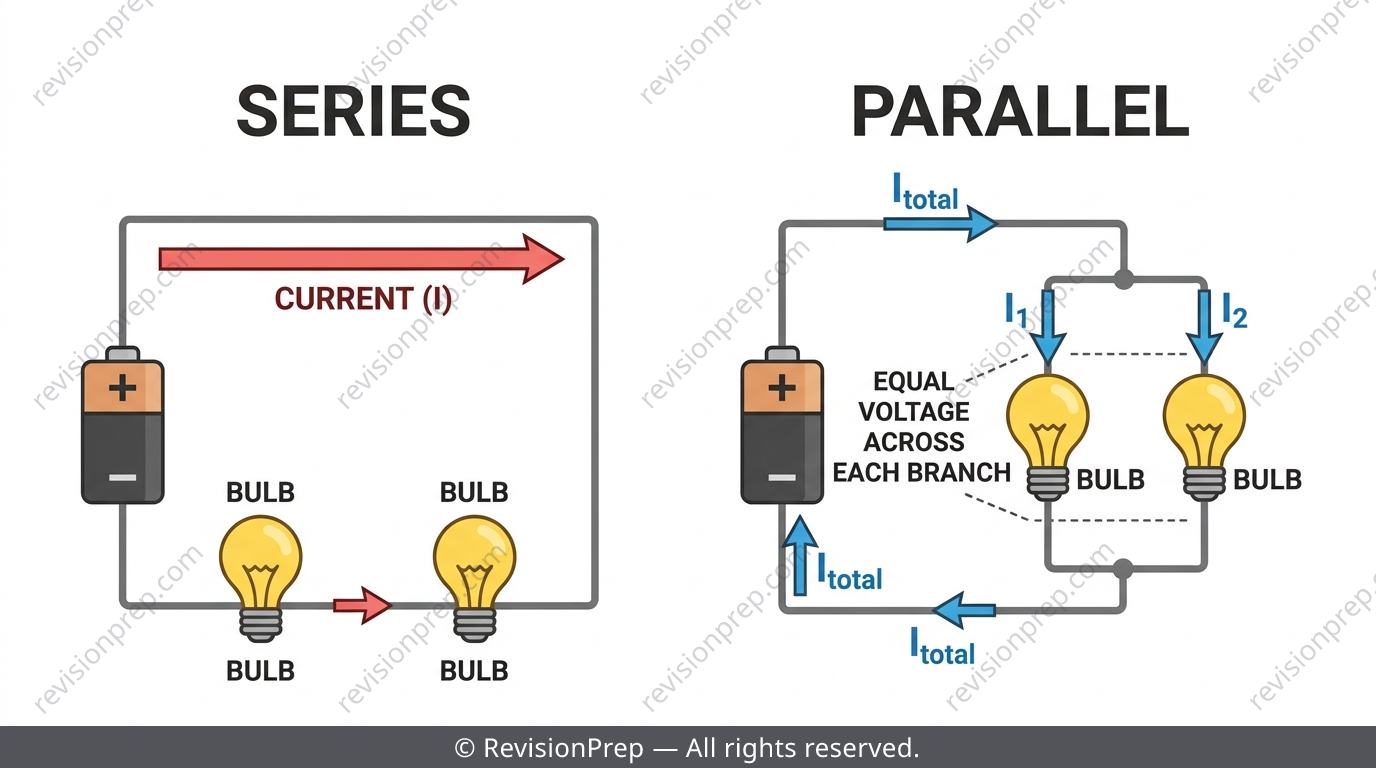
In a series circuit, every component shares the same single loop, so the same current flows through each one — there's nowhere else for the charge to go. In a parallel circuit, components sit on separate branches: the same voltage appears across each branch, but current splits between branches depending on their resistance. Adding a bulb in series dims every bulb because the same current now shares more total resistance around the loop.
Exam tip
When a circuit-diagram question asks you to compare brightness or current, always state whether components are in series (same current) or parallel (same voltage, split current) before calculating anything.
Common mistake
Assuming current is the same everywhere in a parallel circuit — it only splits at junctions and recombines; voltage, not current, is what stays equal across parallel branches.
Mini summary
Series: same current, shared resistance, one bulb dims all. Parallel: same voltage per branch, current splits according to branch resistance.
Quick formula sheet
Practice questions
- State whether static electricity or current electricity describes charge that stays in one place.
- Name the device that melts to protect a circuit from overcurrent.
- State the direction conventional current flows outside a battery.
- A current of 2.0 A flows for 30 seconds. Calculate the total charge delivered.
- Explain why a compass placed beside (not on the axis of) a bar magnet does not point directly at the nearest pole.
- Explain why adding a second bulb in series makes both bulbs dimmer.
- A magnetic pole of strength 0.40 A·m sits in a field of 5.0 mT. Calculate the force on the pole, showing unit conversions clearly.
- Compare a fuse and a circuit breaker, naming the mechanism each uses and one advantage of the circuit breaker.
- A parallel circuit has two branches of different resistance connected across the same battery. Explain how the current in each branch compares, and why the voltage across each branch is the same.
Frequently asked questions
What is the main difference between static and current electricity?+
Static electricity is charge that has built up and stays put on an object until it discharges. Current electricity is charge continuously flowing around a complete circuit.
Do magnetic field lines really stop at the poles of a magnet?+
No — field lines run N to S outside the magnet but continue S to N inside it, forming a closed loop. They never dead-end at a pole.
Why do engineers prefer electromagnets over permanent magnets in cranes and MRI scanners?+
Electromagnets can be switched on and off and their strength controlled by changing the current — a permanent magnet can't be turned off, which makes it far less practical and often less safe.
What's the difference between a fuse and a circuit breaker?+
Both interrupt current when it exceeds a safe rated value, but a fuse does this by melting a thin wire and must be replaced, while a circuit breaker trips a switch and can be reset.
Is current the same in every part of a series circuit?+
Yes — in series, every component shares one loop, so the same current flows through each component. In parallel, it's the voltage across each branch that stays the same, not the current.
How do I convert units correctly in Q = It or F = Bm?+
Always convert time to seconds and field strength to teslas before substituting. A common trap is using minutes or millitesla directly, which throws the answer off by a factor of 60 or 1000.
Ready to master Electricity and Magnetism for MYP 5?
Related articles