
Cells and Living Systems
How cells build tissues, organs and whole organisms — and why shape always matches job
Quick facts
Cells and Living Systems is the foundation unit for IB MYP 1 Sciences, and it all comes back to one idea: a cell is the smallest unit that can carry out life on its own. From there, simple organisms stay as single cells while complex organisms build up layers — cells into tissues, tissues into organs, organs into systems. Examiners consistently test whether you can link a cell's shape to its job, not just describe the shape, and whether you can correctly order the levels of biological organization without mixing up tissue and organ. This teaser walks through the five ideas that show up most in unit tests and Criterion A/C tasks: the organisation hierarchy, specialised cells, plant vs animal cell structure, unicellular vs multicellular life, and the complexity trend linking cell-type number to organism size. The full revision notes on RevisionPrep cover every definition, table and trap question in depth.
What you’ll be able to do
Levels of Biological Organization
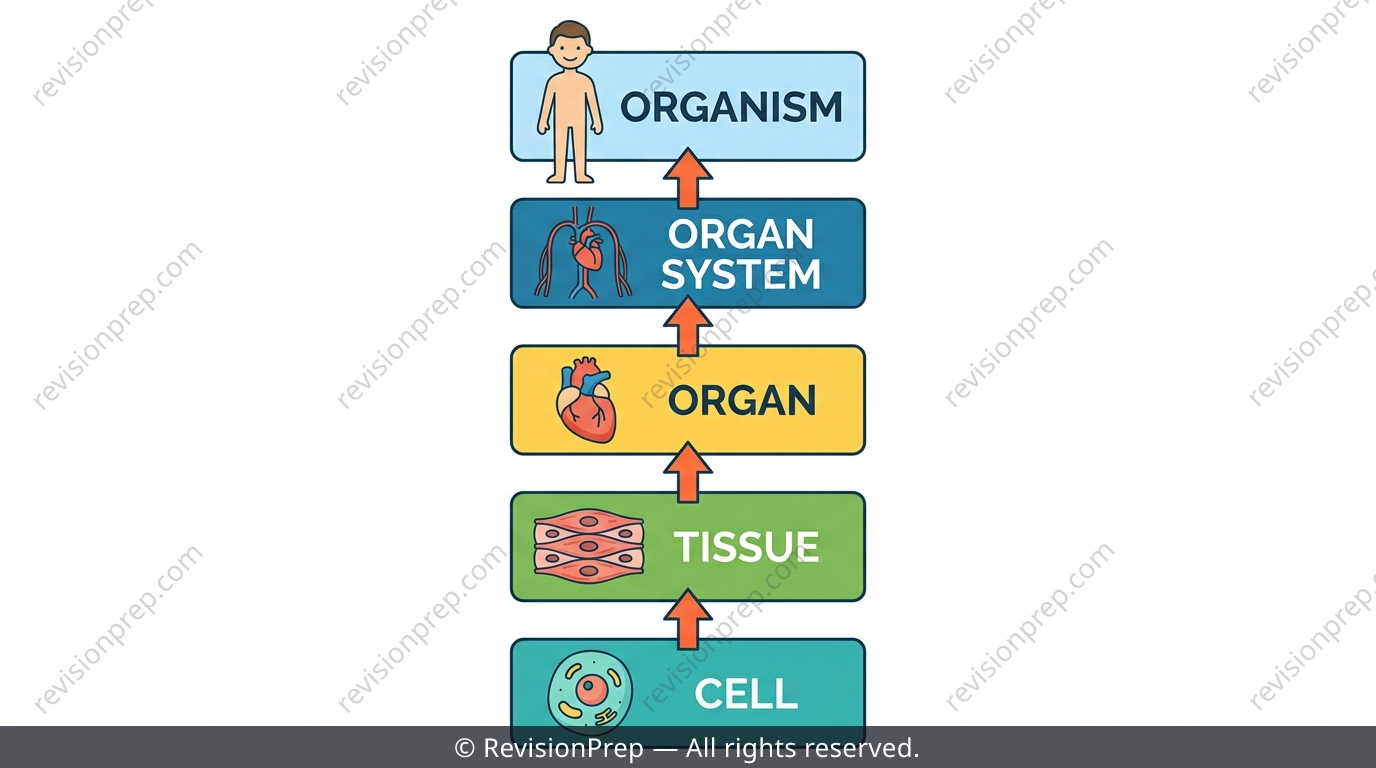
Living things are built in layers, each one made from units of the layer below it: cell → tissue → organ → organ system → organism. A tissue is a group of similar cells doing the same job; an organ is made of different tissues working together for one purpose. You can't skip a step — there's no organ without tissues, and no tissue without cells. This unit stops at 'organism'; population and ecosystem levels belong to a separate ecology topic.
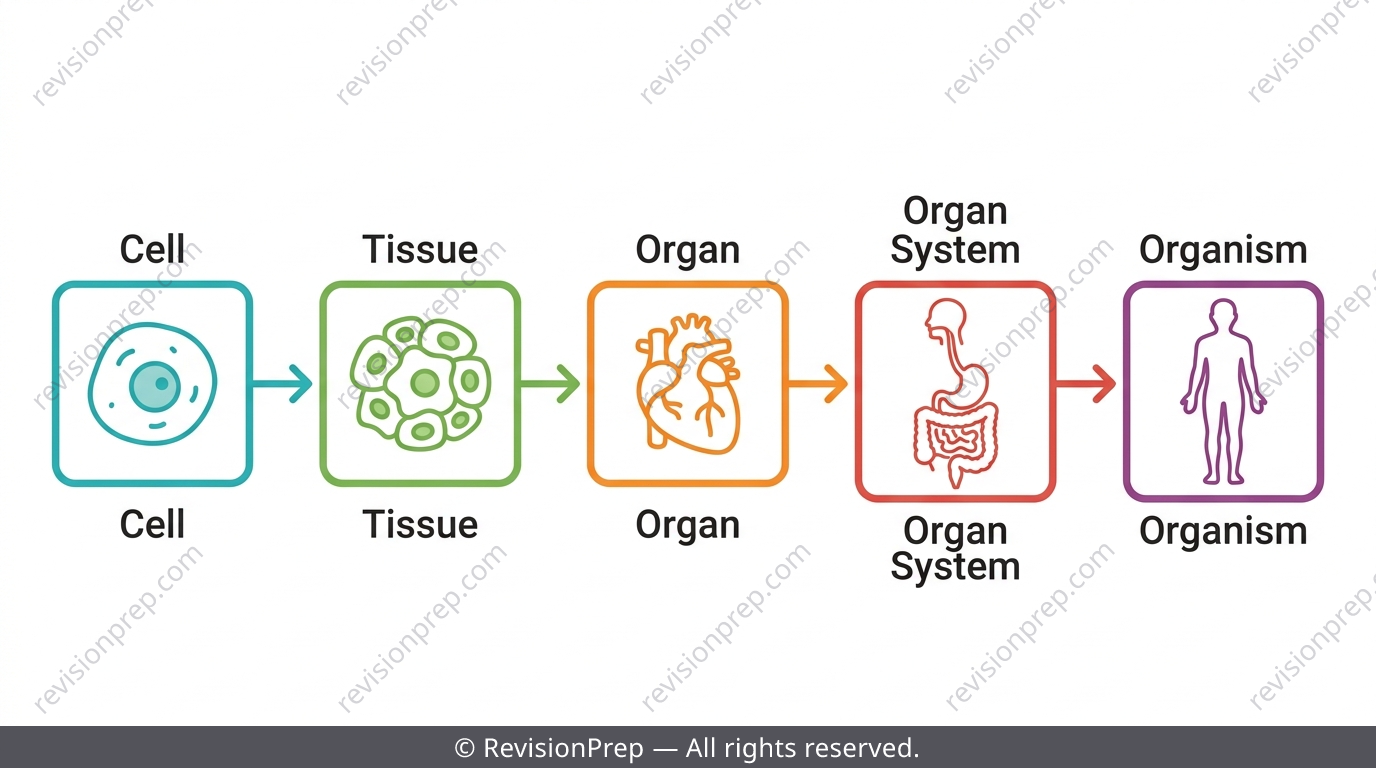
| Level | Made of |
|---|---|
| Cell | The basic living unit |
| Tissue | Similar cells doing the same job |
| Organ | Two or more different tissues |
| Organ system | Multiple organs working together |
| Organism | One or more organ systems |
Exam tip
If a question asks you to list levels 'from cells to organ systems,' stop exactly there — adding 'organism' when it wasn't asked for wastes time and earns no extra marks.
Common mistake
Reversing tissue and organ, or listing 'organelle' as a level. Remember: tissues are similar cells, organs are different tissues — 'similar before different' is the checkpoint.
Mini summary
Hierarchy: Cell → Tissue → Organ → Organ system → Organism, each level physically built from the one below.
Specialized Cells and Their Functions
A specialized cell has a shape and structure adapted for one job, not for general survival. This is the most heavily tested idea in the unit — examiners want the mechanical link between shape and job, not just a description of the shape. Losing an organelle can itself be a specialisation: a mature red blood cell has no nucleus, freeing space for more oxygen-carrying haemoglobin.
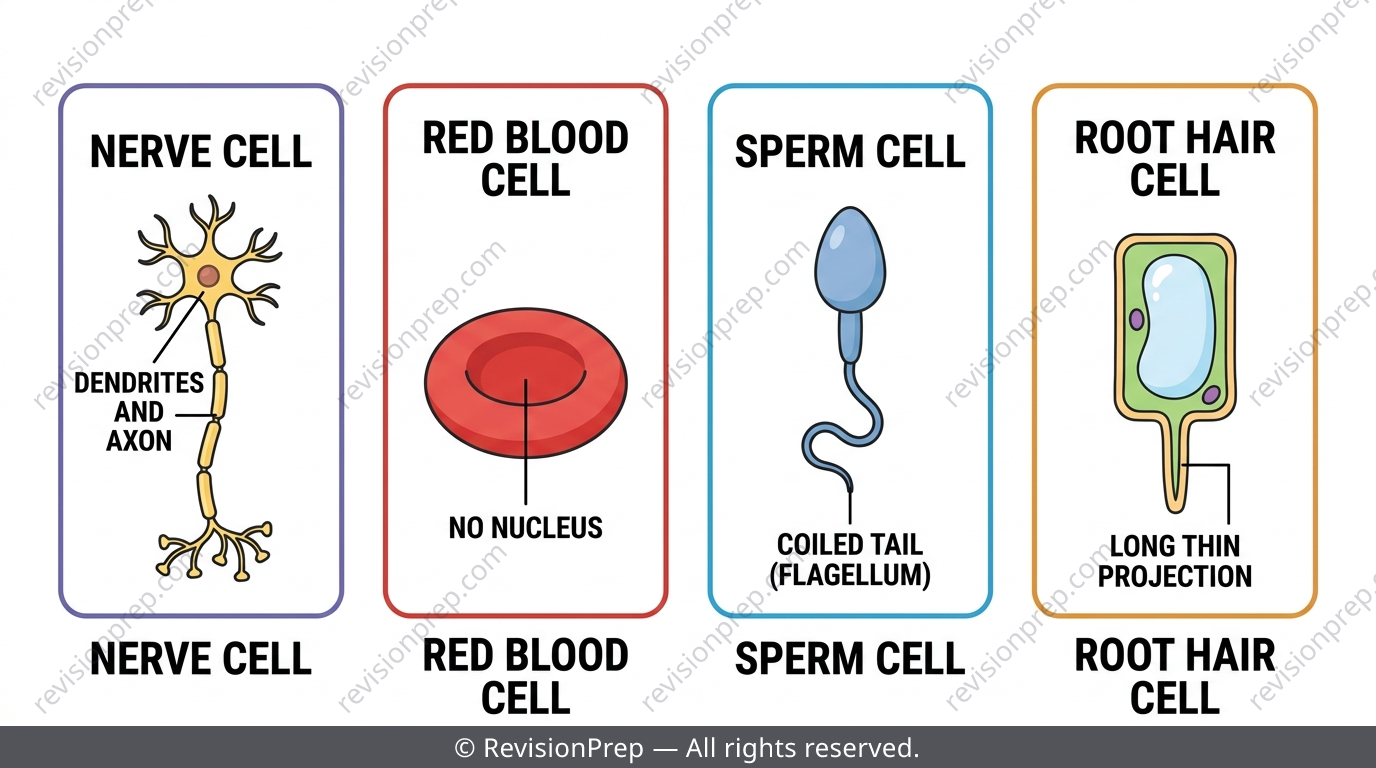
| Cell type | Key feature | Why it helps |
|---|---|---|
| Nerve cell | Long, thin shape | Signal travels further in one cell |
| Red blood cell | No nucleus, disk shape | More room for haemoglobin, more oxygen carried |
| Sperm cell | Coiled tail | Enables swimming movement |
| Root hair cell | Long thin extension | Increases surface area for water uptake |
Exam tip
Always finish with a 'so that...' clause: disk shape → increases surface area → faster oxygen diffusion. Naming the correct shape without explaining the consequence scores zero.
Common mistake
Writing 'it is long so it can send signals' without explaining why length helps — this restates the shape instead of explaining the mechanism, so it earns no marks.
Mini summary
A specialized cell's structure is adapted to do ONE job efficiently — always explain the mechanism, never just repeat the shape.
Plant and Animal Cell Differences
Plant and animal cells share the same core organelles — nucleus, cytoplasm, cell membrane, mitochondria — because both need to control themselves and release energy. The real differences trace back to one fact: plants make their own food and stay upright without a skeleton, so they need extra parts animal cells don't. Only three structures are plant-exclusive: cell wall, chloroplasts, and a large permanent vacuole.
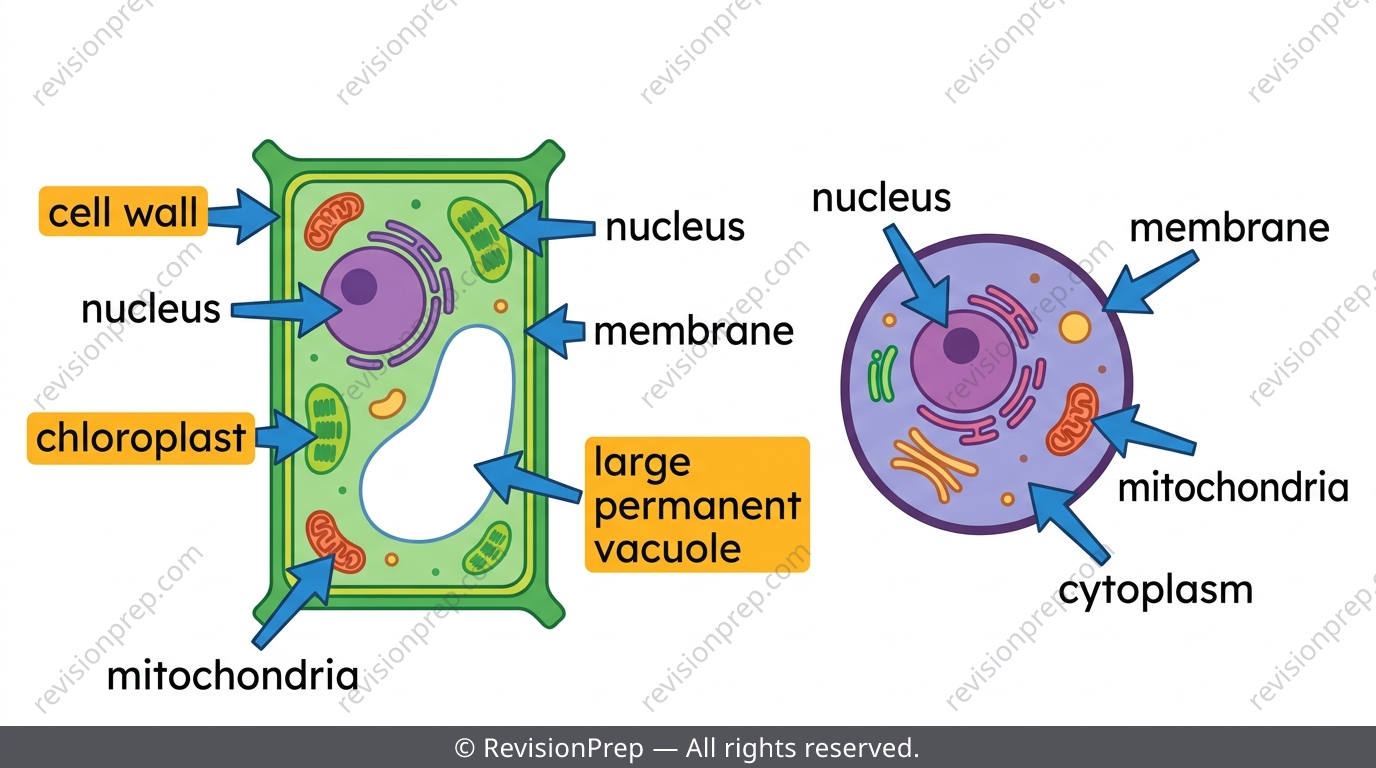
| Feature | Plant cell | Animal cell |
|---|---|---|
| Cell wall | Present (cellulose) | Absent |
| Chloroplasts | Present | Absent |
| Large permanent vacuole | Present | Absent |
| Cell membrane, nucleus, mitochondria | Present | Present |
Common mistake
Claiming animal cells don't have a membrane or nucleus. Only the cell wall, chloroplasts and large permanent vacuole are plant-exclusive — everything else is shared.
Mini summary
Shared: membrane, nucleus, cytoplasm, mitochondria. Plant-only: cell wall, chloroplasts, large permanent vacuole.
Unicellular vs Multicellular Organisms
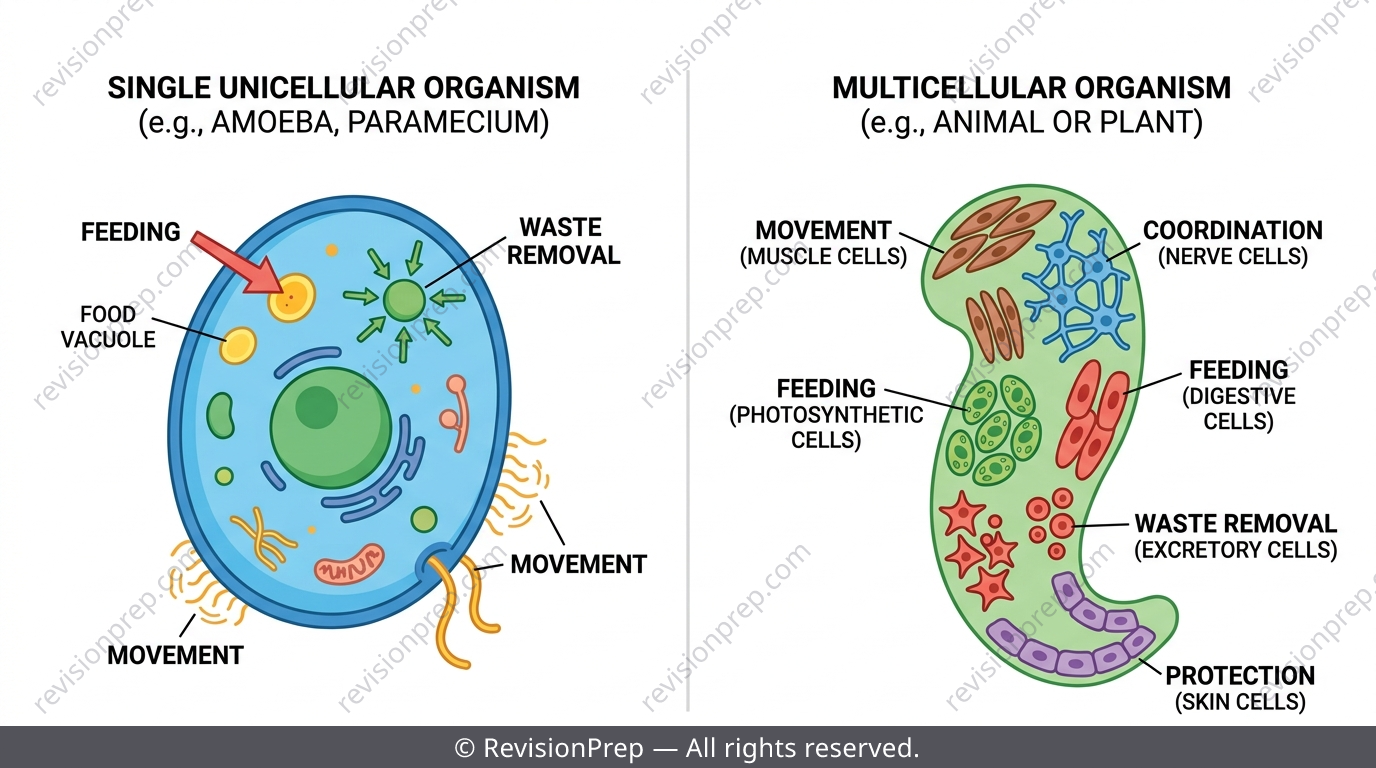
A unicellular organism is a complete living thing made of just one cell, which must feed, remove waste, move and reproduce all by itself. A multicellular organism spreads those jobs across many specialised cells, so thousands of dedicated specialists each do one job well instead of one generalist cell doing everything badly. Once cells group into tissues or organs, those parts become dependent — a heart removed from the body cannot survive alone, unlike a single-celled organism.
Common mistake
Assuming any organ or tissue can survive independently. Only two levels can genuinely 'live alone': a single cell (unicellular organism) or a complete organism with all systems working together.
Mini summary
Unicellular = one cell does everything; multicellular = many specialised cells share the workload.
Complexity and Cell-Type Trend
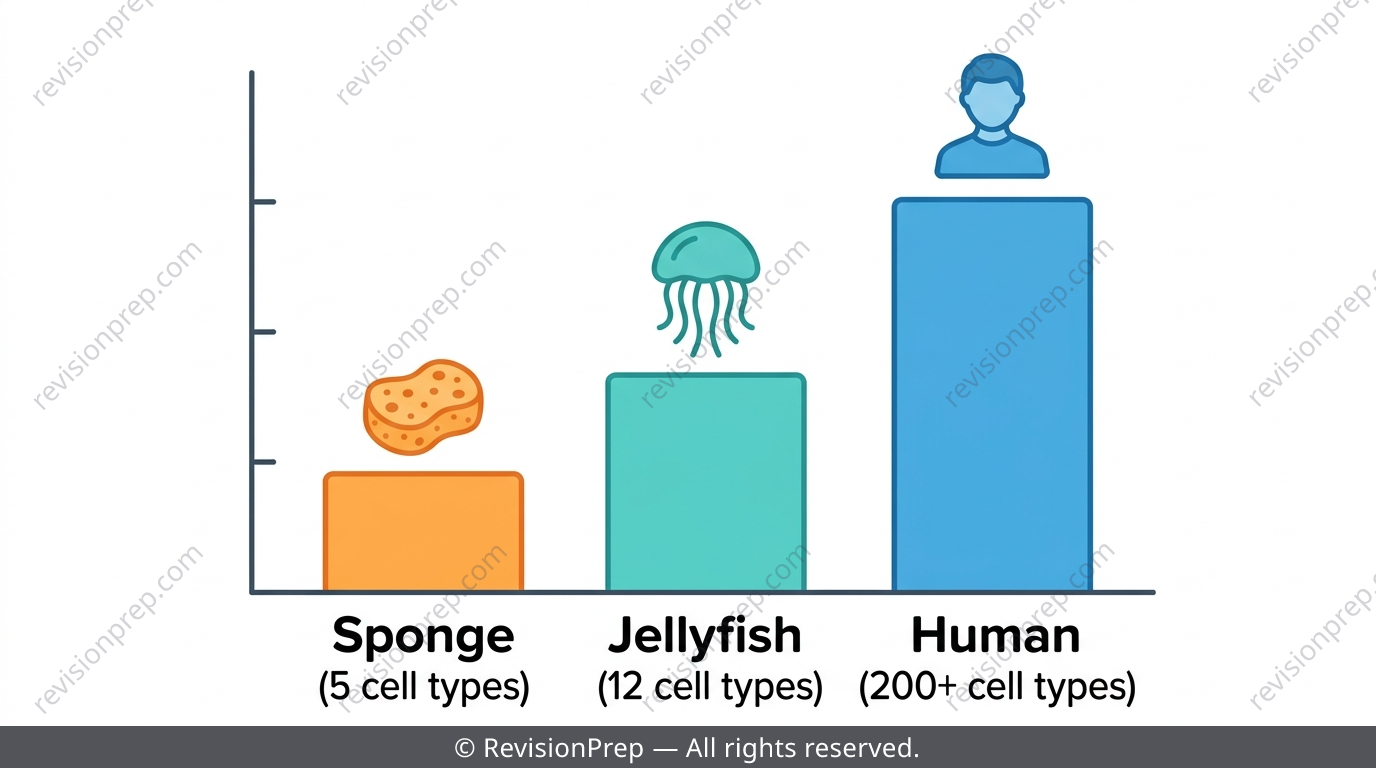
As organisms get bigger and more complex, they need more different cell types to handle more different jobs. A sponge has around 5 cell types, a jellyfish about 12, and a human over 200 — this rising trend is a favourite exam data question. More cell types also means more levels of organisation are needed to coordinate them, which is exactly why humans have tissues, organs and organ systems while a sponge does not.
Exam tip
When a question gives you cell-type numbers for different organisms, describe the trend clearly: 'as complexity increases, the number of different cell types increases' — then link it to the need for division of labour.
Mini summary
More complex organisms need more different cell types, because more different jobs must be handled by specialists rather than one generalist cell.
Quick formula sheet
Practice questions
- List the levels of biological organization in order from cell to organ system.
- Name two organelles found in both plant and animal cells.
- Define what a unicellular organism is.
- Describe how the shape of a red blood cell helps it carry out its job.
- Explain why a tissue cannot exist without cells, but a cell can exist without a tissue.
- State two structures found only in plant cells and explain why plants need them.
- A sponge has 5 cell types, a jellyfish has 12, and a human has over 200. Describe the trend and explain why it occurs.
- Explain why an organ removed from an organism cannot survive alone, using the idea of dependency between organisation levels.
- A student writes 'nerve cells are long so they can send signals' as a full-mark answer. Explain why this would not receive full marks and rewrite it correctly.
Frequently asked questions
What is the correct order of the levels of biological organization?+
From smallest to largest: cell, tissue, organ, organ system, organism. Each level is physically built from the units of the level directly below it.
What is the difference between a tissue and an organ?+
A tissue is a group of similar cells doing the same job; an organ is made of two or more different tissues working together for a specific function.
Why does a red blood cell have no nucleus?+
Losing the nucleus frees up internal space, allowing the cell to carry more haemoglobin and therefore more oxygen — the missing organelle is itself a specialisation.
What structures do plant cells have that animal cells don't?+
Only three: the cell wall, chloroplasts, and a large permanent vacuole. Every other organelle, including the membrane, nucleus and mitochondria, is shared by both.
Why do more complex organisms have more cell types?+
More complex organisms need more different jobs handled by dedicated specialist cells rather than one generalist cell doing everything, which is why cell-type count rises with complexity.
How do I answer a 'how does shape help function' question correctly?+
State the shape, then explain the physical consequence with a 'so that...' clause, for example: disk shape so that surface area increases, allowing faster oxygen diffusion.
Master Cells and Living Systems with the Full MYP 1 Notes
Related articles