
Waves, Sound and Light
One idea — energy travelling without matter travelling with it — explains colour, pitch, loudness and sonar all at once.
Quick facts
Light and sound feel like completely different topics, but IB MYP 1 Sciences tests them as two versions of the same story: energy moving through space without matter moving with it. Light is a transverse wave that needs no medium; sound is longitudinal and always needs one. Once that single distinction clicks, colour, dispersion, pitch, loudness and even sonar stop feeling like separate facts to memorise and start feeling like the same wave logic applied to different situations. This teaser walks through the five ideas examiners return to again and again — the electromagnetic spectrum, how objects get their colour, why sound can't cross a vacuum, what actually controls pitch and loudness, and the classic traps students fall into on data-based questions. For full worked examples, definitions and practice sets, the complete revision notes are linked at the end.
What you’ll be able to do
The EM Spectrum, Dispersion and ROYGBIV
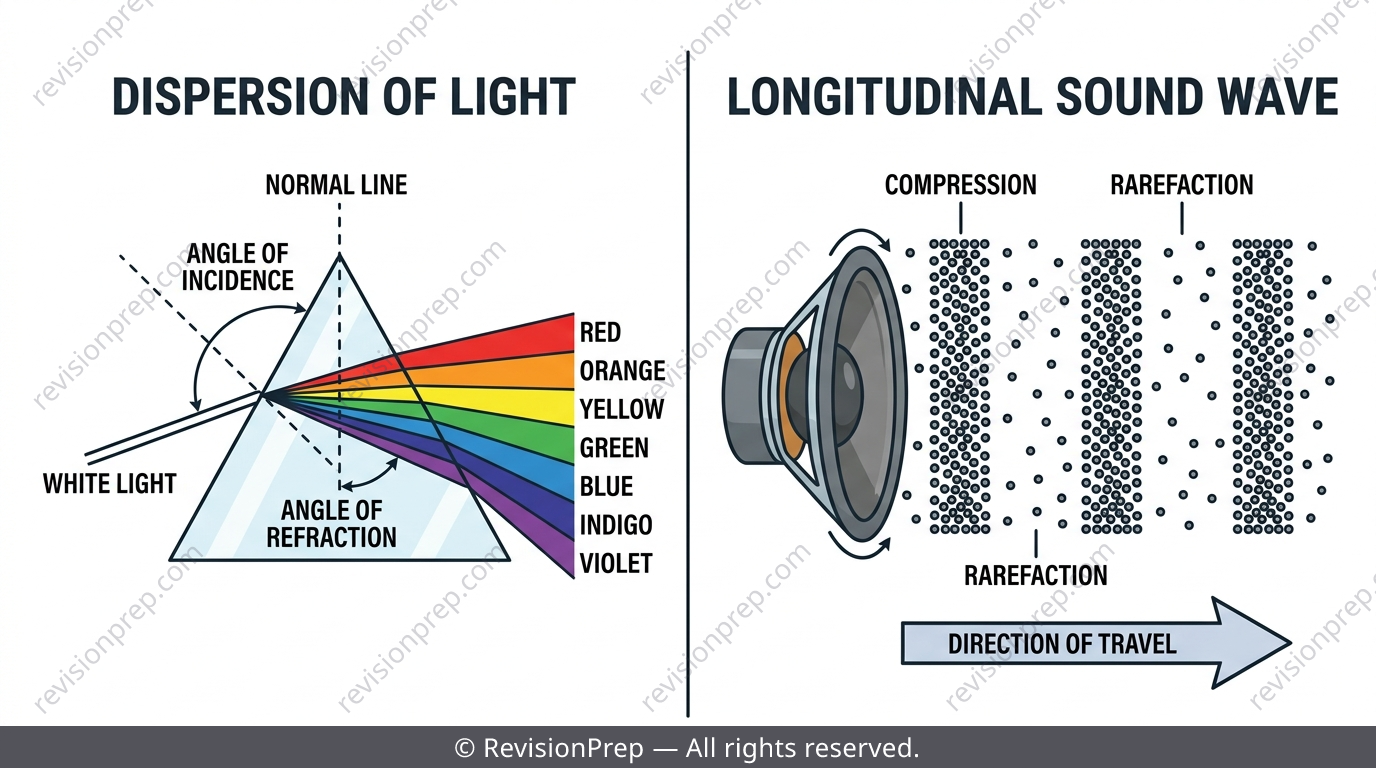
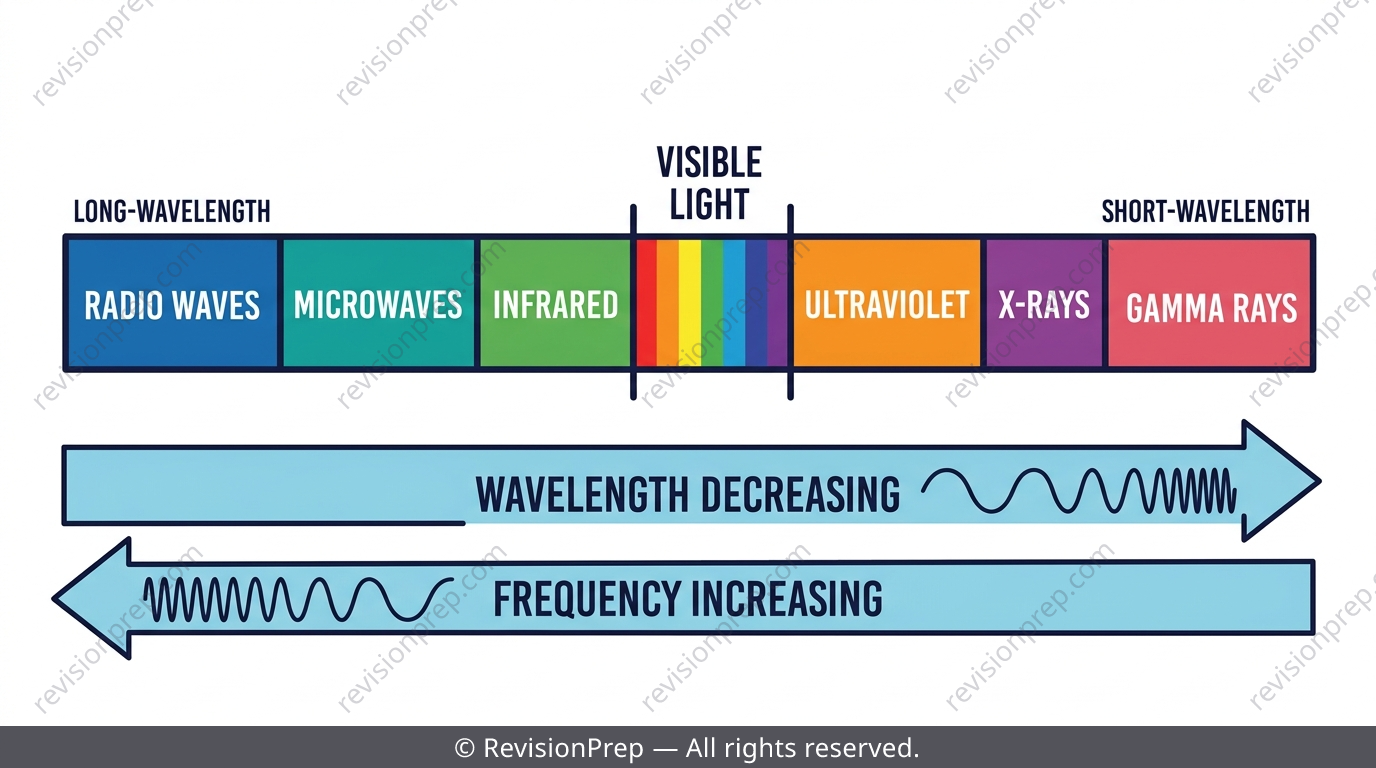
Visible light is just one narrow band of the electromagnetic spectrum, sandwiched between infrared and ultraviolet, and every EM wave travels at m/s in a vacuum but differs in wavelength and frequency. White light is a mixture of all visible wavelengths, which is why a prism can split it apart through dispersion — each wavelength refracts by a slightly different amount. Red has the longest wavelength and lowest frequency; violet has the shortest wavelength and highest frequency (ROYGBIV).
Exam tip
A 'list the seven colours' question is worth 1 mark for the correct order alone — don't waste time explaining wavelength unless the question says 'Explain'.
Common mistake
Assuming a bigger angle from the normal means more bending. Actually a SMALLER angle from the normal means the light swung further off its original path — that's MORE refraction, not less.
Mini summary
Dispersion splits white light because each wavelength refracts by a different amount; red bends least, violet bends most.
Why Objects Have Colour: Reflection vs Absorption
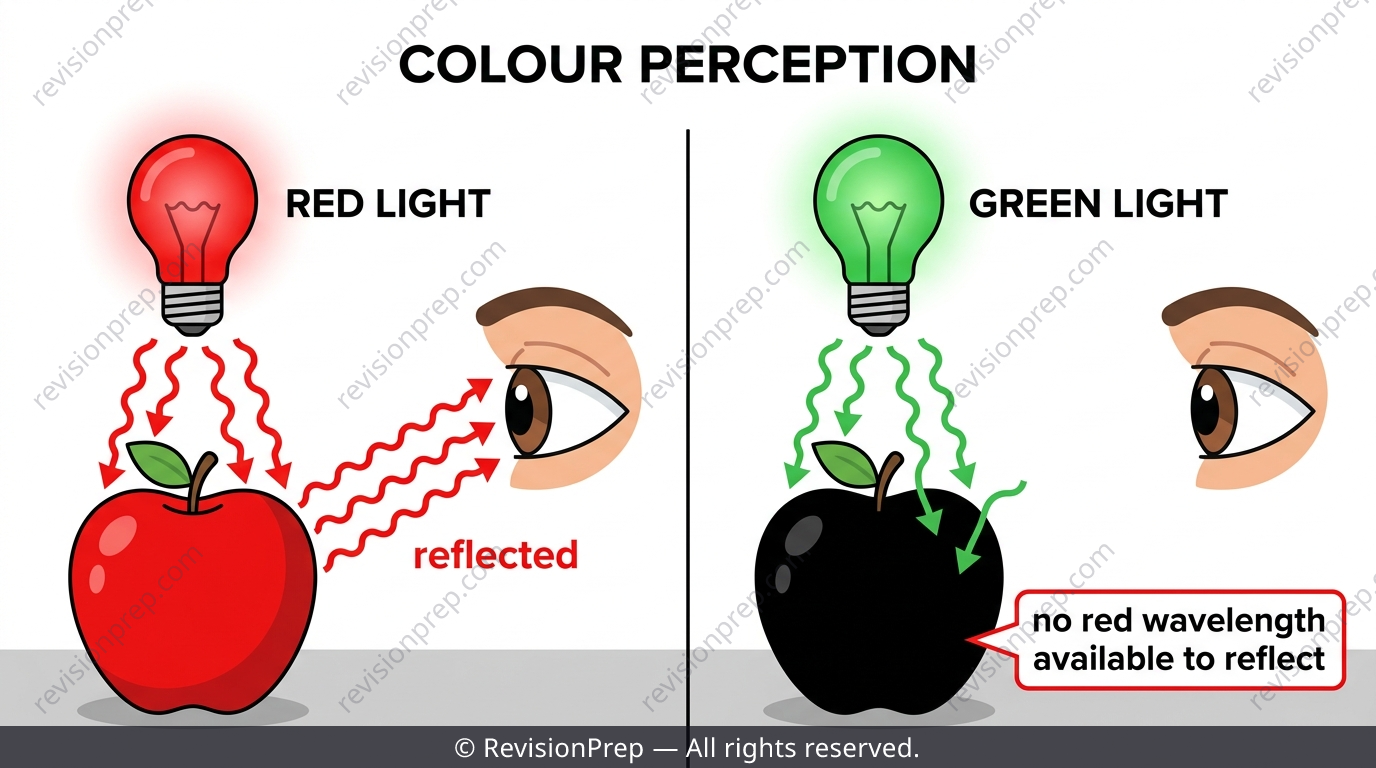
An opaque object's colour is simply the wavelength(s) of light it reflects back to your eye — every other wavelength hitting it is absorbed and turned into heat. Shine light that contains no matching wavelength on that object and it will look black, no matter how brightly coloured it usually appears. Mixing coloured LIGHT is additive (red + green light = yellow light, and all three make white), which is the opposite of mixing paint pigments, which is subtractive toward black.
Common mistake
Assuming an object 'glows its usual colour' regardless of the light shining on it, or assuming red + green light mixes like red + green paint (brown/grey). Colour depends on which wavelengths are AVAILABLE to reflect, and light mixing is additive, not subtractive.
Mini summary
An object's colour is what it reflects, not what it 'contains'; light mixing is additive, pigment mixing is subtractive.
Sound: A Longitudinal Wave That Needs a Medium
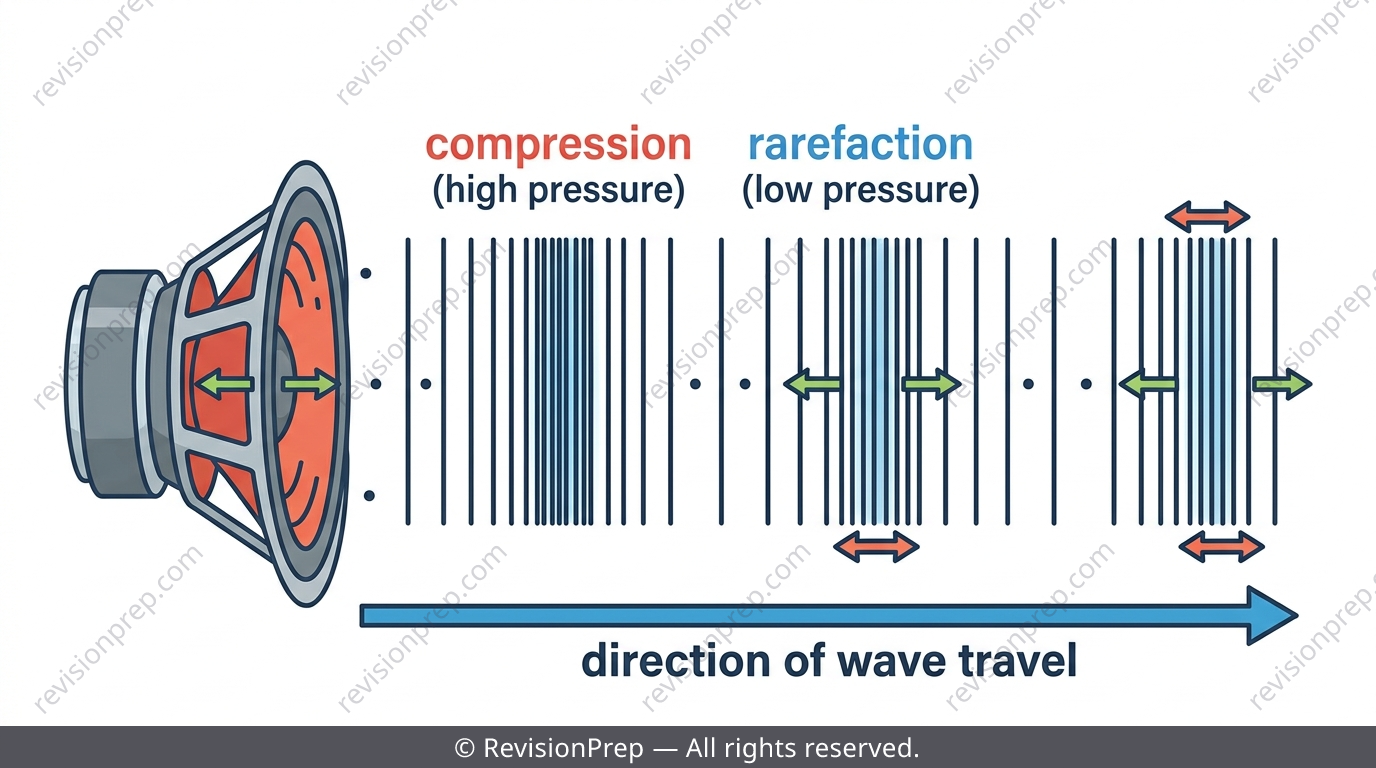
Sound is produced by a vibrating source pushing and pulling particles of a surrounding medium, creating alternating compressions (particles bunched together, high pressure) and rarefactions (particles spread apart, low pressure) that travel outward. Unlike light, sound particles vibrate PARALLEL to the direction the wave travels, making it longitudinal rather than transverse. Because sound is mechanical, it absolutely requires a medium — solid, liquid or gas — and cannot cross a vacuum.
Exam tip
On any wave diagram, compressions are where particles/coils are drawn CLOSE together, never far apart — mixing up the two labels is a very common way to lose the identification mark.
Common mistake
Believing sound can travel through empty space, as movies often show with silent-then-loud space explosions. Sound needs particles to bump into each other; a vacuum has none, so sound cannot travel through it.
Mini summary
Sound is a longitudinal wave of compressions and rarefactions that always needs a medium to travel — unlike light.
Pitch and Loudness: Frequency and Amplitude
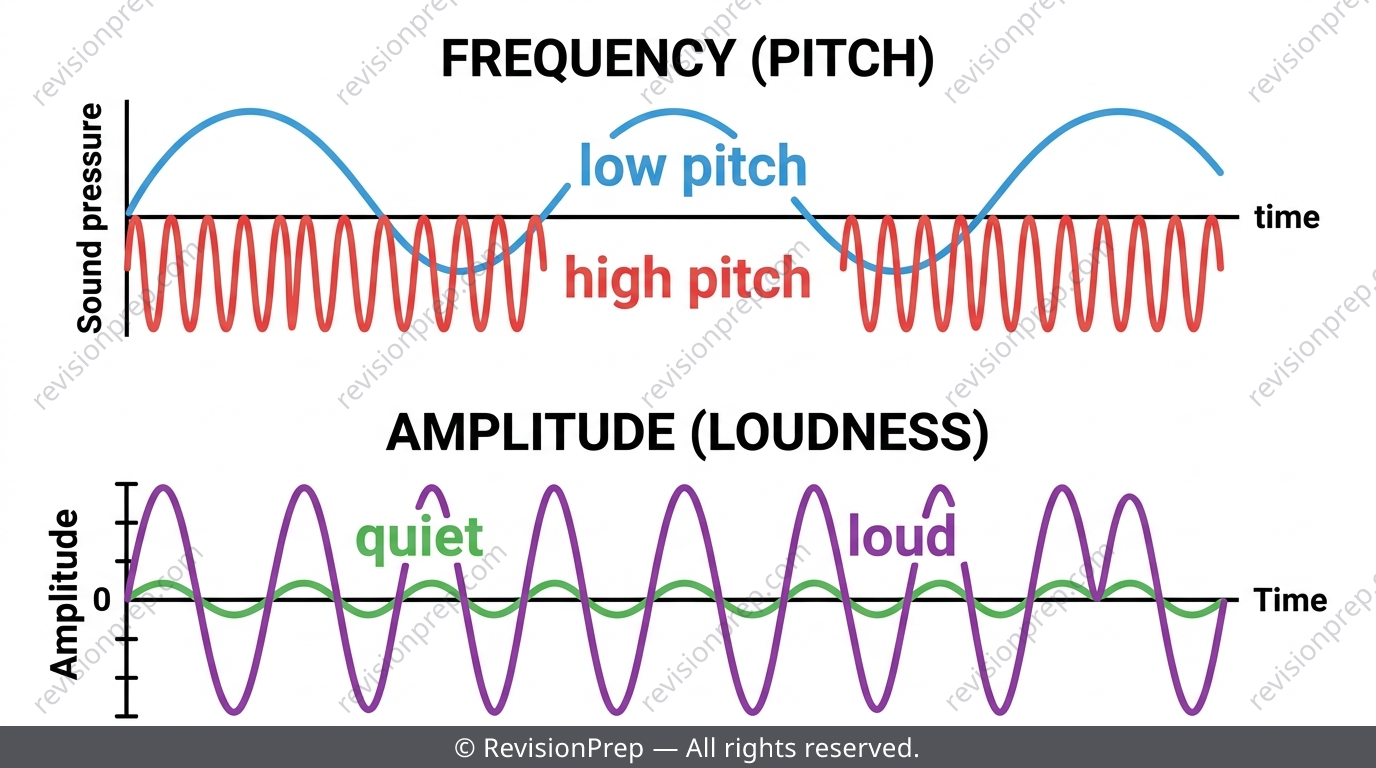
Pitch is how high or low a sound seems and is controlled entirely by frequency: more vibrations per second means higher pitch, fewer means lower pitch. Loudness is how loud or quiet a sound seems and is controlled by amplitude — a bigger vibration carries more energy and is measured in decibels (dB). As you move away from a source, loudness fades because the same energy spreads over a larger area, but pitch stays exactly the same regardless of distance.
Mini summary
Frequency decides pitch; amplitude decides loudness — distance changes loudness but never pitch.
Hearing Range and Speed of Sound Through Media
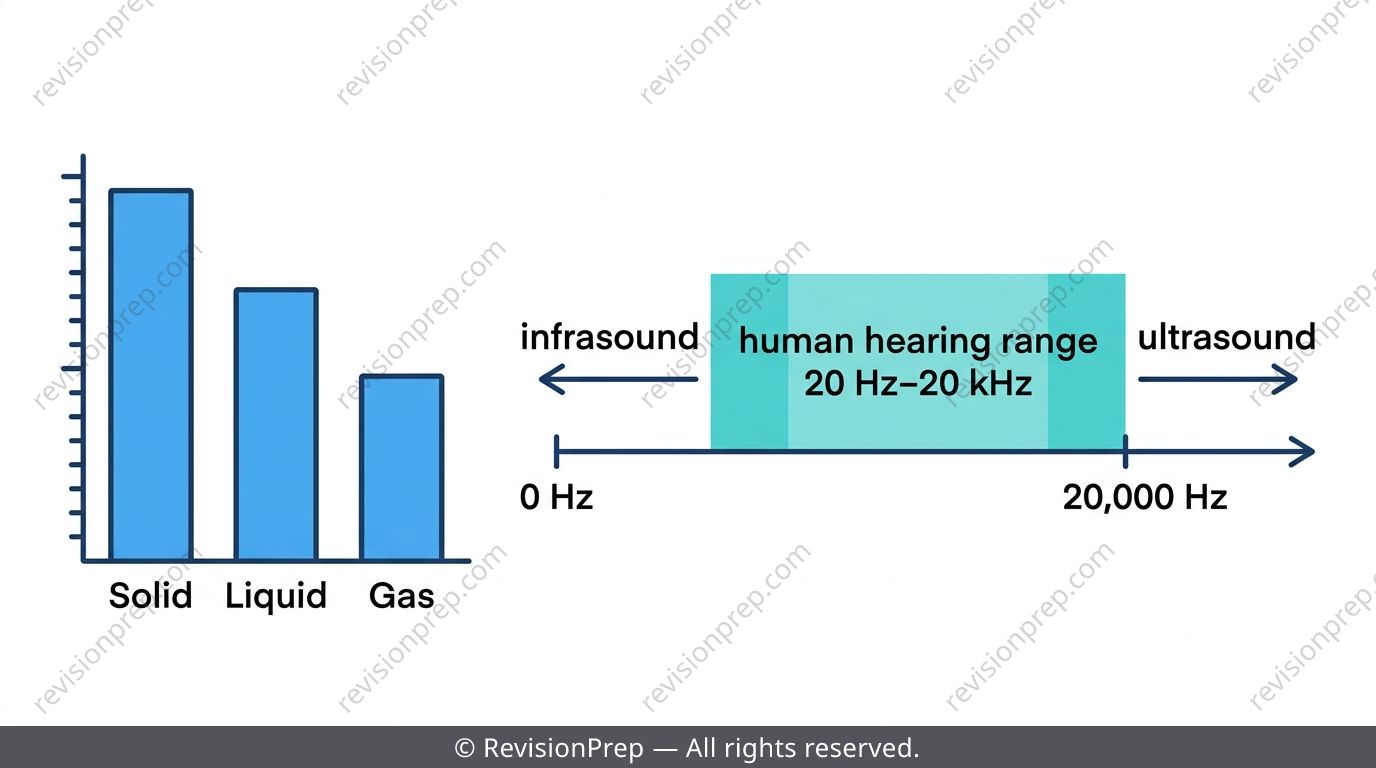
Human hearing spans roughly 20 Hz to 20,000 Hz (20 kHz); below this is infrasound (elephant calls, earthquake tremors) and above it is ultrasound (dog whistles, bat calls, medical ultrasound). Sound travels fastest through solids, slower through liquids, and slowest through gases like air, because tightly packed particles pass a vibration to their neighbours more quickly. Hearing itself works because sound vibrations reach the eardrum, are passed on by tiny middle-ear bones, and are converted into electrical signals the brain interprets as sound.
Mini summary
Hearing range: 20 Hz–20,000 Hz; sound speed order is solids > liquids > gases.
Quick formula sheet
Practice questions
- List the seven colours of the visible spectrum in order from longest to shortest wavelength.
- State whether sound is a transverse or longitudinal wave.
- State the approximate frequency range of human hearing in Hz.
- Explain why a prism splits white light into a rainbow of colours.
- Explain why an opaque red object would appear black if lit only with green light.
- Explain why sound cannot travel through a vacuum but light can.
- A prism bends red light to 19.5° from the normal, yellow to 19.0°, and blue to 18.5°. Identify which colour refracts the most and justify your answer.
- Explain, using compressions and rarefactions, how a vibrating guitar string produces sound that a listener several metres away can hear.
- A student tests three prism angles (30°, 45°, 60°) and measures rainbow width on a screen. Identify the independent and dependent variables and explain your reasoning.
Frequently asked questions
Why does light need no medium but sound always does?+
Light is an electromagnetic wave that carries energy through oscillating electric and magnetic fields, which don't need particles to exist. Sound is a mechanical, longitudinal wave — it relies on particles bumping into their neighbours, so without a medium (as in a vacuum) there's nothing to pass the vibration along.
What determines the colour of an object?+
The colour you see is the wavelength(s) of light the object reflects back to your eye; every other wavelength is absorbed and converted to heat. Change the light source and you can change the object's apparent colour entirely.
What's the difference between pitch and loudness?+
Pitch is controlled by frequency — more vibrations per second means a higher pitch. Loudness is controlled by amplitude — a bigger vibration carries more energy and sounds louder, measured in decibels.
Why does sound travel faster through solids than through air?+
In solids, particles are packed tightly together, so a vibration is passed from particle to particle very quickly. In gases like air, particles are far apart, so it takes longer for the vibration to transfer between them.
Is mixing light colours the same as mixing paint colours?+
No. Mixing coloured light is additive — red and green light combine to make yellow light, and all three primary colours of light make white. Mixing pigments or paints is subtractive, moving toward black as more colours are combined.
What are infrasound and ultrasound?+
Infrasound is sound below the human hearing range (below about 20 Hz), like elephant calls or earthquake tremors. Ultrasound is sound above the human hearing range (above about 20,000 Hz), like dog whistles, bat calls, and medical ultrasound scans.
Get the Full Waves, Sound and Light Revision Notes
Related articles