
Matter and Its Properties
The MYP 1 foundation unit that teaches you to classify before you explain
Quick facts
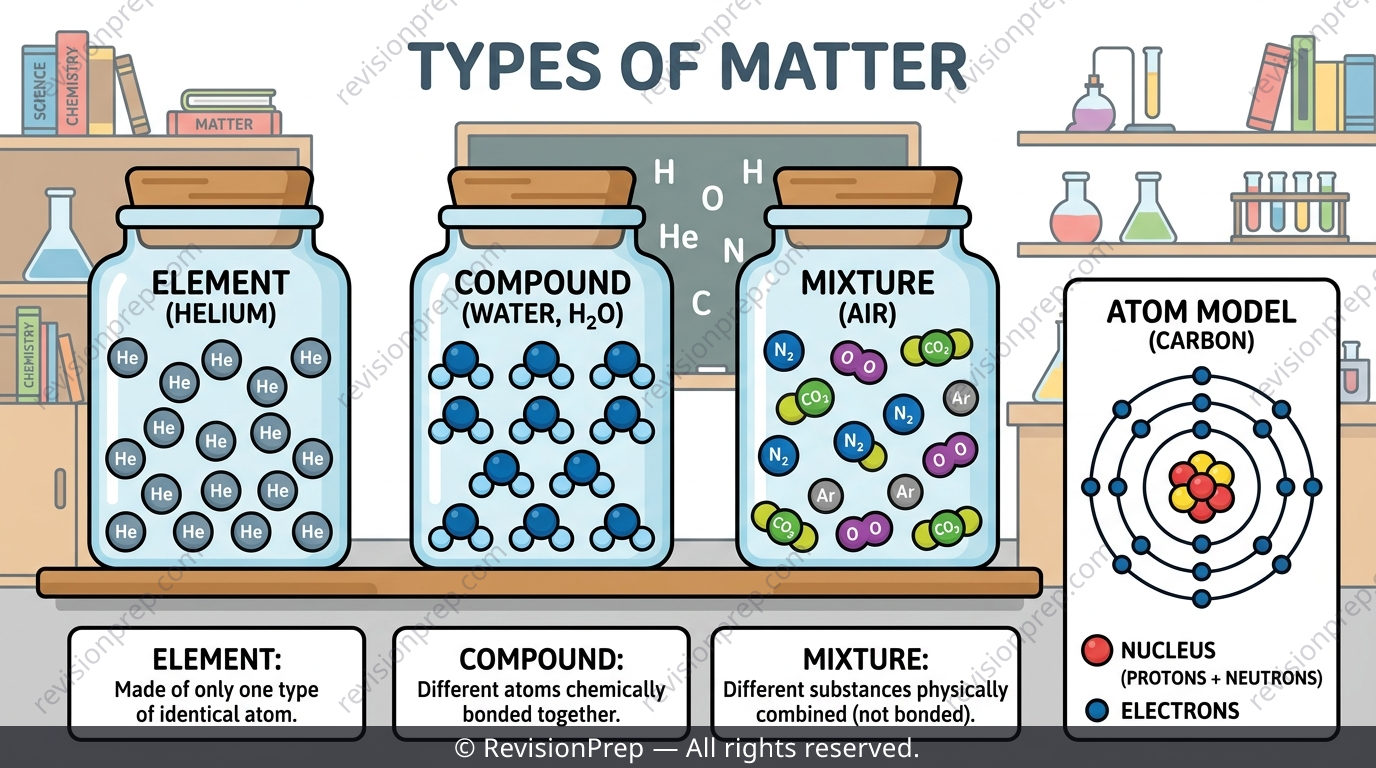
Matter and Its Properties is the first big MYP 1 Sciences unit, and it sets up almost everything you'll study in chemistry and physics afterwards. The core skill examiners want is simple: classify matter using observable evidence before you try to explain anything. That means knowing your elements, compounds and mixtures, understanding the protons, neutrons and electrons inside an atom, choosing the right separation technique for a mixture, reading pH with indicators, and telling a physical change apart from a chemical one. This teaser walks through the five ideas that matter most for MYP Criterion A and B, flags the exact mistakes examiners see every year, and points you to the full revision notes for worked examples, complete tables and step-by-step practice.
What you’ll be able to do
Elements, Compounds and Mixtures
Every sample of matter is exactly one of three things: an element (one type of atom only), a compound (elements chemically bonded in a fixed ratio, forming a genuinely new substance), or a mixture (substances physically combined with no fixed ratio and no new bonds). Water behaves nothing like the hydrogen and oxygen gases it's made from — that's the compound test in action. A mixture, by contrast, keeps the properties of its parts and can always be separated back out physically. Examiners test whether you can classify from a properties table, not whether you've just memorised the definitions.
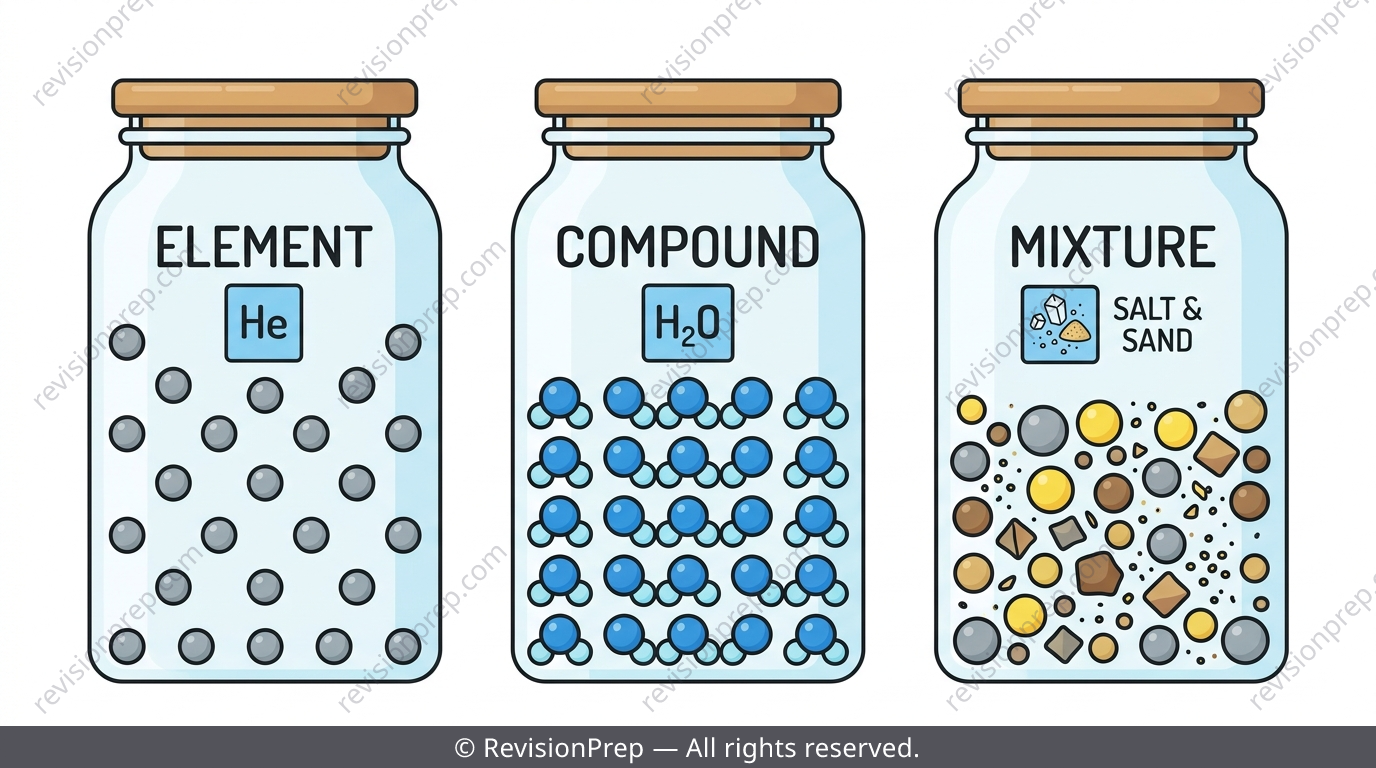
| Feature | Element | Compound | Mixture |
|---|---|---|---|
| Composition | One type of atom | Elements chemically bonded | Substances physically combined |
| Ratio | N/A | Fixed ratio | No fixed ratio |
| New substance formed? | N/A | Yes | No |
| Can be separated physically? | N/A | No — needs chemical means | Yes |
Exam tip
For 1-mark 'identify' questions, give the single correct word or symbol only — don't add an explanation you're unsure about, or you risk contradicting a correct answer.
Common mistake
Writing a symbol with both letters capitalised, e.g. 'HE' instead of 'He', or 'CL' instead of 'Cl'. Always keep the second letter lower case.
Mini summary
Element = one atom type; compound = new substance with a fixed ratio; mixture = physically combined and separable.
Atomic Structure: Protons, Neutrons, Electrons
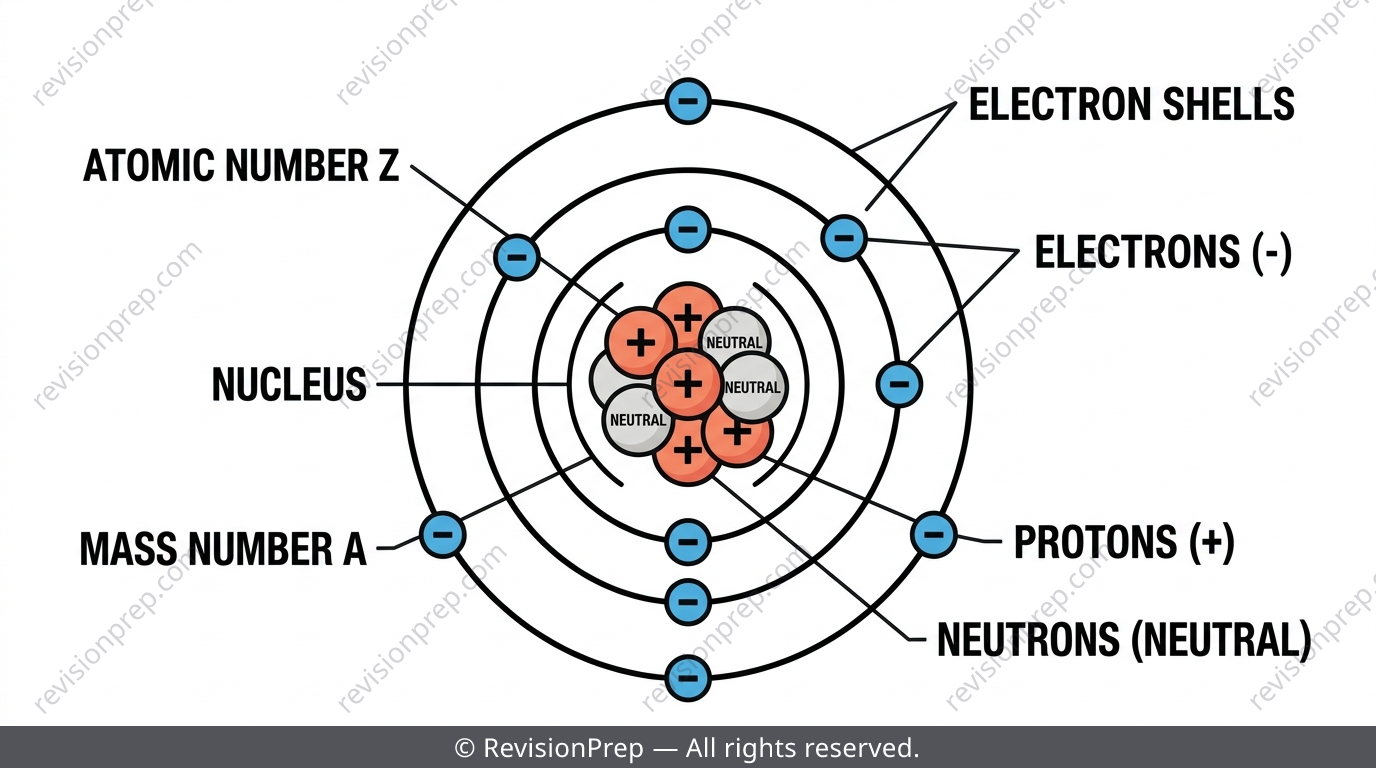
Every atom is built from three particles: protons (positive, in the nucleus), neutrons (no charge, also in the nucleus), and electrons (negative, orbiting in shells). The atomic number () equals the number of protons and is the element's identity card — change it and you change the element entirely. The mass number () is protons plus neutrons, so the number of neutrons is found with .
Exam tip
Write out first, substitute the larger number (mass number, A) before subtracting the atomic number (Z) — don't do it the other way round.
Common mistake
Swapping mass number and atomic number when finding neutrons, e.g. calculating $6 - 12$ instead of $12 - 6$.
Mini summary
Protons and neutrons sit in the nucleus; electrons orbit in shells. Z = protons = element identity; A = protons + neutrons.
Separation Techniques
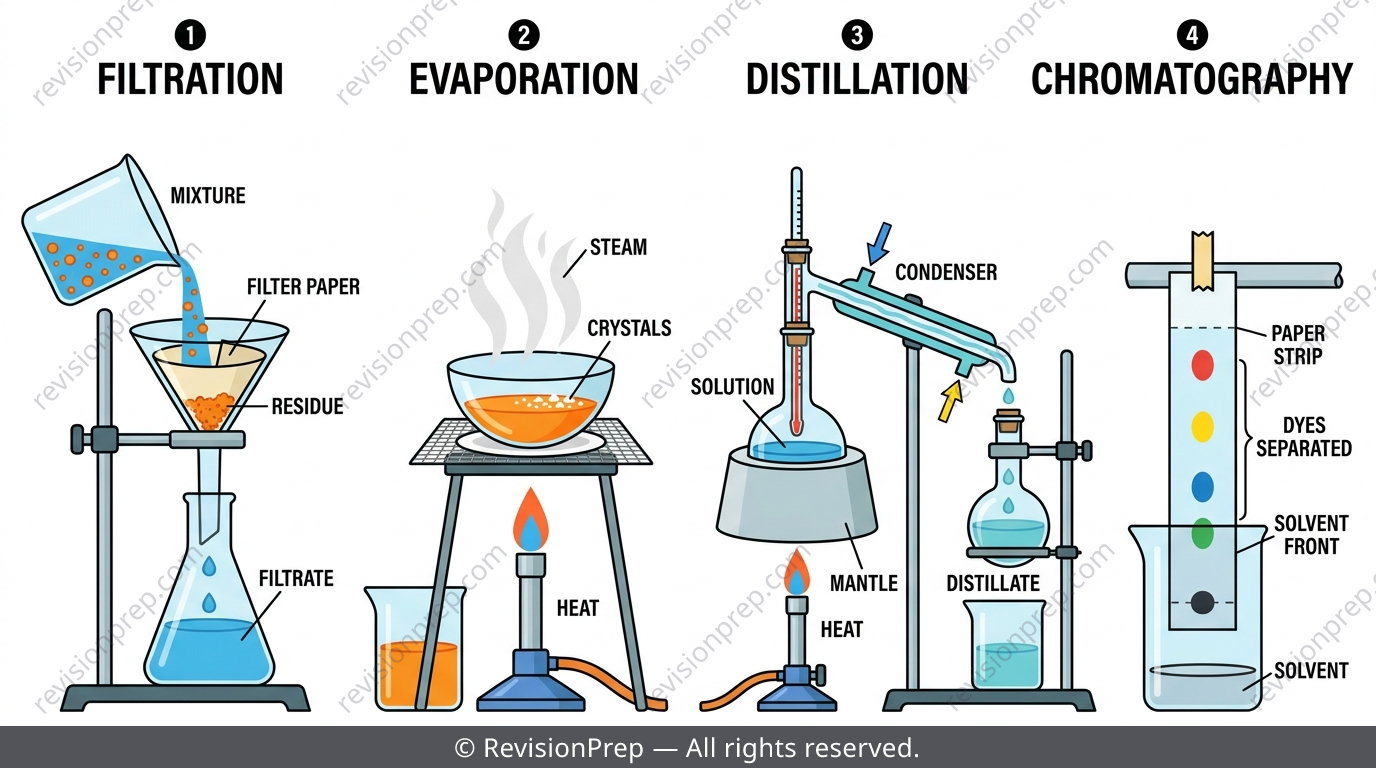
Every separation technique exploits exactly one physical difference between substances — find that difference first, then pick the method. Filtration separates an insoluble solid from a liquid using particle size; evaporation removes a dissolved solid by boiling off the liquid; distillation separates a solvent using boiling point differences and keeps everything (nothing is lost); chromatography separates dyes based on differing solubility; magnetic separation pulls out magnetic materials like iron, nickel and cobalt.
| Technique | Property exploited | Best for separating… |
|---|---|---|
| Filtration | Particle size | Insoluble solid + liquid |
| Evaporation | Boiling point | Dissolved solid from solution (liquid lost) |
| Distillation | Boiling point | Solvent from solution / miscible liquids (nothing lost) |
| Chromatography | Solubility | Dyes/substances in a mixture |
| Magnetic separation | Magnetism | Magnetic vs non-magnetic materials |
Exam tip
If the question asks what should be 'kept the same' for a fair test, name the specific controlled variable (e.g. magnet strength), not just the object itself.
Common mistake
Suggesting filtration to separate a dissolved solid from a liquid — if the solid has dissolved, use evaporation or distillation instead.
Mini summary
Match the technique to the physical difference: size (filtration), boiling point (evaporation/distillation), solubility (chromatography), magnetism (magnetic separation).
Acids, Bases and pH
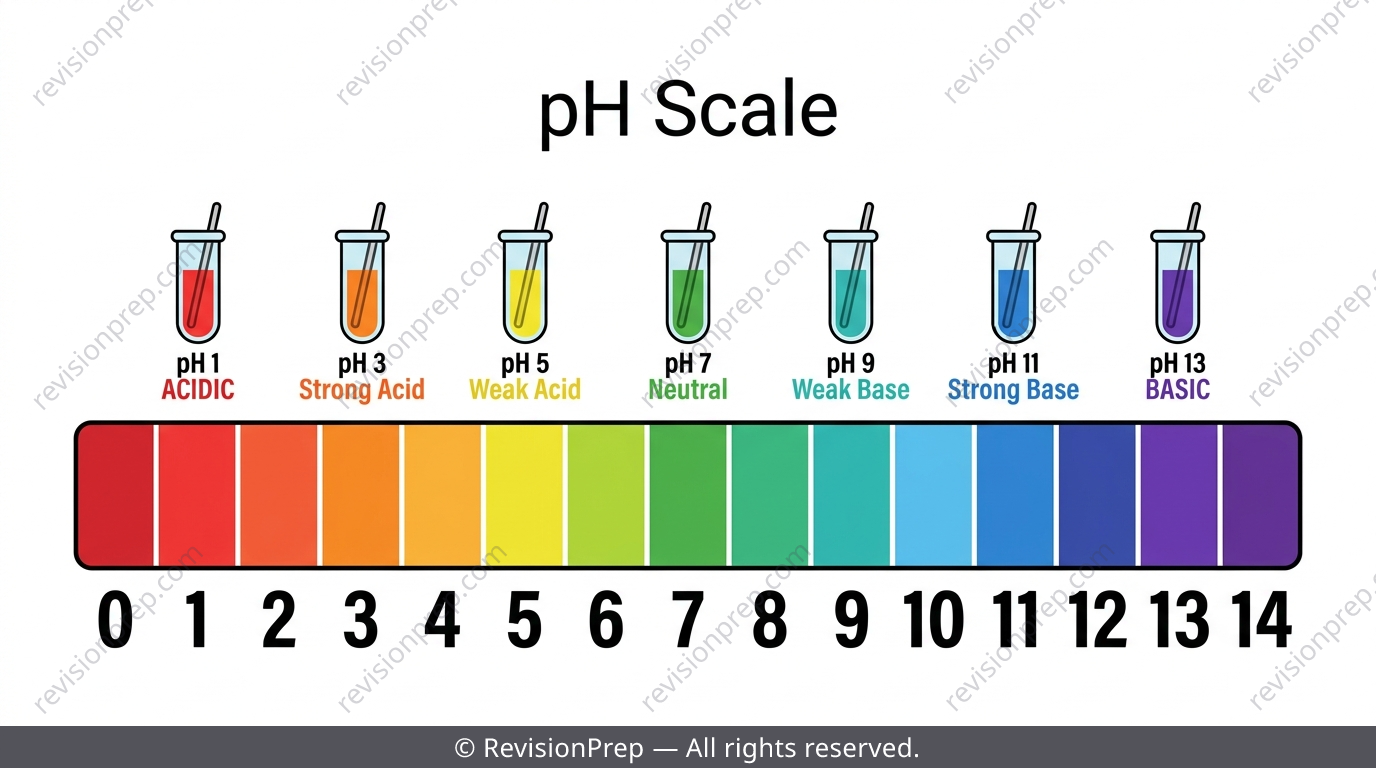
Acids and bases are classified along the pH scale, and indicators are simply the tool that turns pH into a visible colour change. Instead of measuring pH directly, you read the colour an indicator turns when added to a substance and match it to whether that substance is acidic, neutral or basic. This is a classification skill, just like sorting elements, compounds and mixtures — observe first, then decide.
Exam tip
Describe the colour change an indicator produces and link it directly to the acid/base classification — don't just name the indicator.
Mini summary
pH classifies acids and bases; indicators make that classification visible through colour.
Particle Theory & Physical vs Chemical Change
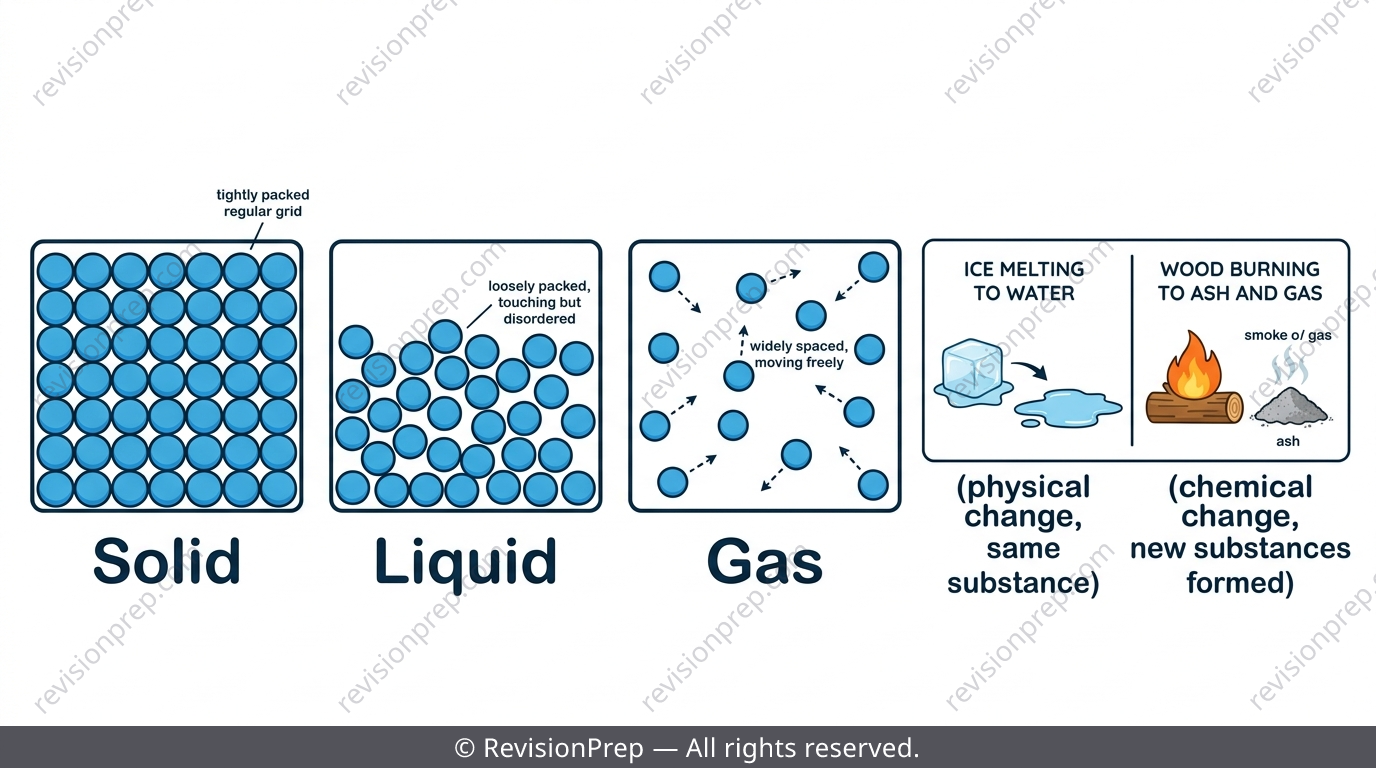
Particle theory explains solid, liquid and gas behaviour using just two ideas: how the particles are arranged and how much energy they have — nothing more mysterious than that. Whether a change is physical or chemical always comes down to one test: has a genuinely new substance formed? If yes, it's chemical; if the same substance is just in a different state or shape, it's physical.
Mini summary
States of matter = arrangement + energy. Physical vs chemical change = has a new substance actually formed?
Quick formula sheet
Practice questions
- State whether table salt dissolved in water is an element, compound or mixture, and explain why.
- Write the correct chemical symbol for iron and for helium, following the capitalisation rule.
- An atom has atomic number 8 and mass number 16. Find its number of neutrons.
- A mixture contains sand and salt dissolved in water. Describe the two separation techniques needed to fully separate all three components.
- Explain why water () has completely different properties from hydrogen gas and oxygen gas.
- An indicator turns red when added to a colourless liquid. State whether the liquid is acidic, neutral or basic, and explain what the indicator is showing.
- Two unknown solids have identical melting points but one conducts electricity and one does not. Explain how you would classify them and what further evidence you would need.
- A student burns a piece of magnesium ribbon and notices a new white powder forms with a different mass to the original ribbon. Argue whether this is a physical or chemical change, using the correct test.
- Design a fair test to compare how effectively two different filter papers separate the same mixture, identifying the independent, dependent and controlled variables.
Frequently asked questions
What's the easiest way to tell an element from a compound?+
Check if it's made of only one type of atom (element) or two-plus elements chemically bonded into something with new properties (compound). If the properties are completely different from any starting substance, it's a compound.
How do I remember the chemical symbol capitalisation rule?+
The first letter is always capital and the second letter (if there is one) is always lower case — writing both capitals turns one element into what looks like two separate one-letter elements.
Why can't I use filtration to get salt out of salt water?+
Filtration only works when the solid hasn't dissolved. Once salt dissolves, its particles are too small to be caught by filter paper, so you need evaporation or distillation instead.
What's the difference between atomic number and mass number?+
Atomic number (Z) is just the number of protons and defines the element. Mass number (A) is protons plus neutrons combined, so neutrons = A − Z.
How do I know if a change is physical or chemical?+
Ask whether a genuinely new substance has formed. If yes, it's chemical; if it's the same substance in a different state or shape, it's physical.
Does RevisionPrep provide official IB exam papers for this unit?+
No — RevisionPrep offers original mock papers and exam-style practice questions to help you revise, not official exam board material.
Master Matter and Its Properties with the full MYP 1 revision notes
Related articles