
Earth and Space Science
Weathering, the Solar System, Moon phases and eclipses — the MYP 1 essentials in one quick read
Quick facts
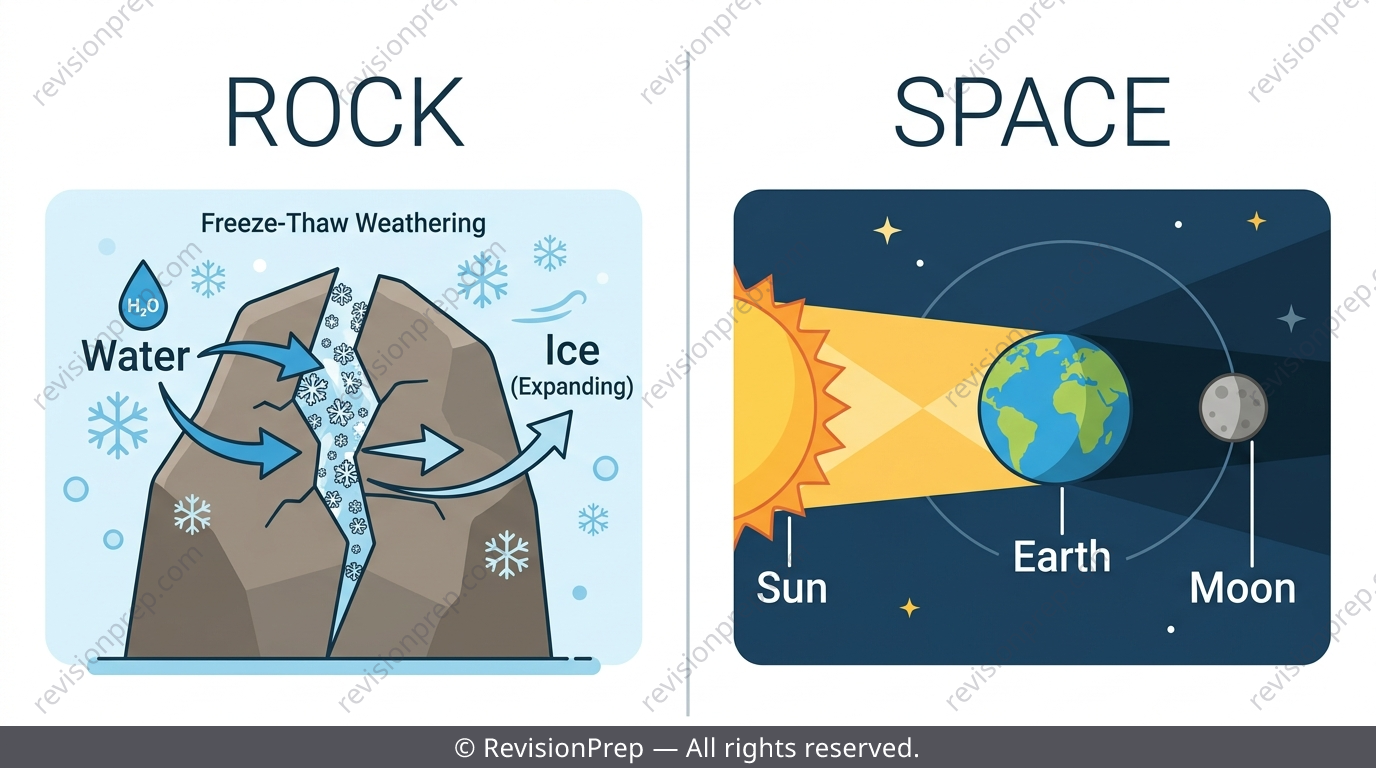
Earth and Space Science in IB MYP 1 connects two big ideas: what Earth's surface is made of and how it changes, and where Earth sits in space relative to the Sun and Moon. You'll meet weathering and erosion, the structure of the Solar System, and the geometry behind Moon phases and eclipses. Exam-style questions in this topic love data tables of rock masses and diagrams of the Sun-Earth-Moon system, so understanding the mechanisms behind each process matters more than memorising labels. This teaser walks through the five ideas examiners return to most — weathering versus erosion, the Solar System's structure, and how phases and eclipses actually work — before pointing you to the full revision notes for worked examples, definitions and practice questions.
What you’ll be able to do
Weathering vs Erosion: The Key Distinction
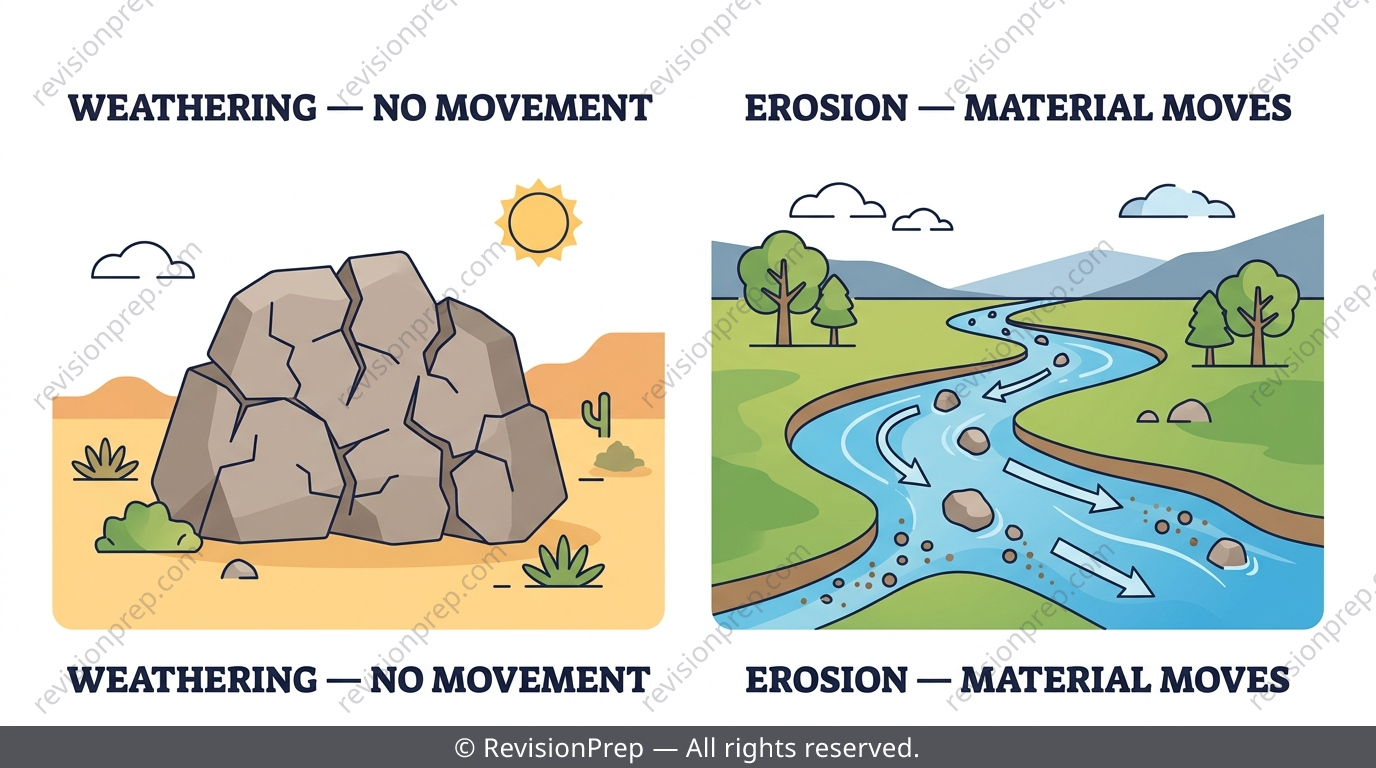
Weathering breaks rock down exactly where it sits — nothing moves away. Erosion is what happens next: wind, water, ice or gravity carry that broken material somewhere else. The single test examiners want you to apply is simple: has the material moved from where it broke?
Exam tip
If a question asks you to 'state what weathering means,' give one precise sentence — breakdown of rock in place — rather than listing all three types, which wastes time on a 1-mark question.
Common mistake
Calling any rock breakdown 'erosion,' even cracking that stays exactly where it happened. No movement means it's weathering, not erosion.
Mini summary
No movement = weathering. Movement by wind, water, ice or gravity = erosion.
Physical, Chemical and Biological Weathering — and What Speeds It Up
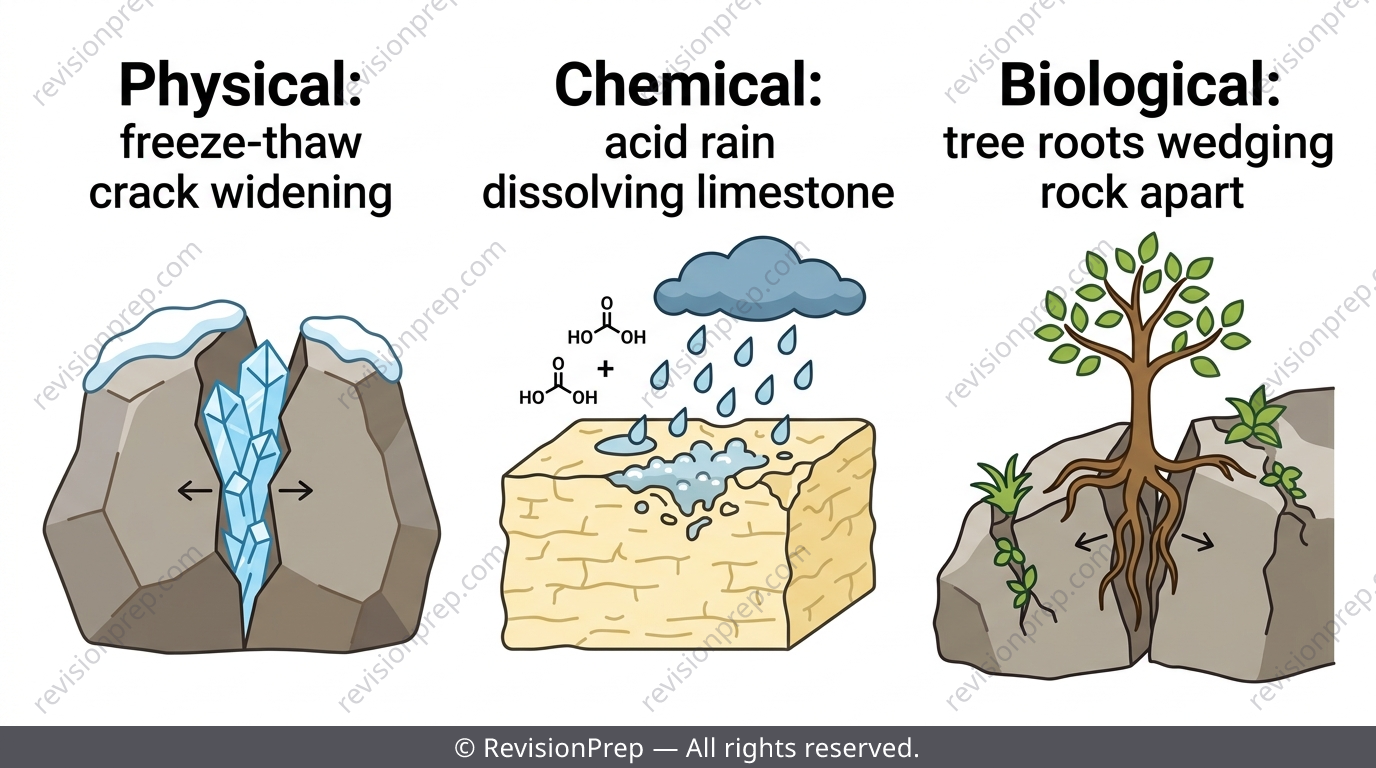
Physical weathering breaks rock into smaller pieces with no chemical change, like freeze-thaw, where water expands about 9% as it freezes and forces cracks wider. Chemical weathering changes the rock's minerals into something new, as acid rain does when it reacts with limestone. Biological weathering involves living things, such as roots wedging cracks apart. Weathering rate depends on rock type, climate and how much surface area (cracks and joints) is exposed.
Exam tip
Data questions on weathering give you numbers first — read the table carefully before jumping to 'freeze-thaw' or 'acid rain' as your answer.
Common mistake
Answering 'water freezes and breaks the rock' without mentioning that the water expands and pushes on the crack walls — this only earns partial credit.
Mini summary
Physical = shape/size change only; chemical = new substance forms; biological = living things involved; rate depends on rock type, climate and surface area.
The Solar System: Planets, Dwarf Planets, Asteroids and Comets
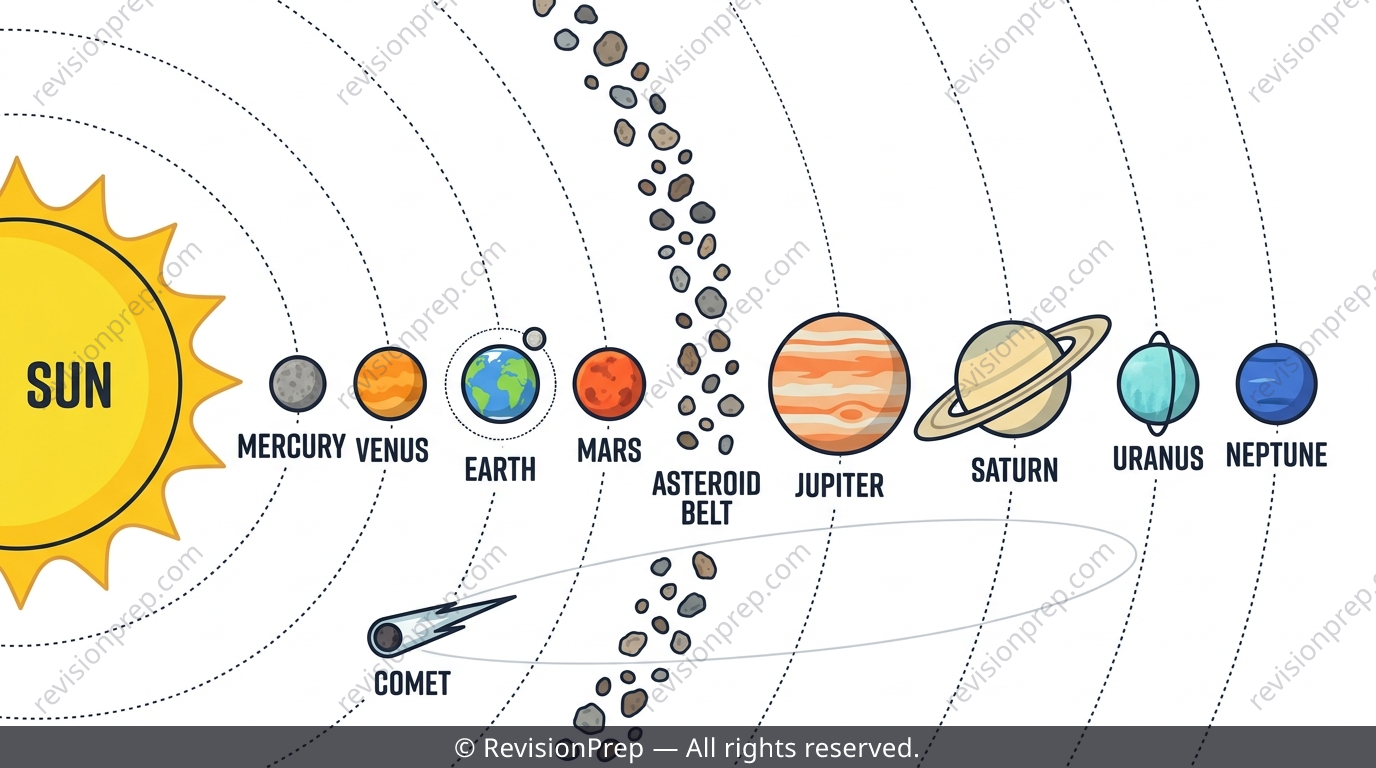
The Solar System is the Sun plus everything gravitationally bound to it. Inner planets — Mercury, Venus, Earth, Mars — are small, dense and rocky, while outer planets — Jupiter, Saturn, Uranus, Neptune — are much larger but far less dense, made mostly of gas and ice. Dwarf planets like Pluto orbit the Sun but haven't cleared their orbital path, and the asteroid belt sits between Mars and Jupiter. Gravity keeps everything in orbit — planets are constantly falling toward the Sun but moving sideways fast enough to keep missing.
Exam tip
Scale-model questions always want a scale factor calculated from the data given — never invent a 'nice round' scale like 1 cm = 10,000 km.
Common mistake
Assuming a dwarf planet like Pluto is simply 'too small' to be a planet — the real distinguishing criterion is that it hasn't cleared its orbital neighbourhood.
Mini summary
Inner planets: small, dense, rocky. Outer planets: large, low-density gas/ice giants. Dwarf planets share every planet trait except clearing their orbit.
Why the Moon Has Phases
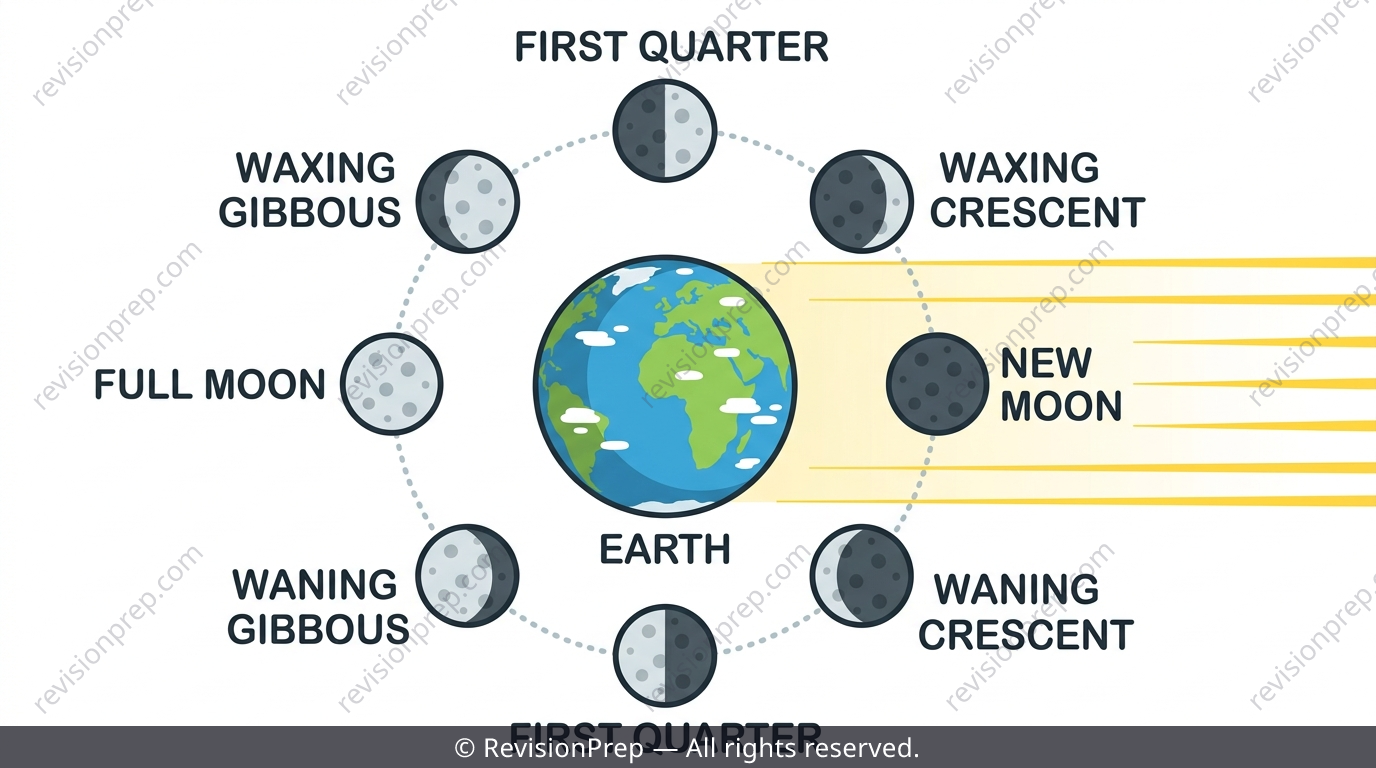
The Moon produces no light of its own — it only reflects sunlight. As it orbits Earth roughly every 27.3 days, the amount of its permanently sunlit half that faces Earth changes, giving the full cycle of phases in about 29.5 days. The order runs new moon, waxing crescent, first quarter, waxing gibbous, full moon, waning gibbous, last quarter, waning crescent, then back to new.
Exam tip
Waxing means the lit portion is increasing; waning means it's decreasing — get these two words right and half the phase-naming questions solve themselves.
Common mistake
Believing ordinary Moon phases are caused by Earth's shadow falling on the Moon. Normal phases involve no shadow at all — only how much of the sunlit half faces us.
Mini summary
Phases depend on how much of the Moon's sunlit half faces Earth as it orbits, not on any shadow.
Solar and Lunar Eclipses
A solar eclipse happens when the Moon passes directly between the Sun and Earth, casting its shadow onto Earth — this can only occur at new moon. A lunar eclipse happens when Earth passes directly between the Sun and Moon, casting Earth's shadow onto the Moon — this can only occur at full moon. Eclipses aren't monthly because the Moon's orbit is tilted about 5° relative to Earth's orbit, so the three bodies rarely line up exactly.
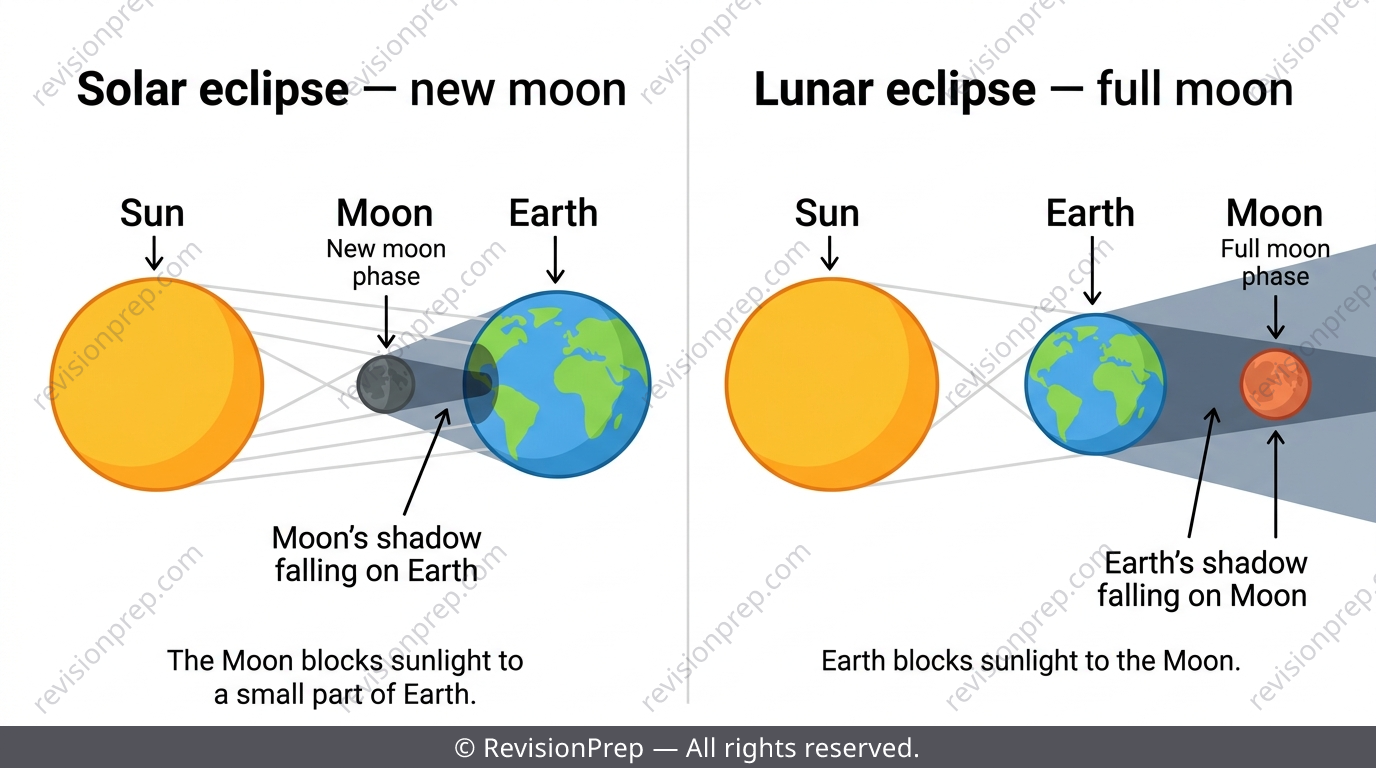
| Feature | Solar eclipse | Lunar eclipse |
|---|---|---|
| Order of bodies | Moon between Sun and Earth | Earth between Sun and Moon |
| Moon phase required | New moon | Full moon |
| What gets shadowed | Earth | Moon |
Exam tip
If a question asks why eclipses don't happen every month, the answer is the ~5° tilt of the Moon's orbit — not distance or speed.
Common mistake
Mixing up which body casts the shadow in each eclipse type — always check whether it's new moon (solar) or full moon (lunar) first.
Mini summary
Solar eclipse: Moon's shadow on Earth, at new moon. Lunar eclipse: Earth's shadow on Moon, at full moon.
Quick formula sheet
Practice questions
- Define weathering in one sentence.
- Name the four inner (rocky) planets in order from the Sun.
- State which Moon phase is required for a solar eclipse to occur.
- Explain why freeze-thaw weathering can eventually split a rock, mentioning what happens to the water.
- Explain why a dwarf planet like Pluto is not classified as a full planet.
- Explain why ordinary Moon phases are not caused by Earth's shadow.
- Four rock samples lose different masses after a year in different conditions — explain how you would decide which condition caused the greatest weathering, and why the pattern (not just the raw numbers) matters.
- A model uses a marble of diameter 1.3 cm for Earth (real diameter 12,750 km). Explain how you would calculate a consistent model diameter for another planet.
- Explain why eclipses do not happen every month even though the Moon orbits Earth roughly every 27.3 days.
Frequently asked questions
What is the main difference between weathering and erosion?+
Weathering breaks rock down in place with no movement; erosion is the transport of that broken material by wind, water, ice or gravity.
Why do outer planets have no solid surface to stand on?+
Outer planets like Jupiter and Saturn are gas and ice giants — they're much larger than inner planets but far less dense, made mostly of gas and ice rather than rock.
Why does the Moon appear to change shape every night?+
The Moon reflects sunlight and doesn't produce its own light. As it orbits Earth, the amount of its permanently sunlit half facing us changes, creating the cycle of phases.
Why isn't there a solar or lunar eclipse every month?+
The Moon's orbit is tilted about 5° relative to Earth's orbit around the Sun, so the Sun, Earth and Moon only line up exactly a few times a year.
What makes something a dwarf planet instead of a planet?+
A dwarf planet, like Pluto, is round and orbits the Sun like a planet, but it hasn't cleared other objects out of its orbital path — that's the one criterion it fails.
Does distance from the Sun cause the seasons?+
No — this is a common misconception. Seasons are explained by Earth's axial tilt, not by how close or far Earth is from the Sun at different times of year.
Get the full Earth and Space Science revision notes
Related articles