
Structure: Models of Bonding and Structure
Ionic, covalent and metallic bonding as one Coulombic continuum — not three separate boxes
Quick facts
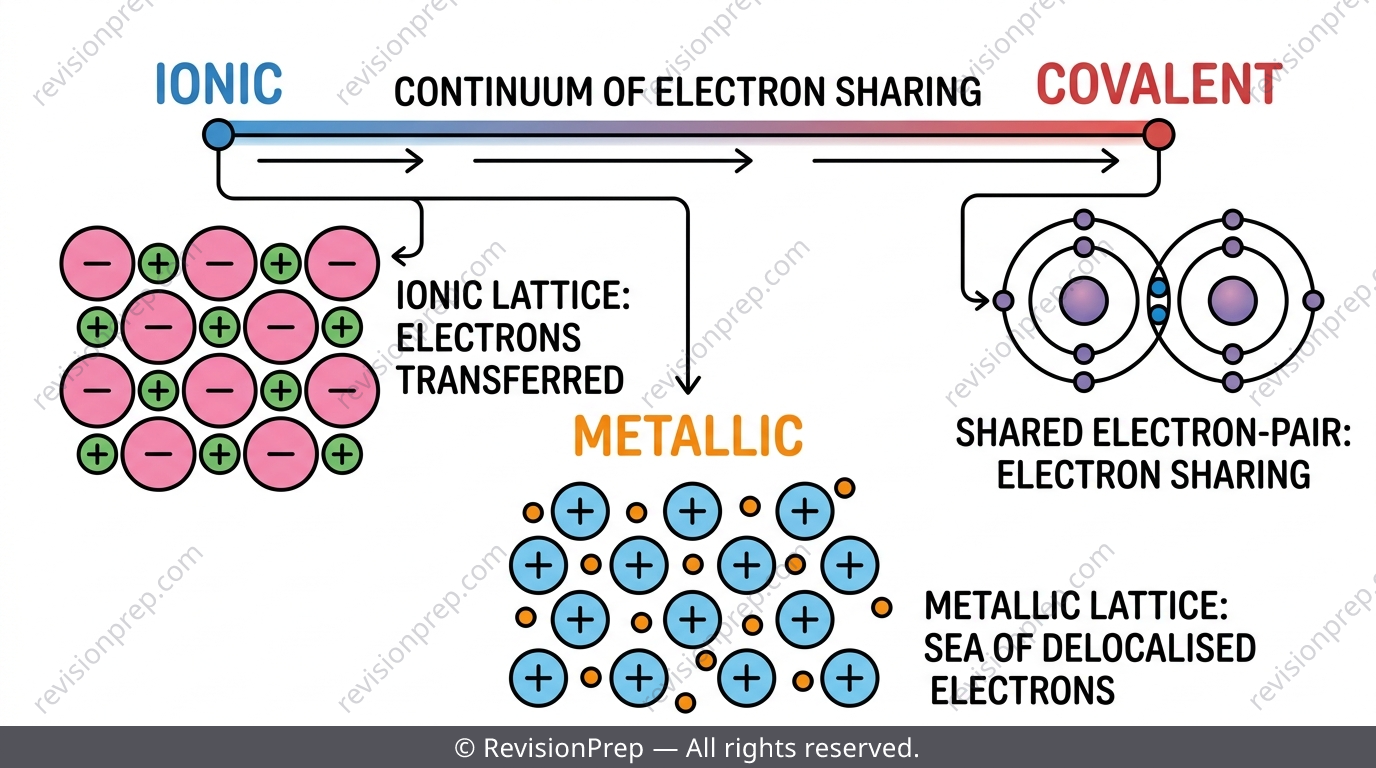
IB Chemistry doesn't want you memorising ionic, covalent and metallic bonding as three unrelated topics — it wants you to see them as one Coulombic continuum, where real bonds like Al–Cl sit somewhere between the pure ionic and pure covalent limits. This is exactly the thinking behind Structure 2.1–2.4: build the three bonding models, then use them to explain why NaCl is brittle, why diamond has an enormous melting point, and why metals conduct electricity as a solid. Examiners recycle the same handful of ideas — lattice enthalpy proportionality, coordination number from radius ratio, VSEPR geometry, and delocalised electron seas — dressed up in different contexts across Paper 1 and Paper 2. This teaser walks through the five ideas that generate almost every mark on this topic, with the exact traps IB loves to set. For the full derivations, worked Born-Haber cycles and structure comparisons, head to the complete RevisionPrep notes.
What you’ll be able to do
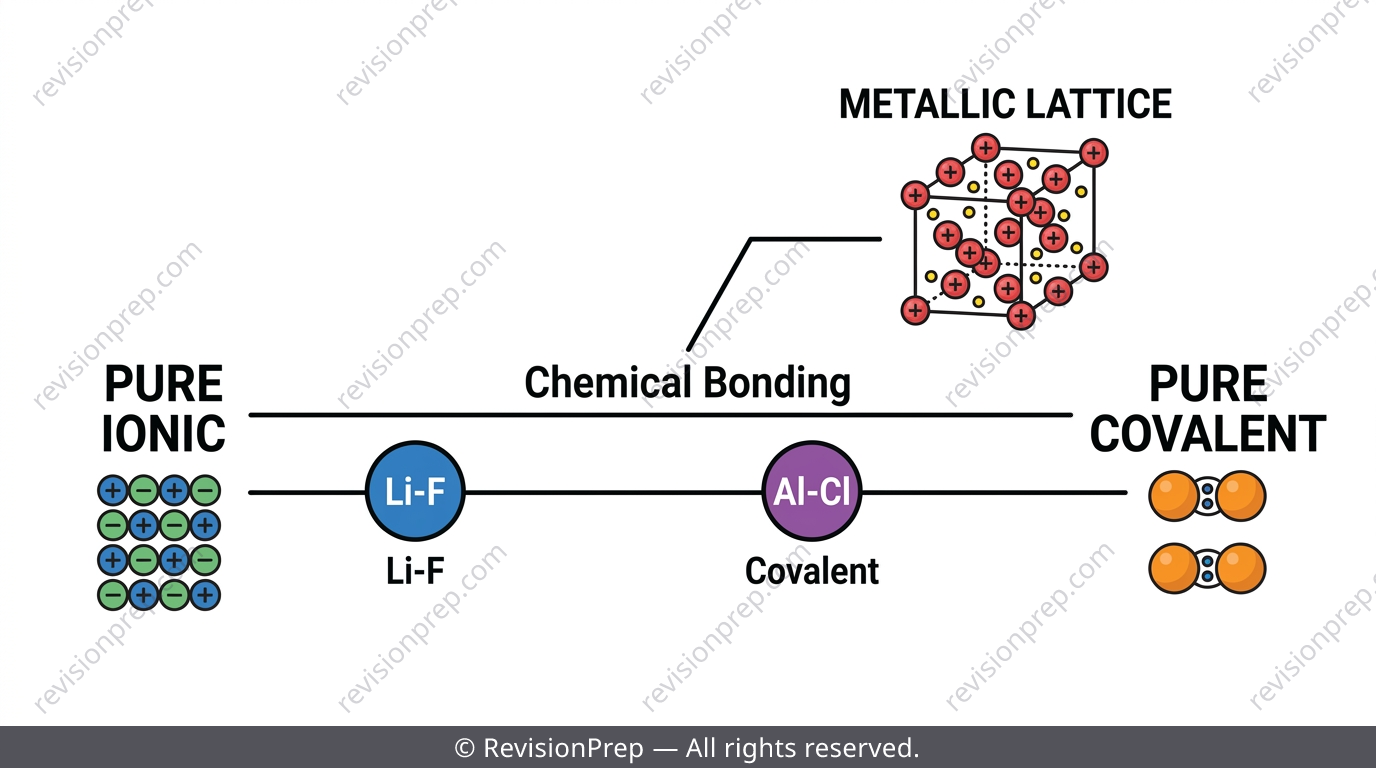
The Bonding Continuum: Why Ionic, Covalent and Metallic Aren't Separate Boxes
Pure ionic bonding (complete electron transfer) and pure covalent bonding (perfectly equal sharing) are idealised extremes. Most real bonds — Al–Cl, for instance — sit somewhere in between, and HL specifically expects you to justify where on that spectrum a given bond falls. Structure 2.1–2.3 build each model; Structure 2.4 uses them together to explain real material properties like melting point, solubility and brittleness.
Exam tip
When a question gives you charges, radii or a lattice structure, it is almost always testing the same Coulombic argument dressed in a new context — identify charge and radius sum first, don't invent a new explanation each time.
Mini summary
Ionic, covalent and metallic are limits of one electron-sharing spectrum, not separate categories.
The Ionic Model: Lattice Enthalpy and Coordination Number
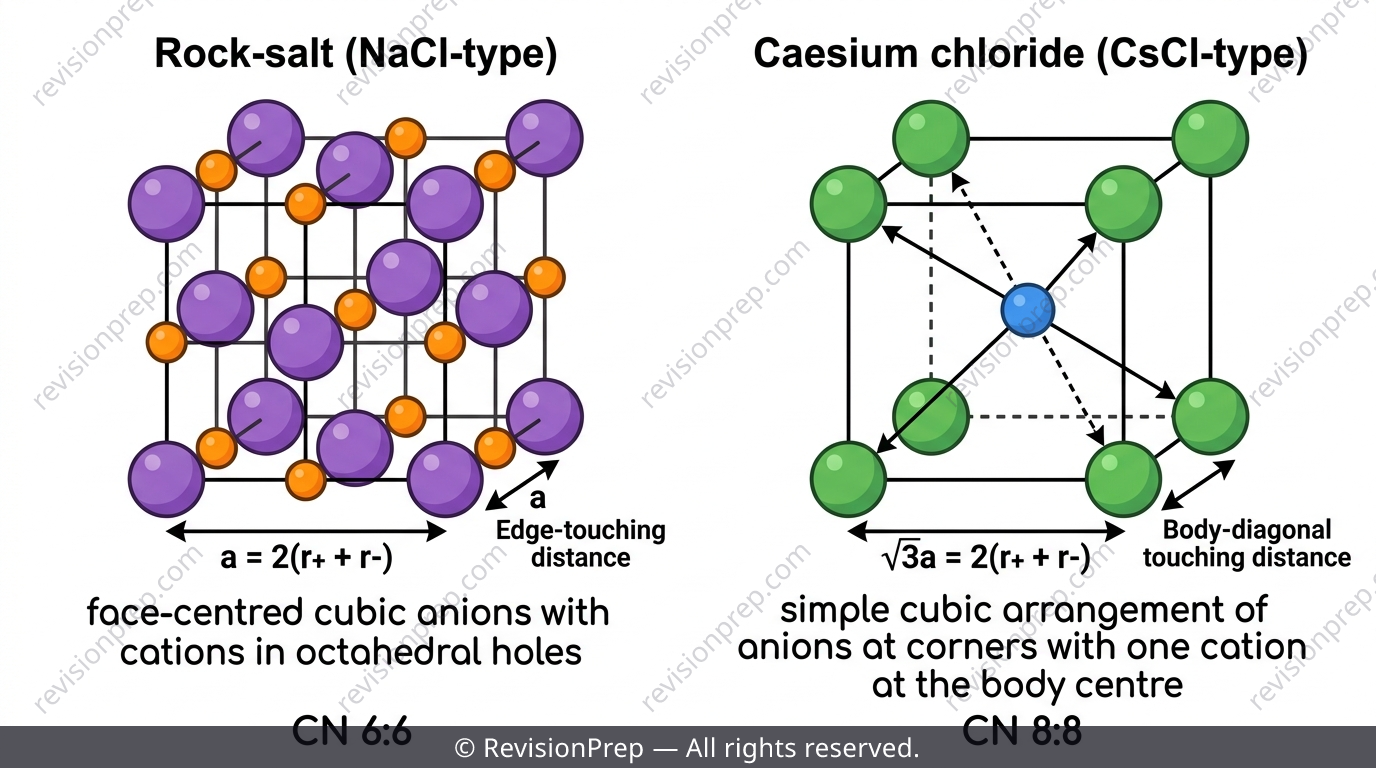
An ionic lattice is a giant 3-D array where every ion attracts every oppositely-charged neighbour non-directionally, which is why lattice enthalpies are so large. Coordination number — the number of nearest oppositely-charged neighbours — is fixed by the radius ratio : a small cation relative to its anion fits fewer neighbours around it. Rock-salt structures give CN 6:6 (FCC anions, cations in octahedral holes); caesium chloride gives CN 8:8 because the larger Cs fits comfortably against 8 corner Cl ions. Shearing an ionic lattice brings like-charge ions adjacent, and the repulsion shatters the crystal — hence hard but brittle, never malleable.
| Structure type | Anion arrangement | Coordination number | Touching direction |
|---|---|---|---|
| Rock-salt (NaCl-type) | Face-centred cubic | 6:6 | Along the cell edge |
| Caesium chloride (CsCl-type) | Simple cubic | 8:8 | Along the body diagonal |
Common mistake
Assuming every ionic lattice is CN 6:6 because rock-salt is the classic taught example — always re-derive CN from the described geometry or the radius ratio, never assume NaCl by default.
Mini summary
Lattice enthalpy scales with ; coordination number comes from geometry or radius ratio, never assumption.
The Covalent Model: VSEPR, Hybridisation and Sigma/Pi Bonds
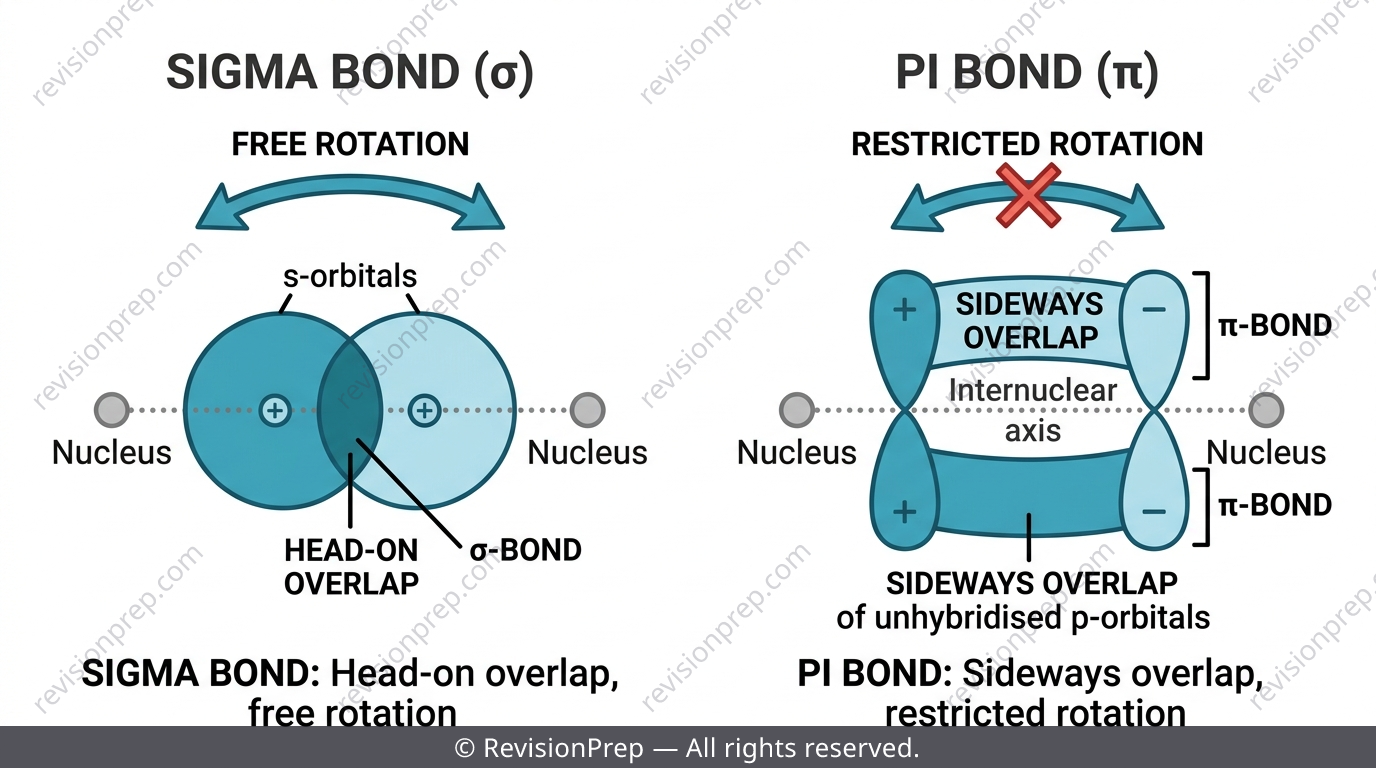
Covalent bonding shares electrons rather than transferring them. VSEPR predicts molecular shape from electron domains around a central atom, with lone pairs repelling more strongly than bonding pairs and compressing bond angles below the ideal. Hybridisation (HL) links the number of electron domains to orbital mixing — 4 domains means sp³, for example. A sigma bond (head-on overlap, always present, allows rotation) differs from a pi bond (HL, sideways overlap of unhybridised p-orbitals, restricts rotation, found in double/triple bonds). Delocalisation in systems like benzene spreads pi electron density over several atoms, making bonds intermediate in length and unusually stable.
Common mistake
Seeing a high melting point in a covalent substance like SiO or diamond and concluding 'covalent bonds are weak' — check first whether it's a giant covalent network (bonds span the whole crystal, very high mp) or small molecules held by weak intermolecular forces (low mp). The covalent bond itself is always strong.
Mini summary
VSEPR gives shape from electron domains; sigma bonds allow rotation, pi bonds don't; delocalisation gives intermediate bond lengths.
The Metallic Model: A Sea of Delocalised Electrons
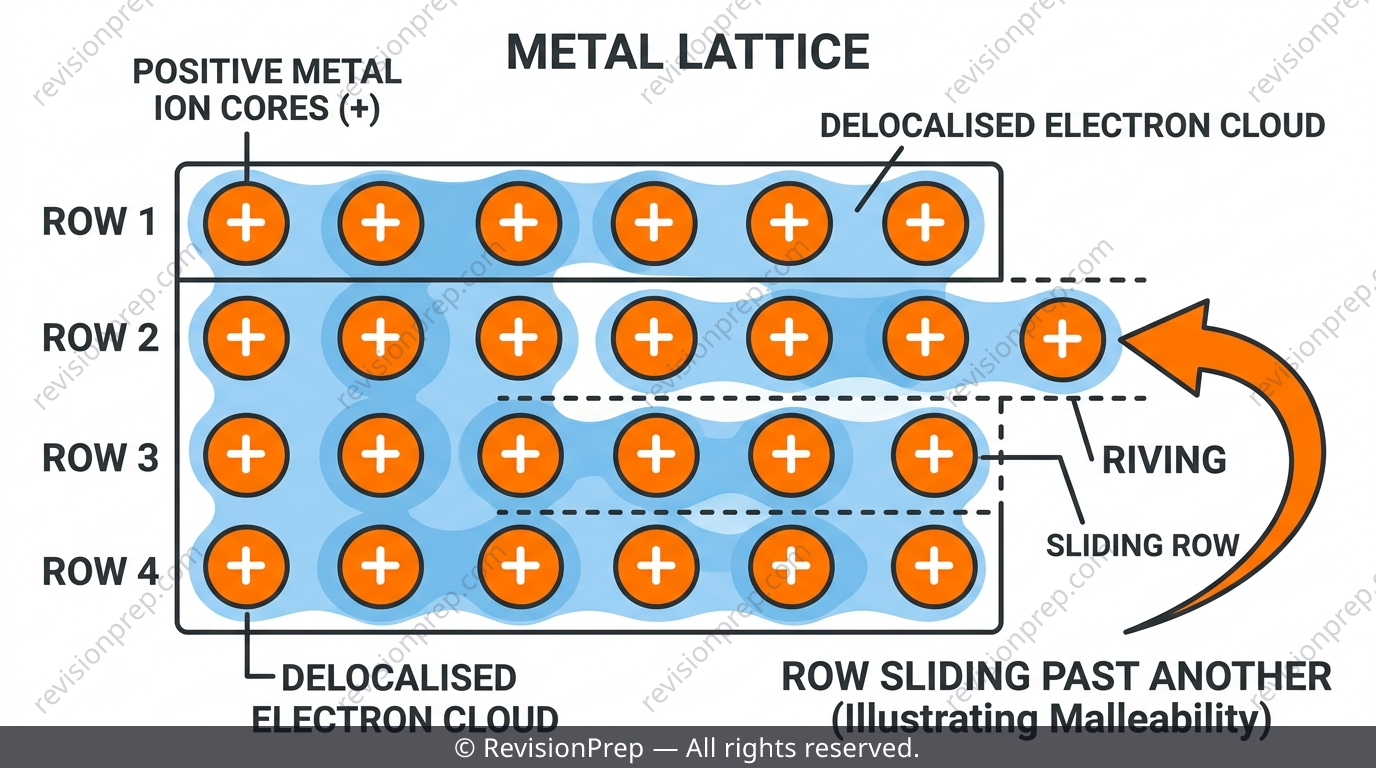
A metal is a lattice of positive ion cores sitting in a sea of delocalised valence electrons that belong to the whole structure, not any single atom. Because this bonding is non-directional, planes of cations can slide past each other without breaking bonds, explaining malleability and ductility. The same free-moving electrons conduct electricity in both the solid and molten states — unlike ionic solids, metals don't need to melt first to conduct.
Mini summary
Non-directional bonding to a delocalised electron sea explains malleability, ductility and conductivity together.
Structure 2.4: Using the Models to Predict Real Properties
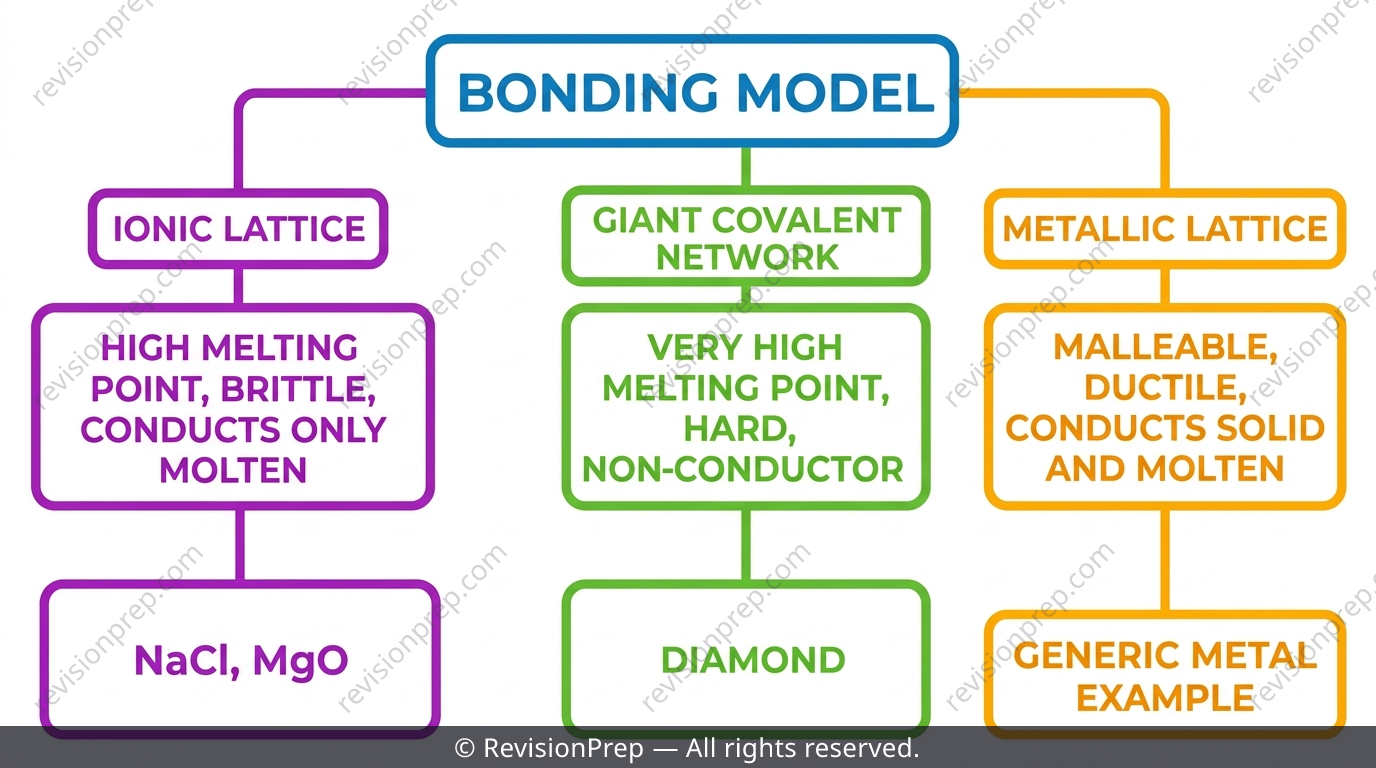
The recurring exam move is to give lattice data — charges, radii, or structure type — and ask which factor controls melting point, solubility or brittleness. NaCl versus MgO melting points, for example, come down entirely to the higher charges in MgO increasing lattice enthalpy through the relationship — molar mass is irrelevant because you're breaking electrostatic bonds, not comparing molecular weight. Brittleness is explained by like-charge repulsion after shearing, not by 'weak bonds', since ionic bonds are actually very strong, just non-directional.
Exam tip
For property-comparison questions, identify the structure type first, then apply the single Coulombic relationship — don't invent a fresh explanation for melting point versus solubility versus lattice enthalpy; it's the same idea every time.
Mini summary
Every property-prediction question reduces to identifying structure type, then applying the same Coulombic or bonding-model logic.
Quick formula sheet
Practice questions
- Define coordination number and explain what determines its value in an ionic lattice.
- State whether NaCl-type and CsCl-type structures have their ions touching along the edge or the body diagonal of the unit cell.
- Explain why metals can conduct electricity in both the solid and molten states.
- MgO and NaCl both adopt the rock-salt structure. Explain why MgO has a much higher melting point.
- Use VSEPR theory to predict the shape and approximate bond angle of a central atom with 4 electron domains, one of which is a lone pair.
- Explain, using the shearing of ion planes, why ionic solids are hard but brittle rather than malleable.
- An ionic lattice has anions in a simple cubic array with one cation at the body centre. Derive the coordination number of the cation from this geometry and justify your reasoning.
- Using the Born-Haber cycle terms, explain why lattice enthalpy is subtracted rather than added when calculating enthalpy of formation.
- Explain, using sigma and pi bonding, why rotation is restricted around a carbon-carbon double bond but not around a carbon-carbon single bond.
Frequently asked questions
Why do IB exams treat ionic, covalent and metallic bonding as a continuum?+
Because real bonds rarely sit exactly at the pure ionic or pure covalent extreme — compounds like Al–Cl have partial covalent character even though they're usually labelled ionic. HL questions ask you to justify where a bond sits on that spectrum.
How do I find the coordination number of an ion in a lattice?+
Either count the nearest oppositely-charged neighbours from the described geometry, or apply the radius ratio rule to . Never assume it's 6:6 just because rock-salt is the most familiar structure.
Why are ionic solids brittle if the bonds are strong?+
The bonds are strong but non-directional. Shearing slides one plane of ions past another, and like-charge ions can end up adjacent — the resulting repulsion shatters the crystal, unlike the sliding planes in a metal.
Does a low melting point mean covalent bonds are weak?+
No. A low melting point in a covalent substance usually means you're breaking weak intermolecular forces between separate molecules, not the covalent bonds themselves. Giant covalent networks like diamond have very high melting points because the bonds span the whole crystal.
What's the difference between the rock-salt and caesium chloride edge-length formulas?+
In rock-salt, ions touch along the unit cell edge, so . In CsCl, the cation sits at the body centre and touches anions along the body diagonal, so . Identify the structure before choosing the formula.
How does the metallic model explain conductivity?+
Delocalised valence electrons belong to the whole lattice, not individual atoms, so they can move freely under an applied electric field in both the solid and molten states, with no need to melt first.
Master every bonding model with the full RevisionPrep notes
Related articles