
Reactivity: How Much, How Fast, and How Far?
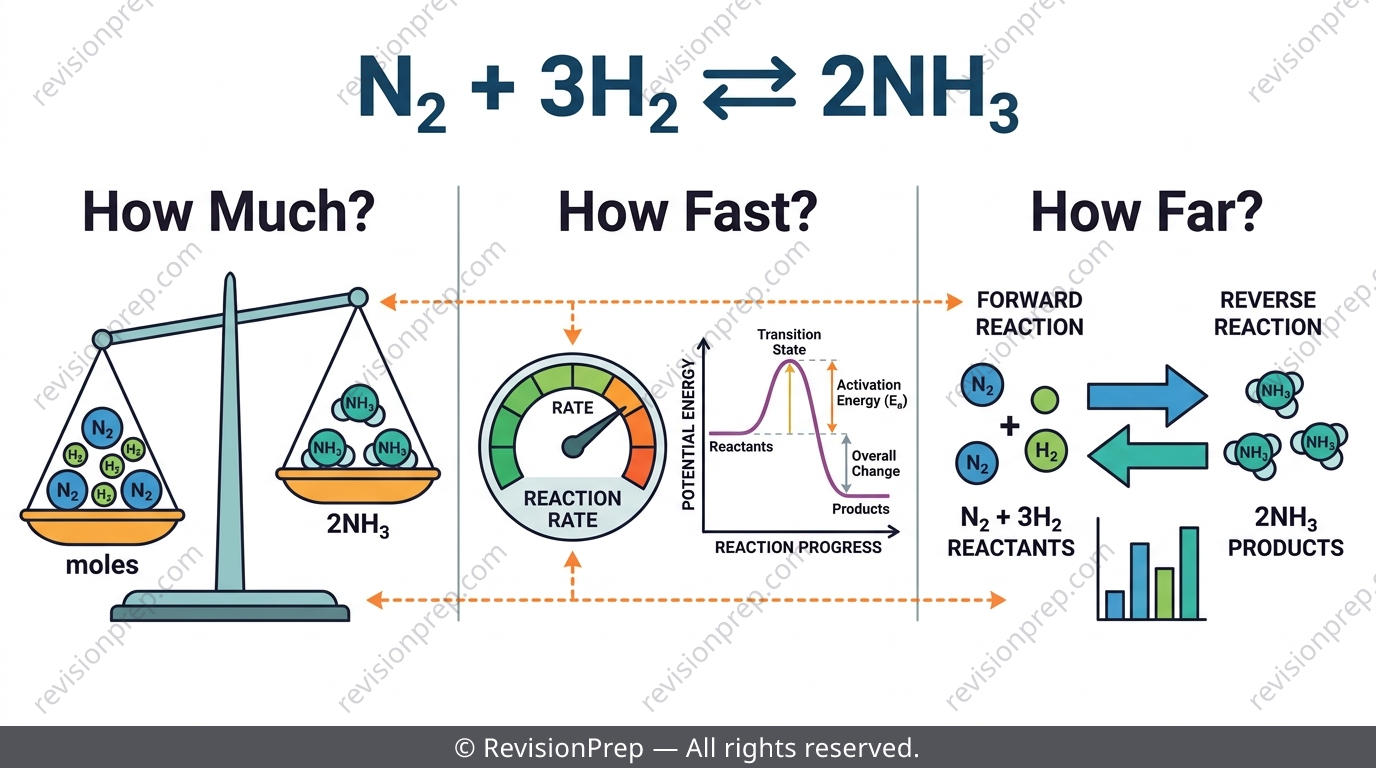
The three lenses examiners use on every single reaction: stoichiometry, kinetics, and equilibrium.
Quick facts
IB DP Chemistry loves to test the same reaction from three angles in one question: how much product actually forms, how fast it forms, and how far the reaction goes before it settles down. This is the Reactivity strand — stoichiometry (How Much), kinetics (How Fast), and equilibrium (How Far) — and Kc calculations combined with limiting reagent reasoning are near-guaranteed features of SL and HL exams. Students lose easy marks not from bad chemistry but from mixing up 'constant' with 'equal,' forgetting to square a coefficient in a Kc expression, or assuming Le Chatelier shifts also change Kc's value. This teaser walks through the five ideas worth locking down first: the three-question framework, limiting reagent and yield, dynamic equilibrium, building an ICE table, and exactly which variable is allowed to change Kc itself. The full revision note covers every worked example and trap in detail.
What you’ll be able to do
Three Questions, One Reaction
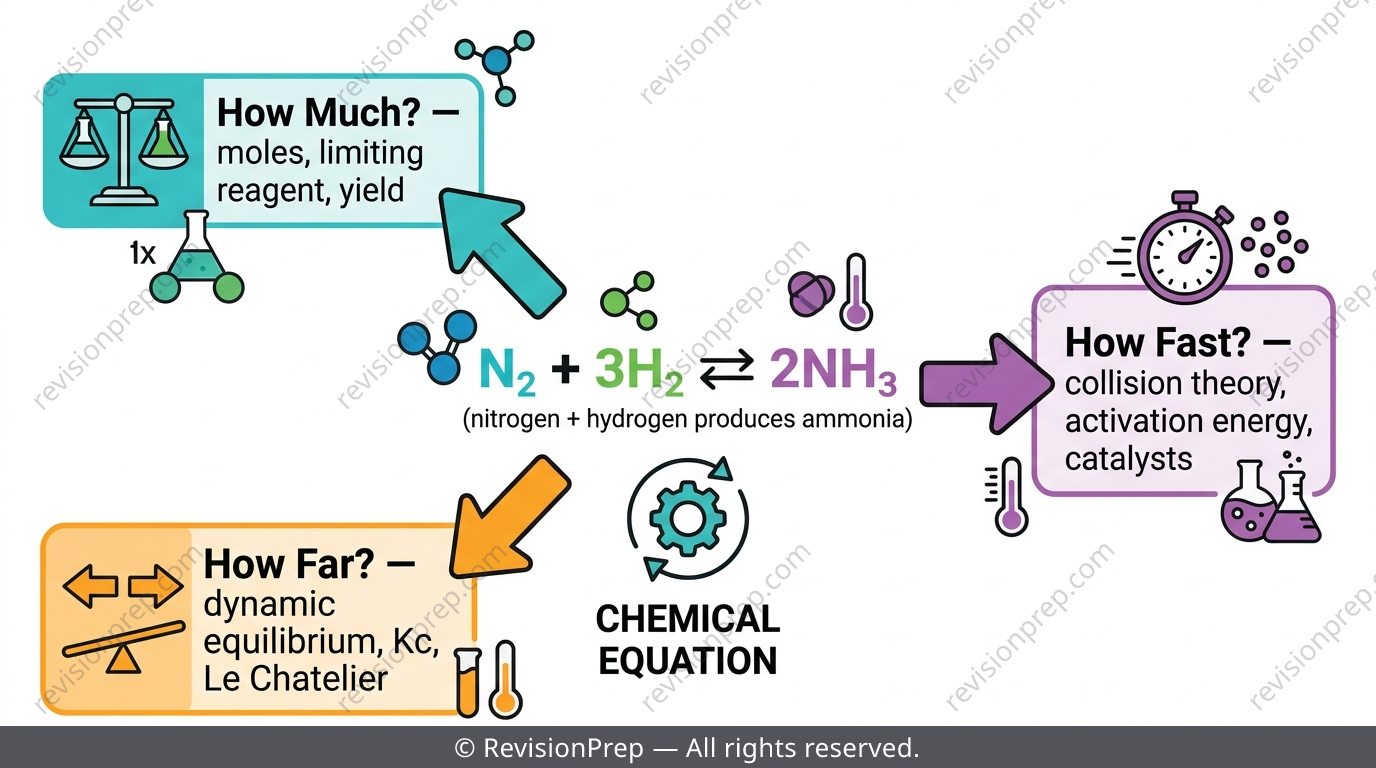
Every reaction can be interrogated the same three ways: how much product forms (stoichiometry), how fast it forms (kinetics), and how far it goes before stopping (equilibrium). These aren't separate topics in isolation — examiners routinely ask about all three within a single multi-part question on one reaction, such as a methanol synthesis question moving from limiting reagent to rate to Kc. Temperature is the one variable that genuinely touches all three, since it changes Kc, reshapes the energy distribution driving rate, and (HL) appears in the Arrhenius equation.
Exam tip
When you see a long-answer question, expect it to cycle through 'how much,' 'how fast,' and 'how far' on the same equation — read every part before starting your working.
Mini summary
Stoichiometry, kinetics, and equilibrium are three lenses applied to the same chemical reaction.
How Much: Limiting Reagent, Yield, and Atom Economy
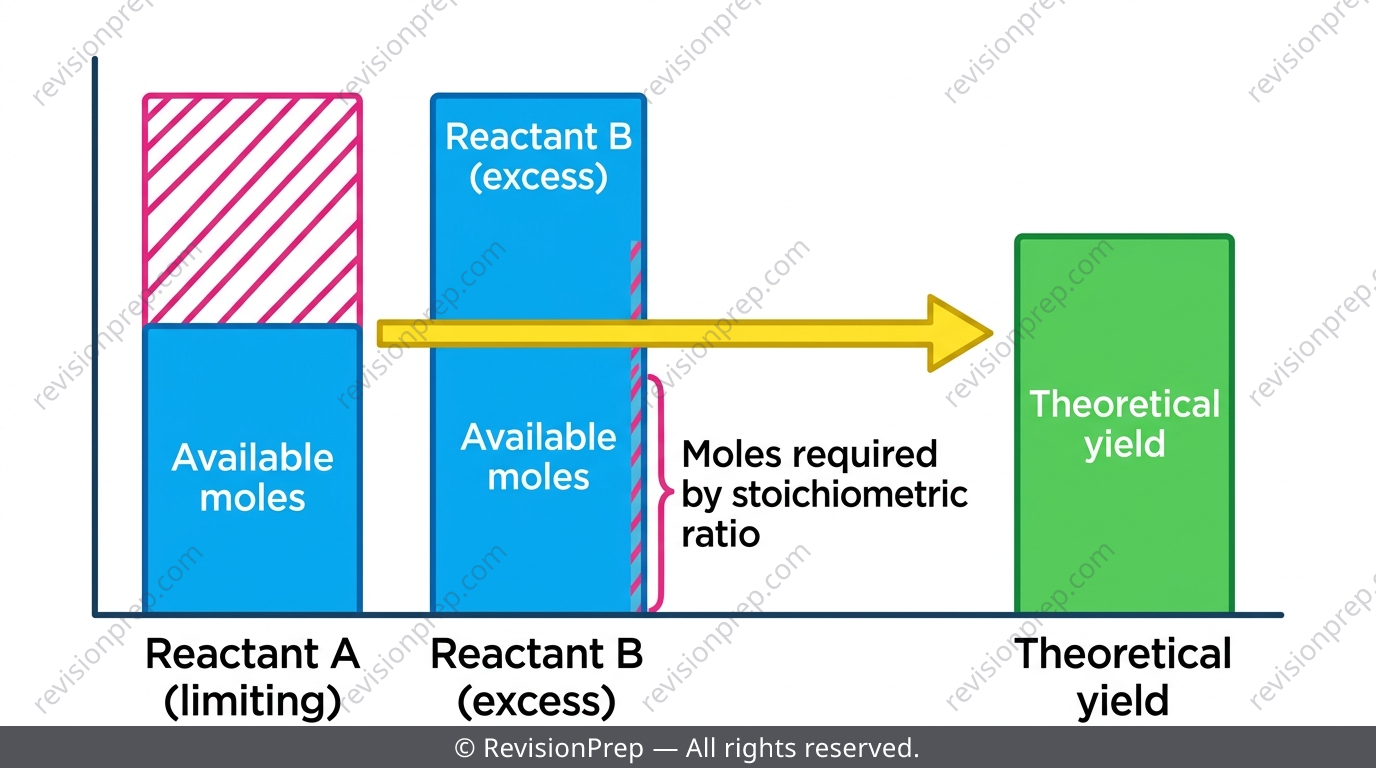
A balanced equation gives mole ratios only — it says nothing about the actual amounts you're given. Real mixtures are almost never in exact stoichiometric ratio, so one reactant runs out first (the limiting reagent) while the other is left over (in excess); the limiting reagent, not the one you have most of, sets the maximum possible product. Theoretical yield assumes 100% conversion with no losses, while actual yield is always less due to incomplete reactions, side products, or losses during purification. Atom economy is fixed by the reaction pathway itself, whereas percentage yield reflects how well the reaction was actually carried out.
Common mistake
Assuming the reactant you have the most moles of must be in excess — always compare against the required mole ratio, not raw quantity.
Mini summary
Limiting reagent caps product amount; theoretical yield is the ceiling, actual yield and percentage yield measure real-world performance.
How Far: Dynamic Equilibrium and Le Chatelier's Principle
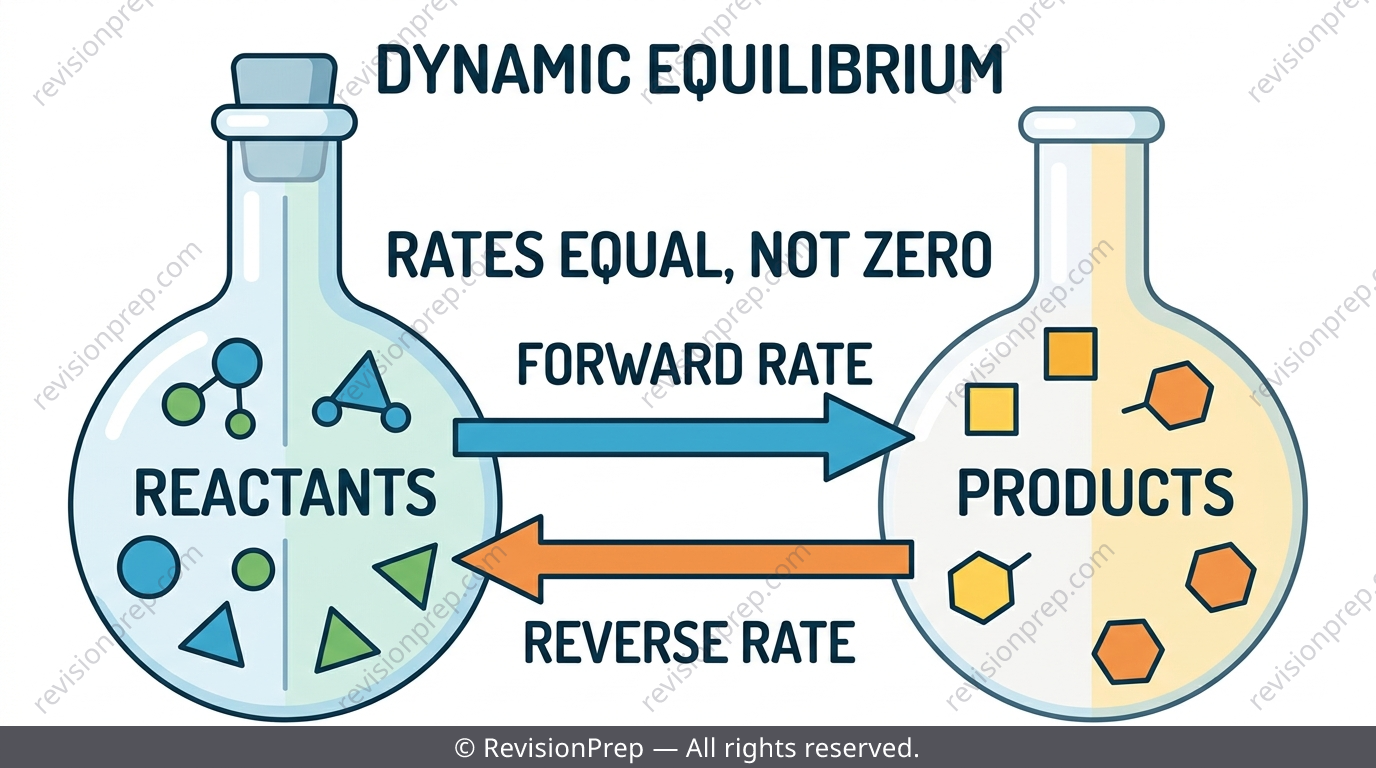
A reversible reaction (⇌) in a closed system settles into dynamic equilibrium, where forward and reverse rates become equal, not zero — the reaction hasn't stopped, it just looks static macroscopically. Concentrations stay constant at equilibrium but are almost never equal to each other, a distinction that gets confused constantly in exam answers. Equilibrium can be reached from either direction — starting from pure reactants, pure products, or any mixture gives the same Kc at a given temperature. Le Chatelier's principle predicts that a change in concentration, pressure/volume, or temperature shifts the position of equilibrium to partially counteract that change.
Common mistake
Confusing 'constant' concentrations with 'equal' concentrations at equilibrium — they are rarely the same value.
Mini summary
At dynamic equilibrium, forward and reverse rates are equal, concentrations stop changing, and the same Kc is reached regardless of starting point.
Writing Kc and Building an ICE Table
For , , with all concentrations measured at equilibrium. Pure solids and separate pure liquid phases are omitted, but homogeneous liquid solutes dissolved in the mixture are included — treating every species written as (l) as automatically excluded is a classic mistake that changes both the expression and the numerical answer. Units of Kc depend on , so recalculate them fresh for every reaction rather than assuming mol dm⁻³. An ICE table (Initial, Change, Equilibrium) is the universal method, but the Change row must be scaled by each species' own stoichiometric coefficient, not treated as the same value x for everything.
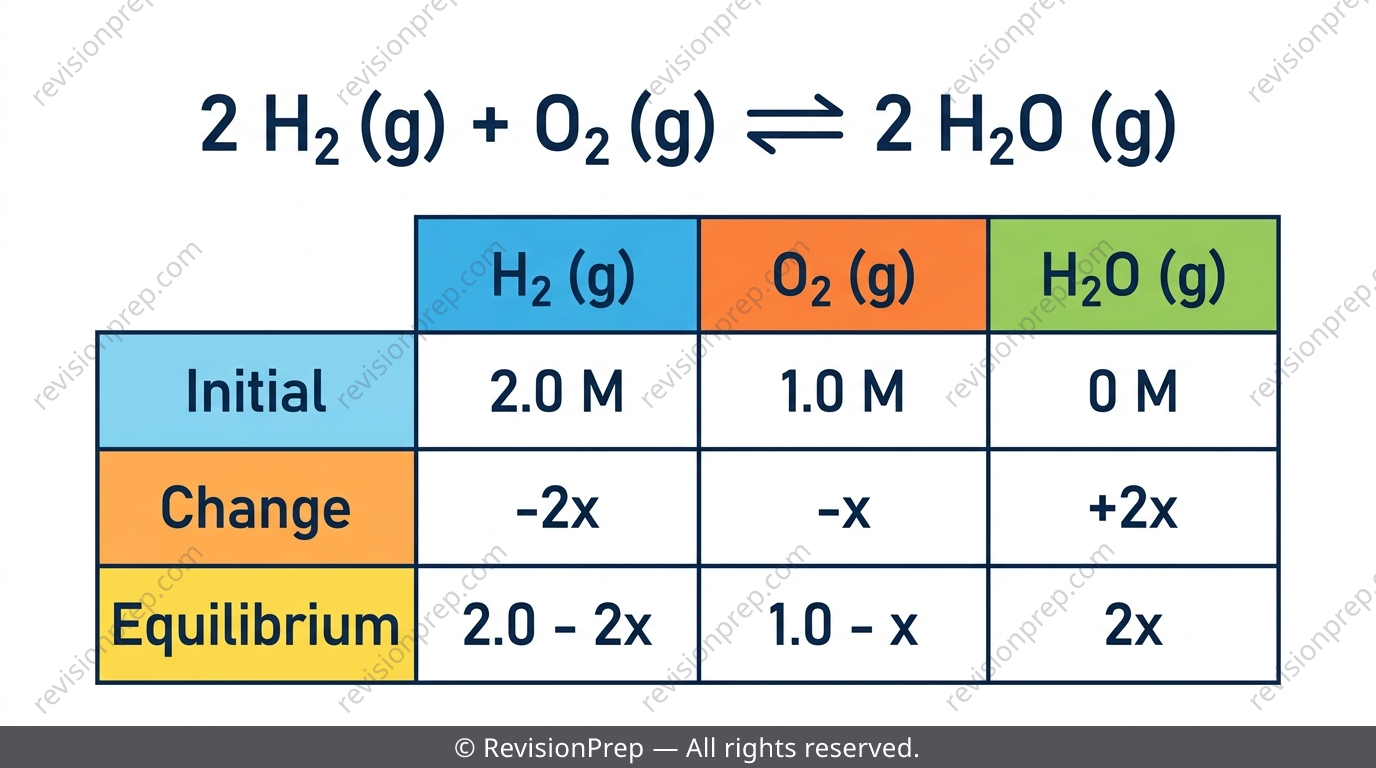
| Row | What goes here |
|---|---|
| Initial | Concentrations given in the question, before reaction |
| Change | ±x scaled by each species' stoichiometric coefficient |
| Equilibrium | Initial ± Change, substituted into the Kc expression |
Exam tip
Write the balanced equation directly above the ICE table and multiply each Change entry by its own coefficient before doing any arithmetic.
Mini summary
Kc is products over reactants raised to coefficients; ICE tables organise the arithmetic, and units must be recalculated for each reaction.
Only Temperature Changes Kc
Concentration, pressure, and catalysts can all shift the position of equilibrium or the route taken to reach it, but none of them change the numerical value of Kc at a given temperature — only temperature does that. A large Kc means the equilibrium mixture favours products, but it says absolutely nothing about how quickly that equilibrium is reached, since Kc is about extent, not speed. Rate itself (How Fast) is governed by collision theory, activation energy, and catalysts, which is why a reaction can have a huge Kc yet still be too slow to observe without heating or a catalyst.
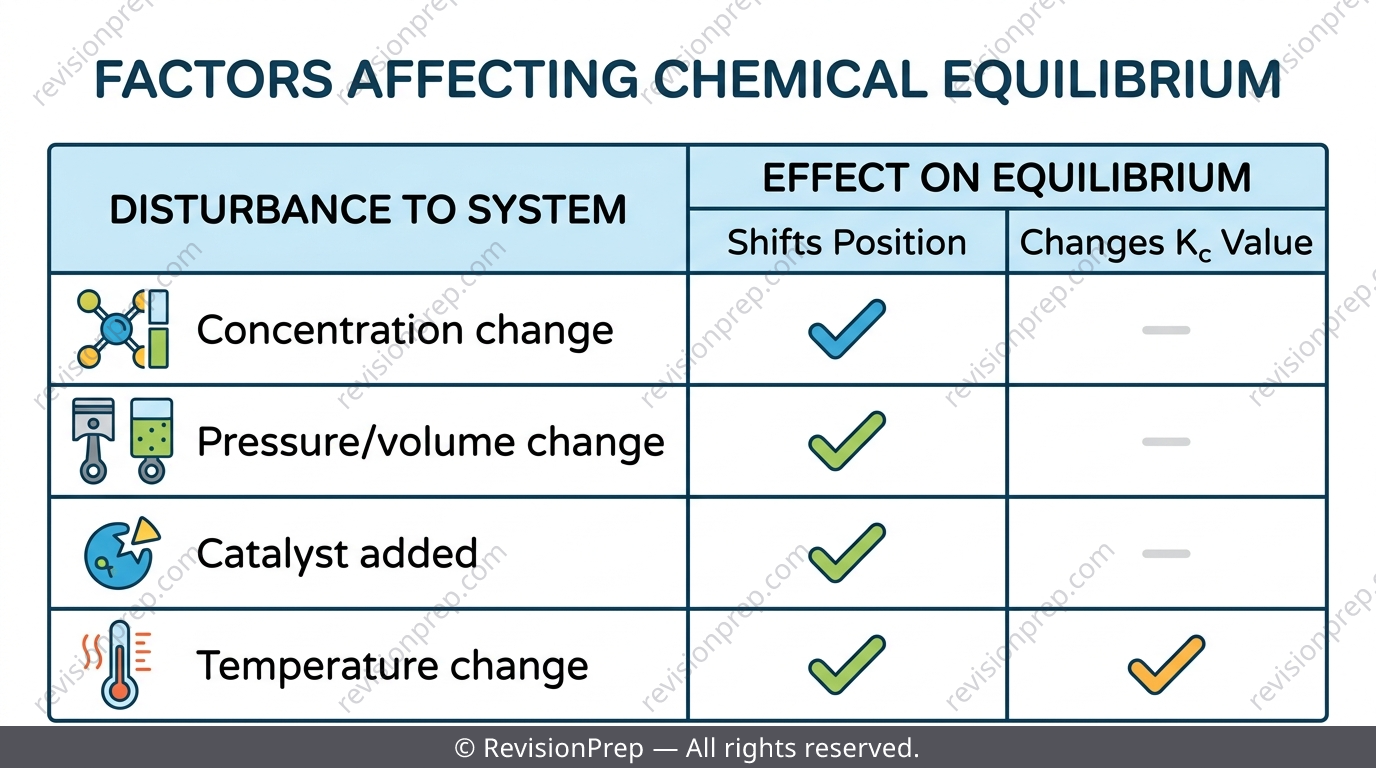
Common mistake
Saying 'Kc stays the same but the position shifts' for a temperature change — that rule only applies to concentration or pressure changes at constant temperature.
Mini summary
Concentration, pressure, and catalysts shift equilibrium position only; temperature is the sole variable that changes Kc's value.
Quick formula sheet
Practice questions
- Define dynamic equilibrium, making clear why forward and reverse rates are equal rather than zero.
- Write the Kc expression for .
- State two variables that shift the position of equilibrium but do not change the value of Kc.
- 3.00 mol of A and 3.00 mol of B are mixed in a 1.00 dm³ container: . At equilibrium, 2.00 mol of C is present. Calculate Kc, including units.
- Explain why a pure solid catalyst is excluded from a Kc expression but a dissolved reactant is not, using the idea of separate pure phases.
- For an exothermic forward reaction at equilibrium, predict the effect of increasing temperature on both the equilibrium position and the value of Kc.
- 5.00 mol of CO(g) and 8.00 mol of H₂(g) are placed in a 2.50 dm³ sealed reactor: . At equilibrium, . Set up a full ICE table and calculate Kc with correct units.
- 1.20 mol ethanoic acid and 1.20 mol ethanol are mixed in a 1.00 dm³ flask. At equilibrium, 0.800 mol ethyl ethanoate is present. Calculate Kc, explaining why water and ethanol must both appear in the expression.
- A student claims that because Kc for a reaction is very large, the reaction must reach equilibrium quickly. Evaluate this claim using the distinction between extent and rate.
Frequently asked questions
What is the difference between Kc and Q?+
Kc uses equilibrium concentrations only, while Q uses concentrations at any point in the reaction and is used to predict which direction the system will shift to reach equilibrium.
Does a catalyst change the value of Kc?+
No. A catalyst changes how quickly equilibrium is reached but never changes the value of Kc itself — only temperature does that.
Why are some liquids left out of the Kc expression?+
Only genuinely separate pure phases, like a pure liquid layer or a solid catalyst, are omitted. A liquid dissolved in the reaction mixture, like ethanol or water in an esterification, must still be included.
How do I know which reactant is the limiting reagent?+
Compare the mole ratio you actually have against the mole ratio required by the balanced equation — the reactant that runs out first based on that ratio is limiting, regardless of which one you have more of.
Does a large Kc mean the reaction happens fast?+
No. Kc describes how far a reaction goes (extent), not how fast it gets there (rate) — a reaction can have a huge Kc but still be extremely slow without a catalyst or heating.
Why do I need to recalculate Kc units every time?+
Units of Kc depend on Δn, the difference between total product and reactant mole coefficients, which changes from reaction to reaction — you can never assume mol dm⁻³.
Master Reactivity with the Full IB DP Chemistry Notes
Related articles