
Reactivity: What Are the Mechanisms of Chemical Change?
Proton transfer, electron transfer, radicals and curly arrows — the four ways bonds break, unpacked for Paper 1 and Paper 2.
Quick facts
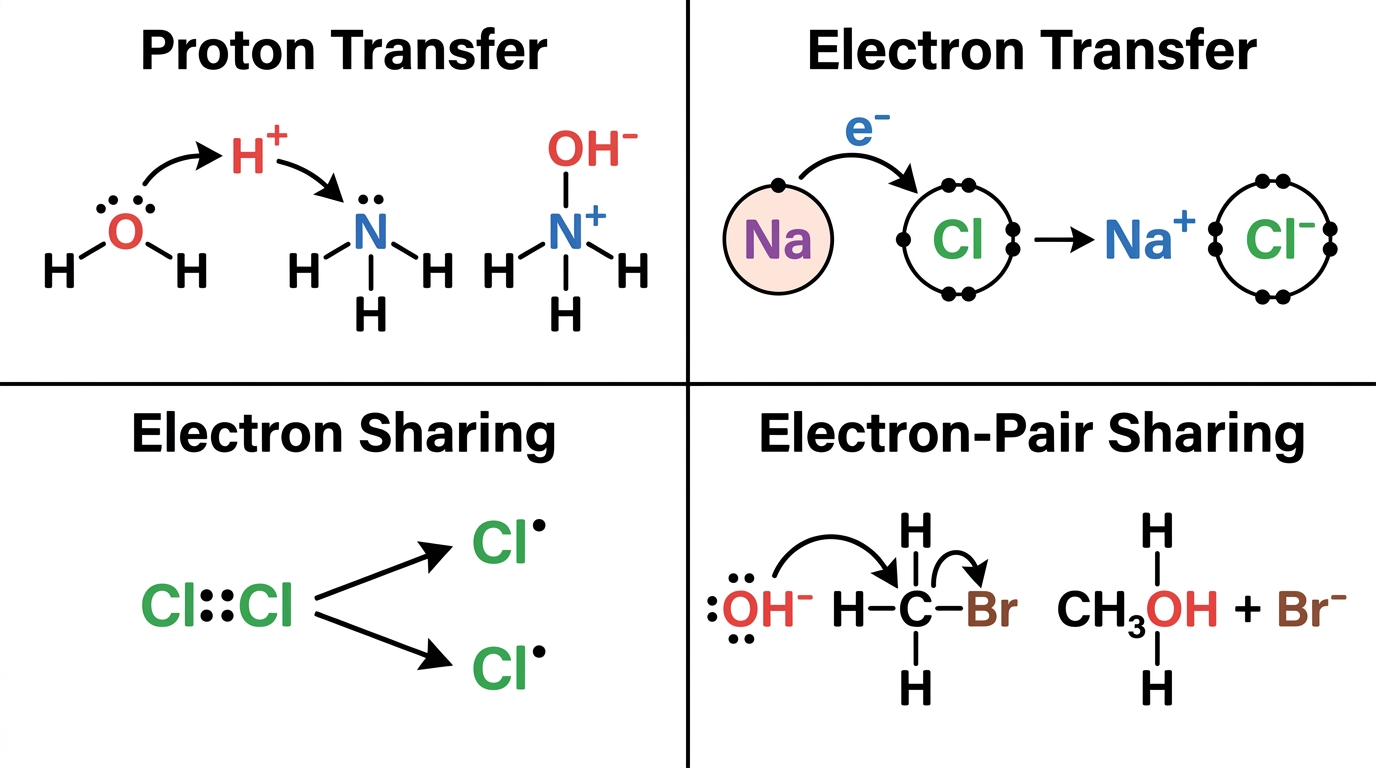
Every chemical reaction can be sorted by one simple question: what actually moves? In IB DP Chemistry's Reactivity 3, that question splits reactions into four families — proton transfer (acid-base chemistry), electron transfer (redox), electron sharing (radicals) and electron-pair sharing (organic mechanisms with curly arrows). Examiners test the same skill in all four: name the moving particle, identify the species correctly (acid, oxidising agent, radical, nucleophile), then explain what happens as a result — a pH change, a colour change, a new product. This teaser walks through the five ideas that appear most often in Paper 1 and Paper 2: Brønsted–Lowry theory, strong vs weak acids, / calculations, oxidation number rules for redox, and the fission types behind radical and organic mechanisms. The full revision notes go much deeper into diagrams, HL extensions and worked traps.
What you’ll be able to do
The Big Picture: Four Mechanisms, One Skill
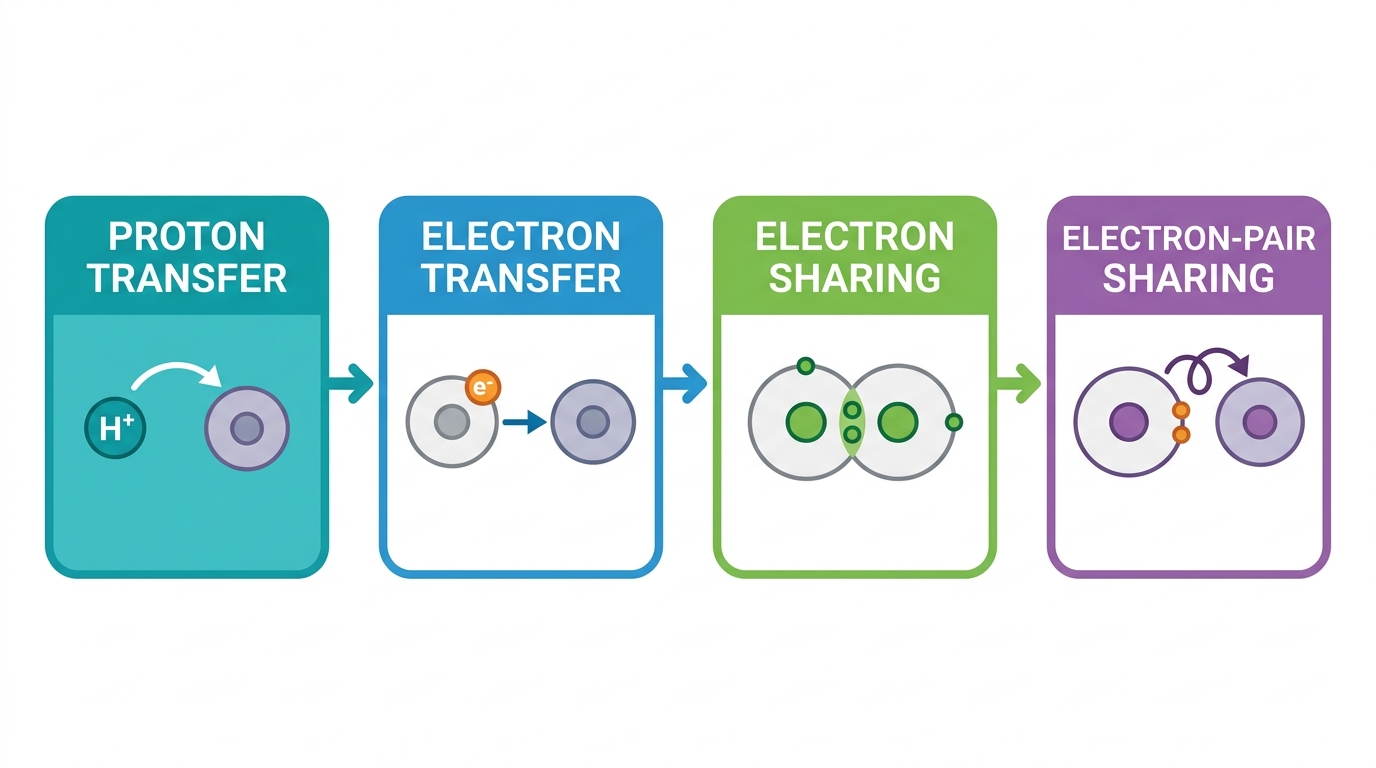
Reactivity 3 groups every mechanism by what particle physically moves. Proton transfer (R3.1) is acid-base chemistry — only moves, oxidation states stay unchanged. Electron transfer (R3.2) is redox — electrons move completely, changing oxidation numbers. Electron sharing (R3.3) involves single unpaired electrons formed by homolytic (symmetric) bond breaking, while electron-pair sharing (R3.4) moves a full electron pair via heterolytic (uneven) bond breaking, shown with curly arrows. The examiner always wants the same three steps: name the moving particle, name the species precisely, then state the consequence.
Exam tip
Command terms like 'deduce', 'identify' and 'state the role of' require the specific species named with reasoning shown — a vague description loses the mark.
Proton Transfer: Acids, Bases and Conjugate Pairs
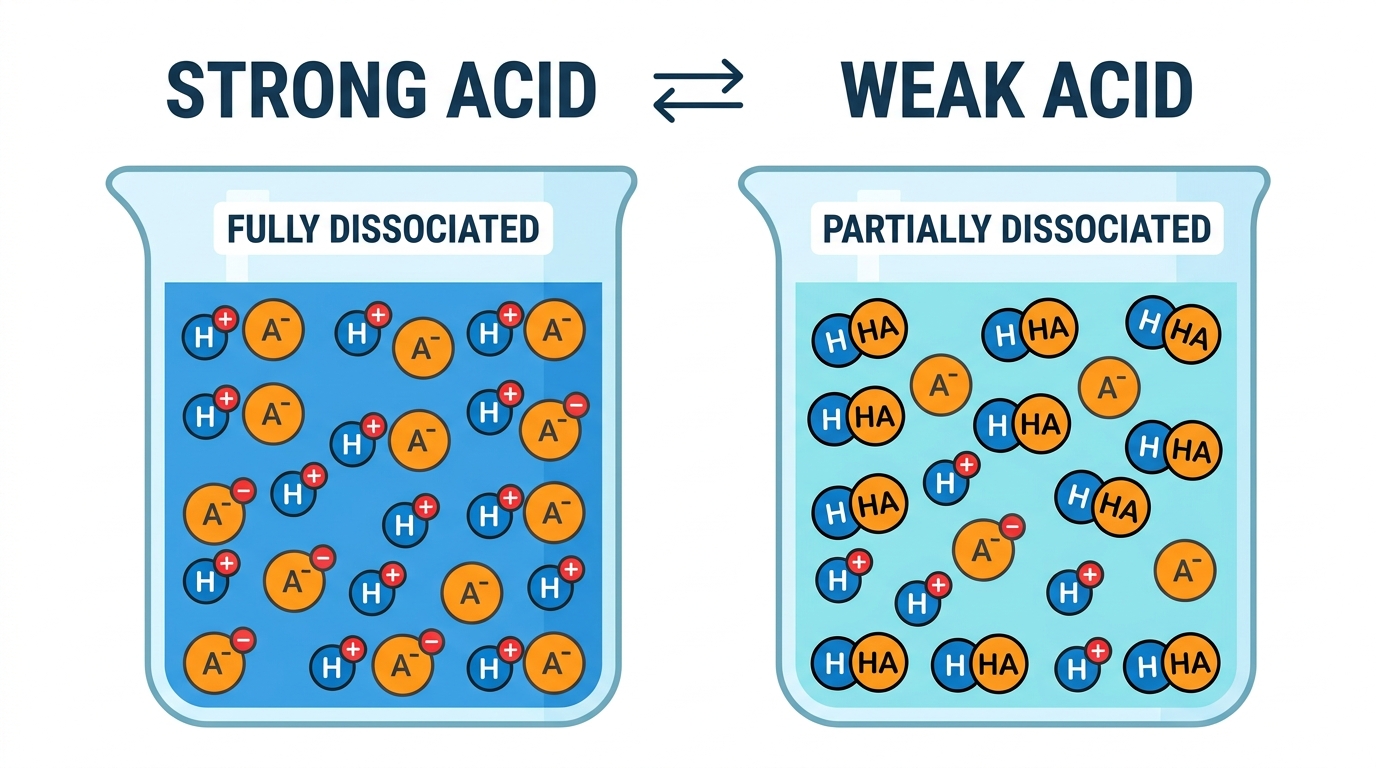
A Brønsted–Lowry acid donates a proton; a base accepts one — nothing about oxidation state changes. Water is amphiprotic, acting as an acid or base depending on its partner. Conjugate acid-base pairs differ by exactly one : conjugate acid = species + , conjugate base = species − . Strong acids/bases dissociate essentially completely, while weak ones only partially dissociate, leaving an equilibrium between molecule and ions — and metal oxides like CaO form basic solutions by reacting with water to make hydroxides, not by releasing directly.
| Property | Strong acid/base | Weak acid/base |
|---|---|---|
| Dissociation | Essentially complete | Partial, equilibrium exists |
| Ion concentration (same conc.) | High | Lower |
| pH (same molar conc.) | Further from 7 | Closer to 7 |
| Conductivity (same molar conc.) | Higher | Lower |
Common mistake
Treating 'strong acid' and 'concentrated acid' as the same idea — a concentrated weak acid does not automatically have a lower pH than a dilute strong acid.
Quantifying Acid Strength: Ka, pKa and pH
pH is calculated from hydrogen ion concentration, and at 298 K, follows from the ionic product of water. For a weak acid HA, measures how far dissociation proceeds — a small (large ) means the equilibrium sits mostly on the undissociated side, i.e. a weak acid, regardless of concentration. The weaker the acid, the stronger its conjugate base holds onto protons.
Exam tip
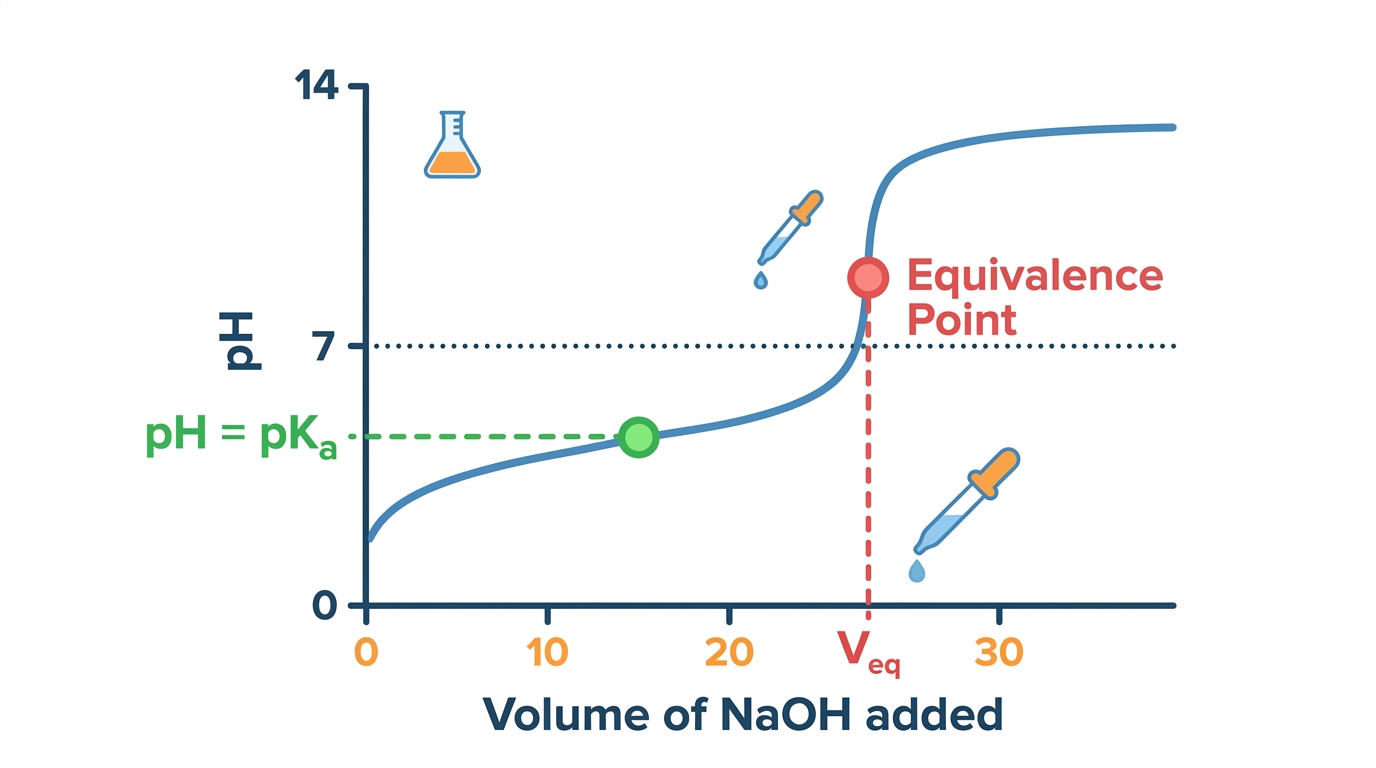
On a titration curve, read at the flat HALF-equivalence point, not the steep equivalence point — this single misread costs the whole mark.
Electron Transfer: Oxidation, Reduction and Agents
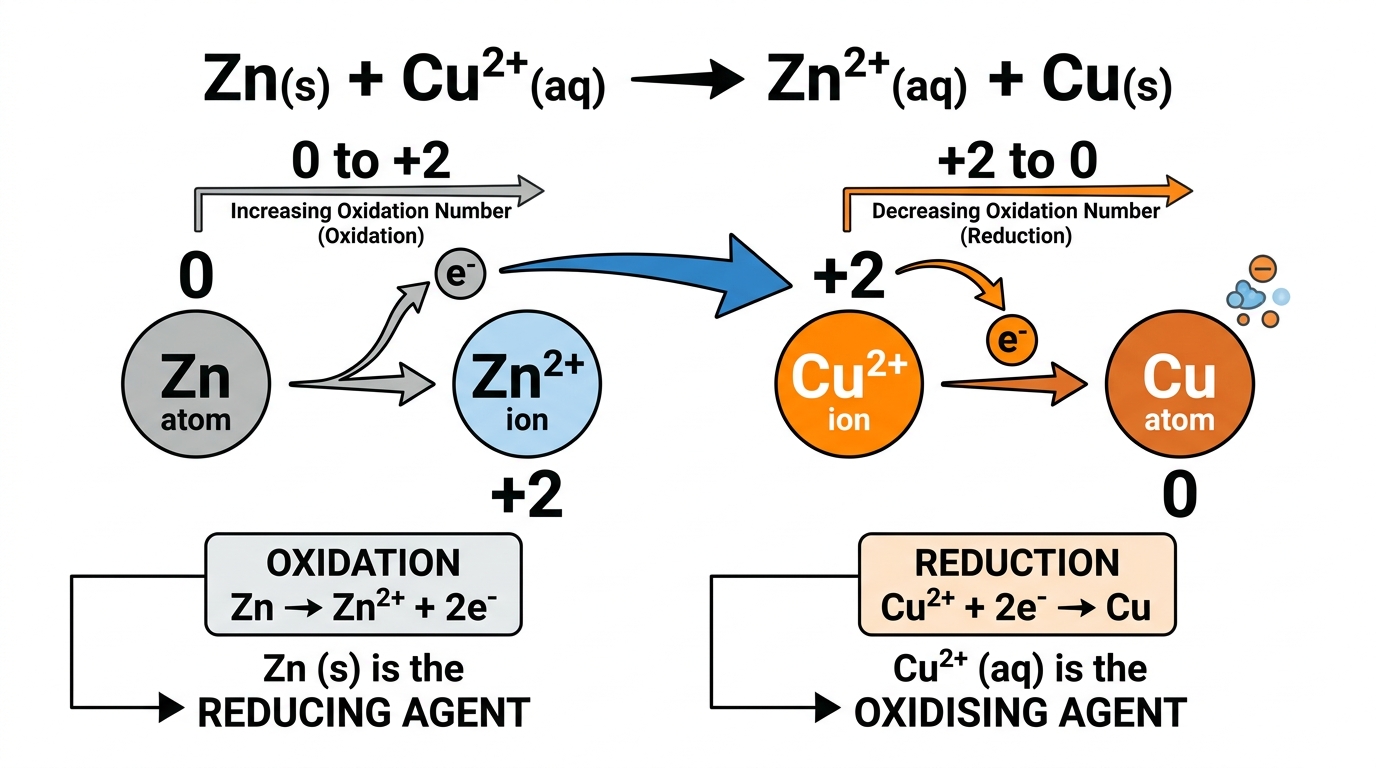
Oxidation is loss of electrons (increase in oxidation number); reduction is gain of electrons (decrease in oxidation number) — and they always happen together. Oxidation numbers follow set rules: uncombined elements are 0, monatomic ions equal their charge, oxygen is usually −2, hydrogen usually +1. The oxidising agent is the species that gets reduced, removing electrons from the other species; the reducing agent is the species that gets oxidised. Voltaic cells convert a spontaneous redox reaction into electrical energy; electrolytic cells use an external supply to force a non-spontaneous one.
Common mistake
Naming the species that is itself oxidised as the 'oxidising agent'. Fix: apply OIL RIG first, then name agents — whatever is reduced is the oxidising agent.
Electron Sharing & Curly Arrows: Radicals, Nucleophiles and Electrophiles
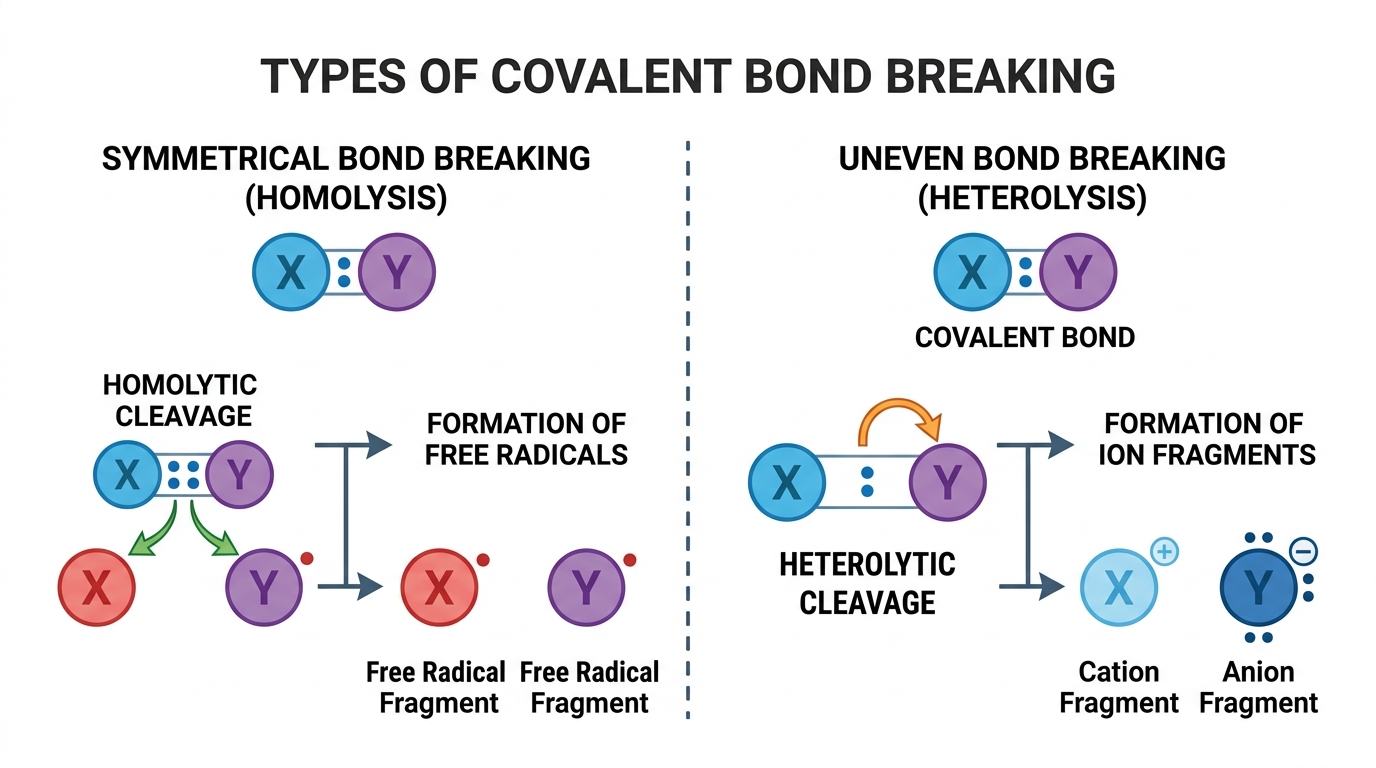
Electron sharing reactions (R3.3) involve homolytic fission — a bond splits symmetrically so each fragment keeps one unpaired electron, forming a radical. This matters for alkanes, which have no polar bonds or lone pairs and so are unreactive except via radical pathways. Electron-pair sharing reactions (R3.4) instead involve heterolytic fission, where a bond splits unevenly and a full electron pair moves together — the basis of nucleophile/electrophile mechanisms shown with curly arrows in organic chemistry.
Mini summary
Homolytic fission → two radicals (one electron each). Heterolytic fission → an ion pair (both electrons go to one fragment), the starting point for curly-arrow mechanisms.
Quick formula sheet
Practice questions
- State the Brønsted–Lowry definitions of an acid and a base.
- Give the oxidation number of oxygen in H2O2 and explain why it differs from its usual value.
- Identify the moving particle in a proton transfer reaction versus an electron transfer reaction.
- Write the conjugate base of HSO4- and the conjugate acid of NH3.
- For the reaction Mg(s) + 2HCl(aq) → MgCl2(aq) + H2(g), identify the oxidising agent and justify using oxidation numbers.
- Explain why a 0.10 mol dm-3 solution of ethanoic acid has a higher pH than a 0.10 mol dm-3 solution of hydrochloric acid.
- Using a sketched titration curve for a weak acid titrated with a strong base, explain how you would determine pKa and justify your chosen point.
- Compare homolytic and heterolytic fission in terms of the products formed and the type of reagent likely to trigger each.
- Explain why basic metal oxides like MgO produce alkaline solutions without directly releasing hydroxide or accepting protons themselves as the primary step.
Frequently asked questions
What is the difference between proton transfer and electron transfer reactions?+
Proton transfer (acid-base) reactions only move H+ between species with no change in oxidation number. Electron transfer (redox) reactions move electrons completely between species, changing oxidation numbers.
How do you identify the oxidising agent in a redox reaction?+
Track oxidation number changes for both species. The oxidising agent is the species that gets reduced (oxidation number decreases) — it is not the species being oxidised.
What is a conjugate acid-base pair?+
Two species differing by exactly one H+, such as CH3COOH and CH3COO-. The conjugate acid has one more H+ than the conjugate base.
Why do a strong acid and weak acid at the same concentration have different pH?+
Concentration tells you how much acid was dissolved, but strength (extent of dissociation) tells you how many ions actually form. A strong acid dissociates fully, producing more H+ and a lower pH than a weak acid at the same concentration.
What is homolytic fission?+
Homolytic fission is symmetric bond breaking where each fragment keeps one electron from the shared pair, forming two radicals with unpaired electrons.
How do you find pKa from a titration curve?+
Locate the half-equivalence point (where half the acid has reacted) — the pH at that point equals the pKa, not the pH at the steep equivalence point.
Master every Reactivity 3 mechanism before your next exam
Related articles