
Reactivity: How Much, How Fast, and How Far?
Untangling equilibrium, stoichiometry and rate for IB Chemistry HL
Quick facts
IB Chemistry loves to test three very different questions under one topic heading: how far a reaction goes, how much product forms, and how fast it gets there. Students constantly mix these up — assuming a huge Kc means a fast reaction, or that the smaller mass given in a question must be the limiting reagent. This teaser breaks down the five ideas examiners hit hardest at HL: the Kc/Qc expression, why only temperature changes Kc, the two-stage logic behind Le Chatelier compression questions, finding the true limiting reagent, and the crucial difference between percentage yield and atom economy. Get these five straight and you've covered the backbone of Reactivity 2 questions on Paper 2. The full revision notes go further with ICE tables, Arrhenius graphs and fully worked numerical examples.
What you’ll be able to do
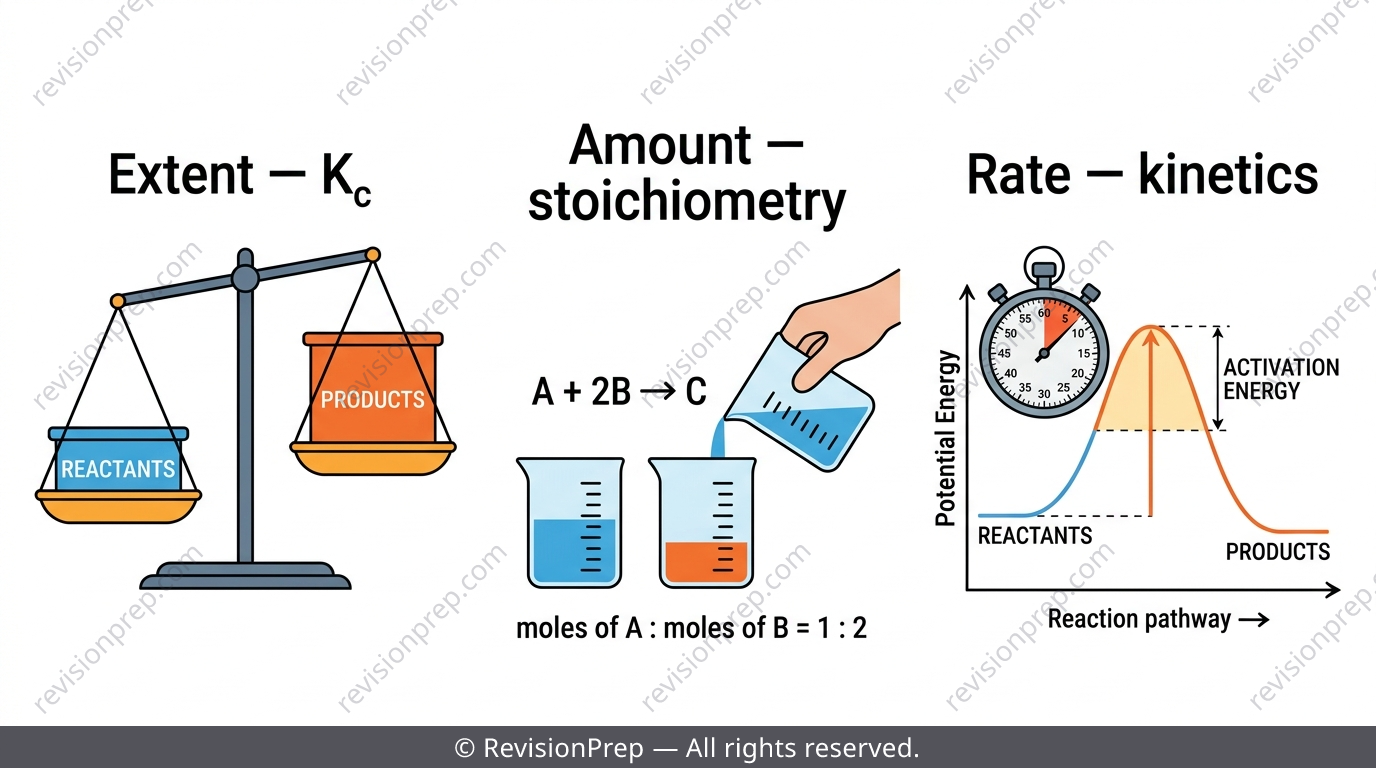
Extent, Amount and Rate: Three Separate Questions
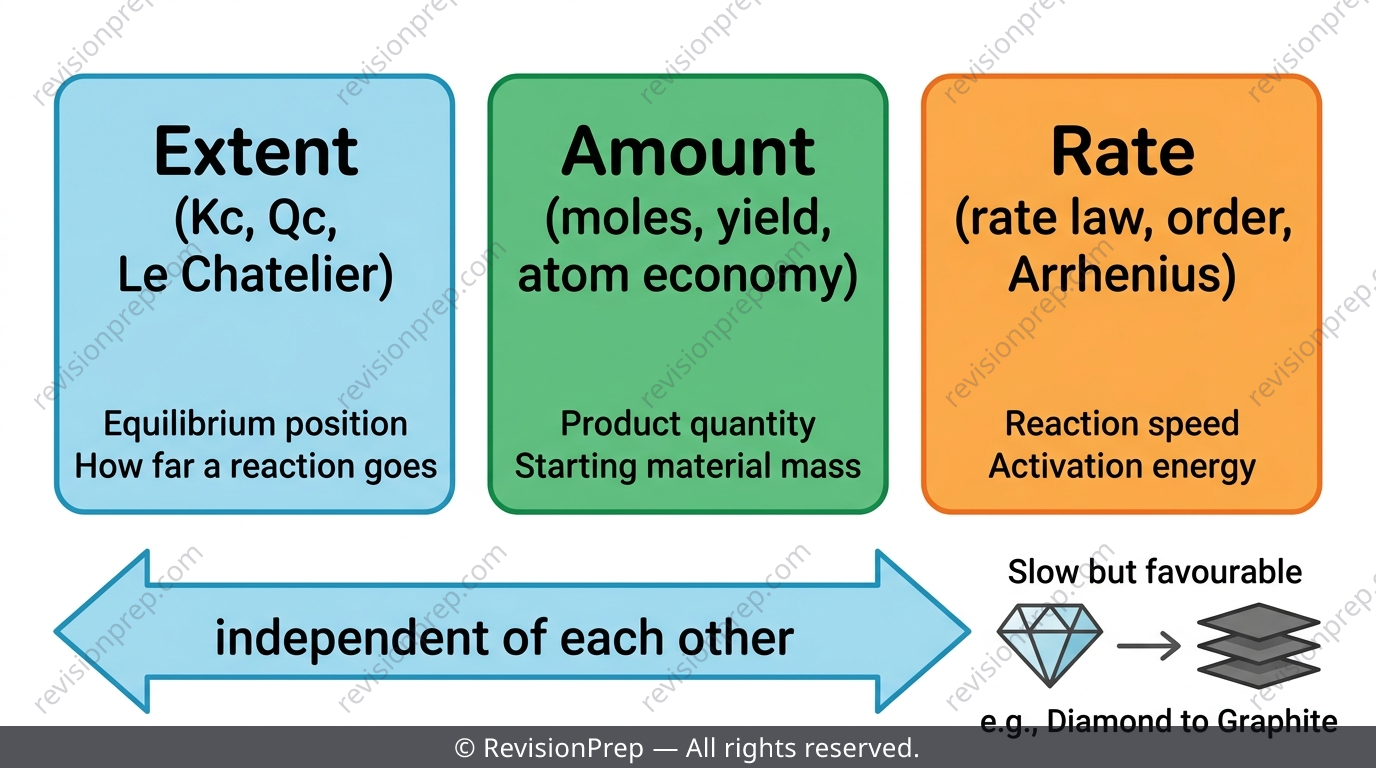
Every reactivity question in IB Chemistry falls into one of three boxes: extent (Kc, Qc, Le Chatelier), amount (stoichiometry, yield, atom economy) or rate (rate law, order, Arrhenius). These are independent — a reaction can be fast with a tiny equilibrium constant, or thermodynamically favourable yet kinetically dead slow, like diamond turning into graphite. HL adds the numerical machinery to all three: ICE tables for Kc, integrated rate laws, and the linear Arrhenius equation, while SL stays qualitative throughout.
Exam tip
If a question asks 'will this reaction happen' vs 'how quickly', check which of the three boxes it's actually testing before reaching for a formula.
Mini summary
Extent, amount and rate answer completely different questions — never assume one tells you about another.
Dynamic Equilibrium, Kc and Qc
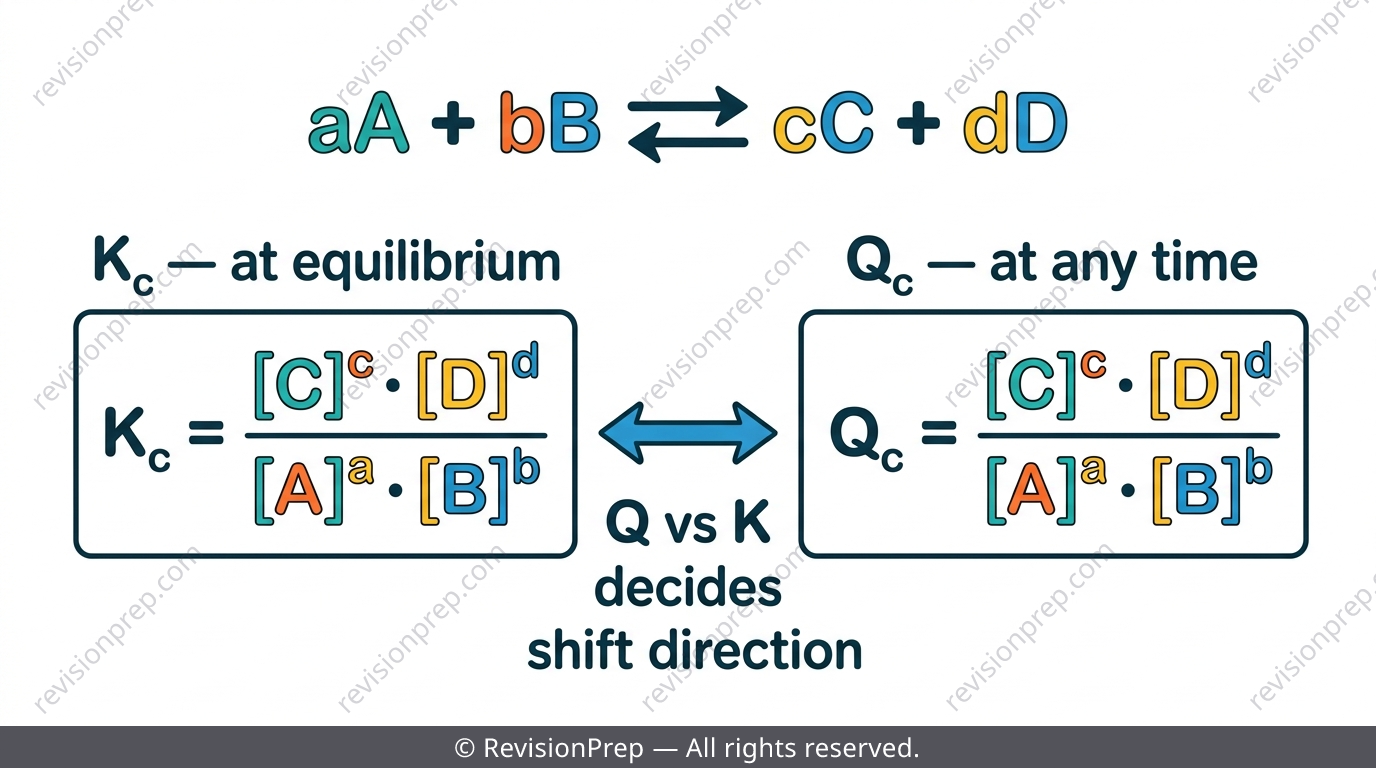
In a closed system, dynamic equilibrium means the forward and reverse reactions run at equal rates, so macroscopic concentrations stop changing — but reactants and products keep interconverting. uses equilibrium concentrations in the general expression, while uses the same expression at any point in the reaction, so comparing to tells you which way the system still needs to shift. Solids and pure liquids never appear in the expression because their effective concentration is constant.
| Term | Uses concentrations at... | Tells you |
|---|---|---|
| Kc | equilibrium only | position of equilibrium at a fixed T |
| Qc | any point in the reaction | direction still to travel toward equilibrium |
Exam tip
Memorise the direction rule as 'Q too big → too much product → shift left' — mixing up this inequality is the single most common error on this topic.
Common mistake
Writing units on Kc out of habit — always check first; if , Kc has no units.
Mini summary
Kc and Qc share one expression — Kc is the equilibrium snapshot, Qc is the anytime snapshot.
Le Chatelier's Principle vs the Value of Kc
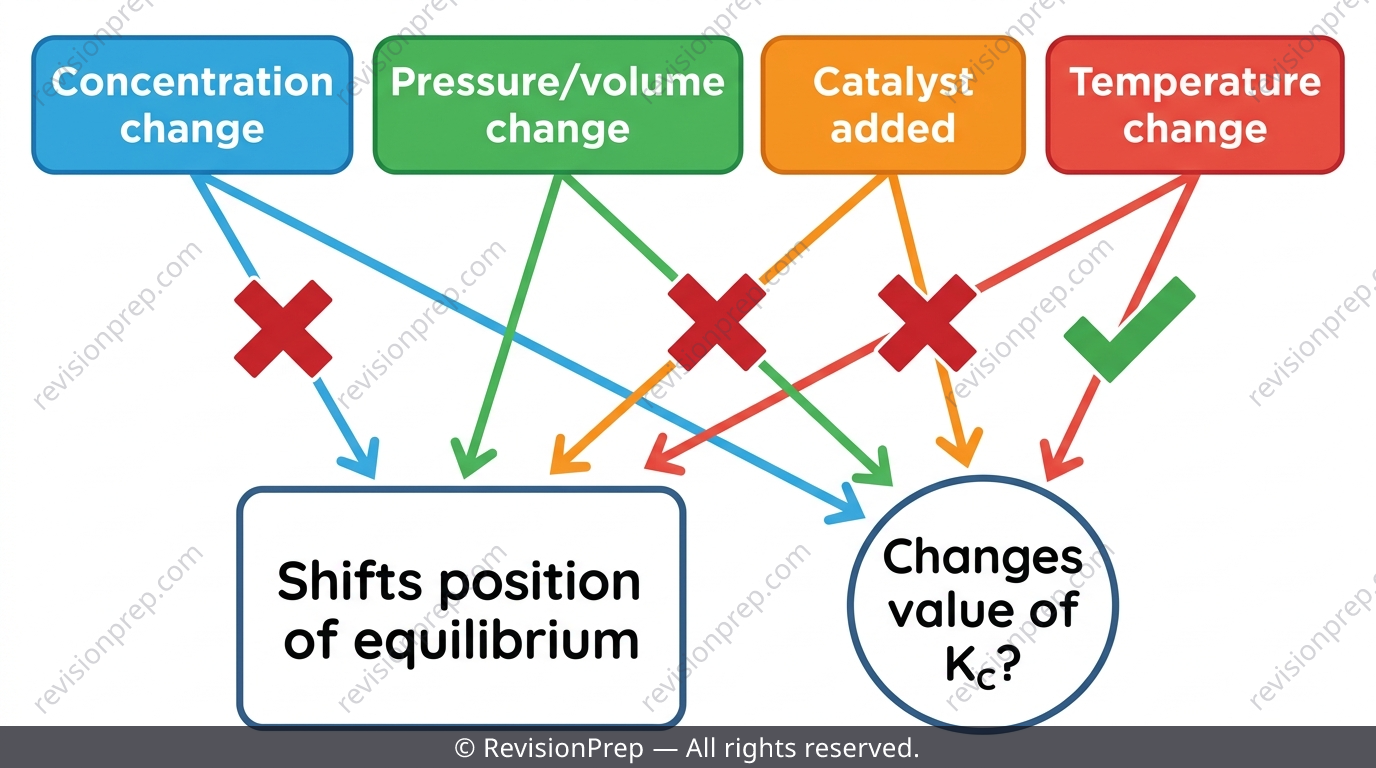
This is the HL distinction examiners hunt for: only a change in temperature alters the actual value of . Concentration, pressure/volume changes and catalysts can shift the position of equilibrium — which side has more stuff — and change how quickly equilibrium is reached, but the ratio itself stays fixed at constant temperature. Compression or addition questions always have two stages worth separate marks: the instant-after concentrations (before any reaction occurs) and the new equilibrium concentrations after the shift.
Exam tip
Report both the instant-after state and the final shifted state in compression/addition questions — markschemes award points for each stage separately.
Common mistake
Treating a pressure, concentration or catalyst change as something that changes Kc — lock in that only temperature does this.
Mini summary
Kc changes with temperature only; everything else just changes how equilibrium is reached, not the constant itself.
Stoichiometry: Finding the Real Limiting Reagent
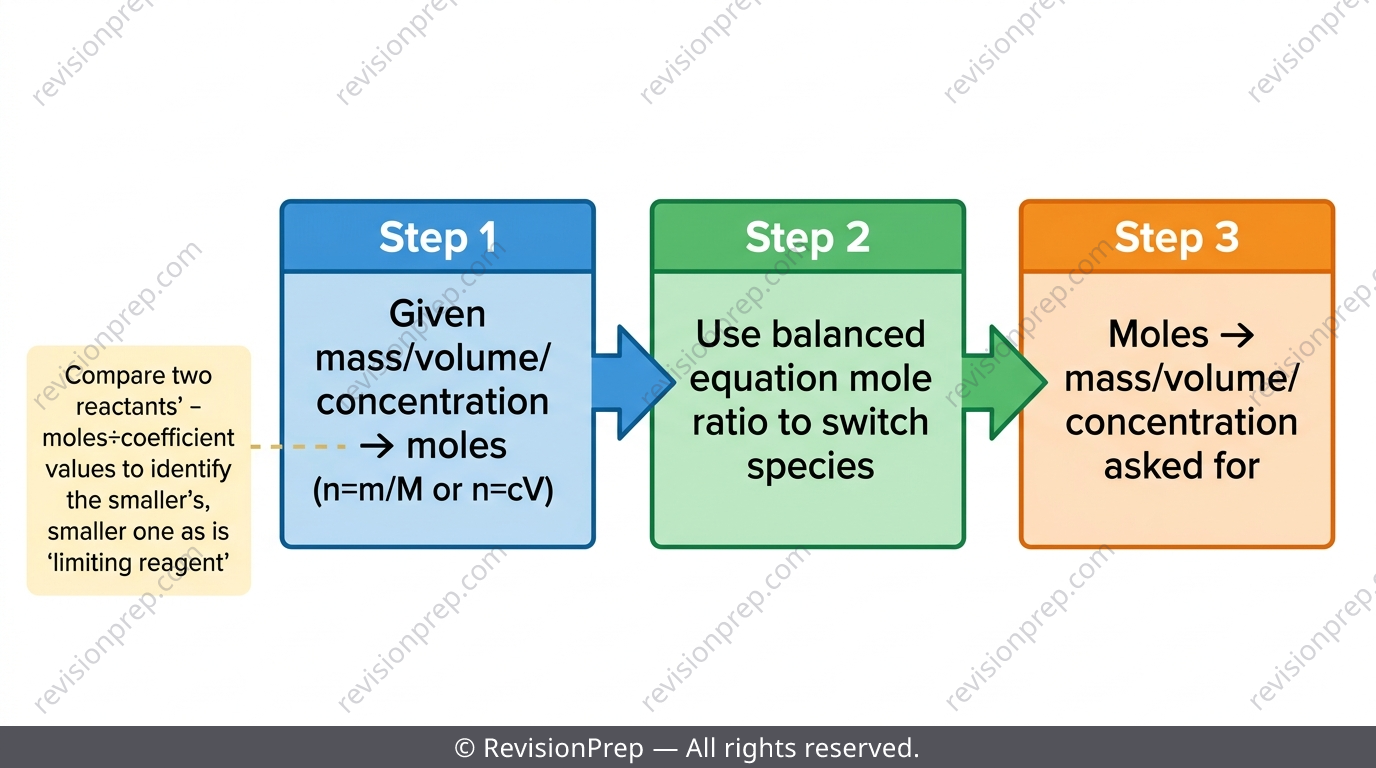
Every stoichiometry question follows the same three moves: convert what you're given into moles, use the balanced equation's ratio to jump between species, then convert back into mass, volume or concentration as the question asks. The limiting reagent is whichever reactant runs out first and fixes the maximum possible product — you find it by comparing moles divided by coefficient for each reactant, never by comparing raw starting masses.
Exam tip
For gas-law questions, convert pressure to Pa and volume to m³ before substituting — unit mismatches are a frequent silent mark loss.
Common mistake
Assuming the reactant with the smaller mass in grams is automatically limiting — mass alone means nothing without molar mass and stoichiometric ratio.
Mini summary
Moles ÷ coefficient, not raw mass, identifies the limiting reagent every time.
Percentage Yield vs Atom Economy
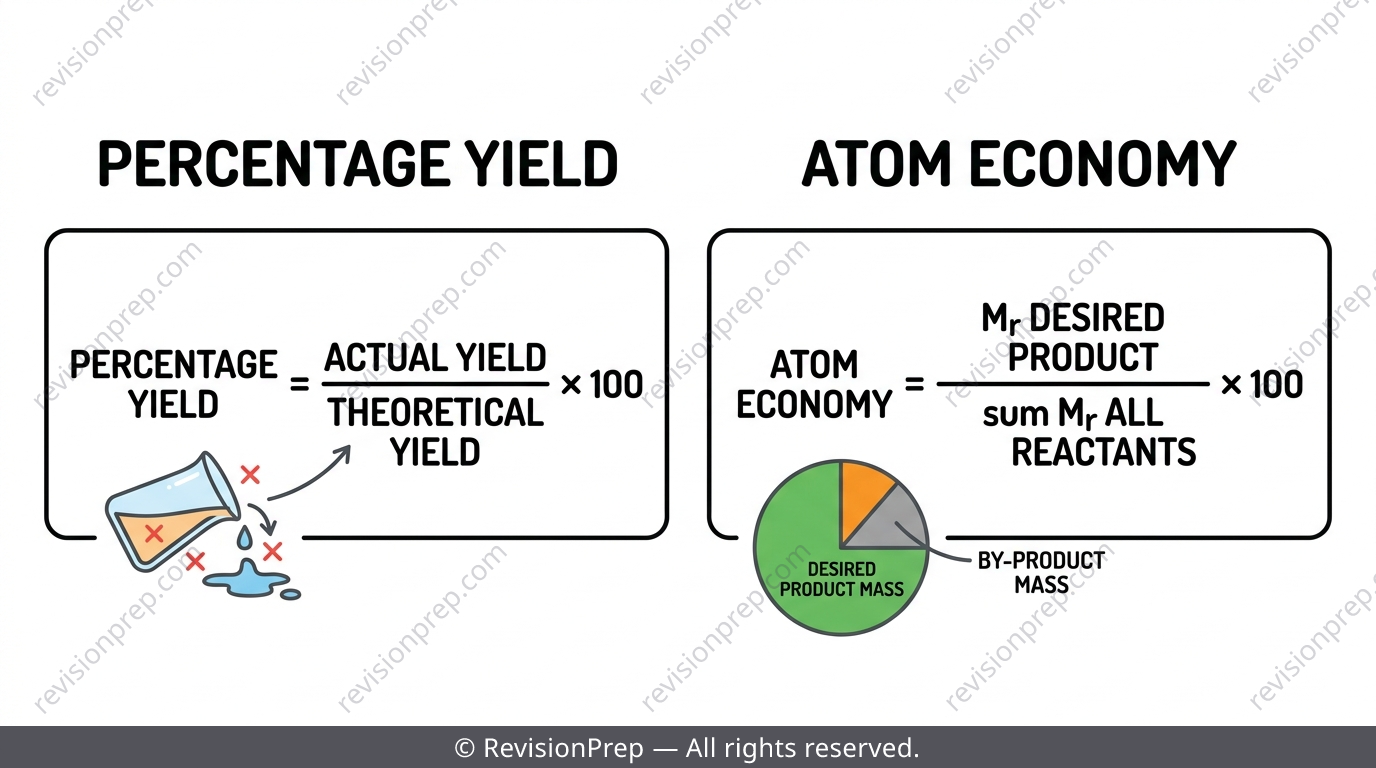
Percentage yield compares actual product obtained to the theoretical yield calculated from the limiting reagent, capturing real-world losses like side reactions or purification. Atom economy is a purely theoretical measure comparing the desired product's molar mass to the total molar mass of all reactants, showing how little mass is wasted regardless of practical losses — a reaction can have 100% atom economy and still give a low percentage yield, or vice versa. At STP, the IB data booklet uses and , giving a molar volume of , not the older 22.4 value.
Exam tip
Double-check you're using for STP, not 22.4 — examiners specifically check for the current IB value.
Common mistake
Swapping the two formulas — using actual yield inside the atom economy calculation, or using both reactant masses inside the percentage yield calculation.
Mini summary
Yield measures practical efficiency; atom economy measures theoretical mass efficiency — they test completely different numbers.
Quick formula sheet
Practice questions
- Write the Kc expression for the equilibrium N2(g) + 3H2(g) ⇌ 2NH3(g).
- Explain why solids and pure liquids are left out of a Kc expression.
- State which single factor changes the value of Kc.
- For a reaction with Kc = 0.50, a student calculates Qc = 4.0 for a given mixture. State and explain which direction the reaction will shift.
- 20.0 g of a reactant with M = 60.05 g/mol reacts with excess of a second reactant to give 24.0 g of product with M = 88.11 g/mol. Calculate the percentage yield if the theoretical yield is 29.4 g.
- Explain why halving the volume of a gaseous equilibrium mixture requires two separate answers rather than one.
- Given 1.0 mol N2, 1.0 mol H2 and 2.0 mol NH3 in a 1.0 dm³ container at a temperature where Kc = 0.50, determine which way the system shifts to reach equilibrium.
- Explain, using the concepts of extent and rate, why diamond converting to graphite is thermodynamically favourable but does not happen at a noticeable rate.
- A reaction has 100% atom economy but a percentage yield of only 40%. Explain how both statements can be true simultaneously.
Frequently asked questions
What is the difference between Kc and Qc?+
Kc uses concentrations only at equilibrium, while Qc uses the same mathematical expression at any point in the reaction. Comparing Qc to Kc tells you which direction the system still needs to shift.
Does a catalyst change the value of Kc?+
No. A catalyst speeds up how quickly equilibrium is reached but never changes the value of Kc — only a temperature change does that.
How do I find the limiting reagent?+
Convert every given mass to moles, then divide each by its coefficient in the balanced equation. Whichever reactant gives the smallest value is limiting — never judge by raw mass alone.
What's the difference between percentage yield and atom economy?+
Percentage yield compares actual product obtained to theoretical yield, reflecting real-world losses. Atom economy compares the desired product's mass to the total mass of all reactants, ignoring practical losses entirely.
What molar volume should I use at STP in IB Chemistry?+
Use 22.7 dm³ per mole, based on the IB data booklet's STP definition of 273 K and 10^5 Pa — not the older 22.4 value.
Can a reaction be favourable but still very slow?+
Yes — extent (thermodynamics) and rate (kinetics) are independent. Diamond converting to graphite is thermodynamically favourable but kinetically extremely slow.
Ready to lock in Reactivity for IB Chemistry HL?
Related articles