
Structure: Classification of Matter
Classify first, predict second — the shortcut behind every isomer, functional-group and periodicity question.
Quick facts
Every IB DP Chemistry question is secretly asking one thing first: have you classified this correctly? Organic compounds are grouped into homologous series by their functional group, so once you spot the group, reactivity and naming follow automatically. Elements are grouped by position in the periodic table — same group, same number of valence electrons, same chemical family. This topic (Structure 3.1 and 3.2) is the entry point into organic synthesis, inorganic trends, and isomer-spotting MCQs that appear on Paper 1 year after year. Get comfortable classifying by functional group, by 1°/2°/3° carbon, and by block on the periodic table, and a huge chunk of exam content becomes pattern recognition rather than memorisation. This teaser covers the five ideas worth locking in first — the full revision notes go much deeper into mechanisms, HL stereoisomerism, and worked examples.
What you’ll be able to do
Homologous Series & Functional Groups
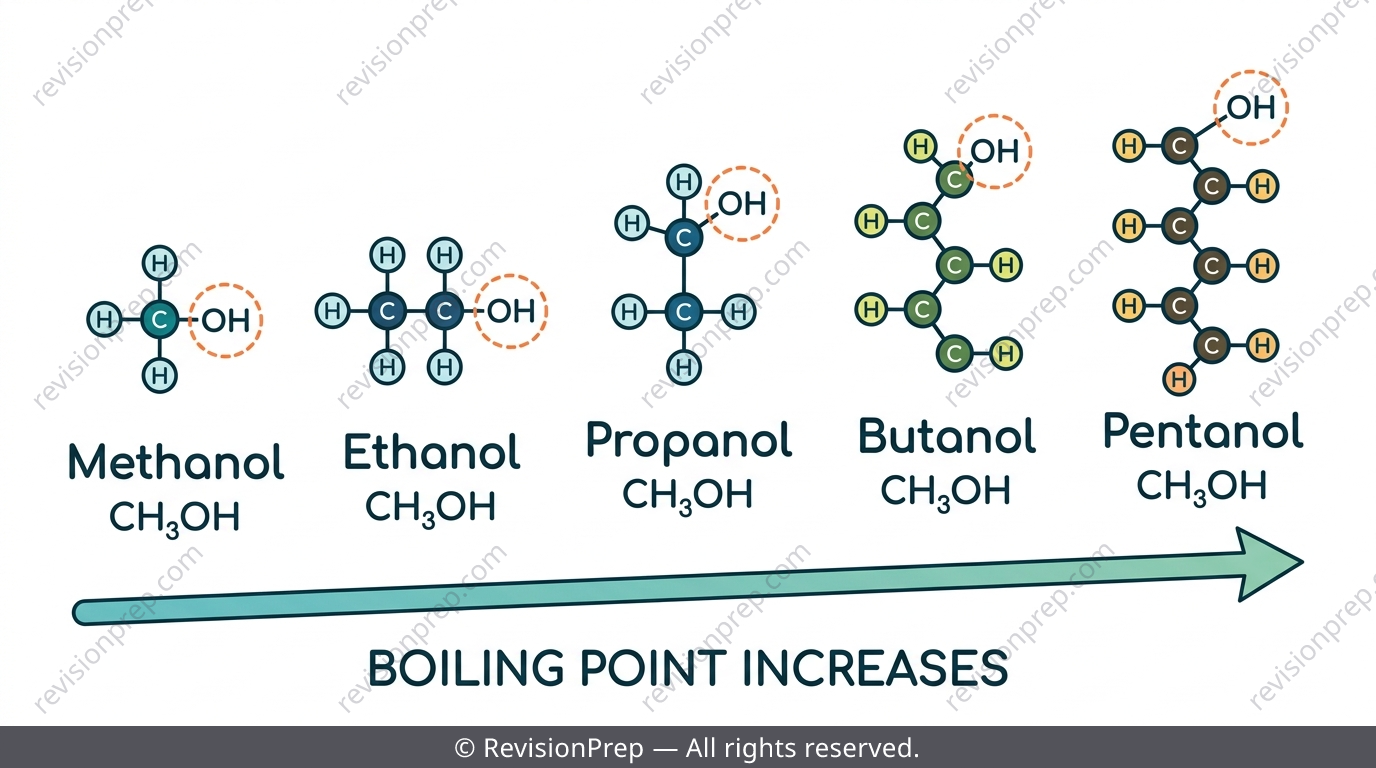
A homologous series is a family of compounds sharing the same general formula and functional group, with each member differing by a unit. Physical properties like boiling point change gradually along the series, but chemical behaviour stays essentially constant — because reactivity is controlled by the functional group, not the hydrocarbon backbone. Recognising the functional group instantly tells you which reactions and tests apply.
| Homologous series | General formula | Key functional group | Suffix/prefix | Example |
|---|---|---|---|---|
| Alkane | C–C, C–H only | -ane | Propane | |
| Alkene | C=C | -ene | Propene | |
| Alcohol | –OH | -ol | Ethanol | |
| Ketone | C=O (non-terminal) | -one | Propanone | |
| Carboxylic acid | –COOH | -oic acid | Ethanoic acid |
Mini summary
Functional group = the chemistry; carbon chain = the physical property gradient.
IUPAC Naming & Suffix Priority
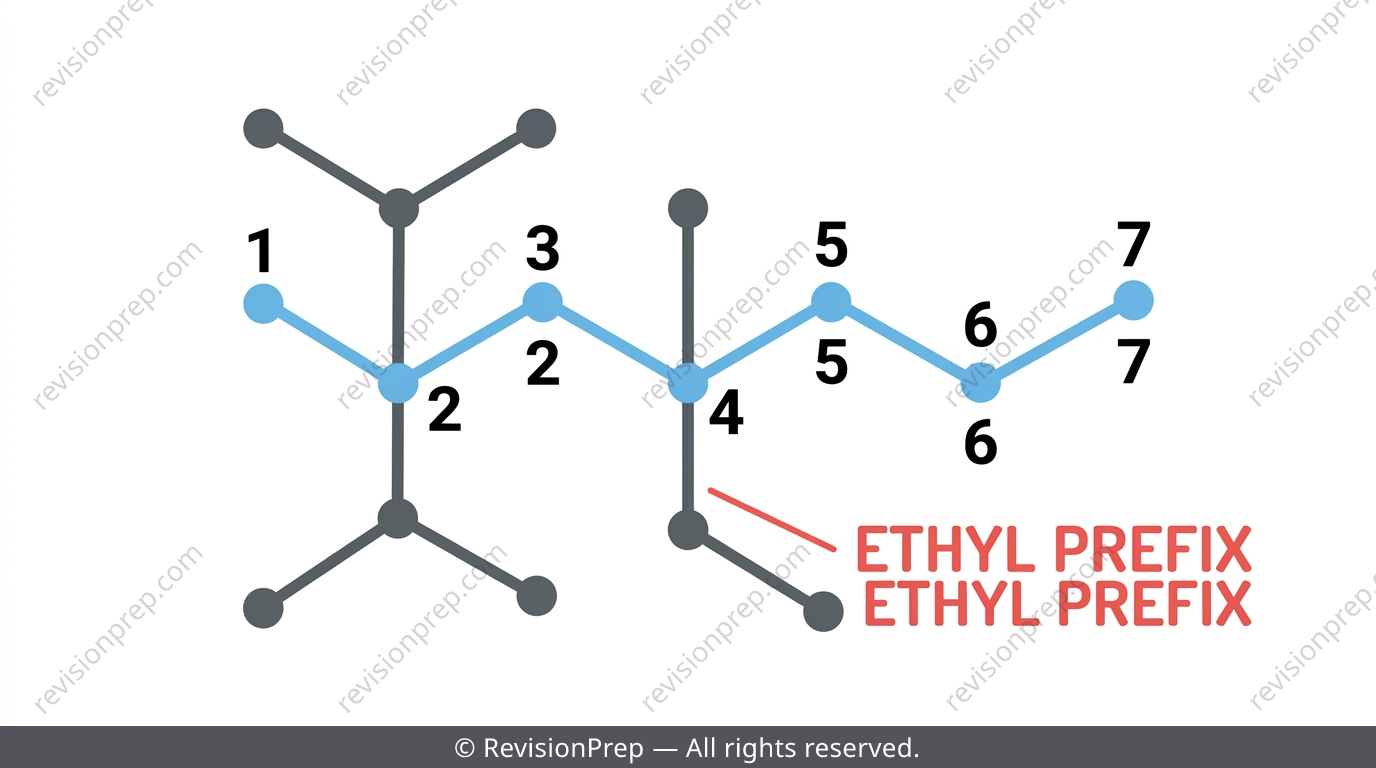
Find the longest continuous chain that contains the principal characteristic group, number it to give that group the lowest possible locant, then cite substituents as prefixes in alphabetical order. When multiple functional groups are present, only the highest-priority one gets the suffix: carboxylic acid > ester > amide > nitrile > aldehyde > ketone > alcohol > amine, with alkenes, alkynes, and halogens always cited as prefixes only.
Exam tip
Before naming anything, physically trace and count the longest carbon chain — miscounting it (e.g. seeing a 5-carbon chain that doesn't actually exist) is the single most common naming error.
Common mistake
Picking a name based on how the structure 'looks' branched rather than actually tracing the longest continuous chain through the drawn structure.
Structural Isomers & Degree of Unsaturation
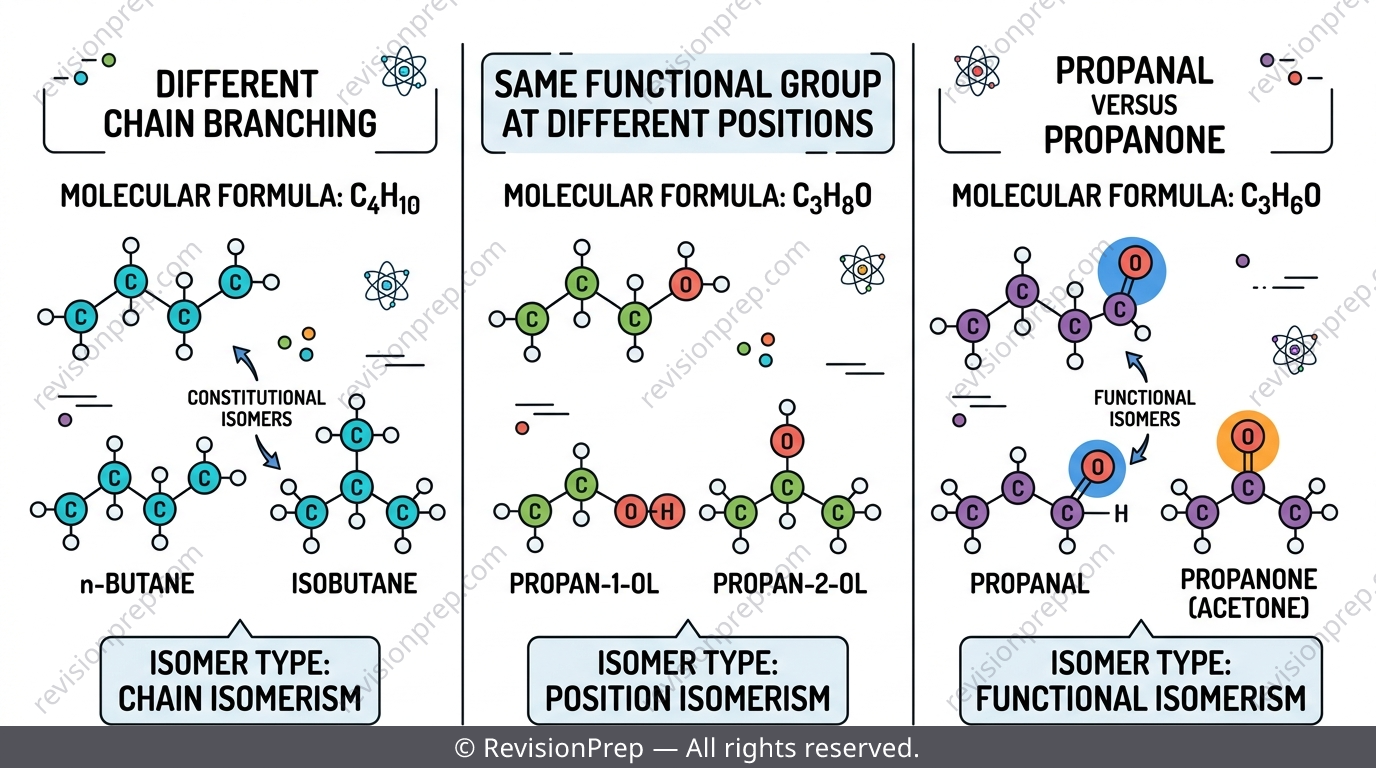
Structural isomers share a molecular formula but differ in atom connectivity, split into three types: chain isomers (different branching), position isomers (functional group at a different locant), and functional group isomers (an entirely different group — can be propanal or propanone). The index of hydrogen deficiency (IHD) tells you how many rings or π bonds a formula must contain, which narrows down possible structures fast.
Exam tip
being either propanal or propanone is a classic functional-group-isomer trap — always check IR/chemical test data before assuming which one it is.
Common mistake
Trying to identify a specific isomer from the molecular formula or a physical value alone, instead of using functional-group tests (Na metal, Tollens', iodoform) as the real diagnostic evidence.
Mini summary
Same formula, different structure — chain, position, or functional group. IHD counts rings + π bonds.
Primary, Secondary, Tertiary & Oxidation Diagnostics
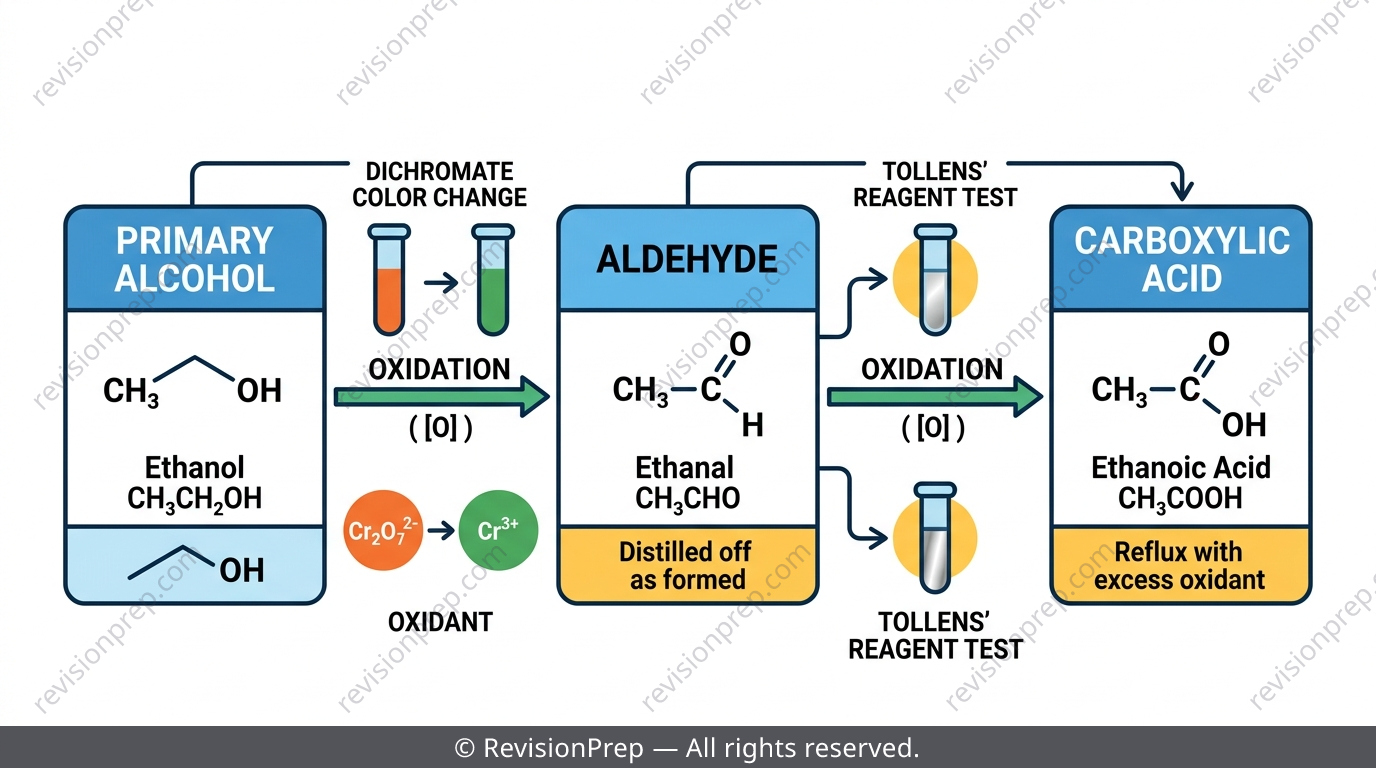
A primary (1°) carbon is attached to only one other carbon, secondary (2°) to two, and tertiary (3°) to three — for alcohols, a tertiary carbon has no H left to remove, which is exactly why tertiary alcohols resist oxidation completely. Primary alcohols oxidise stepwise: distilled off as it forms stops the reaction at the aldehyde, while reflux with excess oxidant pushes all the way to the carboxylic acid. Diagnostic tests confirm structure: Na metal effervescence means O–H present, Tollens'/Fehling's positive means an aldehyde, and a positive iodoform test means a or group.
Exam tip
Whenever a question says the product is 'distilled off as it forms', that's the examiner telling you oxidation stops at the aldehyde — reflux with excess oxidant means it goes all the way to the acid.
Common mistake
Confusing 'the molecule looks branched' with 'the alcohol is tertiary' — always check the specific carbon directly bonded to the –OH group.
Mini summary
Classify the carbon (1°/2°/3°), then match it to the correct oxidation pathway and diagnostic test.
Periodic Table Classification: Periods, Groups & Blocks
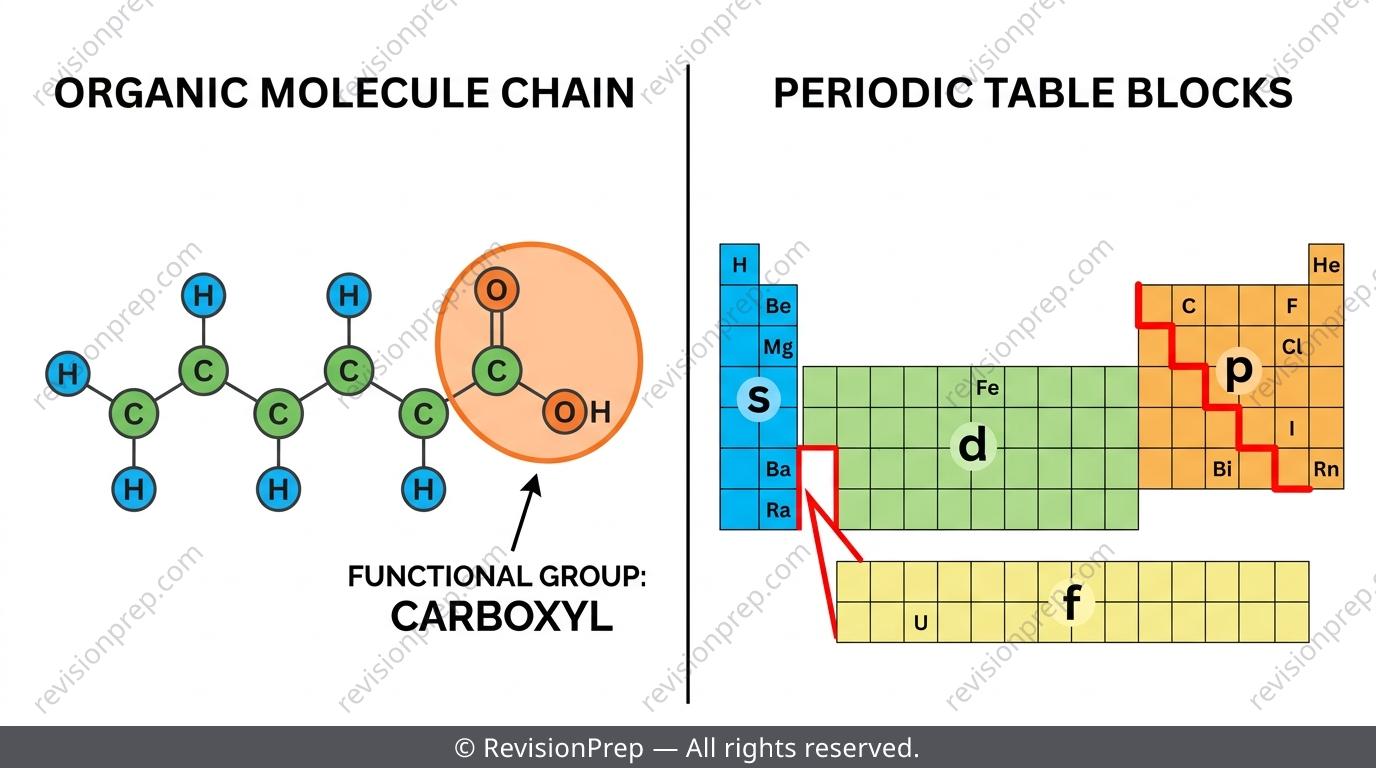
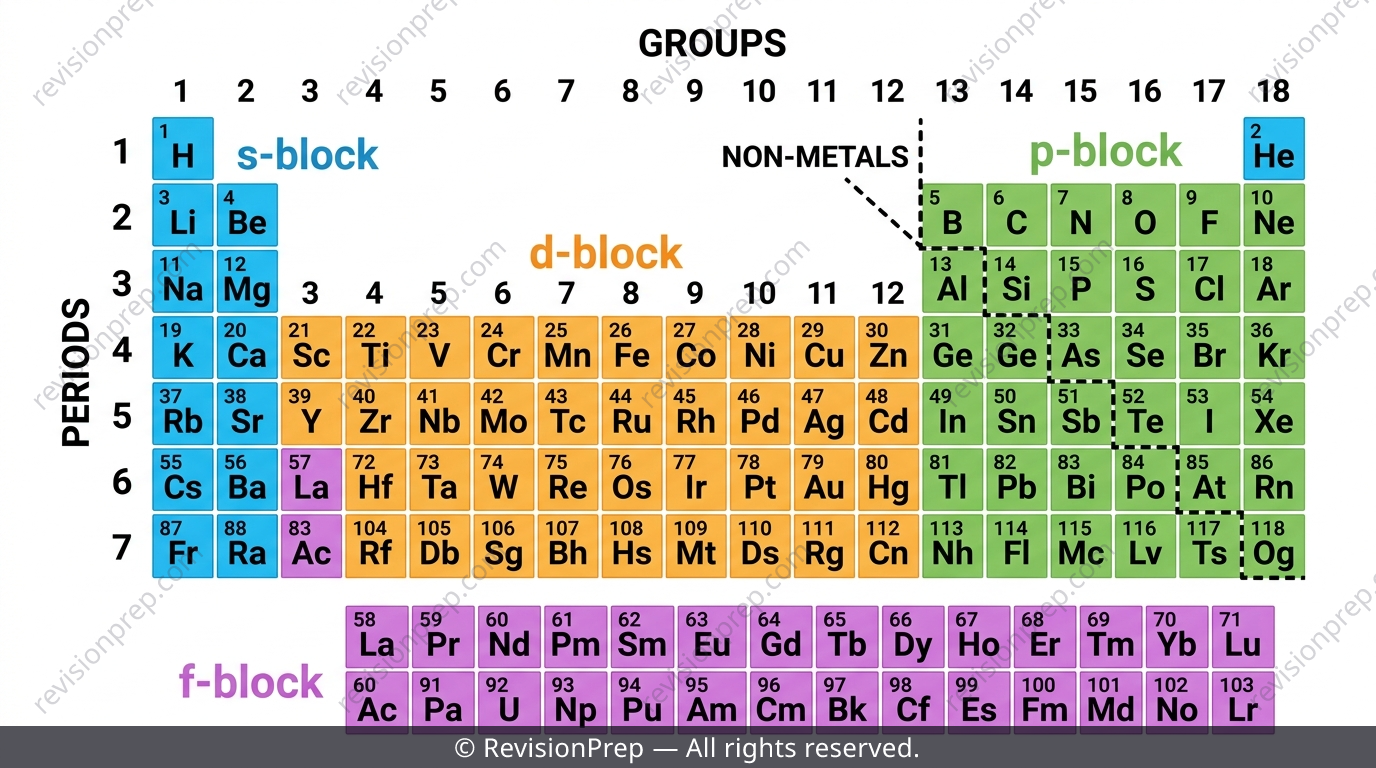
Elements are arranged by increasing atomic number into periods (rows = number of occupied electron shells) and groups (columns = number of valence electrons), so elements in the same group share predictable chemistry. Four blocks are named after the sub-shell being filled last: s-block (groups 1–2, plus He), p-block (groups 13–18 except He), d-block (groups 3–12), and f-block (lanthanides/actinides). Metals sit to the left and centre, non-metals to the upper right, separated by the staircase line (B, Si, Ge, As, Sb, Te, At), with metalloids straddling that boundary.
Exam tip
Locate an unfamiliar element by its group and block first — that alone predicts valence electron count and general reactivity before you need any memorised facts.
Quick formula sheet
Practice questions
- Define homologous series and give one example of a general formula.
- State the type of structural isomerism shown when the same functional group appears at a different position on the chain.
- Name the four blocks of the periodic table and state which sub-shell each is named after.
- A compound has the molecular formula . Draw two possible structural isomers and classify the isomerism type between them.
- Explain why a tertiary alcohol cannot be oxidised by acidified potassium dichromate(VI).
- Predict which product forms when a primary alcohol is heated under reflux with excess acidified dichromate, and explain your reasoning.
- Calculate the IHD for a compound with formula and suggest one structural feature consistent with that value.
- A haloalkane reacts fastest in a polar protic solvent with a weak nucleophile. Identify the likely mechanism and the class of substrate (1°/2°/3°) that would react fastest under these conditions, with justification.
- An unknown alcohol gives a positive dichromate test and its oxidation product gives a positive iodoform test but negative Tollens' test. Deduce the class of alcohol and justify using the diagnostic tests described.
Frequently asked questions
What is the difference between a functional group and a homologous series?+
The functional group is the specific reactive part of a molecule; the homologous series is the whole family of compounds built around that functional group, each member differing by a CH2 unit.
How do I know which functional group gets the suffix when a molecule has more than one?+
Use the priority order: carboxylic acid > ester > amide > nitrile > aldehyde > ketone > alcohol > amine. The highest-priority group present takes the suffix; all others become prefixes.
What's the difference between structural isomers and stereoisomers?+
Structural isomers have the same molecular formula but different atom connectivity (chain, position, or functional group). Stereoisomers have identical connectivity but a different spatial arrangement — this is HL content.
Why do tertiary alcohols resist oxidation?+
The carbon bonded to the -OH in a tertiary alcohol has no hydrogen atom left to remove, and oxidation of alcohols requires removing hydrogens from that carbon, so no reaction can occur.
How are elements grouped in the periodic table?+
By period (row, based on number of occupied electron shells) and group (column, based on number of valence electrons), with four blocks — s, p, d, f — named after the sub-shell filled last.
Does SN1 or SN2 favour primary or tertiary substrates?+
SN2 favours primary substrates and depends on both substrate and nucleophile concentration; SN1 favours tertiary substrates and depends only on substrate concentration, via a carbocation intermediate.
Get the full Structure: Classification of Matter revision notes
Related articles