
Structure: Classification of Matter
How chemists sort millions of compounds and elements using just a few patterns — and how IB loves to test it.
Quick facts
Classification of Matter is one of the most reliable topics in IB DP Chemistry — it shows up in some form on almost every Paper 1 and Paper 2. Organic chemists sort compounds into homologous series by functional group, which fixes both the IUPAC name and the reactivity. Inorganic chemists sort elements by atomic number into periods, groups, and blocks, so position on the periodic table predicts electron configuration and behaviour. Both systems exist for the same reason: pattern recognition beats memorisation. This teaser walks through the five ideas examiners return to again and again — functional groups, IUPAC naming priority, structural isomers, the atomic-number periodic table, and blocks/metalloids — plus the traps that quietly cost students marks. The full revision note has every homologous series table, worked IUPAC examples, and periodicity trends in depth.
What you’ll be able to do
Functional Groups & Homologous Series
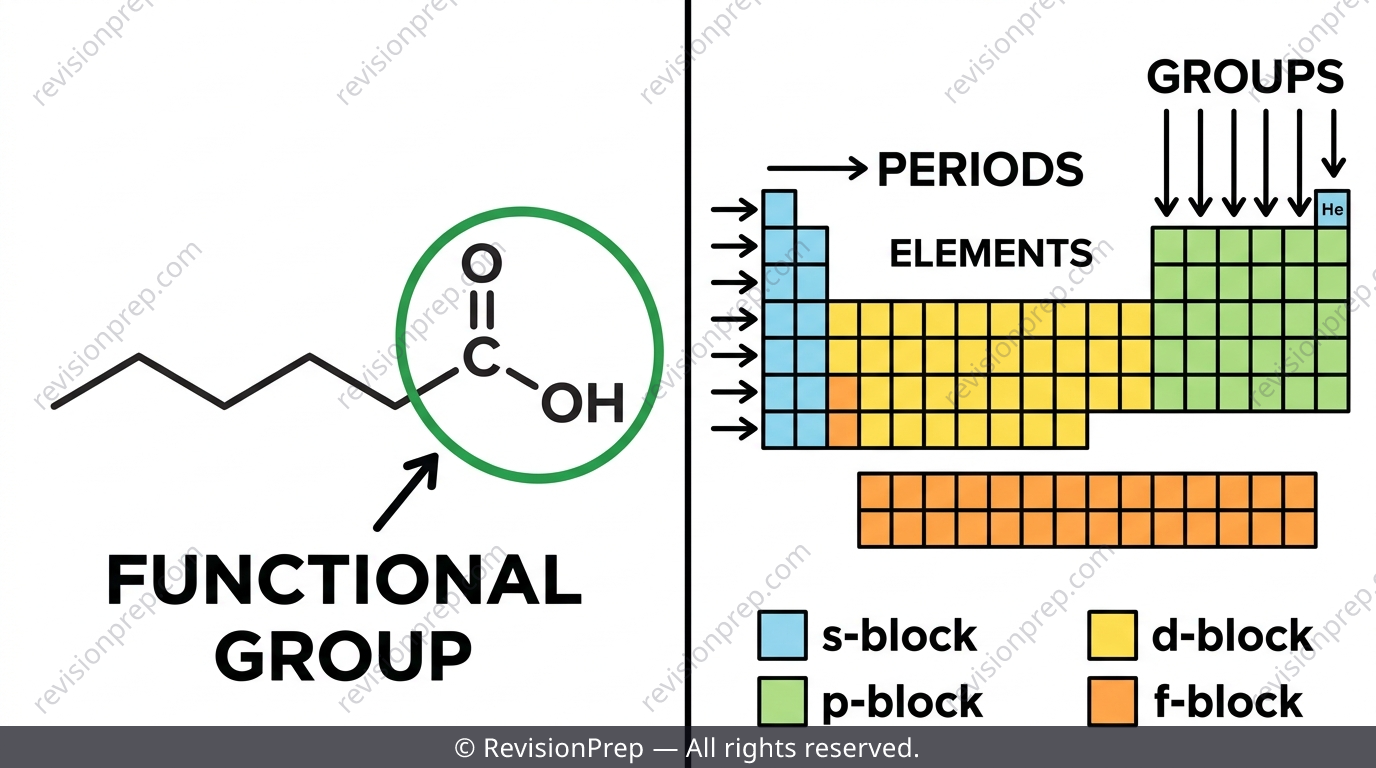
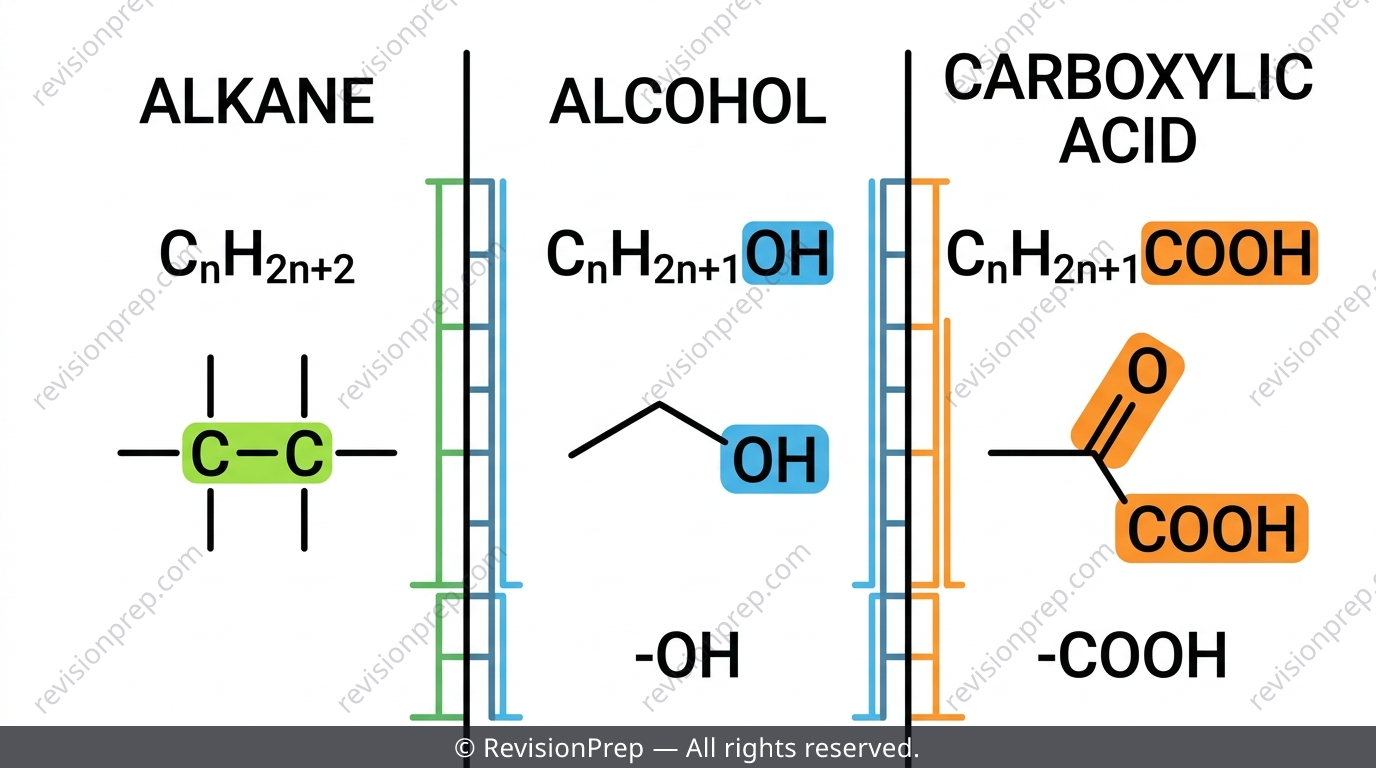
A functional group is the atom or group of atoms responsible for a compound's characteristic reactions. Compounds sharing a functional group form a homologous series: same general formula, similar chemistry, and a gradual (not sudden) change in physical properties like boiling point as the chain lengthens. Saturated compounds have only single C–C bonds; unsaturated compounds contain at least one C=C or C≡C.
Exam tip
Recognise the general formula on sight — screams alkane, screams alcohol.
Mini summary
Same functional group = same family = predictable trend in properties.
IUPAC Naming: The Priority Rules Examiners Test Most
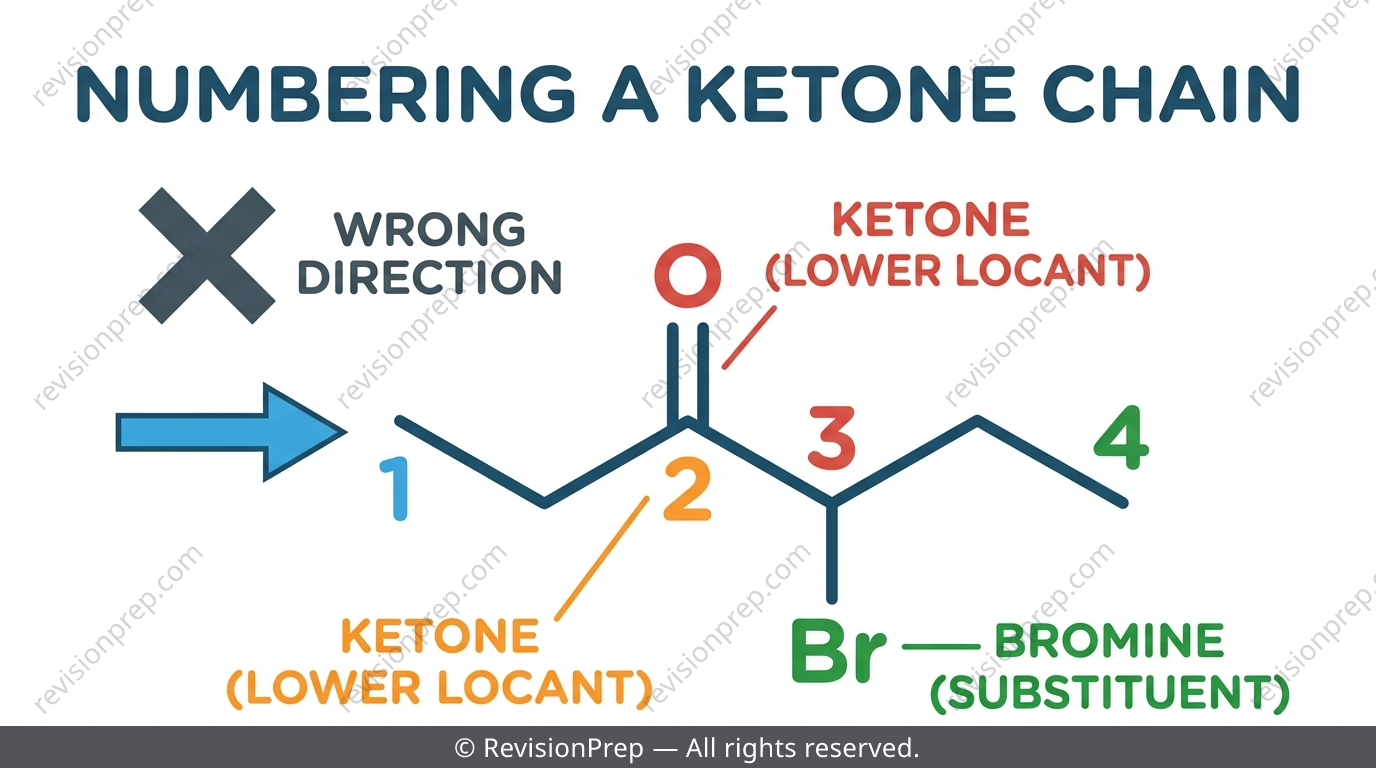
Naming always follows the same three moves: find the longest chain containing the principal group, number it to give that group the lowest locant, then add substituents alphabetically as prefixes. When more than one functional group is present, only the most senior becomes the suffix — everything else is demoted to a prefix, no matter where it sits on the chain.
Exam tip
Memorise the seniority order: acid > ester > aldehyde > ketone > alcohol > amine.
Common mistake
Numbering to give a substituent (like a halogen) the lower locant instead of the principal group or double bond — always fix the principal group's position first.
Mini summary
Principal group decides numbering direction and the suffix; everything else is just a prefix.
Structural Isomers: Same Formula, Different Chemistry
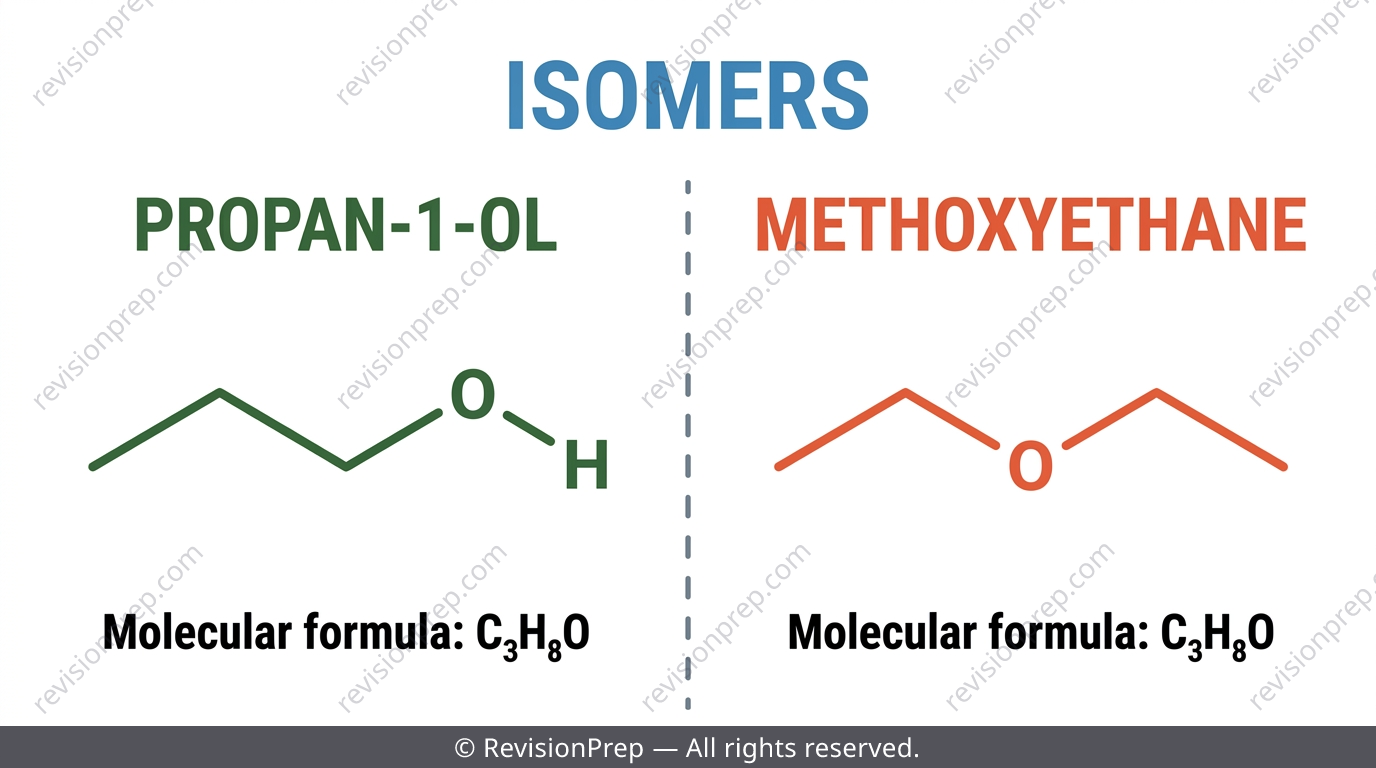
Structural isomers share a molecular formula but differ in how the atoms connect — they can even belong to entirely different homologous series, like an alcohol and an ether both written as . Isomers within the same series can still differ in boiling point, but this comes from differences in shape and dispersion forces between molecules, not from differences in bond strength within the molecule.
Common mistake
Explaining a boiling point difference between isomers with 'weaker bonds' — the C–Br (or similar) bonds are identical; the real cause is intermolecular dispersion forces.
Mini summary
Same atoms, different arrangement, sometimes a completely different chemical identity.
The Periodic Table: Ordered by Atomic Number
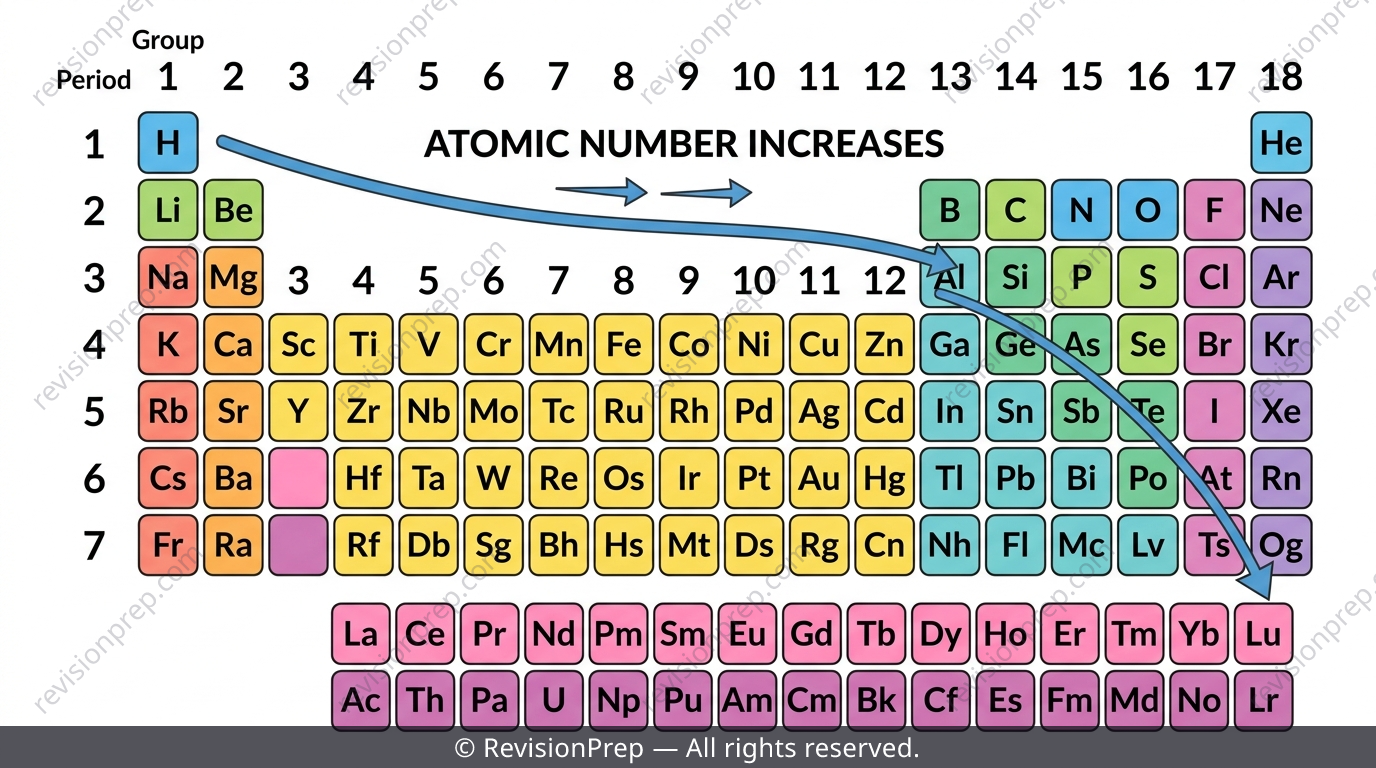
The modern periodic table arranges elements by increasing atomic number, not atomic mass — this single correction over Mendeleev's table resolved anomalies like tellurium sitting before iodine. Rows are periods (7 of them) and columns are groups (18 of them under IUPAC numbering). Period number equals the shell currently being filled; group number roughly equals the number of valence electrons, though this rule breaks down across the d-block.
Exam tip
If a question mentions Mendeleev, it's testing whether you know atomic number—not mass—is the modern ordering principle.
Mini summary
Position on the table is really a map of electron configuration.
Blocks, Metals, Non-Metals and Metalloids
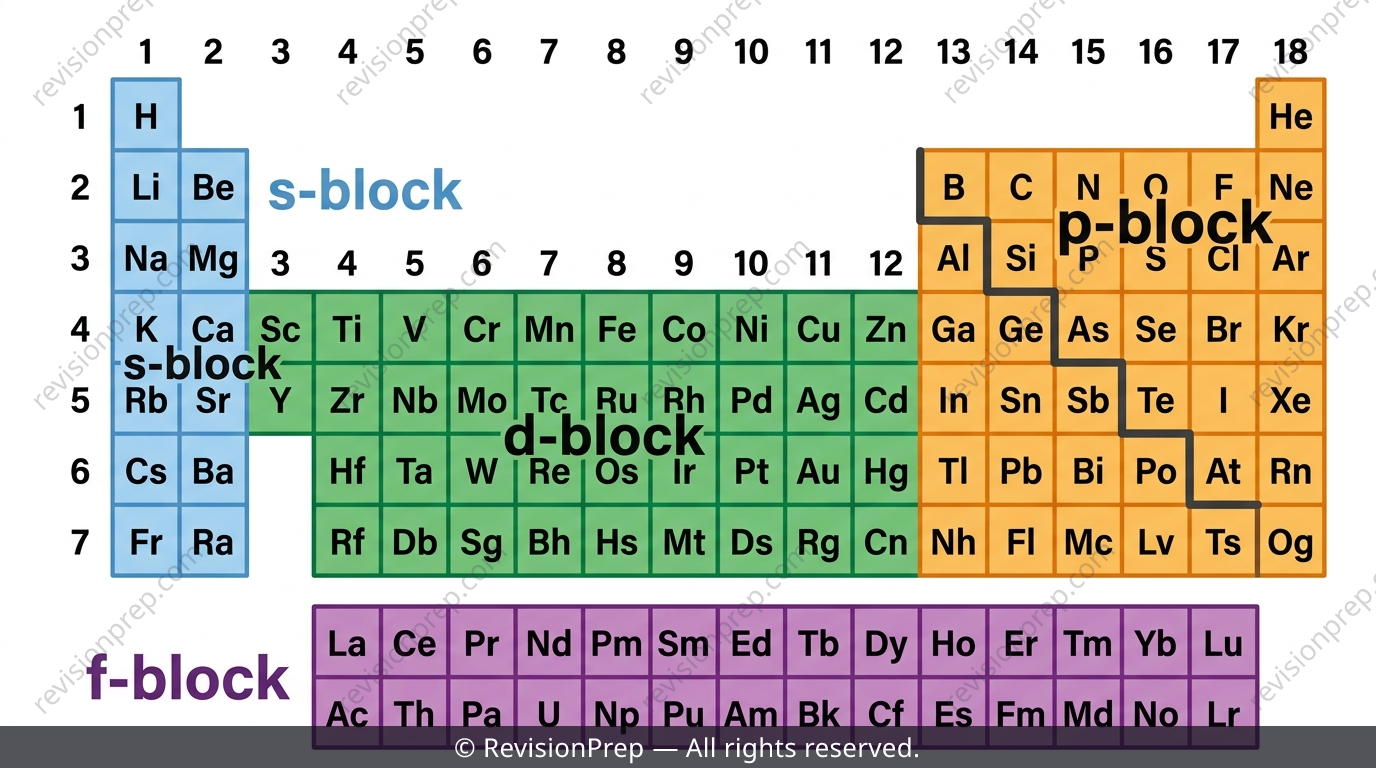
The table is divided into s, p, d, and f blocks, named after the subshell receiving the last electron added under the Aufbau principle. Beyond blocks, elements are classed by behaviour: metals occupy the left and centre, non-metals the upper right, and metalloids sit along the diagonal border between them (B, Si, Ge, As, Sb, Te).
Mini summary
Block tells you which subshell is filling; metal/non-metal/metalloid tells you how the element behaves.
Quick formula sheet
Practice questions
- Define 'functional group' and give one example.
- State whether an alkene is saturated or unsaturated, and explain why.
- Name the four block types found in the periodic table.
- Explain why the modern periodic table uses atomic number rather than atomic mass as its ordering principle.
- Two isomers share the formula but belong to different homologous series. Identify both series and explain the difference in their functional groups.
- Outline the correct order of priority when deciding which functional group becomes the suffix in a compound with both a ketone and a hydroxyl group.
- A cyclic compound has a chlorine substituent on a double-bond carbon in a six-membered ring. Explain the reasoning needed to assign the correct IUPAC locants.
- Two structural isomers of have different boiling points despite identical bond types. Explain the source of this difference without referring to bond strength.
- A compound shows IR absorptions at and a broad band between –. Identify the functional group and justify your answer using both pieces of data.
Frequently asked questions
What is the difference between a functional group and a homologous series?+
A functional group is the specific reactive atom or group in a molecule; a homologous series is the whole family of compounds that share that functional group and general formula.
How do I know which functional group becomes the suffix?+
Use the seniority order: acid > ester > aldehyde > ketone > alcohol > amine. The most senior group present is always the suffix, and every other group becomes a prefix.
Why is the periodic table ordered by atomic number instead of atomic mass?+
Atomic number ordering resolved anomalies from Mendeleev's mass-based table, such as tellurium appearing before iodine, and it reflects electron configuration trends accurately.
Can structural isomers belong to completely different homologous series?+
Yes. Propan-1-ol and methoxyethane share the formula but one is an alcohol and the other an ether, giving them very different chemistry.
What are metalloids and where are they on the periodic table?+
Metalloids are elements with properties between metals and non-metals, found along the diagonal border between the two regions: boron, silicon, germanium, arsenic, antimony, and tellurium.
Why do isomers with identical bonds have different boiling points?+
The difference comes from intermolecular dispersion forces related to molecular shape, not from the strength of the covalent bonds within the molecule.
Get the Full IB DP Chemistry Notes on Classification of Matter
Related articles