
Structure: Models of Bonding and Structure
Ionic, covalent and network models — and the structural feature that explains every property question
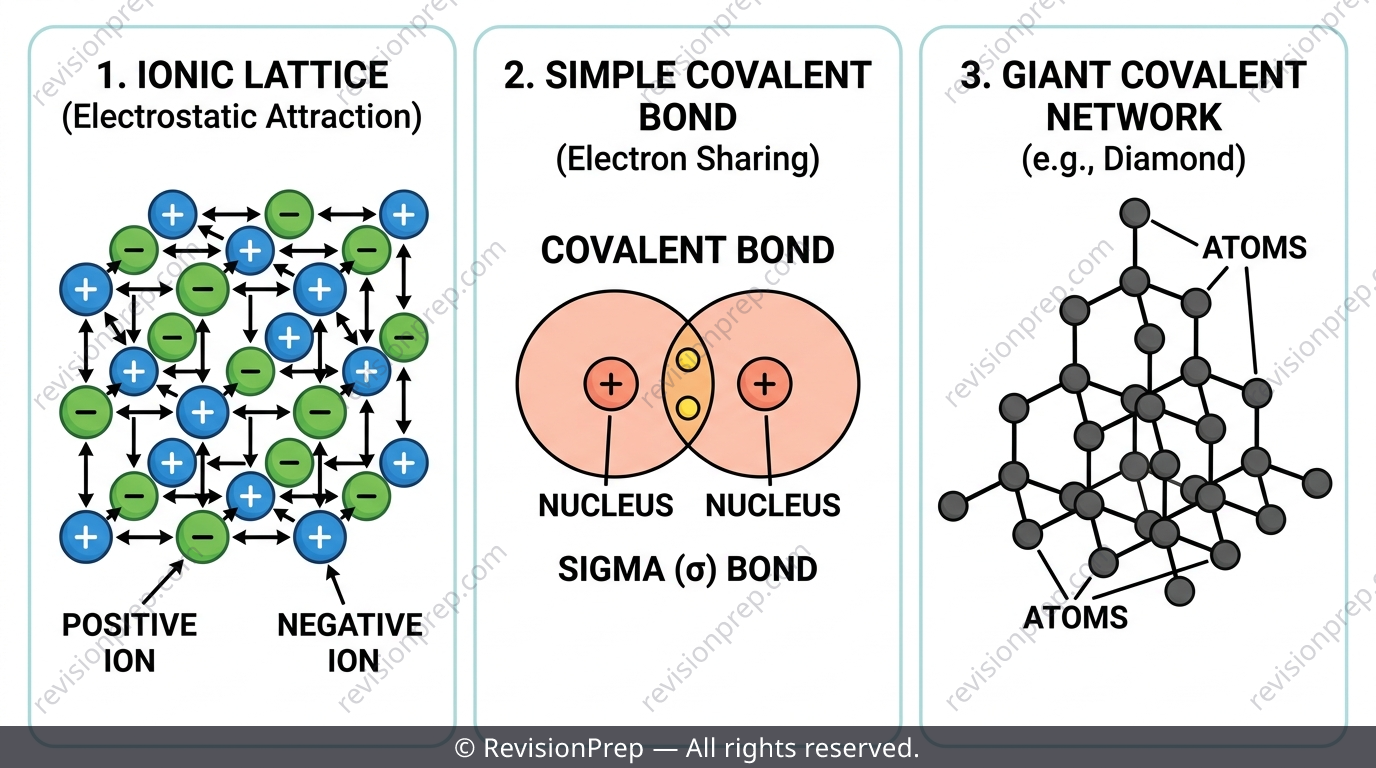
Quick facts
IB Chemistry loves to ask one question in disguise: which structural feature explains this property? Whether it's melting point, conductivity, shape or brittleness, the answer always traces back to a bonding model — ionic, covalent, or the giant covalent network. This topic builds each model from its electrostatic basis, then admits that real bonding sits on a continuum rather than in neat boxes. Coordination number, lattice enthalpy, VSEPR electron domains and the graphite exception are the recurring exam favourites across both Paper 1 multiple choice and Paper 2 short-answer questions. Get the underlying logic right — radius ratio versus charge, mobile ions versus fixed lattice points, sigma versus pi overlap — and you can predict almost any property from structure alone. This teaser covers the five ideas worth locking down first; the full revision notes go deeper into every model, definition and worked exam trap.
What you’ll be able to do
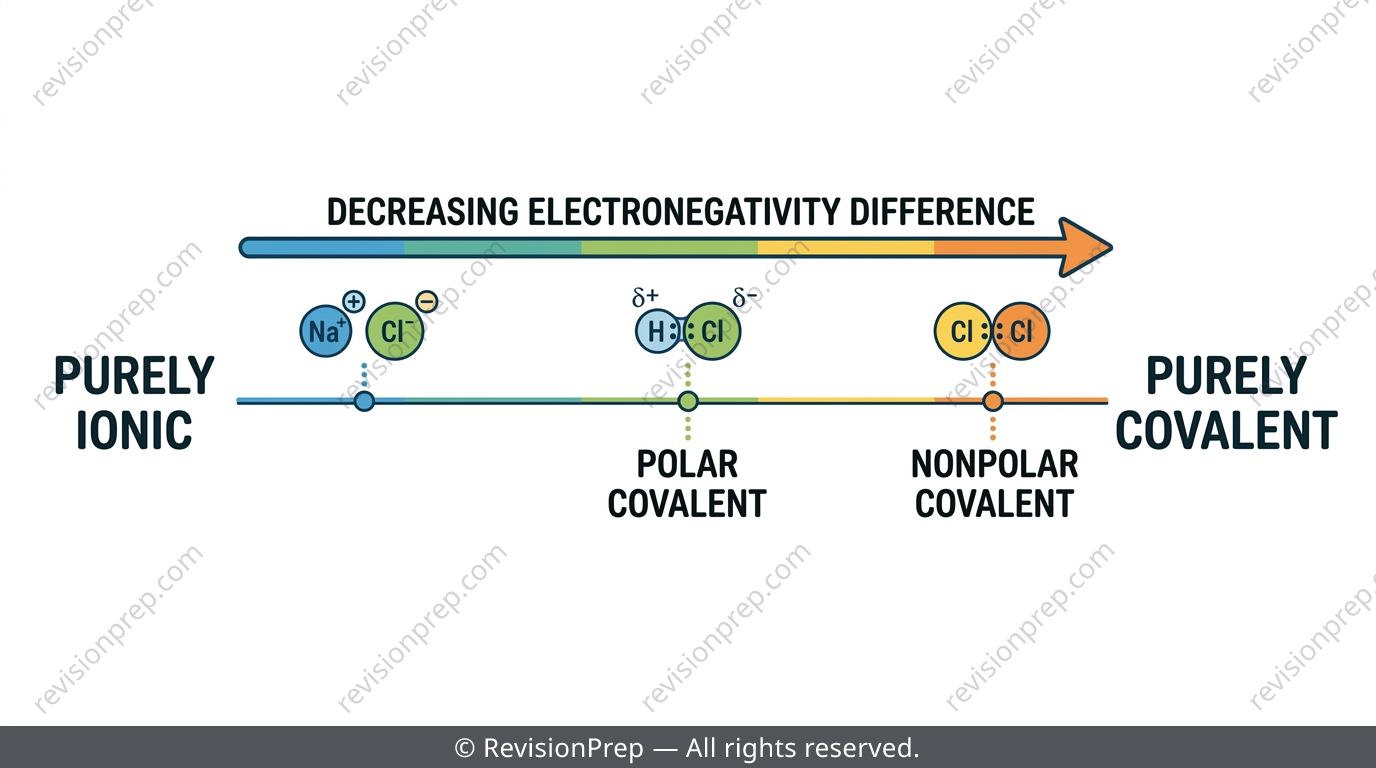
Bonding Is a Continuum, Not Three Separate Boxes
Ionic, covalent and metallic models are deliberate simplifications: real electron density never sits neatly in one category, but each model lets you predict melting point, conductivity, shape and mechanical behaviour with a handful of rules. The model you choose has to match the electronegativity data, not the other way round. Almost every exam question is really asking which structural feature — coordination number, lone pair count, or delocalized electrons — explains the observed property.
Exam tip
Before answering 'explain the property', identify the structure type first, then pick the one feature (mobile ions, shared pairs, delocalized electrons) that actually causes it.
Mini summary
Bonding models are tools for prediction, chosen to fit the electronegativity evidence.
The Ionic Model: Coordination Number, Lattice Enthalpy and Conductivity
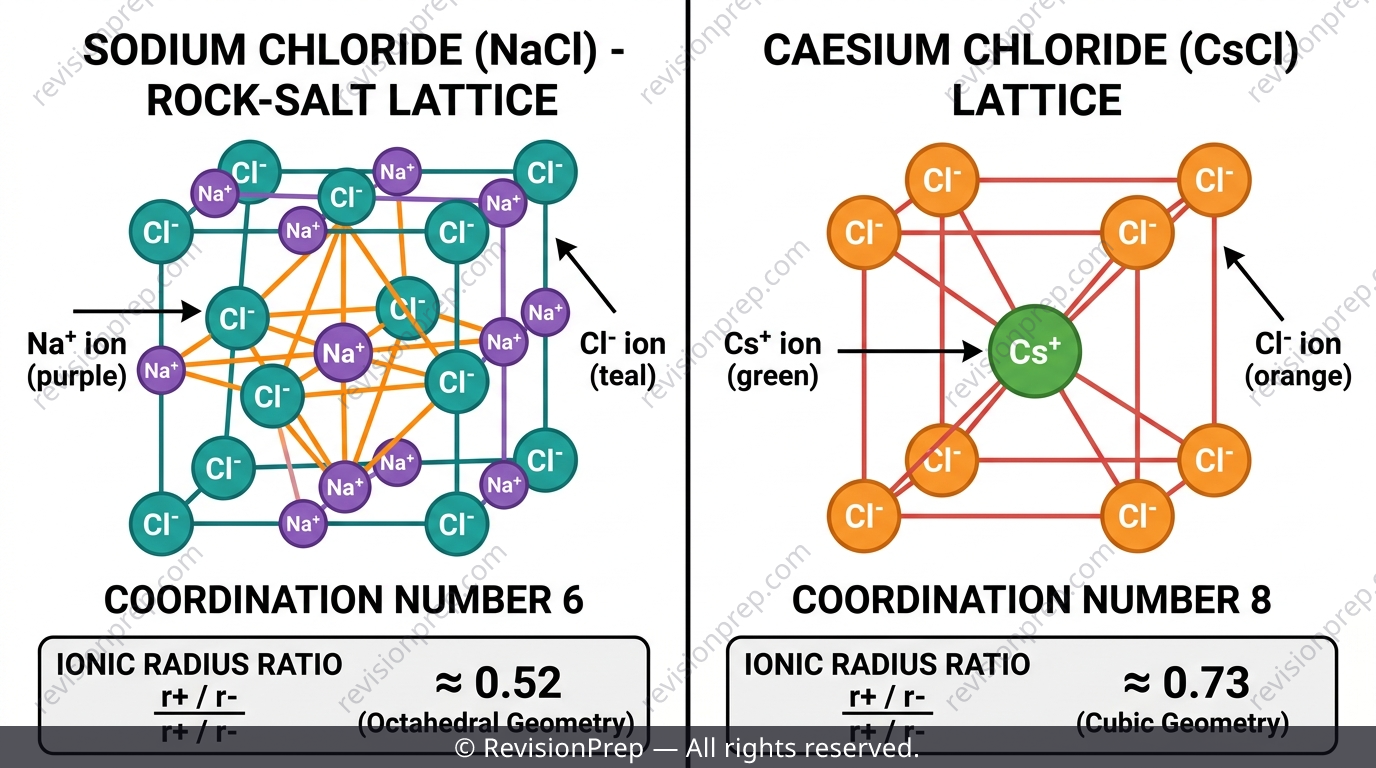
An ionic bond is the electrostatic attraction between oppositely charged ions in a 3-D lattice — there is no single bond, just the sum of every ion–ion attraction acting in all directions. Coordination number is set by the radius ratio , not by charge: NaCl is 6:6 because Na+ is too small relative to Cl– to fit 8 neighbours, while CsCl is 8:8 because Cs+ is large enough. Lattice enthalpy — and therefore melting point — scales with over interionic distance, so charge usually dominates over radius when both change. Ionic solids only conduct once molten or dissolved, because in the solid the ions vibrate about fixed lattice points and cannot migrate.
| State | Are ions free to move? | Conducts electricity? |
|---|---|---|
| Solid | No — fixed in lattice, only vibrate | No |
| Molten | Yes — mobile | Yes |
| Aqueous (dissolved) | Yes — mobile | Yes |
Exam tip
For radius-ratio questions with equal charge (e.g. Na+ vs Cs+), it's purely a size/packing argument — never reach for 'greater charge' if the charges are identical.
Common mistake
Writing 'NaCl(s) conducts electricity because it's made of ions' — always tie the claim to a state change: it conducts only when molten or aqueous.
Covalent Bonds: Sigma, Pi and Coordinate Bonds
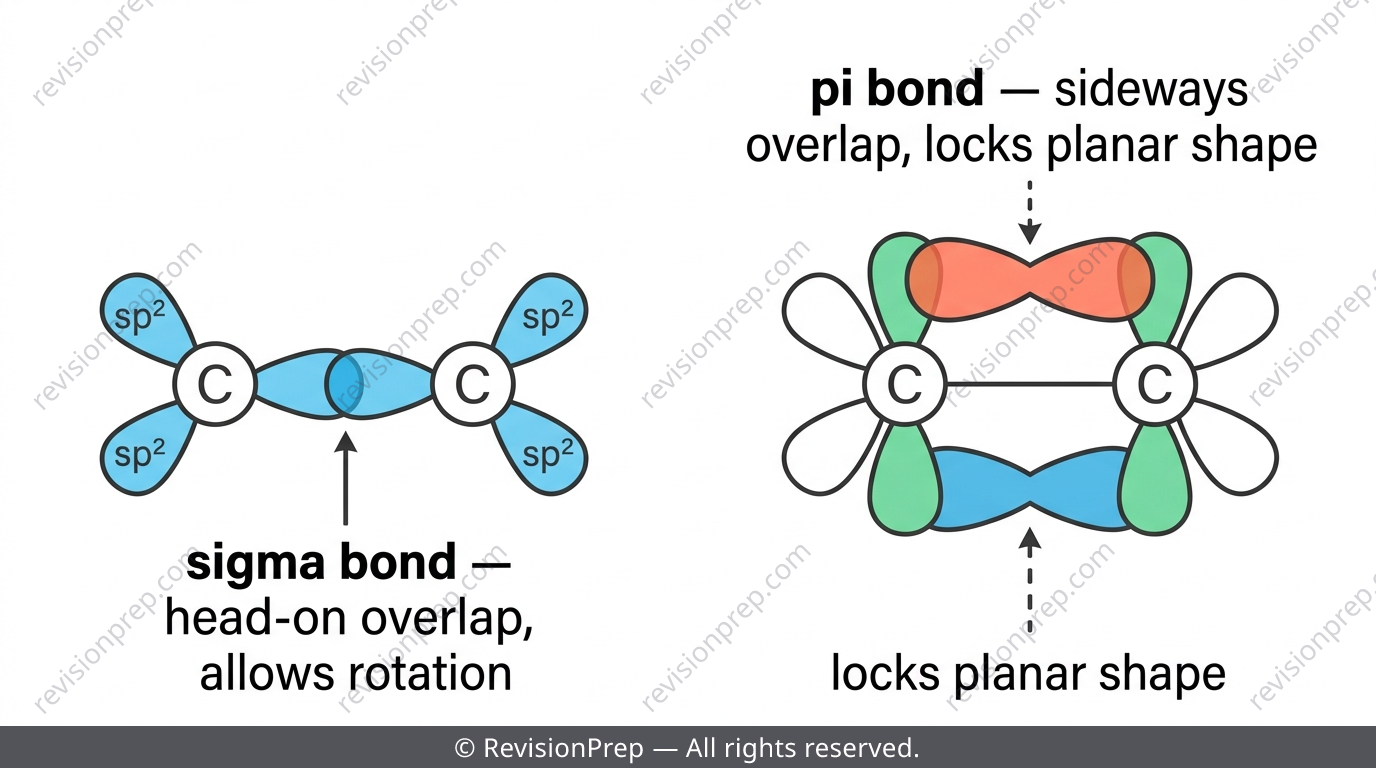
A covalent bond is the electrostatic attraction between a shared electron pair and the nuclei of both bonded atoms; more shared pairs between the same two atoms means a shorter, stronger bond (single < double < triple). A sigma bond forms by head-on overlap along the bond axis and allows free rotation; a pi bond forms by sideways overlap of parallel p-orbitals and locks atoms into a planar, non-rotating arrangement, which is why cis/trans isomers exist around C=C but not C–C. A coordinate (dative) covalent bond has both electrons donated by the same atom — classic exam examples are NH4+, H3O+ and [Ag(NH3)2]+ — but once formed it behaves identically to any other covalent bond.
Exam tip
Molecular polarity depends on both bond polarity AND shape: symmetric arrangements of identical polar bonds (CO2, CCl4) cancel out to give a non-polar molecule overall.
Mini summary
Sigma = rotation possible; pi = locked planar; dative = same electrons, different origin, identical bond once formed.
VSEPR Theory: Predicting Shape and Bond Angle
VSEPR treats every bonding pair and lone pair around the central atom as an electron domain that repels every other domain, pushing them as far apart as possible. Repulsion strength follows lone pair–lone pair > lone pair–bonding pair > bonding pair–bonding pair, so each extra lone pair compresses the bond angle a little further. The named shape only describes where the atoms sit, but lone pairs still take up room.
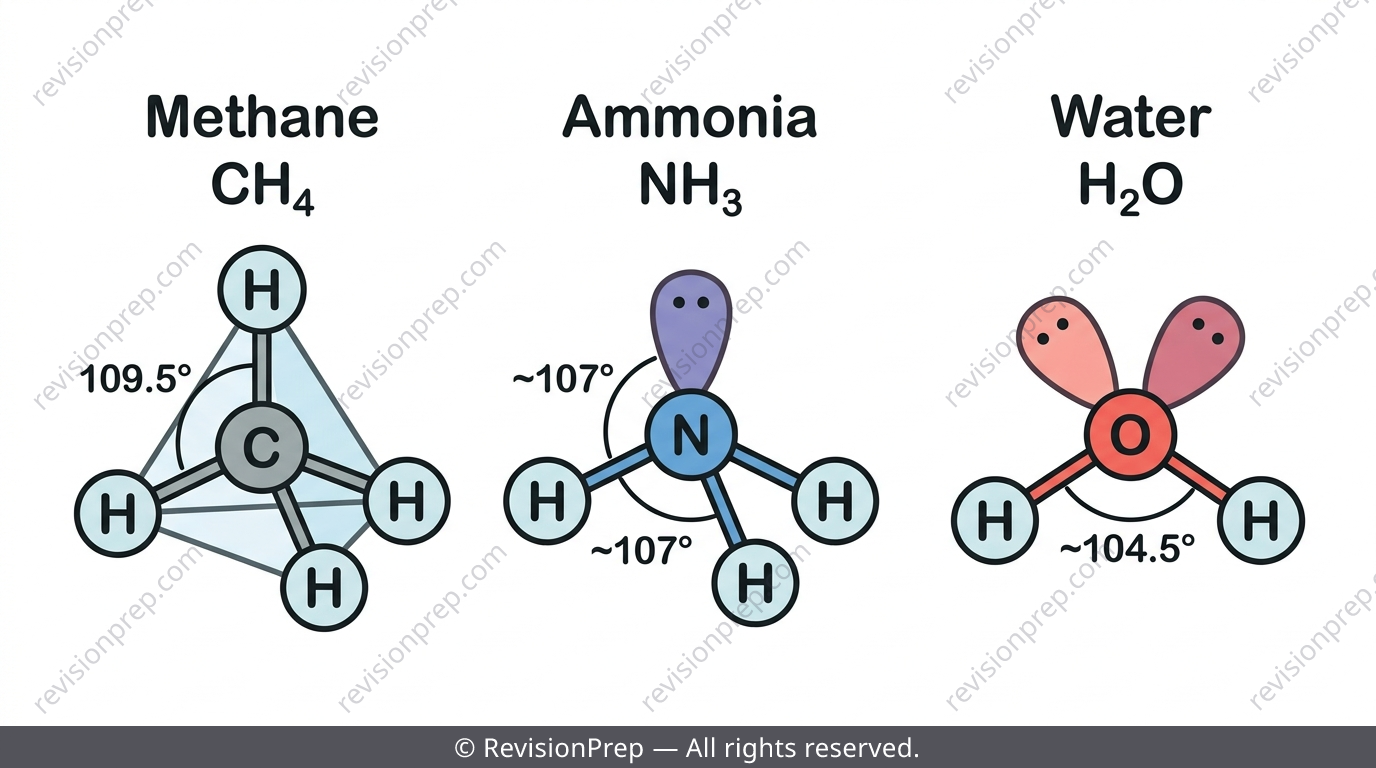
| Domains | Lone pairs | Shape | Bond angle | Example |
|---|---|---|---|---|
| 4 | 0 | Tetrahedral | 109.5° | CH4 |
| 4 | 1 | Trigonal pyramidal | ~107° | NH3 |
| 4 | 2 | Bent / V-shaped | ~104.5° | H2O |
| 3 | 0 | Trigonal planar | 120° | BF3 |
| 3 | 1 | Bent | <120° | SO2 |
| 2 | 0 | Linear | 180° | CO2, BeCl2 |
Exam tip
At Standard Level, shape questions stay within 2–4 electron domains — trigonal bipyramidal and octahedral (5–6 domains, expanded octets like PCl5/SF6) are Higher Level only.
Covalent Network Structures — and the Graphite Exception
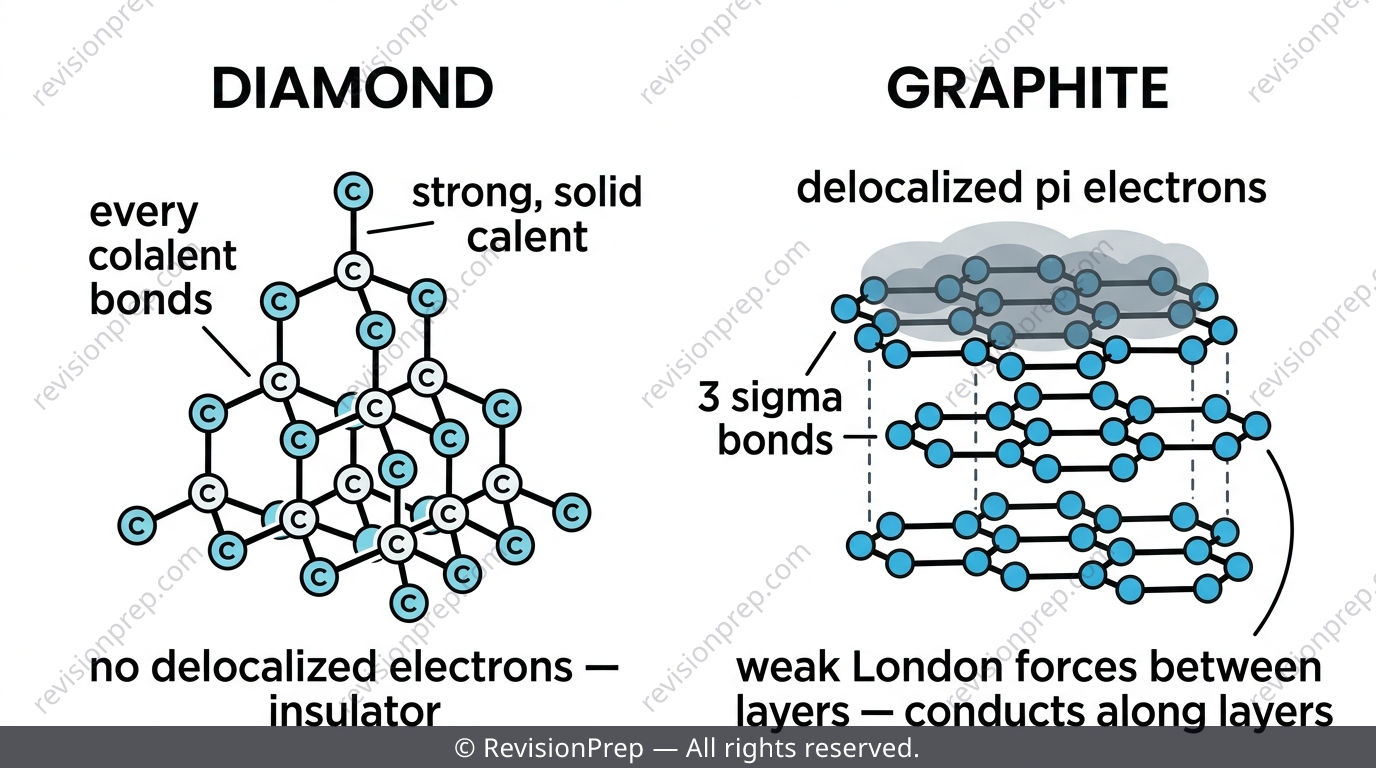
Covalent network (giant covalent) structures repeat strong covalent bonding throughout the entire crystal — diamond, SiO2, SiC — giving very high melting points and usually poor electrical conductivity, since there are no ions or delocalized charge carriers. Graphite is the exam-favourite exception: each carbon forms 3 sigma bonds plus delocalized pi electrons across a layer, and the layers are held together only by weak London forces. That structure lets graphite conduct along its layers while flaking and lubricating between them.
Common mistake
Assuming all giant covalent structures behave the same as diamond — graphite conducts because of its delocalized pi electrons within layers, not despite being 'just carbon'.
Mini summary
Same element, different structure: diamond is an insulator, graphite conducts along its layers.
Quick formula sheet
Practice questions
- State the coordination number of Na+ in the NaCl lattice and explain what physical property determines it.
- Explain why solid ionic compounds do not conduct electricity but molten ionic compounds do.
- Draw the Lewis structure of NH4+ and identify which bond is a coordinate covalent bond.
- NaF, MgO and AlN all adopt the rock salt structure. Rank them from lowest to highest melting point, explaining your reasoning using ionic charge.
- Use VSEPR theory to predict and explain the shape and approximate bond angle of NH3 and H2O.
- Explain, using structure, why graphite conducts electricity but diamond does not, despite both being pure carbon.
- Cs+ has a coordination number of 8 in CsCl, while Na+ has a coordination number of 6 in NaCl. Explain why, given that both ions carry the same charge.
- 0.10 mol dm⁻³ KCl and 0.10 mol dm⁻³ CaCl2 are compared for electrical conductivity. Explain which solution conducts better, considering both the number of ions and their charge.
- Explain why CO2 is a non-polar molecule despite containing polar C=O bonds, using both electronegativity and molecular shape in your answer.
Frequently asked questions
Why doesn't solid NaCl conduct electricity if it's made of ions?+
In the solid, ions vibrate about fixed positions in the lattice and cannot migrate to carry charge. Conductivity only appears once the compound is molten or dissolved, when the ions become mobile.
What decides the coordination number in an ionic lattice?+
Coordination number is set by the radius ratio , not by ionic charge. A relatively larger cation can fit more anions around it before those anions start touching each other — this is why CsCl (8:8) differs from NaCl (6:6) even though both cations are +1.
Why does graphite conduct electricity but diamond doesn't?+
Both are giant covalent structures of carbon, but graphite's layers have delocalized pi electrons spread across each sheet, allowing conduction along the layers. Diamond has no delocalized electrons at all, so it's an electrical insulator.
What's the difference between a sigma bond and a pi bond?+
A sigma bond forms by head-on orbital overlap along the bond axis and allows free rotation. A pi bond forms by sideways overlap of parallel p-orbitals and locks the atoms in a planar, non-rotating arrangement, which is why C=C double bonds can show cis/trans isomerism.
Why is CO2 non-polar if its C=O bonds are polar?+
Molecular polarity depends on shape as well as bond polarity. CO2 is linear and symmetric, so the two polar C=O bond dipoles point in opposite directions and cancel out, giving a non-polar molecule overall.
Do lone pairs affect molecular shape in VSEPR theory?+
Yes. Lone pairs count as electron domains and repel more strongly than bonding pairs, compressing bond angles. This is why NH3 (one lone pair) has a smaller bond angle than CH4, and H2O (two lone pairs) is smaller still.
Master Every Bonding Model Before Your Next Assessment
Related articles