
Unity and Diversity
How shared molecular unity and evolutionary mechanisms explain the diversity of life — plus the awkward case of viruses
Quick facts
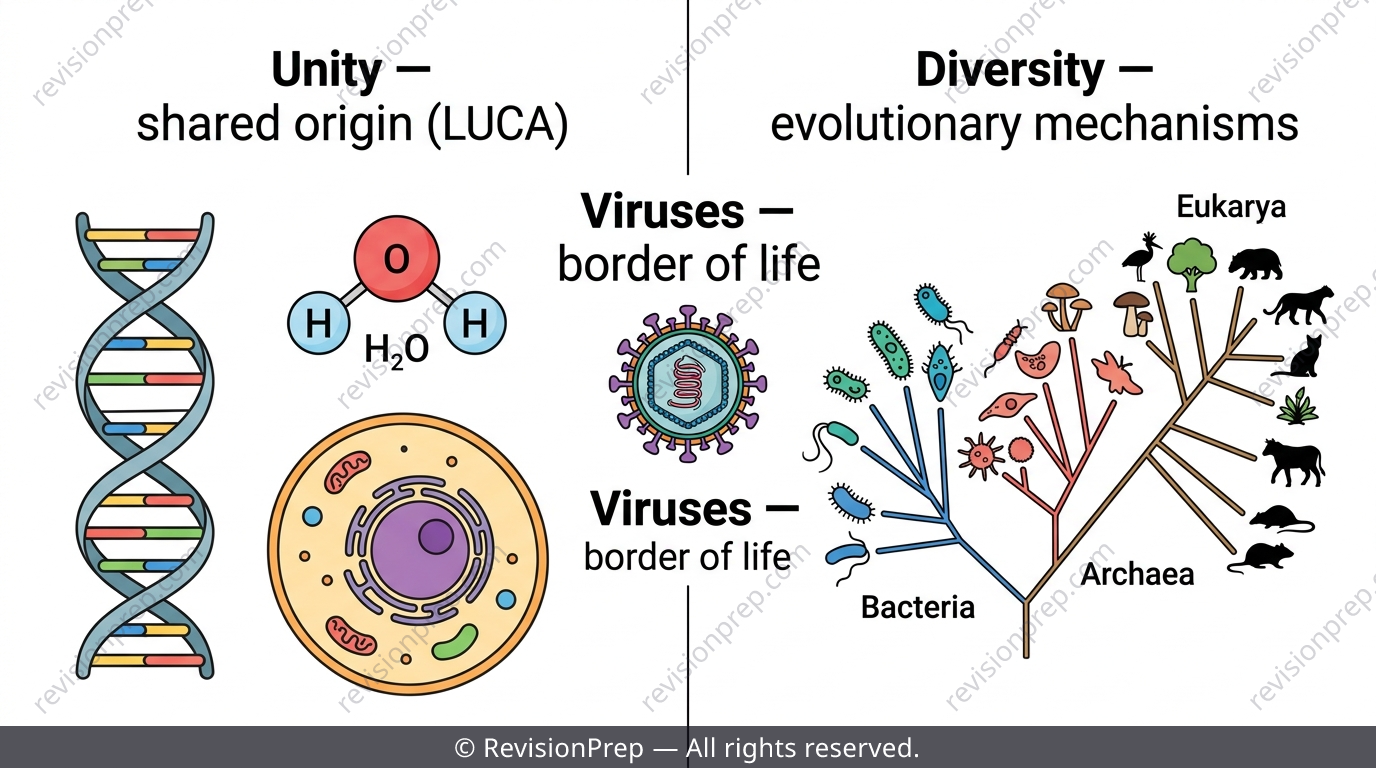
IB DP Biology's Unity and Diversity theme runs on one simple logic: every organism shares deep molecular unity (the universal genetic code, DNA/RNA chemistry, cell theory) because all life traces back to a single common ancestor, LUCA — yet mechanisms like mutation, selection and isolation have generated staggering diversity across three domains and millions of species. Viruses complicate the picture because they fail the cell theory test entirely, making them a favourite exam topic. Water's hydrogen-bonding chemistry ties the whole theme together, explaining everything from transpiration to temperature buffering. This teaser covers the five ideas examiners return to again and again — unity vs diversity, virus structure, viral genome types, lytic/lysogenic cycles and antiviral drugs, and water's life-sustaining properties — before pointing you to the full revision notes for the HL mechanistic depth (Hardy–Weinberg maths, magnification calculations, endosymbiotic evidence).
What you’ll be able to do
Unity vs Diversity: the big picture
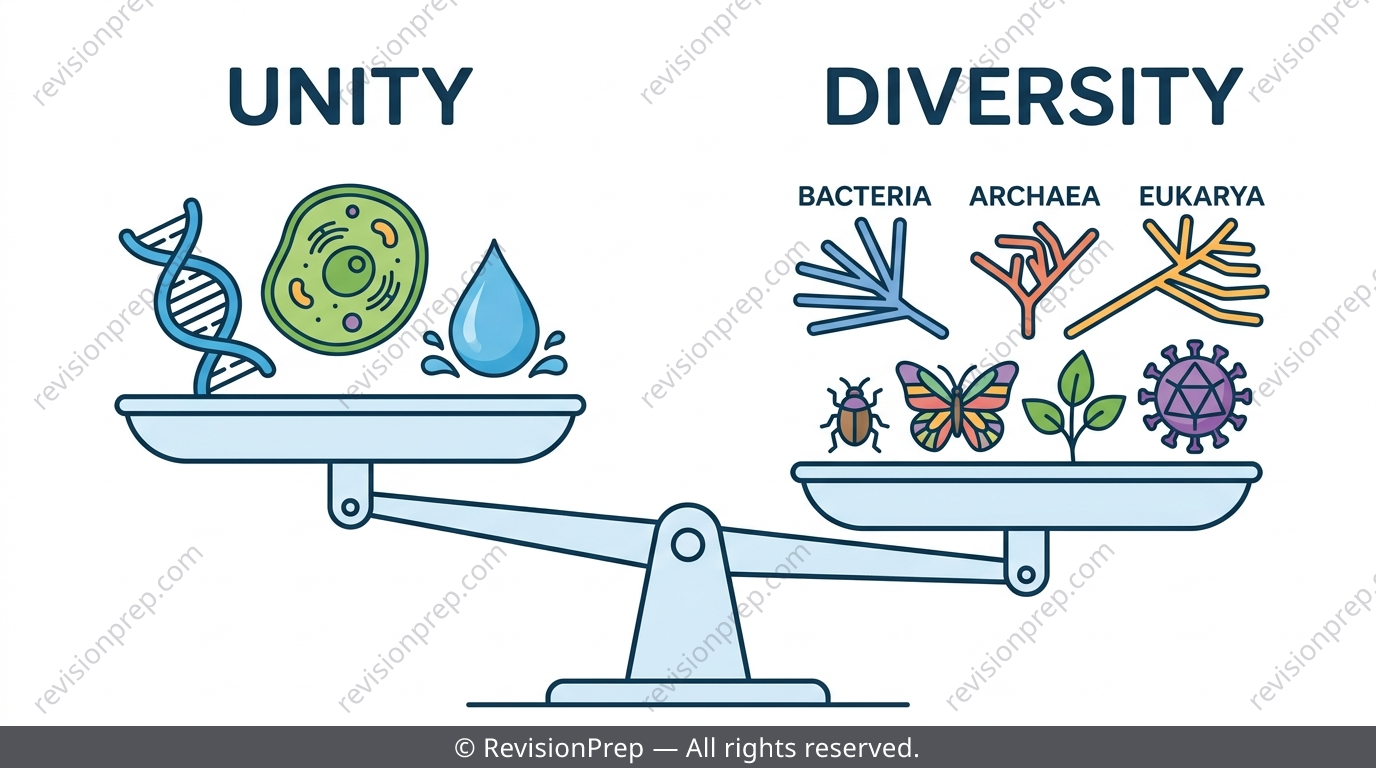
Unity evidence — the universal genetic code, shared DNA/RNA chemistry, cell theory, and water as the universal solvent — all point to a single origin of life (LUCA). Diversity evidence — three domains, millions of species, viral genome variety and adaptive radiations — shows what evolutionary mechanisms did with that shared starting material. Every exam question in this theme is really asking you to place a fact on one side of this line or the other.
Exam tip
If a question asks 'what does X tell us about the history of life?', decide first whether X is evidence of shared ancestry (unity) or evidence of divergence (diversity) before you write anything.
Mini summary
Unity = shared features proving common ancestry; diversity = mechanisms that generated variation from that shared start.
Viruses: acellular particles on the border of life
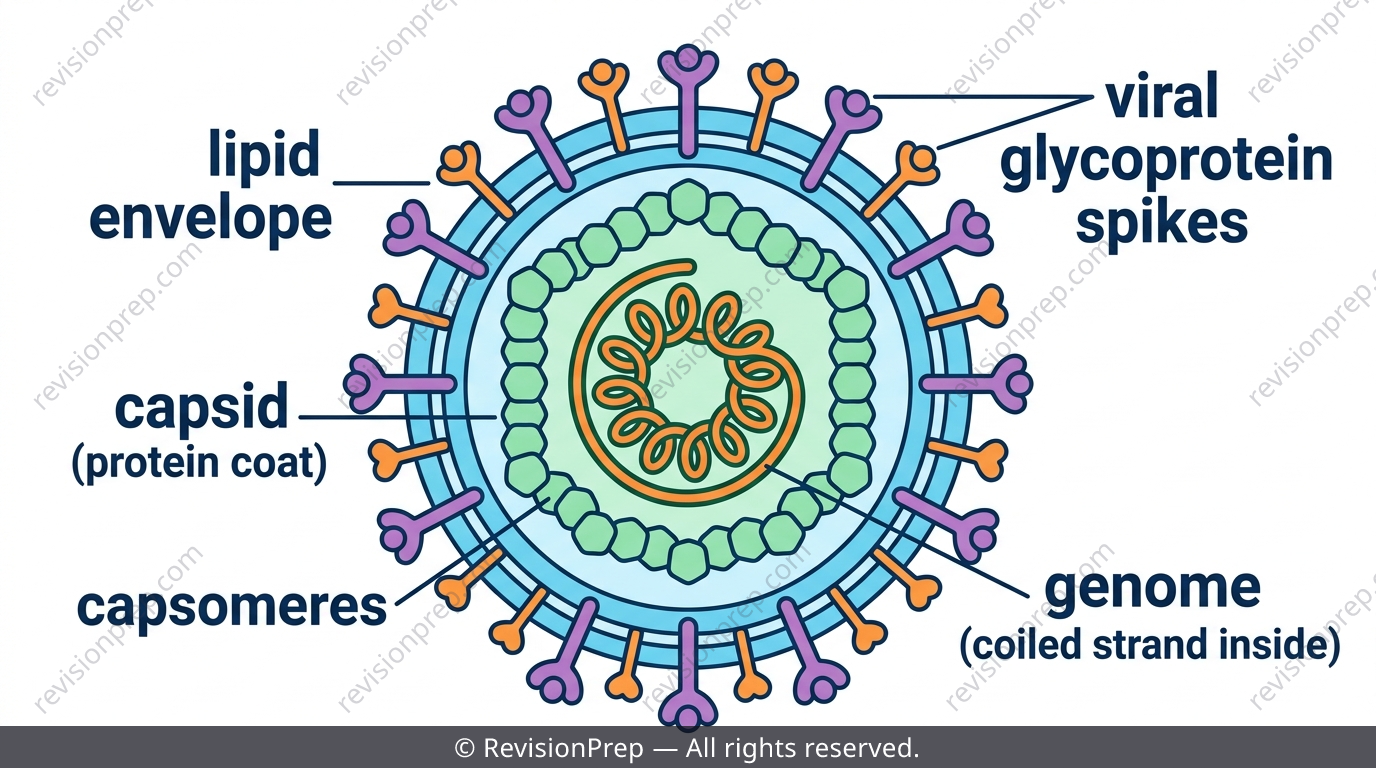
A virus is just a genome wrapped in a protein capsid (built from repeating capsomeres), sometimes with a lipid envelope stolen from the host and studded with viral glycoproteins. With no ribosomes, no metabolism and no independent reproduction, viruses completely hijack host machinery — which is exactly why they fail the cell theory test.
Common mistake
Assuming vaccine mRNA gets reverse-transcribed and integrated into the genome for 'continuous' spike production — instead, muscle cells transiently translate the mRNA, present spike peptides via MHC, and generate memory B/T cells for long-term protection.
Viral genome diversity dictates the first step
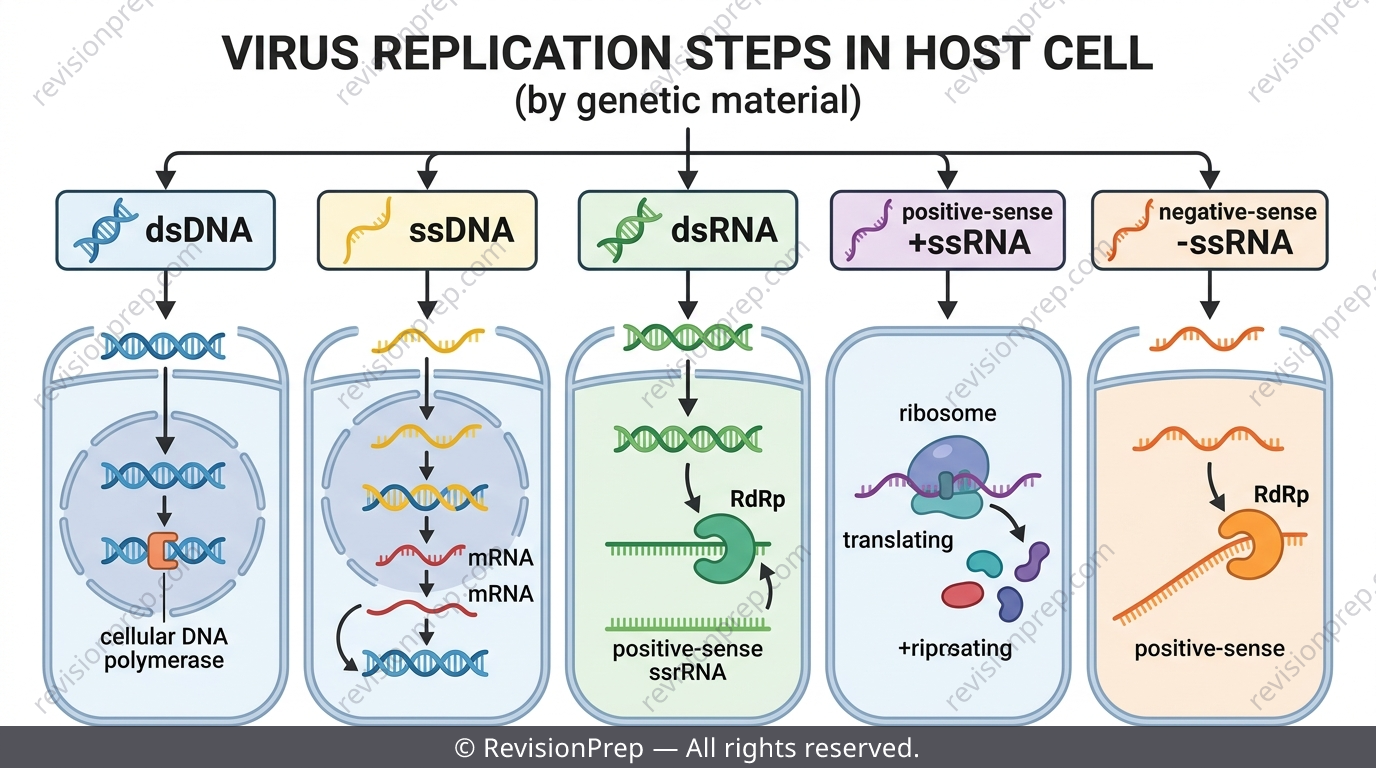
Viral genomes come as dsDNA, ssDNA, dsRNA, positive-sense ssRNA (+), or negative-sense ssRNA (−) — and genome type determines what has to happen the moment the virus enters a host. Positive-sense ssRNA genomes ARE mRNA, so host ribosomes translate them immediately. Negative-sense ssRNA and dsRNA genomes need a packaged viral RNA-dependent RNA polymerase (RdRp) to make mRNA first, while retroviruses like HIV run the process backwards: reverse transcriptase builds dsDNA from the RNA genome, and integrase inserts it into the host chromosome as a provirus.
| Genome type | First step in host |
|---|---|
| (+)ssRNA | Translated directly by host ribosomes |
| (−)ssRNA / dsRNA | Needs packaged RdRp to make mRNA |
| Retrovirus (ssRNA) | Reverse transcriptase makes dsDNA, then integrase inserts it |
Common mistake
In a cell-free translation system with no viral enzymes, dsRNA produces no protein NOT because of degradation, but because there's no RdRp to make mRNA from it — read the question for the 'no viral enzymes' clue.
Lytic vs lysogenic cycles and antiviral drug targets
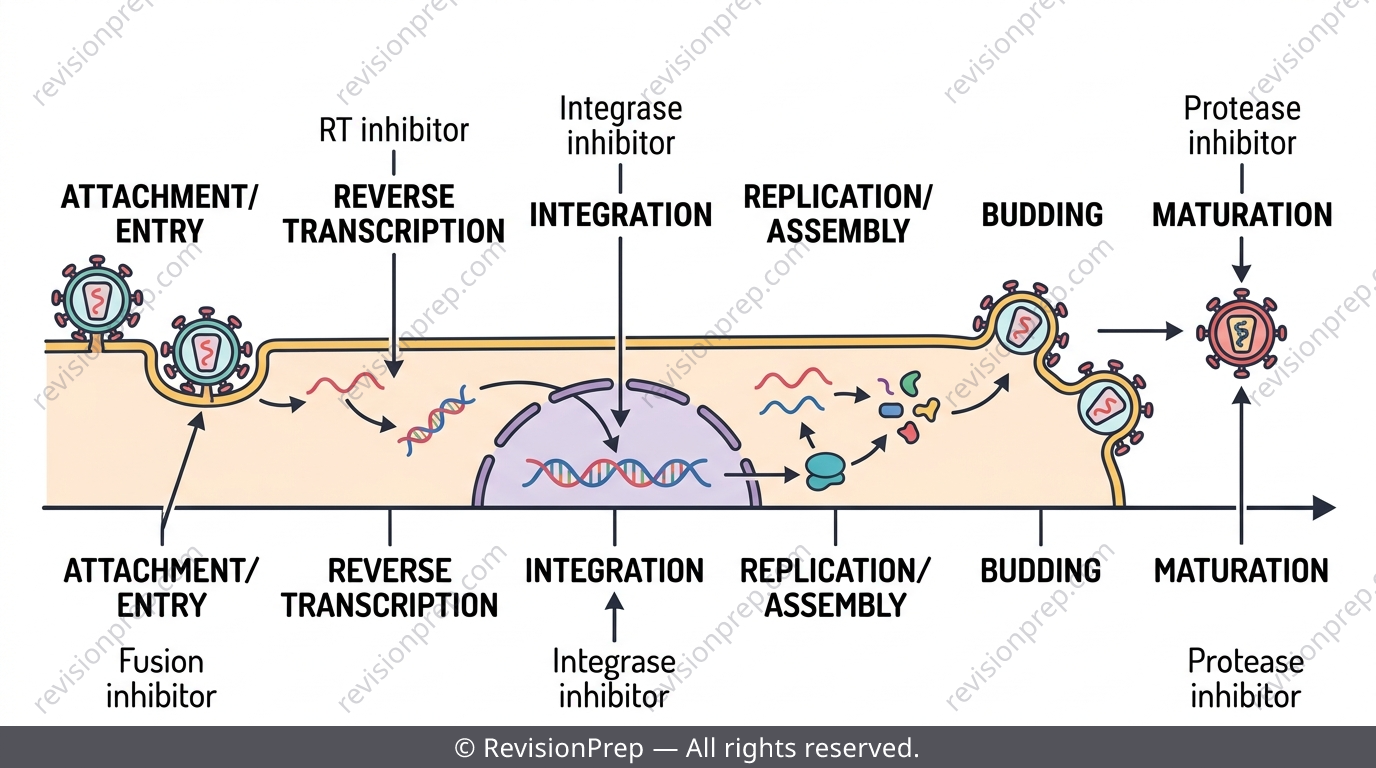
In a lytic cycle the host cell is killed on release of new virions; in a lysogenic cycle the viral genome integrates as a dormant prophage (or provirus in HIV) and replicates passively with the host. Antiviral drugs are exam favourites because each targets one exact stage: fusion inhibitors block entry, reverse transcriptase inhibitors block DNA formation, integrase inhibitors block genome insertion, and protease inhibitors block maturation AFTER budding — meaning immature virions still form and release, just non-infectious.
Exam tip
Name the exact stage a drug blocks and nothing else. Placing a protease inhibitor's effect at 'entry' instead of 'maturation after budding' is a common one-mark loss.
Mini summary
Lytic kills fast; lysogenic hides first. Match each antiviral drug to its precise stage — don't lump them all together as 'blocking entry'.
Water: one cause, five life-sustaining properties
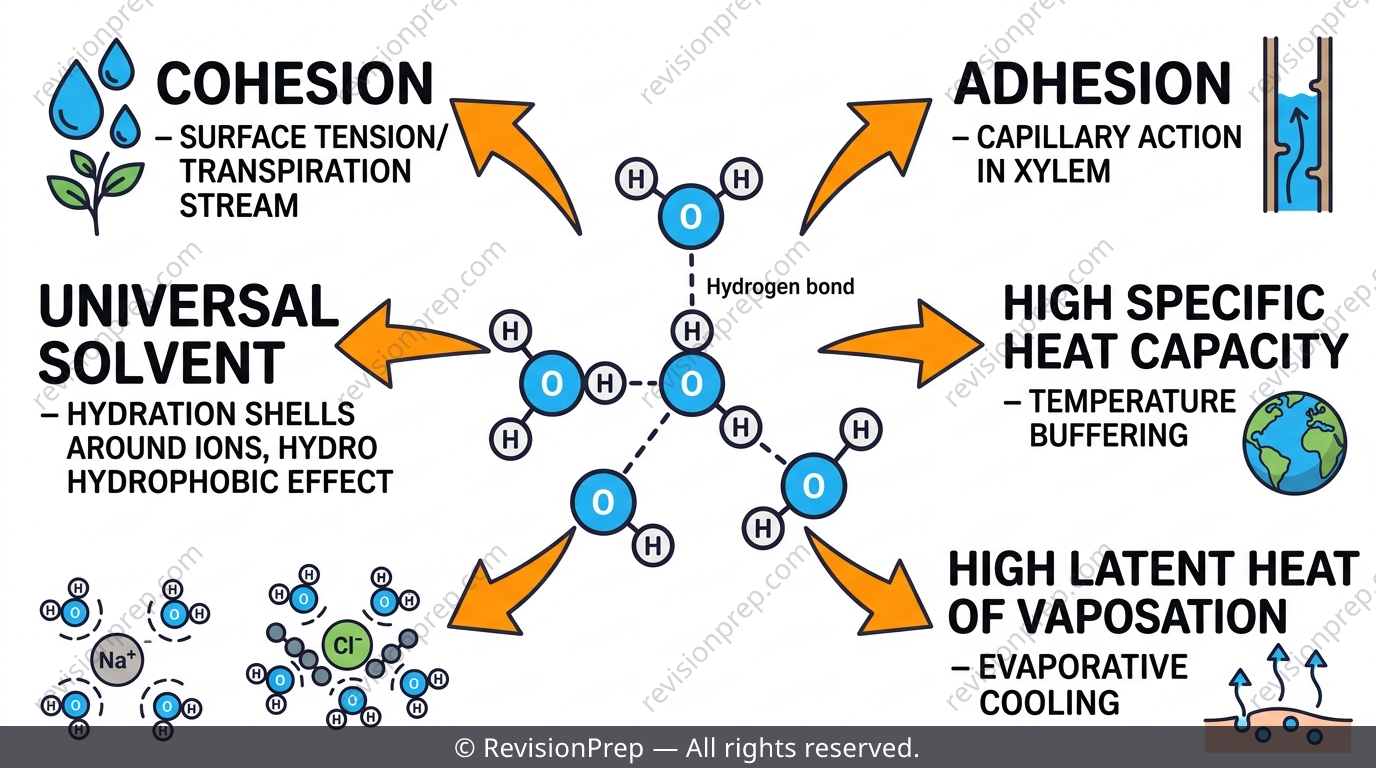
Water's bent shape (~104.5°) creates partial charges on O and H, letting each molecule hydrogen bond to up to four neighbours — the source of every 'special property' examiners ask about. Cohesion (water-water bonds) drives surface tension and the transpiration stream; adhesion (water-other polar surface) drives capillary action in xylem. High specific heat capacity and high latent heat of vaporisation buffer temperature and enable evaporative cooling, while water's polarity makes it an excellent solvent for polar/ionic substances but excludes non-polar ones, underpinning the hydrophobic effect in membranes.
Exam tip
For any 'explain a property of water' question, always give three links: name the property, cite hydrogen bonding as the cause, then state the functional consequence for the organism — skipping the third link is the most common lost mark.
Common mistake
Mixing up cohesion (water-water) and adhesion (water-xylem wall) when explaining capillary action — keep them as two separate mechanisms in any transpiration answer.
Quick formula sheet
Practice questions
- State two pieces of evidence used to support a single common ancestor for all life.
- Explain why viruses are not classified as living organisms according to cell theory.
- Name the property of water responsible for surface tension.
- Distinguish between the first replication step of a positive-sense ssRNA virus and a negative-sense ssRNA virus.
- Explain the difference between a lytic and a lysogenic cycle using an appropriate example.
- Explain why water has a high specific heat capacity and why this matters for aquatic organisms.
- A retrovirus's genome is added to a cell-free system with ribosomes but no reverse transcriptase. Predict and explain the outcome for viral protein production.
- Explain why a protease inhibitor still allows non-infectious virions to be released, using the correct stage of the viral life cycle.
- Using cohesion and adhesion, explain how water moves against gravity through a narrow xylem vessel.
Frequently asked questions
Why aren't viruses considered living organisms in IB Biology?+
Viruses have no ribosomes, no independent metabolism, and cannot reproduce without hijacking a host cell's machinery — they fail the core requirements of cell theory.
What's the difference between positive-sense and negative-sense ssRNA viruses?+
Positive-sense ssRNA genomes act directly as mRNA and are translated immediately by host ribosomes. Negative-sense ssRNA genomes need a viral RNA-dependent RNA polymerase to first make mRNA before translation can occur.
How does a retrovirus like HIV replicate differently from other RNA viruses?+
Retroviruses use reverse transcriptase to convert their ssRNA genome into dsDNA, which integrase then inserts into the host chromosome as a provirus — running the central dogma backwards.
What's the difference between cohesion and adhesion in water?+
Cohesion is the attraction between water molecules themselves (due to hydrogen bonding), driving surface tension and the transpiration stream. Adhesion is the attraction between water and a different polar surface, like cellulose in xylem walls, driving capillary action.
Which exact stage does a protease inhibitor drug block?+
Protease inhibitors block maturation, which happens after budding — so immature virions still form and are released, but they are non-infectious.
How much of the IB Biology exam covers Unity and Diversity?+
It's roughly a fifth of total teaching hours and appears across Paper 1 data-based/MCQ questions, Paper 2 structured and essay questions, and Paper 3 HL synthesis questions.
Master Unity and Diversity with the full DP Biology notes
Related articles