
Form and Function
Every structure exists to solve a problem — learn to spot the problem and the exam answer follows
Quick facts
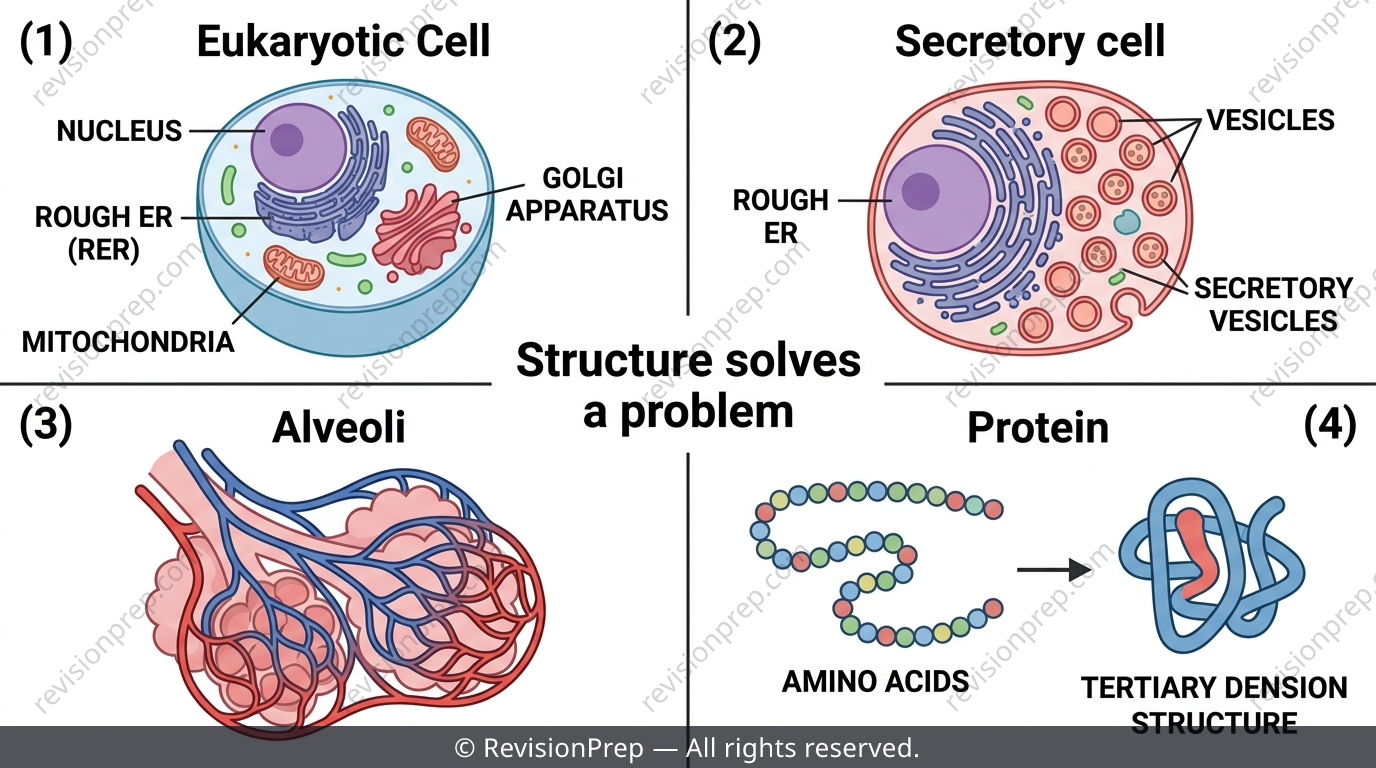
In IB DP Biology, form and function is the thread that ties the whole cells-and-molecules theme together: structure exists because it solves a specific physical problem. This core theme shows up constantly in Paper 1 data questions and Paper 2 structured responses, so examiners love testing whether you can link an organelle, a cell type or a body surface to the exact job it does. Understanding compartmentalization explains why cells package incompatible reactions into separate organelles, while cell specialization shows how identical DNA produces wildly different organelle profiles. Gas exchange surfaces reveal how structure maximises diffusion rate when distance alone would be too slow. Master these five ideas and you'll be able to reason through unfamiliar exam scenarios instead of memorising isolated facts — exactly what IB Biology rewards.
What you’ll be able to do
The Big Idea: Structure Solves a Problem
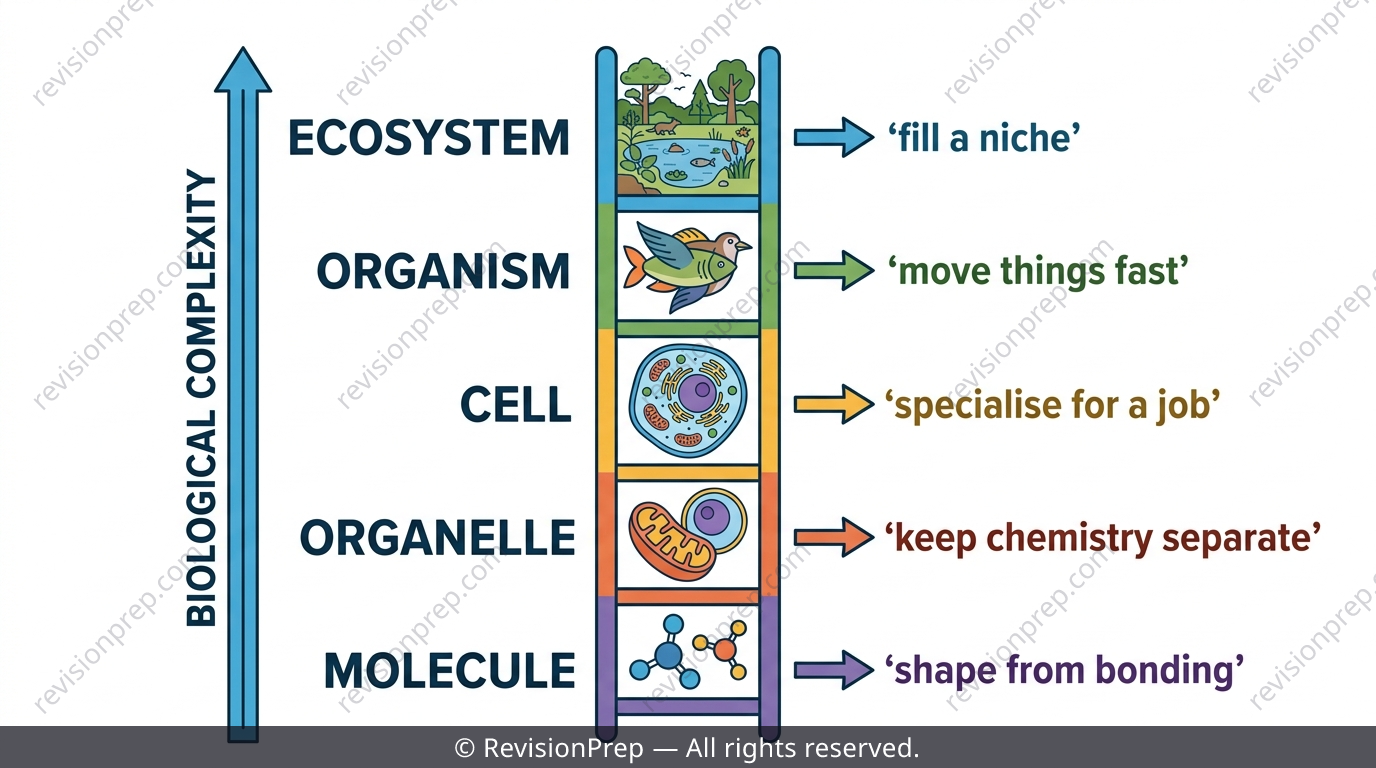
Every structure in this theme — from a single organelle to a whole gas exchange surface — exists because it solves a defined physical problem. Cells need to keep incompatible chemistry apart, organisms need to move substances faster than diffusion alone allows, and molecules need shapes that match their bonding pattern. Once you can state the problem a structure solves, most exam questions become straightforward description rather than guesswork.
Mini summary
State the problem a structure solves, and the function usually follows directly.
Organelles and Compartmentalization
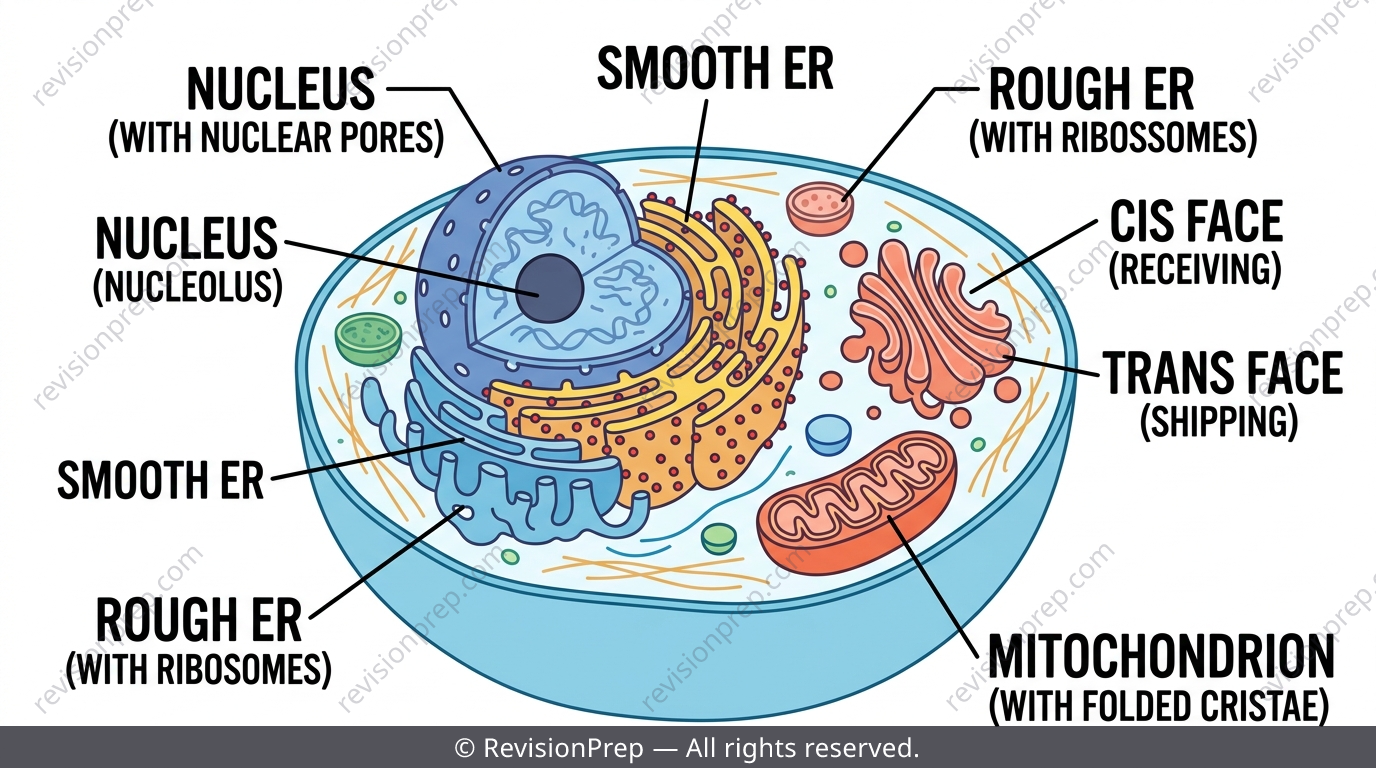
A eukaryotic cell runs thousands of reactions at once, many of which would destroy each other if mixed — lysosomal enzymes would digest cytosolic proteins, and the alkaline chloroplast stroma would disrupt cytosolic pH. Membrane-bound organelles solve this by giving each process its own sealed environment with its own pH, enzymes and ion concentrations. Key players: the nucleus (DNA storage, pores control mRNA/protein traffic), rough ER (protein synthesis and folding), smooth ER (lipid synthesis, detox), Golgi apparatus (modifies and packages proteins, cis to trans face), and mitochondria (folded cristae house the electron transport chain for ATP synthesis).
| Organelle | Key structural feature | Main job |
|---|---|---|
| Nucleus | Double envelope with nuclear pore complexes | DNA storage, transcription, controls macromolecule traffic |
| Rough ER | Ribosome-studded membrane | Translates and folds proteins for secretion/membranes |
| Smooth ER | No ribosomes | Lipid/steroid synthesis, detoxification |
| Golgi apparatus | Stacked membranes, cis and trans faces | Modifies (e.g. glycosylation) and packages proteins |
| Mitochondria | Double membrane, folded cristae | Houses electron transport chain, drives ATP synthase |
Exam tip
If asked which process is 'most immediately' disrupted, pick the very first step that fails — faulty nuclear pores block mRNA export first, not transcription itself.
Common mistake
Don't assume a cell without mitochondria (e.g. a prokaryote) can't do an electron transport chain at all — prokaryotes couple their ETC to the plasma membrane instead, since it's the internal membrane compartment that's missing, not the whole process.
Mini summary
Compartmentalization = separate membrane-bound environments so incompatible reactions don't interfere.
The Secretory Pathway: A Protein's Journey
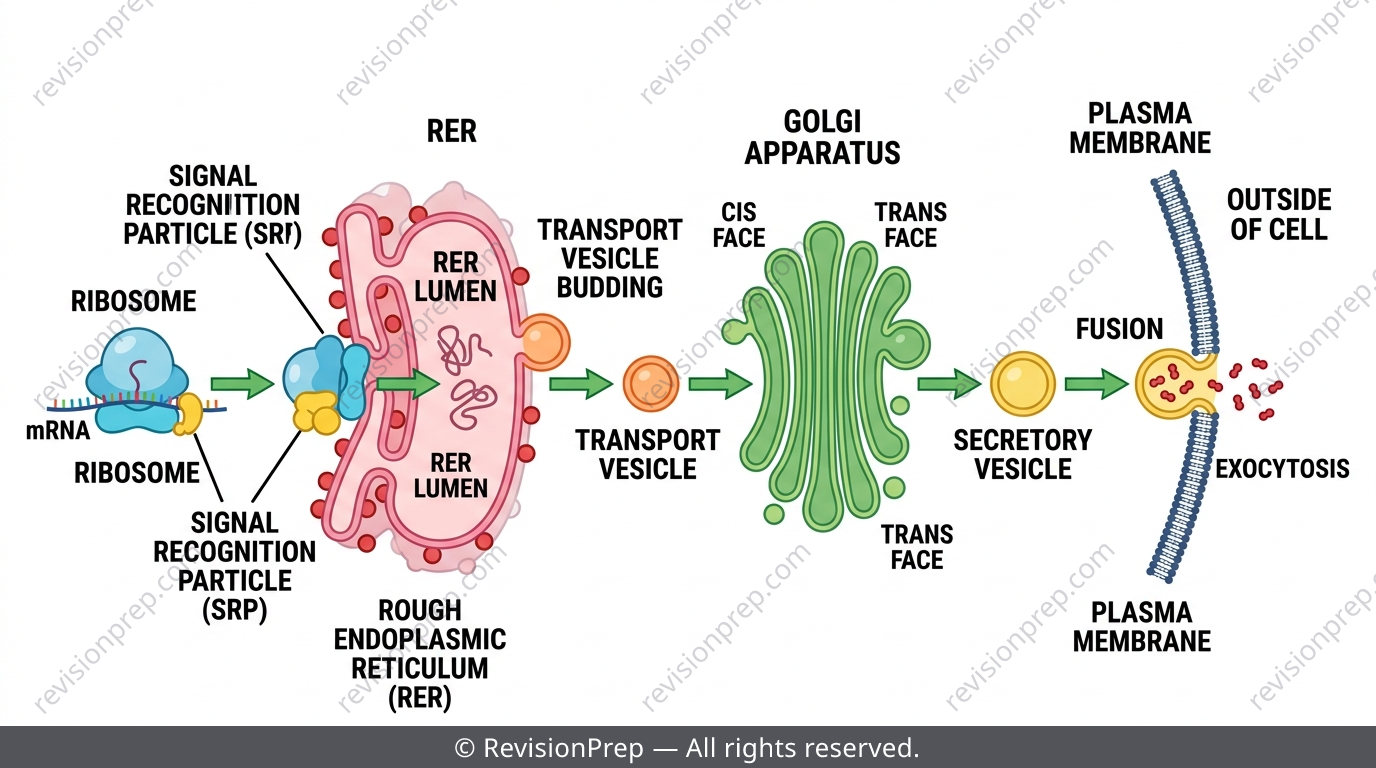
IB loves testing the fixed route a secreted protein takes: ribosome → RER lumen → transport vesicle → Golgi (cis to trans face) → secretory vesicle → exocytosis at the plasma membrane. Getting into the RER in the first place depends on a signal recognition particle (SRP), which binds a signal sequence on the growing polypeptide and pauses translation until the ribosome docks onto the RER membrane — this is co-translational translocation.
Common mistake
In a question about a drug blocking SRP-mediated translocation, don't assume a nuclear transcription factor is affected just because 'nucleus' sounds membrane-related — only proteins using the RER–Golgi pathway are disrupted; free-ribosome proteins are unaffected.
Mini summary
SRP-mediated translocation gets a protein INTO the RER; block it, and secreted proteins get stuck in the cytosol.
Cell Specialization: Organelle Profiles as a CV
Every cell shares the same genome, but differentiation switches genes on or off so cells build different organelle inventories matched to their job. A secretory cell (pancreatic cell, plasma cell) is packed with RER, Golgi and secretory vesicles; an adipocyte is dominated by lipid droplets with little RER; a macrophage is rich in lysosomes rather than secretory machinery. Stem cell potency ranges from totipotent (any cell type, including extra-embryonic tissue) through pluripotent (any body cell) to multipotent (a limited lineage, e.g. blood stem cells).
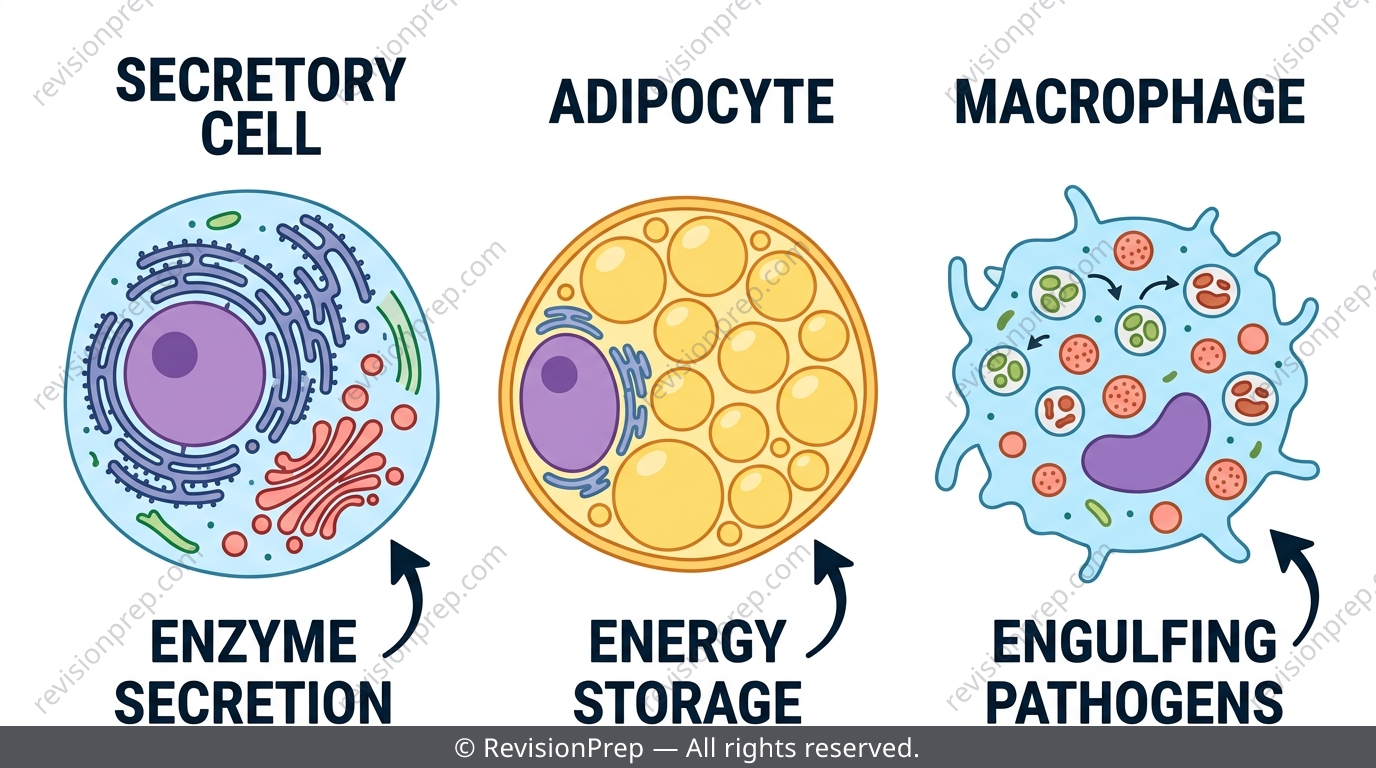
| Cell type | Dominant organelles | Job the organelles reveal |
|---|---|---|
| Pancreatic/plasma cell | RER, Golgi, secretory vesicles | Large-scale protein secretion (enzymes/antibodies) |
| Adipocyte | Lipid droplets, little RER/Golgi | Energy storage, not protein export |
| Macrophage | Many lysosomes | Digesting engulfed material (phagocytosis) |
Common mistake
Never write 'lots of mitochondria means the cell is very active' without naming the process — say what the ATP is used for, e.g. 'many mitochondria supply ATP for flagellar movement in a sperm cell.'
Mini summary
Read organelle abundance AND absence together to identify a cell's specialised function on a micrograph.
Gas Exchange Surfaces: Built for Speed
Diffusion alone is too slow to supply a large organism with oxygen, so gas exchange surfaces are structurally optimised: large surface area (millions of alveoli, roughly a tennis court's worth of surface), short diffusion distance (alveolar and capillary walls each one cell thick, pressed together), a steep concentration gradient maintained by continuous ventilation and blood flow, and a moist surface for gases to dissolve into before crossing.
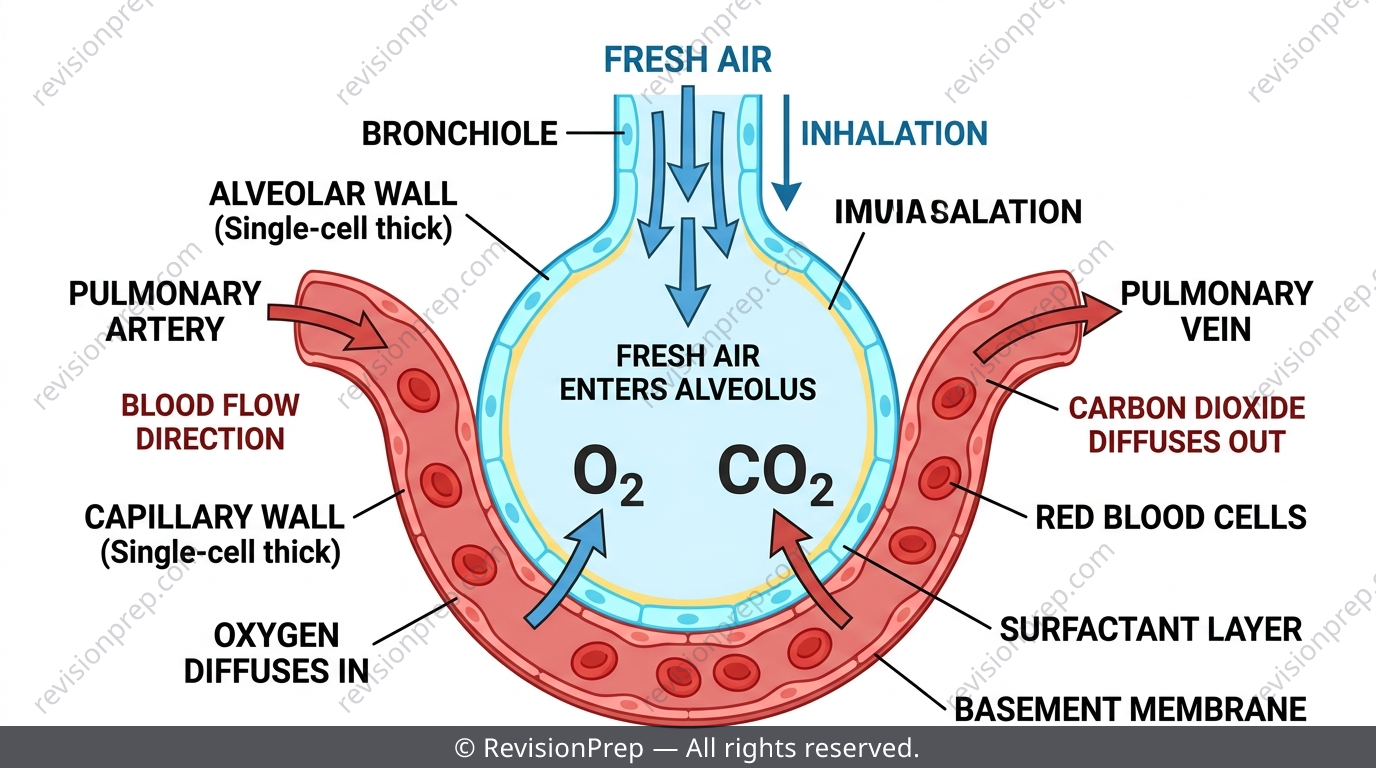
Exam tip
When explaining why the gradient stays steep, mention BOTH sides: fresh air keeps arriving (ventilation) and oxygenated blood keeps leaving while deoxygenated blood keeps arriving (circulation) — one-sided answers lose marks.
Mini summary
Rate of diffusion increases with surface area and concentration gradient, and decreases with diffusion distance.
Quick formula sheet
Practice questions
- Name the organelle where proteins are folded and modified before secretion, and state one feature of its structure.
- State two structural features of alveoli that increase the rate of gas exchange.
- Define compartmentalization and give one reason it is necessary in eukaryotic cells.
- Outline the sequence of the secretory pathway from ribosome to exocytosis.
- Explain why a macrophage would have many lysosomes but few Golgi apparatuses compared with a pancreatic secretory cell.
- Explain why blocking nuclear pore function would disrupt mRNA export but not necessarily transcription.
- A drug blocks SRP function in liver cells. Predict which of two named proteins — a secreted digestive enzyme or a cytosolic transcription factor — would accumulate abnormally, and justify your answer.
- Using the relationship between surface area, diffusion distance and concentration gradient, explain how continuous ventilation and blood flow maintain a steep gradient in the lungs.
- A prokaryote lacks mitochondria yet respires aerobically. Explain how it can still generate ATP via an electron transport chain.
Frequently asked questions
What is compartmentalization and why do cells need it?+
Compartmentalization is dividing a cell into membrane-bound regions with distinct internal environments, so incompatible or specialised chemical processes (like lysosomal digestion versus cytosolic reactions) can happen at the same time without interfering with each other.
What is the correct order of the secretory pathway?+
Ribosome → RER lumen → transport vesicle → Golgi apparatus (cis to trans face) → secretory vesicle → exocytosis at the plasma membrane.
What is the difference between totipotent, pluripotent and multipotent stem cells?+
Totipotent cells can become any cell type including extra-embryonic tissue, pluripotent cells can become any body cell type, and multipotent cells are limited to a narrower range within one lineage, such as blood stem cells.
How do alveoli maximize the rate of gas exchange?+
They provide a huge total surface area, extremely thin walls that minimise diffusion distance, a moist surface for gases to dissolve in, and a steep concentration gradient kept up by continuous ventilation and blood flow.
Why can prokaryotes still make ATP without mitochondria?+
Prokaryotes lack the internal membrane compartment that forms mitochondrial cristae, but many still run an electron transport chain — they just couple it to the plasma membrane instead of a folded inner membrane.
How can I tell a cell's function just from its organelles?+
Read the organelle profile like a CV: lots of RER/Golgi/secretory vesicles signals a secretory cell, lots of lysosomes signals a phagocytic cell, and lipid droplets with little RER/Golgi signals an energy-storage cell like an adipocyte.
Get the full IB DP Biology notes on Form and Function
Related articles