
Models of the Particulate Nature of Matter
The IB DP Chemistry foundation topic behind almost every calculation question on Papers 1 and 2
Quick facts
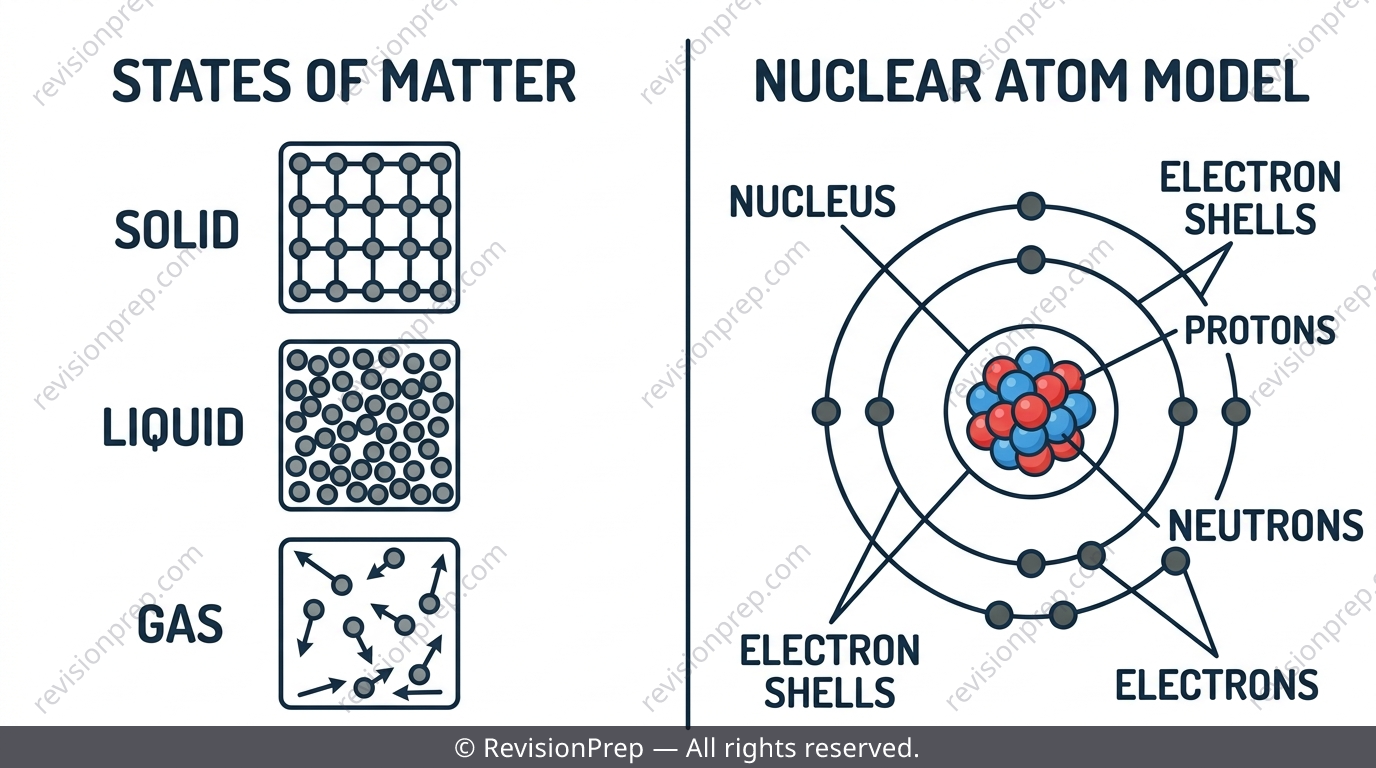
Structure 1 is where IB DP Chemistry builds its particle model from the ground up, and it quietly reappears in almost every calculation question you'll face on Papers 1 and 2. This topic moves from the kinetic molecular theory explaining solids, liquids and gases, through Dalton's atomic theory and the modern evidence that revised it, into the nuclear atom, isotopes, relative atomic mass, mass spectrometry, and electron configuration. Examiners love testing whether you can match specific evidence to specific Dalton postulates, and whether you truly understand relative atomic mass as a weighted mean rather than a simple average. Get these five ideas solid and you'll have the conceptual backbone for isotopes, bonding, and gas calculations throughout the whole course. This teaser hits the key ideas — the full revision notes go much deeper with worked examples and HL detail.
What you’ll be able to do
Kinetic Molecular Theory & States of Matter
The kinetic molecular theory (KMT) models matter as particles in constant motion whose average kinetic energy is proportional to absolute temperature. Whether a substance is solid, liquid or gas depends on the balance between that kinetic energy and the attractive forces between particles: strong attraction relative to KE gives a solid, high KE relative to attraction gives a gas. Liquids sit in between — particles stay close together but have enough energy to flow past one another.
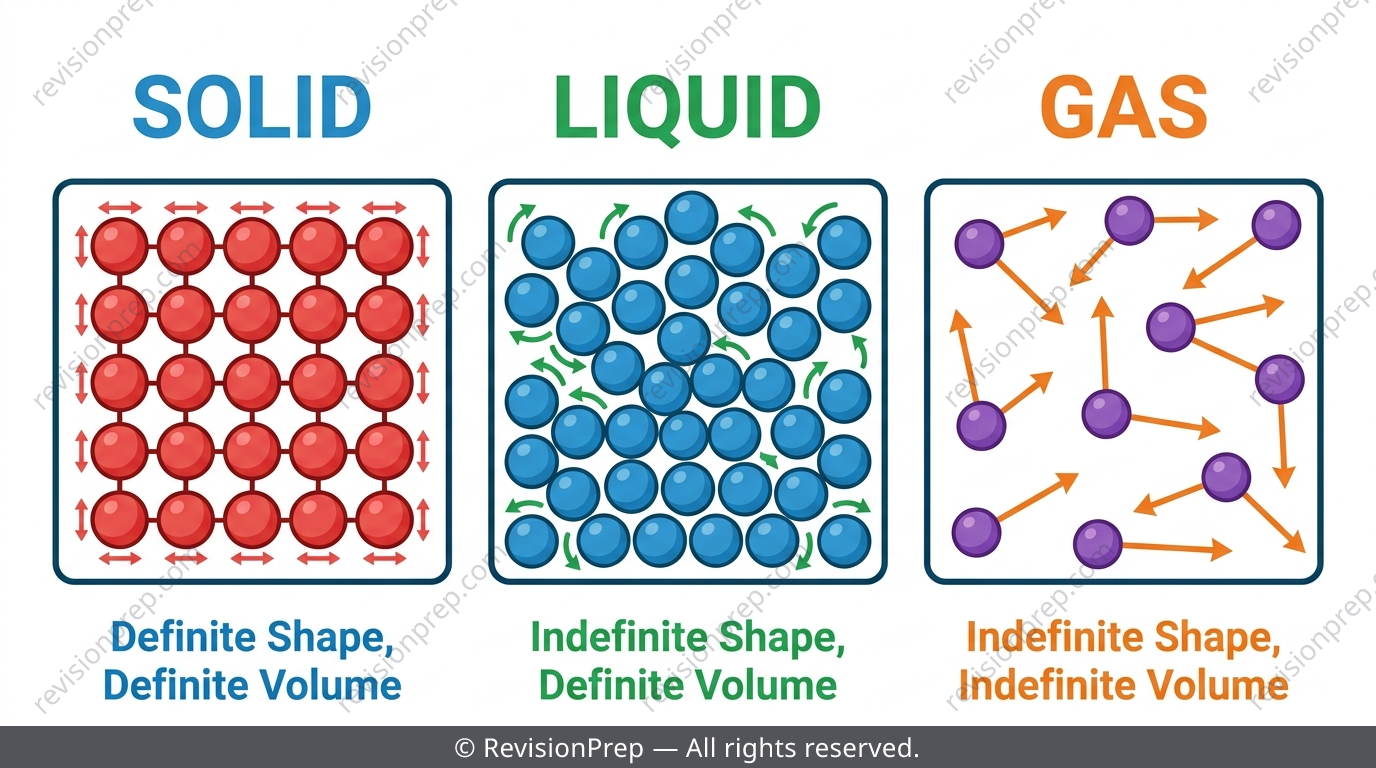
| Property | Solid | Liquid | Gas |
|---|---|---|---|
| Shape | Fixed | Takes shape of container | Fills container |
| Volume | Fixed | Fixed | Not fixed |
| Compressibility | Not compressible | Barely compressible | Highly compressible |
| Particle motion | Vibrate in place | Flow past each other | Move rapidly, independently |
Exam tip
A temperature plateau during heating means energy is overcoming intermolecular forces during a phase change, not adding extra kinetic energy — temperature only rises again once the change is complete.
Common mistake
Confusing liquids and gases because both lack a fixed shape. Always check volume too: fixed volume + flowing particles is uniquely a liquid.
Mini summary
State of matter depends on the balance between particle kinetic energy and interparticle attraction — not on particle mass or identity.
Dalton's Atomic Theory & Modern Evidence
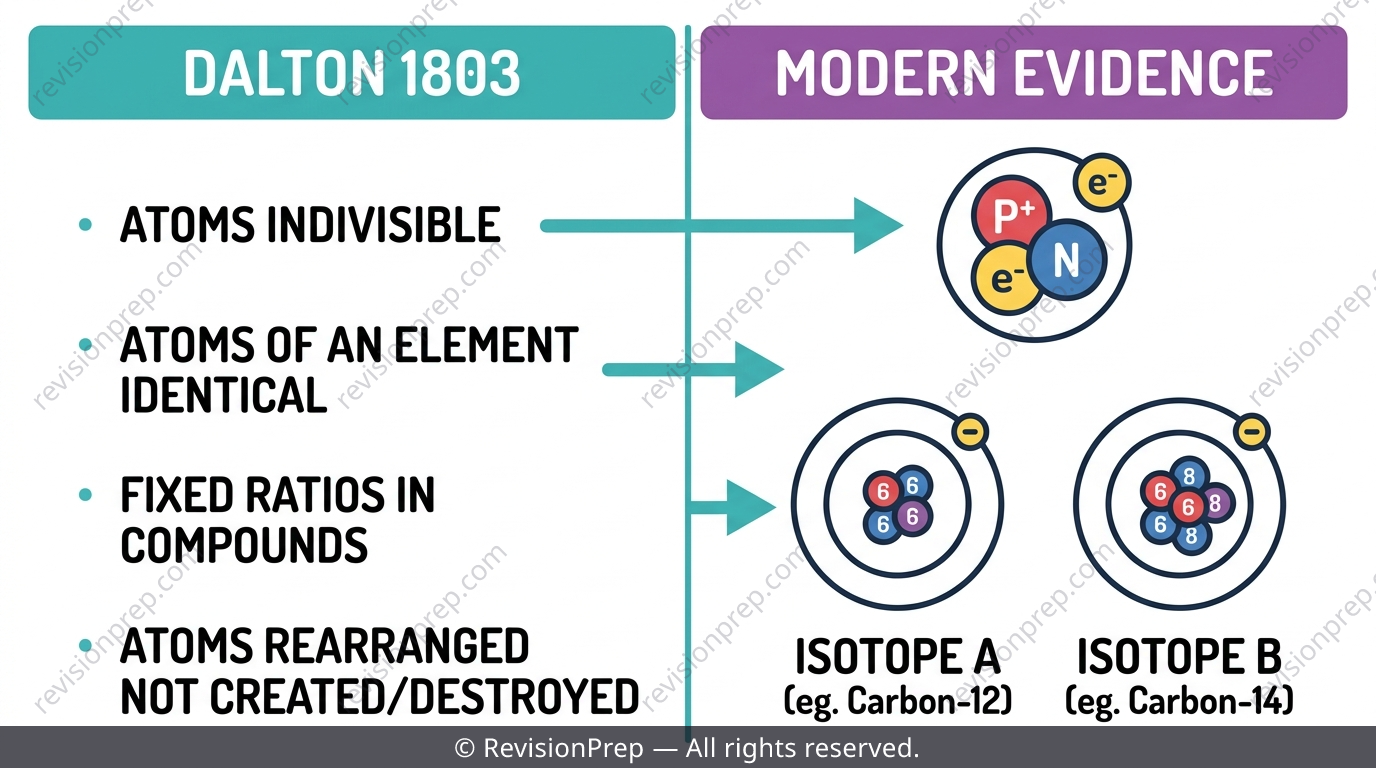
Dalton's 1803 model proposed that atoms are indivisible, all atoms of an element are identical, compounds form in fixed whole-number ratios, and atoms are rearranged (never created or destroyed) in reactions. Modern evidence has revised, not entirely discarded, this: subatomic particles show atoms are divisible, and isotopes show atoms of the same element are not all identical in mass. The ratio and conservation postulates still hold up well today.
Exam tip
When asked what contradicts a specific postulate, match it exactly. Isotopes contradict 'identical in mass'; subatomic particles/electrons contradict 'indivisible'. Mixing these two up is a classic trap.
Common mistake
Seeing 12 g of carbon become 44 g of CO2 and concluding mass was 'created'. In fact, oxygen atoms from the air combined with the carbon — atoms rearranged, none created or destroyed.
Mini summary
Dalton's theory survives mostly intact except for 'indivisible' and 'identical mass', both overturned by subatomic particle discovery and isotopes.
The Nuclear Atom, Isotopes & Relative Atomic Mass
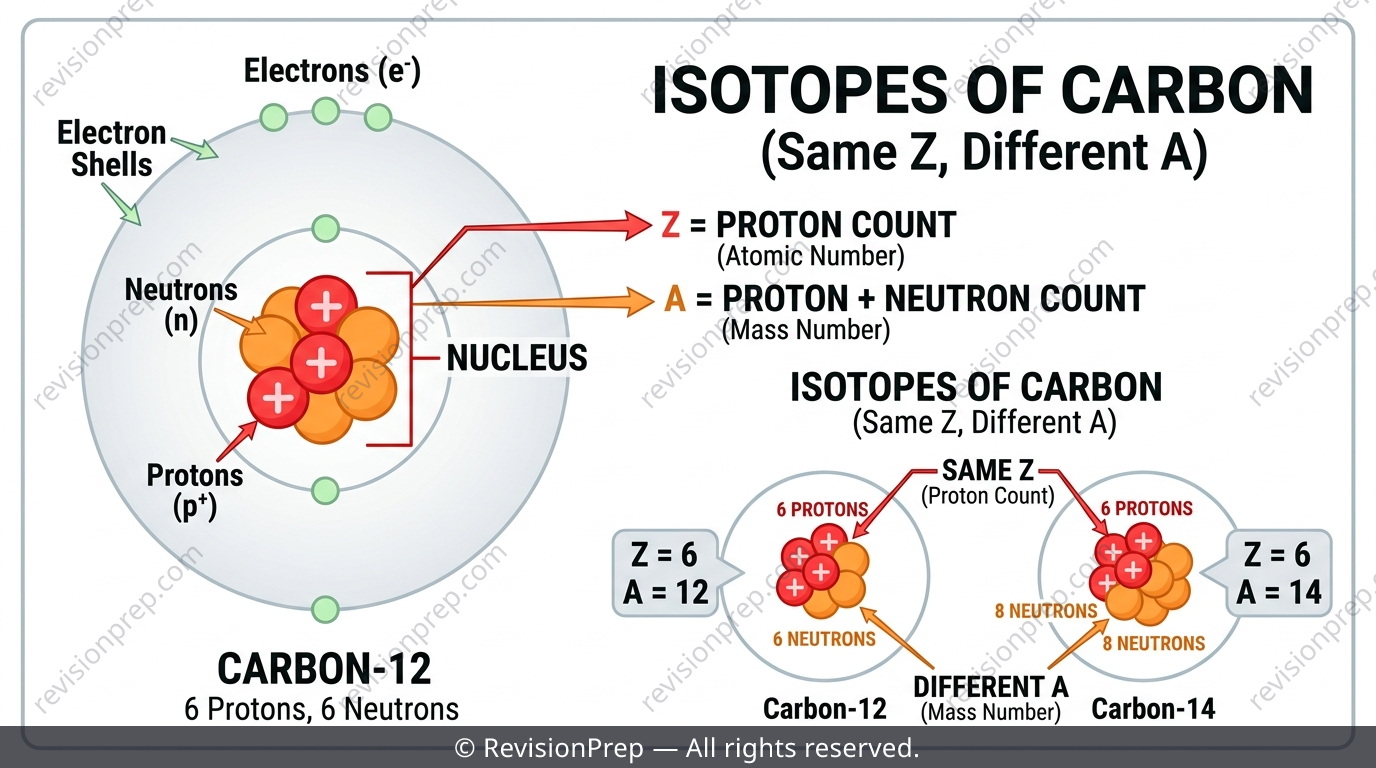
The nuclear model places almost all of an atom's mass in a tiny, dense, positively charged nucleus, with electrons in the space around it. Atomic number () is the proton count and defines the element; mass number () is protons plus neutrons and varies between isotopes of the same element. Relative atomic mass () is the abundance-weighted mean of all naturally occurring isotopes, relative to the mass of carbon-12 — never a simple average.
Exam tip
Always weight by percentage abundance. Averaging isotope masses only works in the rare case of an exact 50:50 split.
Common mistake
Calculating as for chlorine instead of weighting by 75% and 25% abundance — this is the single most common error in this section.
Mini summary
fixes the element; varies between isotopes; is always a weighted mean, never a plain average.
Mass Spectrometry
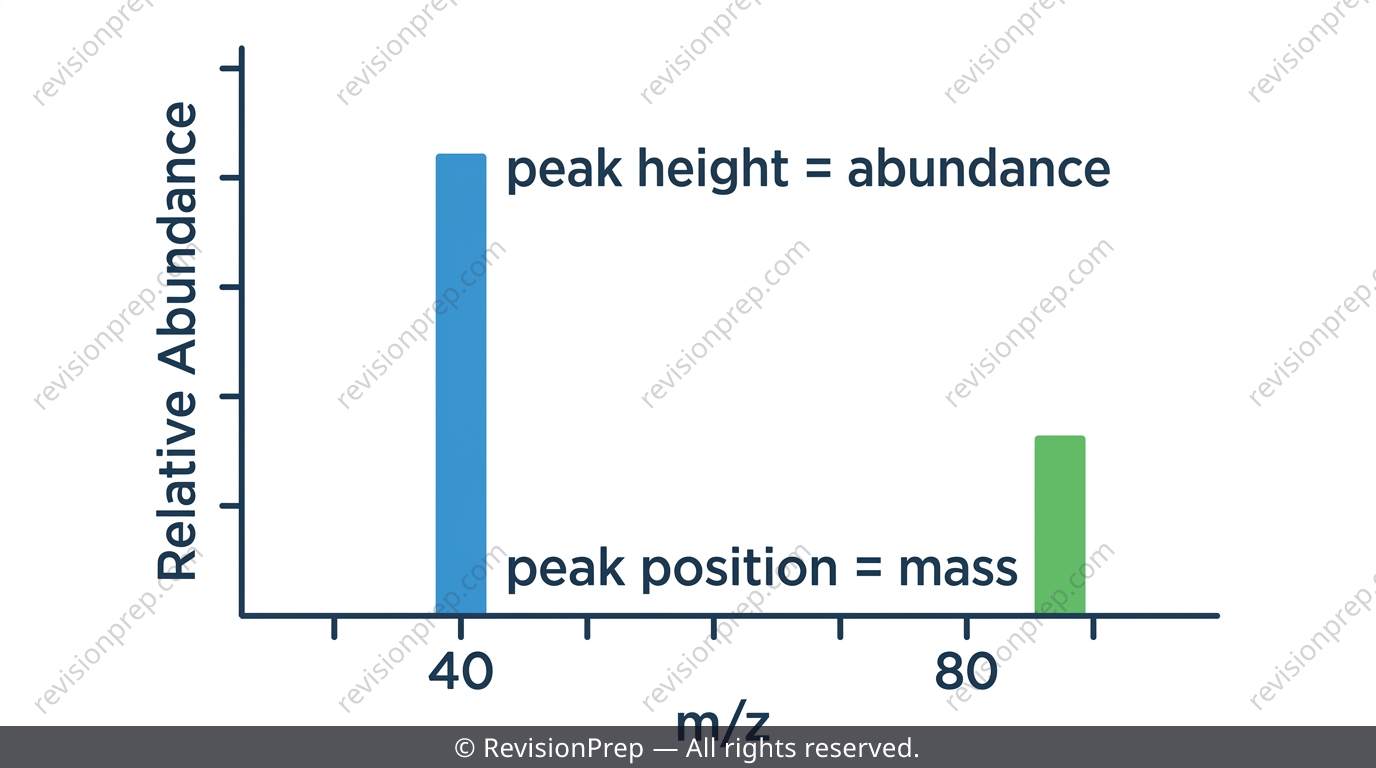
Mass spectrometry separates ions by mass-to-charge ratio (m/z), giving both the mass (peak position) and relative abundance (peak height) of each isotope directly from the spectrum. At HL, time-of-flight instruments accelerate ions through a potential difference and measure how long they take to cross a drift tube of known length, linking kinetic energy, acceleration and velocity.
Exam tip
Read peak position for isotope mass and peak height for relative abundance — you can often answer a mass spectrum question without doing any calculation at all.
Mini summary
A mass spectrum gives mass and abundance together; HL time-of-flight physics explains how ions are separated in the first place.
Electron Configurations
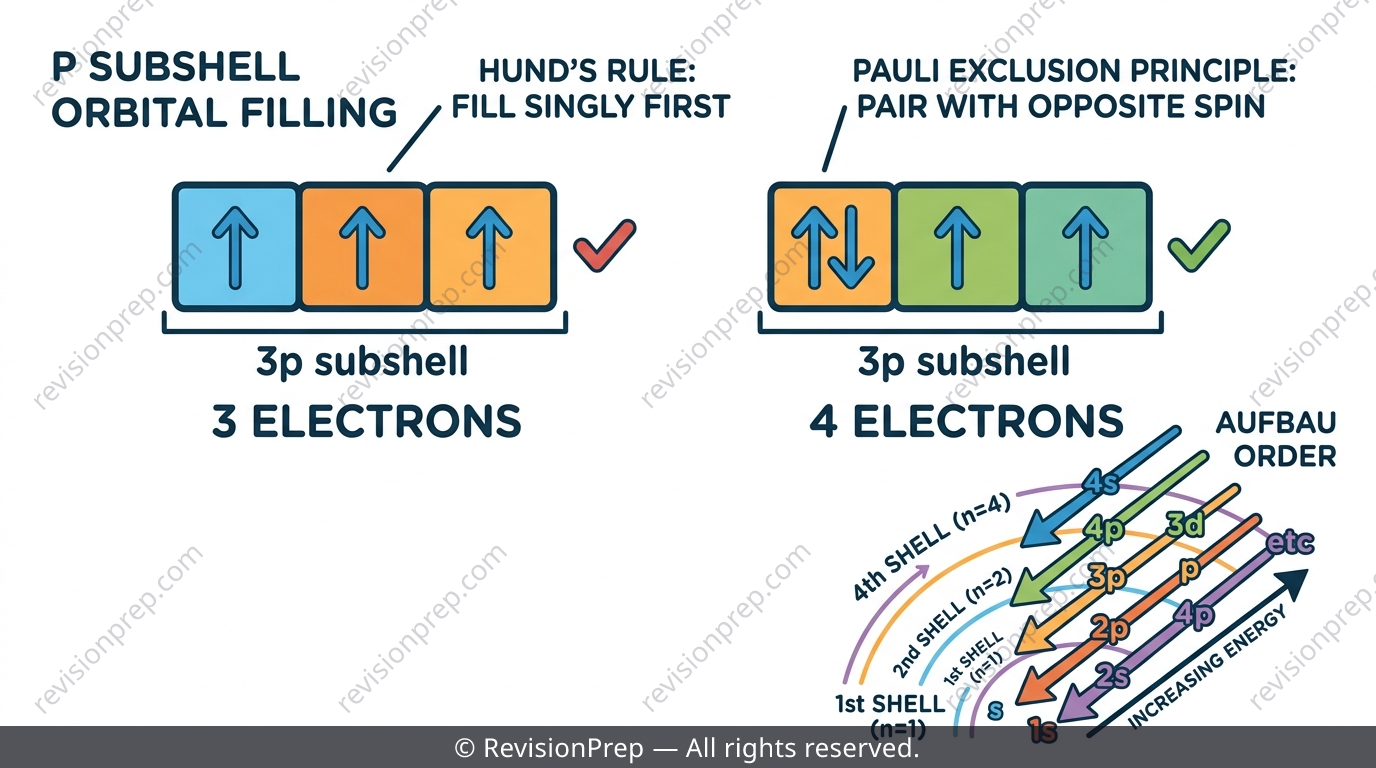
Electrons occupy shells (n = 1, 2, 3…), which split into subshells (s, p, d, f), which split further into orbitals holding a maximum of two electrons with opposite spin. Filling follows the Aufbau principle (lowest energy first), Hund's rule (spread electrons singly across degenerate orbitals before pairing), and the Pauli exclusion principle (max two electrons per orbital, opposite spins).
Exam tip
Remember subshell capacities: s holds 2, p holds 6, d holds 10, f holds 14 — use these to check your configuration adds up to the correct total electron count.
Common mistake
Pairing electrons in a subshell before every orbital in that subshell has one electron — this breaks Hund's rule and is a very common slip under time pressure.
Mini summary
Three rules control filling order: lowest energy first (Aufbau), spread before pairing (Hund's), and max two per orbital with opposite spin (Pauli).
Quick formula sheet
Practice questions
- State the difference between atomic number and mass number.
- List the three subatomic particles and their relative charges.
- Which subshell holds a maximum of 6 electrons?
- Boron has two isotopes: 80.1% boron-11 and 19.9% boron-10. Calculate its relative atomic mass.
- Explain why isotopes of the same element have identical chemical behaviour.
- Write the full electron configuration for a chlorine atom.
- A solid melts at 801 °C and only conducts electricity once molten. Using particle mobility ideas, explain why.
- Explain, using Dalton's postulates, which specific historical discovery disproved 'atoms are indivisible' and which disproved 'atoms of an element are identical'.
- Describe how a time-of-flight mass spectrometer uses acceleration and drift time to distinguish between two isotopes of similar mass.
Frequently asked questions
What is Structure 1 in IB DP Chemistry about?+
It builds the particle model of matter from states of matter, through Dalton's atomic theory, the nuclear atom, isotopes and relative atomic mass, mass spectrometry, and electron configuration, plus ideal gases at HL.
Is the ideal gas content SL or HL only?+
Ideal gases (Structure 1.5) is HL-only. SL students cover Structure 1.1 to 1.4 and can skip the gas laws section entirely.
Why is relative atomic mass not a simple average of isotope masses?+
Because isotopes don't usually occur in equal proportions — must be weighted by each isotope's percentage abundance, or your answer will be wrong unless the split happens to be exactly 50:50.
Why doesn't a solid ionic compound conduct electricity?+
Conduction needs mobile charged particles. In a solid lattice, ions are fixed in position, so there are no free charge carriers — melting or dissolving frees the ions and switches conduction on.
What's the difference between Hund's rule and the Pauli exclusion principle?+
Hund's rule says electrons spread out singly across orbitals of equal energy before pairing up. Pauli exclusion says each orbital can hold a maximum of two electrons, and only with opposite spins.
Which parts of Dalton's atomic theory still hold up today?+
The ideas that compounds form in fixed whole-number ratios and that atoms are rearranged rather than created or destroyed in reactions are still accepted; only 'indivisible' and 'identical mass' were overturned.
Get the full Structure 1 revision notes
Related articles