
Reactivity: What Drives Chemical Reactions?
Enthalpy, calorimetry, Hess's Law and Born-Haber cycles — the core of IB Chemistry Reactivity 1
Quick facts
Every reaction either releases or absorbs energy, and IB Chemistry's Reactivity 1 topic is built entirely around measuring, calculating and eventually explaining that energy change. You'll meet enthalpy change and its sign convention, calorimetry calculations using , and Hess's Law cycles that let you find enthalpy changes you could never measure directly — like the enthalpy of formation of propane. At HL, Born-Haber cycles extend this further to lattice enthalpy, and entropy finally explains why some endothermic reactions still happen spontaneously. This topic shows up everywhere: Paper 1 sign-convention traps, Paper 2 Hess's Law and calorimetry data questions, and Paper 3 practical calorimetry analysis. Get the five ideas below solid, then head to the full revision notes for every formula, worked example and trap in one place.
What you’ll be able to do
1. What Is Enthalpy Change? (Signs & Direction)
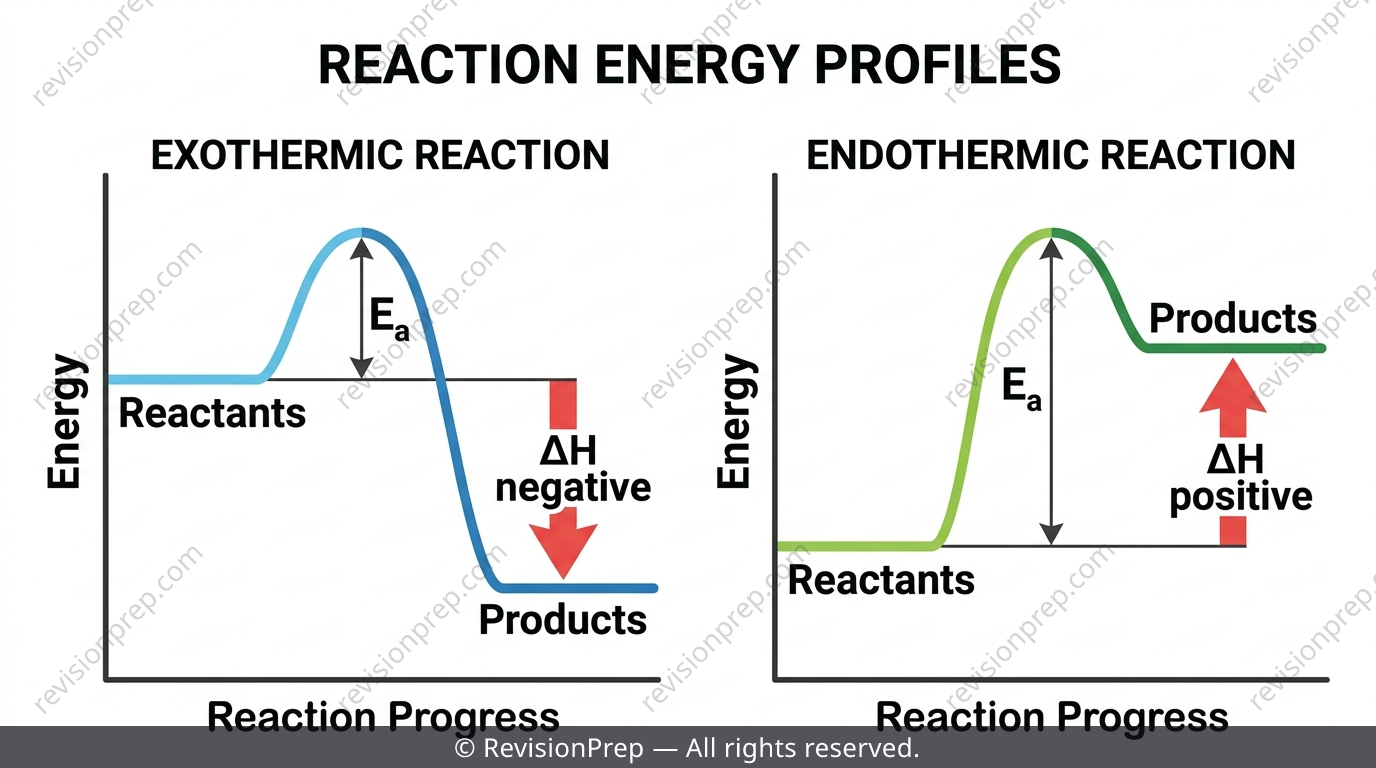
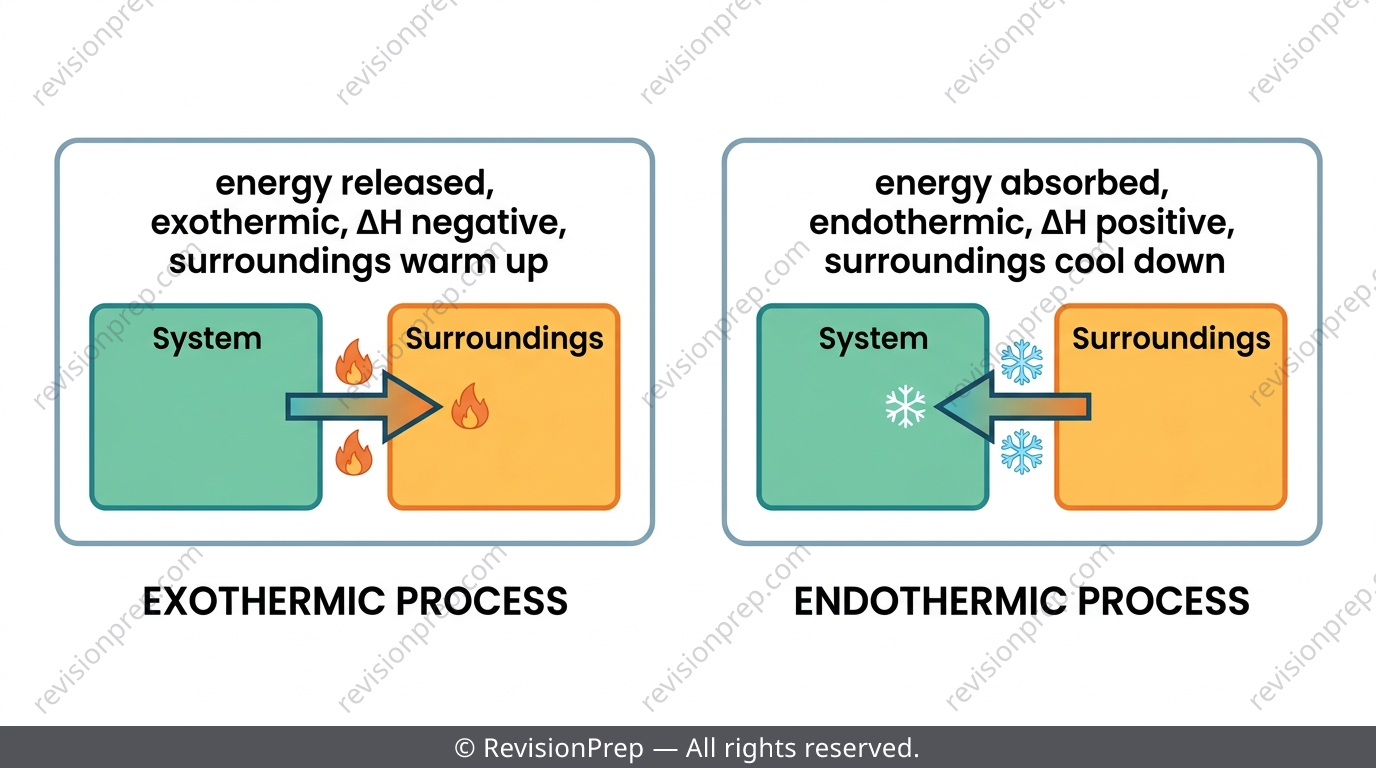
Enthalpy is the heat content of a system at constant pressure, but you can never measure itself — only the change, . An exothermic reaction releases energy from the system into the surroundings (surroundings warm up, negative); an endothermic reaction pulls energy from the surroundings into the system (surroundings cool, positive). Every sign error in this topic traces back to forgetting the order: products minus reactants, not the other way around.
Exam tip
Don't judge exo/endo from 'which number looks bigger' — always compute products minus reactants explicitly before deciding the sign.
Common mistake
Assuming a falling solution temperature means 'nothing happened' or that the process must be exothermic — a temperature drop means heat left the solution, which is endothermic.
Mini summary
ΔH = H(products) − H(reactants); exothermic is always negative, endothermic always positive.
2. Standard Conditions & Types of Enthalpy Change
Any written with a ° symbol must be measured under standard conditions: 100 kPa pressure, a stated temperature (usually 298 K), and solutes at 1 mol dm. The three named types you must know are enthalpy of formation (1 mole of compound formed from its elements in standard states), enthalpy of combustion (1 mole of substance burned completely in excess oxygen), and enthalpy of neutralisation (acid + base forming 1 mole of water). Mixing these definitions up is a fast way to lose easy marks on definitions.
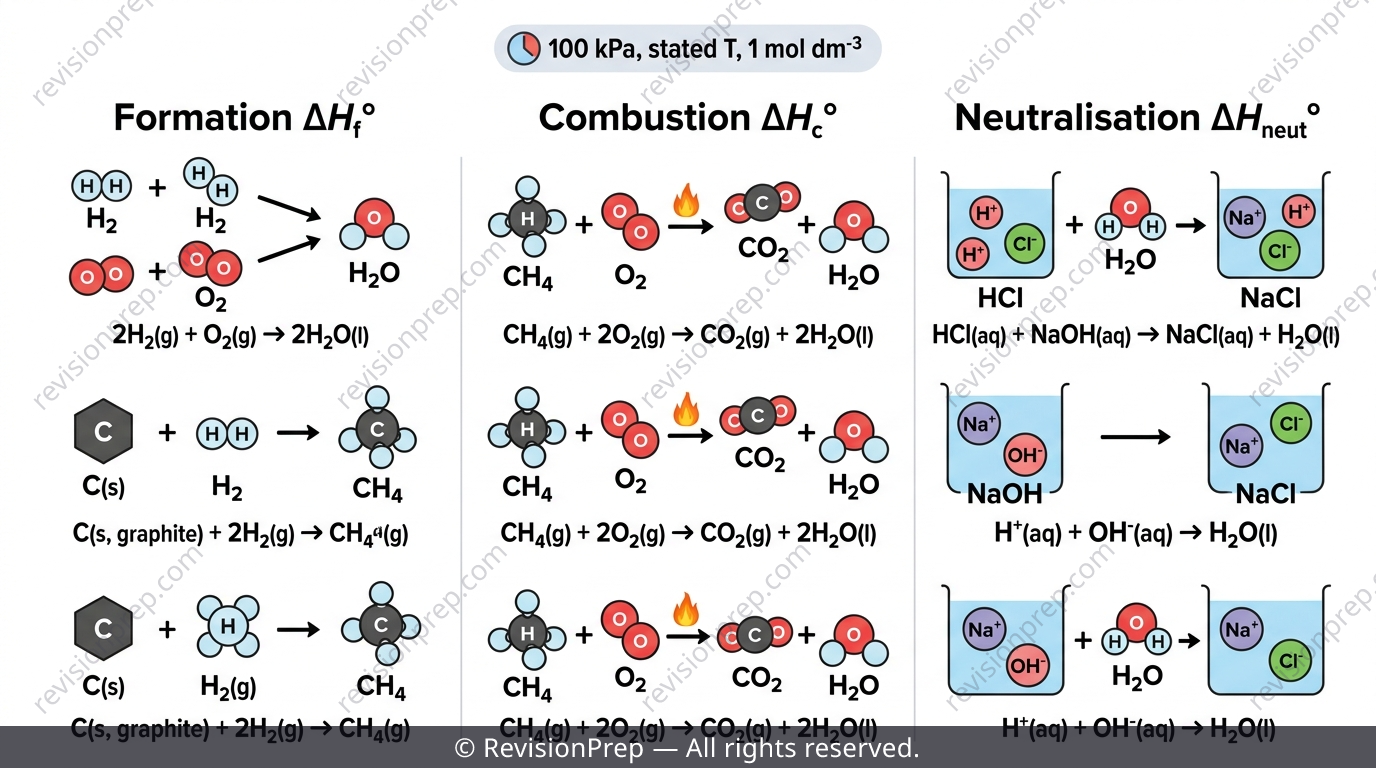
| Enthalpy change | Symbol | Defined for |
|---|---|---|
| Formation | ΔHf° | 1 mol compound from elements in standard states |
| Combustion | ΔHc° | 1 mol substance burned completely in excess O₂ |
| Neutralisation | ΔHneut° | Acid + base forming 1 mol water, standard conditions |
Exam tip
If a question uses the ° symbol, state the standard conditions (100 kPa, stated T, 1 mol dm⁻³) explicitly — this can be a dedicated mark point.
Mini summary
Know the ° conditions and the exact wording of formation, combustion and neutralisation definitions.
3. Calorimetry: From Temperature Change to ΔH
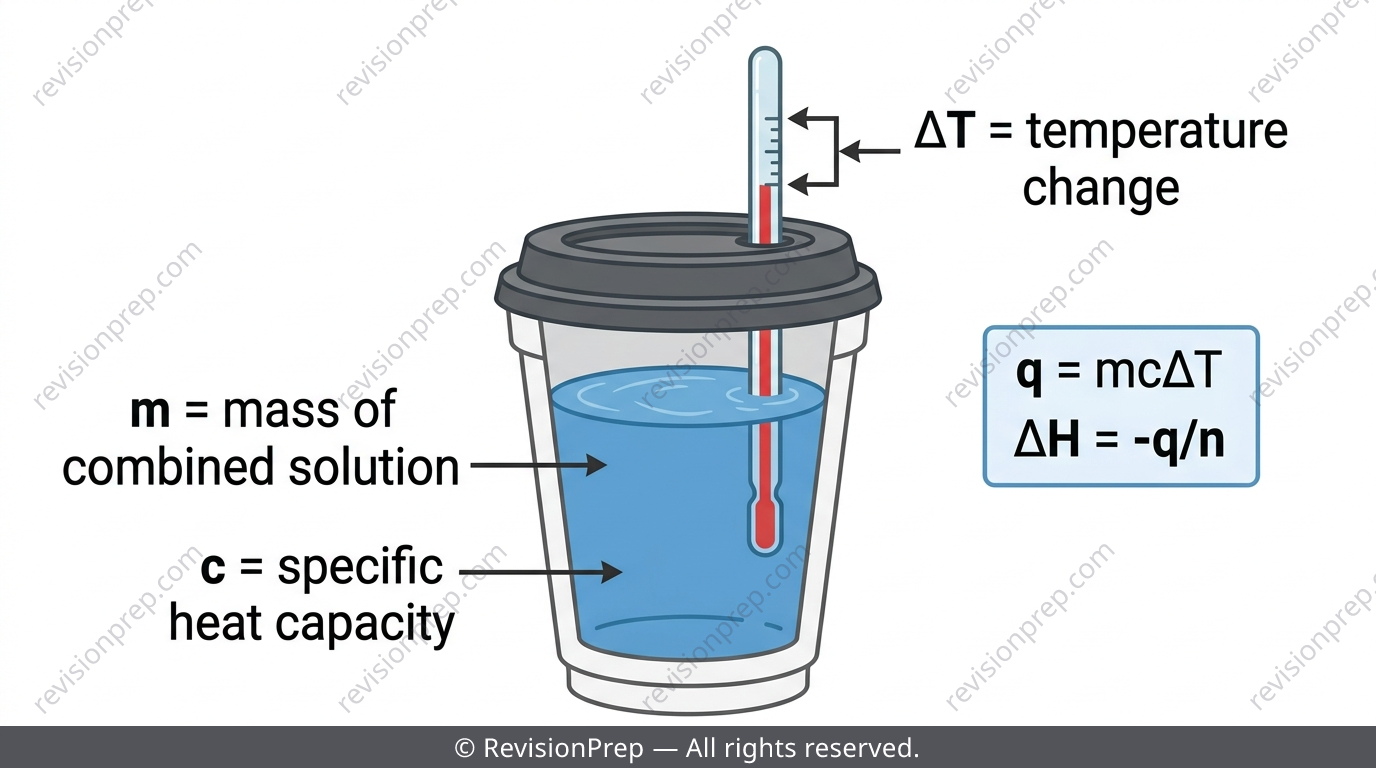
Calorimetry measures the temperature change of the surroundings (usually a solution) to infer the enthalpy change of the reaction itself. First find the heat transferred with , then convert to a molar enthalpy change with , flipping the sign because describes the surroundings while describes the system. Real experiments always lose heat to the air, container and thermometer, so your experimental will always be smaller than the data booklet value.
Exam tip
State explicitly: 'no heat is lost to the surroundings or calorimeter, and the specific heat capacity of the solution equals that of water' — this exact sentence is often a Paper 2 mark point.
Common mistake
Using the mass of just one solution (e.g. 50.0 g) instead of the combined final mixture mass (e.g. 100.0 g) — this halves q and gives a badly wrong molar enthalpy change.
Mini summary
q = mcΔT finds heat lost/gained by the surroundings; ΔH = −q/n converts it to molar enthalpy change of the system.
4. Hess's Law: Formation vs Combustion Cycles
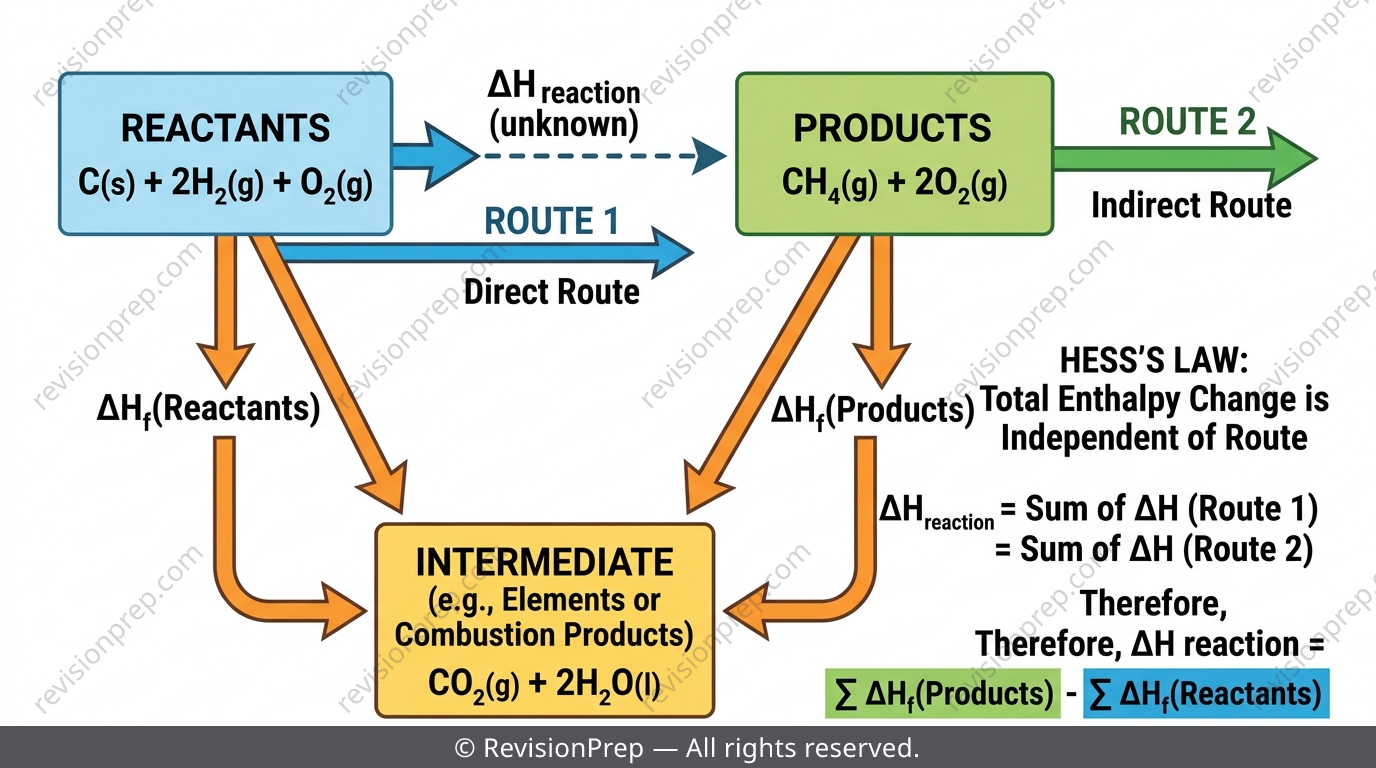
Hess's Law states that the total enthalpy change between two fixed states is the same regardless of the route taken, because enthalpy is a state function. This lets you calculate enthalpy changes that can't be measured directly, like forming propane from carbon and hydrogen gas. With formation data, use ; with combustion data the pattern inverts to . Average bond enthalpies offer a rougher route via , but treat results as estimates only since bond enthalpies are averaged across many compounds.
Exam tip
Always draw the Hess's Law cycle before plugging numbers in — it makes clear which values are being subtracted from which, especially with combustion data.
Common mistake
Copying the formation-cycle pattern (products minus reactants) onto combustion data — the combustion pattern is inverted and gets the sign backwards if you don't check the cycle.
Mini summary
Formation data: products − reactants. Combustion data: reactants − products. Bond enthalpies: broken − formed (estimate only).
5. Bond Enthalpies & Born-Haber Cycles (HL)
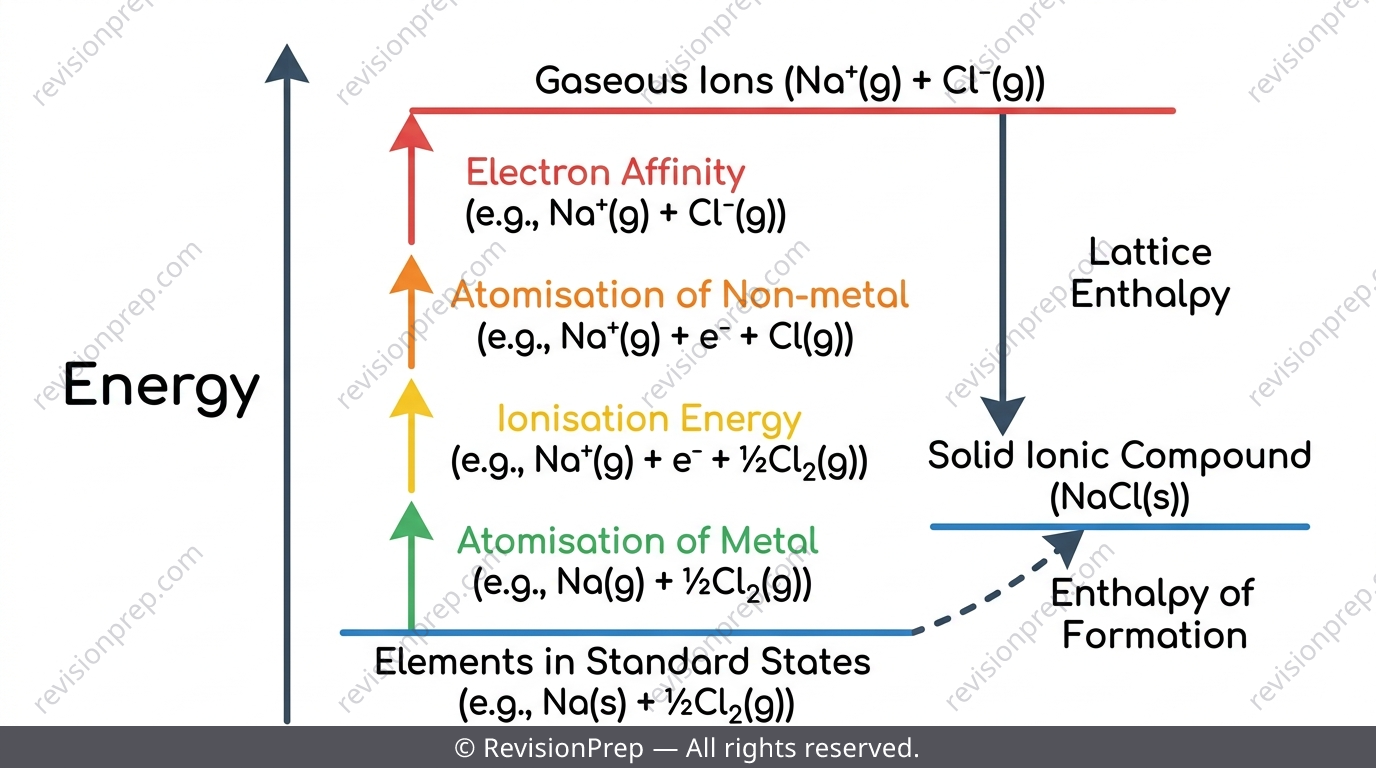
At HL, Hess's Law extends into the Born-Haber cycle for ionic compounds, combining atomisation enthalpies, ionisation energy and electron affinity to solve for lattice enthalpy — a quantity, like , that can never be measured directly. The key relationship is . Don't confuse crystal hydration (solid + water of crystallisation forming a hydrate) with the separate HL concept of ionic hydration enthalpy — same word, two different cycles entirely.
Exam tip
Sketch the full Born-Haber cycle with every arrow direction correct before solving for the unknown — sign errors here usually come from an arrow drawn the wrong way.
Common mistake
Confusing 'enthalpy of hydration' of a crystal (solid → hydrated solid) with the HL ionic hydration enthalpy of gaseous ions dissolving in water.
Mini summary
Born-Haber cycles use Hess's Law to find lattice enthalpy, which can never be measured directly.
Quick formula sheet
Practice questions
- Define exothermic and endothermic reactions in terms of energy flow between system and surroundings.
- State the three conditions indicated by the ° symbol in ΔH°.
- Write the formula linking heat energy, mass, specific heat capacity and temperature change.
- Explain why experimental calorimetry enthalpy values are always smaller in magnitude than data booklet values.
- A student uses 50.0 g instead of the combined 100.0 g of solution when calculating q. Explain the effect this has on the calculated molar enthalpy change.
- Outline how you would use standard enthalpies of formation to calculate the enthalpy change of a reaction.
- Given combustion enthalpies for C(s), H₂(g) and C₃H₈(g), outline the Hess's Law cycle needed to find ΔHf°[C₃H₈(g)], explaining why the pattern differs from a formation-data cycle.
- Explain, with reference to a Born-Haber cycle, why lattice enthalpy cannot be measured directly and must instead be calculated.
- A reaction profile shows reactants at 50 kJ mol⁻¹, products at 20 kJ mol⁻¹, and activation energy 40 kJ mol⁻¹ above the reactants. Determine ΔH and classify the reaction, explaining your reasoning.
Frequently asked questions
What's the difference between standard enthalpy of formation and combustion?+
Formation is the enthalpy change when 1 mole of a compound forms from its elements in their standard states. Combustion is the enthalpy change when 1 mole of a substance burns completely in excess oxygen. They're used differently in Hess's Law cycles, and the calculation pattern for combustion data is inverted compared to formation data.
Why is my calorimetry experimental value always smaller than the data booklet value?+
Real calorimetry setups always lose some heat to the air, the container and the thermometer, so less temperature change is recorded than the true reaction would produce. This means your calculated |ΔH| will consistently come out smaller than the accepted value.
What mass should I use in q = mcΔT for a neutralisation reaction?+
Use the mass of the final combined solution (both reactant volumes added together, converted to mass via density), not just one of the original solutions. Using only one solution's mass will roughly halve your calculated q and give a badly wrong molar enthalpy change.
Why does the Hess's Law pattern flip when using combustion data instead of formation data?+
With formation data, the unknown compound's formation sits on the products side of the cycle, giving products minus reactants. With combustion data, burning the compound is one of the measurable steps, so the cycle is built the other way round, giving reactants minus products instead.
What is a Born-Haber cycle used for in IB Chemistry HL?+
A Born-Haber cycle applies Hess's Law to ionic compounds, linking atomisation enthalpies, ionisation energy, electron affinity and enthalpy of formation to solve for lattice enthalpy, which can never be measured experimentally.
Why does HL add entropy to the enthalpy topic?+
Enthalpy alone can't explain why some endothermic reactions still happen spontaneously. At HL, entropy is introduced as the missing piece that, together with enthalpy, properly predicts whether a reaction will occur on its own.
Master Reactivity 1 with the Full IB Chemistry DP Revision Notes
Related articles