
Reactivity: What Drives Chemical Reactions?
Enthalpy, calorimetry, Hess's Law, fuels and (HL) Gibbs free energy — the numbers examiners actually test
Quick facts
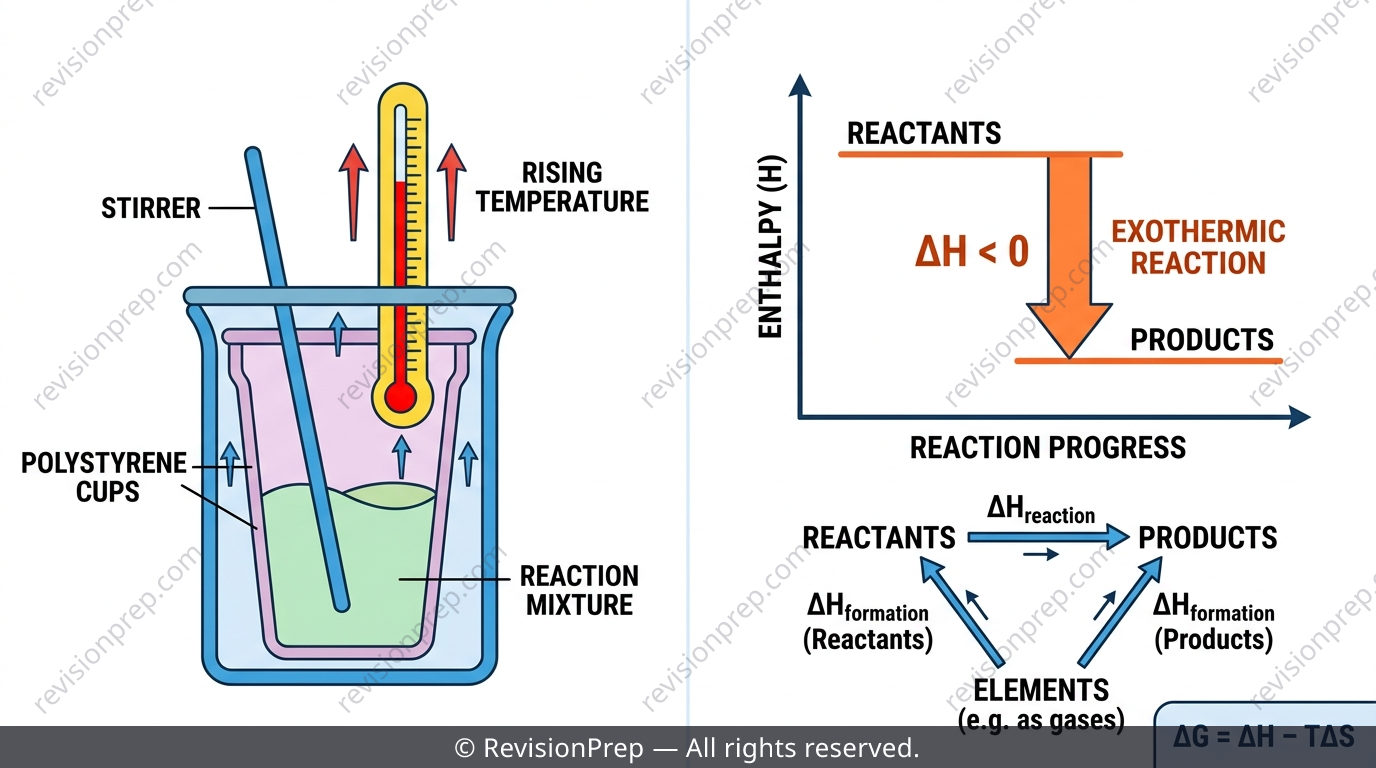
Why do some reactions release heat while others soak it up — and why do some reactions happen at all? Reactivity 1 in IB Chemistry answers this by tracking enthalpy change, ΔH: the heat exchanged at constant pressure. You'll learn to measure ΔH experimentally using calorimetry, calculate it without running a reaction at all using Hess's Law, and compare fuels using two different but easily confused quantities. At Higher Level, you'll go further and ask why enthalpy alone can't predict whether a reaction actually proceeds, bringing in entropy and Gibbs free energy. These ideas turn up constantly in Paper 1 and Paper 2, especially calorimetry calculations and Hess's Law cycles. This teaser covers the five ideas examiners return to again and again — the full revision notes work through every calculation, cycle, and error type in detail.
What you’ll be able to do
Enthalpy Change: Exothermic vs Endothermic
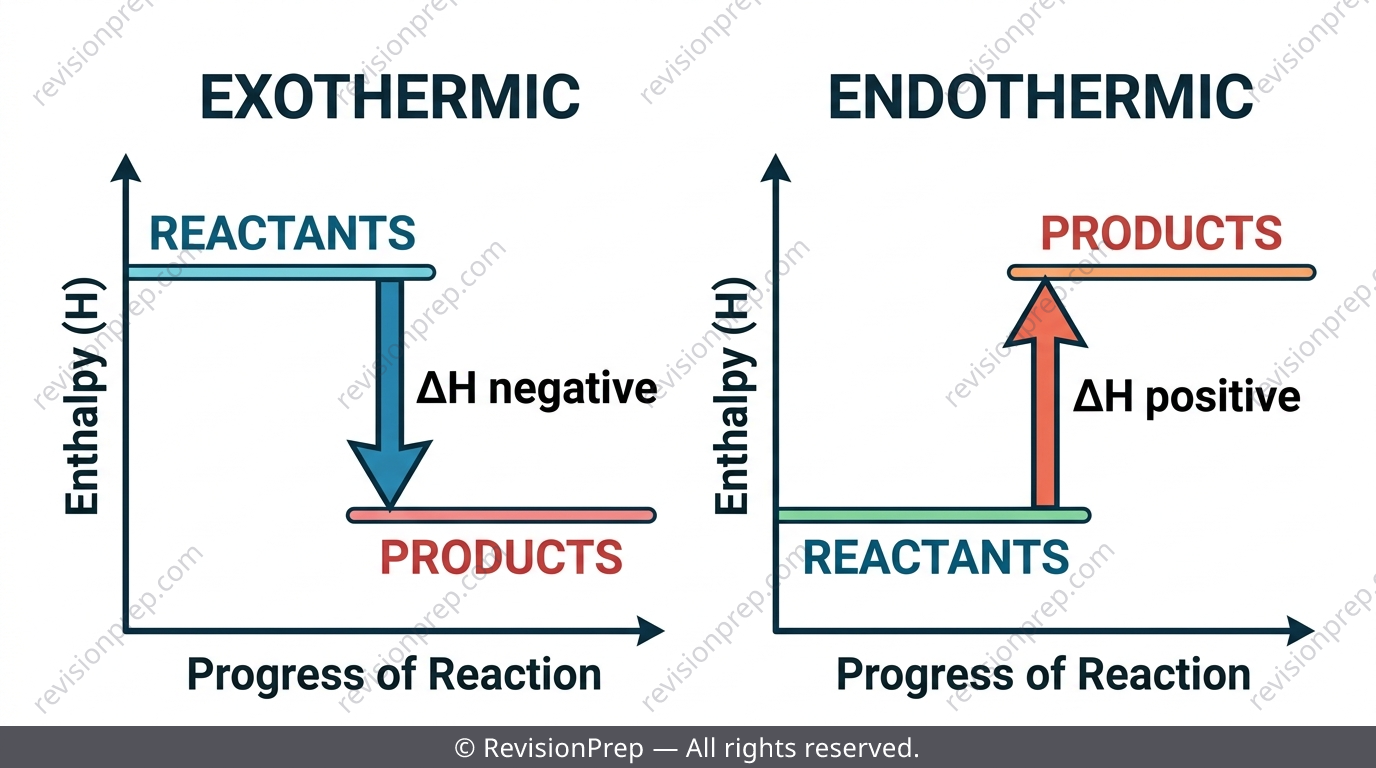
ΔH is the heat exchanged with the surroundings at constant pressure, and it belongs to the system even though you always measure the surroundings' temperature. In exothermic reactions, reactants sit above products on the energy diagram, ΔH is negative, and the surroundings warm up; in endothermic reactions it's the reverse — the surroundings cool down and ΔH is positive. Three standard enthalpy changes come up repeatedly: formation (ΔH_f°), combustion (ΔH_c°, always exothermic), and reaction (ΔH_r°, exactly as the equation is written), all measured at 100 kPa and a stated temperature.
Exam tip
Before drawing or choosing an enthalpy diagram, check what the temperature data actually shows — don't assume exothermic just because 'something changed'.
Common mistake
Seeing a temperature drop (e.g. ammonium nitrate dissolving) and calling it exothermic because the temperature 'changed' — a drop means the surroundings lost heat to the system, so it's endothermic.
Calorimetry: Turning a Thermometer Reading into ΔH
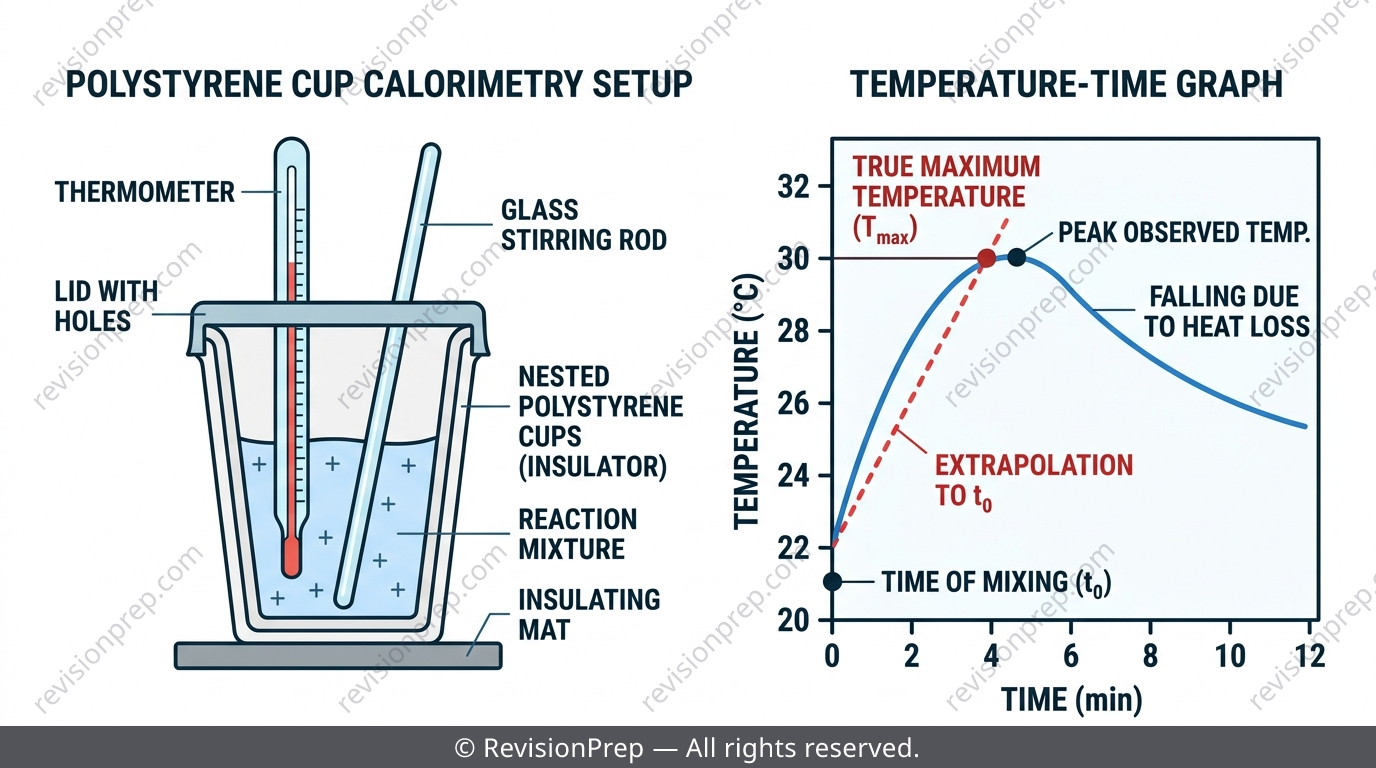
The standard method: measure the mass of solution that absorbs the heat, record the temperature change, then calculate q = mcΔT (adding the container's heat capacity if it isn't negligible). Divide by moles of the limiting reagent and apply ΔH = −q/n, where the minus sign converts heat gained by the surroundings into ΔH of the system. If a question instead states a calorimeter's heat capacity in kJ K⁻¹, that's your signal to use q = CΔT directly instead of hunting for a mass and c.
| Source of error | Effect on calculated |ΔH| | How to reduce it |
|---|---|---|
| Heat lost to surroundings/air | Calculated |ΔH| too small | Use an insulated cup with a lid |
| Container's heat capacity ignored | Calculated |ΔH| too small | Add mcΔT term for the container |
| Reaction not instantaneous | Calculated |ΔH| too small (peak missed) | Extrapolate temp-time graph back to mixing time |
Exam tip
Show three separate lines of working every time: q = mcΔT (with units), then n, then ΔH = −q/n. Examiners mark each line separately.
Common mistake
Using the mass of the solid reactant instead of the mass of the solution in q = mcΔT — this gives an answer wrong by roughly two orders of magnitude, a classic MCQ trap.
Hess's Law: Calculating ΔH You Can't Measure Directly
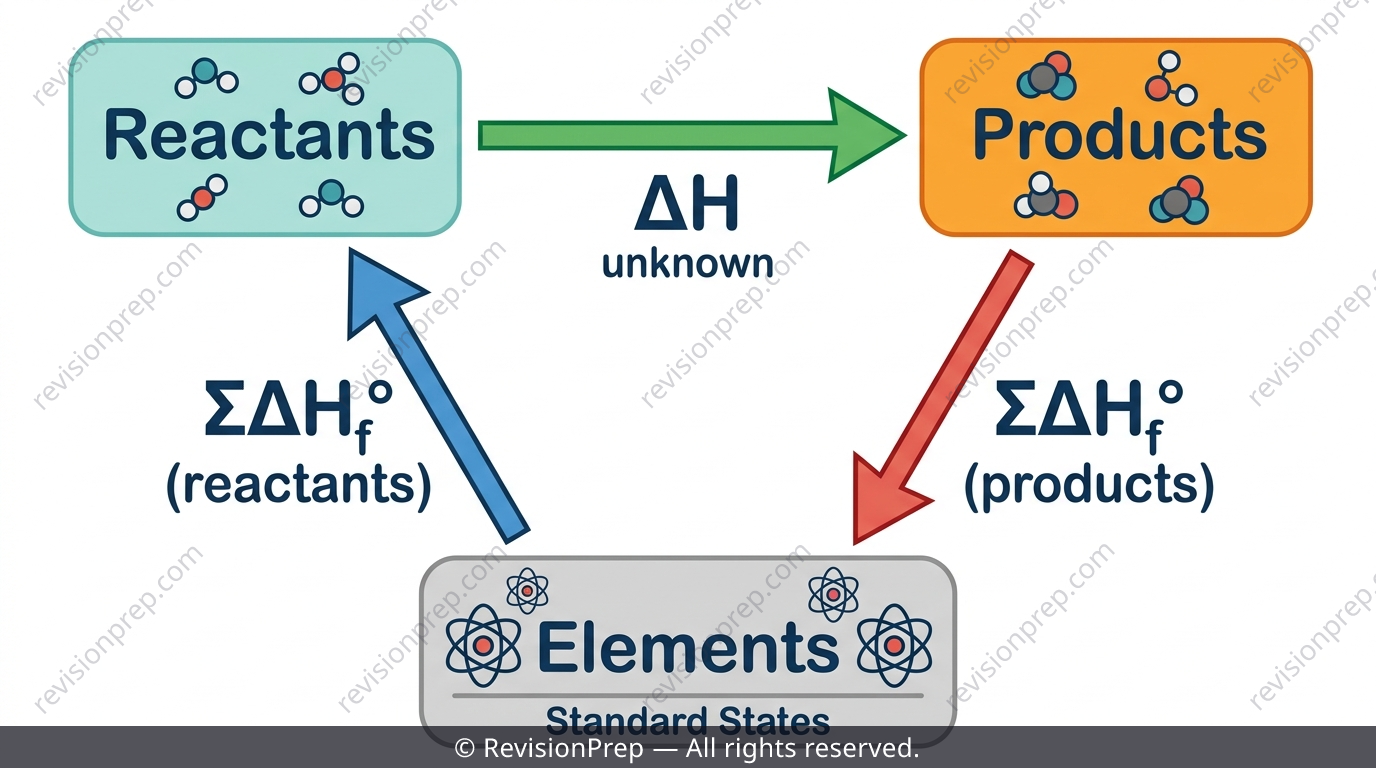
Enthalpy is a state function — it depends only on start and end points, never on the path taken. That's why you can build a legal detour through data you actually have: via enthalpies of formation (reactants → elements → products), via enthalpies of combustion (useful for organic compounds), or via mean bond enthalpies (breaking bonds in reactants minus forming bonds in products). Remember that elements in their standard states always have ΔH_f° = 0, since they're the reference point the whole scale is built from.
Exam tip
Bond enthalpy calculations always use MEAN values averaged across many molecules, so treat the answer as an approximation, not an exact value.
Comparing Fuels: kJ mol⁻¹ vs kJ g⁻¹
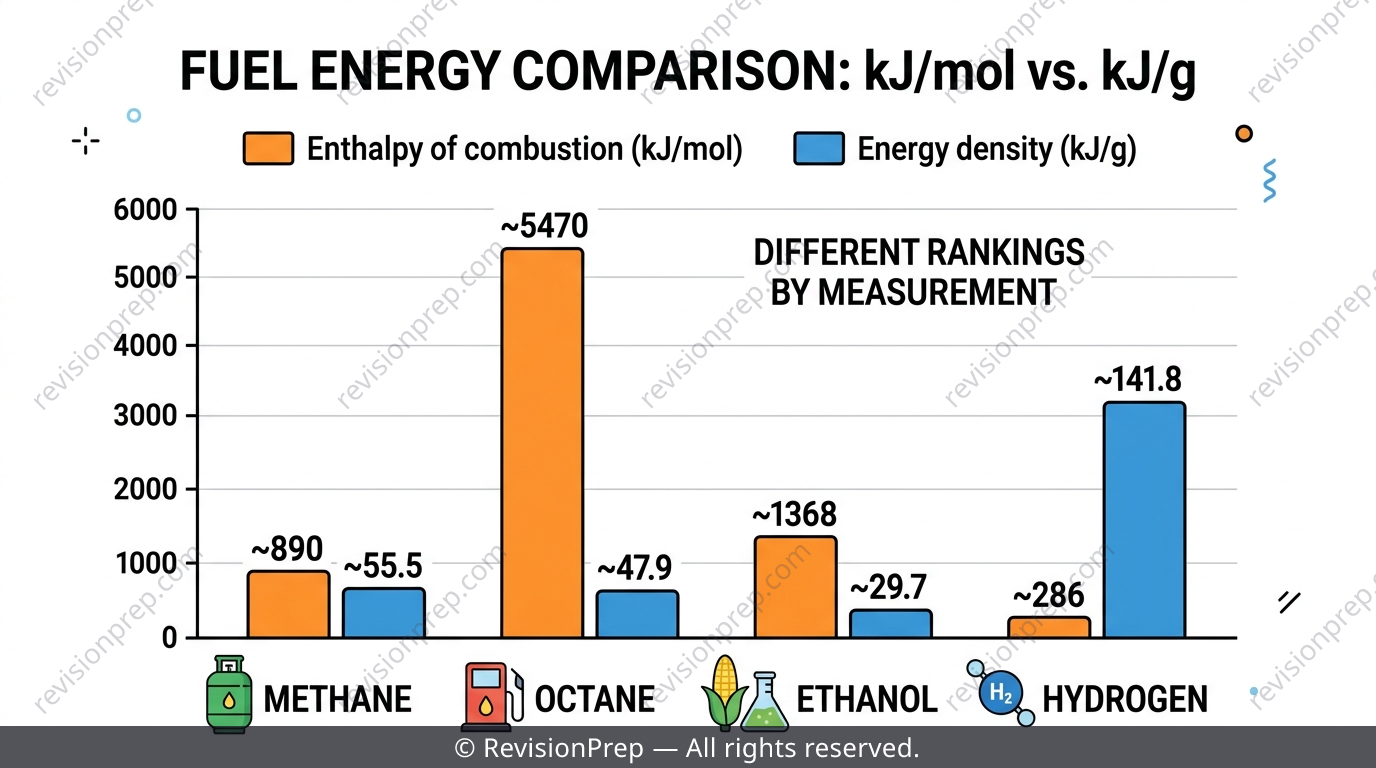
Fuels get judged by two different numbers that are easy to mix up: enthalpy of combustion, measured per mole (kJ mol⁻¹), and energy density, measured per gram (kJ g⁻¹). A fuel with a large molar enthalpy of combustion isn't automatically the best commercial choice if its molar mass is also large, since energy density accounts for how much energy you get per unit mass actually burned. Always check which unit a question asks for before comparing fuels.
Common mistake
Comparing fuels using enthalpy of combustion (kJ mol⁻¹) values directly, without converting to energy density (kJ g⁻¹) — this can give the wrong ranking for practical fuel choice.
HL Only: Spontaneity and Gibbs Free Energy
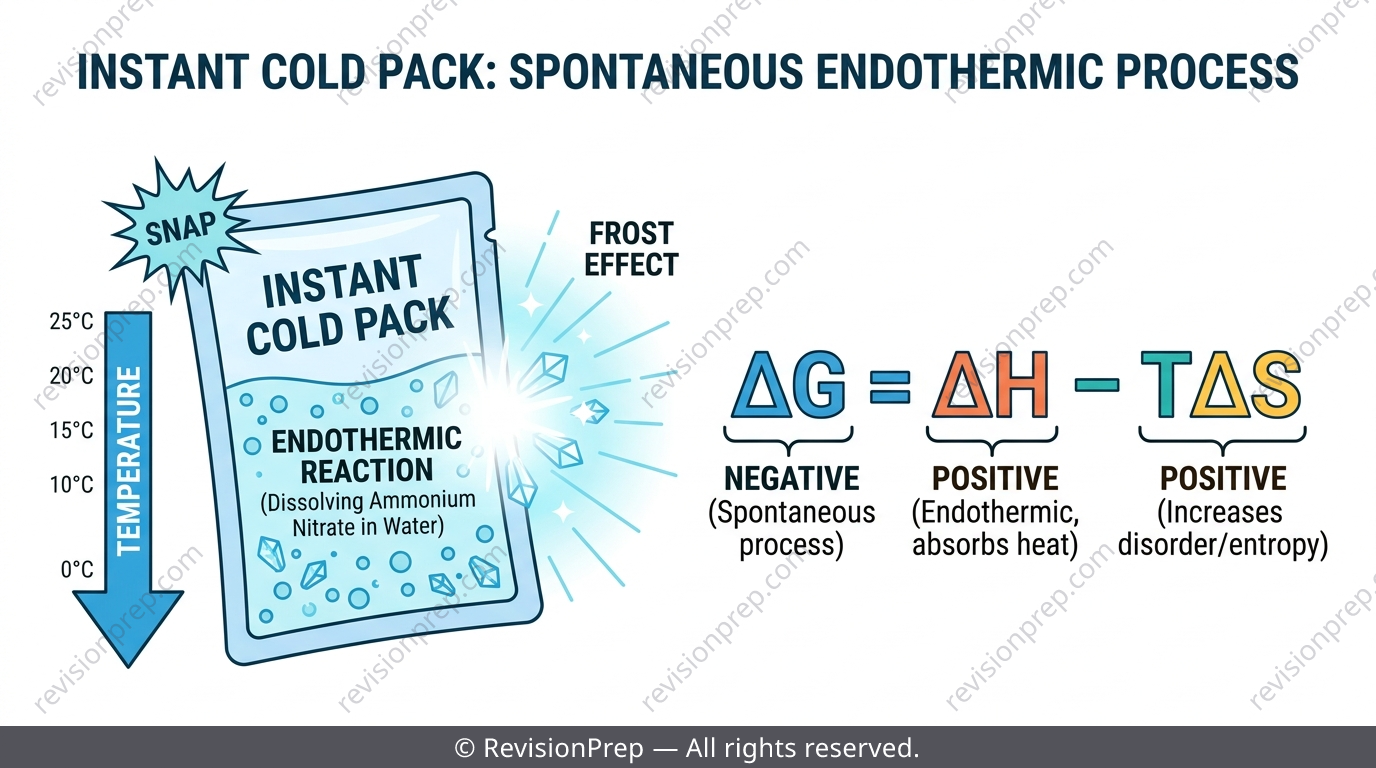
At HL, spontaneity is decided by ΔG = ΔH − TΔS, not by ΔH alone. This is exactly why some endothermic processes — like an instant cold pack — still happen on their own: a large positive ΔS (entropy increase) combined with a high enough T can make ΔG negative even when ΔH is positive. This section never appears on SL papers, so SL students can skip it entirely.
Exam tip
If ΔH alone can't explain why an endothermic process happens spontaneously, think entropy — the answer almost always involves TΔS outweighing ΔH.
Quick formula sheet
Practice questions
- State whether a reaction is exothermic or endothermic if the surroundings' temperature falls during the reaction.
- Write the definition of standard enthalpy of formation, ΔH_f°.
- State the units used for enthalpy of combustion and for energy density, and explain the difference between them.
- 0.040 mol of a metal reacts with 100.0 g of acid, raising the temperature from 21.0 °C to 33.5 °C. Calculate the molar enthalpy change of reaction using c = 4.18 J g⁻¹ K⁻¹.
- Explain, using Hess's Law, why enthalpy of formation data can be used to calculate an enthalpy of reaction that is too dangerous to measure directly.
- Explain why neglecting the heat capacity of the calorimeter container causes the calculated |ΔH| to be smaller than the true value.
- A bond enthalpy calculation and an experimental combustion calculation for the same reaction give different ΔH values. Explain why these two values are not expected to match exactly.
- Explain, using ΔG = ΔH − TΔS, why an endothermic process such as a cold pack activating can still occur spontaneously.
- Design one improvement to a simple calorimetry experiment that would reduce the systematic underestimation of |ΔH|, and justify your choice.
Frequently asked questions
What is the difference between exothermic and endothermic reactions?+
Exothermic reactions release heat to the surroundings, so the surroundings warm up and ΔH is negative. Endothermic reactions absorb heat from the surroundings, so the surroundings cool down and ΔH is positive.
Why do you use the mass of solution, not the solid, in q = mcΔT?+
The solution is what actually absorbs or releases the heat and whose temperature you measure, so it's the mass that belongs in q = mcΔT — using the solid's mass gives an answer wrong by roughly two orders of magnitude.
Why does Hess's Law work?+
Enthalpy is a state function, meaning ΔH depends only on the initial and final states, not the path taken. This lets you calculate an unmeasurable ΔH by adding up known enthalpy changes along an alternative route.
Is entropy and Gibbs free energy tested at SL?+
No. Reactivity 1.4 (entropy and Gibbs free energy, ΔG = ΔH − TΔS) is HL-only content and never appears on an SL Chemistry paper.
Why does neglecting heat loss always make calculated ΔH smaller, not larger?+
Any heat lost to the air or absorbed by the container never reaches the thermometer, so the recorded temperature change underestimates the true value, making the calculated |ΔH| smaller than reality.
How is enthalpy of combustion different from energy density?+
Enthalpy of combustion is measured per mole (kJ mol⁻¹), while energy density is measured per gram (kJ g⁻¹). Fuels can rank differently depending on which value you use, so always check which is being asked for.
Master Reactivity 1 with the Full IB DP Chemistry Notes
Related articles