
Structure: Models of the Particulate Nature of Matter
The particle model, the nuclear atom, isotopes and quantised electrons — the foundation of IB DP Chemistry Structure.
Quick facts
Every IB DP Chemistry calculation you'll ever do — moles, gas volumes, empirical formulas — rests on how you picture matter at the particle level. This topic builds three nested models: the particle model explaining why solids, liquids and gases behave differently, the nuclear atom model showing what's inside every atom, and the electron configuration model showing where electrons actually sit. Along the way you'll meet isotopes, relative atomic mass calculations, and the historical experiments (Dalton, Thomson, Rutherford, Chadwick) that built our modern picture of the atom. These ideas show up constantly on Paper 1 as quick-fire MCQs and on Paper 2 as short data-based questions, so getting the definitions and reasoning precise — not just the vocabulary — pays off across the whole course.
What you’ll be able to do
The Particle Model: Solids, Liquids and Gases
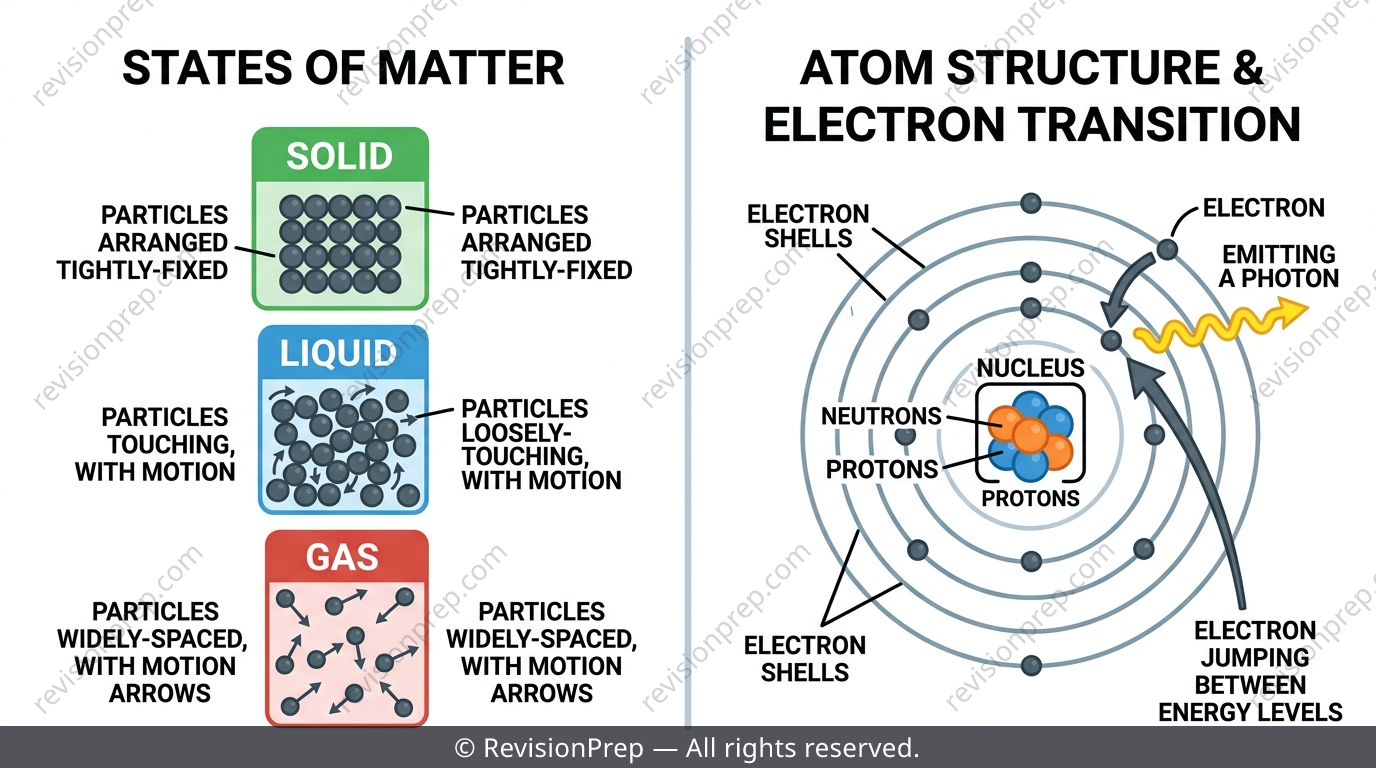
All matter is made of particles in constant, random motion, with average kinetic energy directly proportional to temperature in kelvin. What separates a solid from a gas isn't a different kind of physics — it's the balance between attractive forces between particles and their kinetic energy. In solids, forces dominate and particles vibrate in fixed positions; in gases, kinetic energy dominates completely and particles move independently, filling any container.
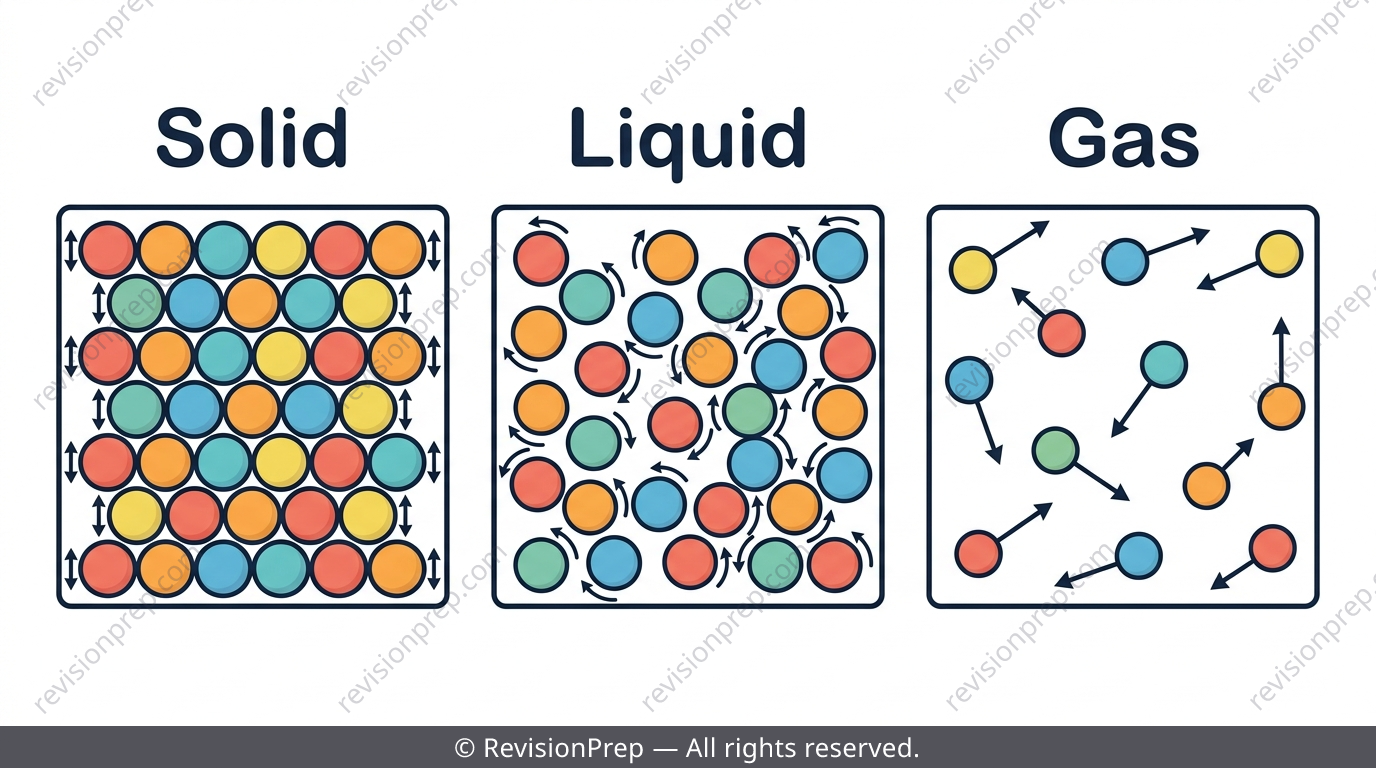
| Property | Solid | Liquid | Gas |
|---|---|---|---|
| Shape | Fixed | Takes container shape | Fills container |
| Volume | Fixed | Fixed | Not fixed |
| Particle arrangement | Fixed lattice positions | Close, can slide past each other | Widely spaced, independent |
| Forces vs kinetic energy | Forces dominate | Balanced | Kinetic energy dominates |
Exam tip
A full-mark answer must mention BOTH relative distance/spacing AND relative attractive forces — 'particles move faster in a gas' alone doesn't explain fixed shape and is a common distractor.
Common mistake
Explaining state differences using speed alone ('gas particles move faster') without mentioning that attractive forces are negligible in gases and strong in solids.
Mini summary
State of matter = balance between kinetic energy and intermolecular attractive forces, not a different type of physics.
Evaporation, Boiling and Heating Curve Plateaus
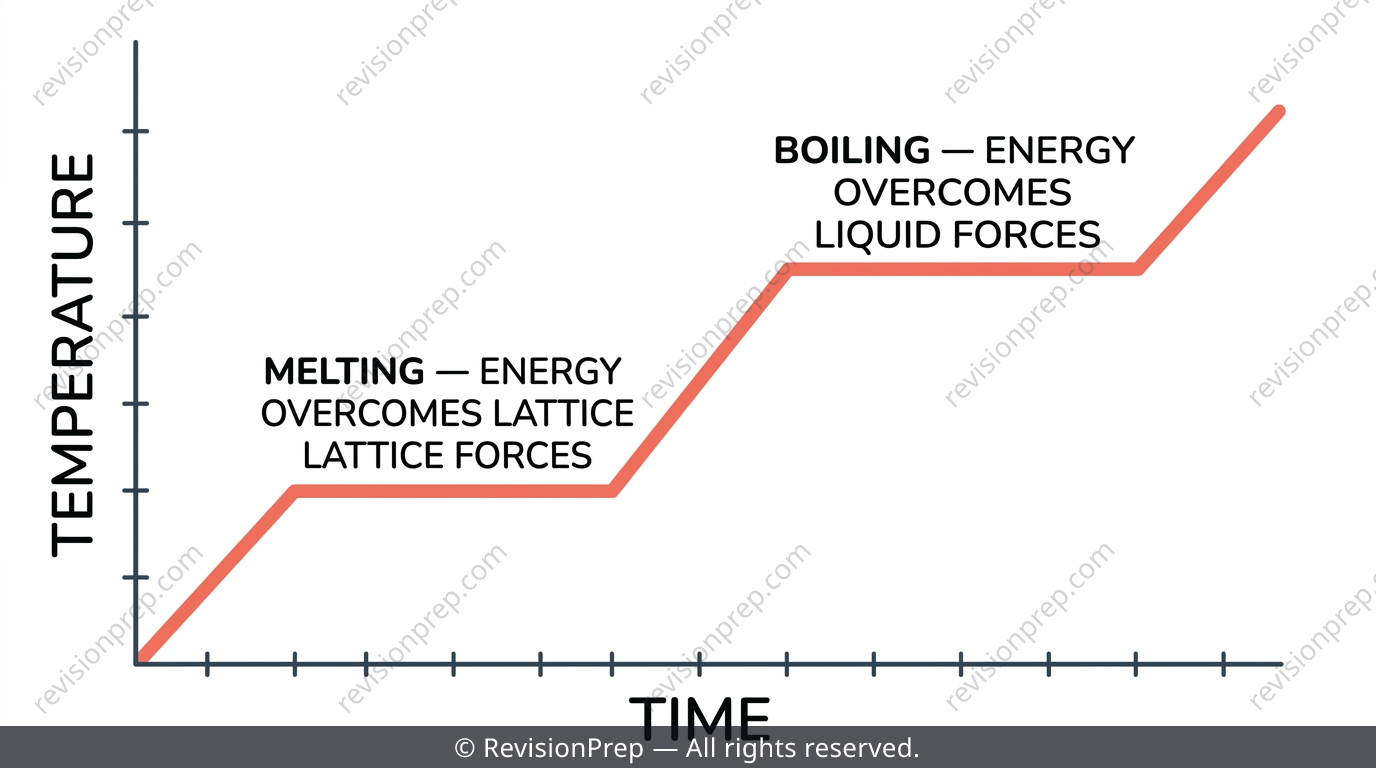
Evaporation is the escape of only the highest-energy particles from a liquid's surface, and it happens at any temperature below the boiling point. Boiling is vaporisation throughout the entire bulk of the liquid at one fixed temperature, occurring when vapour pressure equals atmospheric pressure. On a heating curve, temperature plateaus during melting and boiling because all added energy is breaking intermolecular attractions rather than speeding particles up.
Exam tip
When a question gives a constant heating power and plateau time, you must calculate energy using before comparing fusion and vaporisation — reading time ratios straight off the graph loses the method mark.
Common mistake
Treating evaporation and boiling as interchangeable terms, or claiming evaporation 'only happens at the boiling point.'
Mini summary
Evaporation = surface, any temperature below bp. Boiling = whole liquid, one fixed temperature. Plateaus = energy overcoming forces, not raising temperature.
From Dalton to the Nuclear Atom
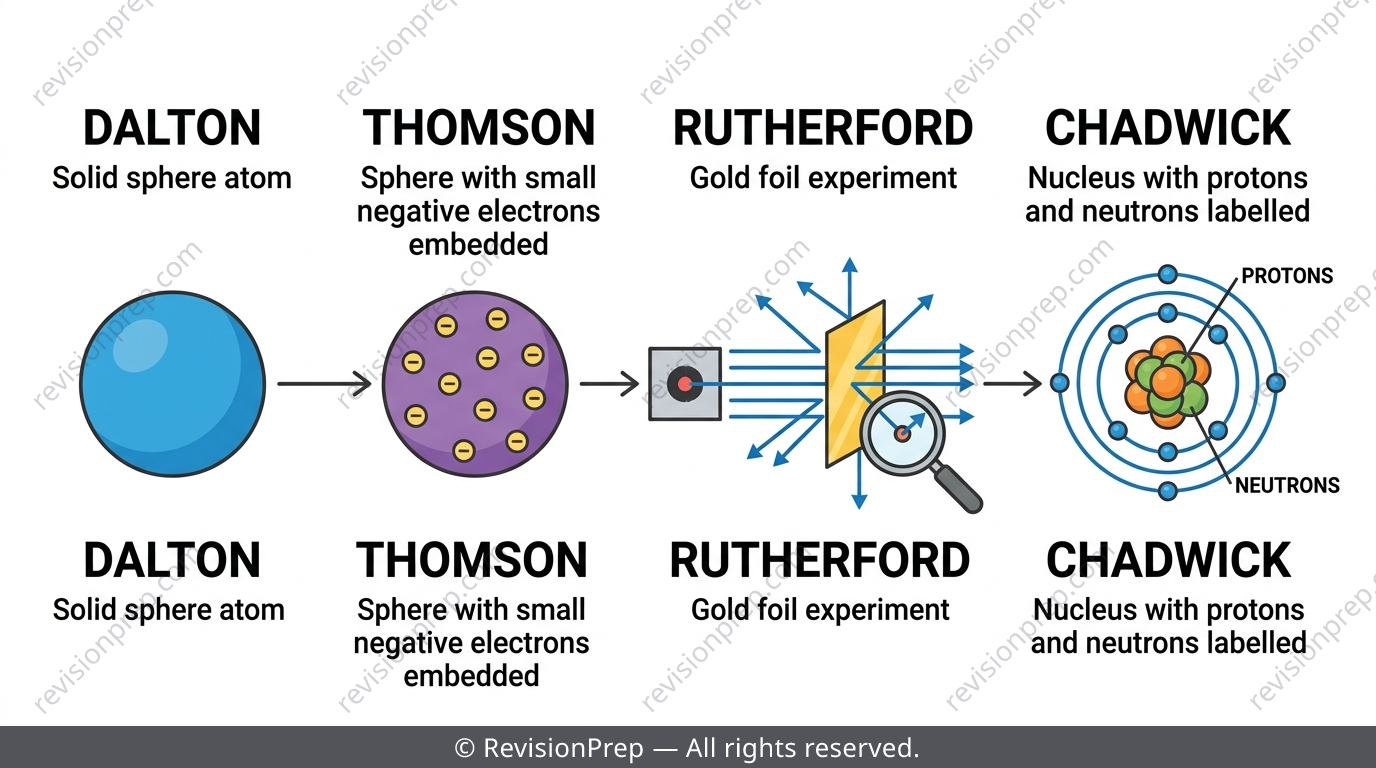
Dalton proposed atoms as indivisible and identical within an element. Thomson's cathode ray experiments discovered the electron, proving atoms are divisible. Rutherford's gold foil experiment — most alpha particles passing straight through, a few deflecting sharply — revealed a tiny, dense, positively charged nucleus, and Chadwick later confirmed the neutron. The discovery of isotopes was the specific evidence that overturned Dalton's 'identical mass' postulate.
Exam tip
Match each historical discovery to the exact postulate it disproved: electron discovery contradicts 'indivisible', isotopes contradict 'identical mass' — don't mix these up.
Common mistake
Selecting 'discovery of the electron' when asked which discovery disproved Dalton's 'identical atomic mass' claim — that role belongs specifically to isotopes.
Mini summary
The nuclear atom model was built up in stages: electron (Thomson) → nucleus (Rutherford) → neutron (Chadwick) → isotopes disprove identical mass.
Isotopes and Relative Atomic Mass (Ar) Calculations
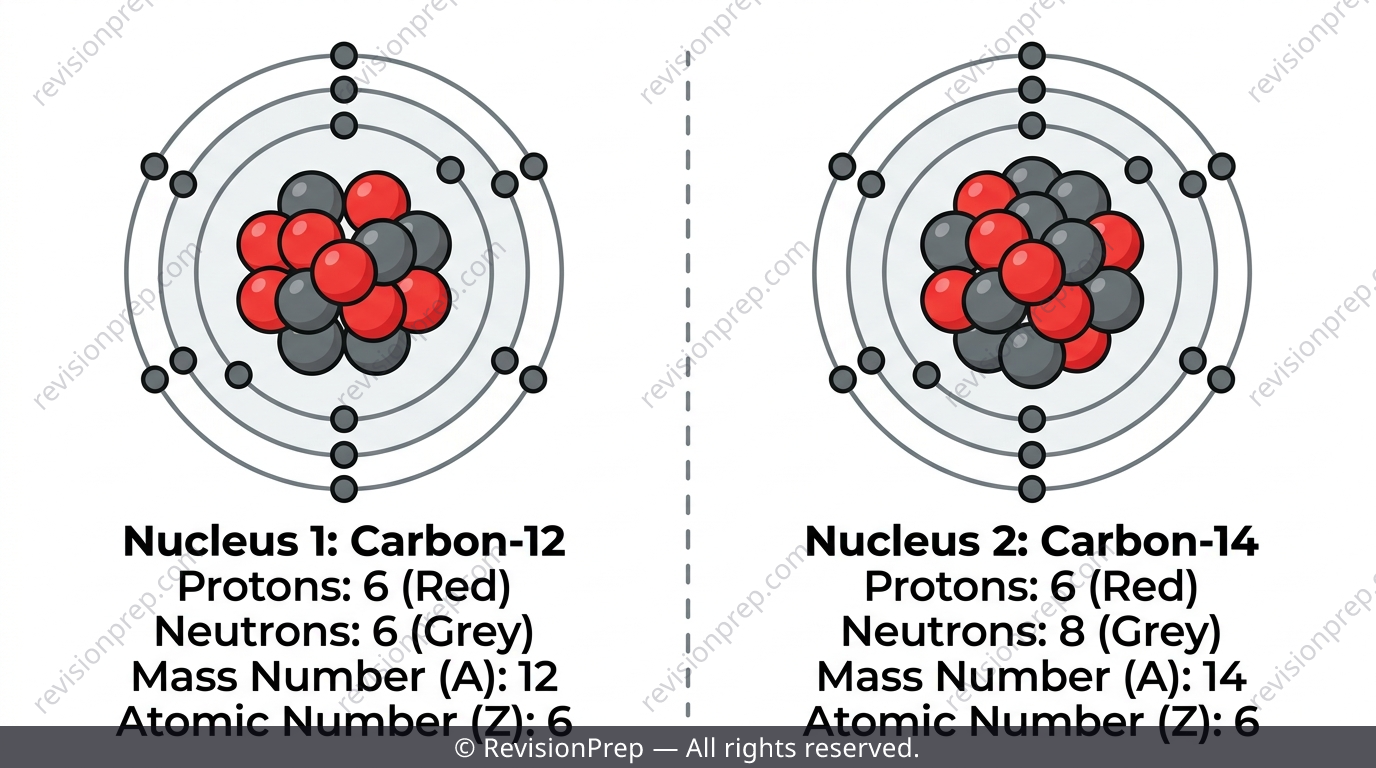
Atomic number () is the number of protons, defining the element, while mass number () is the total protons plus neutrons for one specific atom. Isotopes share the same but differ in neutron number and therefore , with identical chemical behaviour but different mass. Relative atomic mass () is the abundance-weighted mean mass of all naturally occurring isotopes, measured directly by mass spectrometry.
Exam tip
Always show the weighting step explicitly: mass × (%abundance/100) for each isotope, then sum — this earns the method mark even if the final answer is slightly off.
Common mistake
Calculating an unweighted average of isotope masses (e.g. simply averaging chlorine's two isotope masses) instead of weighting by percentage abundance.
Mini summary
Z = protons, A = protons + neutrons, isotopes = same Z different A, Ar = weighted mean from mass spectrometry data.
Quantised Energy Levels and Emission Spectra
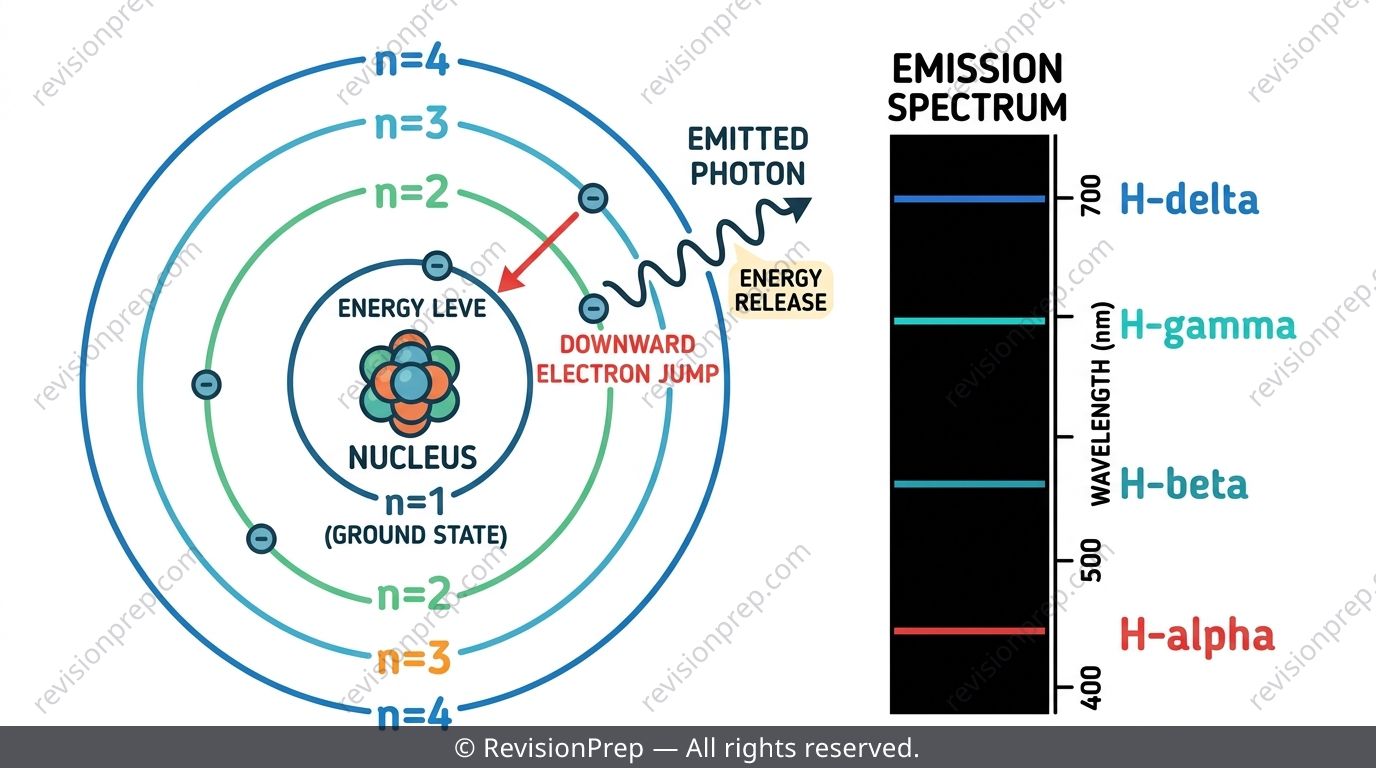
When atoms absorb energy, electrons jump to higher energy levels; when they fall back down, they emit photons at very specific frequencies, producing a line emission spectrum rather than a continuous rainbow. These discrete lines are direct experimental evidence that electron energy is quantised — only certain fixed energy levels are allowed, not a continuous range.
Exam tip
Link the observation directly to the conclusion: distinct spectral lines (not a continuous spectrum) is the evidence, quantised energy levels is the conclusion — state both in your answer.
Common mistake
Describing emission spectra without connecting the discrete lines to the idea of quantised, fixed electron energy levels.
Mini summary
Line emission spectra (not continuous spectra) are the experimental evidence that electrons occupy discrete, quantised energy levels.
Quick formula sheet
Practice questions
- State the key difference between evaporation and boiling.
- Define atomic number and mass number in your own words.
- Explain why gases can be compressed easily but solids cannot.
- Boron has two isotopes: (19.9%, mass 10.01) and (80.1%, mass 11.01). Calculate the relative atomic mass of boron to 3 significant figures.
- Using kinetic theory, explain why temperature stays constant while a substance melts, even though heating continues.
- Identify which historical discovery disproved Dalton's postulate that atoms of an element are identical, and explain why.
- A substance is heated at a constant power. Its boiling plateau lasts three times longer than its melting plateau. Explain, using particle theory and the relevant energy equation, what this tells you about the relative strength of forces overcome during boiling versus melting.
- Explain how line emission spectra provide evidence that electron energy levels are quantised rather than continuous.
- Describe what Rutherford's gold foil observations (most alpha particles passing straight through, a few deflecting sharply) each individually reveal about atomic structure.
Frequently asked questions
What is the difference between evaporation and boiling in IB Chemistry?+
Evaporation only involves the highest-energy particles escaping from a liquid's surface, and can occur at any temperature below the boiling point. Boiling occurs throughout the whole liquid at one fixed temperature, when vapour pressure equals atmospheric pressure.
Why does temperature stay constant during a phase change?+
During melting or boiling, all the energy being added is used to overcome intermolecular attractive forces rather than increasing particle kinetic energy, so temperature plateaus until the phase change is complete.
What discovery disproved Dalton's atomic theory?+
Several discoveries refined Dalton's model: the electron (Thomson) disproved 'indivisible atoms', while isotopes specifically disproved the claim that all atoms of an element have identical mass.
How do you calculate relative atomic mass from isotopes?+
Multiply each isotope's mass by its fractional percentage abundance, then sum these values across all isotopes — never take a simple unweighted average.
What is the difference between atomic number and mass number?+
Atomic number () is the number of protons and defines the element. Mass number () is the total number of protons plus neutrons in one specific atom.
What evidence shows that electron energy is quantised?+
Line emission spectra show discrete, specific frequencies of light rather than a continuous spectrum, which is direct evidence that electrons can only occupy certain fixed, quantised energy levels.
Master every part of Structure with the full RevisionPrep notes
Related articles