
Reactivity: What Are the Mechanisms of Chemical Change?
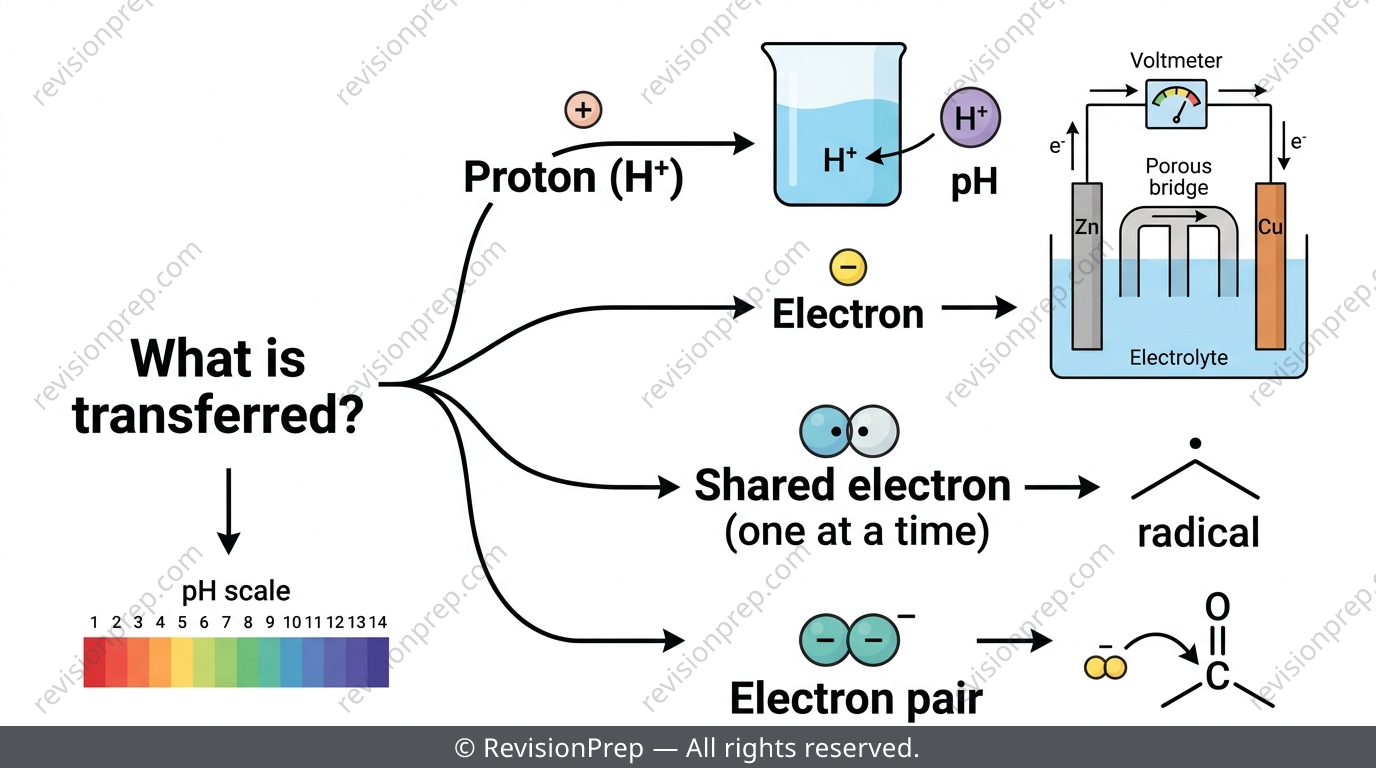
Classify every reaction by what actually moves: a proton, an electron, or a shared electron pair.
Quick facts
IB DP Chemistry Reactivity 3 can feel like four unrelated topics — acids, redox, radicals, and organic mechanisms — but there's one unifying question that unlocks all of it: what species is actually moving? Proton transfer reactions give you Bronsted-Lowry acid base theory, conjugate pairs, and buffer solutions. Electron transfer covers redox, standard electrode potential, and Faraday's law electrolysis calculations. Electron sharing brings in homolytic and heterolytic fission through radical substitution mechanisms with fishhook arrows. Electron-pair sharing introduces nucleophile electrophile reactions IB chemistry students meet in curly-arrow mechanisms like SN1 and SN2. Once you classify a reaction correctly, the vocabulary, arrows, and formulas follow automatically. This teaser breaks down the five ideas examiners test most, plus the mistakes that cost marks every year — the full revision notes go much deeper into every mechanism and calculation.
What you’ll be able to do
1. The One Question That Classifies Every Reaction
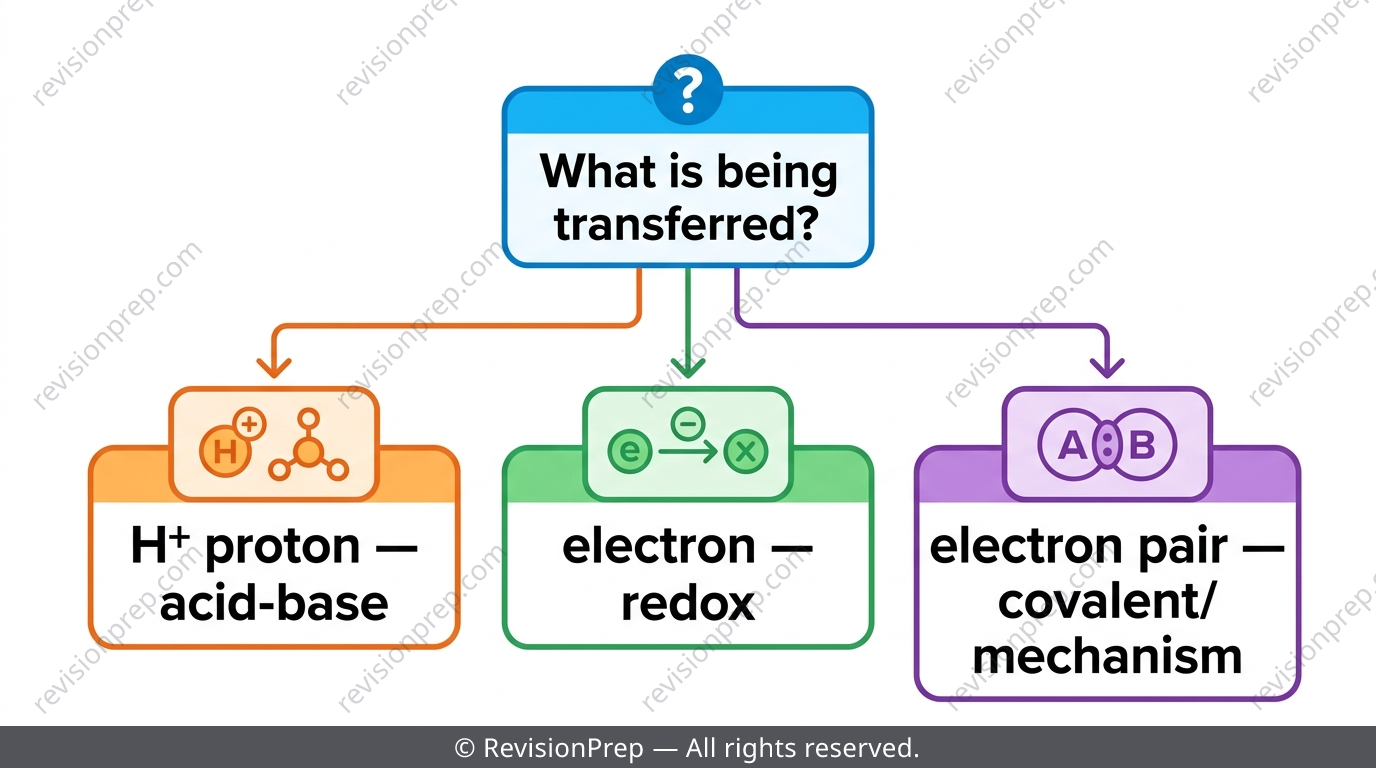
Before analysing any mechanism, ask: is a proton moving, an electron moving, or is a pair of electrons being shared? Reactivity 3 groups all reactions by what species is transferred, not by product type. Get the classification right and the correct vocabulary, arrows, and formulas follow automatically — this is the fastest way to approach an unfamiliar exam question.
Mini summary
Classify first by transferred species — proton, electron, or electron pair — then apply the matching rules.
2. Proton Transfer: Acids, Bases & Buffers
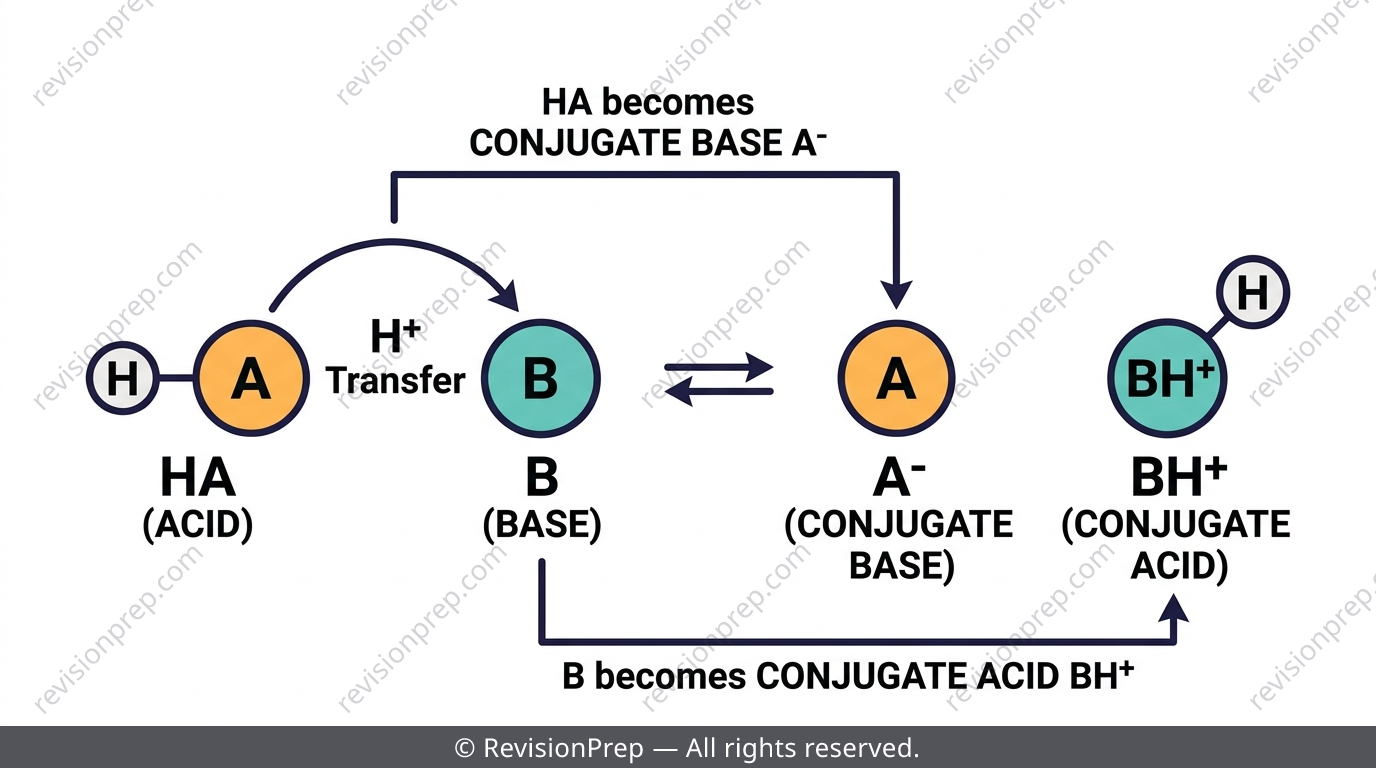
A Bronsted-Lowry acid donates H⁺ and a base accepts it, forming conjugate acid-base pairs that differ by exactly one proton and one unit of charge. Strong acids/bases dissociate almost completely, while weak ones establish an equilibrium described by or — strength is about the extent of dissociation, never concentration. At HL, polyprotic acids lose protons stepwise with , and buffers use the Henderson-Hasselbalch equation to resist pH change.
| Term | Meaning |
|---|---|
| Conjugate acid | Species formed when a base gains a proton |
| Conjugate base | Species formed when an acid loses a proton |
| Amphiprotic | Can act as acid or base depending on partner |
Exam tip
To find a conjugate pair fast, add or remove exactly one H⁺ and adjust the charge by one unit — for HSO₄⁻, the conjugate acid must be H₂SO₄.
Common mistake
Assuming 'strong acid' means 'more concentrated' — strength is about % dissociation, not concentration.
Mini summary
Conjugate pairs differ by one H⁺; strength = extent of dissociation, not concentration.
3. Electron Transfer: Redox & Electrochemistry
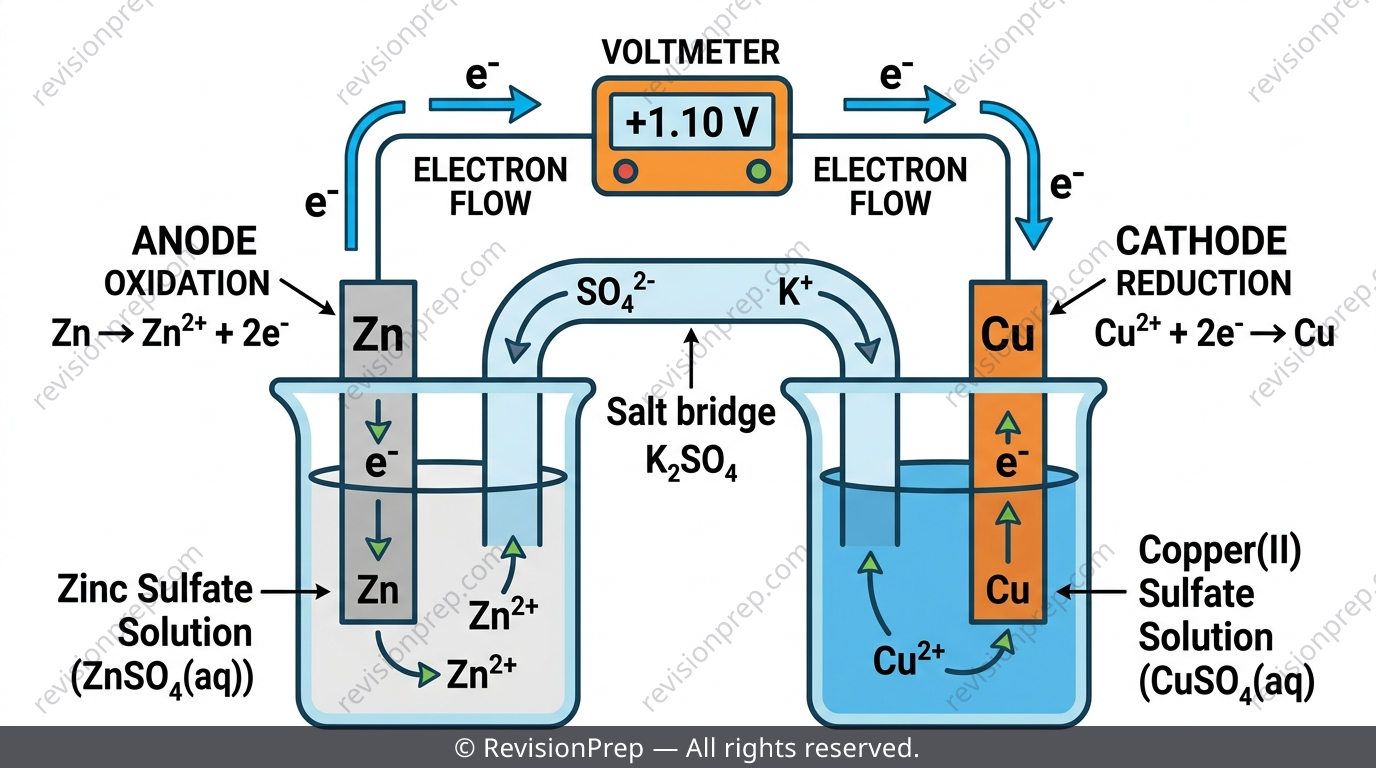
Redox reactions involve simultaneous oxidation (electron loss) and reduction (electron gain), split into half-equations balanced for atoms, then charge. The oxidising agent is reduced; the reducing agent is oxidised. Standard electrode potential ranks species by how readily they gain electrons, and tells you whether a reaction is spontaneous. At HL, Faraday's law (, ) quantifies electrolysis products.
| Feature | Galvanic cell | Electrolytic cell |
|---|---|---|
| Energy | Produces electricity | Consumes electricity |
| Reaction type | Spontaneous (E°cell positive) | Non-spontaneous |
Exam tip
Always write — subtracting the wrong way round is the most common sign error and flips spontaneity conclusions.
Common mistake
Subtracting anode minus cathode instead of cathode minus anode when calculating E°cell.
Mini summary
Redox = electron transfer; use E°cell = E°cathode - E°anode, positive means spontaneous.
4. Electron Sharing: Radical Chain Mechanisms
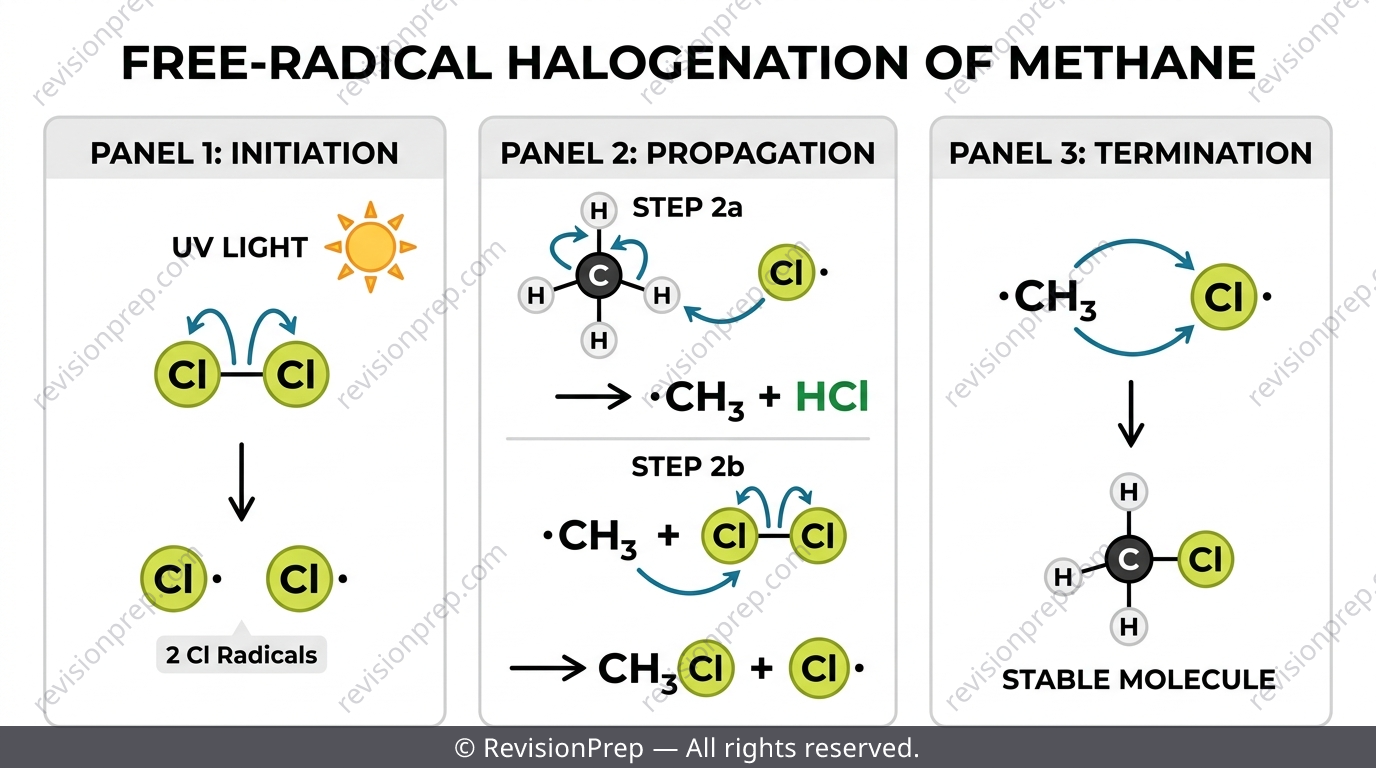
A covalent bond is a shared electron pair between atoms of similar electronegativity. Homolytic fission splits this bond so each fragment keeps one electron, forming two radicals — species with an unpaired electron, highly reactive and drawn with single-barbed fishhook arrows. Free-radical substitution (e.g. methane + chlorine under UV) proceeds through initiation, propagation, and termination, with propagation always written as two steps that regenerate the chain.
| Stage | What happens |
|---|---|
| Initiation | UV/heat causes homolytic fission, generating first radicals |
| Propagation | Radical reacts with a stable molecule, forming product + new radical (two steps) |
| Termination | Two radicals combine to form a stable molecule |
Exam tip
Propagation must be shown as TWO separate steps that together regenerate the original radical — one step alone loses a mark.
Common mistake
Using double-barbed curly arrows for radical mechanisms — radicals always need single-barbed fishhook arrows since only one electron moves at a time.
Mini summary
Homolytic fission gives radicals; chain mechanisms need initiation, two propagation steps, and termination, all drawn with fishhook arrows.
5. Electron-Pair Sharing: Nucleophiles & Electrophiles (HL)
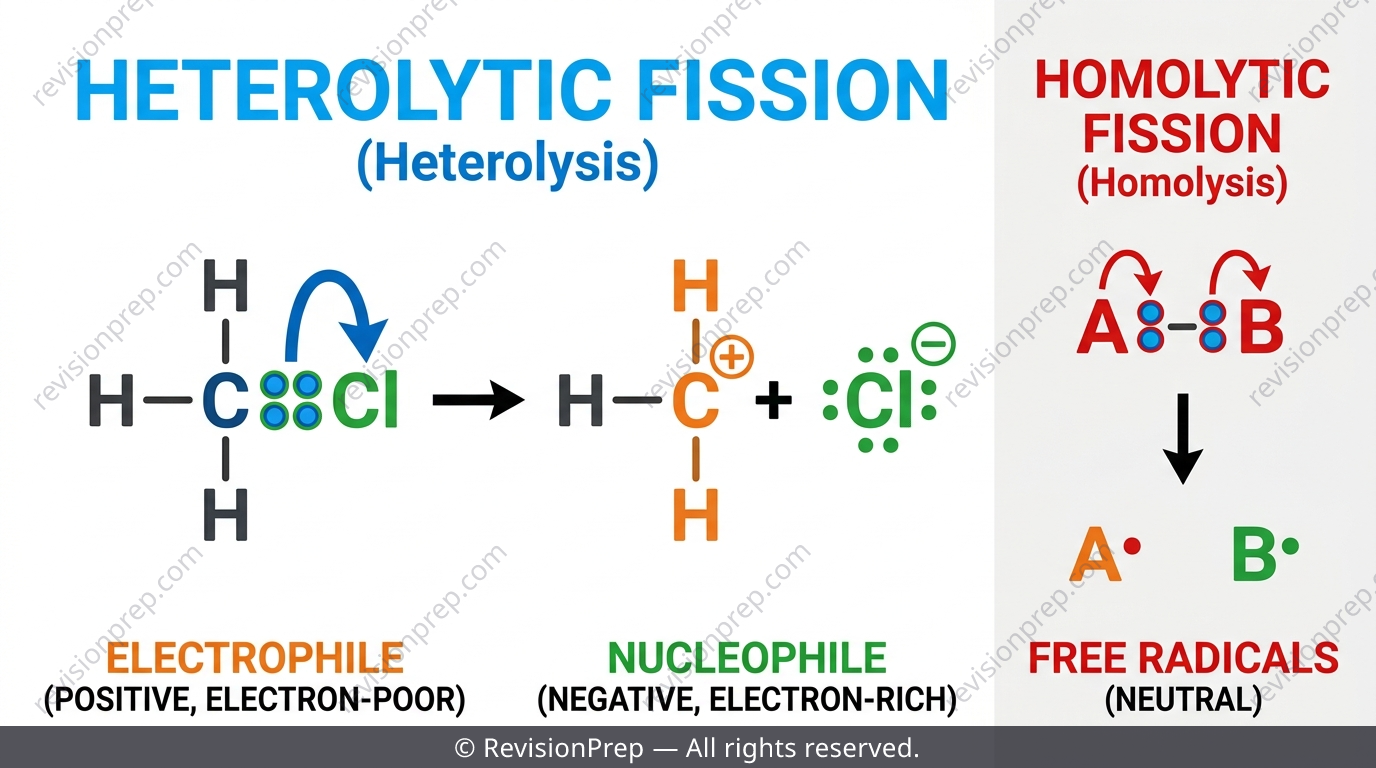
Where covalent bonds break heterolytically, both electrons go to one atom rather than splitting evenly, producing full curly arrows instead of fishhooks. This underpins nucleophile-electrophile mechanisms in organic chemistry, including the HL-level SN1 and SN2 substitution pathways. Recognising heterolytic fission versus homolytic fission is the key distinguishing step before drawing any organic mechanism.
Exam tip
Check whether a bond breaks symmetrically (homolytic, fishhook arrows, radicals) or asymmetrically (heterolytic, full curly arrows, ions) before attempting any mechanism question.
Mini summary
Heterolytic fission moves both bonding electrons to one atom, drawn with full curly arrows, underpinning SN1/SN2 mechanisms.
Quick formula sheet
Practice questions
- Identify the conjugate base of H2PO4-.
- State which species is oxidised and which is reduced in Zn + Cu2+ → Zn2+ + Cu.
- Name the three stages of a free-radical substitution mechanism.
- Explain why a strong acid conducts electricity better than a weak acid of the same concentration.
- Calculate E°cell for a cell with E°(cathode) = +0.80 V and E°(anode) = -0.44 V, and state if it is spontaneous.
- Explain why homolytic fission requires energy input such as UV light or heat.
- A diprotic acid has Ka1 ≫ Ka2. Explain why the pH of its solution can be calculated using only Ka1.
- Using Q = It and n(e-) = Q/F, outline how you would calculate the mass of copper deposited during electrolysis given current and time.
- Compare the arrow notation and electron movement in homolytic versus heterolytic fission, explaining why each mechanism type requires a different arrow.
Frequently asked questions
What is the difference between the four reaction types in Reactivity 3?+
They're classified by what is transferred: protons (acid-base), electrons (redox), and shared electron pairs (covalent bonds/radicals, or organic nucleophile-electrophile mechanisms at HL).
Why isn't a strong acid the same as a concentrated acid?+
Strength refers to the extent of dissociation — a strong acid ionises almost completely regardless of concentration, while a weak acid only partially dissociates even at high concentration.
How do you know which electrode is the cathode?+
The cathode is always where reduction occurs, in both galvanic and electrolytic cells — use E°cell = E°cathode − E°anode to check spontaneity.
Why do radical mechanisms use fishhook arrows instead of curly arrows?+
Fishhook (single-barbed) arrows show one electron moving, matching homolytic fission where each fragment keeps one electron; full curly arrows are reserved for electron pairs in heterolytic fission.
What makes a buffer solution work?+
A buffer contains a weak acid and its conjugate base (or weak base and conjugate acid) in comparable amounts, allowing it to neutralise small additions of acid or base via the Henderson-Hasselbalch relationship.
Is Reactivity 3 tested at both SL and HL?+
Yes — proton and electron transfer basics, and radical mechanisms, are SL content, while polyprotic acids, buffers, Faraday's law, and SN1/SN2 mechanisms are HL extensions.
Master Every Mechanism in Reactivity 3
Related articles