
Global Economy
Trade integration, exchange rates and the balance of payments — the whole of IB Economics Paper 2, distilled.
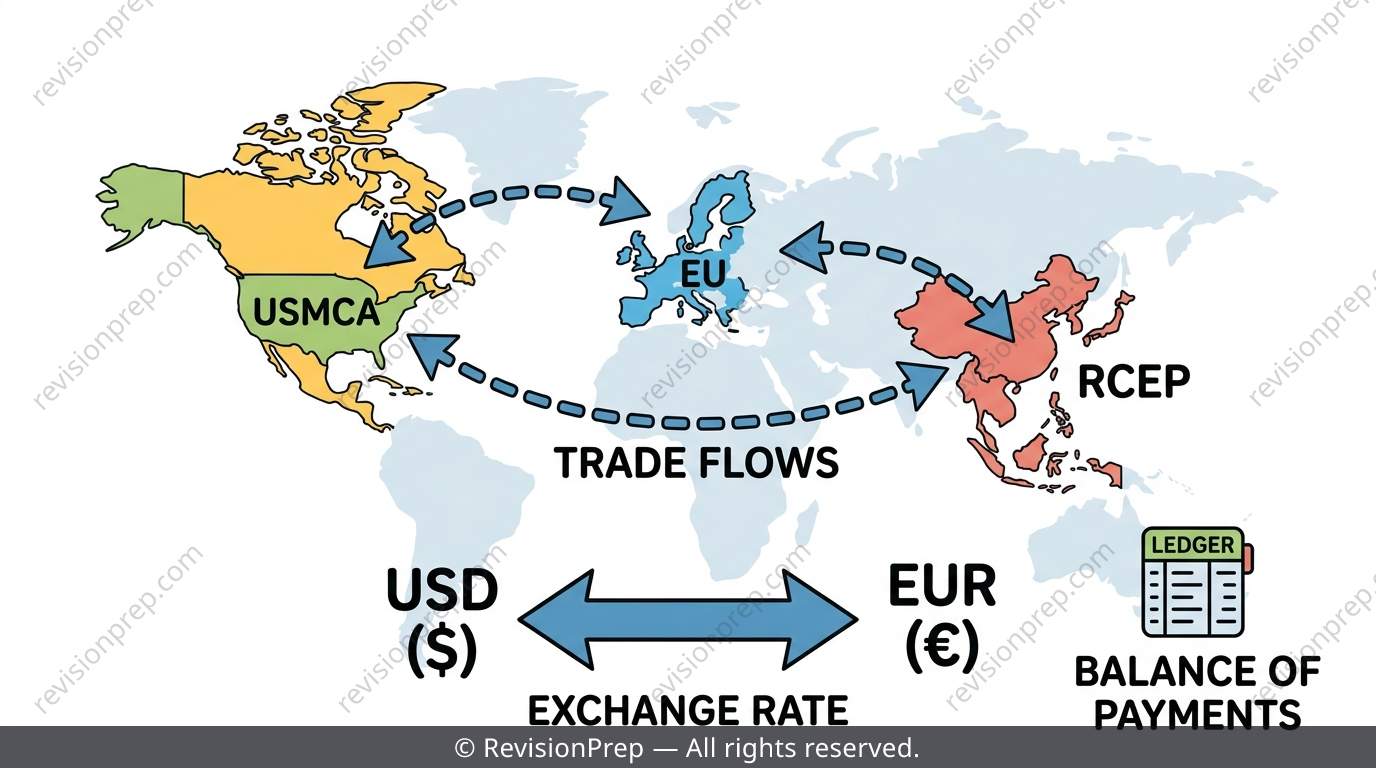
Quick facts
If you're revising IB Economics Global Economy, you're revising the topic that IS Paper 2 at SL — two data-response questions built from real news extracts, worth roughly a third of your final grade. It fuses trade theory (economic integration, the WTO, trade creation and trade diversion) with macro-for-nations concepts (exchange rate regimes and the balance of payments). Almost every question, whether data response or essay, is asking you to spot a winner and a loser — a consumer, a domestic firm, a government, a trading partner — and justify a judgement using the right diagram and definition. This teaser walks through the five ideas examiners return to most: the integration spectrum and WTO rules, trade creation vs diversion, floating vs fixed exchange rates, exchange rate calculations, and the structure of the balance of payments. The full revision notes go deeper into every diagram, formula and mark-scheme trap.
What you’ll be able to do
Economic Integration & the WTO
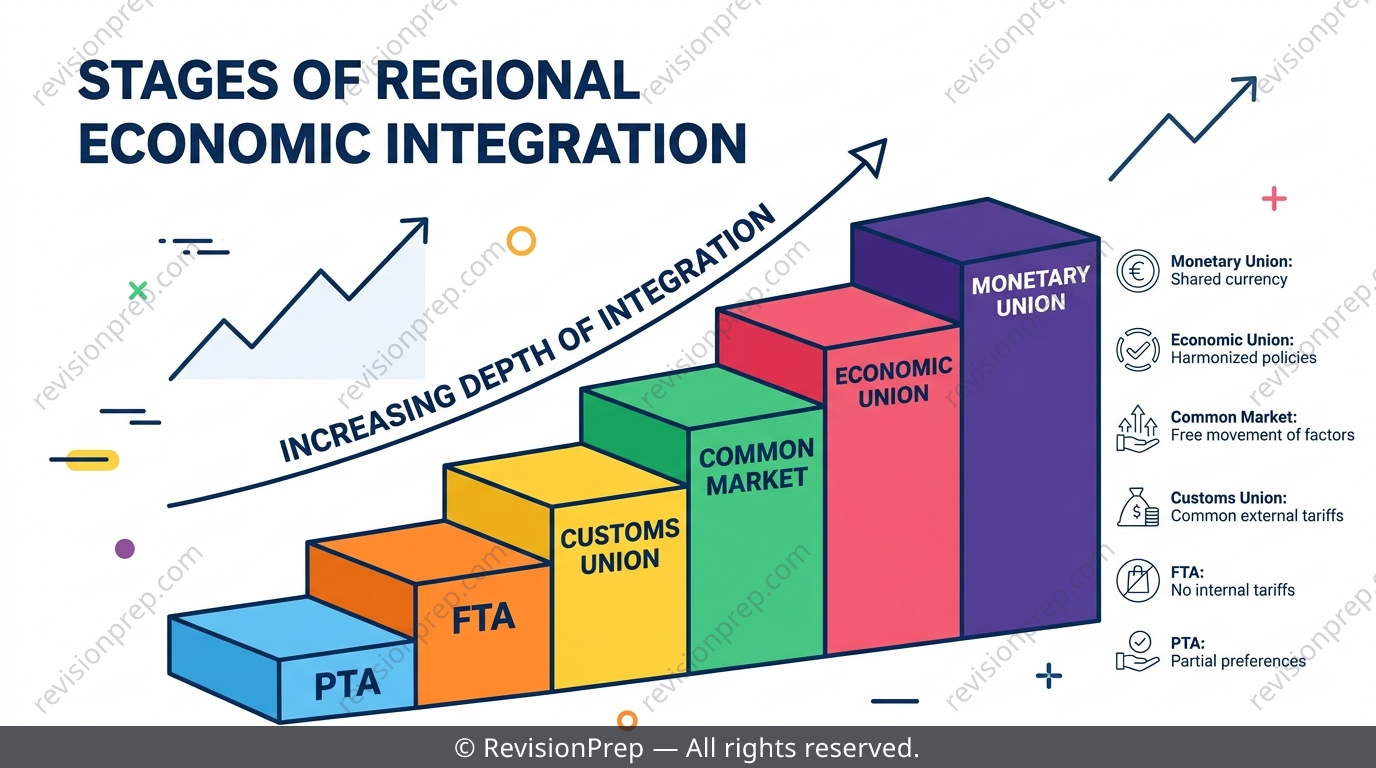
Economic integration is a ladder: PTA (reduced tariffs on select goods) → FTA (zero tariffs between members, own external tariff) → customs union (zero tariffs plus a common external tariff) → common market (+ free movement of labour and capital) → economic union (+ harmonised policy) → monetary union (+ single currency, e.g. the Eurozone). Each rung removes more friction but demands more shared policy. Multilaterally, the WTO chases similar liberalisation through Most-Favoured-Nation (treat every partner as well as your best-treated one) and National Treatment (treat imports like domestic goods once they clear customs) — but regional blocs are a deliberate, legal exception to MFN, which is exactly the tension exam extracts about stalled WTO talks keep testing.
Exam tip
For 'Define a customs union' (2 marks), write two separate clauses: zero tariffs between members AND a common external tariff. Mentioning only the first describes a free trade area and caps you at 1/2.
Mini summary
Integration spectrum: PTA → FTA → customs union → common market → economic union → monetary union; WTO's MFN and National Treatment are its multilateral rules, with regional blocs as the sanctioned exception.
Trade Creation vs Trade Diversion
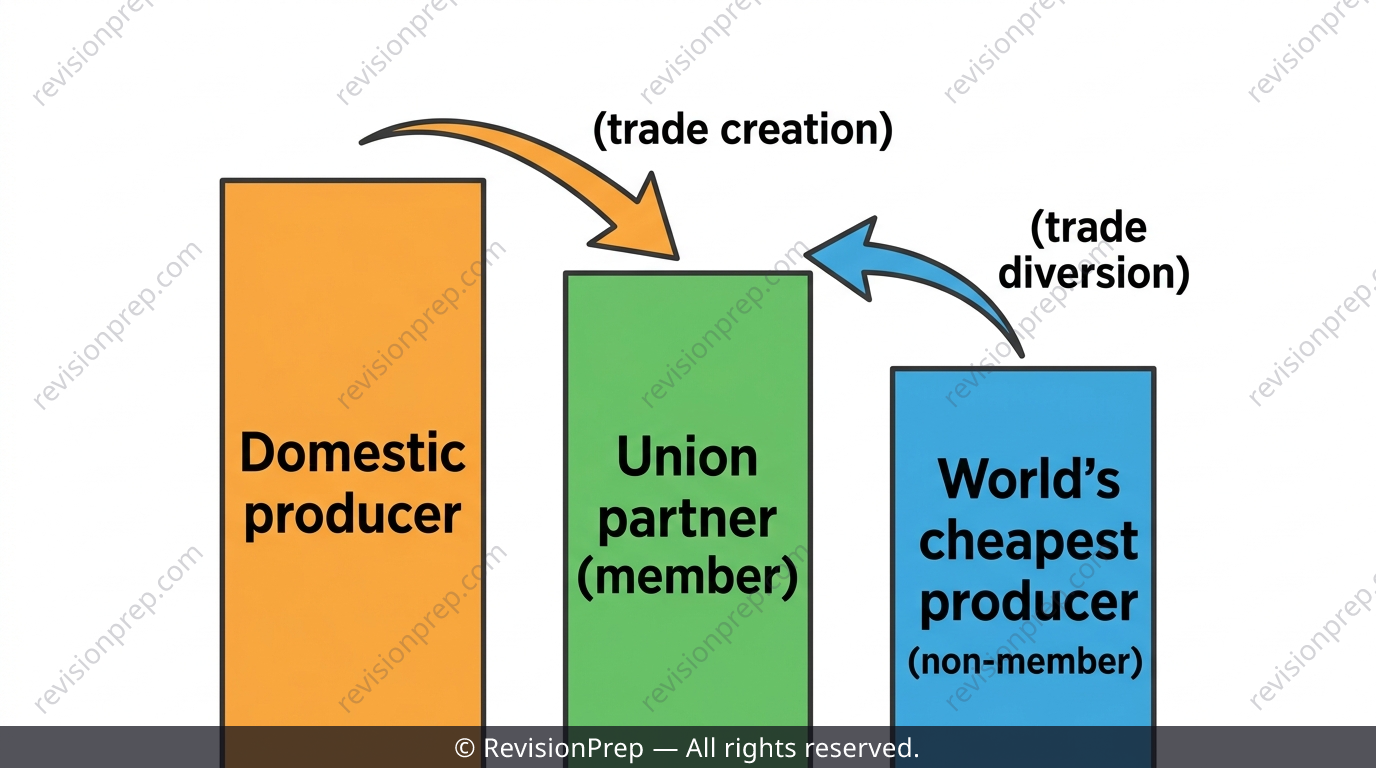
Trade creation happens when a union member switches from a less efficient domestic producer to a more efficient union-partner producer — world efficiency and consumer welfare rise. Trade diversion happens when a member switches away from a more efficient non-member producer to a less efficient member producer purely because the tariff preference makes the member look cheaper — world efficiency falls and the government loses tariff revenue. The trap: an efficient outsider existing is not enough to prove diversion; you must trace what the country was actually doing before the union and show a genuine switch away from that outsider.
Common mistake
Writing 'trade diversion is buying from a less efficient producer' and stopping there. State the full mechanism: efficient outsider → tariff makes them relatively expensive → less efficient member looks cheaper → net loss of global efficiency and lost tariff revenue.
Mini summary
Trade creation = domestic → efficient member (efficiency up). Trade diversion = efficient non-member → less efficient member (efficiency down).
Exchange Rate Regimes: Floating vs Fixed
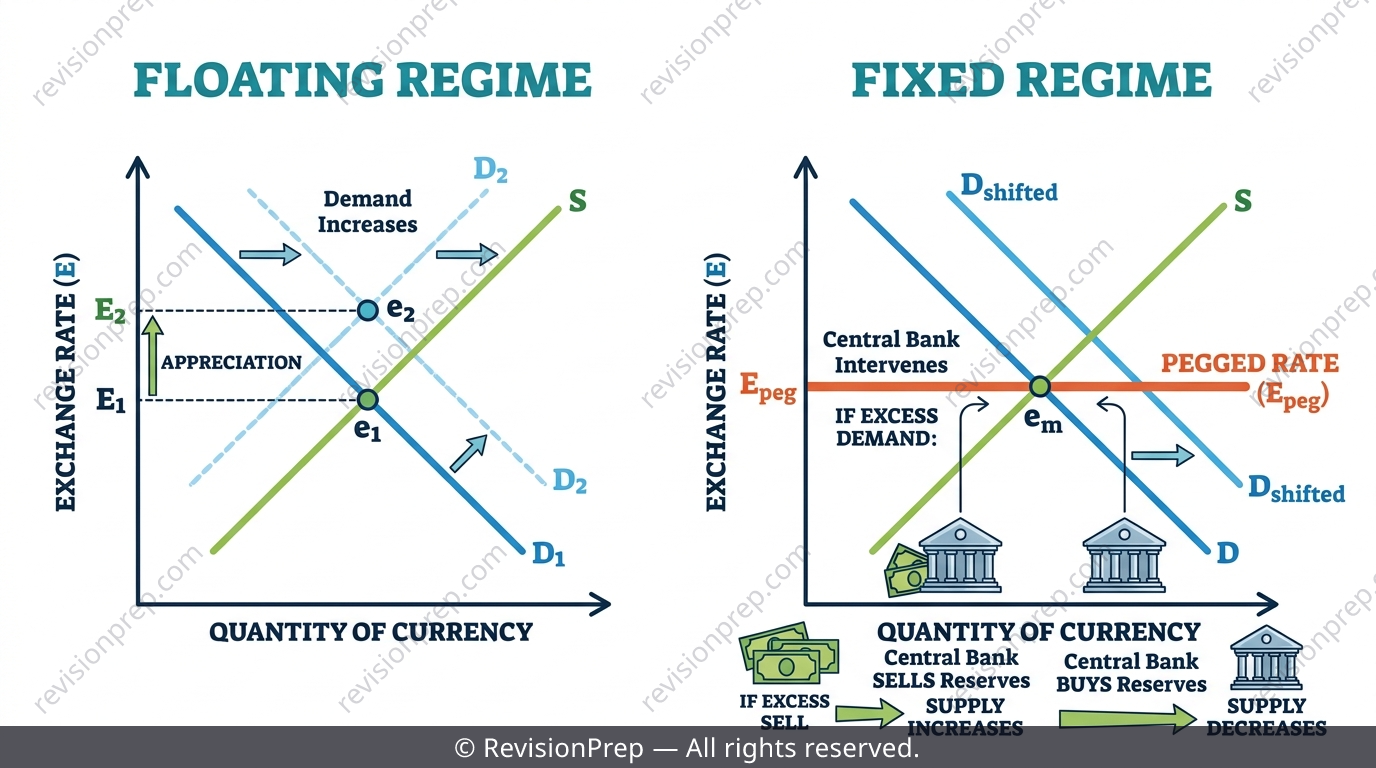
An exchange rate is the price of one currency in another. Under a floating regime, demand and supply in the forex market set the rate freely and it appreciates or depreciates. Under a fixed regime, the central bank commits to a rate and defends it with reserves, deliberately revaluing or devaluing it; a managed float sits in between. Same direction of movement, completely different mechanism and command word — mixing up the vocabulary is one of the most common ways to lose marks.
Exam tip
'Explain the effect of a rise in interest rates on the exchange rate' wants you to shift the DEMAND curve for the currency (hot money inflows chasing higher returns), not supply.
Common mistake
Using 'devaluation' to describe a market-driven fall in a floating currency, or vice versa. Floating regime → appreciation/depreciation (market-driven). Fixed regime → revaluation/devaluation (a deliberate government decision).
Mini summary
Floating rates move via demand/supply (appreciation/depreciation); fixed rates are reset by policy (revaluation/devaluation).
Calculating & Interpreting Exchange Rate Movements
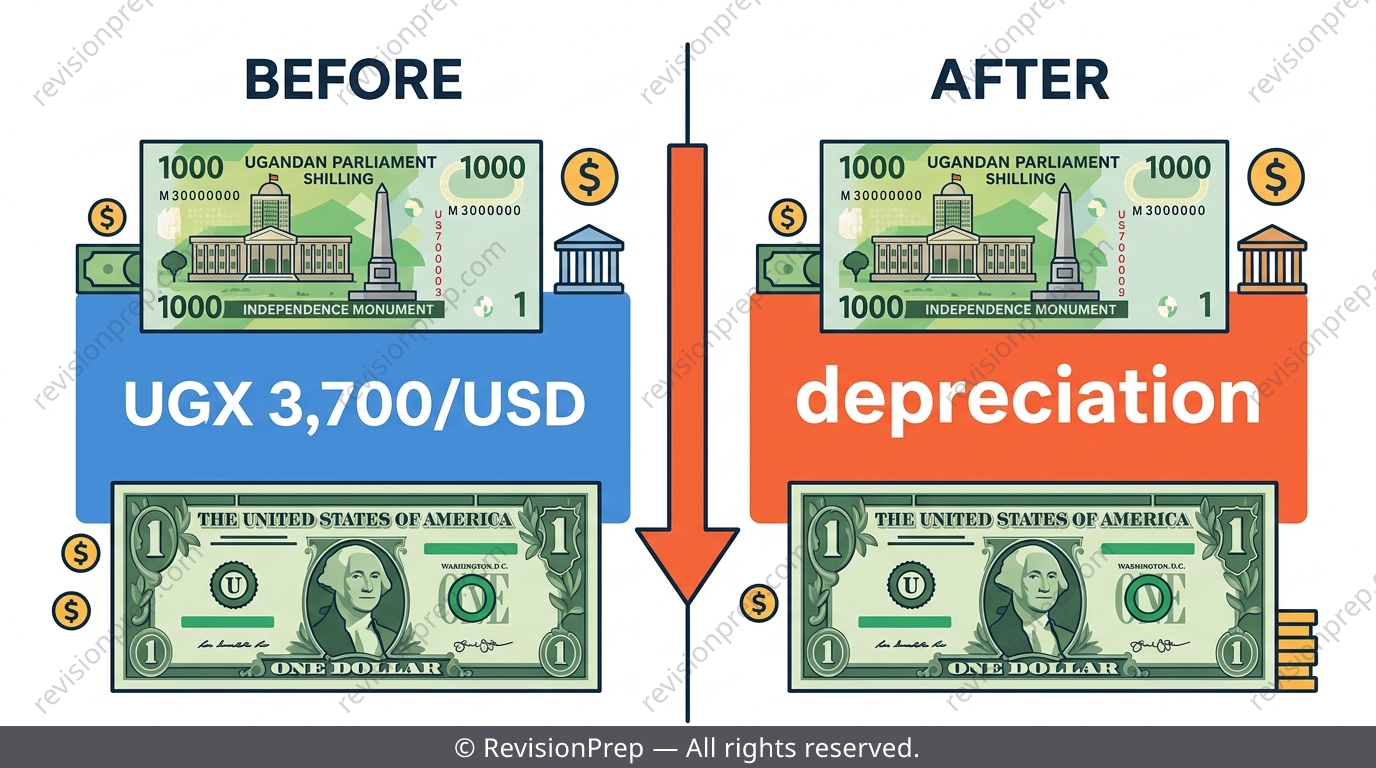
Percentage appreciation or depreciation is calculated as . Always check direction: more local currency per unit of foreign currency means depreciation, not appreciation, even if the number looks like it 'went up'. To convert a foreign-currency import bill into local currency, multiply the foreign price by the units of local currency per unit of foreign currency. HL students should also recognise the Marshall-Lerner condition () and the J-curve, though SL is only examined on the basic demand/supply model.
Common mistake
Seeing a currency's shilling-per-dollar rate rise (e.g. UGX 3,700 → 3,900 per USD) and instinctively calling it an appreciation. Ask: is this more or fewer units of local currency per unit of foreign currency? More = depreciation.
Mini summary
Use the % change formula and always confirm direction before labelling a move as appreciation/depreciation or revaluation/devaluation.
Balance of Payments: Current & Capital Accounts
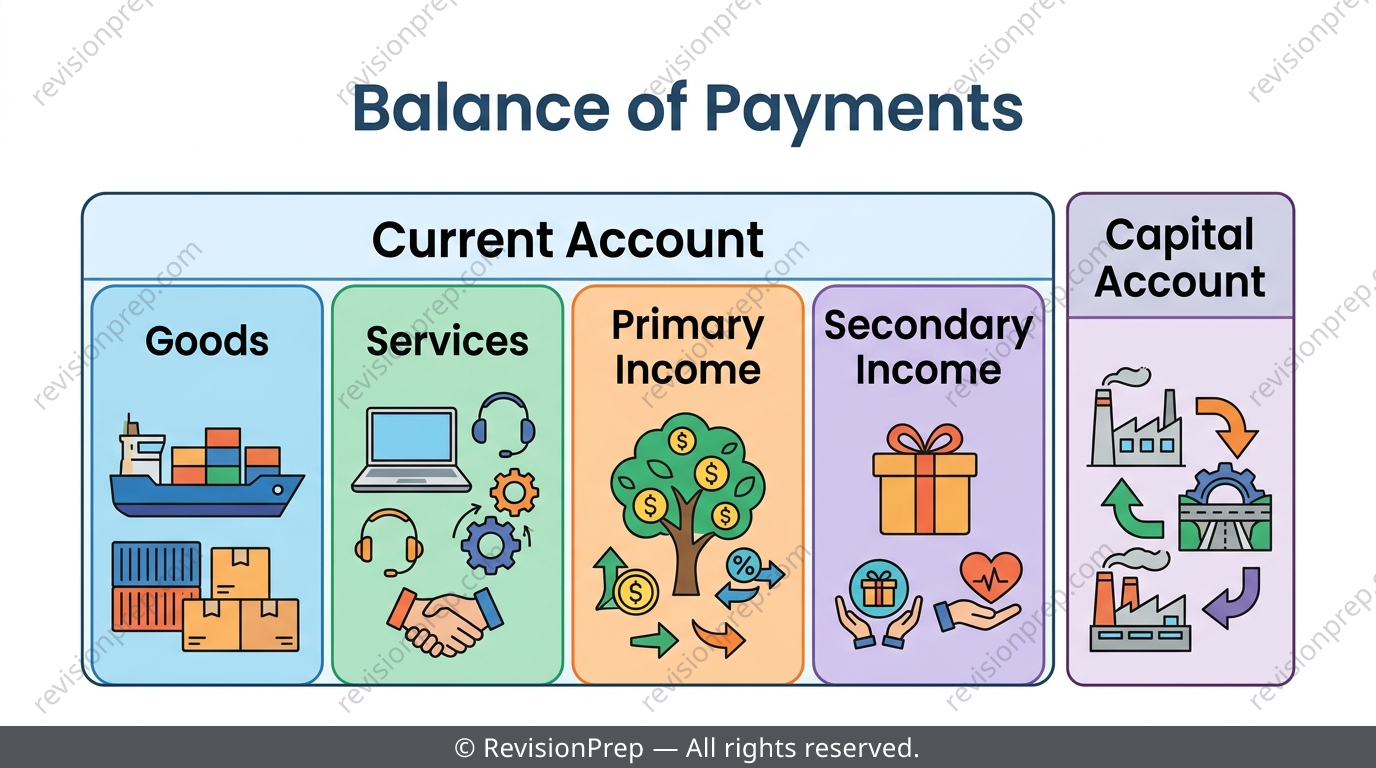
The balance of payments records a country's transactions with the rest of the world across several accounts. The current account covers trade in goods (visible), trade in services (invisible), primary income (interest, profit, dividends, wages earned abroad) and secondary income (transfers such as remittances and aid). The capital account is usually a small line item covering capital transfers and sales of non-produced, non-financial assets like patents. A third account, the financial account, completes the picture — the full revision notes break down exactly how it fits with the other two.
Mini summary
Current account = goods + services + primary income + secondary income; capital account = capital transfers and non-produced assets; financial account covered in full notes.
Quick formula sheet
Practice questions
- Define a free trade area and a customs union, highlighting the key difference between them.
- State the WTO's Most-Favoured-Nation principle in your own words.
- Distinguish between a floating and a fixed exchange rate regime.
- Explain why regional trade blocs are considered an exception to the WTO's MFN principle.
- Using an example, distinguish between trade creation and trade diversion.
- Explain, using a demand and supply diagram, the effect of a rise in interest rates on a floating exchange rate.
- A country joins a customs union. Before joining, it imported from the world's cheapest producer outside the union; after joining, it switches to a union-partner producer that is less efficient but tariff-free. Evaluate whether this represents trade creation, trade diversion, or both.
- Discuss whether deeper economic integration (e.g. a monetary union) is always beneficial for member countries.
- Evaluate the view that a currency depreciation will always improve a country's current account balance.
Frequently asked questions
What is the difference between trade creation and trade diversion?+
Trade creation is switching from a less efficient domestic producer to a more efficient union-partner producer, raising world efficiency. Trade diversion is switching from a more efficient non-member producer to a less efficient member producer purely because of the tariff preference, lowering world efficiency.
What is the difference between a customs union and a free trade area?+
Both remove tariffs between members, but a free trade area lets each member keep its own external tariff (requiring rules of origin checks), while a customs union adds a common external tariff on non-members.
What's the difference between depreciation and devaluation?+
Depreciation is a market-driven fall in a floating currency's value. Devaluation is a deliberate central bank decision to reset a fixed currency's value lower. Same direction, different mechanism.
How much of the IB Economics grade is Global Economy worth?+
At SL, it forms the entirety of Paper 2 (two data-response questions), which is roughly a third of your total grade, plus it can appear as an essay strand in Paper 1.
What is the Marshall-Lerner condition?+
It's an HL-only rule stating a currency depreciation only improves the current account if the sum of the price elasticities of demand for exports and imports exceeds 1. SL students are not examined on it directly.
What is recorded in the current account of the balance of payments?+
The current account records trade in goods, trade in services, primary income (interest, profits, dividends, wages earned abroad), and secondary income (transfers such as remittances and aid).
Get the full IB Economics Global Economy notes
Related articles