
IB Microeconomics: The Syllabus Area That Shows Up on Every Single Paper
Supply, market failure, and HL market power — the concepts examiners test in every session, distilled.
Quick facts
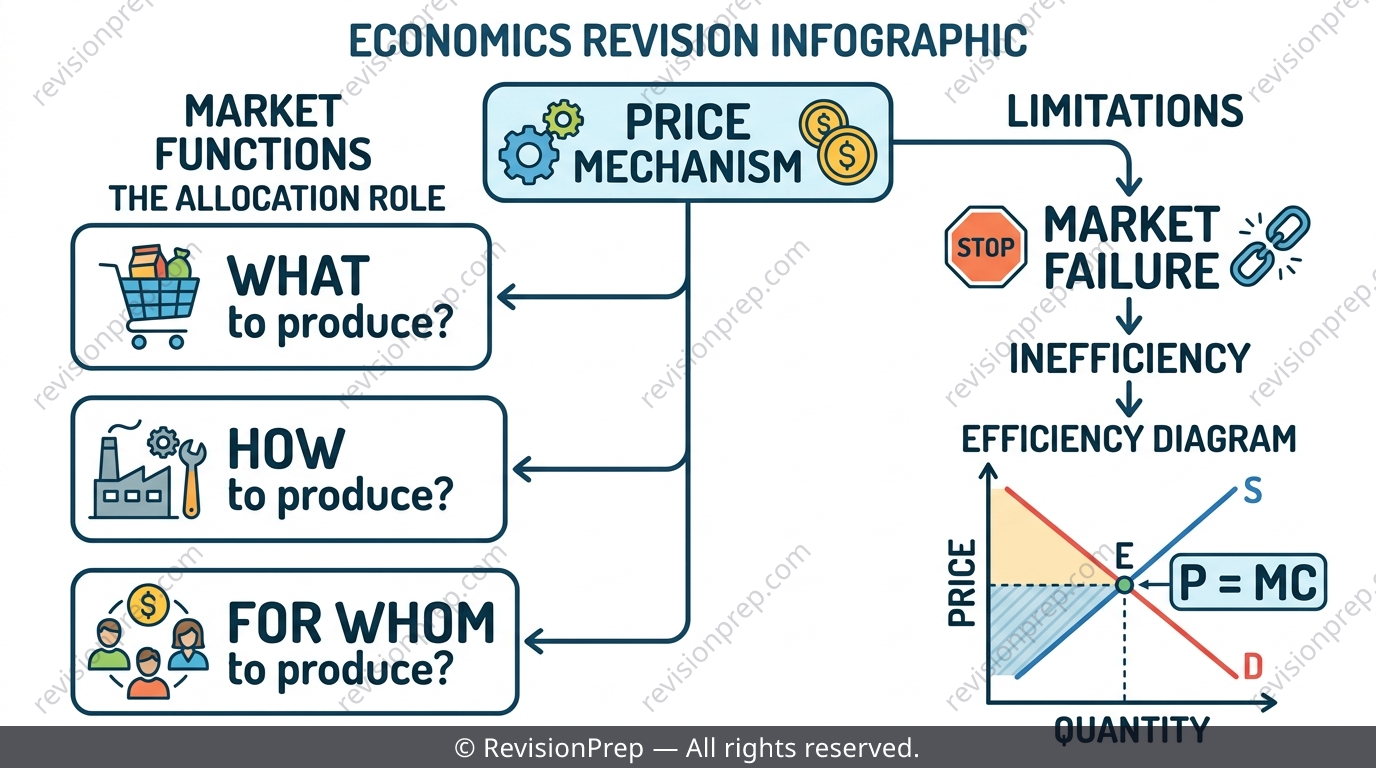
IB Economics microeconomics is the single most examined syllabus area in the whole course — it drives Paper 1 essays, resurfaces throughout Paper 2 data response, and (for HL) supplies most of the quantitative work on Paper 3. At its core, microeconomics asks how individual markets decide what gets produced, how, and for whom, using the price mechanism — and what happens when that mechanism breaks down. This teaser walks through the five ideas examiners reward most: why market failure dominates Paper 1, how supply shifts under tax and subsidy shocks, the crucial distinction between adverse selection and moral hazard, HL-only market power and price discrimination, and the diagram technique that turns a good answer into a top-band one. For the full worked examples, formulas, and mark-scheme language, the complete revision notes go much deeper.
What you’ll be able to do
Why Microeconomics Dominates Every IB Economics Paper
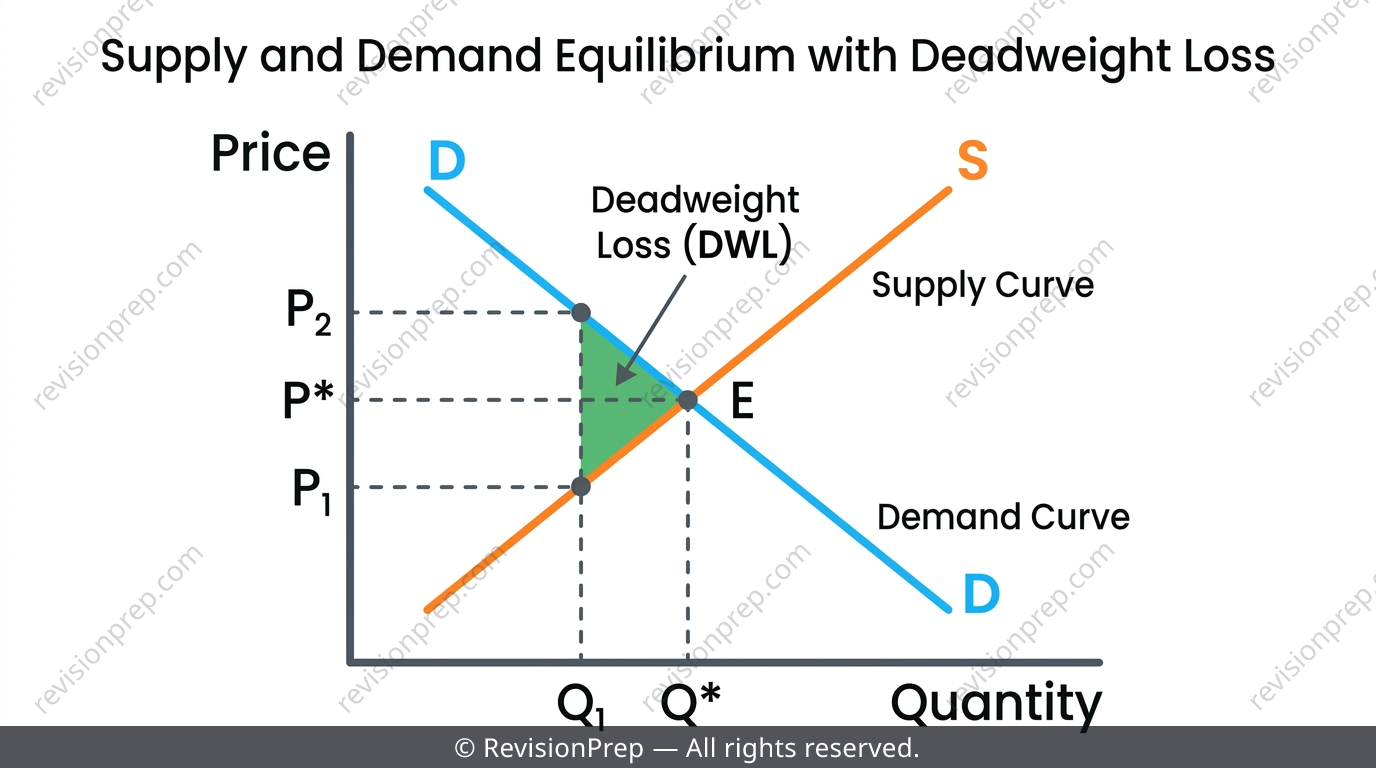
Microeconomics answers what, how, and for whom for individual markets, normally through the price mechanism — until something breaks it. Roughly half the chapter is market failure (externalities, public goods, asymmetric information, market power), which is exactly where Paper 1 essays cluster, and HL students also face market power and behavioural economics as extension topics. Every diagram question rewards the same three things: correctly labelled axes/curves, a clearly marked equilibrium or welfare-loss area, and a one-sentence link back to allocative efficiency.
Exam tip
Whatever the diagram, end your explanation with a link to or — examiners specifically look for that closing sentence.
Mini summary
Micro is tested in every paper, every session — market failure diagrams and the allocative-efficiency link are the highest-value skill.
Supply: The Law, Shifts vs Movements, and Tax/Subsidy Shocks
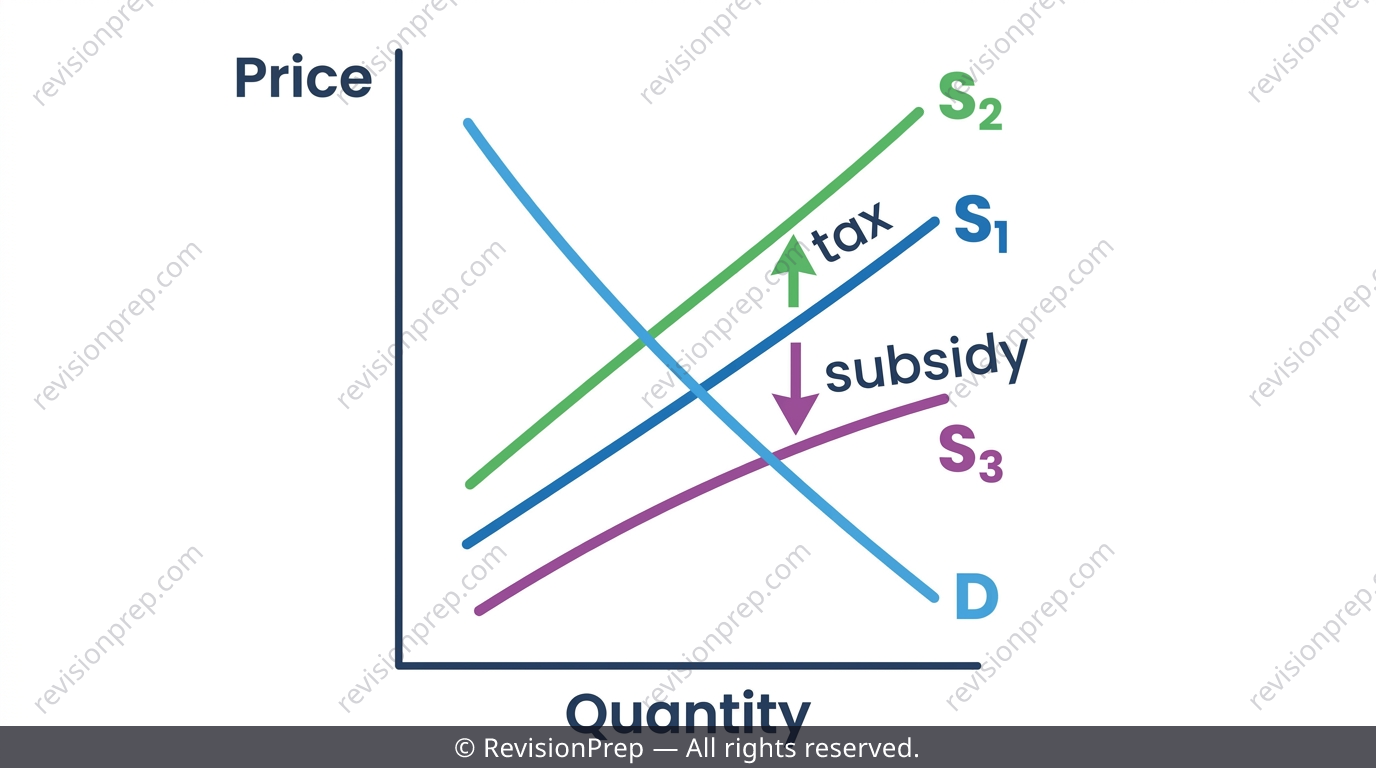
The law of supply says quantity supplied rises as price rises, ceteris paribus, because higher prices cover rising marginal costs. A change in the good's own price is always a movement along the curve; a change in anything else — costs, technology, taxes, subsidies, competitive or joint supply, expectations — shifts the whole curve. IB commonly gives supply as a linear equation to solve simultaneously with demand rather than relying only on the diagram.
| Determinant | Effect on Supply |
|---|---|
| Higher factor costs (wages, rent, materials) | Shifts left (decrease) |
| Better technology/productivity | Shifts right (increase) |
| Indirect tax | Shifts left/up (acts like a cost increase) |
| Subsidy | Shifts right/down (acts like a cost decrease) |
| Price of competitively/jointly supplied good | Can shift left or right |
Exam tip
Solve algebraically first; the diagram should confirm your numbers, not replace them.
Common mistake
Shifting the supply curve horizontally by the tax or subsidy amount instead of vertically — a per-unit tax/subsidy changes the price-intercept, so it's always a vertical shift.
Asymmetric Information: Adverse Selection vs Moral Hazard
Asymmetric information exists when one party to a transaction knows more than the other about quality, risk, or effort, so the market misprices the deal or breaks down entirely. IB splits the problem by timing: adverse selection is a hidden-characteristic problem that exists before the contract is signed (Akerlof's 'market for lemons'); moral hazard is a hidden-action problem that emerges after the contract, when one party takes on more risk because they no longer bear its full cost. Insurance markets are the classic exam setting for both at once, while labour markets show adverse selection from the employer's side, fixed through signalling or screening.

| Concept | Timing | Example |
|---|---|---|
| Adverse selection | Before the contract | High-risk individuals more likely to buy insurance |
| Moral hazard | After the contract | Insured person takes more risks once covered |
Exam tip
For 'explain how X leads to market failure' questions, name the mechanism, state the specific behavioural change, and explicitly link it to a market outcome — a definition alone scores half marks.
Common mistake
Defining moral hazard as 'high-risk people being more likely to buy insurance' — that's actually adverse selection. Anchor the discriminator on timing.
Market Power (HL): MR = MC, Allocative Inefficiency and Price Discrimination
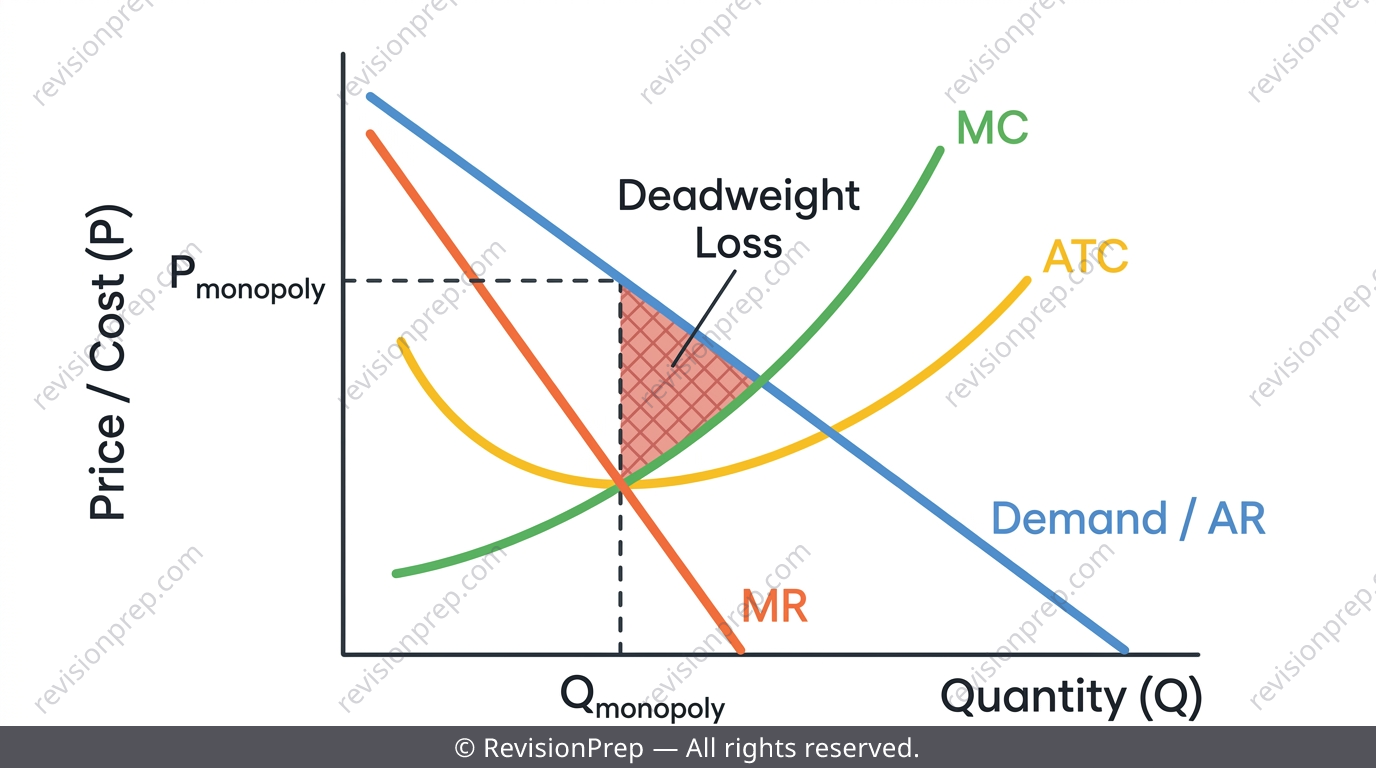
A firm with market power faces a downward-sloping demand curve, so marginal revenue lies below average revenue (demand). Profit-maximising output occurs where , but the price charged is read up to the demand curve rather than off the MC curve, producing — the definition of allocative inefficiency, plus deadweight welfare loss. Natural monopoly arises when economies of scale make one large firm genuinely more cost-efficient, though it will still restrict output unless regulated; price discrimination (charging different prices for the same good when costs are identical) needs market power, the ability to segment consumers, and prevention of resale.
| Degree | How it works |
|---|---|
| First-degree | Perfect — each consumer pays their maximum willingness to pay |
| Second-degree | By quantity/bundle — e.g. bulk discounts |
| Third-degree | By market segment — e.g. student/senior pricing |
Exam tip
Always read the price off the demand curve at the profit-maximising quantity, not off the MC curve — this is the step examiners check first.
Reading Market-Failure Questions: Spot the Overlap and Nail the Diagram
Real markets rarely appear as one 'pure' failure — an insurance market can combine asymmetric information with an equity evaluation, and examiners reward candidates who notice the overlap. Government responses vary by failure type: compulsory insurance or screening for asymmetric information, and price caps, profit regulation, or breaking up dominant firms for market power. Whatever the failure, the strongest answers always close by naming the welfare-loss area and linking it back to allocative efficiency.

Exam tip
Before finishing any market-failure paragraph, ask: have I identified the mechanism, shown it on a diagram, and linked it to or ?
Mini summary
High-scoring answers combine correct labelling, a clear welfare-loss area, and an explicit allocative-efficiency conclusion.
Quick formula sheet
Practice questions
- Define adverse selection and moral hazard, and state which occurs before and which after a contract is signed.
- State two determinants (other than price) that would shift a supply curve to the left.
- Explain why a movement along the supply curve differs from a shift of the supply curve.
- Using an insurance market example, explain how a pooled premium can lead to adverse selection when insurance is voluntary.
- Explain why a per-unit subsidy causes a vertical rather than a horizontal shift of the supply curve.
- Explain why a firm with market power sets but charges a price above marginal cost.
- Given linear demand and supply equations plus a specified per-unit tax, calculate the new equilibrium price and quantity and identify the price received by producers.
- Evaluate whether compulsory universal insurance is an effective policy response to adverse selection, referring to signalling and screening as alternatives.
- Discuss why real-world markets, such as insurance or labour markets, often display more than one type of market failure simultaneously, using specific examples.
Frequently asked questions
How much of IB Economics is microeconomics?+
Microeconomics is the most heavily tested syllabus area — expect at least one full micro question on every paper (Paper 1, Paper 2, and Paper 3 for HL) in every exam session.
What is the difference between adverse selection and moral hazard?+
Adverse selection is a hidden-characteristic problem that exists before a contract is signed (e.g. high-risk people are more likely to buy insurance); moral hazard is a hidden-action problem that emerges after the contract, when behaviour changes because risk is no longer fully borne by that party.
Why does a subsidy shift the supply curve vertically, not horizontally?+
A per-unit subsidy changes the price needed to supply a given quantity, which alters the price-intercept term in , so it always shifts the curve vertically (down) rather than sideways.
Is market power part of SL or HL Economics?+
Market power (including price discrimination and natural monopoly) is HL-only content in the IB Economics syllabus and does not appear on SL papers.
Why is price greater than marginal cost under market power?+
A firm with market power produces where but charges the price read off the demand curve at that output, which sits above MC — this gap is the definition of allocative inefficiency.
What are the three conditions needed for price discrimination?+
The firm needs market power, the ability to identify or segment consumers by elasticity of demand, and a way to prevent resale between the segments.
Get the Full IB Microeconomics Revision Notes
Related articles