
Global Economy: IB DP Economics Revision Guide
Protectionism, balance of payments, growth vs development and exchange rates — the unit that dominates Paper 3.
Quick facts
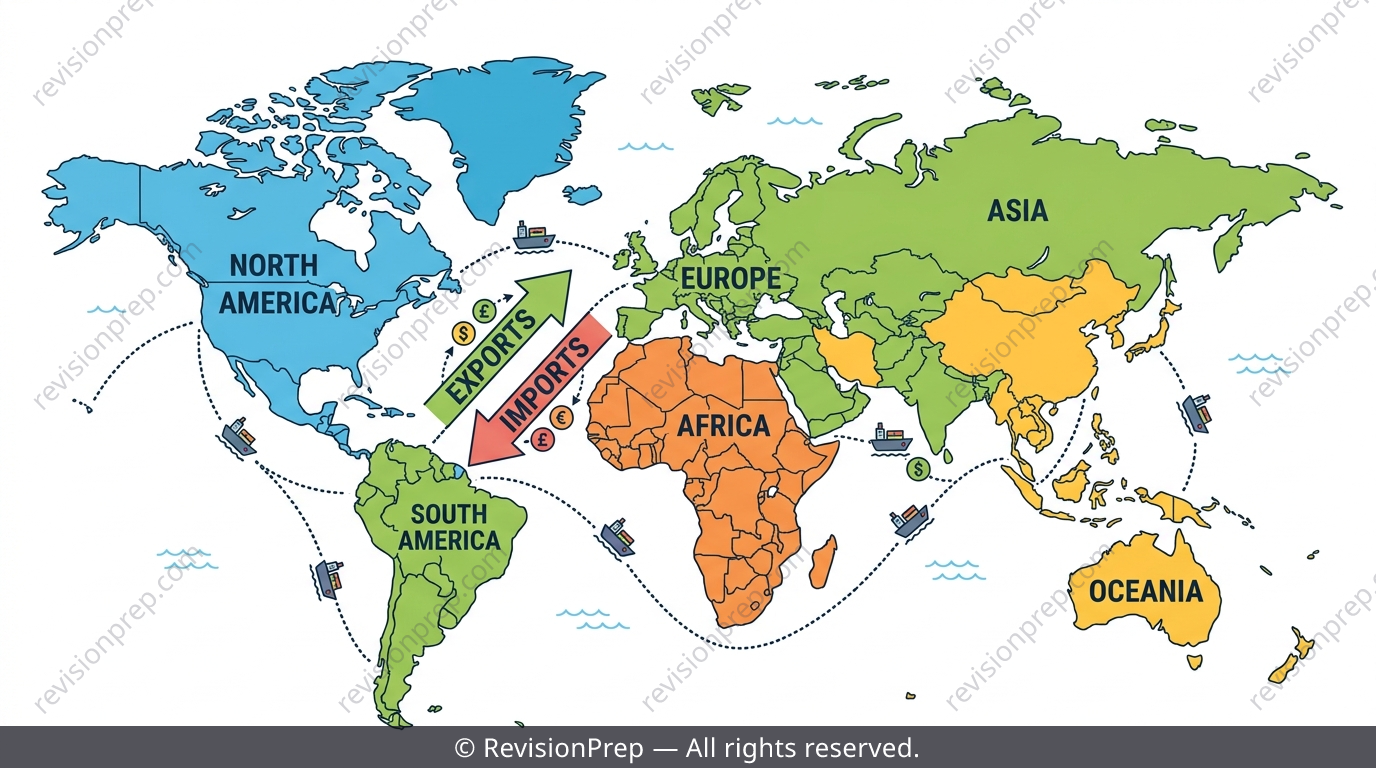
The Global Economy unit is where IB DP Economics gets its sharpest teeth: it's the reason Paper 3 exists for HL students, and a frequent guest star in Paper 1 essays and Paper 2 data-response questions. At its core, this unit tells four connected stories — why countries trade and who tries to block it, how money flows between economies through the balance of payments, how developing countries try to catch up, and how exchange rates tie it all together. SL students learn to read the diagrams; HL students must calculate the areas, percentages and indices behind them. This teaser walks through the five ideas examiners return to most — protectionism arguments, balance of payments accounts, growth vs development strategies, exchange rate basics, and why Paper 3 leans so heavily on this unit — before pointing you to the full revision notes for every formula, worked example and diagram.
What you’ll be able to do
Arguments For and Against Trade Protection
Protectionism questions are never abstract — they're built around a specific tariff, quota or industry in the stimulus. Arguments FOR protection include infant industry support, anti-dumping, national security, employment protection and government revenue in weak-tax LEDCs. Arguments AGAINST include higher consumer prices, propping up inefficient firms, retaliation risk, and resource misallocation away from comparative advantage.

Exam tip
For 'to what extent' questions, state your judgement in the first sentence, then build the essay to defend it — examiners reward a visible, sustained stance.
Common mistake
Reciting every memorised argument regardless of fit (e.g. citing 'national security' for a textiles tariff) instead of matching arguments to the stimulus's income level, industry type and duration of protection.
Mini summary
Match every protectionism argument to specific stimulus evidence — generic lists lose evaluation marks.
Balance of Payments: Current, Financial and Capital Accounts
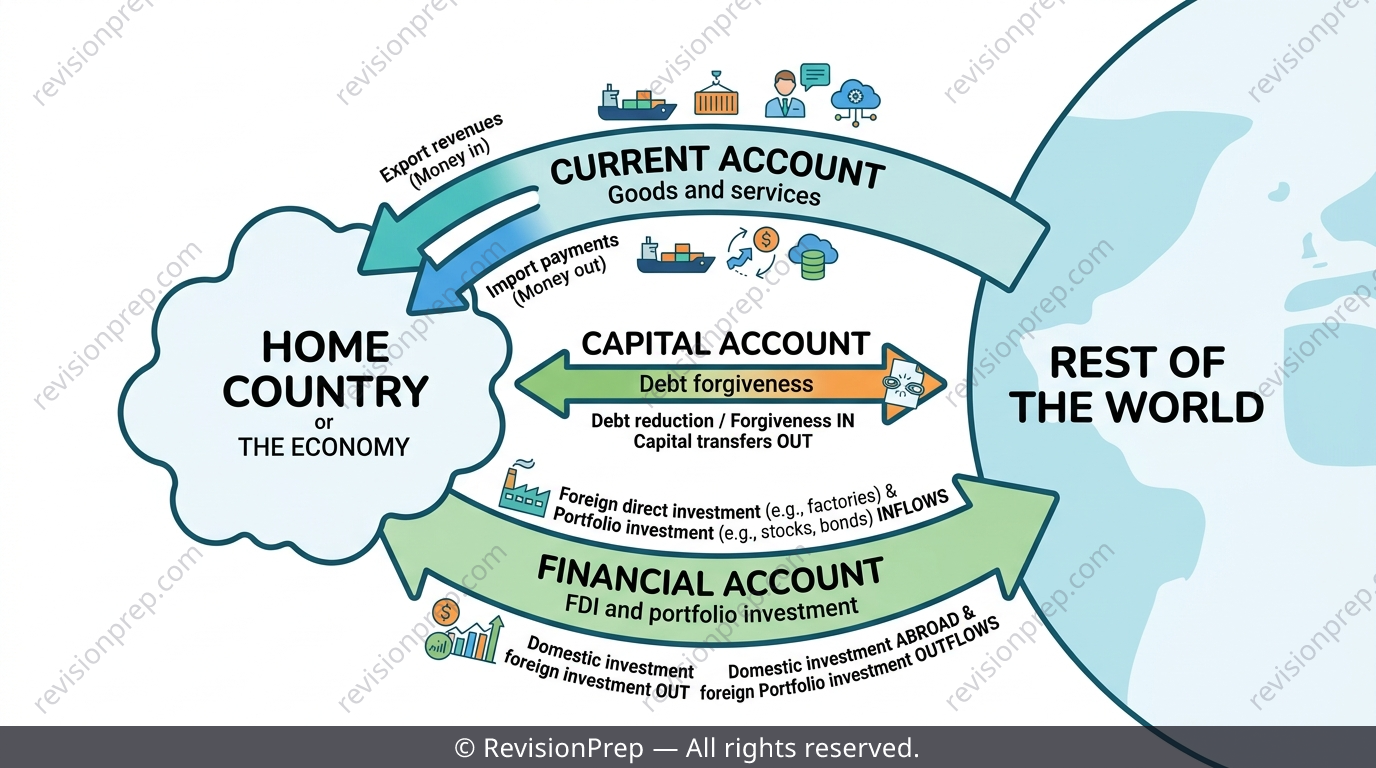
The balance of payments records all transactions between a country's residents and the rest of the world across three accounts. The current account (goods, services, primary income, secondary income) is examined in most depth, while the financial account — FDI, portfolio investment, reserve changes — is its main financing counterpart. A current account deficit must be offset by a financial account surplus or falling reserves, since the overall BOP always balances.
| Account | What it records |
|---|---|
| Current account | Goods + services trade, primary income, secondary income (e.g. remittances) |
| Financial account | FDI, portfolio investment, changes in official reserves |
| Capital account | Small transfers: debt forgiveness, migrants' asset transfers |
Exam tip
At HL, before claiming depreciation fixes a current account deficit, check the Marshall-Lerner condition — the sum of export and import price elasticities of demand must exceed 1.
Common mistake
Confusing FDI or portfolio investment with the 'capital account' — those belong in the financial account, which is the one tested in depth.
Mini summary
Current account deficits aren't automatically a crisis — how they're financed (FDI vs hot money vs reserves) determines sustainability.
Economic Growth vs Economic Development Strategies
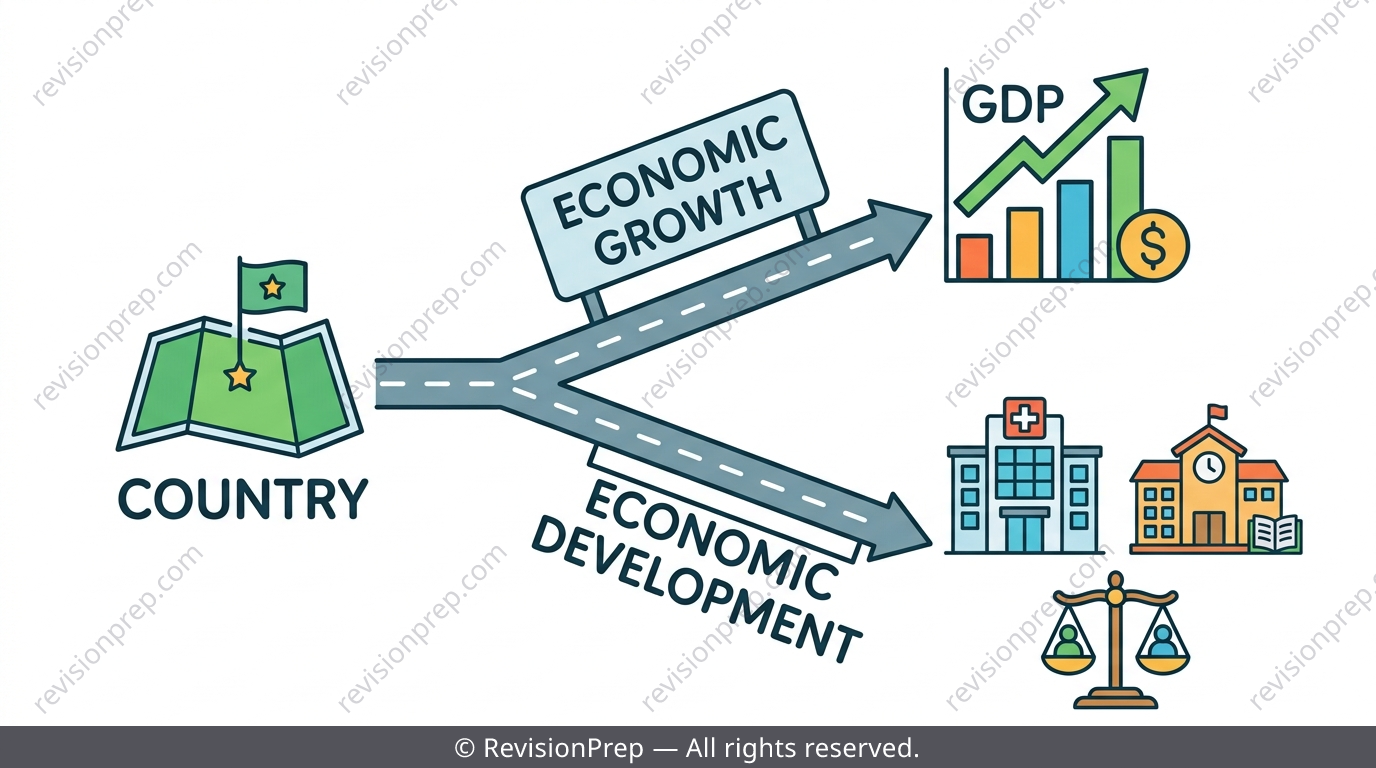
Growth is a quantitative rise in real GDP; development is a broader, qualitative improvement in health, education, freedom and reduced poverty — a country can grow without developing. Market-oriented strategies (trade liberalisation, FDI, privatisation, floating exchange rates) trust price signals, while interventionist strategies (import substitution, export promotion, government-led infrastructure, aid, microfinance) trust government to fix market failures.
Common mistake
Claiming a growth strategy automatically improves development without checking distribution or non-income indicators — growth is necessary but not sufficient for development.
Mini summary
Never treat growth and development as synonyms — real economies blend market-oriented and interventionist strategies.
Exchange Rates: The Basics
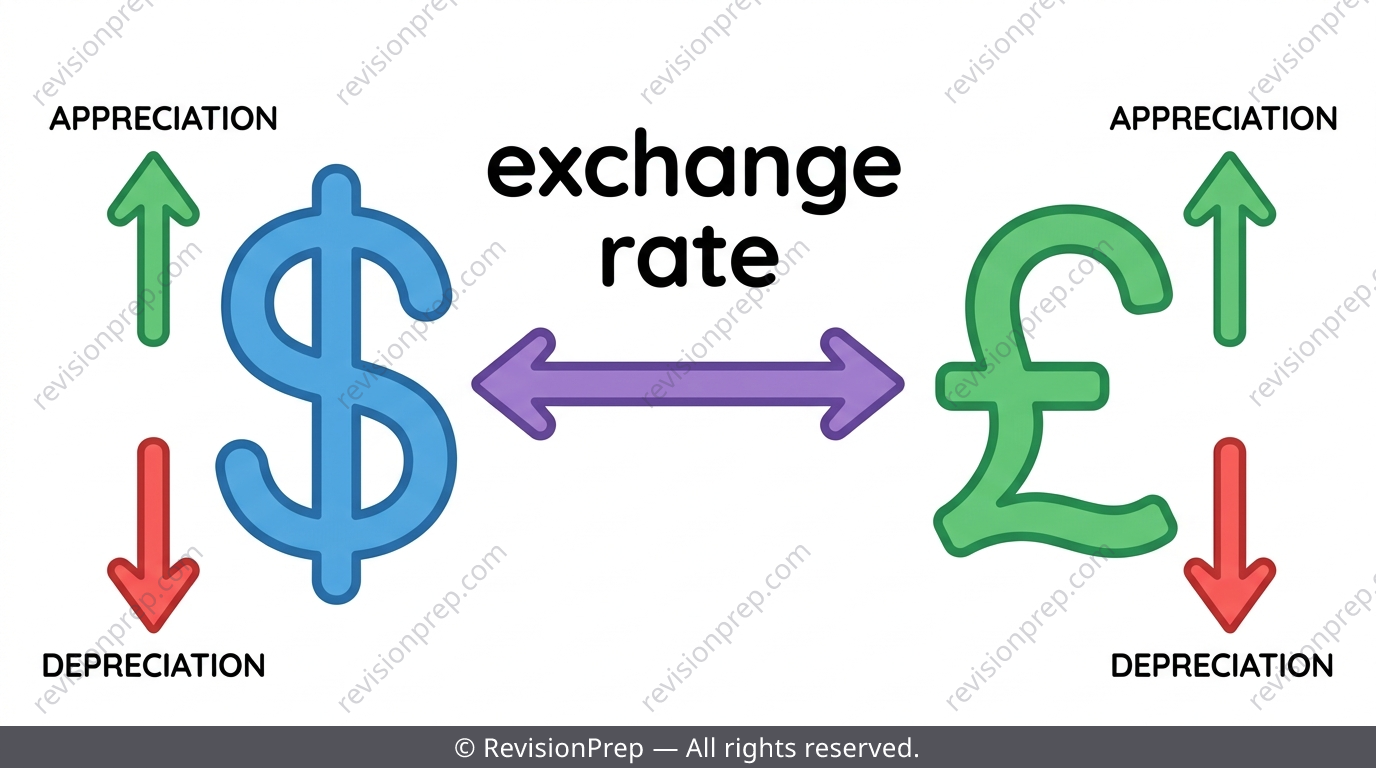
An exchange rate is simply the price of one currency expressed in terms of another, and it links directly back to the balance of payments — it determines how competitive a country's exports and imports are. Movements in the exchange rate affect the current account, which is why HL students must be ready to calculate percentage changes and connect them to trade flows, not just describe direction.
Mini summary
Exchange rate movements feed straight into the current account — always link the two in an exam answer.
Why Paper 3 Leans So Heavily on This Unit
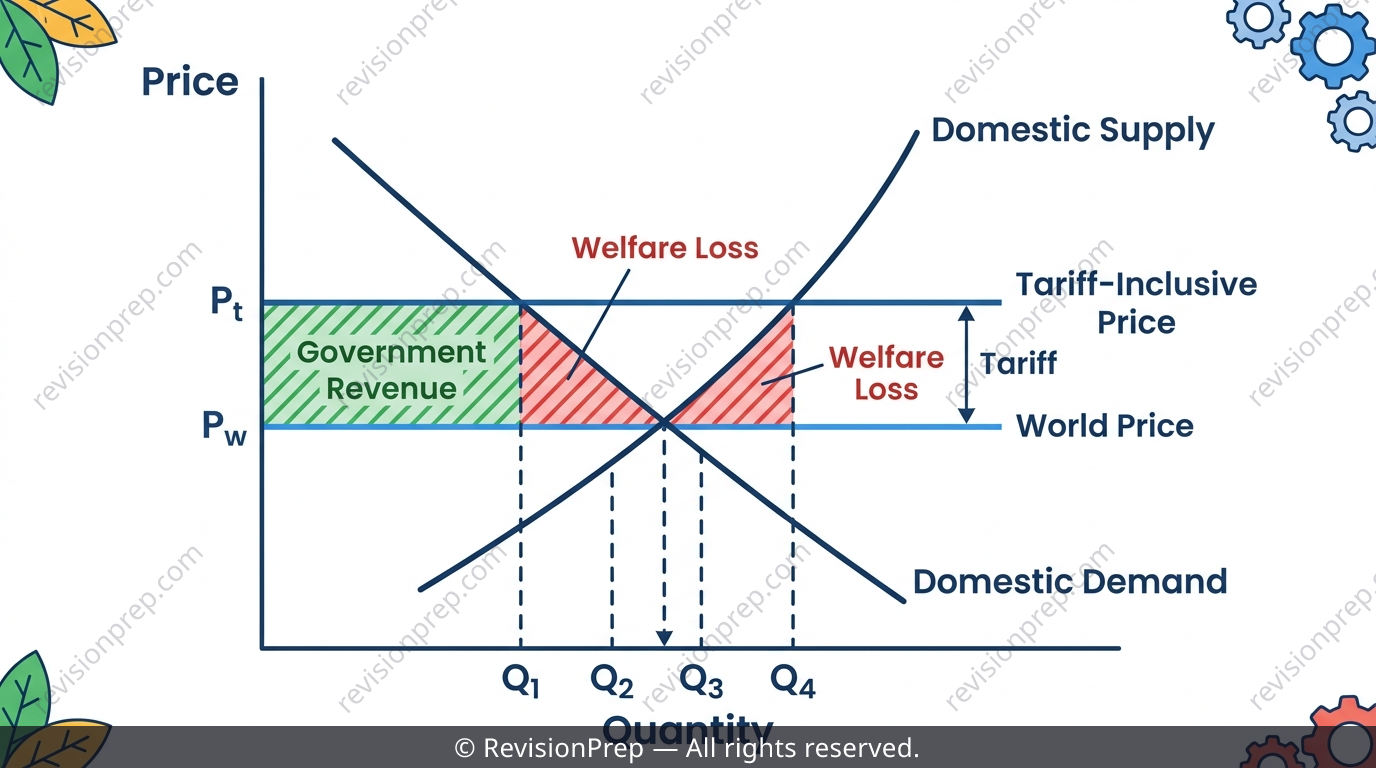
At HL, this unit carries real numerical weight: tariff and quota welfare-loss calculations, elasticity-based quantity changes, exchange rate percentages, and HDI dimension indices are all fair game on Paper 3. SL students learn the diagrams; HL students are expected to calculate the areas and values behind them — that distinction shapes almost every worked example you'll meet in the full notes.
Exam tip
Practise reading a diagram and immediately identifying which area or index it's asking you to calculate — Paper 3 rewards speed and accuracy over memorised theory.
Mini summary
The SL/HL split in this unit is calculation, not content — know which diagrams you need to quantify.
Quick formula sheet
Practice questions
- Define dumping and give one reason a government might impose an anti-dumping tariff.
- List the four components of the current account.
- State the difference between economic growth and economic development.
- Explain why a current account deficit is not automatically an economic crisis.
- Outline two arguments for and two arguments against protecting a domestic car industry with a tariff.
- Compare one market-oriented and one interventionist strategy a developing country might use to raise living standards.
- Evaluate whether a small developing country should remove a long-standing tariff on its car industry, using the infant industry argument to support your judgement.
- A country's current account shows: goods balance −USD 12bn, services balance +USD 5bn, primary income −USD 2bn, secondary income +USD 3bn. Calculate the current account balance and discuss how it might be financed.
- To what extent does depreciation guarantee an improvement in a country's trade balance? Refer to the Marshall-Lerner condition in your answer.
Frequently asked questions
What's the difference between the financial account and the capital account?+
The financial account records ongoing asset ownership flows like FDI, portfolio investment and reserve changes, and is heavily tested. The capital account is small and covers one-off transfers like debt forgiveness — don't mix the two up.
Is economic growth the same as economic development?+
No. Growth is a quantitative rise in real GDP, while development is a broader qualitative improvement in health, education, freedom and poverty reduction. A country can grow without developing.
Why does Paper 3 focus so much on the Global Economy unit?+
Paper 3 is HL-only and quantitative, and this unit supplies most of its calculation-based content: tariff and quota welfare-loss areas, elasticity-based quantity changes, exchange rate percentages and HDI indices.
How do I answer a 'to what extent' protectionism essay well?+
State your judgement in your first sentence, then build the essay around specific details from the stimulus (industry type, income level, how long protection has existed) rather than a generic list of arguments.
What is the Marshall-Lerner condition and when do I need it?+
It states that depreciation only improves the trade balance if the sum of export and import price elasticities of demand exceeds 1. Use it whenever you're asked to evaluate whether depreciation will fix a current account deficit.
Does this unit only appear in Paper 3?+
No — it's also a common essay option in Paper 1 and a core theme in Paper 2 data-response questions, in addition to being the entire focus of the HL Paper 3 paper.
Get the Full Global Economy Revision Notes
Related articles