
Calculus in IB Maths AI: Limits, Derivatives & Differential Equations
The single biggest topic in AI HL — worth roughly 30% of the exam and almost guaranteed a full Paper 2 question.
Quick facts
If one topic decides your IB Maths AI HL grade, it's Calculus — roughly 30% of the marks and almost certain to anchor a full Paper 2 question. This teaser walks through the five ideas that matter most: how differentiation, integration, limits and differential equations fit together as one connected story, why limits and continuity quietly justify every derivative you write, the three routes for solving a differential equation, the logistic growth model that keeps reappearing in context questions, and the HL-only skills of implicit differentiation and related rates. Each concept comes with the real formulas, the traps students fall into every year, and the examiner logic behind command terms like 'show that'. For the full worked examples, complete formula derivations and mark-scheme-style practice, the full revision notes go much deeper than this overview.
What you’ll be able to do
The Four Strands of IB Calculus (and Why They're Connected)
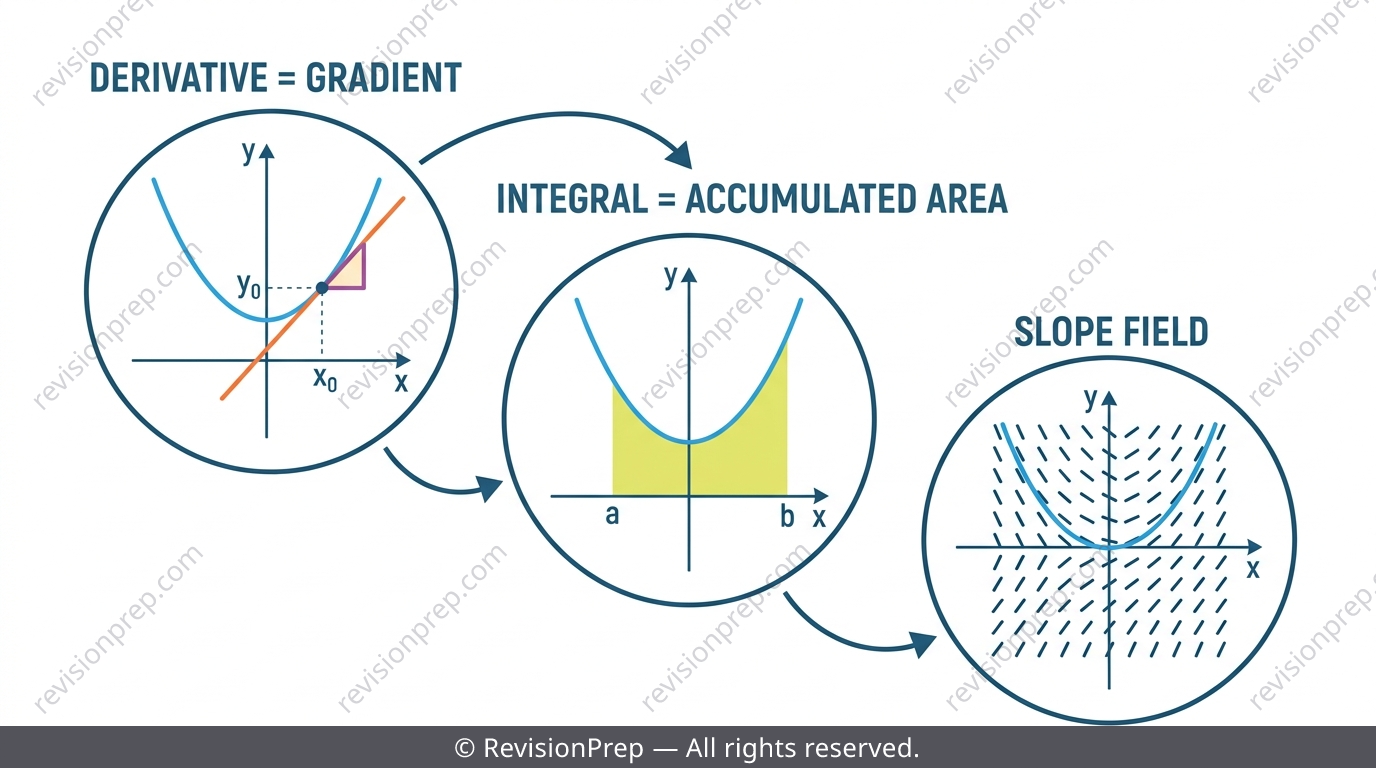
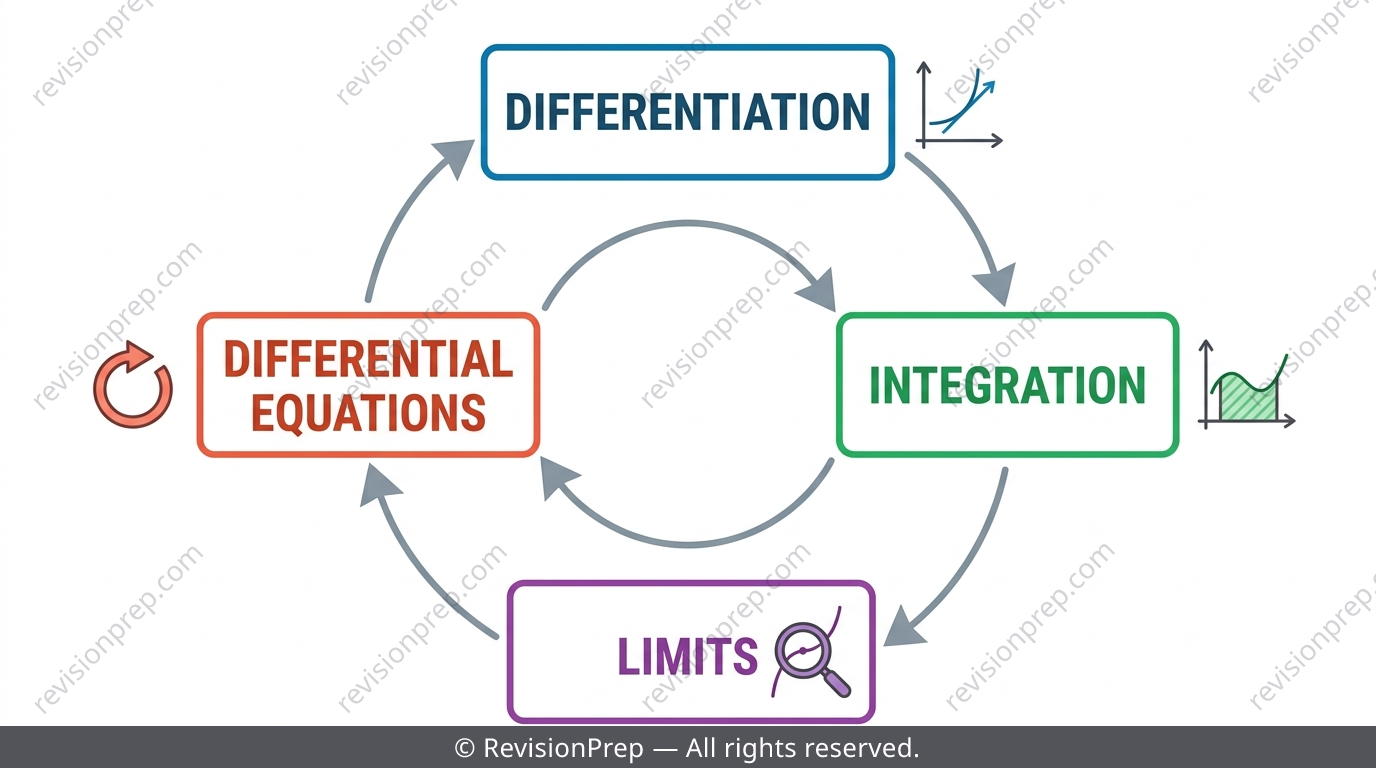
Every calculus question is secretly testing the same skill: translating a real situation into differentiation, integration, limits, or a differential equation, then translating the answer back. Differentiation describes rate of change; integration reverses that process to accumulate it; limits justify why the whole toolkit is legitimate; differential equations appear when the rate of change IS the physical law you're given. At HL, five new skills sit on top of the SL toolkit: implicit differentiation, related rates, integration by substitution and by parts, volumes of revolution, and the full differential equations strand.
Exam tip
The GDC is powerful but does not replace algebra on 'show that' or 'verify' questions — the command term decides how much working you must physically show.
Mini summary
Calculus = differentiate, integrate, use limits to justify it, and use differential equations when the rate of change is the given law.
Limits and Continuity: The Foundation Under Every Derivative
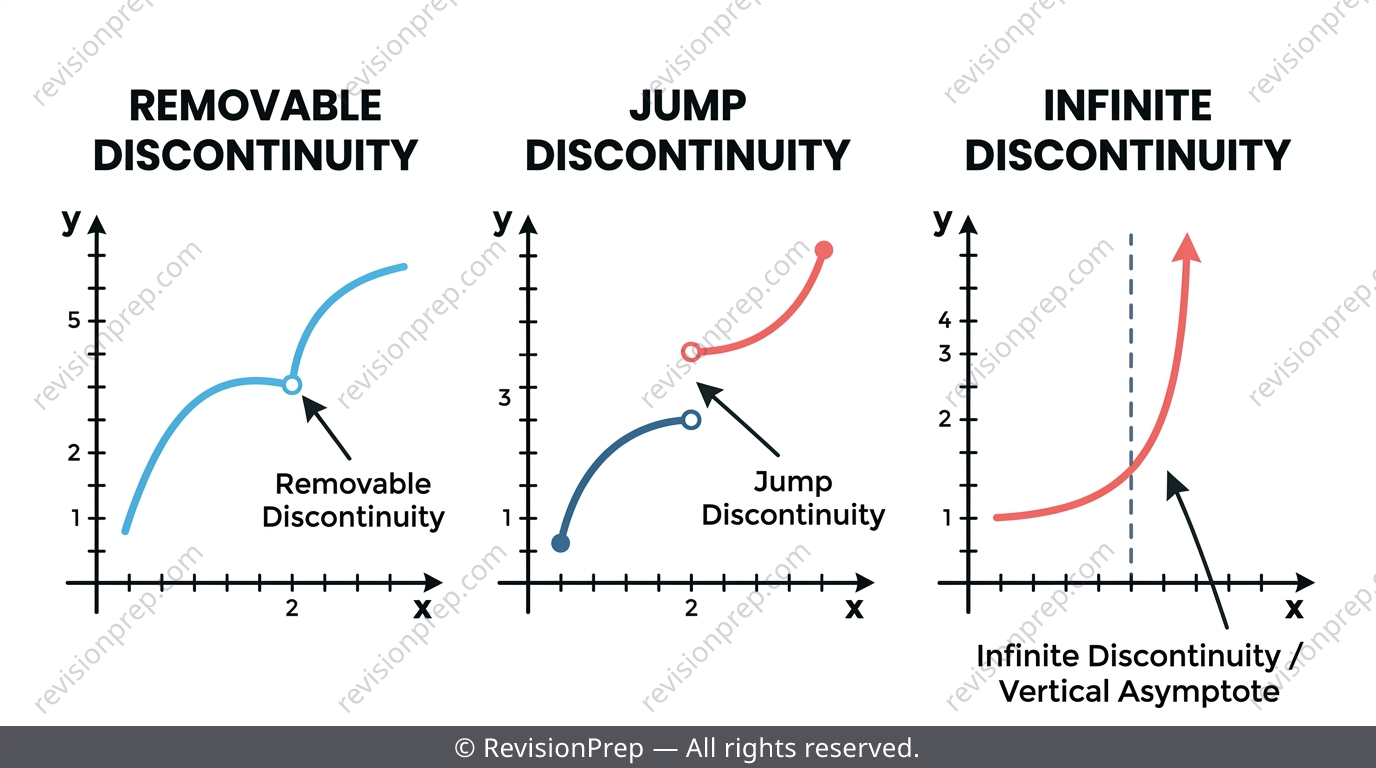
A limit describes the value heads towards as approaches a point, even if it never actually gets there. Continuity is stronger: it requires to exist, the limit to exist, and the two to be equal — break any one of these and you have a discontinuity. This matters because the derivative itself is defined as a limit, , so if that limit doesn't exist, neither does the derivative.
| Discontinuity type | What happens |
|---|---|
| Removable | A 'hole' — the limit exists but doesn't equal |
| Jump | Left- and right-hand limits exist but disagree |
| Infinite | Function shoots to near (vertical asymptote) |
Common mistake
Substituting directly into a rational function's limit instead of dividing through by the highest power of first.
Mini summary
Continuity needs defined, the limit to exist, and both to match — check left- and right-hand limits separately.
Three Ways to Solve a Differential Equation
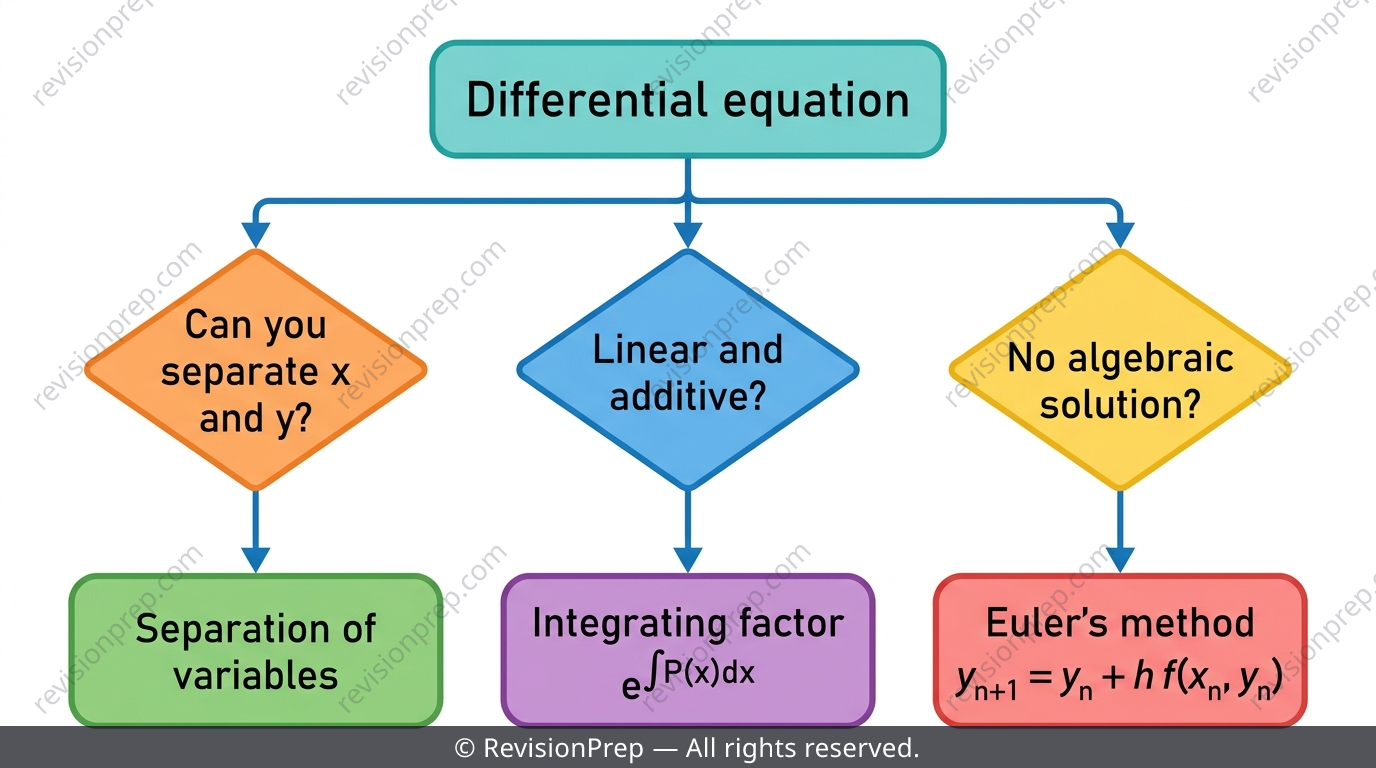
A differential equation translates a rate-of-change sentence into symbols — 'cooling rate proportional to temperature difference' becomes . HL asks for three solution routes depending on the equation's shape, plus the logistic model as a named special case.
| Method | When to use | What you get |
|---|---|---|
| Separation of variables | General solution via direct integration | |
| Integrating factor | (linear, additive) | Exact algebraic solution |
| Euler's method | No algebraic solution exists | Numerical approximation, step by step |
Exam tip
For 'show that satisfies the DE and the initial condition' questions, marks are given for BOTH differentiating and substituting back into the DE AND checking the boundary value separately — do both explicitly.
Common mistake
Writing the integrating factor as instead of , or forgetting to integrate the coefficient of before exponentiating.
Mini summary
Separable ⇒ split and integrate; linear/additive ⇒ integrating factor ; unsolvable algebraically ⇒ Euler's method.
The Logistic Model: Growth That Slows Down
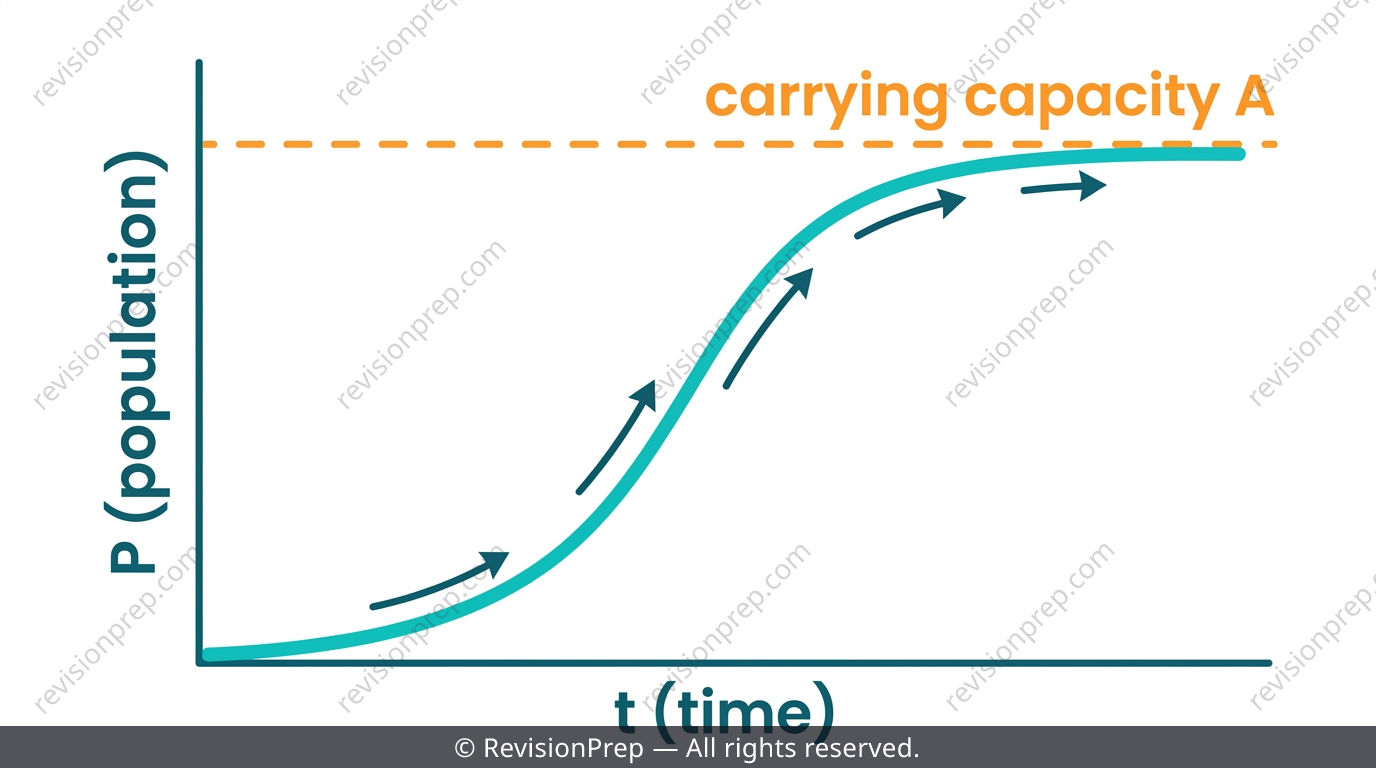
The logistic equation models growth that slows as a population approaches a carrying capacity , and it reappears constantly in context questions about populations, harvesting, and spread. Separating variables and applying partial fractions gives the general solution . Equilibrium solutions occur where , which for logistic growth is exactly at and .
Common mistake
Losing the absolute value signs in the logarithms during integration, or computing the wrong way round instead of derived correctly from the initial condition.
Mini summary
Logistic growth always solves via partial fractions , with equilibria at and .
Implicit Differentiation and Related Rates (HL Only)
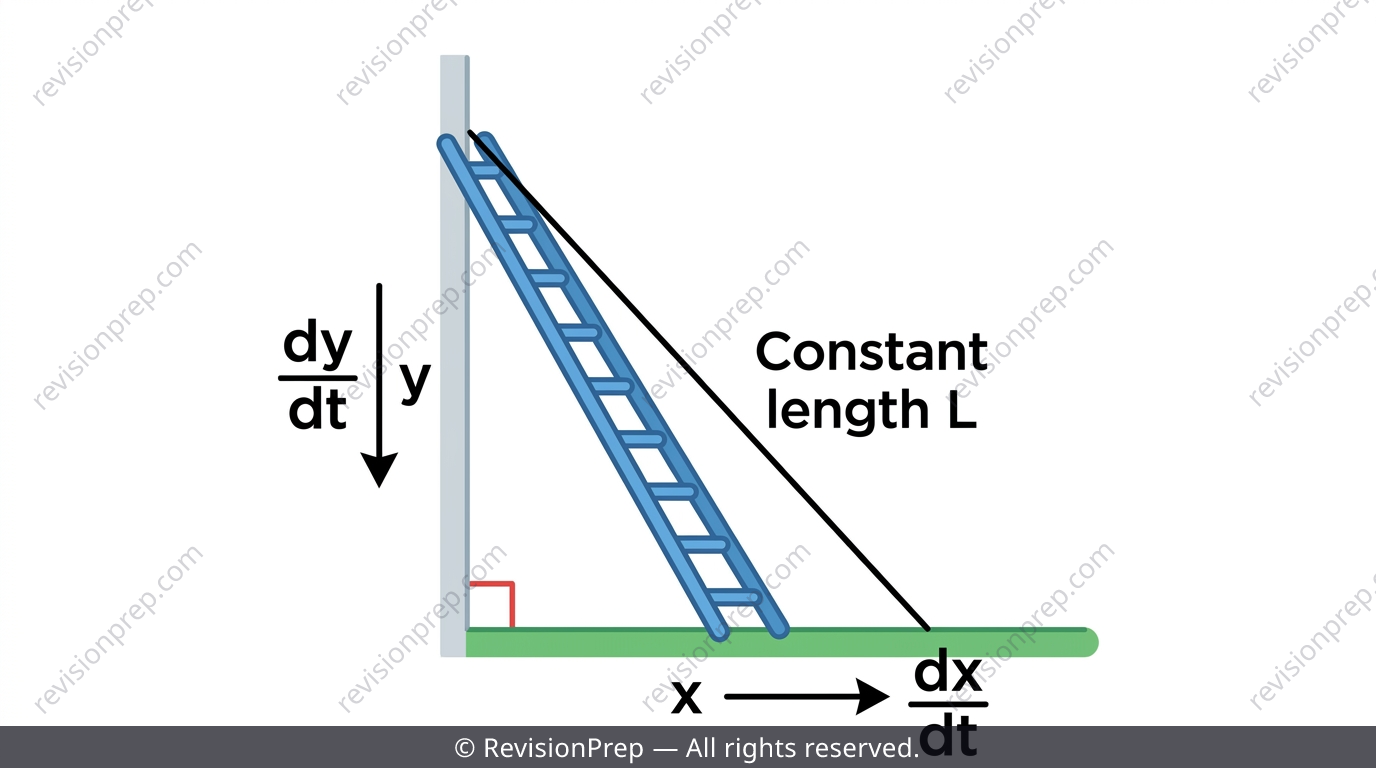
Once you can differentiate, exams stop asking 'find ' in isolation and start asking what it means: is the function growing or shrinking, where is it steepest, what design is optimal? At HL, implicit differentiation lets you differentiate equations where can't be isolated, using the chain rule on every term. Related rates problems connect two changing quantities through a shared variable, usually time, so that finding one rate tells you the other.
Mini summary
Implicit differentiation handles equations you can't rearrange for ; related rates link two quantities changing together via time.
Quick formula sheet
Practice questions
- State the three conditions required for a function to be continuous at .
- Classify the discontinuity in a rational function where a common factor cancels top and bottom.
- Write down the general form of a separable differential equation.
- Solve given , using separation of variables.
- Find the integrating factor for .
- Evaluate , showing the division step.
- Given with , derive the general solution in terms of and .
- Use Euler's method with to estimate for , .
- Prove from first principles that the derivative of is , showing every expansion step.
Frequently asked questions
How much of IB Maths AI HL is calculus?+
Roughly 30% — it's the largest single topic, tested across both Paper 1 and Paper 2, and almost always anchors a full Paper 2 question.
What's new in calculus at HL compared to SL?+
Implicit differentiation, related rates, integration by substitution and by parts, volumes of revolution, and the entire differential equations strand including Euler's method and the logistic model.
How do I know which method to use for a differential equation?+
If you can separate x and y terms, use separation of variables. If it's linear and additive (y and x tangled by addition, not multiplication), use the integrating factor. If it can't be solved algebraically at all, use Euler's method.
What's the difference between a limit and continuity?+
A limit is the value a function approaches; continuity requires that the function actually reaches that value AND is defined there — all three conditions must line up.
Why does the logistic model keep appearing in exam questions?+
It models realistic growth that slows near a carrying capacity, so it fits population, harvesting, and spread contexts — recognising its structure instantly tells you to use partial fractions.
Can I rely on the GDC instead of doing the algebra?+
No — on 'show that' or 'verify' command-term questions, the calculator can check your answer but won't earn the method marks; you must write out the algebraic steps.
Get the Full IB Maths AI Calculus Revision Notes
Related articles