
Number and Algebra
Exponentials, logs, binomial expansions, and sequences — the backbone of IB Maths AI, decoded fast.
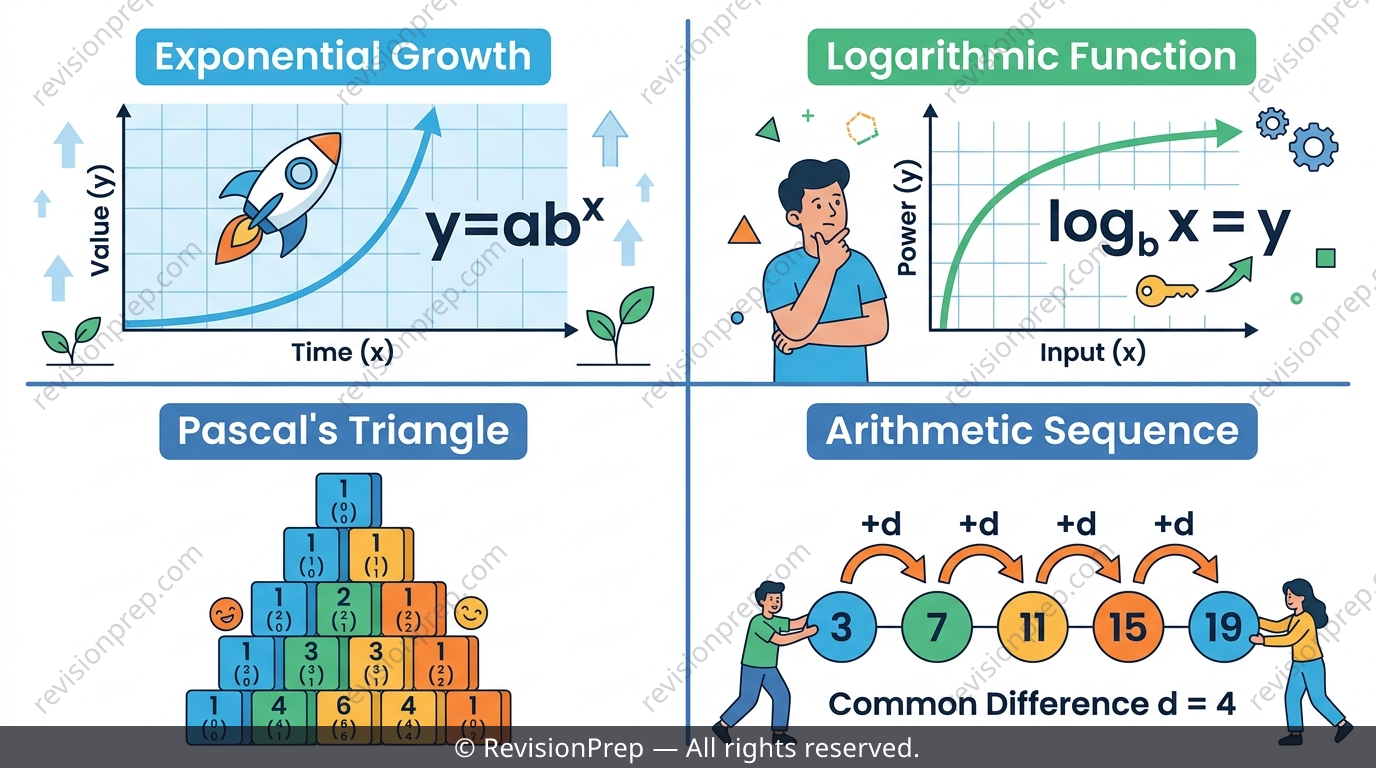
Quick facts
IB Maths AI Number and Algebra is where growth, decay, and pattern-spotting collide with algebra — it's the strand that turns real contexts like population growth, drug concentration, and theatre seating into solvable equations. Whether you're isolating an exponential term to take logs, expanding a binomial with the general term formula, or spotting whether a sequence adds or multiplies, the same three-step approach works every time: identify the pattern, choose the matching formula, then solve. This topic underpins financial maths and modelling questions elsewhere on the paper, so getting comfortable with exponential and logarithmic functions, arithmetic and geometric sequences, and (for HL) the binomial theorem pays off across the whole exam. This teaser covers the five ideas examiners return to most, with the traps that cost real marks — the full revision notes go deeper into every formula and worked example.
What you’ll be able to do
Exponential and Logarithmic Functions
An exponential function like or changes by a constant factor every time increases by 1 — that's the entire idea, everything else is manipulation. Logarithms exist purely to pull a trapped variable down out of the exponent, so whenever sits in a power, isolate the exponential term first and then take or of both sides. Two data points on a model are just simultaneous equations wearing an exponential disguise.
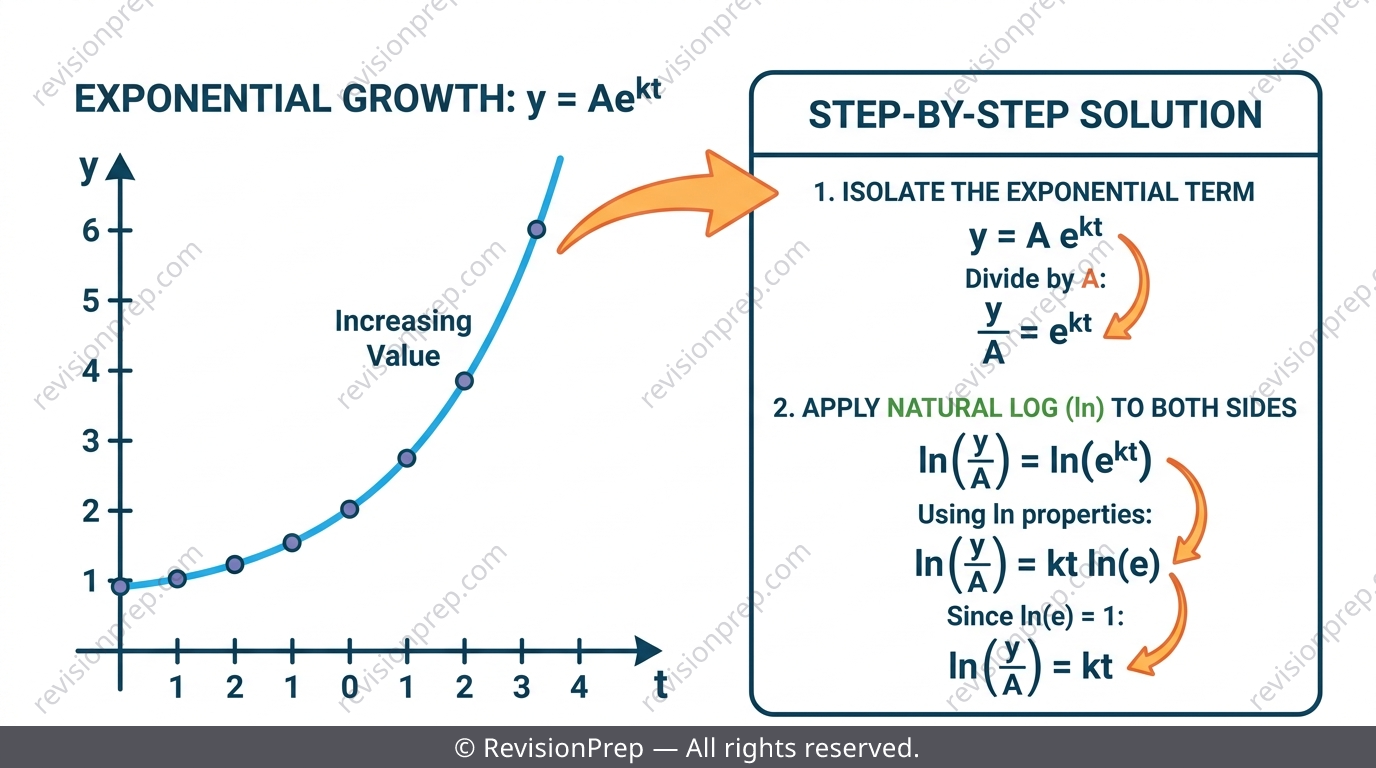
| Operation | Exponent form | Matching log law |
|---|---|---|
| Multiplication | ||
| Division | ||
| Power |
Exam tip
'Exact value' means leave your answer as a log or fraction — a rounded decimal loses the final mark.
Common mistake
Writing : there is no log law for a sum inside the bracket, only for products, quotients, and powers.
Mini summary
Isolate the exponential, then take logs — never log across a sum.
Binomial Theorem (HL only)
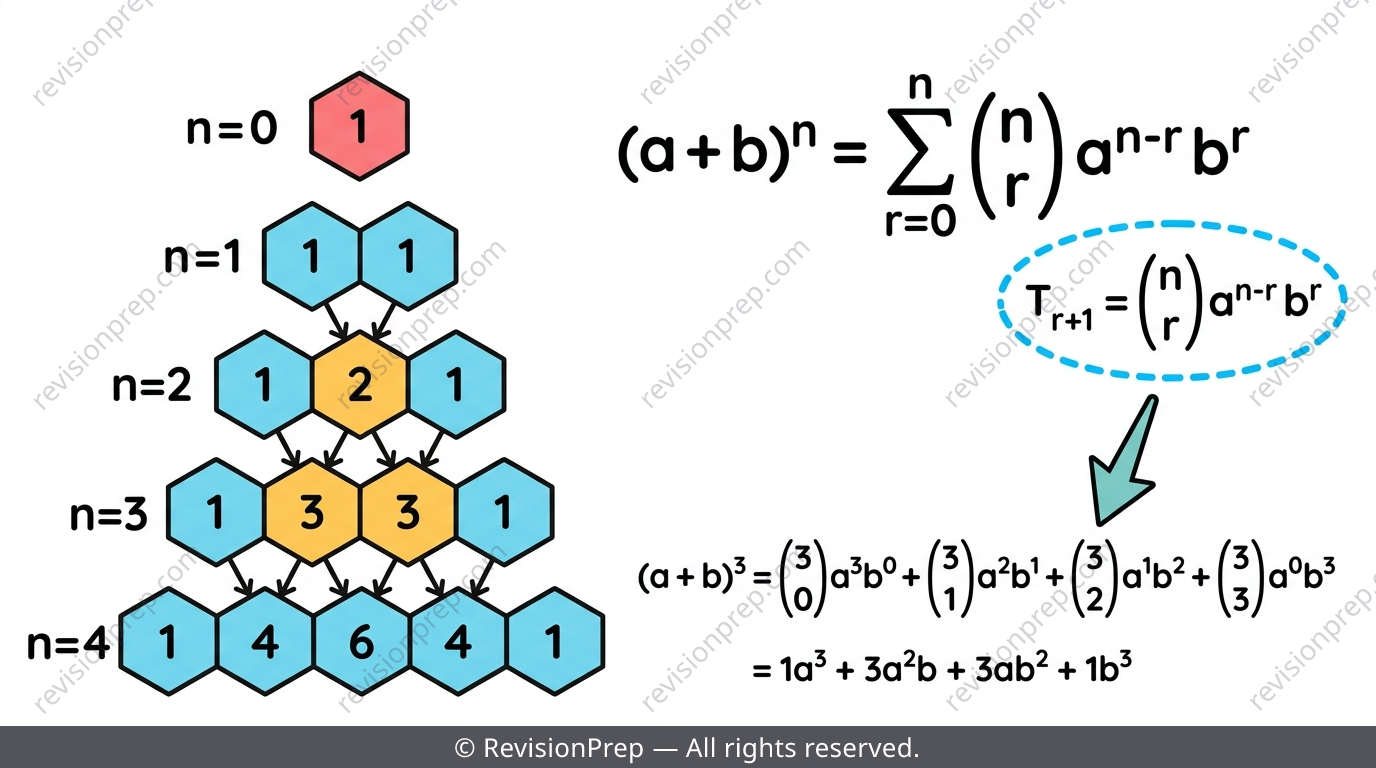
The binomial theorem expands without multiplying it out term by term — essential once , where hand expansion becomes error-prone. Pascal's triangle gives coefficients by eye for small , while (your GDC's nCr button) works for any instantly. This is a reliable stand-alone 4–6 mark question at HL — SL students never see it.
Exam tip
Set the power of equal to the target power of to find , then always label the term , never .
Common mistake
Forgetting to raise the whole bracketed term to the power — e.g. writing as instead of correctly cubing both the coefficient and the variable.
Mini summary
Powers of and always sum to ; the term with is .
Arithmetic Sequences and Series
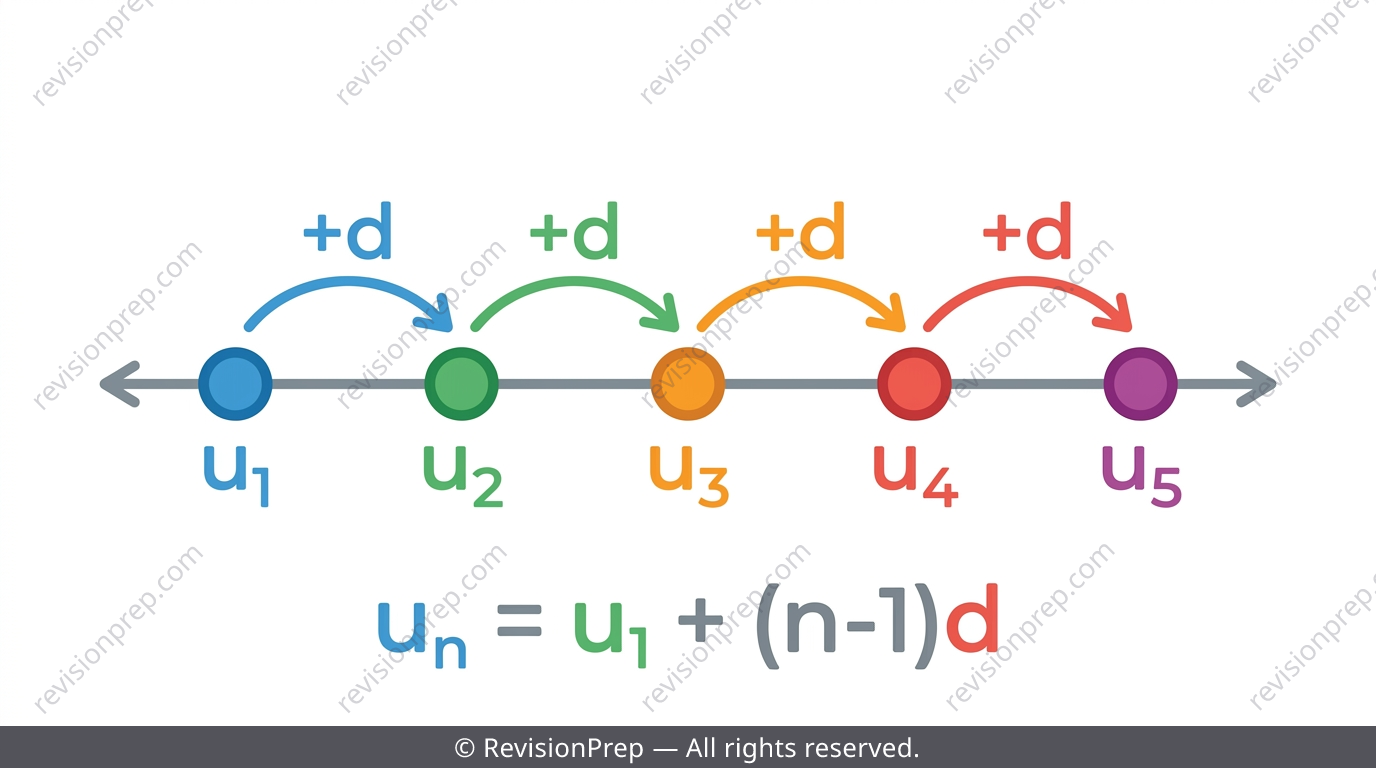
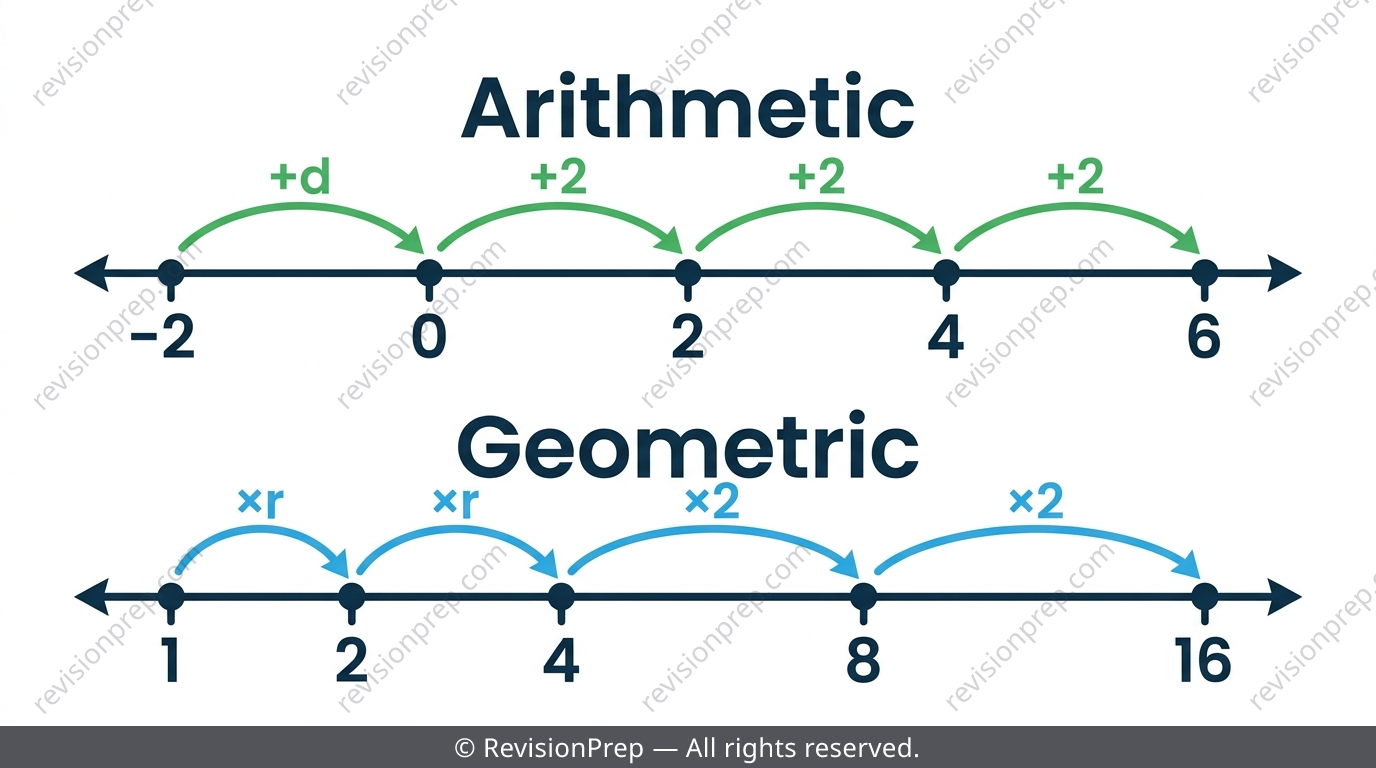
An arithmetic sequence adds a fixed common difference to get from one term to the next — check that and so on. Every formula needs just two ingredients, and , and any term or partial sum falls straight out of those. IB loves hiding these in context — theatre rows, stacked cans, fixed pay rises — so translate the words into and before touching a formula.
Exam tip
Self-check your nth-term formula with : it must return exactly, catching the classic vs slip instantly.
Common mistake
Writing instead of — this silently shifts every term forward by one position.
Mini summary
Arithmetic = constant addition of ; always in the nth-term formula.
Geometric Sequences and Series
A geometric sequence multiplies by a fixed ratio each step — check and so on. It's the discrete cousin of the exponential function: is exactly with integer . Any 'changes by a fixed percentage' context — car depreciation, compound interest, colony growth — is a geometric sequence with .
Exam tip
Spot percentage-change wording immediately: convert it to a ratio before writing any formula.
Common mistake
Confusing a geometric context for an arithmetic one when a question mentions 'increases by 5%' rather than 'increases by 5' — the first is multiplicative (geometric), the second additive (arithmetic).
Mini summary
Geometric = constant multiplication by ; links directly to exponential models.
Sum to Infinity & Real-World Applications
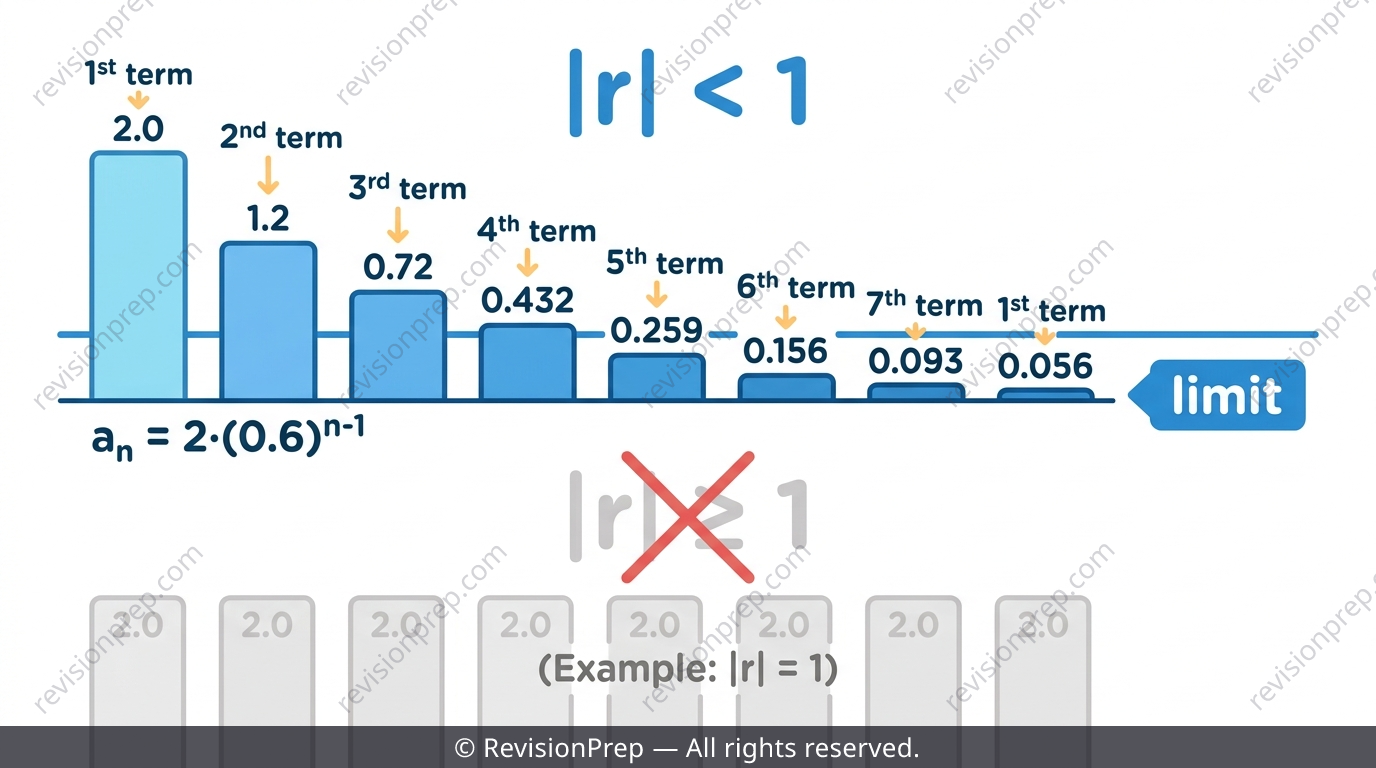
A geometric series only has a finite sum to infinity when — outside that range the terms never shrink and the total never settles. This condition is exactly why compound interest and depreciation problems (both geometric) behave so differently from a shrinking geometric sum like a bouncing ball's total distance. Recognising whether a context is exponential, arithmetic, or geometric — and whether applies — is the final skill examiners test across every real-world Number and Algebra question.
Exam tip
Before summing to infinity, always state and check explicitly — this is often a required method line, not just a formality.
Common mistake
Applying a sum-to-infinity formula to a series where , which produces a meaningless or undefined result.
Mini summary
Sum to infinity exists only for ; always verify the condition before using the formula.
Quick formula sheet
Practice questions
- Simplify using the laws of exponents.
- Find the 10th term of the arithmetic sequence with and .
- State the ratio of the geometric sequence
- Solve for , giving your answer to 3 significant figures.
- Find the sum of the first 15 terms of an arithmetic series with and .
- Find the coefficient of in the expansion of .
- A population is modelled by . Given and , find the exact value of in the form .
- A geometric series has and sum to infinity . Find and hence .
- For , determine which term contains and find its coefficient.
Frequently asked questions
What is the difference between an arithmetic and a geometric sequence?+
An arithmetic sequence adds a constant difference between terms, while a geometric sequence multiplies by a constant ratio . Check consecutive differences for arithmetic and consecutive ratios for geometric.
Is the binomial theorem examinable at SL in Maths AI?+
No — the binomial theorem is HL-only content in Maths AI. SL students are not assessed on it.
How do I solve an exponential equation where the variable is in the exponent?+
Isolate the exponential term completely on one side of the equation, then take or of both sides to bring the variable down.
When does a geometric series have a sum to infinity?+
Only when . If the common ratio's absolute value is 1 or greater, the terms don't shrink and no finite sum exists.
Why can't I split $\log(a+b)$ into $\log a + \log b$?+
Log laws only apply to products, quotients, and powers — there is no log law for addition or subtraction inside the bracket.
What does $T_{r+1}$ mean in the binomial theorem?+
It's the general term formula, and the term number is always one more than — so gives the 4th term, not the 3rd.
Get the full IB Maths AI Number and Algebra notes
Related articles