
Geometry and Trigonometry
The IB DP Maths AA topic that turns shapes into equations and angles into ratios
Quick facts
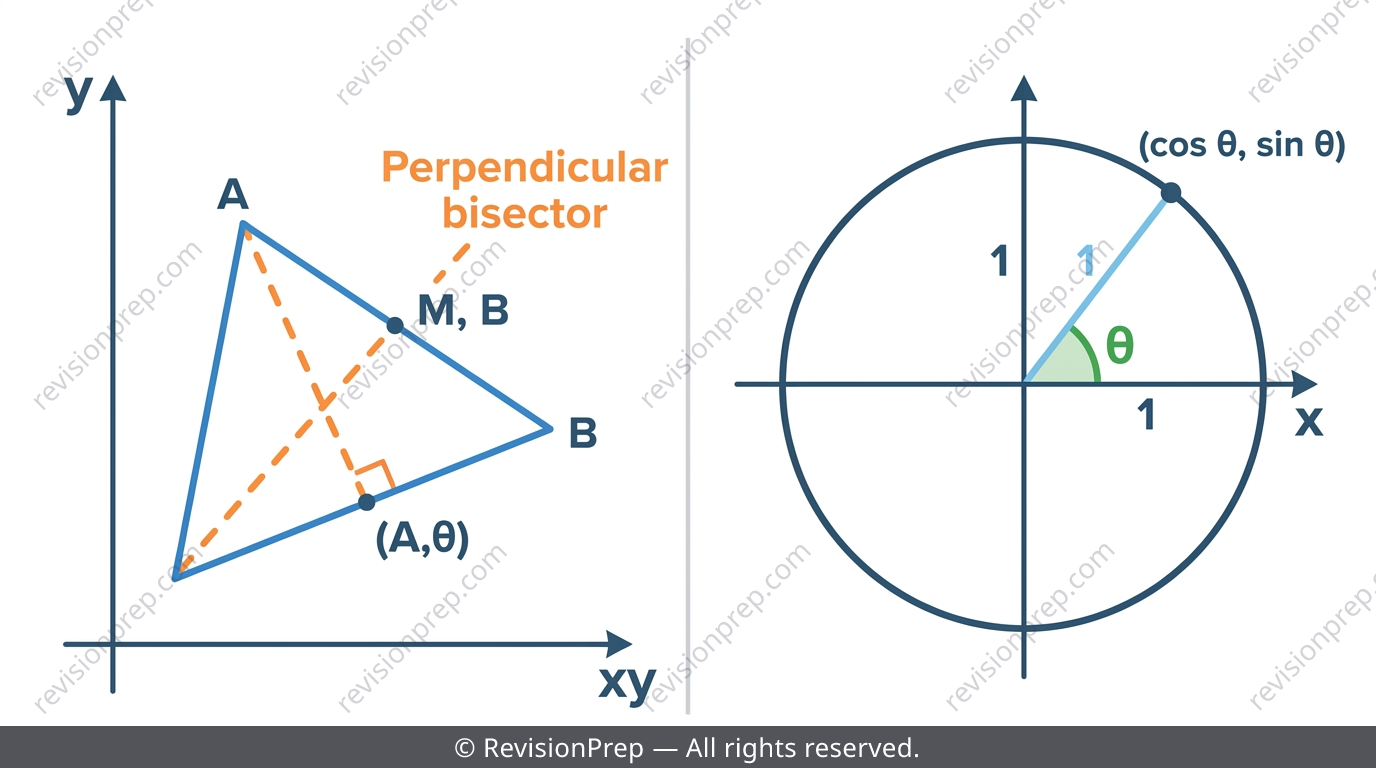
IB DP Maths AA Geometry and Trigonometry has two personalities: coordinate geometry on the xy-plane, where every geometric claim becomes an equation, and trigonometry on the unit circle, where angles become ratios you manipulate with identities. Together they make up roughly 20-25% of AA HL assessment and feed straight into vectors and calculus later in the exam. Coordinate geometry questions chain length, midpoint, and gradient into proofs like perpendicular bisectors or equal-area medians. Trig identity questions are proofs in disguise, marked on justification rather than the final line. Sine and cosine rule problems are almost always two-step chains. This teaser covers the five ideas examiners return to again and again — distance and midpoint formulas, perpendicular bisectors, the shoelace area formula, the median and midsegment theorems, and the unit circle definitions behind every trig identity — before you head into the full revision notes for worked examples and complete formula derivations.
What you’ll be able to do
Distance, Midpoint & Gradient: The Building Blocks
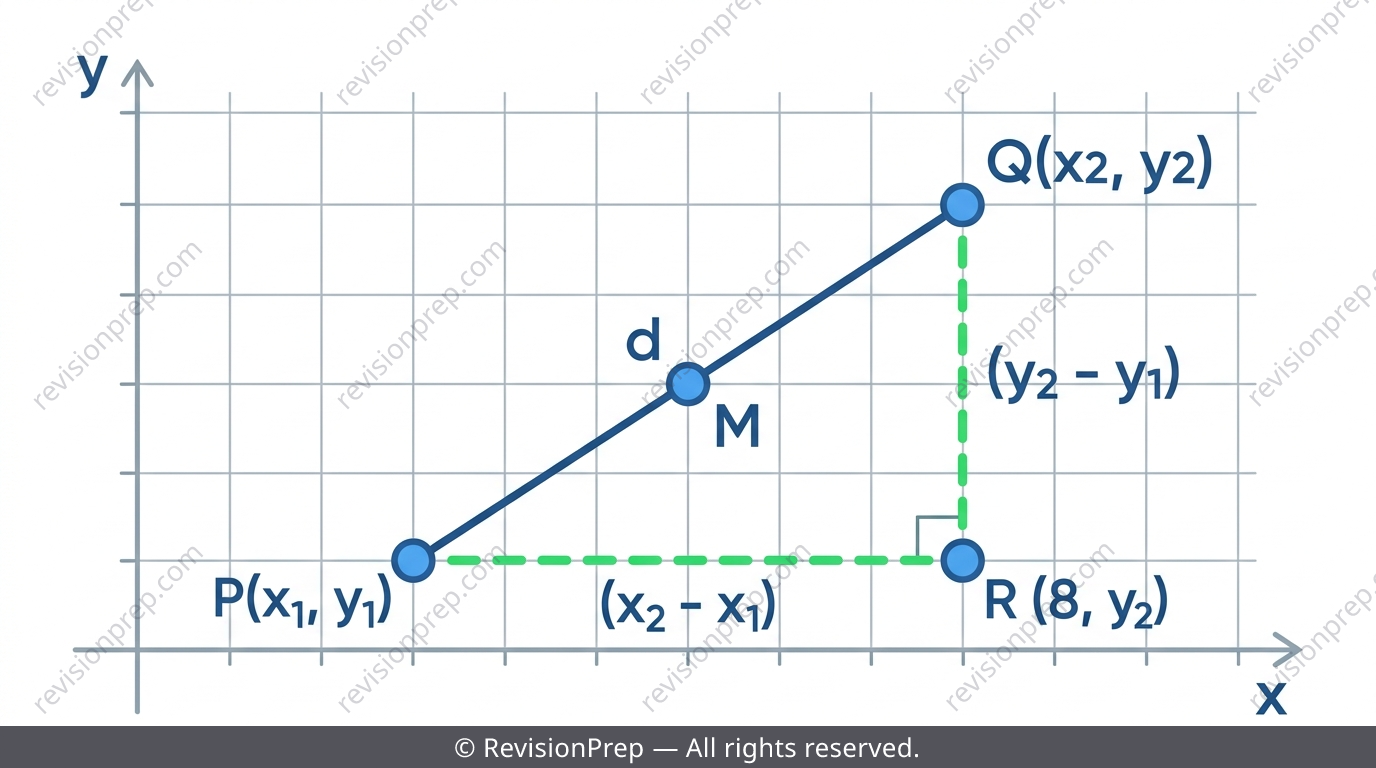
The distance formula is just Pythagoras applied to the horizontal and vertical gaps between two points — sketch the right triangle with legs and if you blank on it. The midpoint is nothing more than averaging the two x-coordinates and the two y-coordinates. Gradient measures rise over run and is the same value anywhere you sample it on a line, which is why a point plus a gradient fully determines an equation.
Exam tip
If a formula slips your mind under pressure, sketch the right triangle for distance or picture 'halfway between' for midpoint — the algebra follows the picture.
Common mistake
Mixing up which point is and which is — it doesn't matter for distance, but it flips the sign of the gradient if you're inconsistent.
Perpendicular Bisectors: Midpoint + Negative Reciprocal
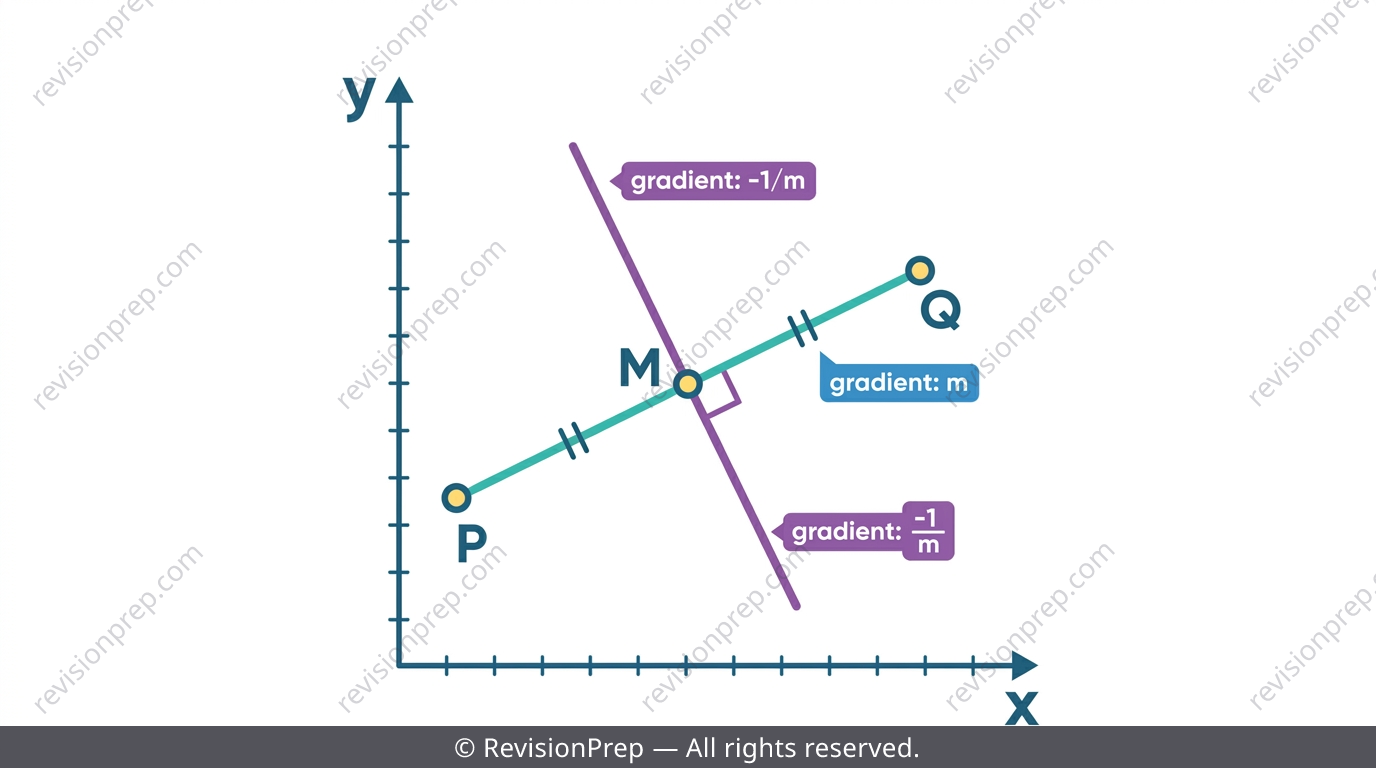
Parallel lines share a gradient; perpendicular lines have gradients whose product is . A perpendicular bisector always starts from the midpoint of the segment, then uses the negative reciprocal of that segment's gradient — in that exact order. Marks are typically given separately for the midpoint, the stated perpendicular gradient, the substitution, and the simplified equation, so show every step.
Exam tip
Write explicitly before substituting, and state clearly which two points you're bisecting — this protects the method mark even if arithmetic slips later.
Common mistake
Using the gradient of the given line itself (or its plain reciprocal) instead of the negative reciprocal — this single slip can lose all the marks in a perpendicular bisector part, even with a correct midpoint.
The Shoelace Formula: Triangle Area from Coordinates
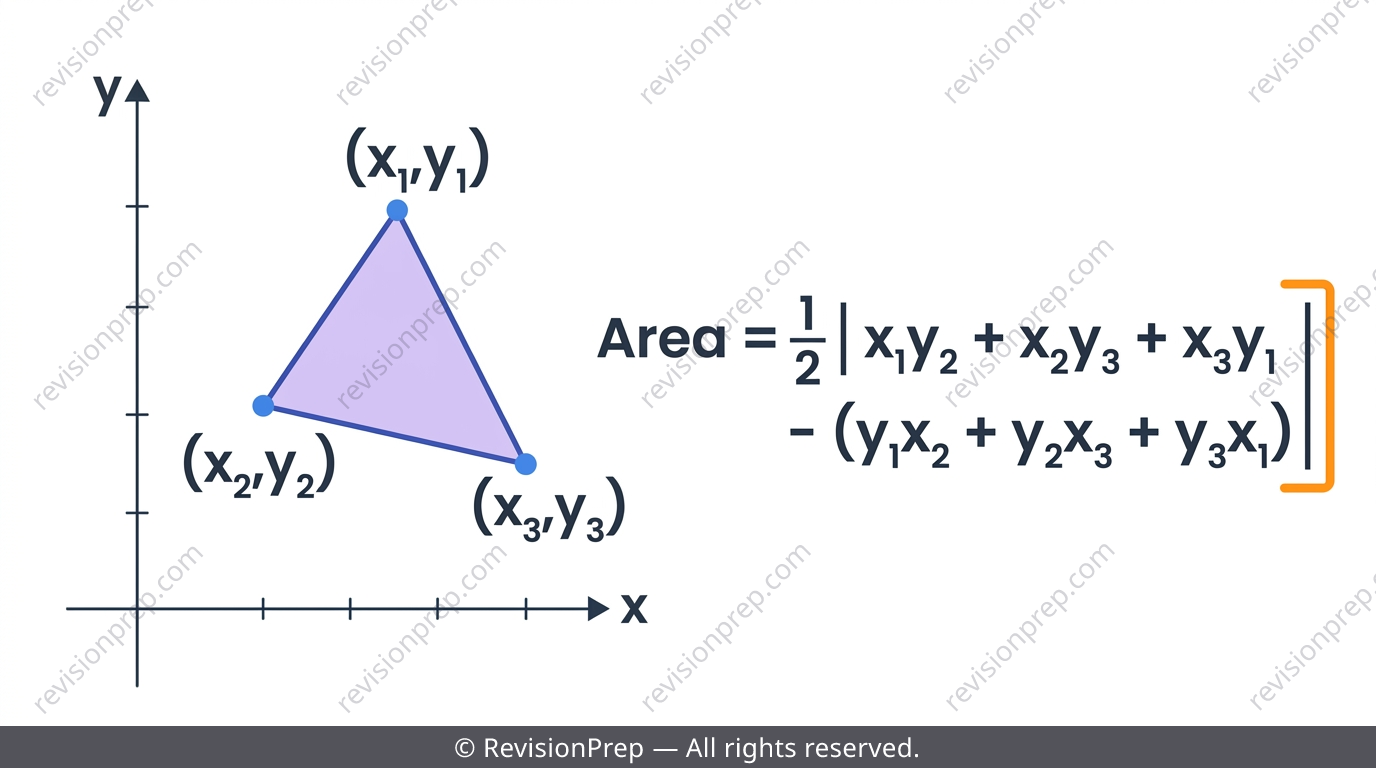
The shoelace formula turns any triangle's three vertices directly into an area, with no need to find a base and height first. Because it's wrapped in an absolute value, an equation like 'area = 18' usually produces TWO valid solutions once the modulus is stripped away. If the expression evaluates to exactly zero, the three points are collinear and don't form a triangle at all.
Exam tip
When one vertex lies on a given line, substitute that line's equation in first so the whole shoelace expression collapses to a single variable before you take the modulus.
Common mistake
Solving only one branch of the absolute value equation and reporting a single answer — many exam questions require both solutions to carry forward into the next part.
Median & Midsegment Theorems: Shortcut Facts
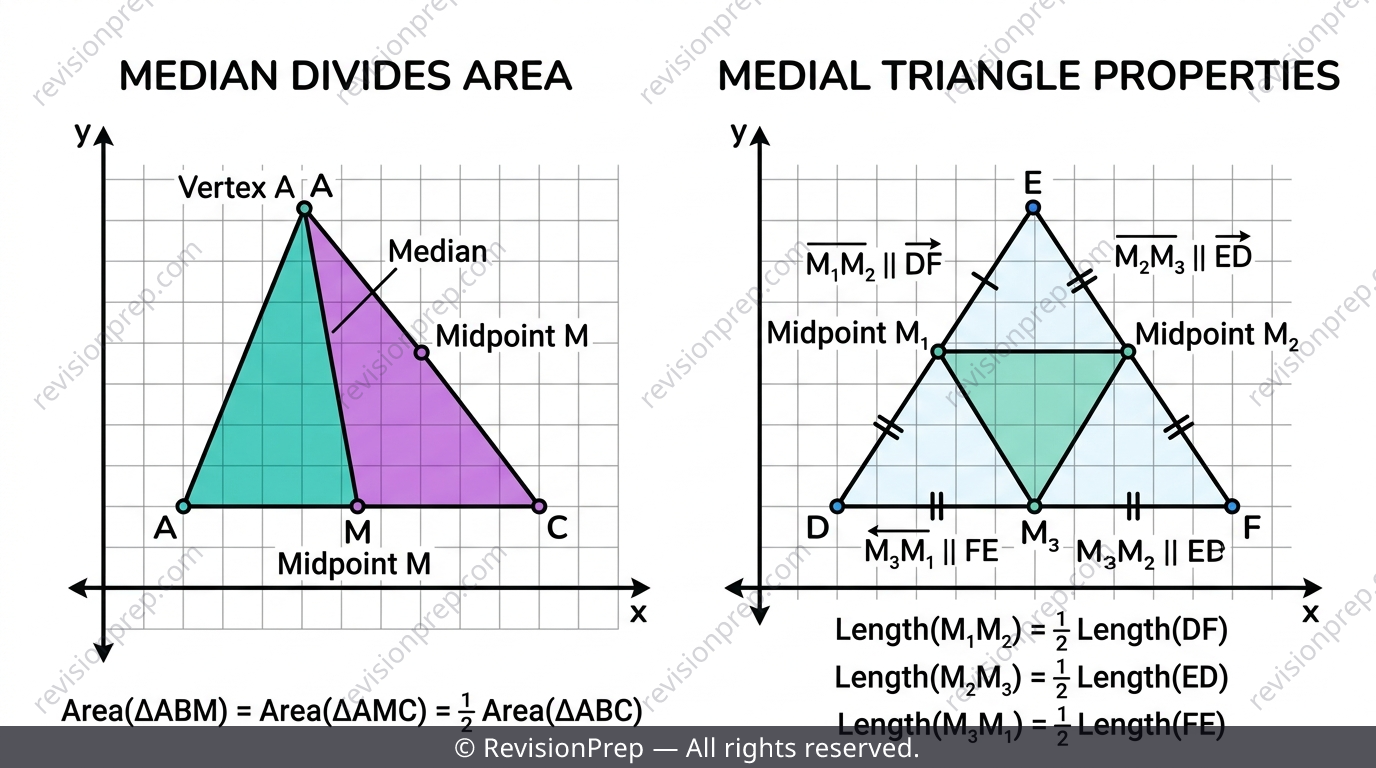
The median from a vertex to the midpoint of the opposite side always splits a triangle into two triangles of EQUAL area — they share the same height and equal base segments by construction. The midsegment theorem says each side of the triangle formed by joining the midpoints of two sides is parallel to, and exactly half the length of, the corresponding side of the original triangle. Spotting these two facts lets you answer 'hence deduce' questions without recomputing the shoelace formula from scratch.
Common mistake
Re-running the full shoelace formula on a sub-triangle after a 'hence deduce' prompt instead of using the median theorem — you may get the right number but lose the reasoning mark.
Mini summary
A median always halves triangle area; a midsegment is always parallel to and half the length of the third side.
Radians, the Unit Circle & Trig Identities
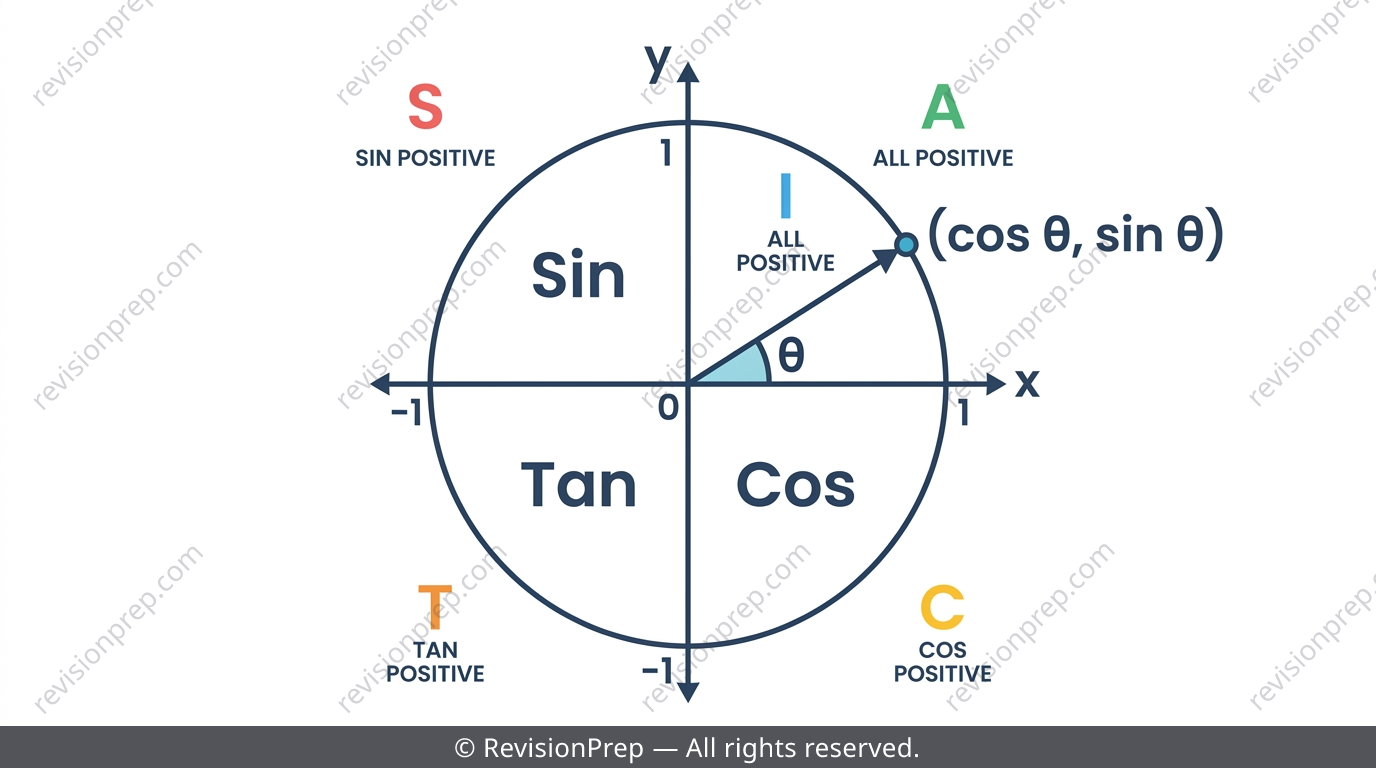
A radian measures an angle by the arc length it cuts on a circle of radius 1, which is exactly why and work directly with no conversion constant — but only when is in radians. On the unit circle, and are defined as the x- and y-coordinates of the point where the terminal arm meets the circle, which works for any real angle, not just to . This gives the Pythagorean identity and the CAST rule for how signs flip by quadrant.
| θ (degrees) | θ (radians) | sin θ | cos θ | tan θ |
|---|---|---|---|---|
| 0° | 0 | 0 | 1 | 0 |
| 30° | π/6 | 1/2 | √3/2 | 1/√3 |
| 45° | π/4 | √2/2 | √2/2 | 1 |
| 60° | π/3 | √3/2 | 1/2 | √3 |
| 90° | π/2 | 1 | 0 | undefined |
Exam tip
If you forget the exact trig values under pressure, redraw the equilateral triangle (for 30°/60°) or the isosceles right triangle (for 45°) and read the ratios straight off the sides.
Common mistake
Plugging degrees straight into or without converting to radians — the working looks right but the answer is guaranteed wrong.
Quick formula sheet
Practice questions
- Find the distance and midpoint between the points A(2,3) and B(8,11).
- Convert 150° to radians and 5π/6 radians to degrees.
- State the exact value of sin(60°) and cos(60°) without a calculator.
- A line passes through (1,5) with gradient -2. Find the equation of the perpendicular bisector of the segment joining this point to (7,1).
- Triangle vertices are (0,0), (6,0), and (3,7). Use the shoelace formula to find its area.
- A sector has radius 5 cm and angle 1.2 radians. Find its arc length and area.
- Triangle PQR has P(1,4), Q(9,-2), and R lies on the line y = 2x - 3. If the area of PQR is 24, find the two possible coordinates of R.
- Prove algebraically, using coordinates (x1,y1), (x2,y2), (x3,y3), that the midsegment joining the midpoints of two sides of a triangle is parallel to and half the length of the third side.
- Show that sin²θ + cos²θ = 1 leads to the identity 1 + tan²θ = sec²θ, stating each algebraic step.
Frequently asked questions
How much of IB Maths AA HL is Geometry and Trigonometry?+
It makes up roughly 20-25% of AA HL assessment as Topic 3, and its coordinate and trig tools reappear directly in vectors and calculus questions later in the same paper.
What's the trick for perpendicular bisector questions?+
Find the midpoint of the segment, take the negative reciprocal of its gradient, then substitute both into point-gradient form — always in that order, and show each step for full marks.
How do I know if three points are collinear?+
Substitute their coordinates into the shoelace area formula — if the result is exactly zero, the points lie on a single straight line and don't form a triangle.
Why do arc length and sector area formulas need radians?+
A radian is defined by arc length equal to the radius, which is exactly why s = rθ and A = ½r²θ work without a conversion constant. Using degrees in these formulas gives a wrong answer even if your working looks correct.
What is the median-bisects-area theorem used for?+
It lets you deduce the area of a sub-triangle formed by a median without recalculating from scratch, since a median always splits a triangle into two equal-area triangles — useful for 'hence deduce' exam-style questions.
Do I need to memorise the exact trig values table?+
Yes — values for 0°, 30°, 45°, 60°, and 90° aren't in the formula booklet. If you forget them under pressure, redraw the equilateral or isosceles right triangle to derive them quickly.
Get the full IB Maths AA Geometry and Trigonometry notes
Related articles