
Functions
Model families, asymptotes, domain/range and inverse functions — the topic that shows up on every single IB Maths AA paper.
Quick facts
Functions is the connective tissue of IB Maths AA — it shows up on Paper 1 as a no-calculator test of transformations, inverses and composites, and on Paper 2 as a GDC-driven modelling question involving exponential, logistic or rational behaviour. Because it's routinely fused with Calculus at HL, examiners expect fluent notation and fast recognition of function families, not just algebra. This teaser walks through the five ideas that decide most of the marks: choosing the right model from a word description, reading off asymptotes correctly, nailing domain and range restrictions, handling composite and inverse functions with proper notation, and the HL extras — odd/even symmetry, self-inverse functions and polynomial root-finding. Master these and you've covered the backbone of both papers. The full revision note goes deeper into every worked example, trap and mark scheme habit examiners reward.
What you’ll be able to do
Choosing the Right Model Family
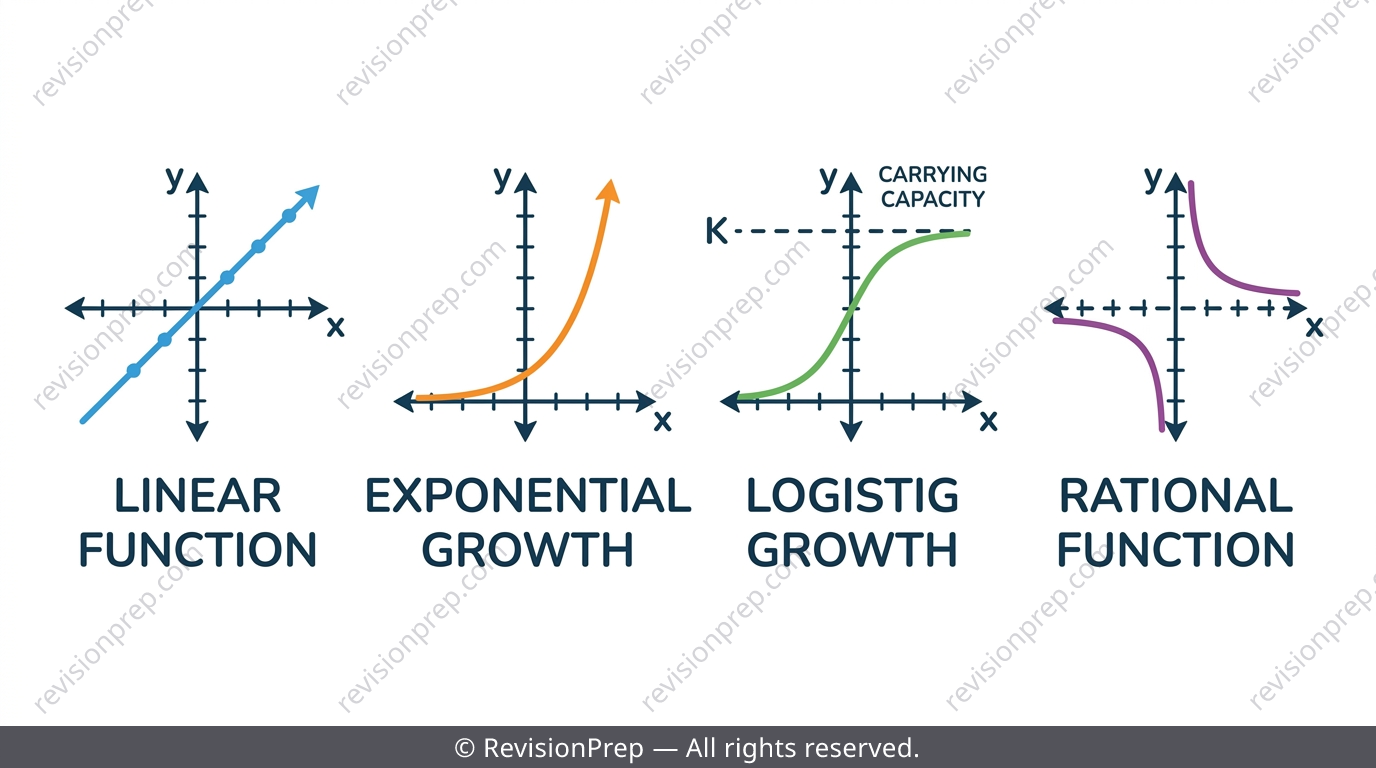
Every modelling question hides its answer in how the quantity changes: a constant amount per unit time means linear, ; a constant percentage rate means exponential, ; growth that slows as it nears a ceiling means logistic; and a quantity that plateaus at a fixed value points to a rational model like . Spot the pattern in the words before you write a single equation — that's the mark examiners are testing first.
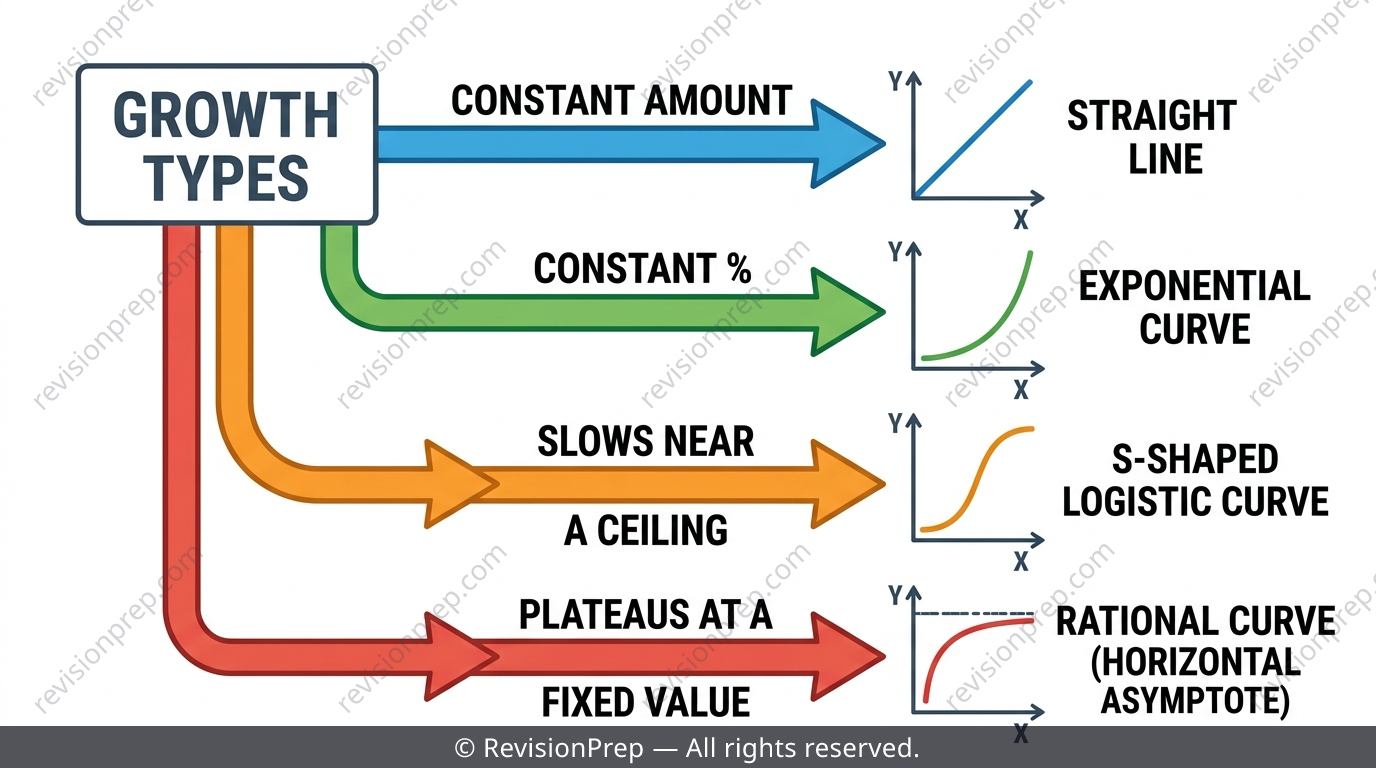
| Model | Rate-of-change behaviour | Long-run behaviour |
|---|---|---|
| Linear | Constant amount added | Increases/decreases without bound |
| Exponential | Constant percentage rate | Grows/decays without bound (or to a limit for cooling models) |
| Logistic (HL) | Proportional to size AND remaining room | Levels off at carrying capacity |
| Rational plateau | Rate of increase shrinks over time | Approaches a fixed horizontal asymptote |
Exam tip
Identify the family from the story first — constant amount, constant percentage, slowing near a ceiling, or plateauing — before writing any equation.
Common mistake
In a parabolic dish question, students substitute the full diameter instead of the radius (halving it first) — using instead of loses all marks on that style of question.
Mini summary
Read the words for constant amount, constant %, slowing growth, or a plateau to pick linear, exponential, logistic or rational instantly.
Reading Asymptotes and Long-Run Behaviour
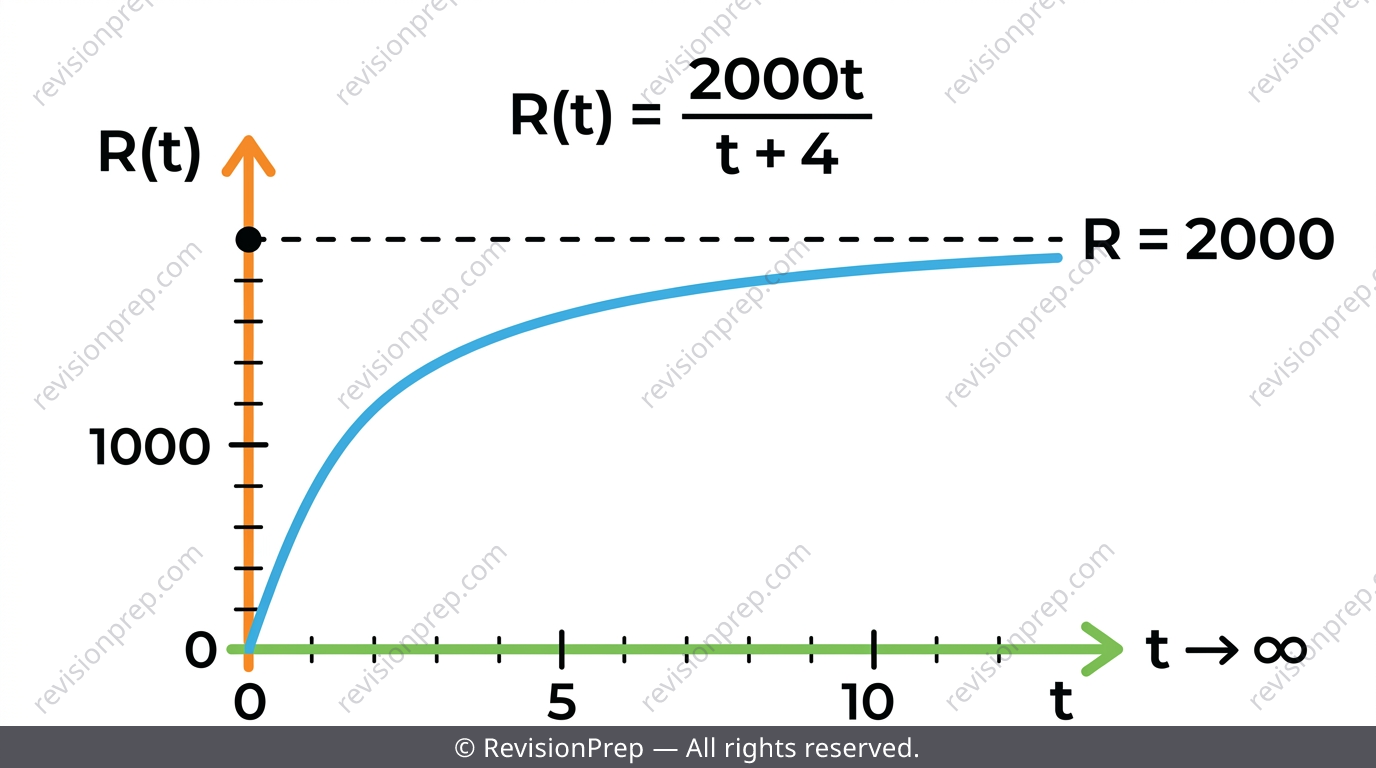
Horizontal asymptotes in rational models come from dividing numerator and denominator by the highest power of the variable; in exponential and logistic models they come from letting the exponential term vanish as . Newton's cooling model never overshoots , and a logistic model always satisfies while passing through at — check both against your algebra.
Exam tip
When a mark scheme shows [1] next to a 'state' command term, write one calculated value plus a one-line context sentence — full justification earns nothing extra.
Common mistake
For , students say or try to take the limit without dividing through first. Fix: divide by the highest power of to get , so as , and .
Mini summary
Divide by the highest power of for rational asymptotes; let the exponential term vanish for exponential/logistic asymptotes.
Domain, Range and One-to-One Functions
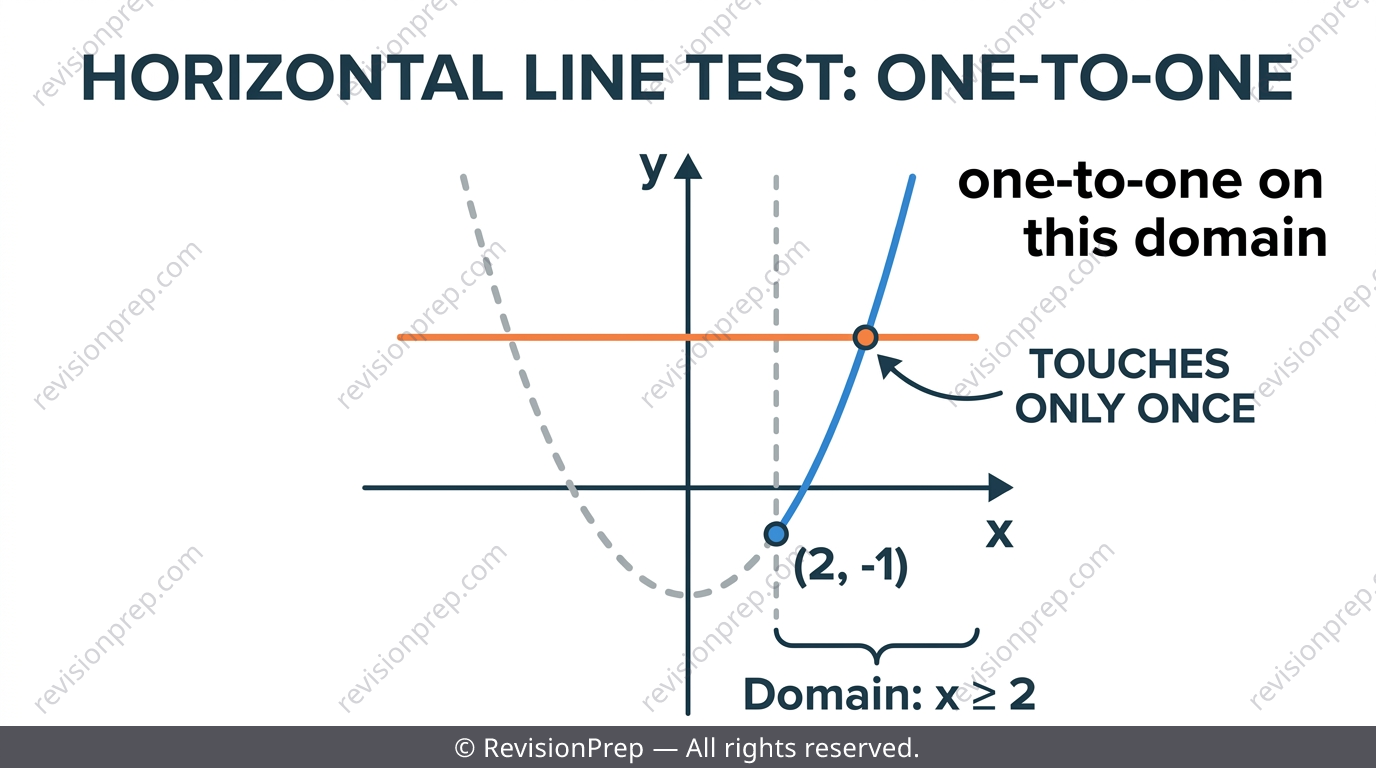
Domain is what you're allowed to feed into a function; range is what comes out. Always scan for the three domain-killers: square roots need the inside , denominators need , and logs need the argument . A function needs to be one-to-one — pass the horizontal line test — before an inverse exists without restricting the domain.
Exam tip
Check all three restrictions — square roots, denominators, logs — before stating a final domain.
Common mistake
For on , students take the root or forget to restrict the domain of to match the range of — both lose marks even with correct algebra otherwise.
Mini summary
Domain restrictions come from square roots, denominators and logs; one-to-one is required before an inverse exists.
Composite and Inverse Functions
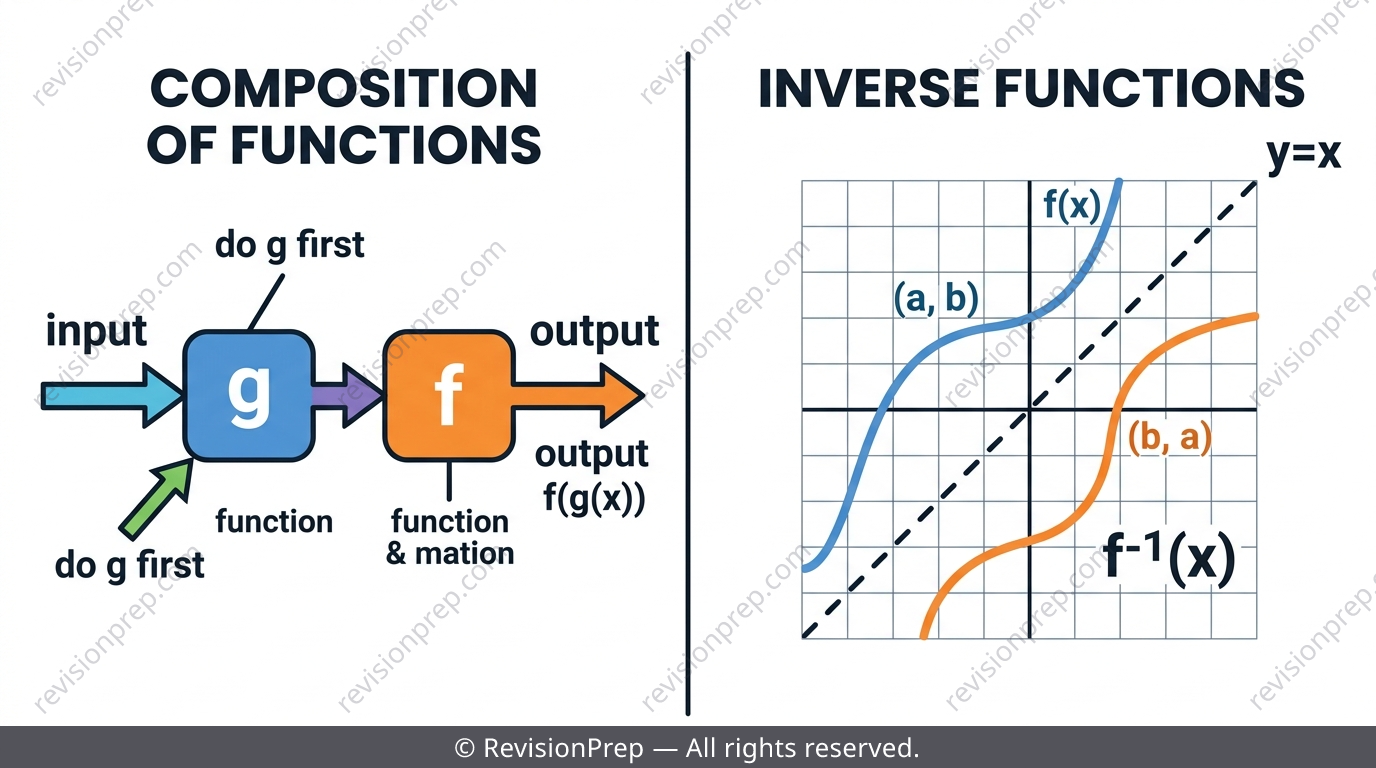
Composite functions apply right-to-left: means do first, then feed the result into . An inverse function undoes entirely — solve for and relabel — and the domain of always equals the range of .
Exam tip
To find an inverse, solve for in terms of , then swap letters — don't try to guess the reciprocal.
Common mistake
Treating inverse notation as a reciprocal. Fix: undoes , while is a different function with vertical asymptotes wherever — they only coincide for special self-inverse functions.
Mini summary
applies right-to-left; undoes and swaps domain with range — never confuse it with .
HL Extras: Odd/Even, Self-Inverse and Polynomial Roots
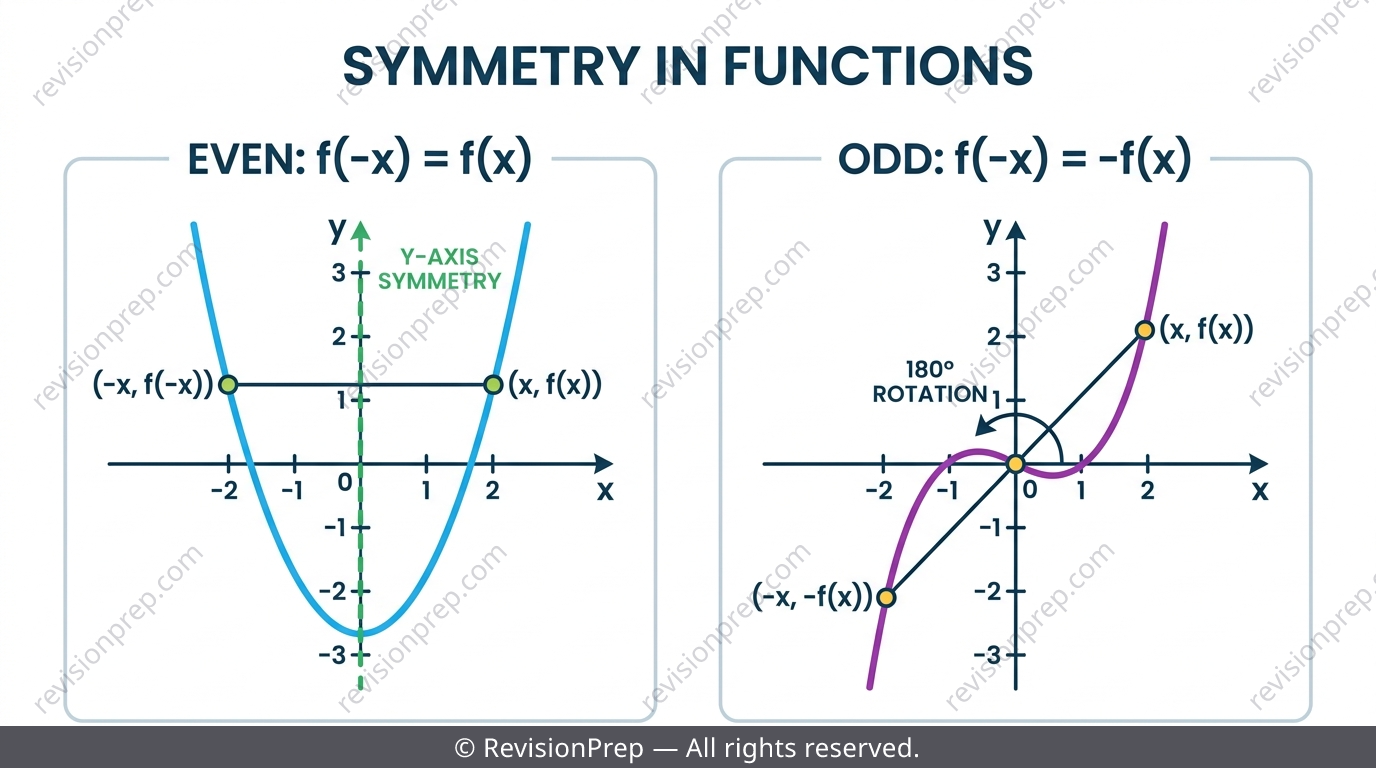
For rational functions , the vertical asymptote sits where the denominator is zero and the horizontal asymptote is the ratio of leading coefficients. Even functions satisfy (mirrored in the y-axis), odd functions satisfy (180° rotational symmetry), and self-inverse functions () are automatically symmetric about . The factor and remainder theorems let you find polynomial roots quickly, and Vieta's formulas link roots directly to coefficients.
Exam tip
Finding one root via the factor theorem in a 'solve completely' question is never the finish line — divide out the remaining quadratic and solve it too.
Common mistake
Stopping after finding a single root with the factor theorem instead of dividing out the remaining quadratic factor, which only collects partial marks.
Mini summary
HL adds rational asymptotes, odd/even symmetry, self-inverse functions, and factor/remainder theorems for full polynomial root-finding.
Quick formula sheet
Practice questions
- A scenario describes a bacteria colony growing by a fixed percentage each hour. Should this be modelled as linear or exponential? Justify in one sentence.
- Find the domain of .
- Given , find .
- For , find the value approaches as .
- Given for , find and state its domain.
- Determine the vertical and horizontal asymptotes of .
- A population follows a logistic model with carrying capacity and . State the value approaches as and justify using the model's structure.
- Show that is self-inverse.
- Use the factor theorem to find all roots of .
Frequently asked questions
How do I know which model to use in an IB Functions question?+
Look at how the quantity changes: constant amount means linear, constant percentage means exponential, growth that slows near a ceiling means logistic, and a value that plateaus means a rational model with a horizontal asymptote.
What is the difference between $f^{-1}(x)$ and $1/f(x)$?+
undoes entirely — solve for and relabel. is the reciprocal function with vertical asymptotes wherever . They only match for special self-inverse functions.
Why does the order matter in composite functions?+
means you apply first and feed that result into . Swapping the order usually gives a completely different function.
How do I find the domain of a function for IB Maths AA?+
Check three things: square roots need the inside , denominators need , and logs need the argument . Combine all restrictions that apply.
Is Functions examined on Paper 1 or Paper 2 in IB Maths AA?+
Both. Paper 1 typically tests transformations, inverses and composites without a calculator, while Paper 2 usually has a GDC-based modelling question involving exponential, logistic or rational functions.
What extra content does HL add to Functions?+
HL adds rational and polynomial function structure, the factor and remainder theorems, odd/even symmetry, self-inverse functions, and the full logistic model derivation.
Get the full Functions revision notes
Related articles