
IB DP Maths AI: Functions
Domain, range, composite & inverse functions, transformations and trig graphs — the exam essentials, fast.
Quick facts
Functions sit underneath almost everything else in IB DP Maths AI — from calculus to modelling — so getting domain, range, composite functions, inverse functions, transformations and trig graphs solid pays off across the whole course. This topic keeps testing the same handful of ideas in new outfits: what inputs are allowed, what outputs actually appear, and how a graph moves or reshapes when its equation changes. Most marks aren't lost on algebra — they're lost on notation slips in composite functions, forgetting to justify why an inverse exists, or mixing up which way a horizontal shift goes. This teaser walks through the five ideas examiners return to again and again, with the traps students fall into and the checks that keep you safe. For the full worked examples, formula derivations and step-by-step methods, the complete revision note is linked at the end.
What you’ll be able to do
Domain and Range
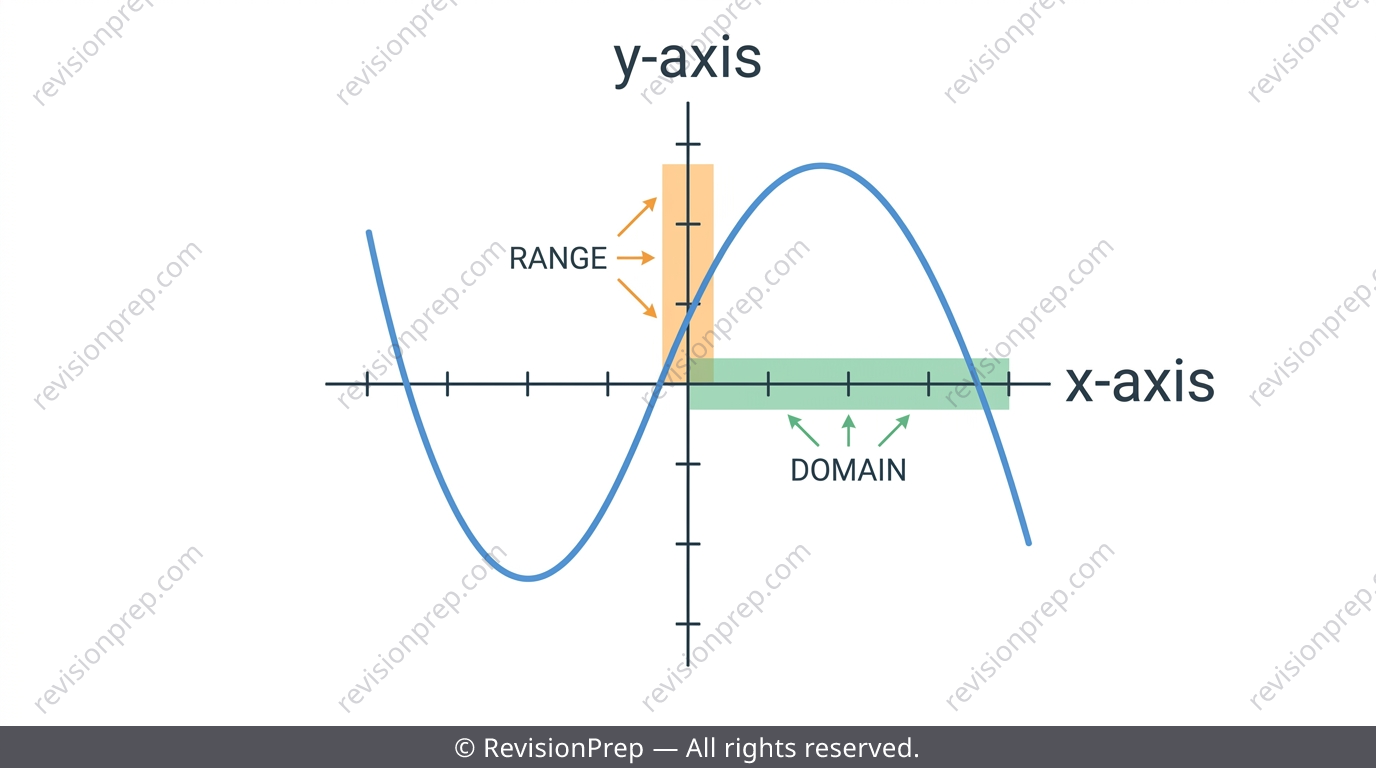
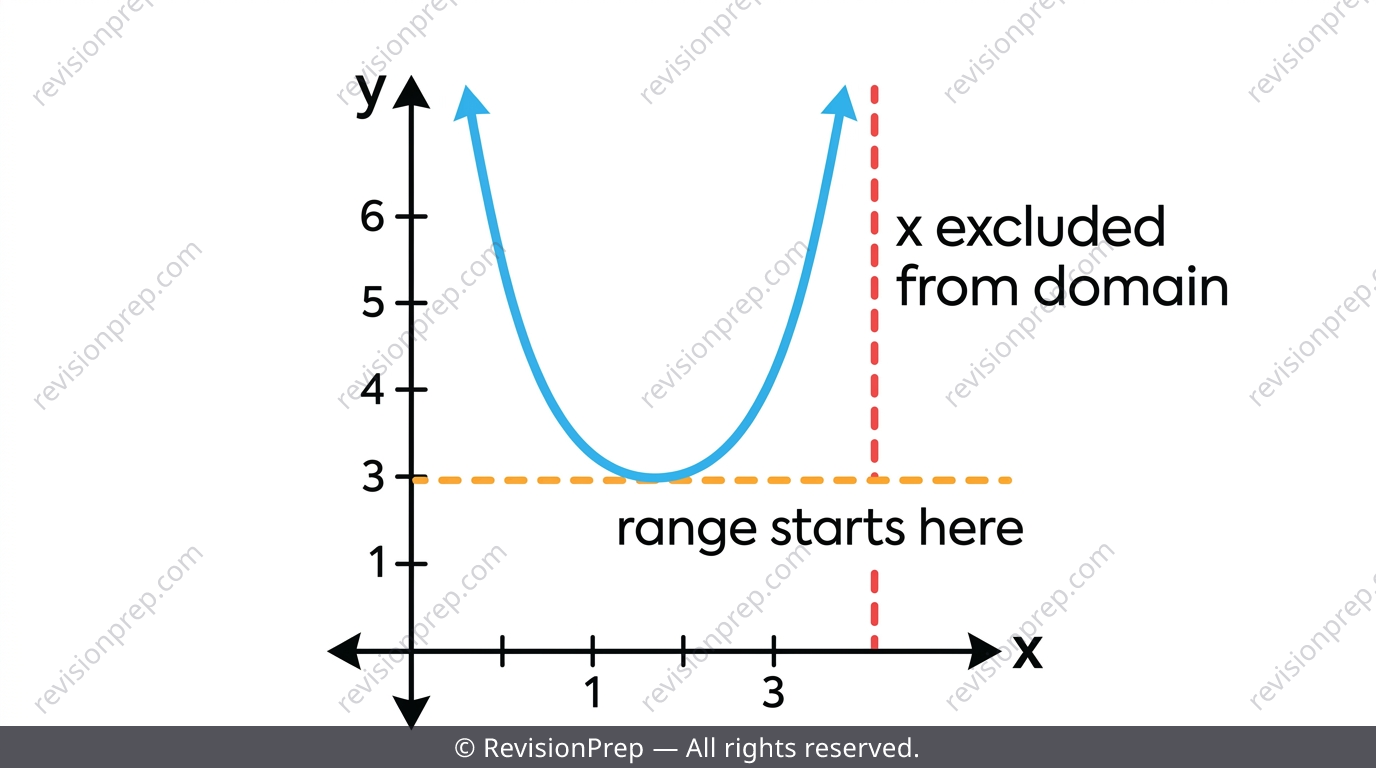
Domain is every -value a function is allowed to accept; range is every -value it actually produces. Domain gets restricted by three classic problems: dividing by zero, square-rooting a negative, or taking the log of a non-positive number. Range must be read from the graph's actual shape — its turning points and asymptotes — never just assumed to be all real numbers.
Exam tip
Always check for division, square roots, and logs first when stating a domain — these three cover almost every restriction you'll be asked about.
Common mistake
Writing the range as whatever codomain the question states, instead of calculating the true minimum or maximum from the function itself.
Mini summary
Domain = allowed inputs (watch division, roots, logs); range = actual outputs (read from the graph, not guessed).
Composite Functions
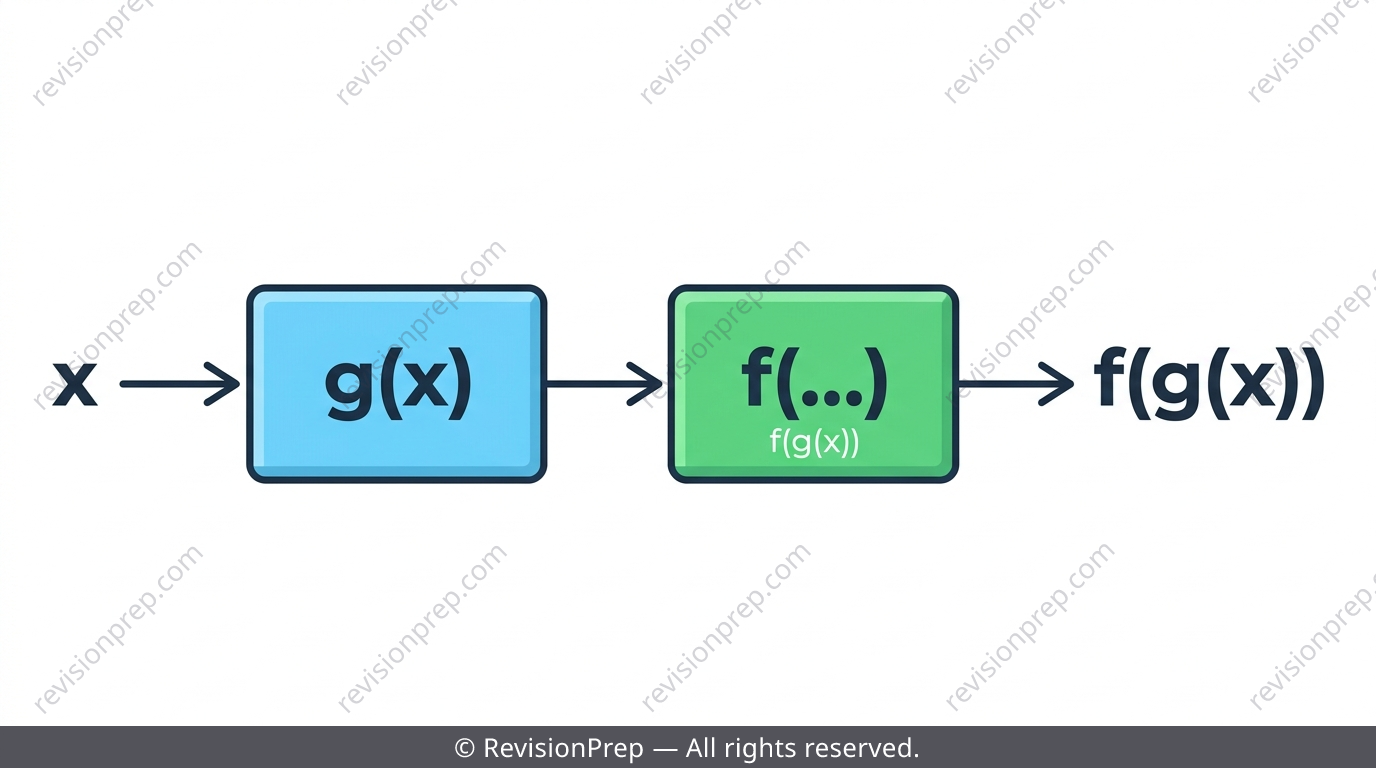
A composite function means apply first, then feed that result into . Order matters completely — and are usually different functions. 'Show that' questions expect full algebraic substitution and simplification down to exactly the required expression, not a jump to the answer.
Exam tip
For 'show that ' questions, examiners award one mark for correct substitution and one for correct simplification — an unexplained jump to loses the method mark.
Common mistake
Reversing the order of composition, applying before when the notation requires first.
Mini summary
= apply , then — always substitute fully and show every simplification step.
Inverse Functions
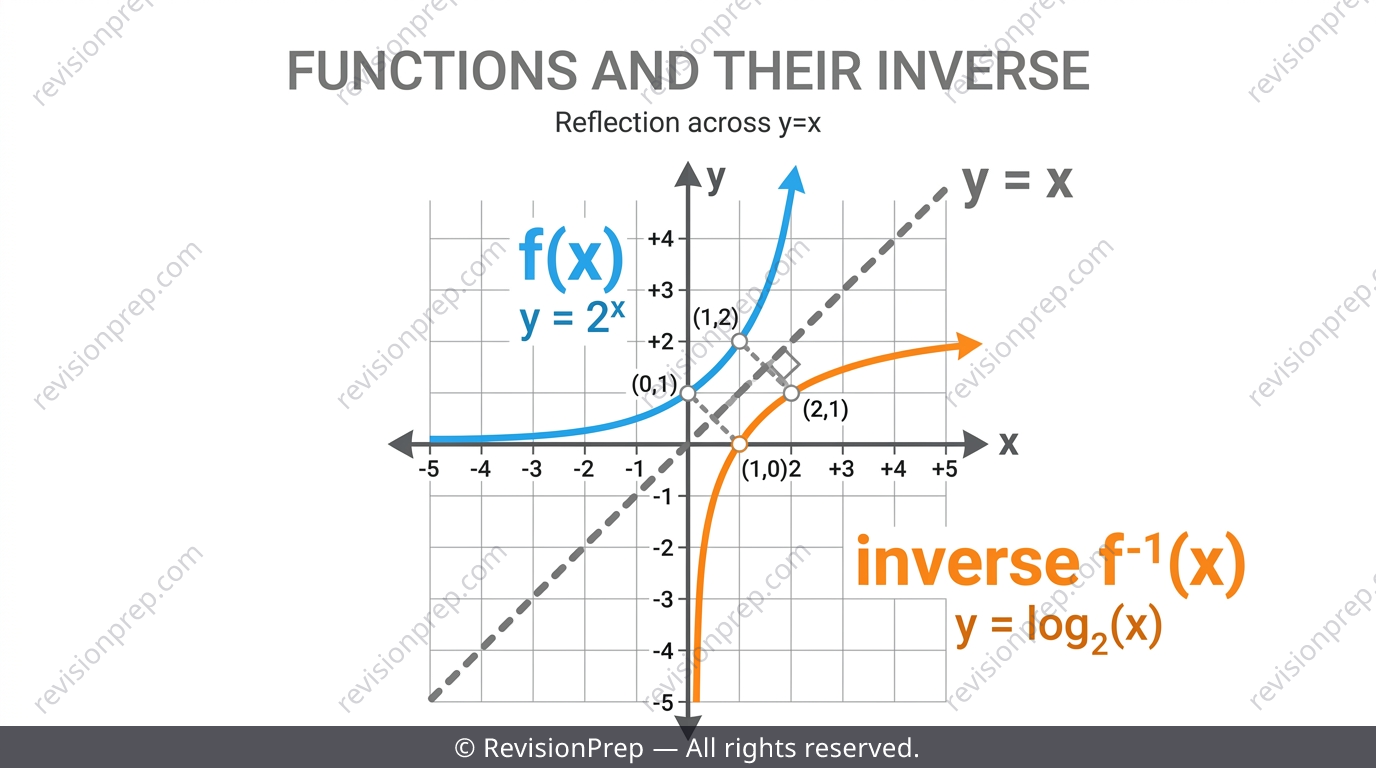
The inverse reverses , satisfying and . An inverse only exists cleanly for one-to-one functions, which is exactly why exam questions restrict the domain of things like . To find it algebraically: write , swap and , then solve for — and always match the sign of any square root to the original restricted domain.
Exam tip
State explicitly why a function is one-to-one (strictly increasing/decreasing on the given domain) before you find its inverse — this justification often carries its own mark.
Common mistake
Algebraically 'finding' an inverse for a many-to-one function like without checking the domain restriction, presenting one formula as valid everywhere.
Mini summary
Inverse exists only for one-to-one functions; domain and range swap between and .
Transformations of Functions
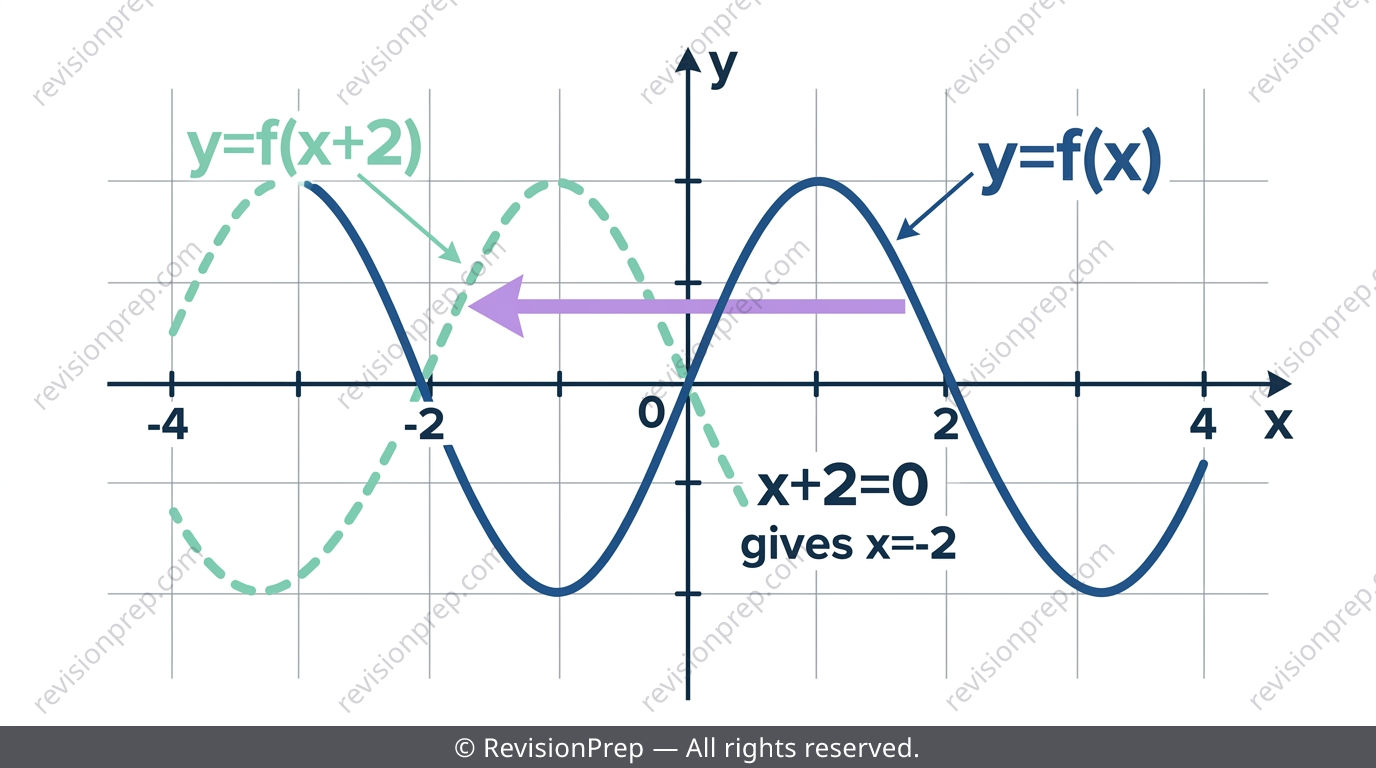
Vertical transformations behave exactly as they look: shifts up/down, stretches away from the -axis. Horizontal transformations feel backwards: shifts LEFT, and compresses horizontally by factor . The safest check is to set the bracket to zero and track where a known point actually moves.
Exam tip
Read the command term carefully: 'describe' wants words for the transformation sequence, while 'write down' or 'state' wants the actual new equation.
Common mistake
Reading as a shift 3 units left because the number is subtracted — solving shows the shift is actually 3 units RIGHT.
Mini summary
Vertical changes match their sign; horizontal changes to do the opposite — always test with a point.
Trigonometric Functions
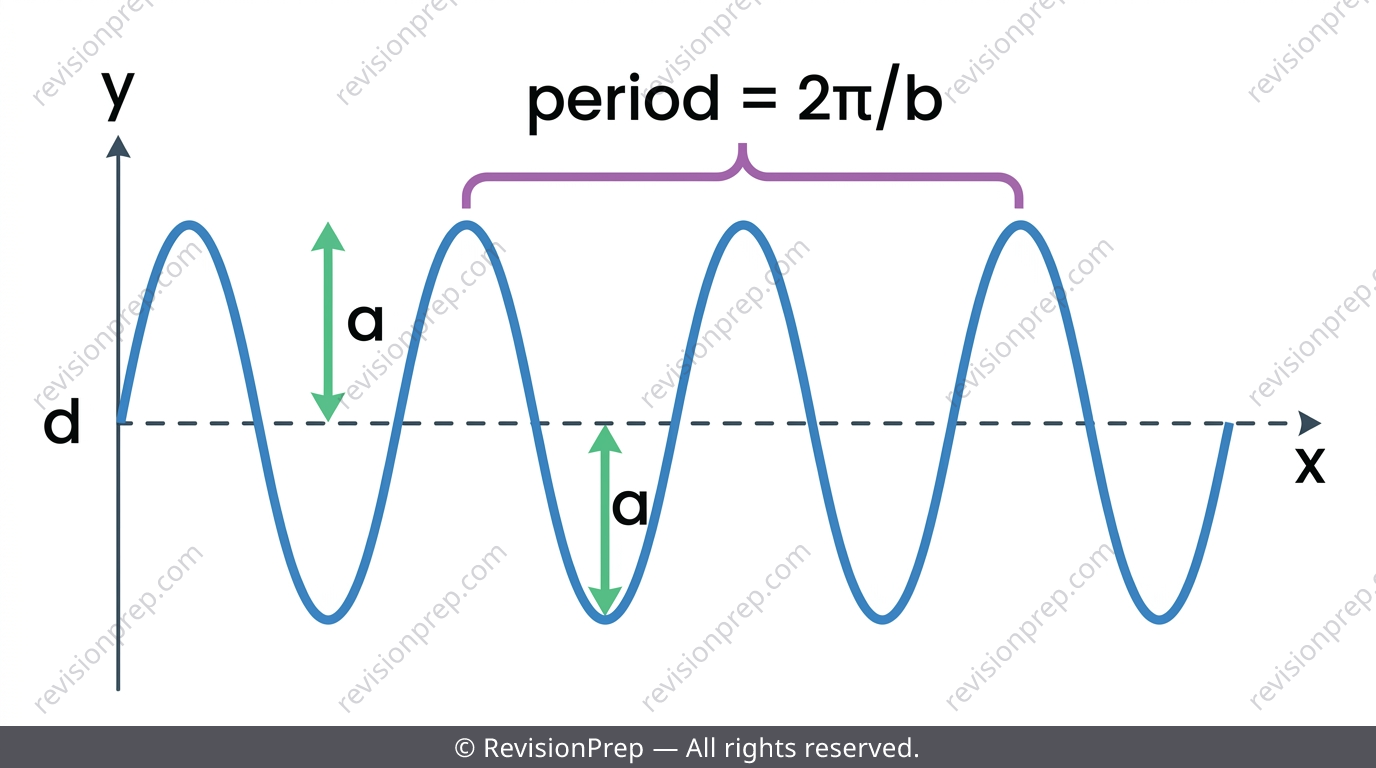
Sine and cosine models like use the same transformation logic as any other graph, but the shape repeats forever. Amplitude and midline together give the range , while the period is — a fixed property of the equation, unaffected by any real-world domain restriction. Tangent graphs have vertical asymptotes wherever cosine equals zero.
Exam tip
For real-world sinusoidal models, always write the equation you're solving before using the GDC graph or intersection method — this secures method marks even when technology gives the final answer.
Common mistake
Using instead of for the period, or leaving the calculator in degree mode when the argument contains .
Mini summary
Range = , period = — both read directly from the equation, independent of context restrictions.
Quick formula sheet
Practice questions
- State the domain of .
- For , find .
- State the period of .
- Find the range of for .
- Given , , find .
- Describe the sequence of transformations mapping to .
- Given and , show that and state the relationship between and .
- For , , determine the range of and show it is one-to-one.
- For , , state the period of the model and find the range of heights.
Frequently asked questions
What's the difference between domain and range in IB Maths AI?+
Domain is the set of allowed -values (inputs); range is the set of -values the function actually produces (outputs). Domain is restricted by division by zero, negative square roots, and non-positive logs; range must be read from the graph's shape.
How do I find the inverse of a function?+
Write , swap and , then solve for . First confirm the function is one-to-one on its stated domain — otherwise no single inverse formula is valid.
Why does $f(x+c)$ shift a graph left, not right?+
Because the transformation is applied inside the function before any output is produced. Setting the bracket to zero, gives , showing the key point moves left when .
How do I find the range of a sine or cosine model?+
Use the amplitude and midline directly: the range is . There's no need to evaluate multiple points once you can read these off the equation.
What makes a function one-to-one?+
Every output corresponds to exactly one input — it passes the horizontal line test. This matters because only one-to-one functions have a genuine inverse.
Why does my period calculation for a trig graph keep coming out wrong?+
Check your calculator mode: if the function's argument contains , stay in radian mode and use , not .
Master Functions with the full IB DP Maths AI revision notes
Related articles