
IB Maths AI Calculus: Limits, Derivatives and the HL-Only Trap
The single biggest topic on AI SL — master the mechanics before you meet the modelling questions
Quick facts
Calculus is the largest single topic on IB Maths AI SL, and it shows up everywhere: Paper 1 tests raw mechanical skill like differentiating and finding a tangent, while Paper 2 hides the same ideas inside real-world modelling contexts with a GDC. Getting comfortable with limits, the derivative rules, and what a gradient actually tells you about a graph is non-negotiable if you want a strong grade. A small but important slice — separable differential equations and logistic growth — is HL-only content, so SL students need to know exactly where their syllabus ends. This teaser walks through the five ideas worth locking down first: limits and continuity, the derivative toolkit, tangents and stationary points, kinematics, and the HL differential equations pocket. The full revision notes go much deeper with worked examples and every trap examiners love to set.
What you’ll be able to do
Limits and Continuity
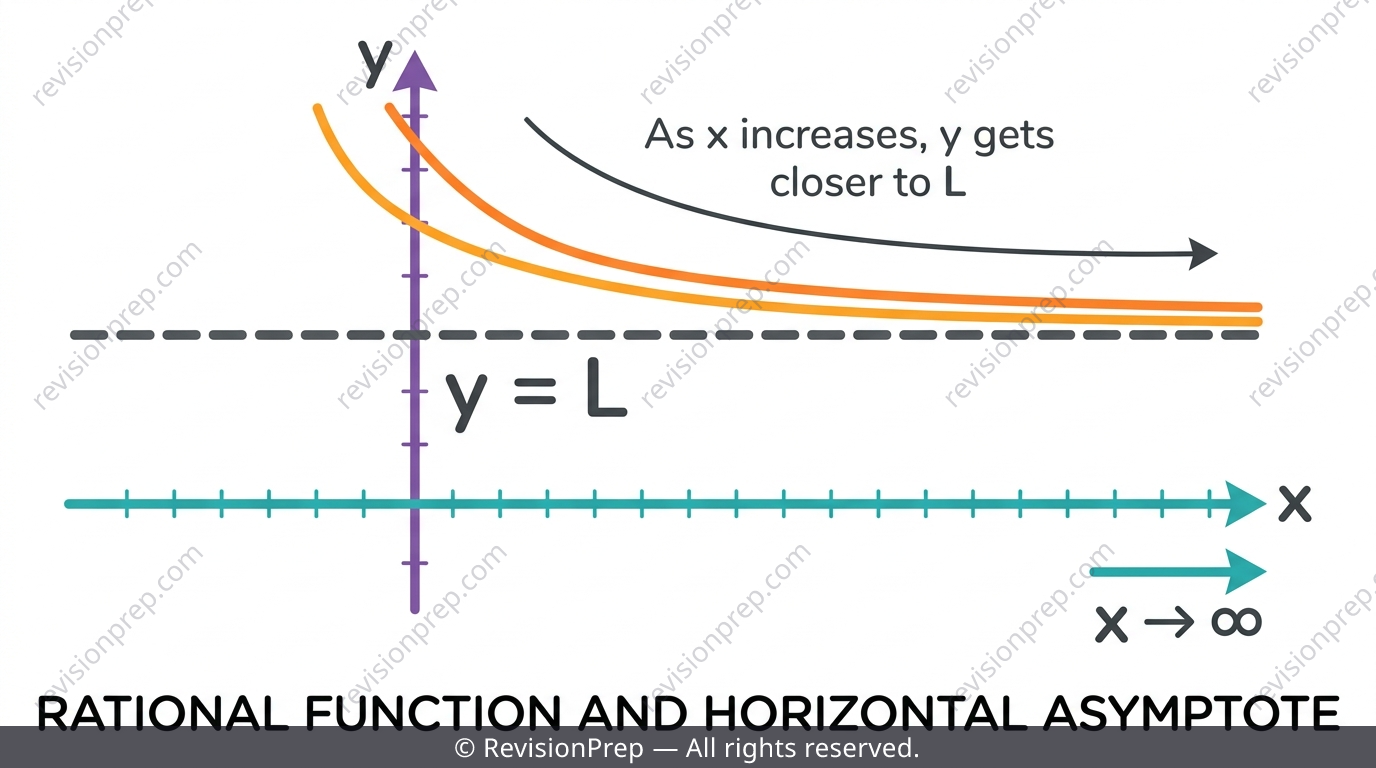
A limit describes the value a function approaches as gets arbitrarily close to a point — the function doesn't even need to be defined there. This idea quietly underpins both horizontal asymptotes and the derivative itself, since a derivative is really the limit of a chord's gradient as two points merge. For rational functions as , the exam-standard method is dividing top and bottom by the highest power of , then comparing degrees.
| Degree comparison | Result as |
|---|---|
| Numerator degree < denominator degree | Limit = 0 |
| Numerator degree = denominator degree | Limit = ratio of leading coefficients |
| Numerator degree > denominator degree | Limit = |
Exam tip
When asked to 'state the equation of the asymptote', write it as an equation like , not just the number — bare numbers lose the mark on these one-mark parts.
Common mistake
Plugging the value straight in, getting , and writing 'the limit doesn't exist'. Instead, factor and cancel the common factor causing the zero, then substitute.
Mini summary
Continuity fails if the function is undefined, the limit doesn't exist, or the two disagree — check all three before you declare it continuous.
The Derivative Toolkit: Product, Quotient and Chain Rules
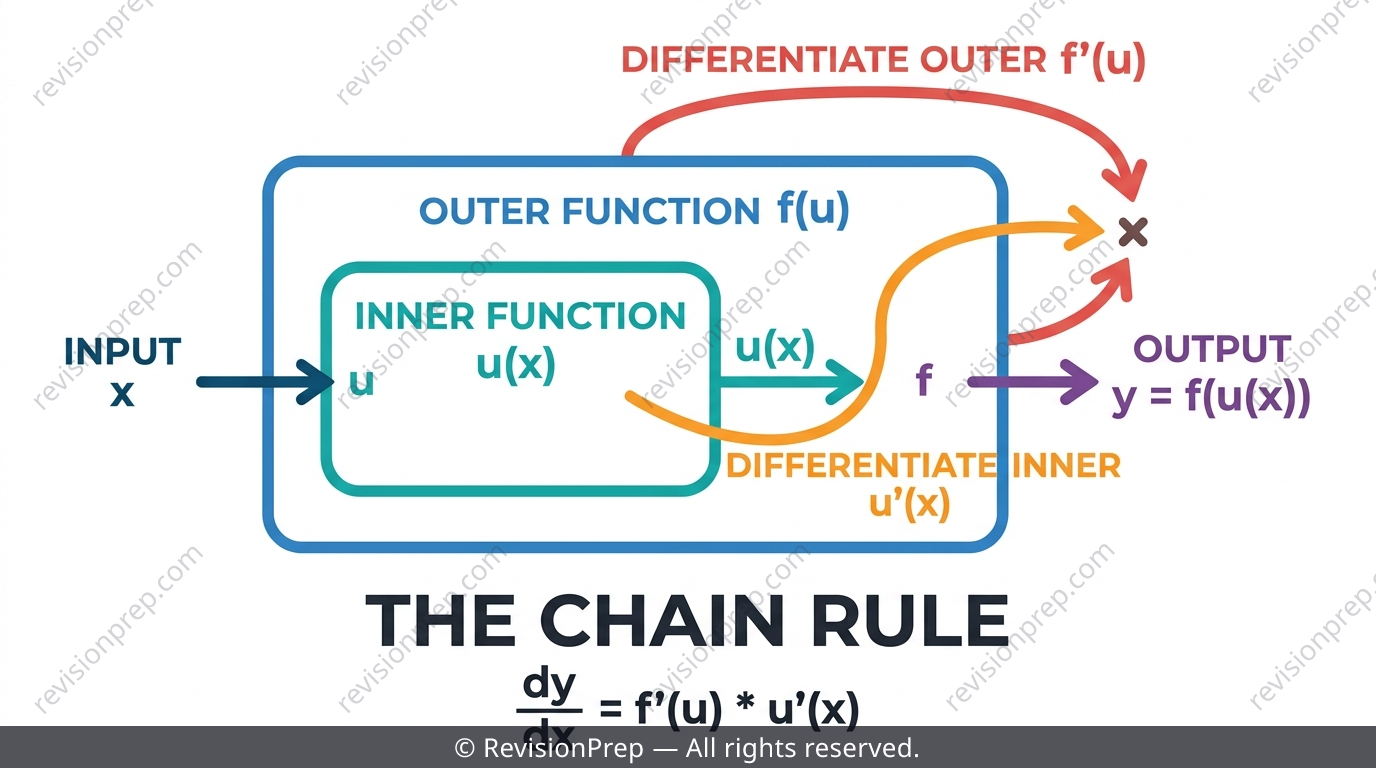
is a new function that outputs the gradient of at every value of — everything else in calculus is just reading or applying that gradient function. For products of two functions use the product rule, for a fraction of two functions use the quotient rule, and for composite functions (a function inside a function) use the chain rule. These three rules combined can differentiate almost anything on the SL syllabus.
Exam tip
Before differentiating, ask: is this a product, a quotient, or a composite function? Naming the structure first stops you reaching for the wrong rule under time pressure.
Common mistake
Trying to differentiate a fraction term-by-term instead of applying the quotient rule properly, or forgetting the inner-function derivative when applying the chain rule.
Mini summary
Fluency here is what separates a fast, clean Paper 1 answer from a slow, error-prone one — these rules need to be automatic, not looked up mid-exam.
Tangents, Normals and Stationary Points
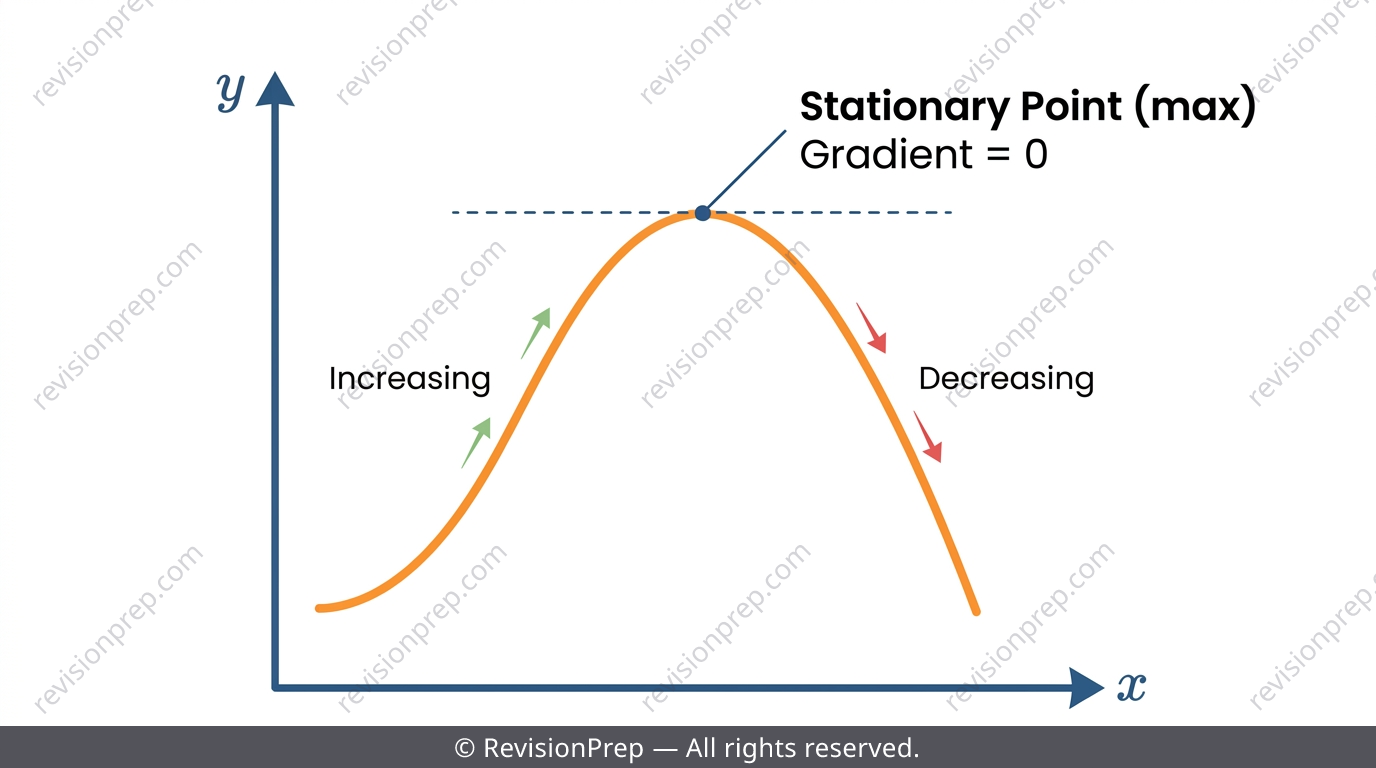
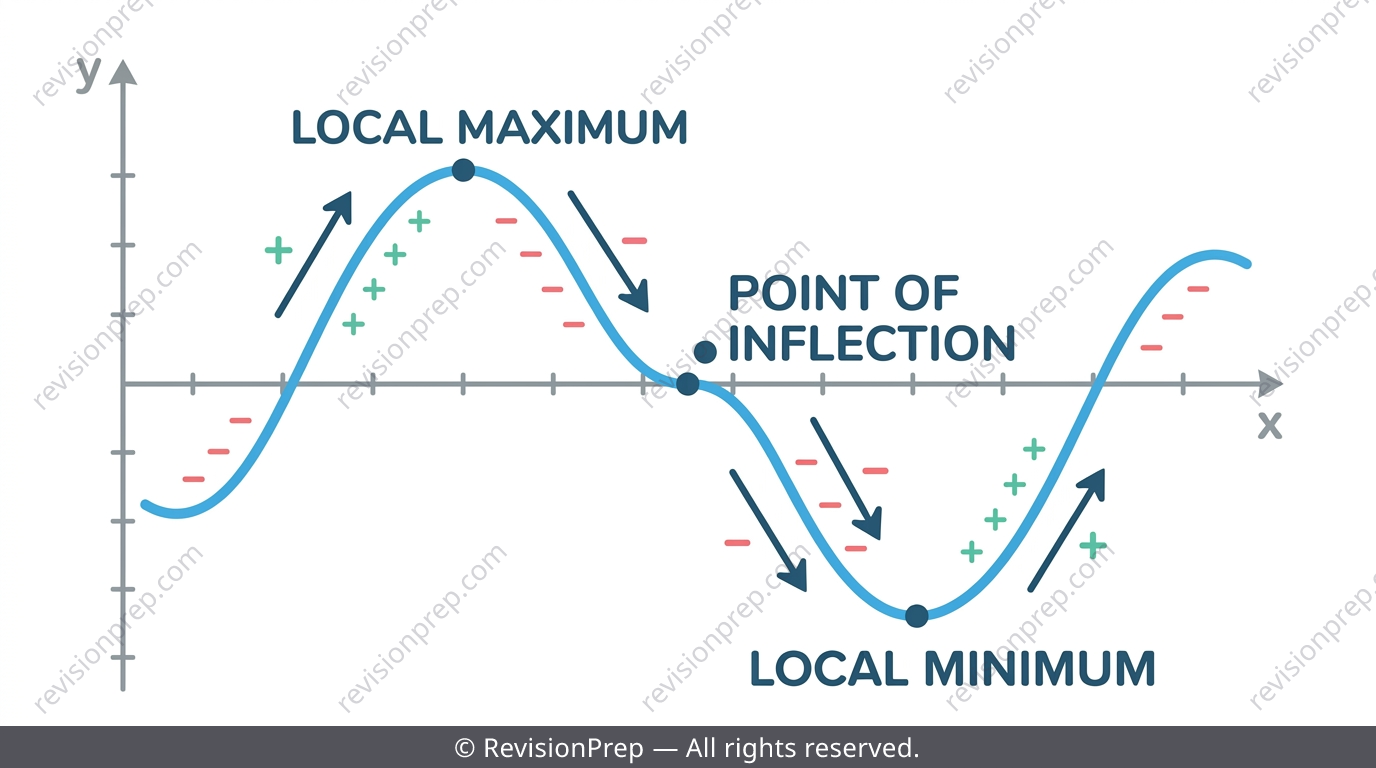
The gradient of the tangent at a point is , giving the line ; the normal is perpendicular, using the negative reciprocal gradient. A stationary point occurs where : use to classify it — concave up () suggests a local minimum, concave down () suggests a local maximum, and a sign change either side of signals a point of inflection.
Exam tip
Always check whether before writing a tangent equation — if it's zero, the tangent is horizontal, not slanted.
Common mistake
Solving and immediately calling the result 'the maximum' without checking or the sign change either side — a stationary point could be a minimum or an inflection instead.
Mini summary
Increasing, decreasing, and stationary behaviour is all read directly off the sign of — sketch the sign pattern before you commit to an answer.
Kinematics: Displacement, Velocity, Acceleration
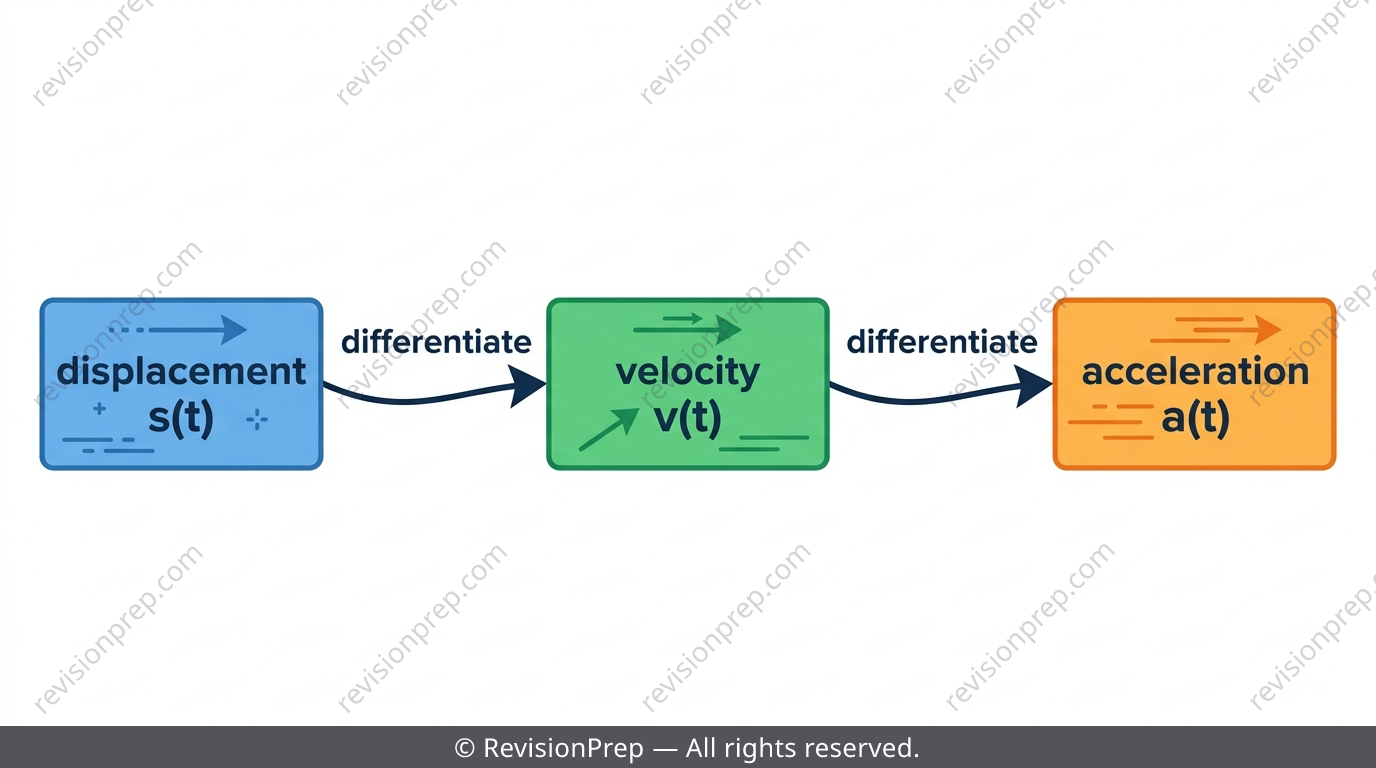
Calculus turns motion problems into a chain of derivatives: displacement , velocity , and acceleration . Differentiate once to get velocity, twice to get acceleration — the same gradient logic from earlier sections just wearing different labels and units.
Exam tip
In Paper 2 context questions, always check the units given in the problem and interpret your derivative in those units — a gradient of a graph becomes a real-world rate.
Common mistake
Mixing up which derivative gives which quantity — always write down before differentiating so you don't stop one step too early or too late.
Mini summary
Kinematics is a direct application of the derivative rules — no new calculus, just a new context to interpret the answer in.
HL-Only: Separable Differential Equations & Logistic Growth
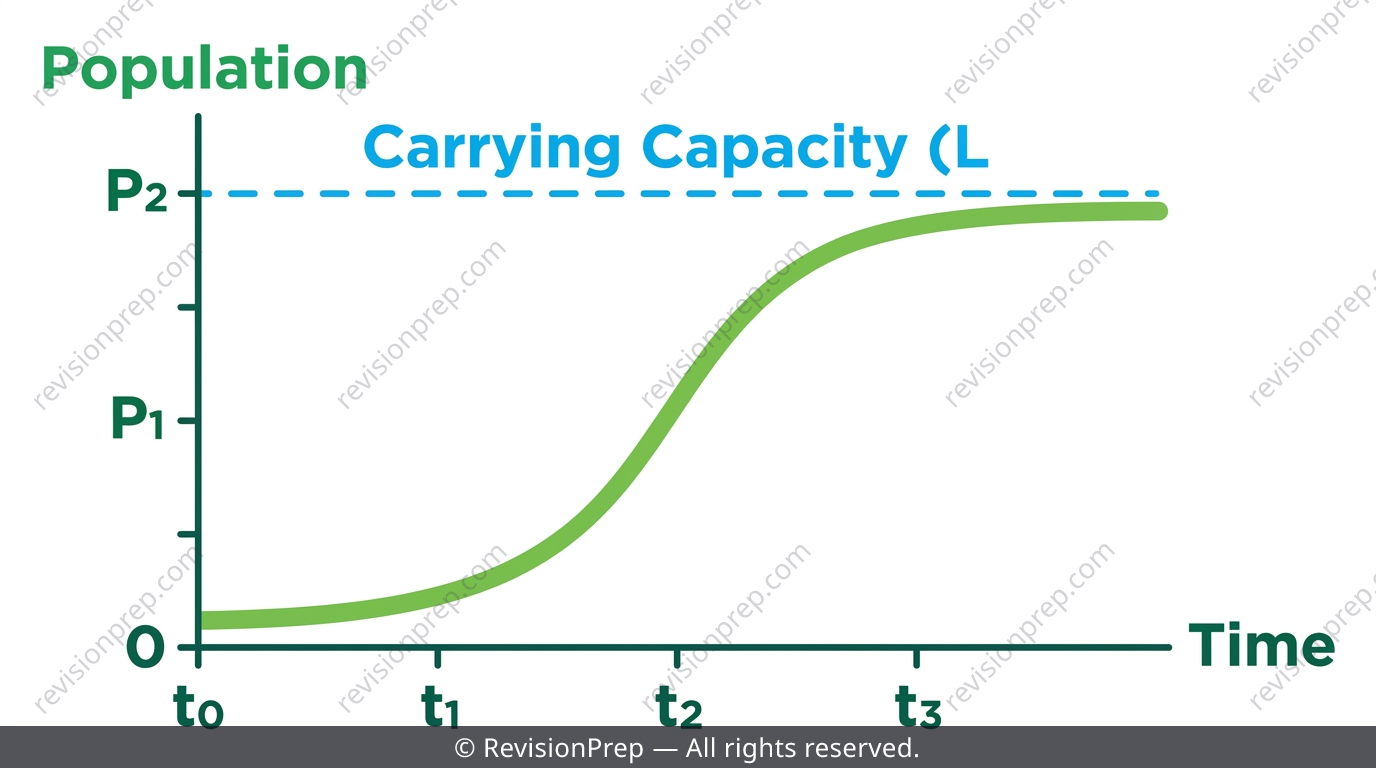
This pocket of calculus is HL content only — confirm with your syllabus before spending SL revision time here. The skill isn't new calculus, it's algebra: rearrange so all the -terms sit with and all the -terms sit with , then integrate each side separately. The logistic equation needs partial fractions because the right-hand side has two different linear factors, both containing .
Exam tip
'Hence' in a logistic-equation question means you must reuse the partial fraction identity given (or derived) in the earlier part — don't start from scratch.
Common mistake
Losing the minus sign on during integration — it silently flips the whole logistic curve upside down later on. Also, seeing any product on the right-hand side and reflexively splitting into partial fractions, even when it's a single power like that just needs the power rule.
Mini summary
General solutions carry an arbitrary constant; particular solutions use a given initial condition to pin that constant down — never skip the substitution step.
Quick formula sheet
Practice questions
- Find and state the horizontal asymptote of the curve.
- Differentiate using the product rule.
- State whether the stationary point of is a maximum or minimum, using the second derivative.
- Find the equation of the tangent to at .
- A particle has displacement . Find its velocity and acceleration at .
- Differentiate using the quotient rule.
- Show that is a valid rearrangement of .
- Given , show that , then find if the particle starts from rest.
- A closed cylindrical can must have volume . Find the radius that minimises total surface area, and confirm it is a minimum.
Frequently asked questions
What percentage of IB Maths AI SL is calculus?+
Calculus makes up roughly 30% of AI SL, making it the single largest topic tested across both Paper 1 and Paper 2.
Are differential equations part of AI SL or only HL?+
Separable differential equations, including logistic growth, are HL-only content. SL students should confirm with their syllabus but generally don't need this section.
How do you find the equation of a tangent line?+
Find the gradient by evaluating at the given point, then substitute into using the point's coordinates.
What's the difference between a limit and continuity?+
A limit describes the value a function approaches near a point, without requiring the function to be defined there. Continuity requires the function to be defined, the limit to exist, and the two to match.
How do you tell a maximum from a minimum from a point of inflection?+
Find where , then check : positive means concave up (likely minimum), negative means concave down (likely maximum), and a sign change with signals a point of inflection.
How is velocity related to displacement in IB calculus questions?+
Velocity is the derivative of displacement with respect to time, and acceleration is the derivative of velocity — differentiate once for and twice for .
Ready to master Calculus for IB Maths AI?
Related articles