
Functions: Domain, Inverses, Composites & Transformations
The IB AI HL toolkit for functions — asymptotes, self-inverse shortcuts and the one equation that covers every transformation.
Quick facts
Functions is one of the most exam-dense topics in IB Maths AI HL — it rarely appears alone and instead fuses with algebra or drives a full Paper 2 modelling question. At its core you need five skills: reading domain and range correctly (not assuming), proving one-to-one algebraically, finding inverse functions and stating their domain properly, composing functions in the right order, and applying the single transformation equation to any graph. Rational functions add a layer — vertical and horizontal asymptotes control both domain and range, and a neat shortcut tells you instantly when a function is self-inverse. This teaser pulls out the five ideas examiners test most, with the traps students fall into every year. For the full worked examples, proofs and practice set, the complete revision note has you covered.
What you’ll be able to do
Domain and Range: Read the Graph, Don't Assume
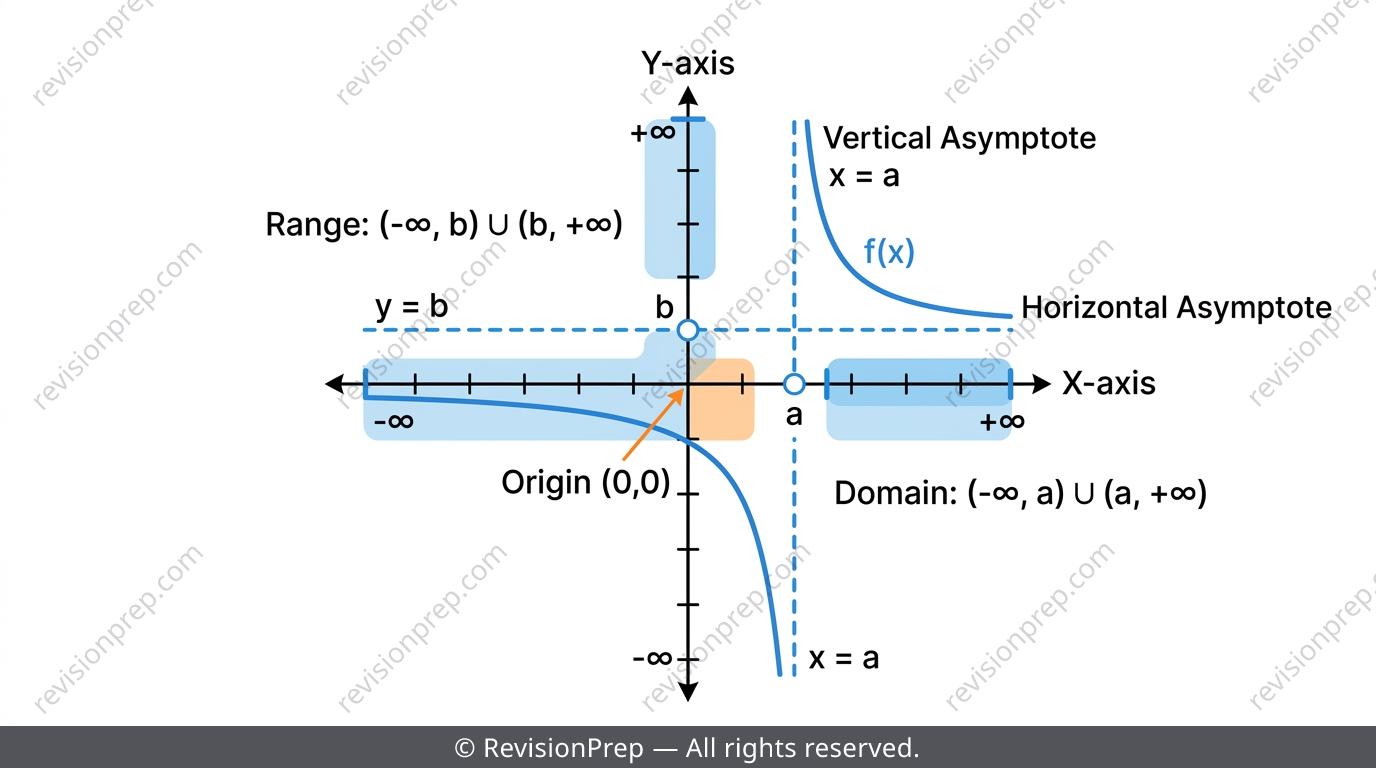
Domain is what makes the formula undefined — check denominators equal to zero, negatives under square roots, or a context restriction like . Range must come from the actual graph, not a guess: a rational function's range typically excludes its horizontal asymptote value. At HL, examiners expect you to justify these with working, especially near asymptotes and endpoints.
| Check | What to look for |
|---|---|
| Denominator | Set equal to zero, exclude that |
| Square root | Set the inside |
| Context | Real-world restriction, e.g. |
| Range | Read from the graph near asymptotes/endpoints |
Exam tip
For 'state the asymptotes' questions worth 2 marks, write full equations like and — bare numbers can cost you a mark.
Common mistake
Assuming domain is all reals without checking denominators or roots first.
Mini summary
Domain = what's undefined; range = what the graph actually produces.
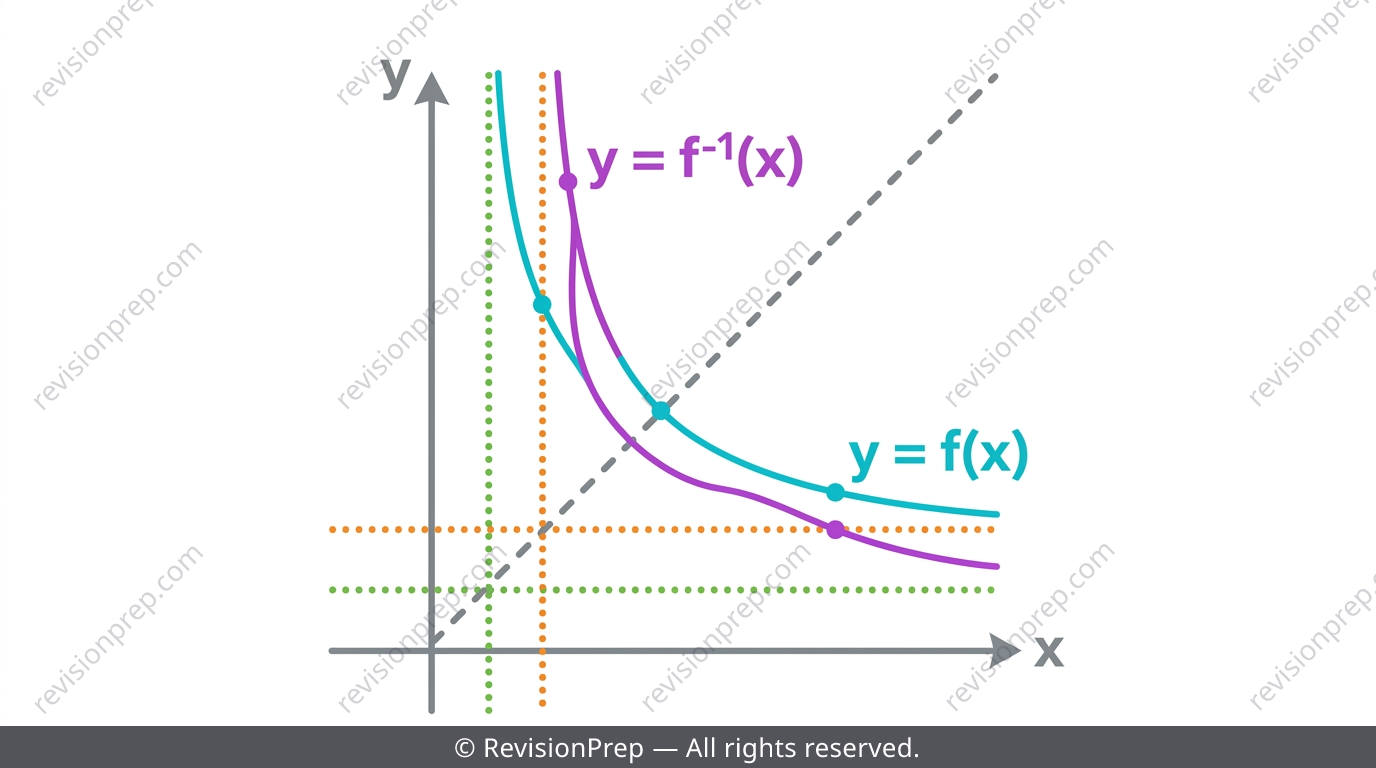
One-to-One Functions and Finding $f^{-1}$
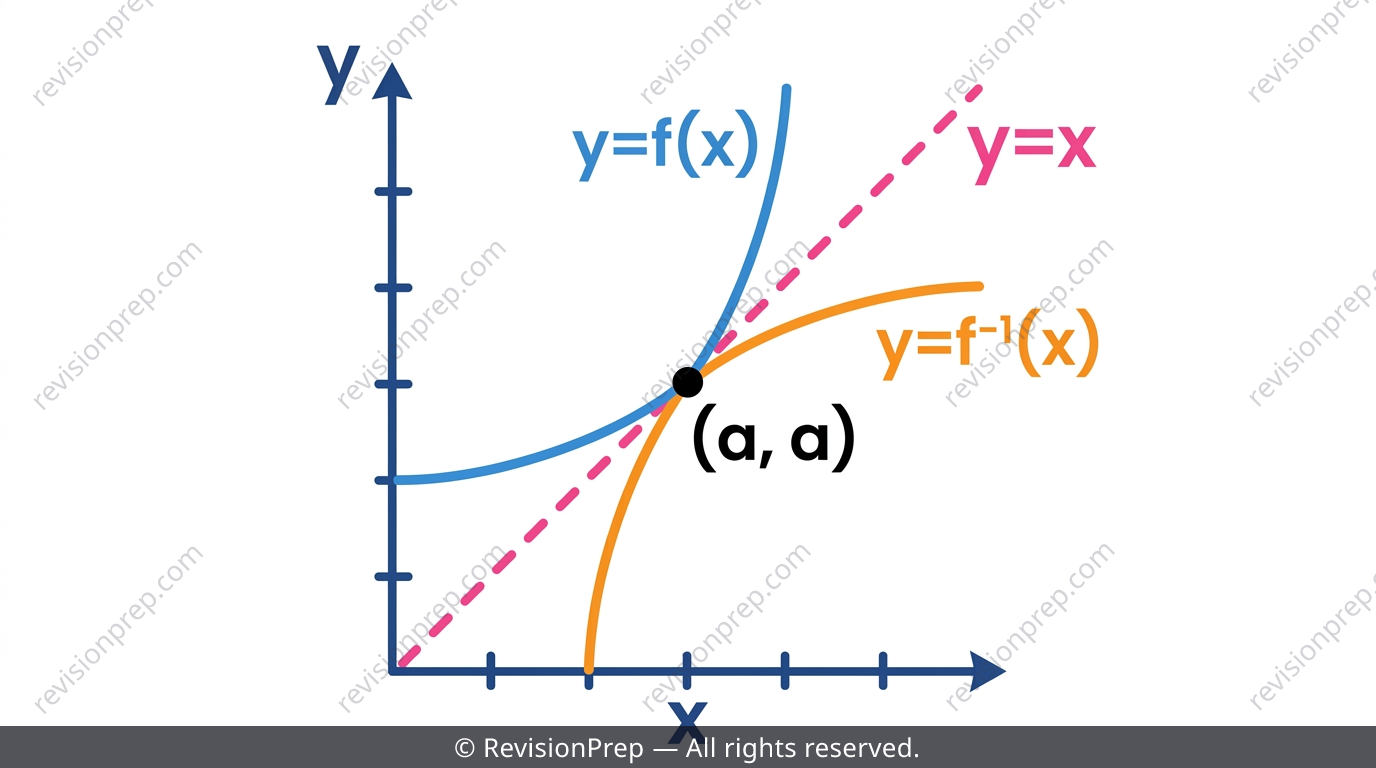
A function needs to be one-to-one before an inverse exists without restricting the domain. Prove it algebraically: assume and show this forces — examiners specifically check that the algebra steps (like two terms cancelling) are shown, not skipped. To find : swap and , solve for , and state its domain as the range of — this last step is the one everyone forgets under time pressure.
Exam tip
When a question gives points on and asks where , solve the faster equation instead of solving from scratch.
Common mistake
Isolating a restricted expression (like a square root) correctly but forgetting to state its sign restriction before squaring.
Mini summary
Prove one-to-one with algebra; find by swapping variables, and always state its domain.
Composite Functions: Order Always Matters
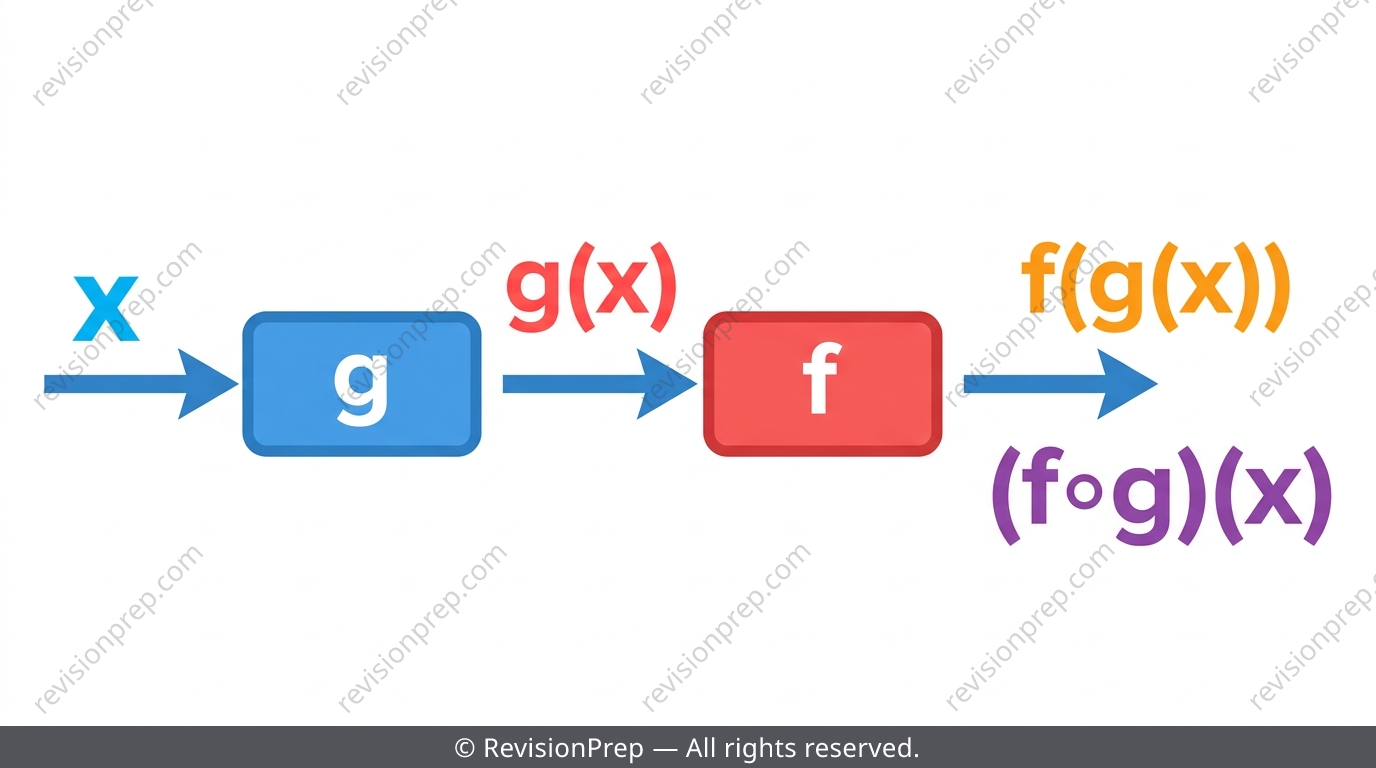
means apply first, then — swapping the order generally gives a different function entirely. The domain of is restricted to -values in the domain of for which also lands inside the domain of . This domain-chaining step is exactly where HL questions like to catch students out.
Common mistake
Forgetting to check that outputs of actually lie in the domain of before accepting the composite's domain.
Mini summary
Composite order matters: acts first, then ; domain must satisfy both functions.
Rational Functions: Asymptotes and the Self-Inverse Shortcut
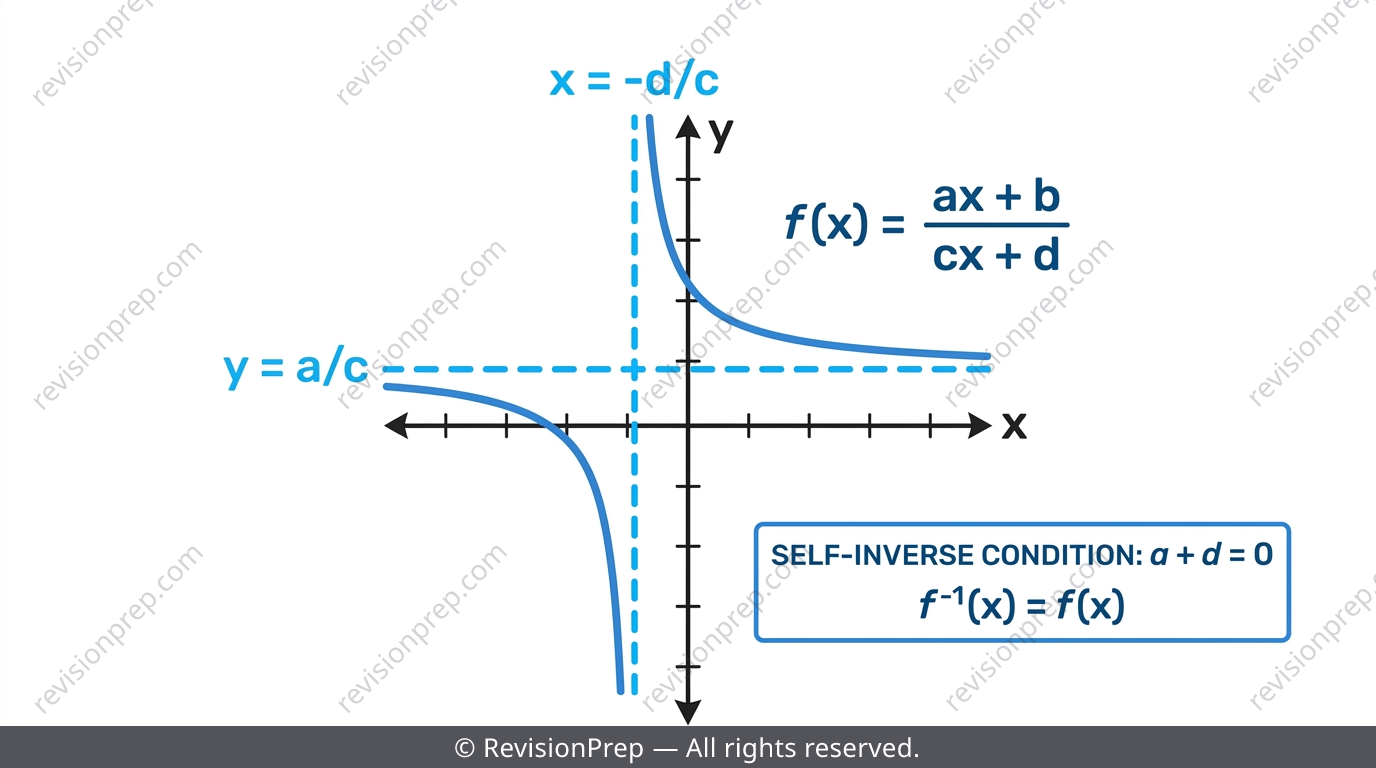
For , the vertical asymptote is and the horizontal asymptote is — these control both domain and range. A powerful shortcut: this type of function is self-inverse exactly when . Don't assume self-inverse just because the shape looks familiar — always check the condition before claiming .
Common mistake
Assuming a rational function is self-inverse purely from its shape without checking .
Mini summary
Asymptotes: , ; self-inverse only when .
Transformations: One Equation Covers Everything
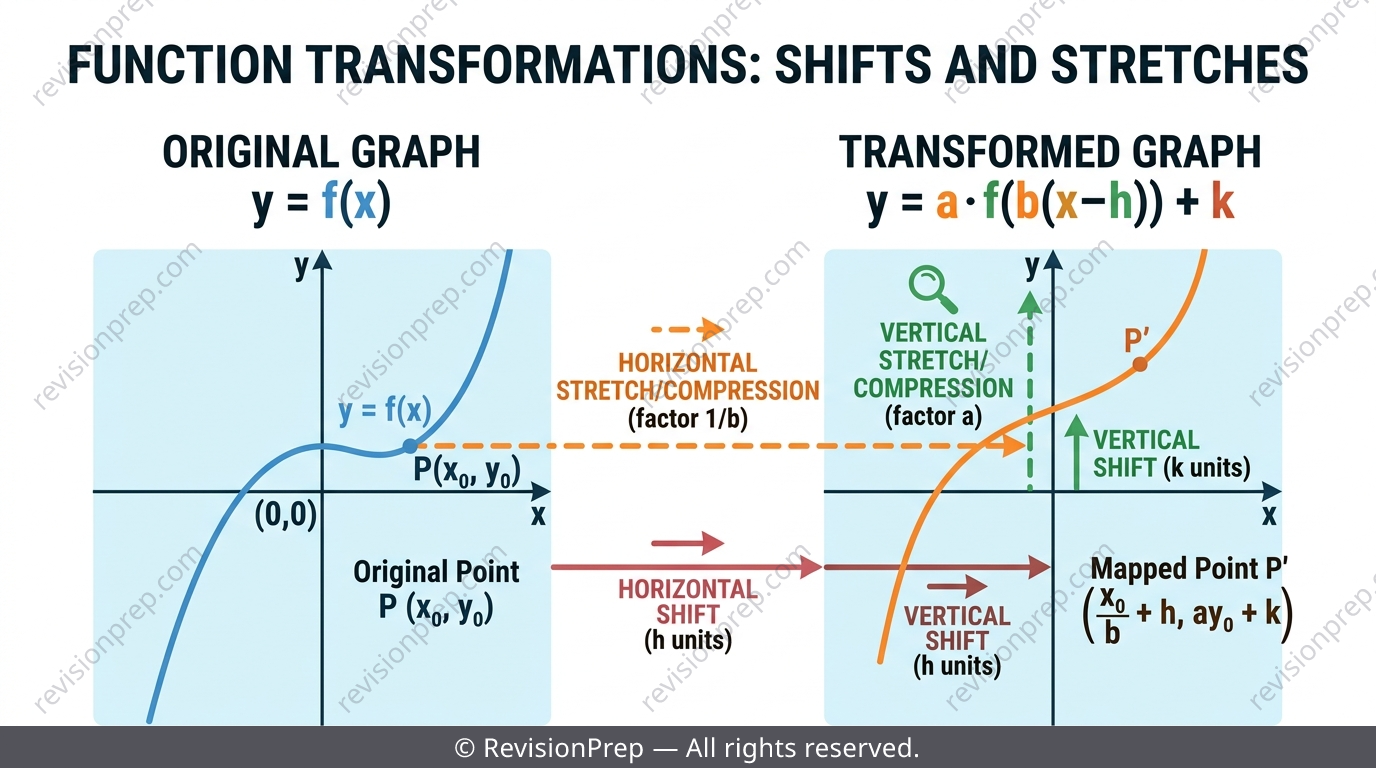
Every translation, stretch and reflection you'll be asked about is one instance of . Outside changes (, ) act on as expected — vertical stretch and shift. Inside changes (, ) act on and behave opposite to intuition — always factorise first to correctly identify before describing any horizontal shift or stretch.
| Parameter | Effect |
|---|---|
| Vertical translation | |
| Vertical stretch factor ; reflection in -axis if | |
| Horizontal translation (from factorised ) | |
| Horizontal stretch factor ; reflection in -axis if |
Exam tip
Given key points but no formula for , transform coordinates directly using .
Common mistake
Reading as 'shift 6 right, then stretch' using the raw number instead of factorising to first.
Mini summary
Identify from the factorised form, then apply the coordinate mapping rule.
Quick formula sheet
Practice questions
- State the domain of .
- Write down the vertical and horizontal asymptotes of .
- If , find .
- Prove that is one-to-one for .
- Given for and , find and its domain.
- Describe fully the transformations that map to .
- Show that is self-inverse, and verify by finding directly.
- For , , find stating its domain, then find where meets .
- A curve passes through . Find the image of this point under .
Frequently asked questions
What's the difference between domain and range?+
Domain is the set of valid inputs (found by checking what makes the formula undefined); range is the set of actual outputs, read from the graph rather than assumed.
How do you know if a function has an inverse?+
It must be one-to-one — every output comes from exactly one input. Prove this algebraically by assuming and showing must follow.
When is a rational function self-inverse?+
For , it's self-inverse exactly when . Always check this condition rather than assuming it from the function's shape.
Why does the order matter in $y=af(x)+k$?+
Because multiplies before is added — applying first gives a completely different (and wrong) transformed graph.
How do I find the domain of a composite function?+
Take the domain of , then remove any -values where falls outside the domain of — both conditions must hold together.
Do I need the formula for $g$ to transform its graph?+
No — if you're given key points, use the coordinate mapping to transform them directly, without ever writing out 's equation.
Master Functions with the Full IB Maths AI Revision Notes
Related articles