
Number and Algebra
Exponentials, logarithms, binomial theorem and sequences — the algebraic backbone of IB Maths AI
Quick facts
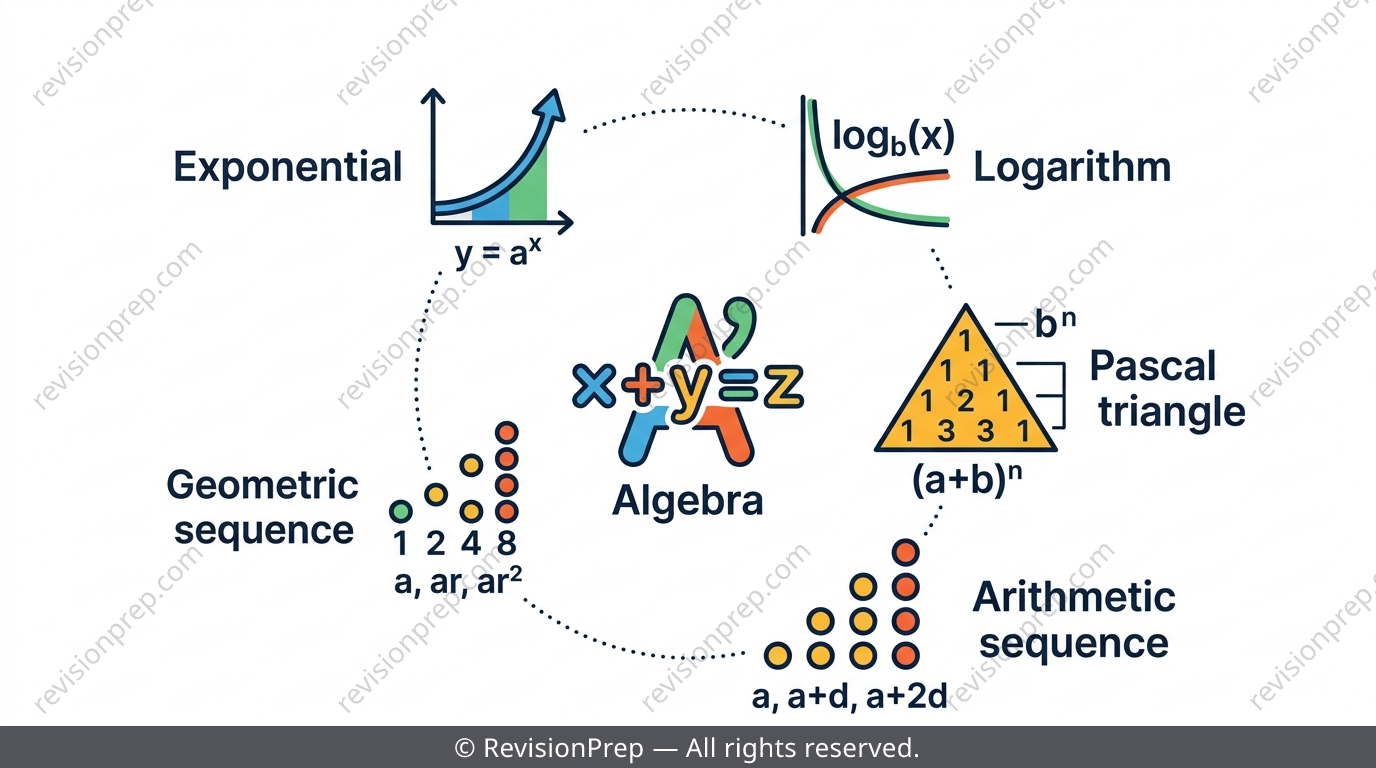
Number and Algebra is the toolkit that quietly powers almost every other topic in IB Maths AI. Get comfortable here and calculus, statistics and financial maths all become easier. This corner of the syllabus covers exponential and logarithmic functions for growth and decay models, the binomial theorem for finding a single term in an expanded bracket, arithmetic and geometric sequences that underpin financial maths, and polynomials with rational functions for factorising, solving and sketching. Exam questions rarely test raw computation — they test whether you can translate a real-world context into the right formula, and whether you know which of , , , or you actually have. This teaser walks through the five ideas examiners return to most often, with the common mistakes that cost marks every session. For the full worked examples, formula derivations and practice sets, the complete revision notes are linked below.
What you’ll be able to do
Exponential and Logarithmic Functions
Exponential models appear in two equivalent forms: , where reads directly as a percentage change, and , where is a rate constant, not a percentage. Logarithms undo exponentials: , and solving for time or any exponent always means isolating the exponential term then taking logs. Half-life and doubling-time calculations depend only on the rate, never on the starting value.
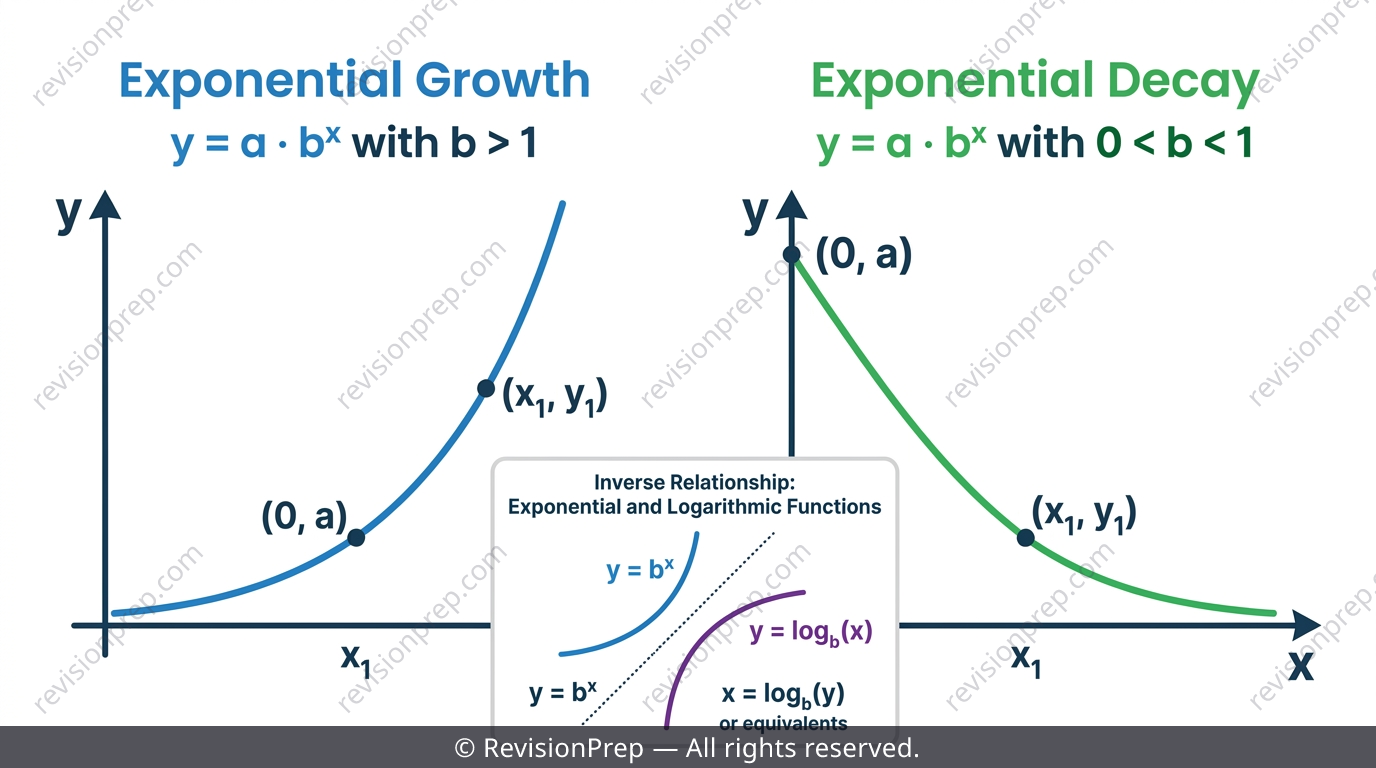
| Form | What the parameter means | Reading a percentage |
|---|---|---|
| = initial value, = growth/decay factor | Read directly off (e.g. = 15% decrease) | |
| = initial value, = rate constant | Compute first, then find or |
Exam tip
Keep full GDC precision through every step and round only once at the end — premature rounding of or exponential values is a frequently penalised accuracy error.
Common mistake
Reading in as a direct percentage — it isn't. Only in gives the percentage directly.
Mini summary
Two equivalent exponential forms, one inverse operation (logs), and rounding discipline are the whole game here.
Binomial Theorem
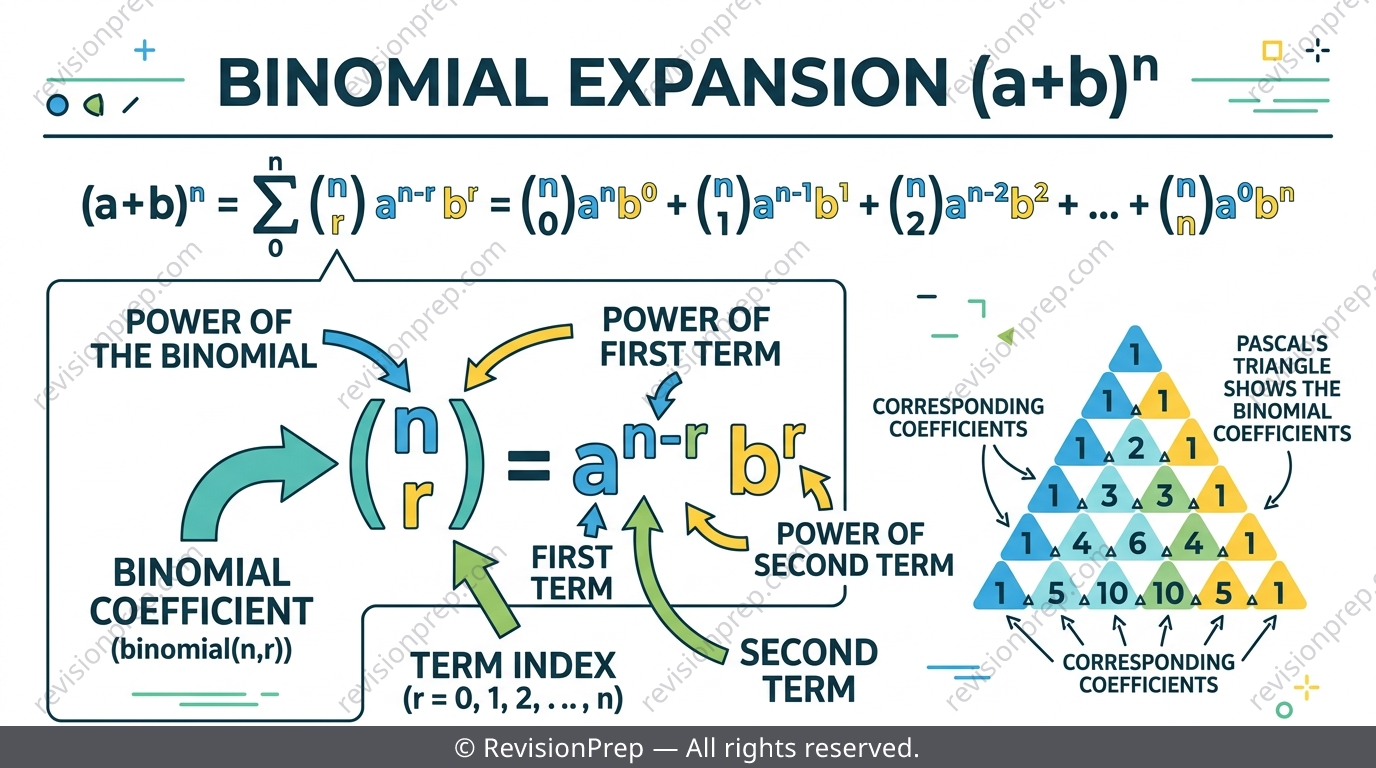
The binomial theorem finds one term of without expanding everything: the general term is , where the power of equals . To find a term with a specific power of the variable, set up the exponent equation first and solve for before substituting anything. Brackets with coefficients, like , require raising the whole term — including the coefficient — to the relevant power.
Exam tip
"Coefficient of " wants a number; "term in " wants the full expression including — mixing these up costs the final accuracy mark.
Common mistake
Setting equal to the target power of the variable instead of solving (or vice versa depending on which factor holds the variable).
Mini summary
One formula, one unknown () to solve for — never expand the whole bracket by hand.
Arithmetic Sequences and Series
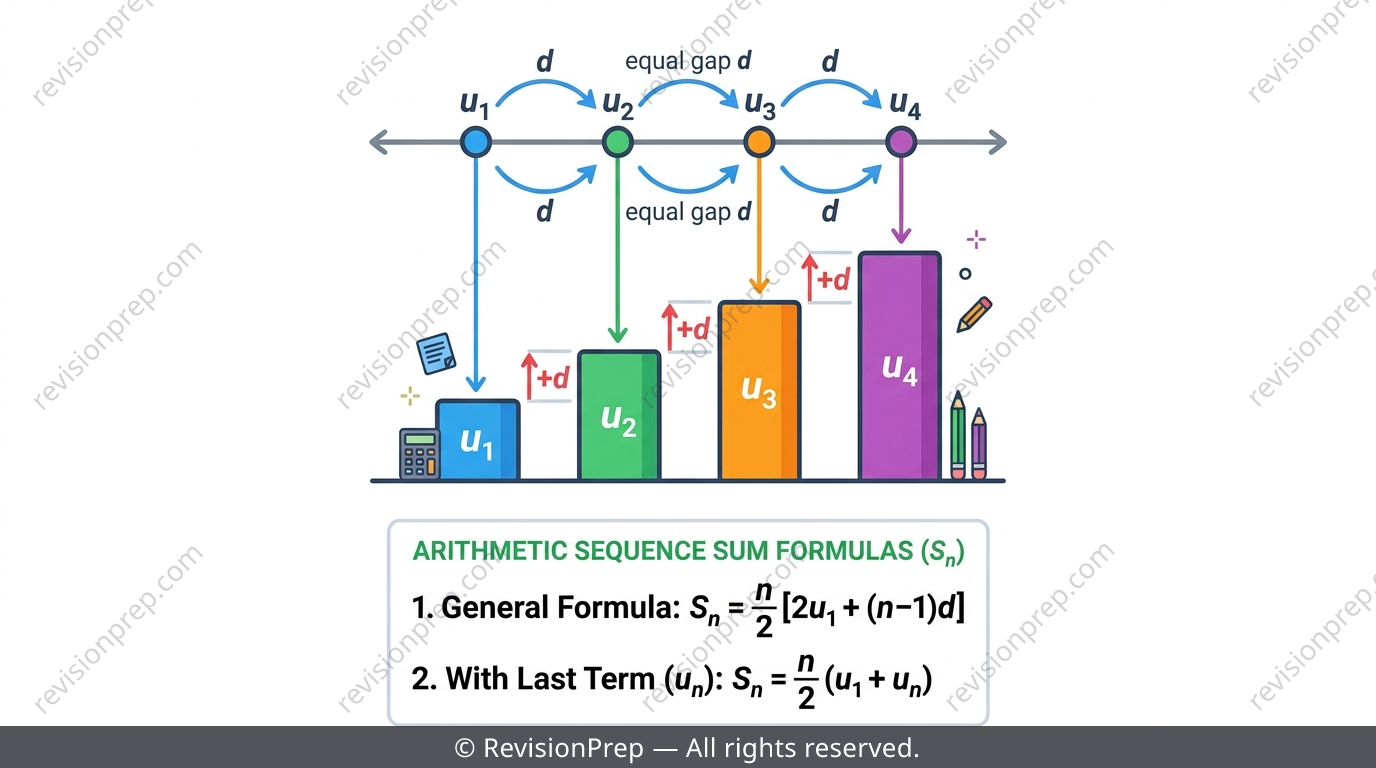
An arithmetic sequence adds the same amount each step, giving linear growth (or decline, if is negative). Every question comes down to identifying which of , , , you know and which you need, then picking the matching formula. Two equivalent sum formulas exist — use whichever matches the information you already have.
Common mistake
Choosing before is actually known, instead of finding first or switching to the other sum formula.
Mini summary
Four unknowns, two formulas for and — the skill is matching data to formula, not the algebra itself.
Geometric Sequences and Series
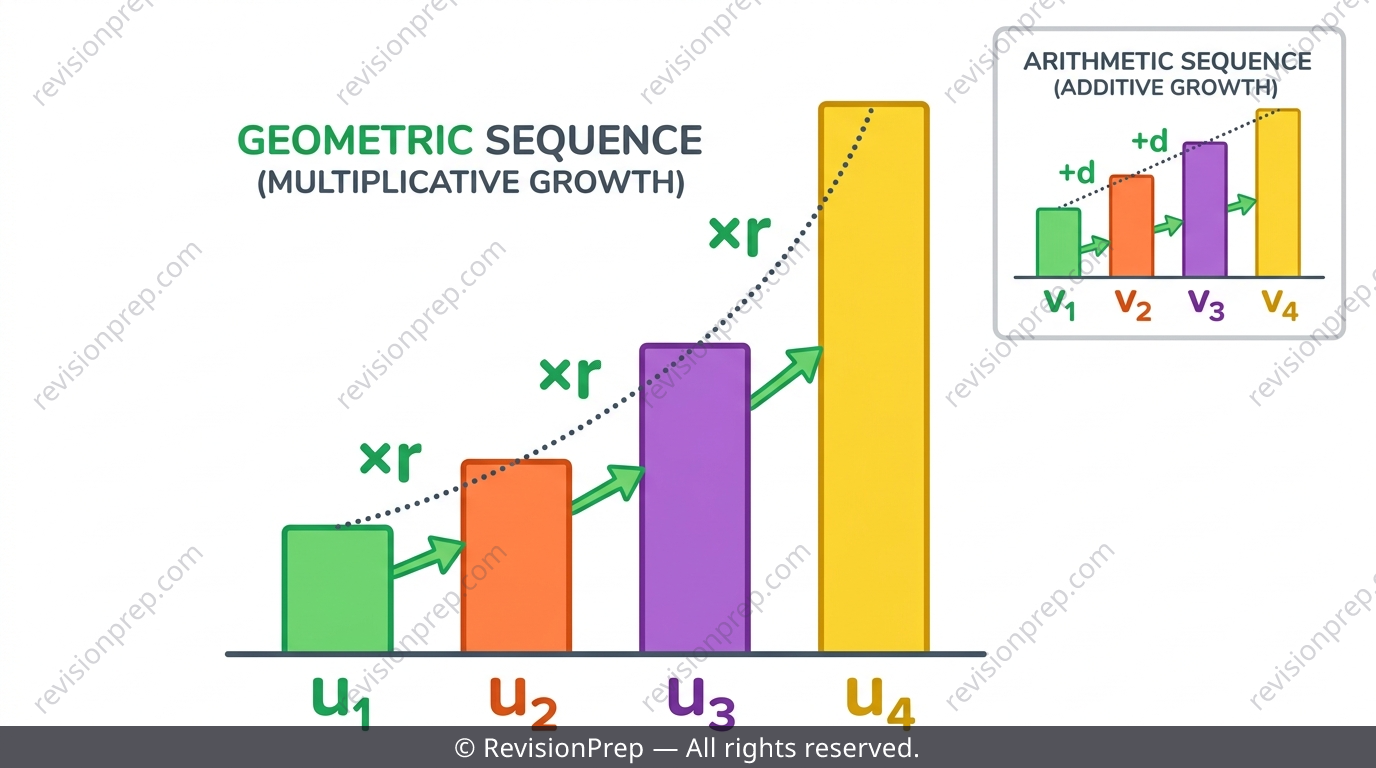
Where arithmetic sequences add a constant amount, geometric sequences multiply by a constant ratio each step — this is the pattern behind compound interest and other financial maths questions. Geometric sequences share the same four-unknown structure as arithmetic ones (, , , ), and most lost marks come from applying an arithmetic formula to a geometric context or vice versa. Always check first whether consecutive terms share a common difference or a common ratio before choosing a formula.
Exam tip
Before touching any formula, test the sequence: subtract consecutive terms (arithmetic check) or divide them (geometric check) to confirm which family you're in.
Mini summary
Multiplicative sibling of the arithmetic sequence — same four unknowns, opposite operation.
Polynomials and Rational Functions
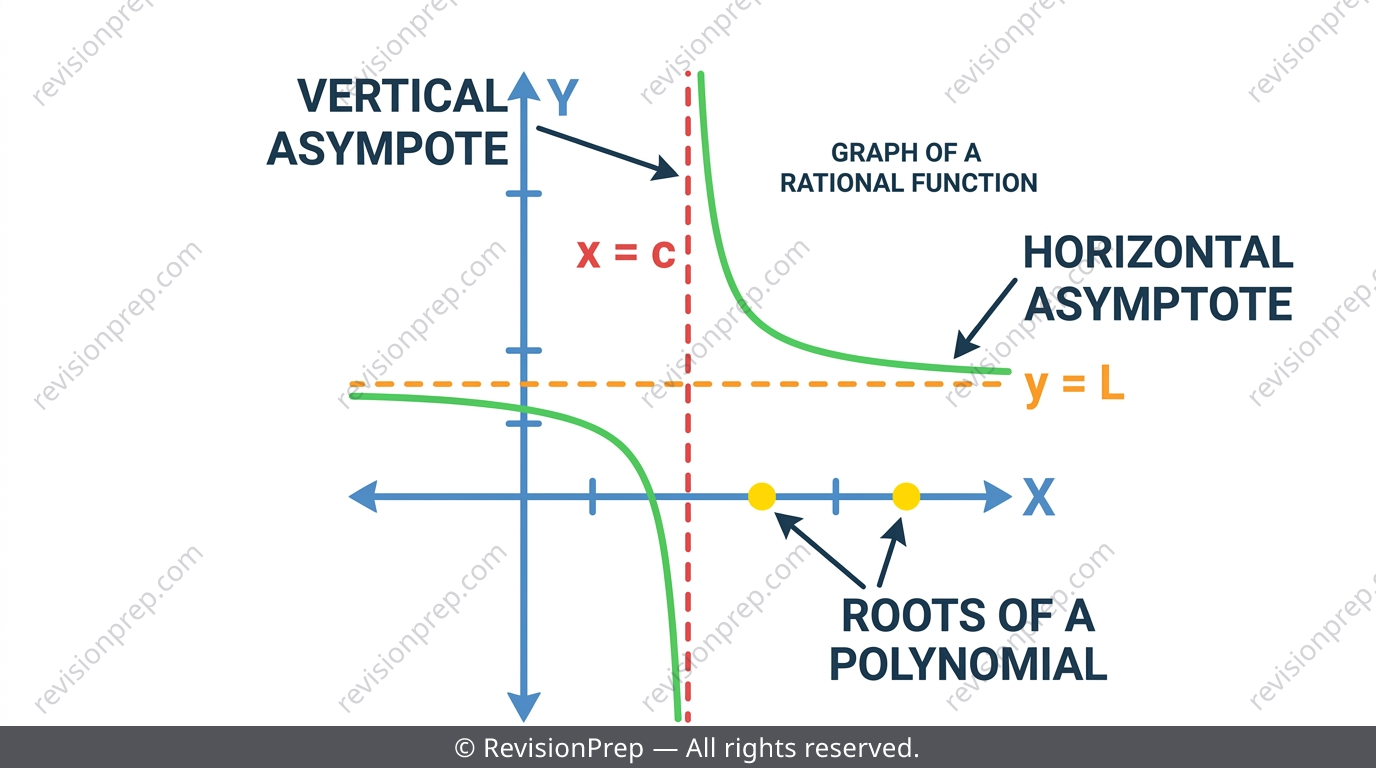
Polynomials and rational functions supply the algebraic machinery — factorising, solving, and sketching — that other topics like calculus and statistics rely on. Exam questions typically test the factor theorem and remainder theorem to identify roots, alongside understanding asymptote behaviour in rational functions. Most root-finding here is GDC-assisted rather than done by hand, so knowing which graphing or solving feature to reach for matters as much as the underlying theory.
Mini summary
The algebra 'toolbox' topic — factor theorem, remainder theorem and asymptotes, mostly solved via GDC.
Quick formula sheet
Practice questions
- Write down the annual percentage change described by .
- Find the value of using the binomial coefficient formula.
- An arithmetic sequence has and . Find .
- Solve for , giving your answer to 3 s.f.
- Find the term containing in the expansion of .
- An arithmetic series has , . Find the smallest such that .
- A radioactive sample decays according to . Calculate the half-life to 3 s.f. and explain why it doesn't depend on the initial mass.
- Find the coefficient of in the expansion of , showing how you determined before substituting.
- A car depreciates according to . Find the number of complete years until its value first falls below , and explain the inequality-direction trap students commonly fall into.
Frequently asked questions
What topics does Number and Algebra cover in IB Maths AI?+
It covers exponential and logarithmic functions, the binomial theorem, arithmetic and geometric sequences and series, and polynomials with rational functions — the algebraic foundations used across the whole course.
How do I know whether to use $y=ab^x$ or $y=ae^{kx}$?+
Both model the same growth or decay shape; questions usually hand you one form directly. Read percentages straight off , but for you must first compute to find the equivalent percentage.
What's the difference between 'coefficient' and 'term' in binomial theorem questions?+
A coefficient is just the number (e.g. 280), while a term includes the variable part too (e.g. ). Answering with the wrong one loses the final mark even with correct working.
How do I tell an arithmetic sequence from a geometric one?+
Check consecutive terms: if subtracting them gives a constant, it's arithmetic; if dividing them gives a constant, it's geometric. Apply the matching formulas only after confirming this.
Why does my half-life calculation not need the initial mass?+
Half-life depends only on the rate constant in the decay model, not on the starting amount — the time to halve is the same at every stage of decay.
Does RevisionPrep provide official IB exam papers for this topic?+
No — RevisionPrep offers original mock papers and exam-style practice questions built around the syllabus, not official exam board material.
Master Number and Algebra with the full IB Maths AI revision notes
Related articles