
Geometry and Trigonometry
Coordinate geometry, circles, right-angle trig and the unit circle — the toolkit that shows up on every Paper 1 and Paper 2.
Quick facts
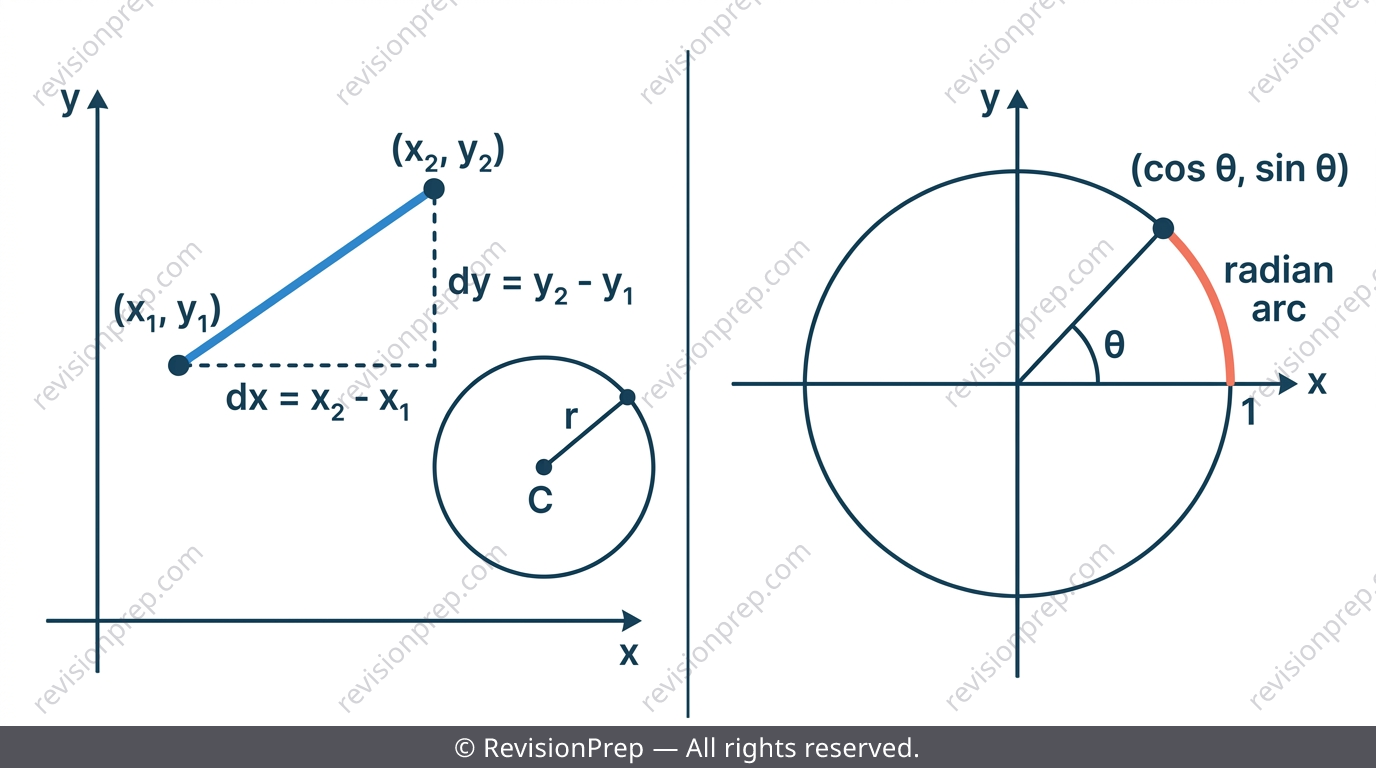
Geometry and trigonometry in IB Maths AA blends two skill sets examiners love combining: coordinate geometry (distance, midpoint, gradient, circles) and trigonometry (SOHCAHTOA, the unit circle, exact values). The trap most students fall into is treating right-angle trig as universal — it only works when there's actually a 90° angle in the triangle you're solving, and spotting when to switch away from it is the single most examined skill in this topic. Meanwhile, coordinate geometry formulas like distance, midpoint and gradient aren't in your data booklet, so they need to be memorised cold. This teaser walks through the five ideas worth locking down first: coordinate geometry essentials, circles as loci, triangle area from coordinates, right-angle trig limits, and the unit circle with radians. The full revision notes go deeper with worked traps and mark-scheme wording.
What you’ll be able to do
Coordinate Geometry: Distance, Midpoint, Gradient
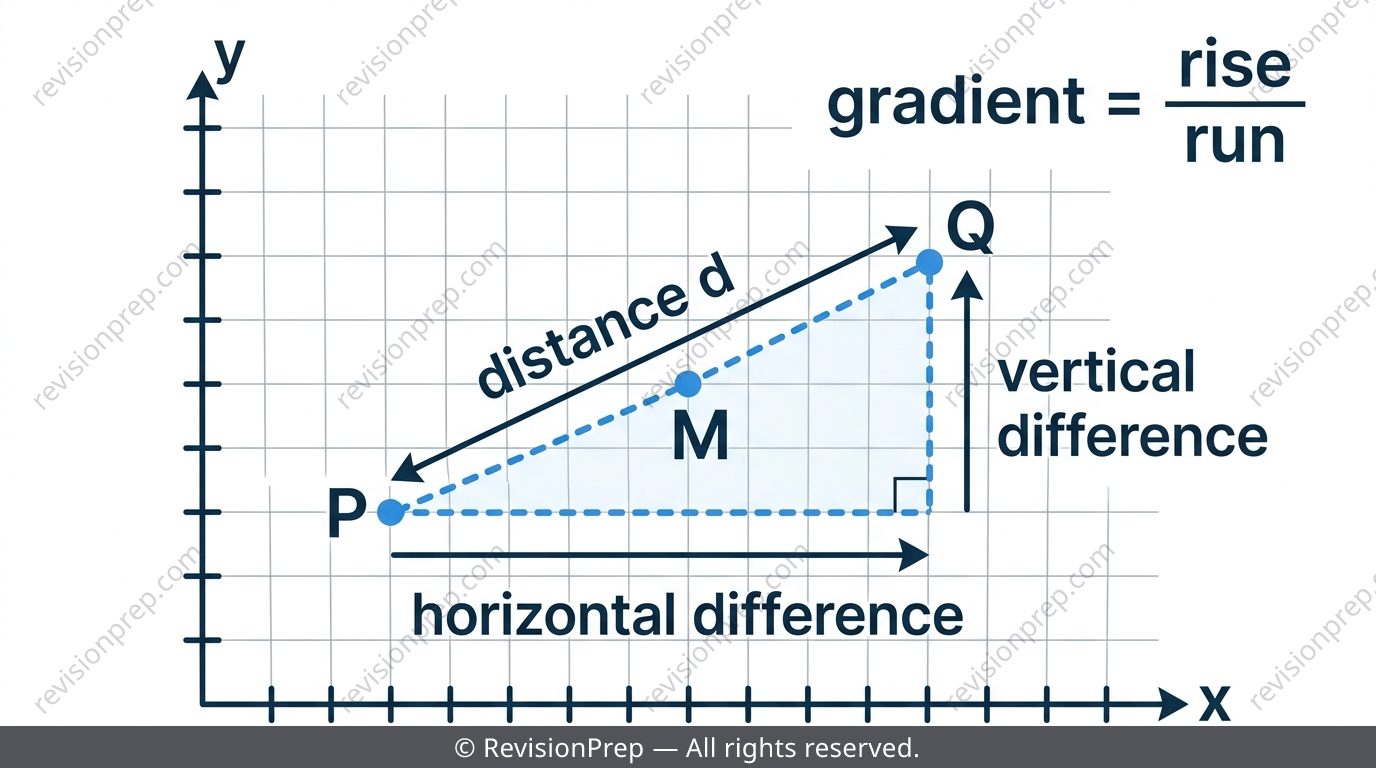
The distance formula is just Pythagoras' theorem wearing a disguise — the segment between two points is the hypotenuse of a right triangle built from the horizontal and vertical differences. Midpoint is simply the average of the coordinates, giving you a point, not a single number. Gradient measures steepness, and it's the key to spotting parallel lines (equal ) and perpendicular lines (). None of these three formulas live in the data booklet, so they need to be automatic.
Exam tip
If a question mixes 'triangle' language with coordinate points instead of side lengths, expect to compute distances first before applying any trig rule.
Mini summary
Distance, midpoint and gradient are unlisted in the booklet — memorise them and know the perpendicular condition .
Circles as a Locus: Standard vs General Form
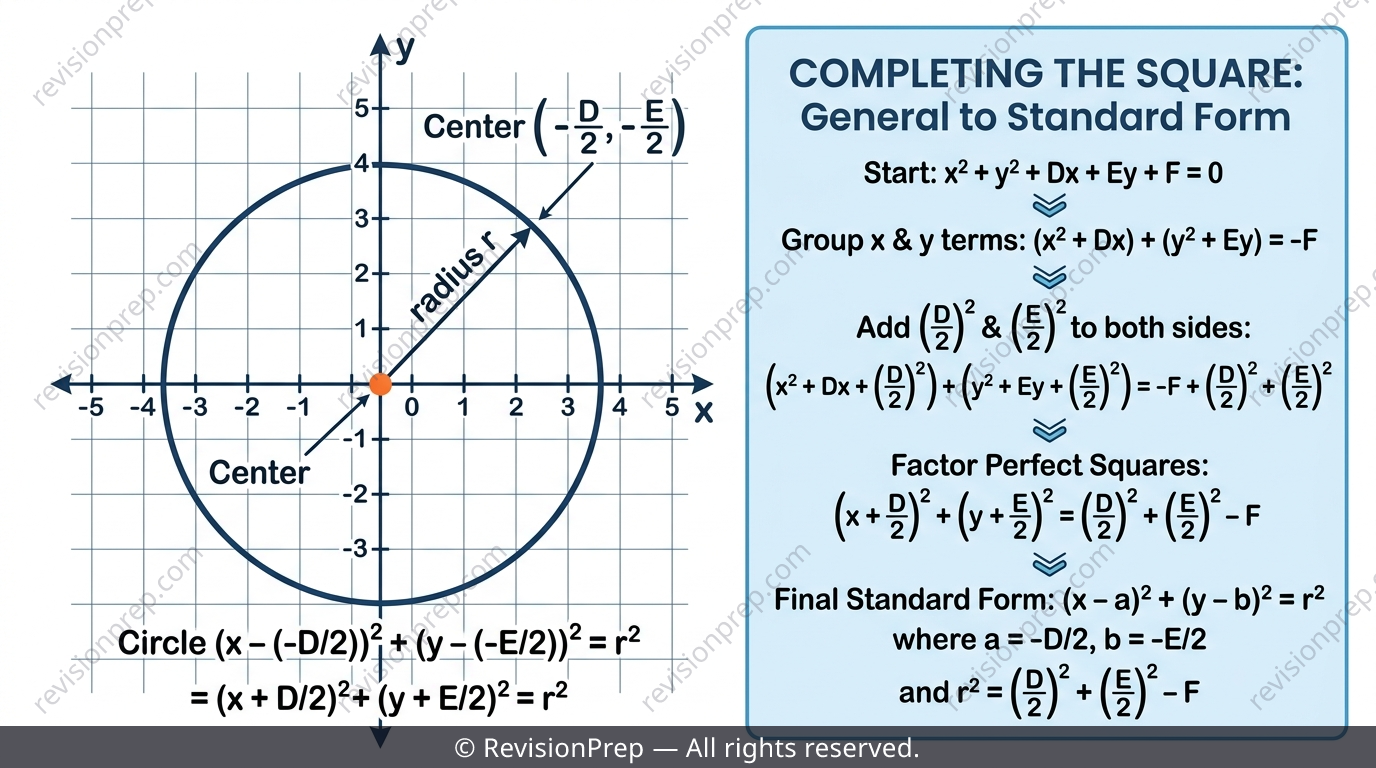
A circle is the set of every point sitting exactly distance from a fixed centre — that single locus idea gives the standard form directly from the distance formula. Exams usually hand you the expanded general form instead, and you recover the centre and radius by completing the square. A very common slip is reading the centre straight off as rather than , or losing a sign mid-calculation.
Exam tip
Complete the square from scratch every time instead of quoting the shortcut formula — the algebra self-corrects sign errors that a memorised formula won't catch.
Common mistake
Reading the centre as instead of , or dropping a sign while completing the square.
Mini summary
General form → complete the square → standard form gives centre and radius .
Triangle Area From Coordinates — Watch for Two Answers
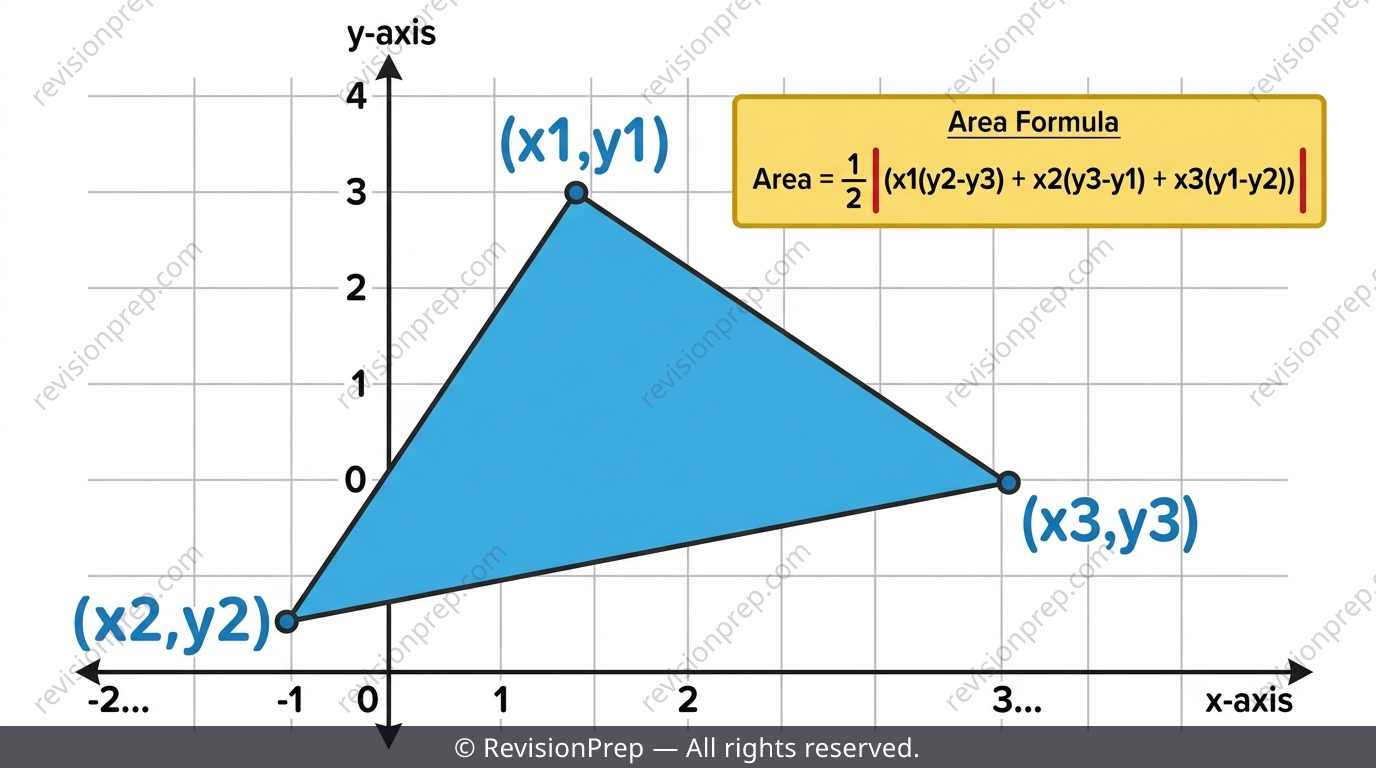
When a triangle is defined only by three coordinate points, the shoelace-style formula gives the area directly without ever finding a height. The modulus in the formula matters because swapping vertex order flips the sign — and it means that any 'area equals a given number' equation typically splits into two valid solutions, not one.
Common mistake
Solving only one branch of an 'area = k' equation and stopping — this throws away half the available marks.
Mini summary
Area from coordinates always carries a modulus; expect a pair of solutions when area is given as a fixed value.
SOHCAHTOA — and Knowing When It Breaks Down
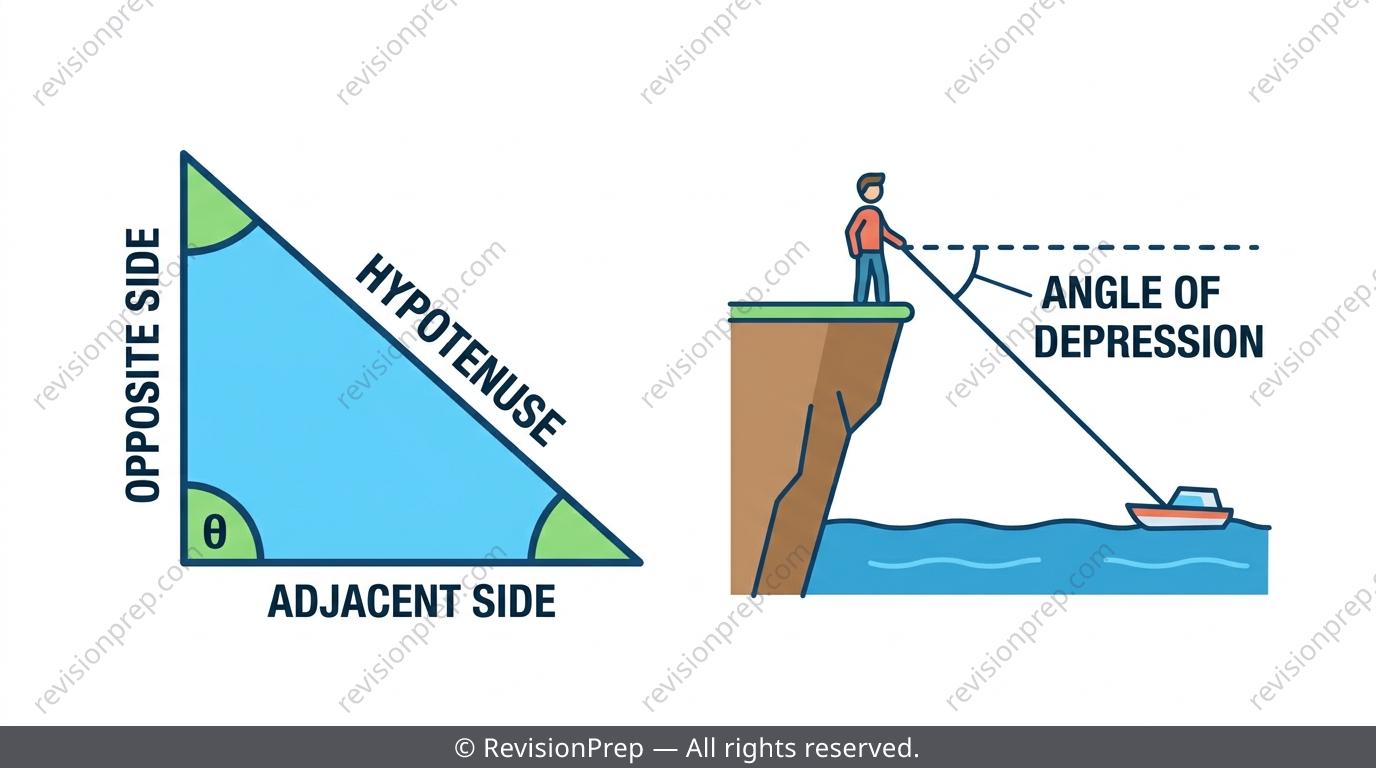
SOHCAHTOA only ever applies inside a right-angled triangle: sine, cosine and tangent as ratios of opposite, adjacent and hypotenuse, underpinned by Pythagoras. The instant a triangle isn't right-angled, you must switch to a different rule — recognising that switch is the most heavily examined skill in this whole topic. Elevation and depression angles are always measured from the horizontal, and they're equal to each other only because the two horizontal lines involved are parallel.
Exam tip
If the question gives an angle using π, switch your calculator to radians; otherwise, use degrees. Sanity-check your final answer against physical plausibility.
Common mistake
Leaving the calculator in the wrong angle mode (RAD instead of DEG, or vice versa) — always check the mode indicator before calculating.
Mini summary
SOHCAHTOA is right-triangle only — the moment the triangle isn't right-angled, a different approach is required.
The Unit Circle, Radians and Exact Values
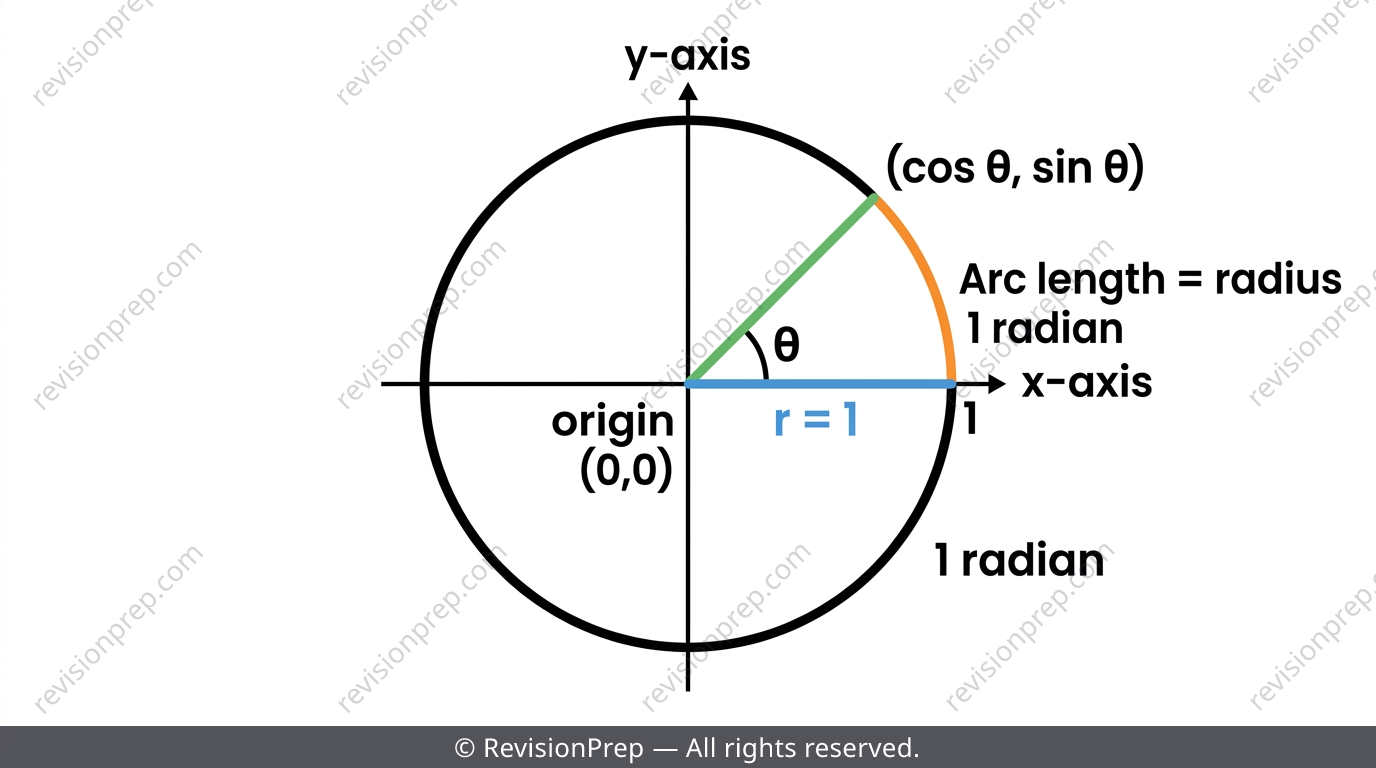
The unit circle generalises trig beyond 0°-90°: is the -coordinate and is the -coordinate of the point reached by rotating angle anticlockwise from the positive -axis, valid for any real angle. Radians measure the same rotation as arc length divided by radius, and arc length and sector area formulas only work correctly when is in radians. The Pythagorean identity is simply restated, since lies on the unit circle.
Exam tip
If a question says 'without a calculator' or wants an answer 'in exact form', recall and similar values from the 30-60-90 and 45-45-90 triangles — there's no lookup table in the data booklet.
Mini summary
The unit circle extends sin/cos to all angles as coordinates; know exact values and radian conversions cold.
Quick formula sheet
Practice questions
- Find the distance between the points and .
- Find the midpoint of the segment joining and .
- State the exact value of and .
- Find the gradient of the line through and , then find the gradient of a line perpendicular to it.
- Find the centre and radius of the circle .
- The angle of elevation to the top of a tower from a point 40 m from its base is 35°. Find the height of the tower.
- Points , , form a triangle of area . Find both possible values of .
- A circle has general equation . Find the perpendicular distance from its centre to the line , and state whether the line intersects the circle.
- Convert radians to degrees, then find the arc length and sector area for a circle of radius 8 cm subtending this angle.
Frequently asked questions
Do I need to memorise the distance, midpoint and gradient formulas for IB Maths AA?+
Yes — these three formulas are not included in the data booklet, so you need to know them from memory, along with the perpendicular condition .
How do I find the centre and radius of a circle from its general equation?+
Complete the square on the -terms and -terms separately to rewrite as , giving centre and radius .
When can I use SOHCAHTOA instead of another trig rule?+
Only when the triangle you're solving has a right angle. If it doesn't, SOHCAHTOA won't work and you need a different approach for non-right triangles.
Why does an area-from-coordinates question sometimes have two answers?+
The triangle area formula uses a modulus, so an equation like 'area = 9' typically produces a pair, giving two valid values for the unknown.
What's the difference between using degrees and radians on my calculator?+
Radians and degrees measure angles differently, and using the wrong mode gives wildly incorrect results. Use radians when the angle is given with π, and check your calculator's mode indicator before every trig calculation.
What exact trig values should I memorise for IB Maths AA?+
You should know sin, cos and tan at 0°, 30°, 45°, 60° and 90° without a calculator, since there's no lookup table for these in the data booklet.
Get the Full Geometry and Trigonometry Revision Notes
Related articles