
Fields
Gravitational and electric fields share one skeleton — master the parallel and Theme D falls into place
Quick facts
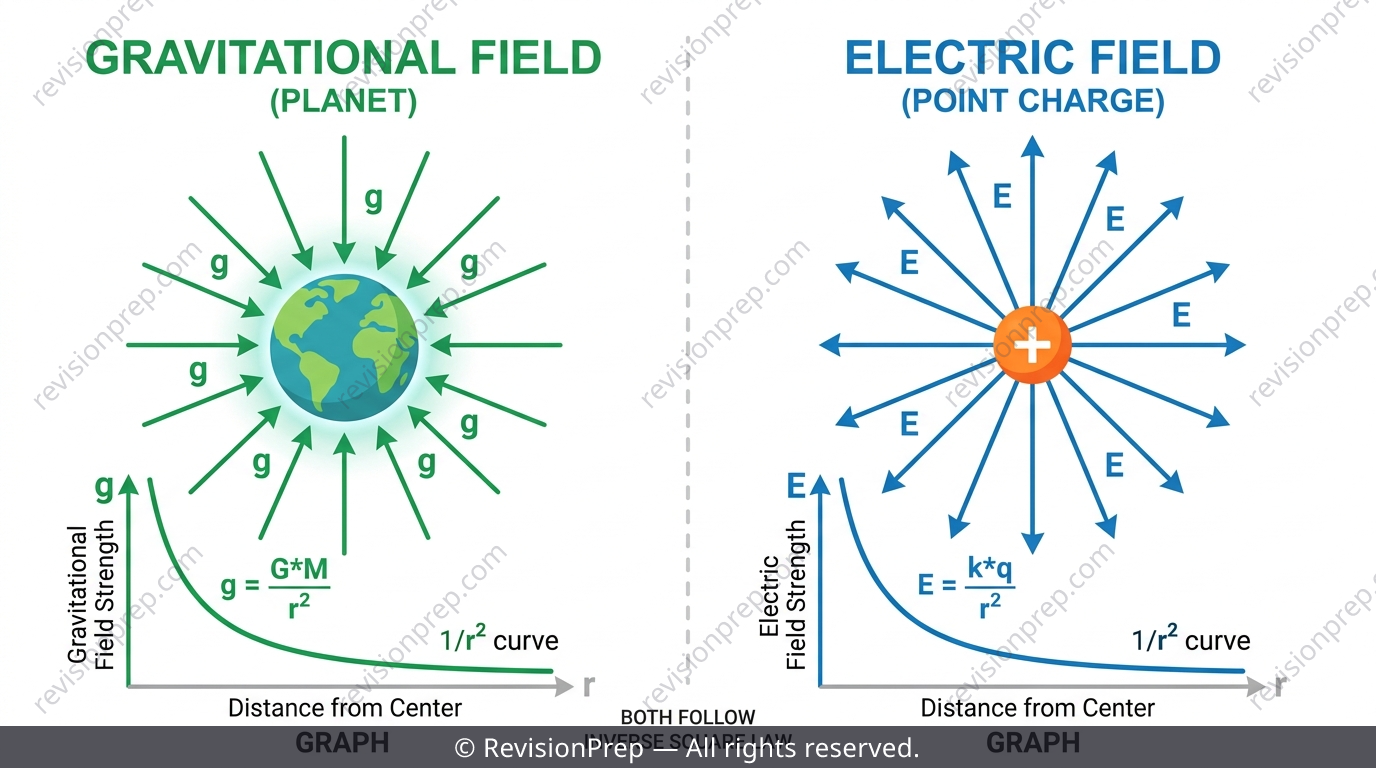
Fields is one of the four core SL themes in IB DP Physics, and it rewards students who spot the pattern rather than memorise separately. Gravitational field strength and electric field strength both fall off as ; gravitational potential and electric potential both measure energy per unit mass or charge. Once you see that gravity is always attractive while electric force can attract or repel, most of the topic becomes applying one structure twice. This teaser covers the five ideas examiners test most: the field-strength-vs-potential distinction, gravitational fields and orbits, electric fields and Coulomb's law, magnetic force equations, and motion of charged particles in uniform fields. For full derivations, worked examples, and the complete formula sheet, the linked revision notes go deeper.
What you’ll be able to do
Field Strength vs Potential: The Master Distinction
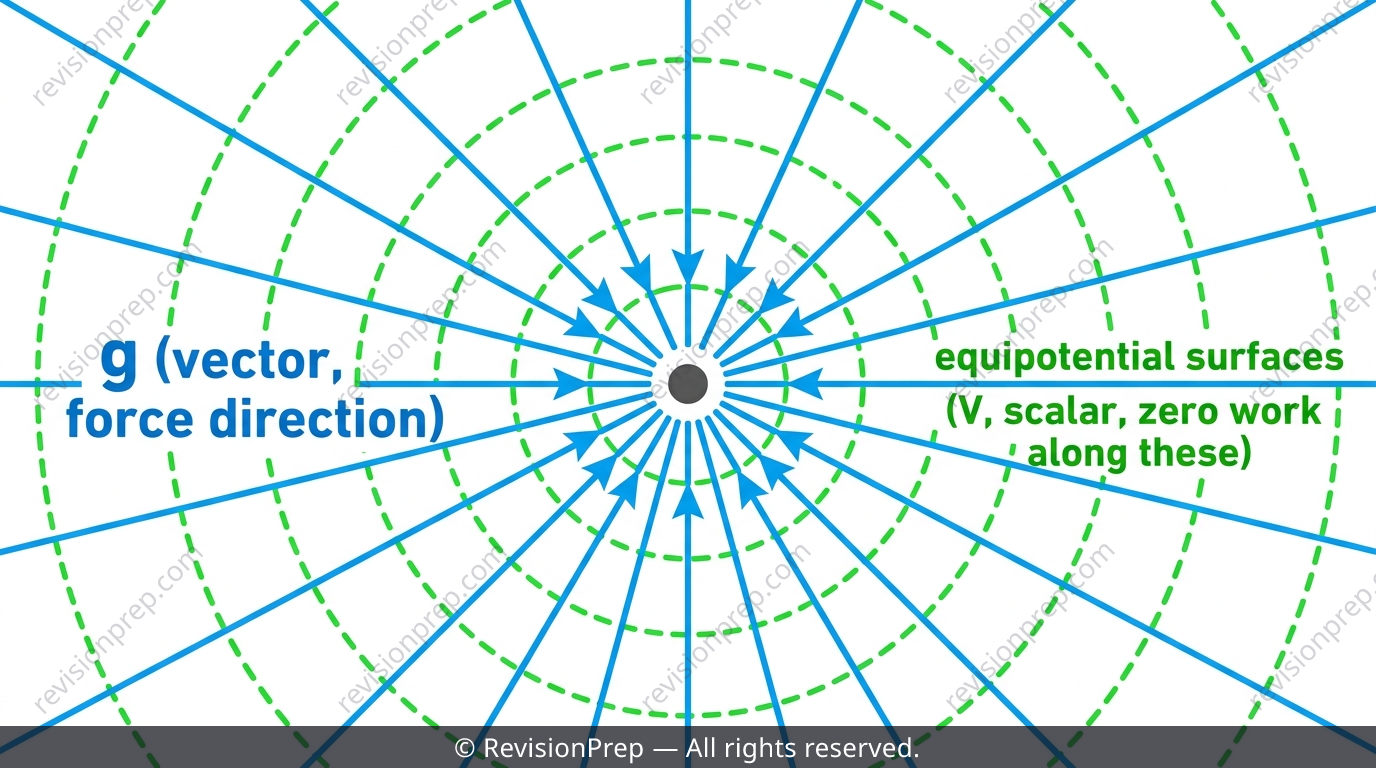
Field strength is a vector — it tells you the force per unit mass or charge and points in the direction a positive test object would accelerate. Potential is a scalar — it tells you the energy per unit mass or charge at a point, with no direction, and it's what you use for work-done calculations. Field lines show force direction; equipotential surfaces are always perpendicular to them and cost zero work to move along.
Exam tip
'State' questions usually want potential (a number); 'calculate the force on...' questions want field strength (a vector). Spot the keyword before you pick a formula.
Mini summary
Field strength = vector (force per unit mass/charge); potential = scalar (energy per unit mass/charge).
Gravitational Fields, Escape Speed and Orbits
Newton's law gives a spherical mass a radial field, exactly as if all its mass were concentrated at the centre — but only outside the sphere. Near Earth's surface the field looks locally uniform (), while at satellite altitudes you must treat it as radial with decreasing as increases. Gravitational potential energy and potential are both defined as zero at infinity, forcing them negative everywhere else — a mass must gain energy to escape to infinity.
| Quantity | Formula | Notes |
|---|---|---|
| Field strength | g = GM/r² | vector, points to centre |
| Potential | V_g = -GM/r | scalar, always negative |
| Escape speed | v = √(2GM/r) | from ½mv² + E_p = 0 |
Common mistake
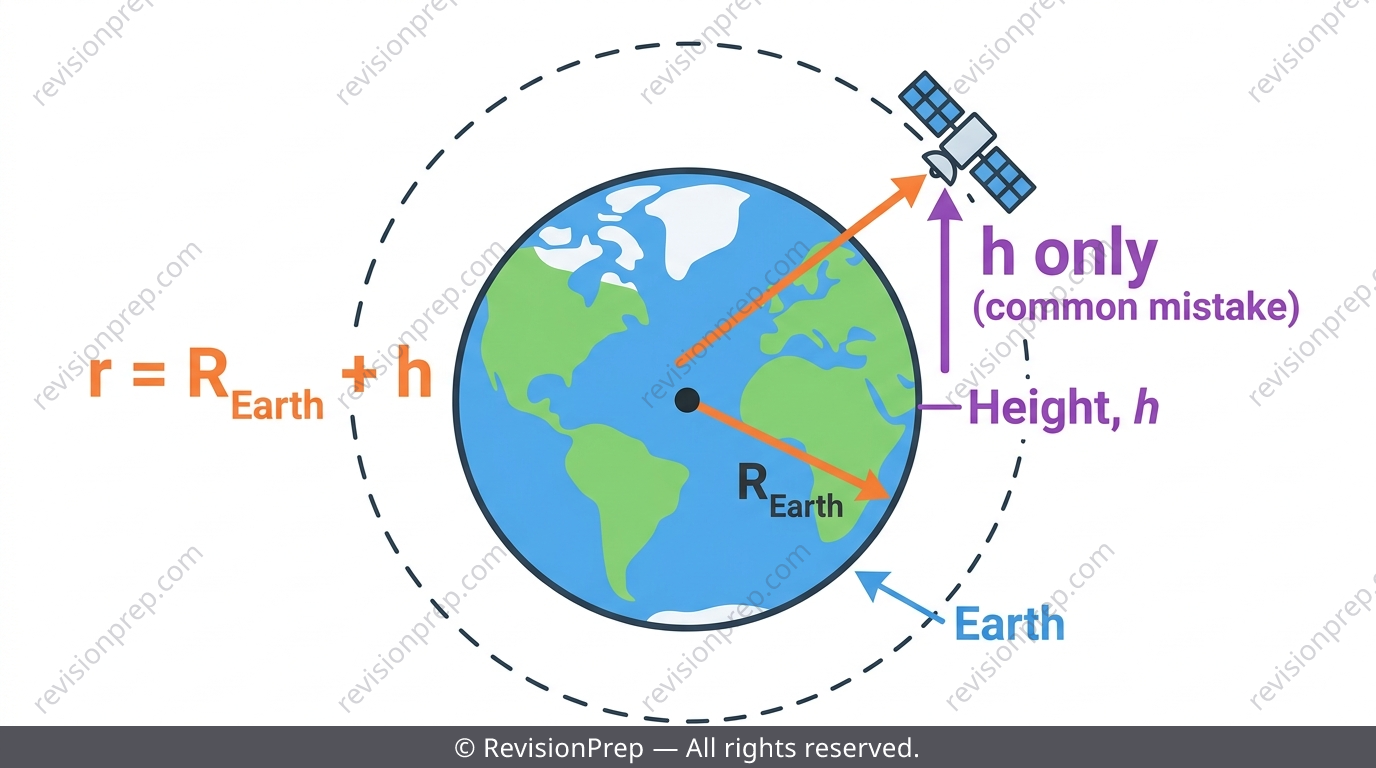
Plugging the given height directly into instead of — always write as its own line of working.
Mini summary
Radius is always measured from the centre of mass; and are negative by definition, not by error.
Electric Fields and Coulomb's Law
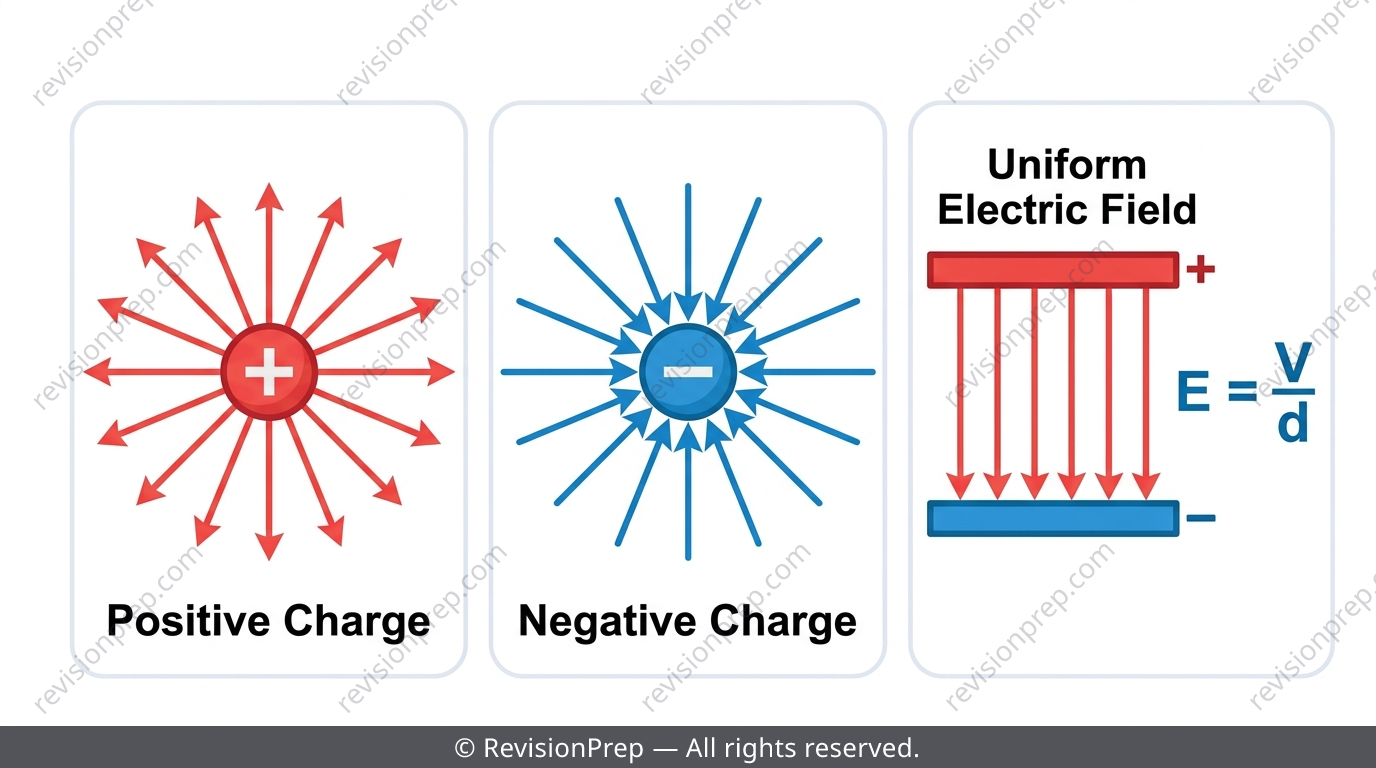
Coulomb's law shares Newton's gravitation's exact structure, but electric force can attract or repel depending on charge sign. Field lines point away from positive charges and into negative ones — always the direction a positive test charge would accelerate. Between oppositely charged parallel plates the field is uniform, giving constant field strength .
Exam tip
Unlike gravity, electric potential energy can be positive or negative depending on the charges' signs — don't assume it's always negative like for gravity.
Mini summary
Same skeleton as gravity, but sign of charge decides attraction or repulsion.
Magnetic Force on Charges and Currents
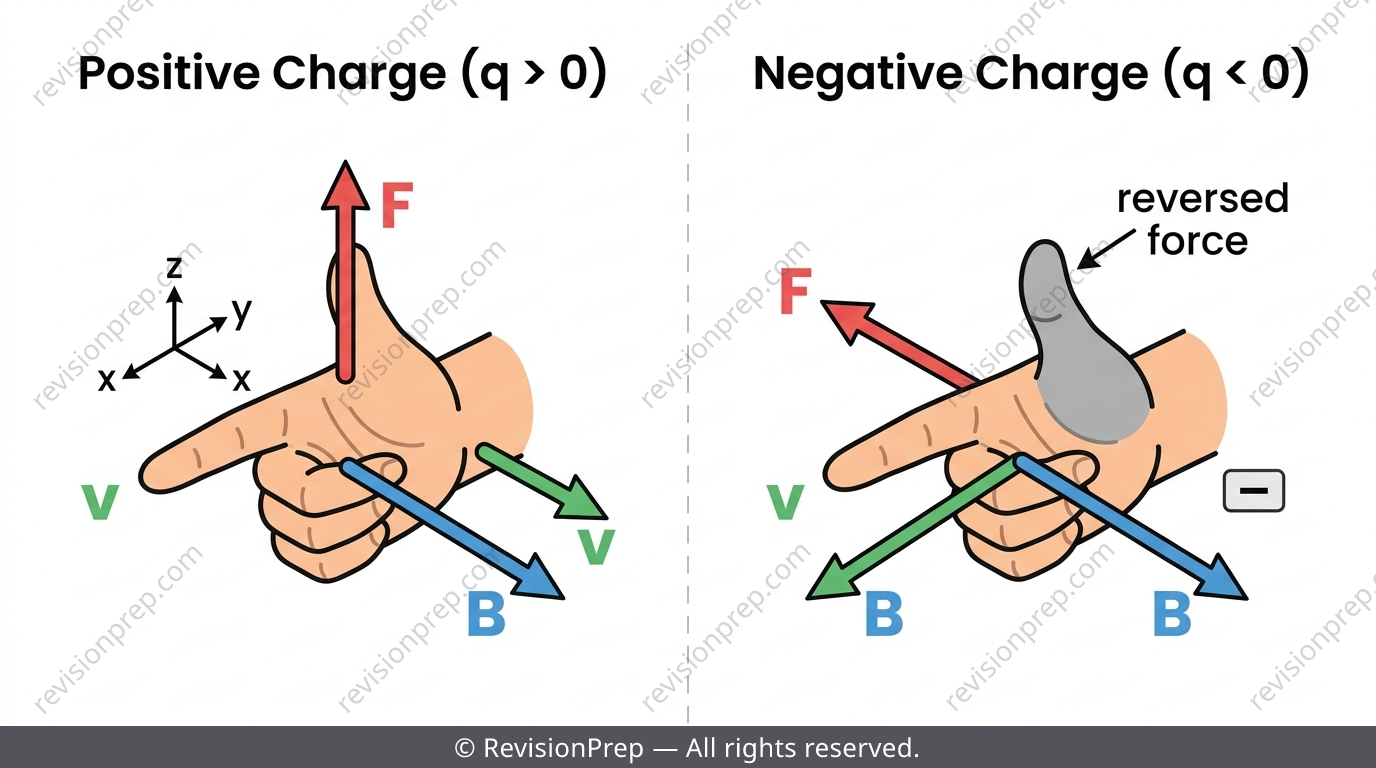
Magnetic fields need a moving charge or current — they're never produced by stationary charge alone, and their field lines always form closed loops with no monopoles. The force on a moving charge is , and on a current-carrying wire it's , where is the angle between velocity (or wire) and the field. Right-hand rules give direction for conventional current or positive charge; for negative charge, work it out normally then reverse it.
Common mistake
Writing or whenever an angle other than is given — always check before substituting; the term is not optional unless perpendicularity is stated or implied.
Mini summary
Never drop ; reverse right-hand-rule direction for negative charges.
Motion in Electric and Magnetic Fields
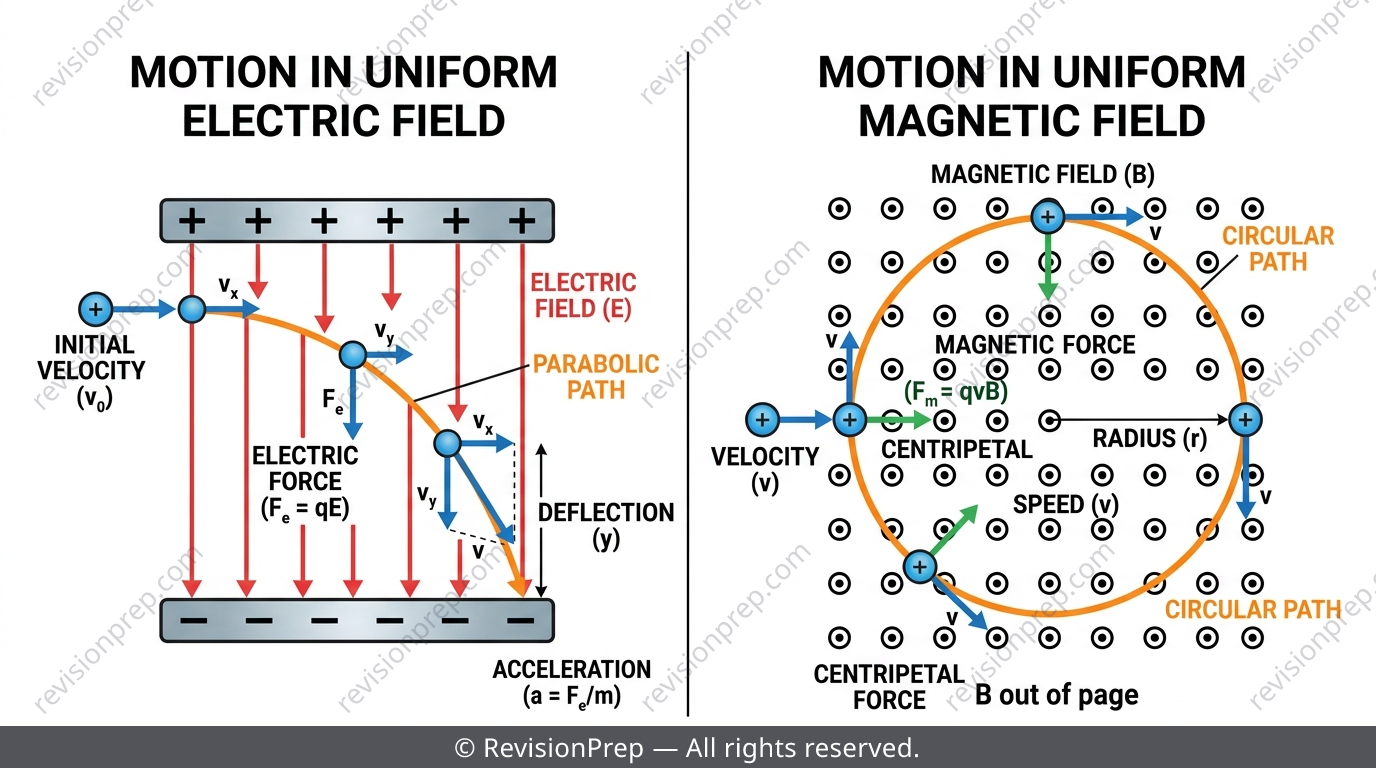
A charged particle in a uniform electric field feels a constant force along the field, giving constant acceleration — combined with constant velocity perpendicular to the field, this produces projectile-style parabolic motion using the same suvat equations as mechanics. A charged particle moving in a uniform magnetic field feels a force always perpendicular to its velocity, so the force only bends the path, never speeds it up or slows it down — producing uniform circular motion instead.
Exam tip
If a question mentions a magnetic field bending a particle's path without changing its speed, that's your cue: circular motion, not projectile motion.
Mini summary
Uniform E field → parabola (projectile motion); uniform B field → circle (constant speed, changing direction).
Quick formula sheet
Practice questions
- State whether gravitational field strength is a vector or scalar quantity, and justify your answer.
- Write down Coulomb's law and identify one structural similarity with Newton's law of gravitation.
- State why gravitational potential is always negative.
- A satellite orbits at height above a planet's surface. Explain why the correct radius to use in is , not alone.
- A charged particle enters a uniform electric field moving perpendicular to it. Describe the shape of its path and explain why.
- Explain why the force on a charge moving parallel to a magnetic field is zero, using .
- Derive the escape speed formula from the condition that total mechanical energy equals zero at infinity.
- A charged particle moves in a circular path inside a uniform magnetic field. Explain why its kinetic energy stays constant even though a force acts on it continuously.
- Compare the equations for gravitational potential and electric potential, explaining why one can be positive while the other cannot.
Frequently asked questions
What is the difference between field strength and potential in IB Physics?+
Field strength (g or E) is a vector giving force per unit mass or charge and has direction. Potential (V_g or V) is a scalar giving energy per unit mass or charge and has no direction — it's used for work-done calculations.
Why is gravitational potential always negative?+
Because the reference point is defined as zero at infinity, and any mass closer than infinity is in a bound, lower-energy state — so its potential must be negative relative to that zero.
How do you calculate escape velocity?+
Set total mechanical energy at the surface to zero: , giving .
What's the difference between gravitational and electric fields?+
Both follow a law, but gravity is always attractive (mass only ever attracts mass), while electric force can attract or repel depending on whether the charges have the same or opposite sign.
When do you need sin theta in F=qvB?+
Whenever the velocity isn't stated (or clearly implied) as perpendicular to the magnetic field. Dropping for a non-90° angle is one of the most common exam errors.
What path does a charged particle follow in a uniform magnetic field?+
A circular path at constant speed, because the magnetic force is always perpendicular to velocity and can only change direction, never speed.
Master Fields with the Complete IB DP Physics Revision Notes
Related articles