
Wave Behaviour
IB DP Physics Theme C essentials: wave model, standing waves, refraction, diffraction and Doppler shift in one teaser.
Quick facts
Wave Behaviour is one of the highest-yield topics in IB DP Physics, showing up across Paper 1, Paper 2, and even data-based Paper 3 questions. At its core, every wave transfers energy without transferring matter — and once you master the vocabulary (wavelength, frequency, period, amplitude) and the equation , everything else builds on that foundation. This teaser covers the five ideas examiners test most: describing waves correctly, standing waves and the notorious node-spacing trap, refraction and total internal reflection, diffraction with interference and polarization, and the Doppler effect. Each concept comes with the exact common mistakes IB students make and the sanity checks examiners expect you to show. For the full depth — every derivation, worked example, and boundary-condition table — head to the complete RevisionPrep notes linked below.
What you’ll be able to do
Wave Model: Describing Any Wave
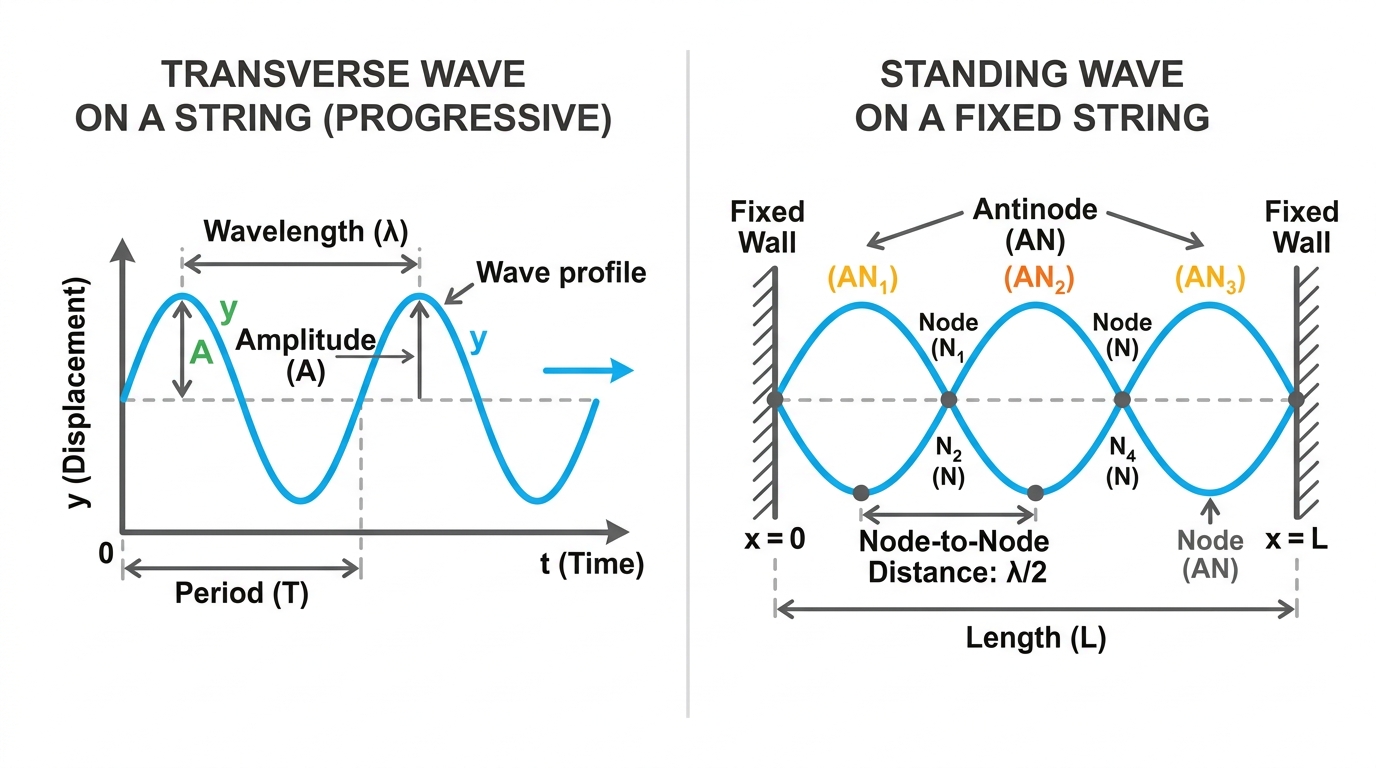
A periodic wave repeats in space (wavelength, ) and in time (period, ), linked by and . Amplitude is the maximum displacement from equilibrium — not the peak-to-peak distance, which is double the amplitude. Wave speed describes how fast the pattern moves, which is completely different from how fast an individual particle in the medium oscillates.
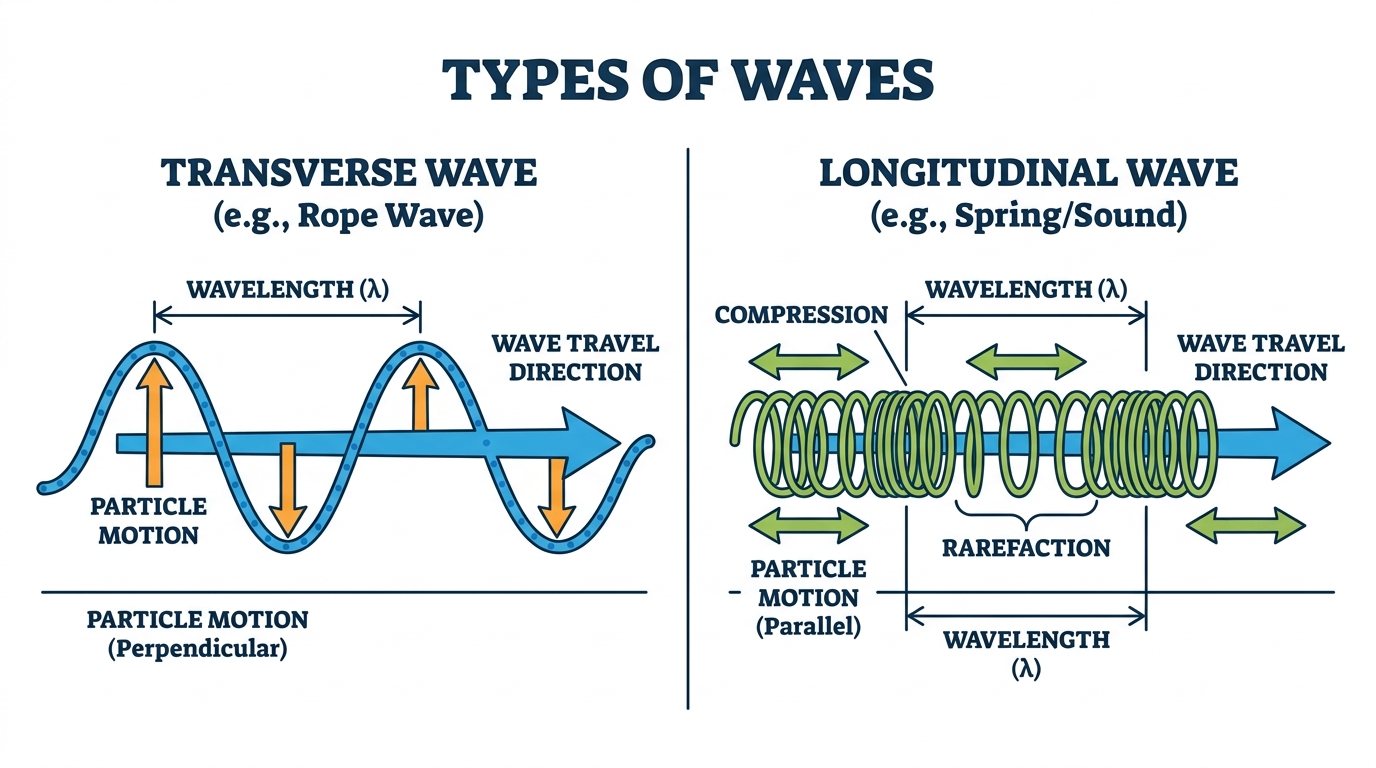
| Feature | Transverse waves | Longitudinal waves |
|---|---|---|
| Oscillation direction | Perpendicular to travel direction | Parallel to travel direction |
| Can be polarized? | Yes | No |
| Example | Light, water surface waves | Sound in air |
Exam tip
Always check which wave and which medium a question describes before choosing a speed value — sound in air is not the speed of light.
Common mistake
Using m s⁻¹ for a sound wave problem just because it's the 'default' speed constant.
Mini summary
Wave speed is fixed by the medium, frequency by the source, and wavelength adjusts via .
Superposition & Standing Waves
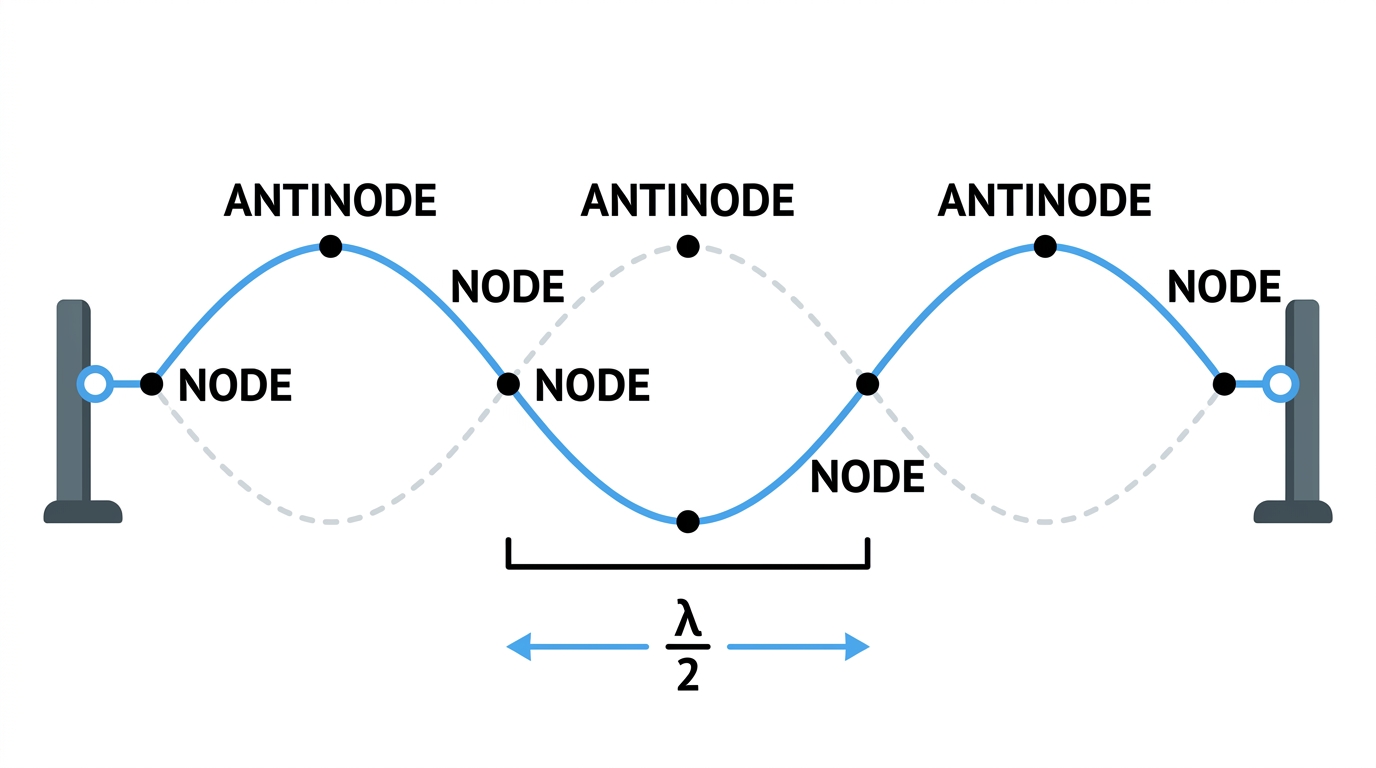
When waves overlap, the resultant displacement is the vector sum of each individual displacement — the principle of superposition. A standing wave forms when two identical waves travel in opposite directions and superpose continuously, such as a wave and its own reflection on a fixed string. Unlike a travelling wave, a standing wave transfers no net energy along its length; energy stays trapped, oscillating between kinetic and potential at the antinodes.
Exam tip
Describing a standing wave needs two separate statements for full marks: amplitude varies with position (zero at nodes, maximum at antinodes) AND there is no net energy transfer along the wave.
Common mistake
Calling the node-to-node (or antinode-to-antinode) distance 'one wavelength' — it's always . A full wavelength spans node–antinode–node–antinode–node.
Mini summary
Nodes are permanent zero displacement; antinodes oscillate at maximum amplitude; adjacent nodes/antinodes are always apart.
Refraction, Snell's Law & Total Internal Reflection
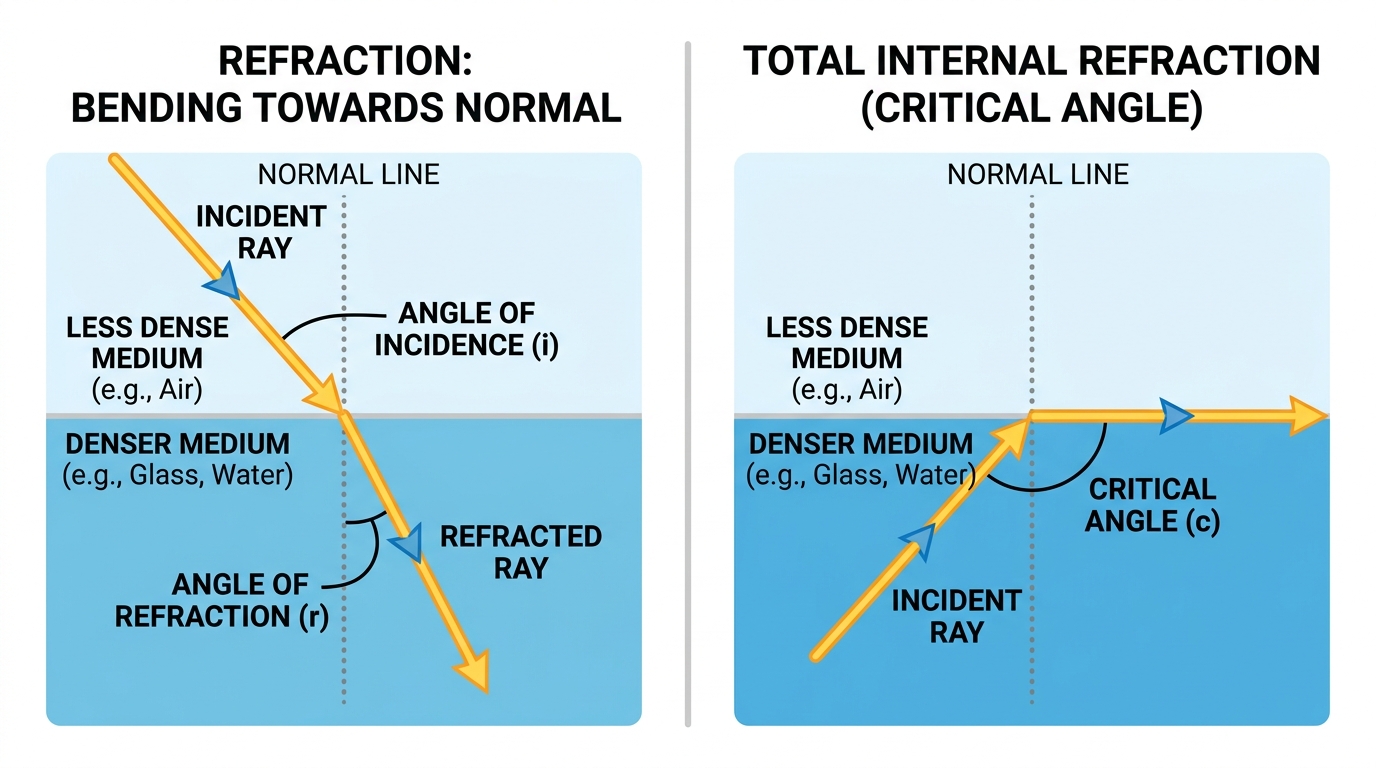
Refraction happens because wave speed changes at a boundary while frequency (set by the source) stays fixed, forcing wavelength to change. Refractive index compares light's speed in vacuum to its speed in a medium — higher means slower speed and bending towards the normal. Total internal reflection can only occur travelling from a slower (denser) medium into a faster one, and only above the critical angle.
Exam tip
Sanity-check any critical angle answer: must come out less than 1. If it's greater than 1, you've inverted the ratio .
Common mistake
Writing instead of , giving an impossible value greater than 1.
Mini summary
Speed and wavelength change at a boundary; frequency never does. TIR needs slow-to-fast travel plus angle above critical.
Diffraction, Interference & Polarization
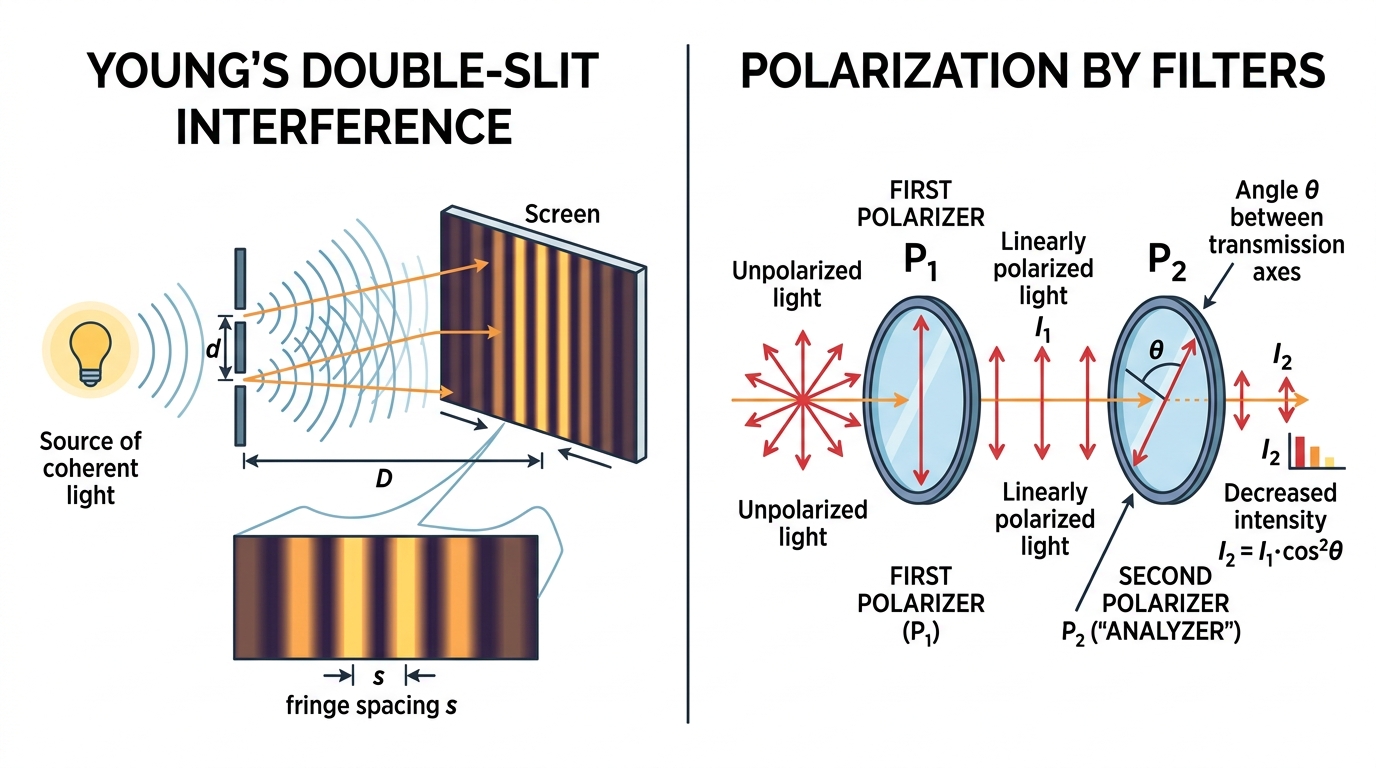
Diffraction is the spreading of a wave through a gap or around an edge, most noticeable when the gap width is comparable to the wavelength. In Young's double-slit setup, coherent light diffracts at each slit and the resulting wavelets interfere, giving fringe spacing ; a diffraction grating extends this with . Only transverse waves can be polarized, and Malus's law gives the transmitted intensity through a second polarizer.
Exam tip
For grating questions, find slit spacing from 'lines per mm' by taking the reciprocal () and converting to metres before substituting.
Common mistake
Forgetting to convert nanometres and millimetres to metres before using , or using instead of in Malus's law.
Mini summary
Diffraction spreads waves at gaps; interference from coherent sources builds fringe patterns; polarization only works on transverse waves.
The Doppler Effect
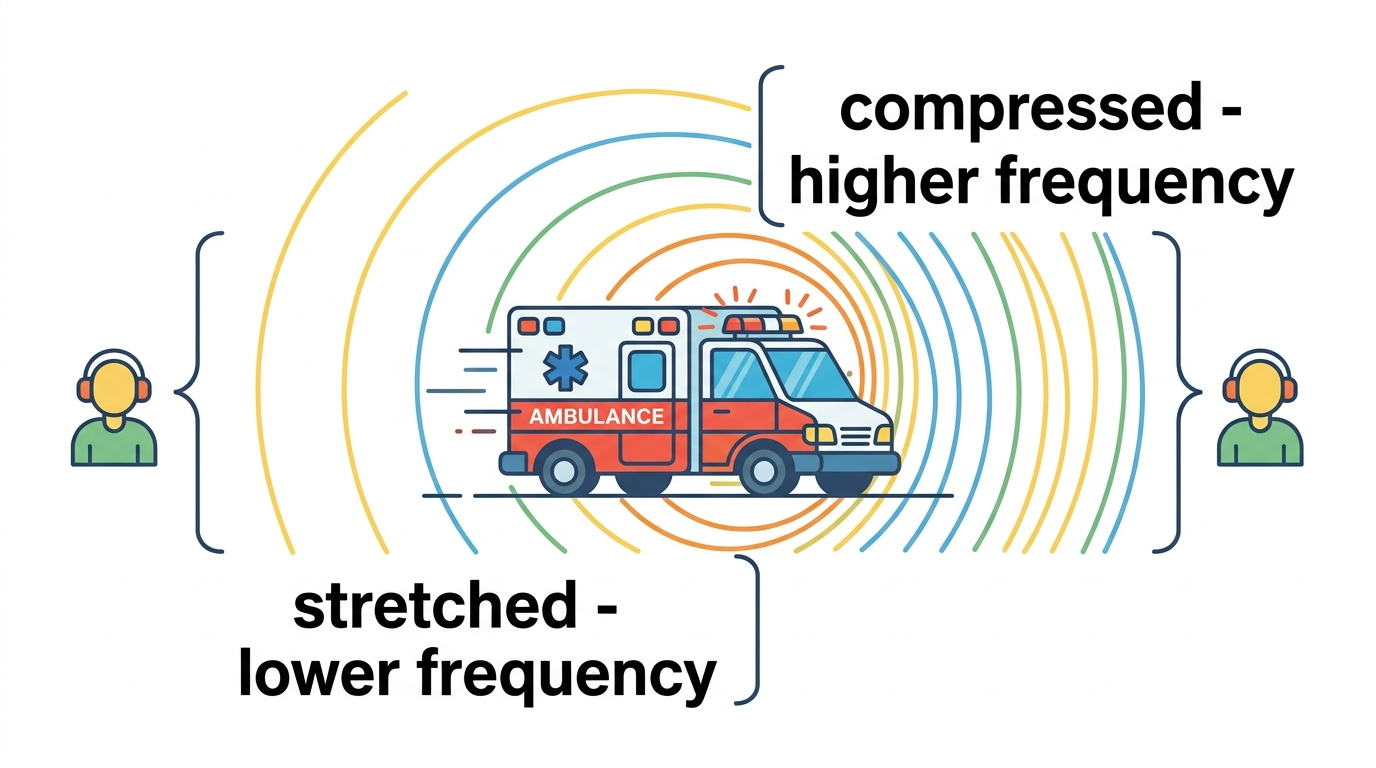
When a source and observer move relative to each other, the observed frequency differs from the emitted frequency because wavefronts bunch up as the source approaches and stretch out as it recedes. For a source approaching a stationary observer, ; for a receding source, . The same bunching/stretching logic extends to light, giving the approximation .
Exam tip
Before trusting your algebra, sanity-check the direction: approaching source means higher observed frequency, receding means lower.
Common mistake
Using for an approaching source, which produces a lower frequency than emitted — physically backwards.
Mini summary
Approaching sources raise observed frequency, receding sources lower it; the same principle underlies redshift and blueshift in light.
Quick formula sheet
Practice questions
- A wave has frequency 250 Hz and wavelength 1.2 m. Calculate its speed.
- State two differences between transverse and longitudinal waves.
- Define wavelength and amplitude for a periodic wave.
- A sound wave in air (v = 340 m s⁻¹) has frequency 500 Hz. Determine its wavelength, and explain why the speed of light must not be used here.
- A standing wave on a string has nodes 0.30 m apart. Determine the wavelength of the wave.
- Light travels from water () into air. Calculate the critical angle for total internal reflection.
- Monochromatic light of wavelength 550 nm passes through a diffraction grating with 400 lines per mm. Determine the angle of the first-order maximum.
- A car horn emits sound at 500 Hz while the car moves towards a stationary observer at 25 m s⁻¹ (speed of sound = 340 m s⁻¹). Calculate the frequency heard, and explain how you would sanity-check your answer.
- Explain, using the principle of superposition, why a standing wave transfers no net energy along its length while still storing energy locally.
Frequently asked questions
What is the difference between a wave pulse and a periodic wave?+
A pulse is a single, one-off disturbance with no wavelength or frequency because nothing repeats. A periodic wave is a continuous train of identical pulses, repeating in both space (wavelength) and time (period).
Why isn't amplitude the same as the peak-to-peak distance?+
Amplitude is the maximum displacement from equilibrium in one direction. Peak-to-peak distance is double that, since it spans from the highest point to the lowest point. Mixing these up causes factor-of-two errors.
Why does frequency stay the same during refraction?+
Frequency is set entirely by the source, not the medium. Since and speed changes at the boundary while frequency can't, wavelength must change instead to keep the equation balanced.
When can total internal reflection actually happen?+
Only when light travels from a slower (optically denser, higher-) medium into a faster (lower-) medium, and only when the angle of incidence exceeds the critical angle given by .
Why can sound waves not be polarized?+
Sound is a longitudinal wave, oscillating parallel to its direction of travel, so there's no perpendicular plane to restrict. Only transverse waves, which oscillate perpendicular to travel direction, can be polarized.
How do I know if a Doppler-shifted frequency should be higher or lower?+
Use the physical rule as a sanity check before trusting algebra: an approaching source always produces a higher observed frequency, and a receding source always produces a lower one.
Get the Full Wave Behaviour Revision Notes
Related articles