
Space, Time, and Motion
Kinematics, momentum, rotation and relativity — the five subtopics examiners love to combine
Quick facts
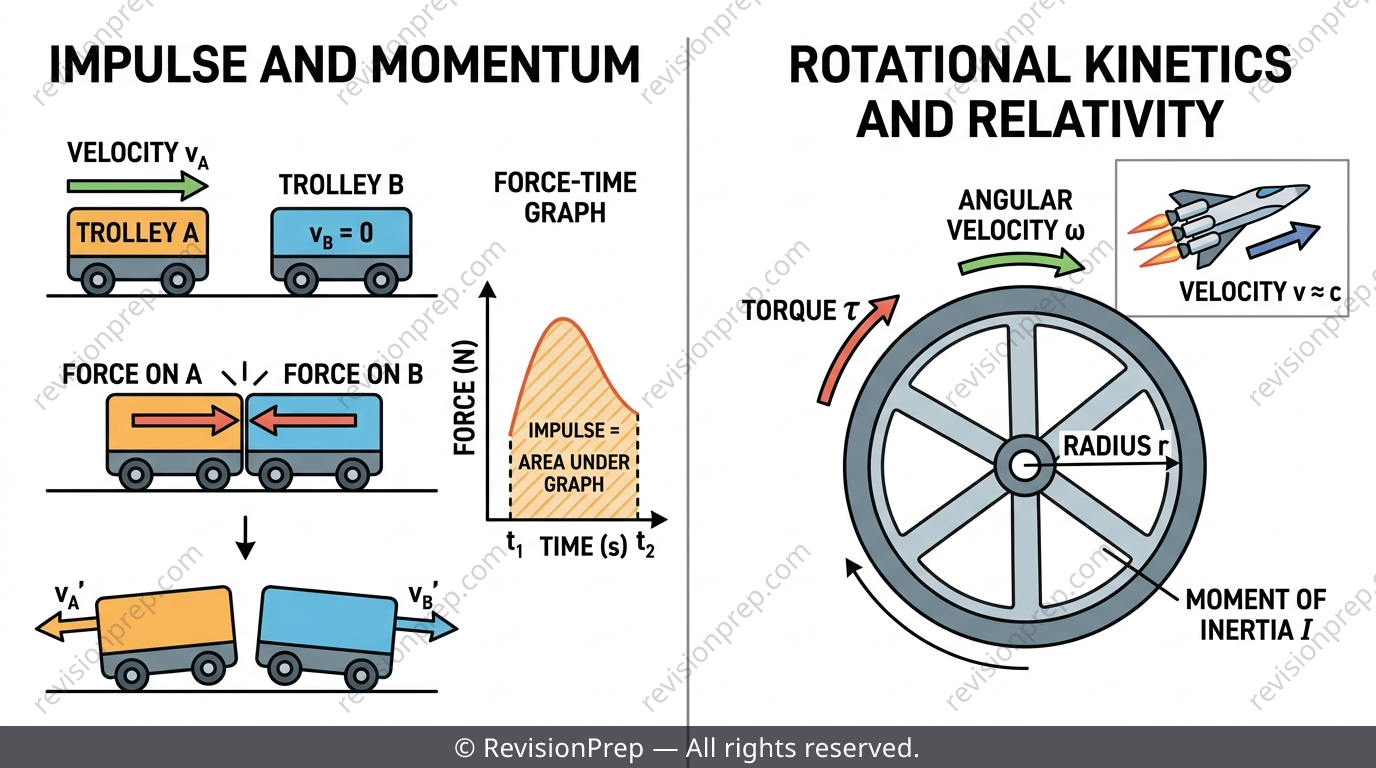
Space, Time and Motion is IB DP Physics' Topic A, and it rewards students who see the pattern underneath the equations rather than memorising formulas in isolation. At SL, you master kinematics, forces and momentum, and work-energy-power in their familiar linear form. At HL, the same physics gets rotated into rigid body mechanics — where torque, moment of inertia and angular momentum mirror force, mass and momentum exactly — and boosted to relativistic speeds in special relativity, where momentum stops being simply . Examiners routinely layer these ideas: a question might start as a straightforward collision and finish by asking for angular momentum or relativistic effects. This teaser walks through the five concepts that show up most often, the traps built into IB-style questions, and the sign conventions and symbolic-first habits that protect your marks. For the full worked examples, data-booklet formulas and standard shapes table, head to the complete revision notes.
What you’ll be able to do
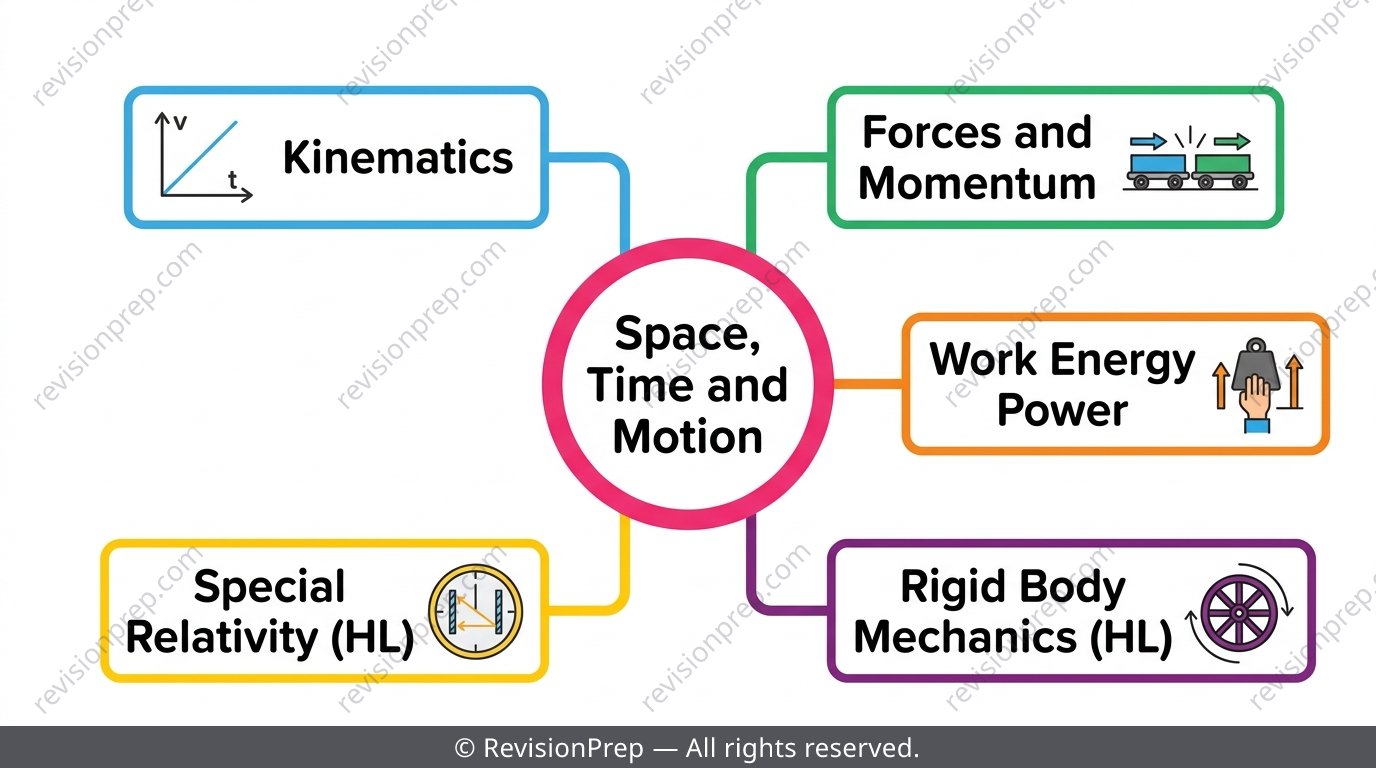
The Big Picture: Five Subtopics, One Exam Strategy
SL students meet kinematics, forces/momentum, and work-energy-power in clean linear form. HL students get the exact same physics twice more: rotated into rigid body mechanics, and boosted to near-light speeds in special relativity. Examiners love layering subtopics — a question can begin as a basic SUVAT problem and end by asking for angular momentum, or start as a momentum collision and finish asking for energy released as rest mass.
Exam tip
Read the whole question before choosing a formula — the final part often needs a completely different subtopic than the opening.
Mini summary
Five subtopics, same underlying physics — SL in linear form, HL adds rotation and relativity.
Forces and Momentum: Newton's Second Law Beyond F = ma
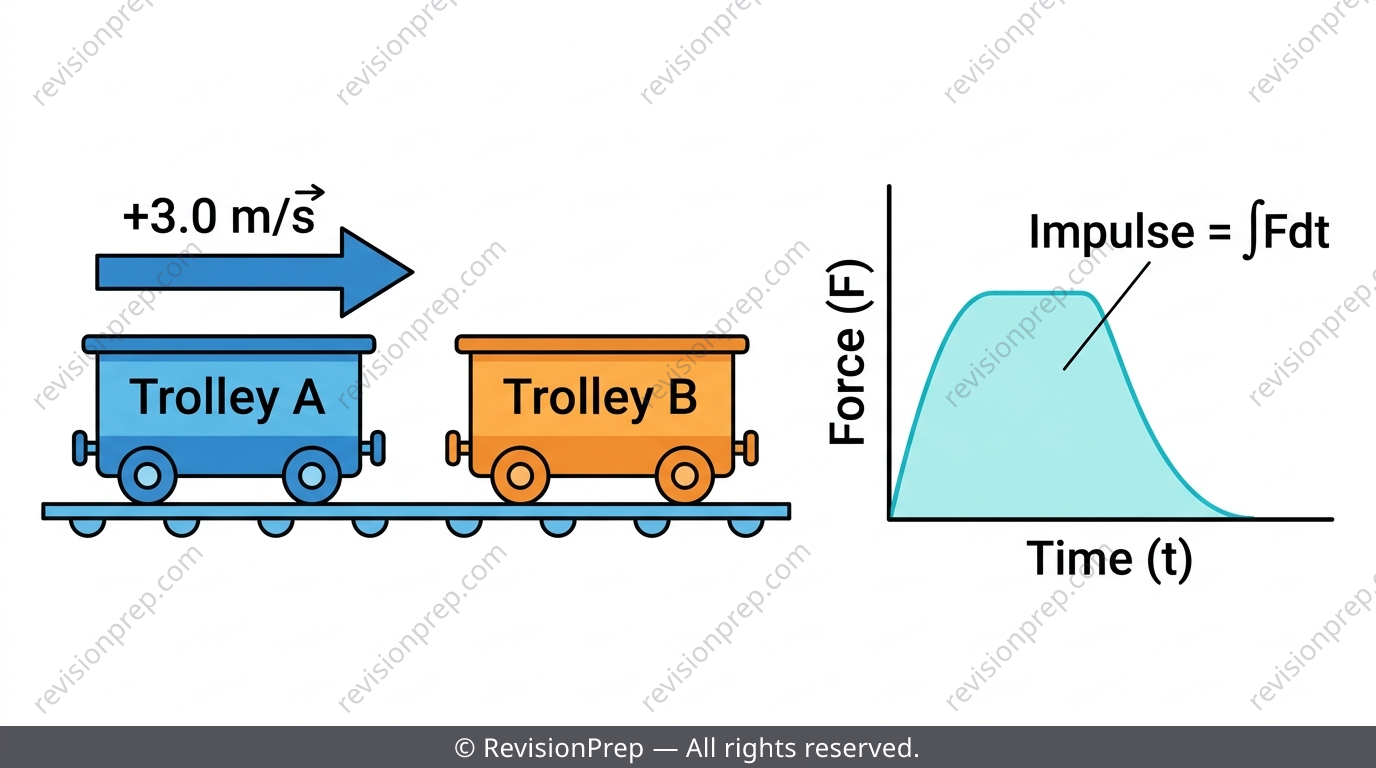
The deepest form of Newton's second law is , not — the mass-times-acceleration version only works when mass stays constant. Momentum is always conserved for an isolated system regardless of whether a collision is elastic, but momentum is a vector, so direction is where most marks disappear. Impulse equals the area under a force-time graph, which for a non-constant force means finding the actual area, not multiplying a single force value by time.
Exam tip
'Show that' momentum questions want the symbolic conservation equation written out first, values substituted second — jumping to a decimal loses the method mark.
Common mistake
Treating momentum as a scalar and adding magnitudes when objects move in opposite directions, instead of assigning signed velocities from the start.
Mini summary
F=Δp/Δt is the real Newton's second law; momentum conserves in every isolated collision, but always with signs.
Rigid Body Mechanics (HL): The Rotational Mirror World
Every linear quantity has a rotational twin: mass becomes moment of inertia, force becomes torque, momentum becomes angular momentum. The genuinely new idea is that moment of inertia depends on how mass is arranged relative to the rotation axis — doubling the radius at which mass sits quadruples its contribution to , since it scales as . Angular momentum is conserved whenever net external torque is zero, exactly like linear momentum, and rolling without slipping links the two worlds via .
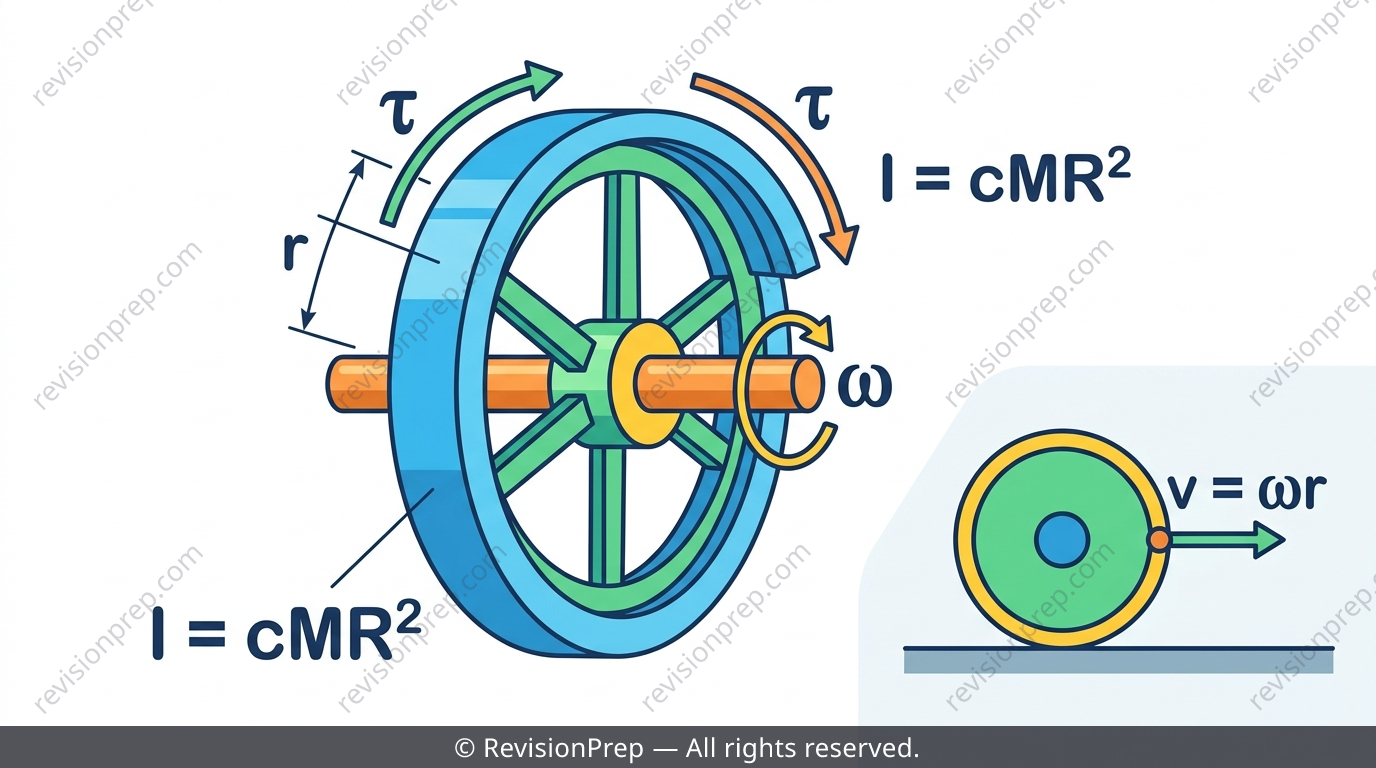
| Linear quantity | Rotational twin |
|---|---|
| Force, | Torque, |
| Mass, | Moment of inertia, |
| Momentum, | Angular momentum, |
| Velocity, | Angular velocity, |
| Acceleration, | Angular acceleration, |
Exam tip
If a question gives three quantities but only two are needed, that's deliberate — check whether answers it directly without ever needing .
Common mistake
Writing or mixing linear and rotational formulas — always write the rotational equation in full symbolic form (, ) before substituting numbers.
Mini summary
F→τ, m→I, p→L, v→ω — same physics, rotated, with I depending on axis and mass distribution.
Special Relativity at HL: When Momentum Isn't p = mv
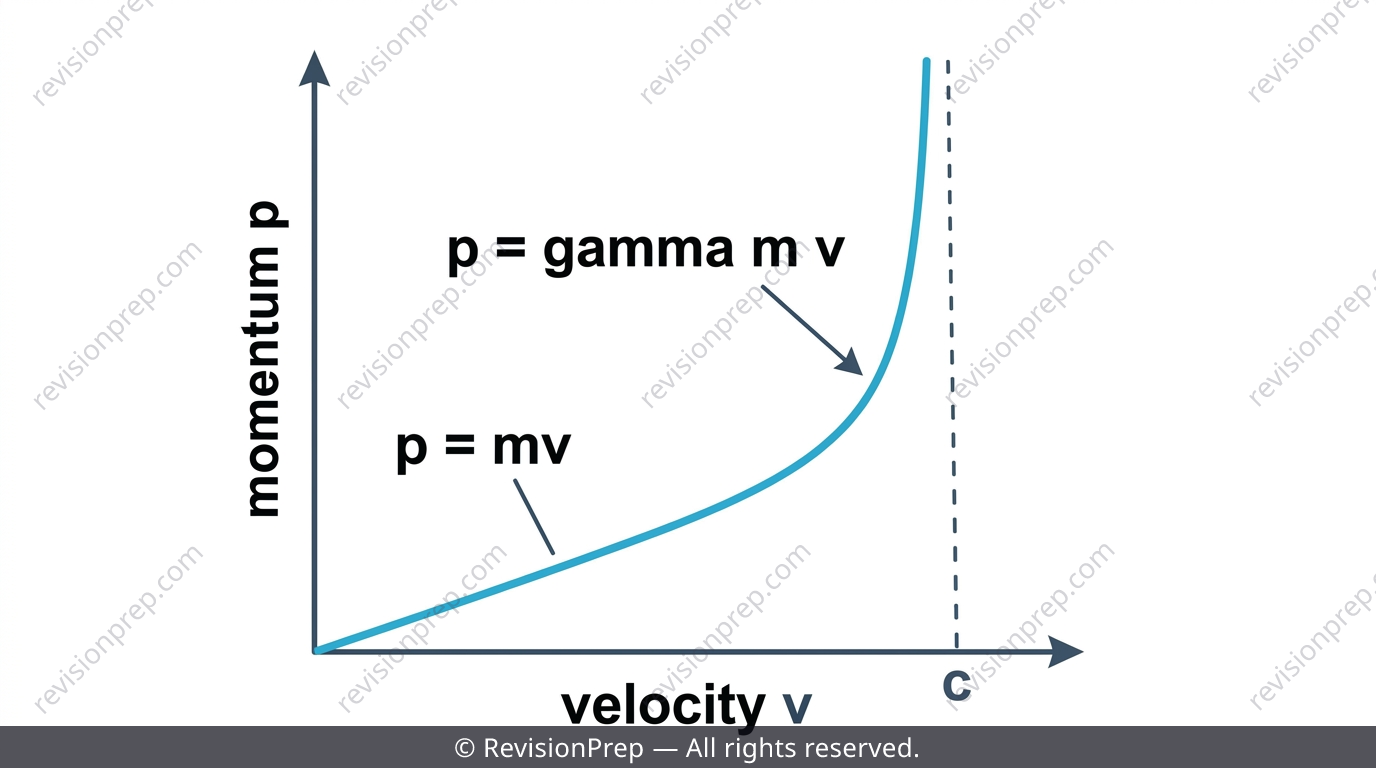
Once speed becomes a significant fraction of the speed of light , momentum is no longer simply — it becomes . This relativistic momentum only reduces back to the classical formula when , since in that limit. This extension is examined within the kinematics and energy strands rather than as a fully separate block, so expect it folded into questions that start with everyday mechanics.
Exam tip
Check the size of relative to before deciding which momentum formula applies — classical is only ever an approximation.
Mini summary
Relativistic momentum p=γmv replaces p=mv only when v is a significant fraction of c.
Work, Energy and Power: The Third Conserved Quantity
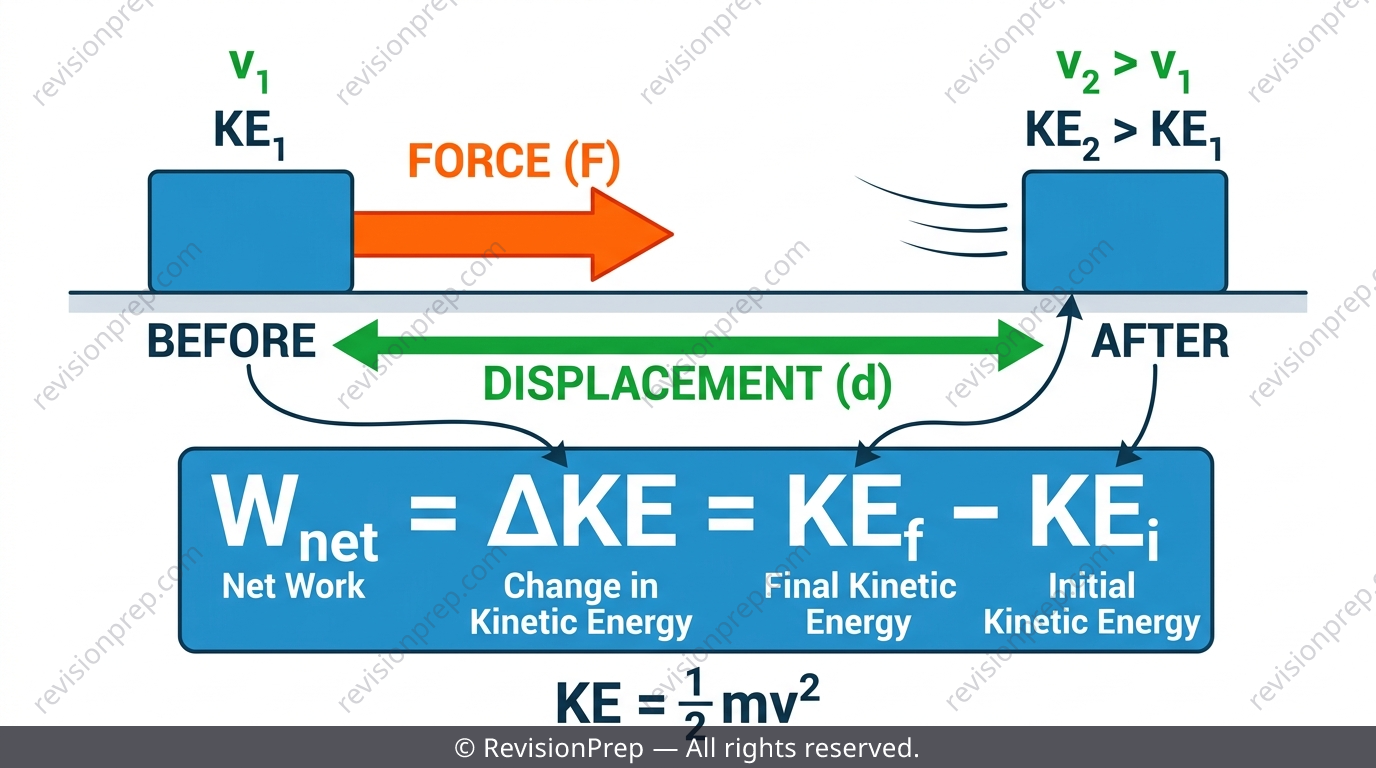
Work is the energy transferred by a force acting through a displacement, and the work-energy theorem links the net work done on an object directly to its change in kinetic energy. This subtopic sits alongside kinematics and momentum as the third pillar of SL mechanics, tracking how much 'oomph' is transferred between objects and systems. Together with momentum conservation, work-energy reasoning is the standard toolkit for combined mechanics problems.
Exam tip
When a problem mixes momentum and energy, check first whether the collision is elastic — only then does kinetic energy stay conserved alongside momentum.
Mini summary
Work transfers energy through a force acting over a displacement; net work equals the change in kinetic energy.
Quick formula sheet
Practice questions
- Define torque and state its SI unit.
- Write the general (most fundamental) form of Newton's second law in terms of momentum.
- State the two quantities that are always conserved in an elastic collision.
- A wheel with moment of inertia 0.20 kg m² experiences a constant torque of 0.50 N m for 4.0 s, starting from rest. Find its angular momentum after this time.
- A ball of mass 0.50 kg moving at 4.0 m/s collides head-on with a stationary 0.50 kg ball and they stick together. Find their common velocity after the collision.
- Explain why relativistic momentum reduces to at everyday speeds.
- A spacecraft applies a constant torque of 15 N m for 5.0 s to a rotor with moment of inertia 300 kg m². Explain why the moment of inertia value is irrelevant if the question only asks for the change in angular momentum.
- A cylinder rolls without slipping down a slope. Explain how connects its translational and rotational motion.
- Two objects collide and momentum is conserved but kinetic energy is not. Explain what this tells you about the type of collision and where the missing energy has gone.
Frequently asked questions
What's the difference between SL and HL Space, Time and Motion?+
SL covers kinematics, forces/momentum, and work-energy-power in linear form. HL adds two extra standalone blocks: rigid body mechanics and special relativity, examined alongside the SL content.
Is torque the rotational equivalent of force?+
Yes — torque, , plays exactly the role for rotation that force plays for linear motion, and it's torque, not force alone, that changes angular velocity.
Why does moment of inertia depend on the rotation axis?+
Moment of inertia depends on how mass is distributed relative to a specific axis, not just total mass, so the same object can have different I values for different axes.
When does momentum become relativistic in IB Physics?+
Once speed v becomes a significant fraction of the speed of light c, momentum is rather than ; the classical formula is only an approximation for v much less than c.
Do IB exam questions combine these subtopics?+
Yes — expect questions that begin as a SUVAT or momentum problem and finish by asking for angular momentum or a relativistic quantity, so read the full question before choosing a formula.
What's the fastest way to solve angular impulse problems?+
Use directly whenever torque and time are given — it often lets you skip finding moment of inertia or angular velocity entirely.
Master Space, Time and Motion with the full DP Physics revision notes
Related articles