
Wave Behaviour
Reflection, refraction, diffraction, interference and polarization — the boundary rules IB Physics loves to test.
Quick facts
IB Physics Wave Behaviour ties together three linked ideas from Theme C: simple harmonic motion as the mechanism, the wave model as the description, and wave phenomena as what happens when waves meet boundaries, gaps, and each other. This is one of the most exam-heavy areas of the course — it shows up constantly in Paper 1 MCQs and guarantees at least one data-based Paper 2 question, with HL students also tackling quantitative diffraction and interference. The trouble is that reflection, refraction, diffraction and interference all look superficially similar, and examiners deliberately blur the boundaries between them. This teaser walks through the five ideas that trip students up most: measuring angles from the normal, the λ/b ratio behind diffraction, path-difference conditions for interference, and the polarization test for wave type. For the full derivations, HL formulas, and worked traps, head to the complete revision notes.
What you’ll be able to do
The Wave Model: Describing Any Wave
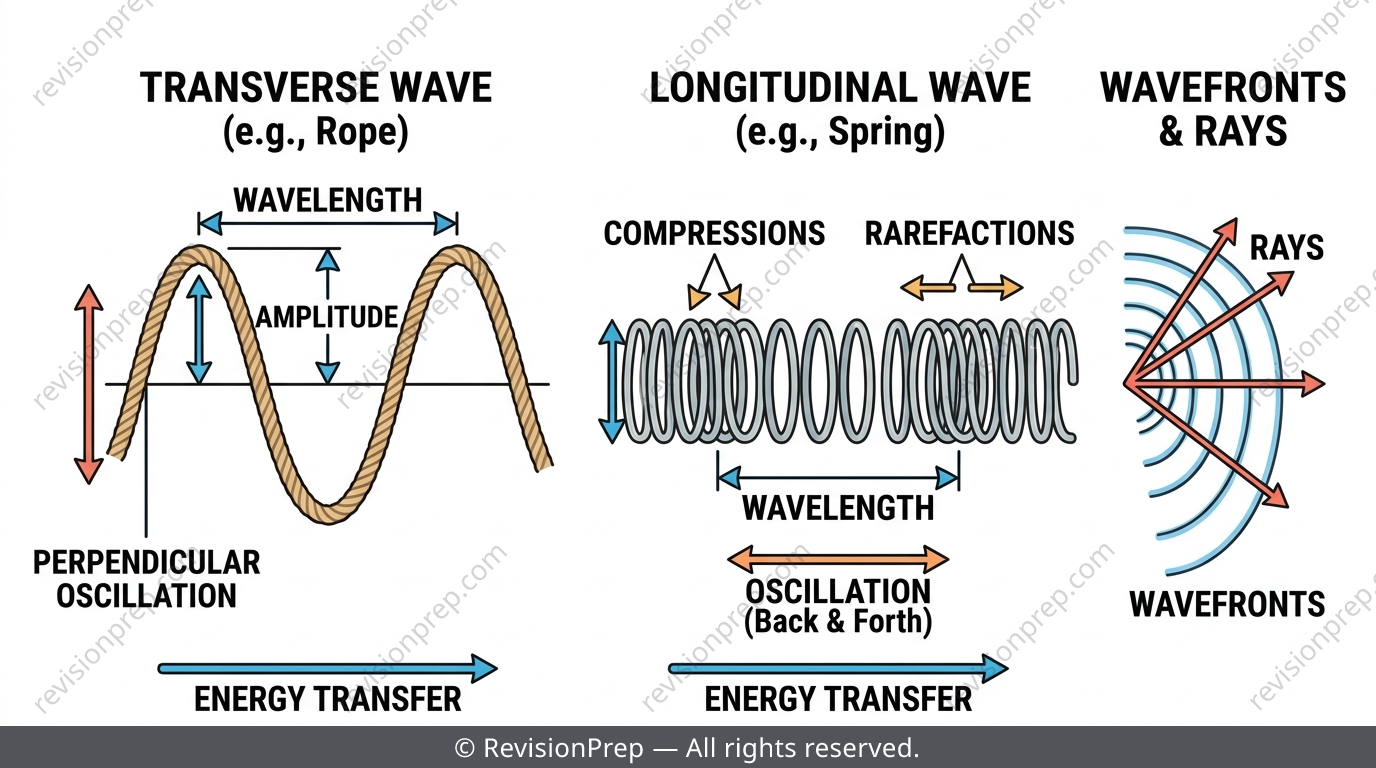
Every wave transports energy without transporting matter — particles or field values oscillate about a fixed point while the disturbance itself moves on. Transverse waves (light, water surfaces) oscillate perpendicular to the direction of travel; longitudinal waves (sound) oscillate parallel to it, as compressions and rarefactions. Wavefronts join points of equal phase, and rays — always perpendicular to wavefronts — show the direction of energy flow. One equation, , links speed, frequency and wavelength for any wave, and intensity follows from a point source and for a given wave.
Exam tip
If a question asks you to classify a wave as transverse or longitudinal, check whether it can be polarized — that's the definitive test.
Mini summary
v = fλ links every wave's key numbers; transverse vs longitudinal is decided by the direction of oscillation relative to travel.
Reflection vs Refraction: The Boundary Rules Exams Blur
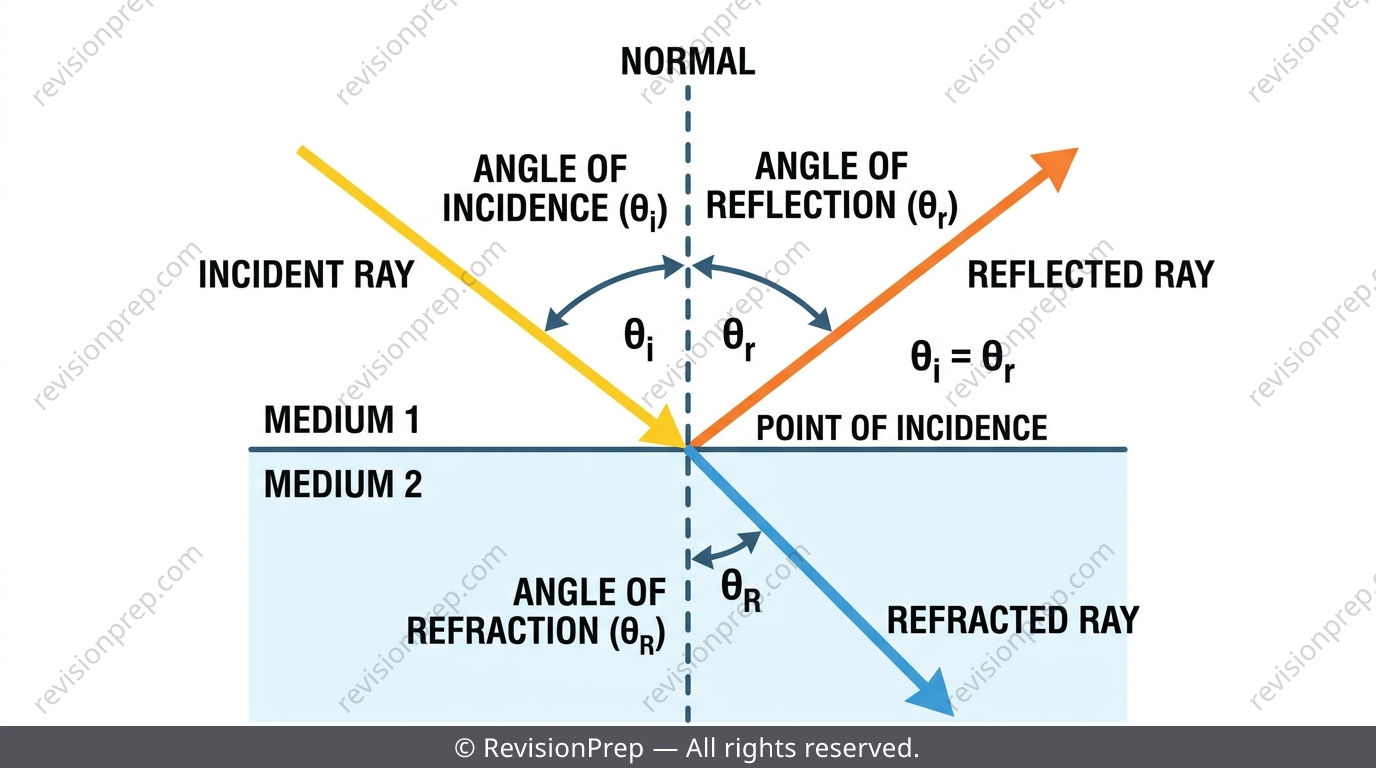
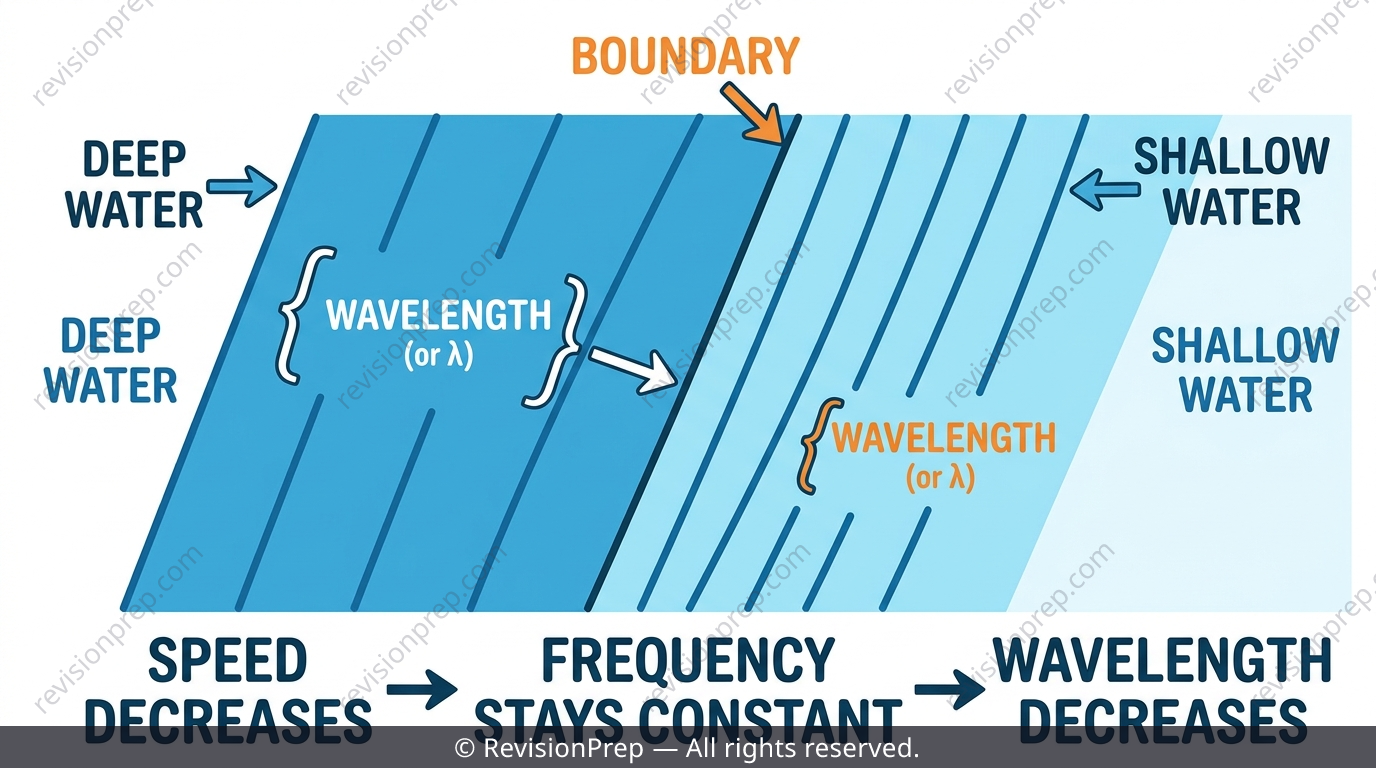
Reflection keeps the wave in its original medium, with angle of incidence equal to angle of reflection — both measured from the normal, never the surface. Refraction bends a wave as it crosses into a medium with a different speed; frequency is fixed by the source and never changes, so speed and wavelength must change together, linked by . Snell's law, , governs the bending, and beyond the critical angle () light undergoes total internal reflection instead of refracting out.
Exam tip
When a Paper 1 stem mixes reflection and refraction vocabulary, scan for the word 'normal' — any answer choice referencing the surface instead is wrong regardless of the numbers given.
Common mistake
Measuring the angle of incidence or reflection from the mirror/reflecting surface instead of the normal.
Mini summary
Angles are always from the normal; frequency never changes at a boundary; v and λ change together.
Diffraction: It's All About λ/b
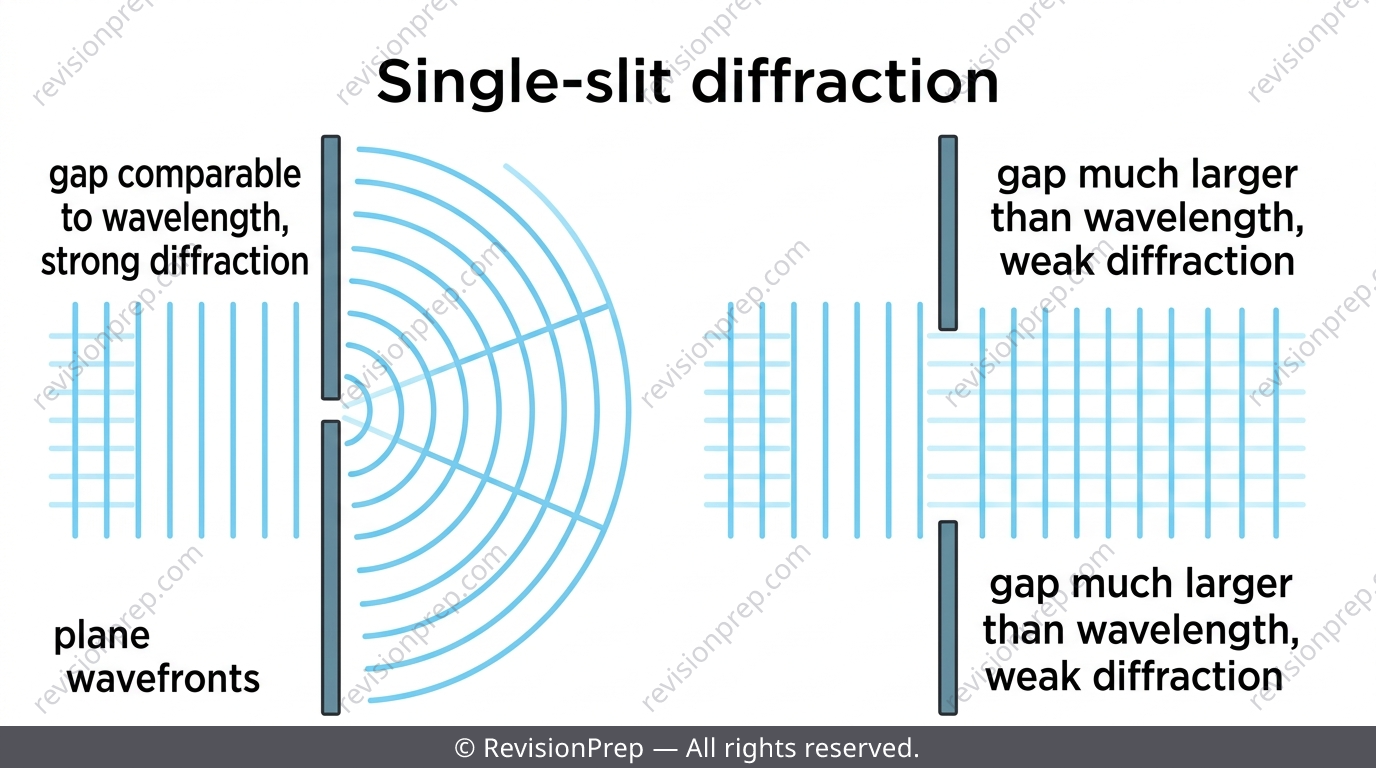
Diffraction is the spreading of a wave at an edge or gap, with wavefronts curving into the geometric shadow and no change in speed. Its significance depends only on the ratio of wavelength to gap width, λ/b — never on either number alone. Counterintuitively, a gap that's large compared to λ produces LESS diffraction, not more, so widening a slit from λ to 10λ narrows the central maximum instead of spreading it further.
Exam tip
Diffraction is explained by Huygens' construction — the gap acts as a new set of point sources — never by a speed change like refraction.
Common mistake
Assuming a physically larger gap always means more diffraction, without comparing it to λ.
Mini summary
Diffraction strength = λ/b ratio; bigger gaps relative to λ diffract less.
Interference: Adding Coherent Waves
Interference is the addition of waves from two or more coherent sources — sources with a constant phase relationship and (usually) equal frequency. At any point, the path difference between the two waves decides the outcome: a path difference of gives constructive interference, while gives destructive interference. Always convert a raw path difference into a multiple of λ before deciding — comparing the raw numbers without dividing is the classic trap.
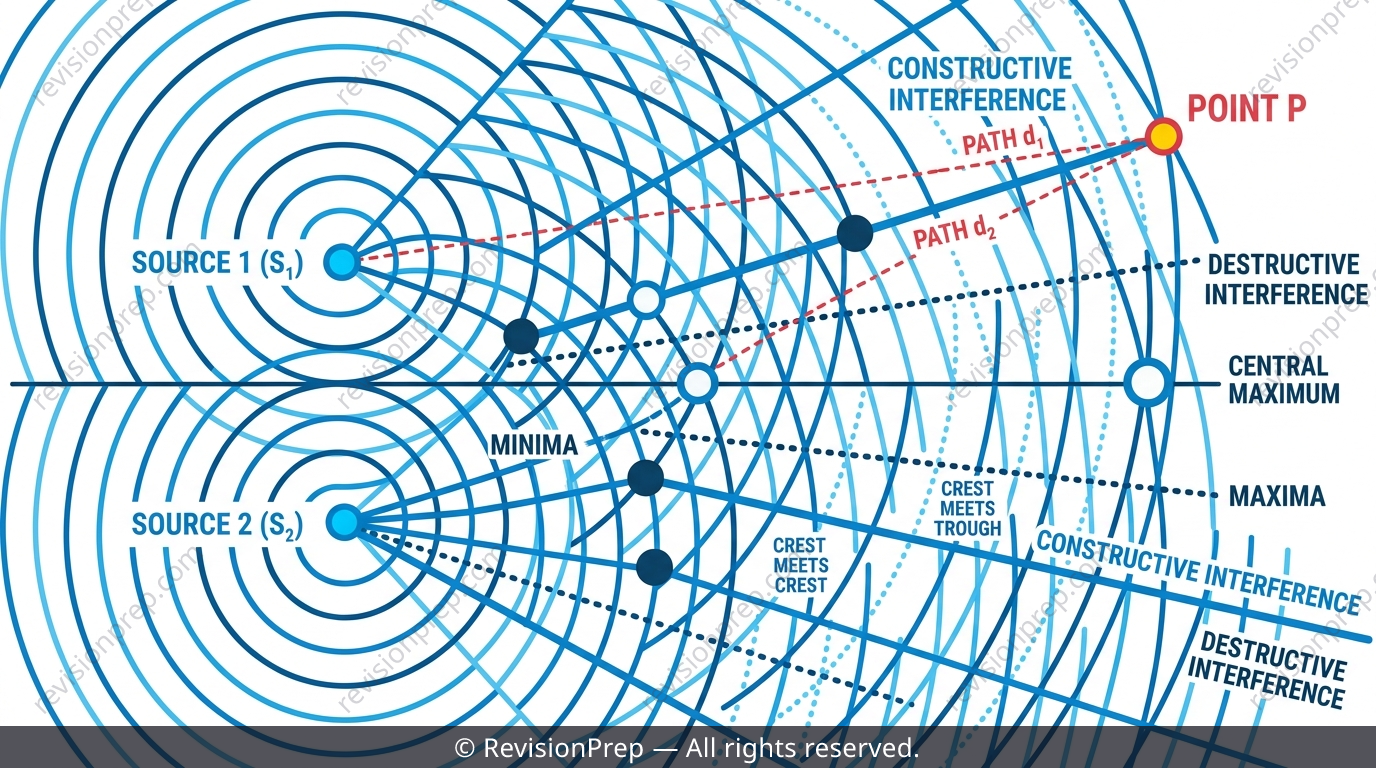
| Path difference | Phase difference | Result |
|---|---|---|
| nλ | 0 (in phase) | Constructive |
| (n + ½)λ | π (antiphase) | Destructive |
Exam tip
HL: the single-slit minima formula and double-slit fringe formula look identical — write out whether you're using b (slit width) or d (slit separation) before substituting.
Common mistake
Comparing raw path-difference and wavelength numbers without dividing to find the multiple of λ first.
Mini summary
Divide path difference by λ first: nλ → constructive, (n+½)λ → destructive.
Polarization: The Definitive Transverse Test
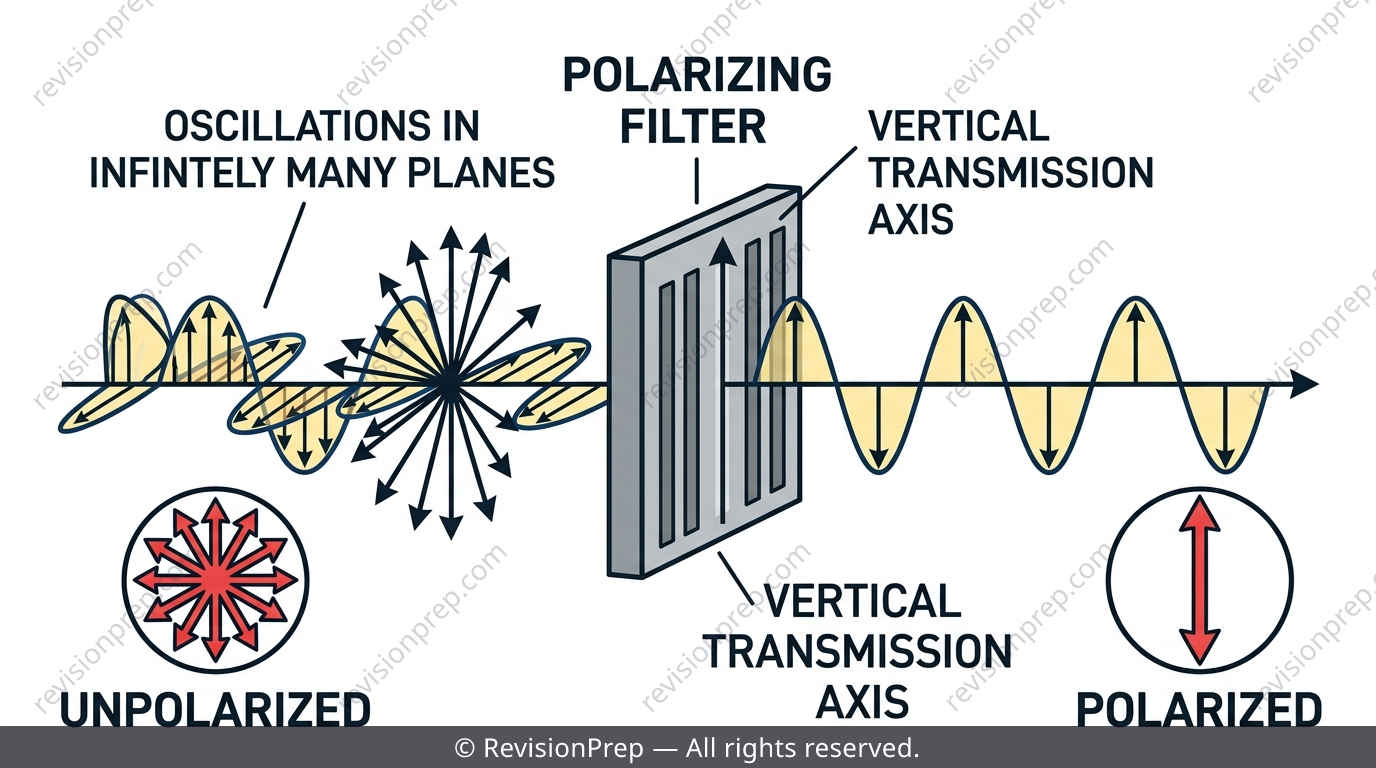
Polarization restricts the oscillations of a transverse wave to a single plane — and only transverse waves can be polarized. This makes polarization the clearest experimental test for distinguishing transverse waves like light from longitudinal waves like sound, which cannot be polarized at all.
Mini summary
Only transverse waves polarize — it's the go-to test for wave type.
Quick formula sheet
Practice questions
- State the law of reflection and identify what both angles are measured from.
- Explain why frequency does not change when a wave crosses into a new medium.
- State which property of a transverse wave polarization restricts.
- A wave slows down as it enters a denser medium. Describe what happens to its wavelength and speed, and explain why.
- Two coherent sources produce a path difference at point P equal to 3λ. State the type of interference at P and justify your answer.
- A slit width increases from λ to 10λ. Describe the effect on the central diffraction maximum and explain why.
- A laser strikes a parallel-sided glass block at 45° to the normal. Describe the direction and position of the emerging ray compared to the original beam.
- At a point in an interference pattern the path difference is λ/2. Describe the superposition occurring there, being careful about what happens if the two source amplitudes are unequal.
- Explain, using Huygens' construction, why diffraction is not caused by a change in wave speed, unlike refraction.
Frequently asked questions
What's the main difference between reflection and refraction?+
Reflection keeps a wave in its original medium with equal angles of incidence and reflection; refraction bends a wave as it crosses into a new medium, changing its speed and wavelength while frequency stays fixed. Both angles are measured from the normal.
Why doesn't frequency change when light enters glass?+
Frequency is set by the source that created the wave, not by the medium it's travelling through. Only speed and wavelength adjust at a boundary, linked by v = fλ.
How do I know if a gap will cause a lot of diffraction?+
Compare the wavelength to the gap width using the ratio λ/b. A larger ratio means stronger diffraction; a gap much bigger than the wavelength diffracts far less, regardless of its absolute size.
What conditions give constructive vs destructive interference?+
Divide the path difference by the wavelength. A whole-number multiple (nλ) gives constructive interference; a half-integer multiple ((n+½)λ) gives destructive interference.
Why can only transverse waves be polarized?+
Polarization restricts oscillation to a single plane, which only makes sense for waves oscillating perpendicular to their direction of travel. Longitudinal waves oscillate along the direction of travel, so there's no perpendicular plane to restrict.
Is diffraction and interference the same thing?+
No. Diffraction is a single wave spreading through one gap or edge, governed by λ/b. Interference is the addition of waves from two or more coherent sources, governed by path difference — they're related but tested with different formulas at HL.
Get the full IB DP Physics notes on Wave Behaviour
Related articles