
The Particulate Nature of Matter
One idea — particles in constant random motion — explains temperature, heat transfer, phase change, gas pressure and the greenhouse effect.
Quick facts
The particulate nature of matter is the foundation of IB DP Physics Theme B — and it's really just one idea applied everywhere: matter is made of particles in constant random motion, and temperature measures their average kinetic energy. From there, everything else follows — how solids, liquids and gases differ, how thermal energy moves by conduction, convection and radiation, why melting ice doesn't get hotter until it's fully melted, how Earth's greenhouse effect keeps the planet warm enough for life, and why gas pressure exists at all. This topic shows up constantly across SL Paper 1 and 2, and examiners love testing whether you can tell heat apart from temperature, or pick the right formula for a phase-change versus a temperature-change calculation. This teaser covers the five ideas worth locking down first — the full revision notes go deeper into every formula, worked example and trap.
What you’ll be able to do
The Particulate Model: States of Matter & Temperature
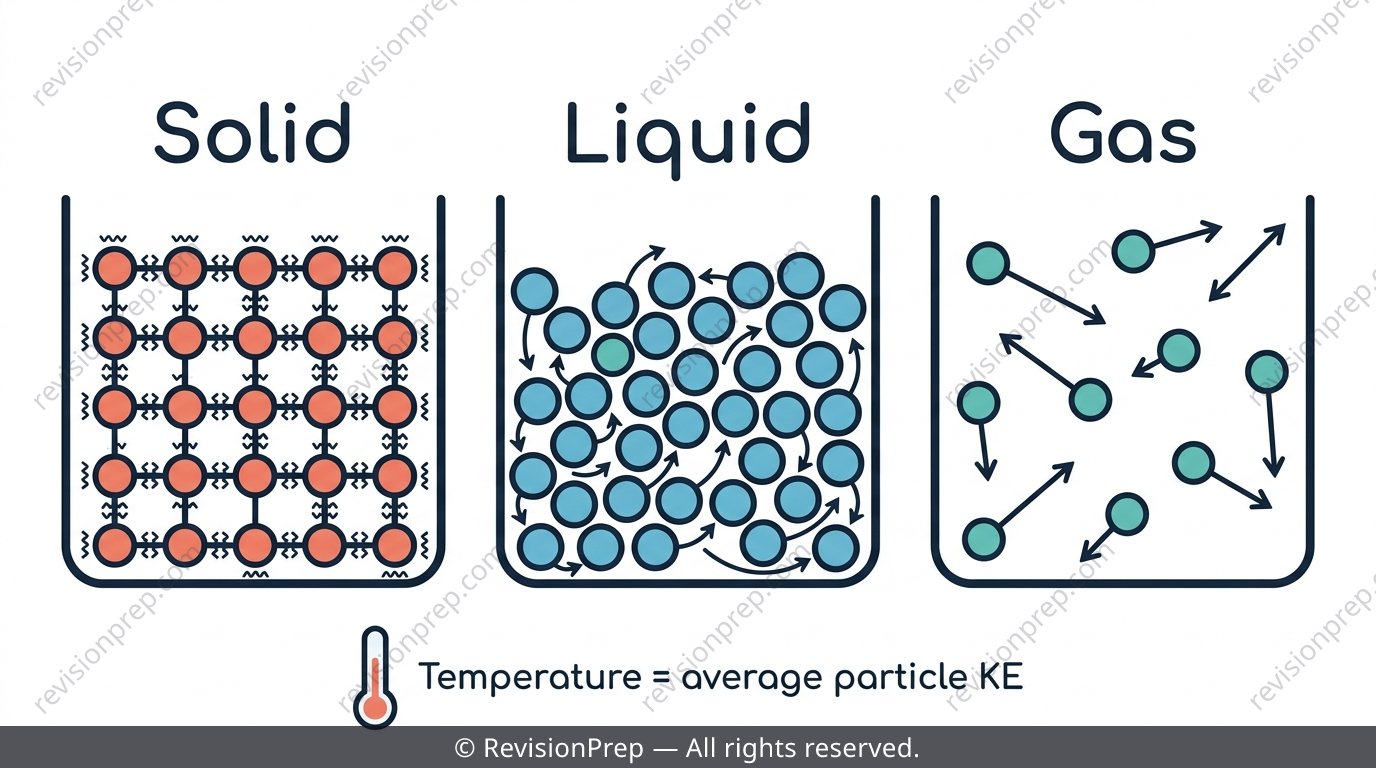
Everything in this topic rests on one idea: matter is made of particles in constant random motion. In solids, particles vibrate around fixed positions; in liquids, they slide past each other while staying close together; in gases, they fly freely between collisions. Temperature is directly proportional to the average random kinetic energy of these particles — it's a microscopic quantity dressed up as a macroscopic reading on a thermometer.
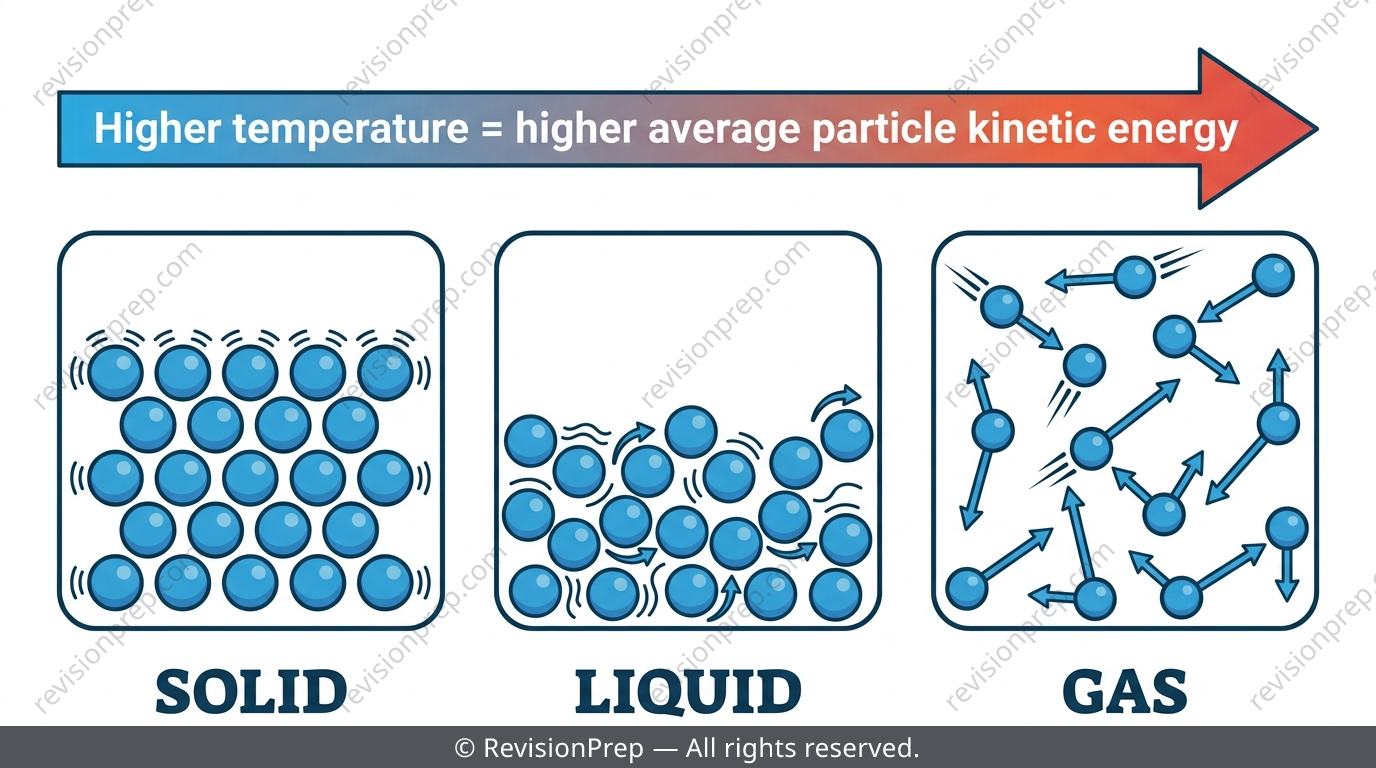
| State | Particle Arrangement | Particle Motion |
|---|---|---|
| Solid | Fixed positions, closely packed | Vibration only |
| Liquid | Close together, no fixed positions | Sliding past each other |
| Gas | Widely spaced | Free flight between collisions |
Common mistake
Treating temperature and heat as interchangeable — the syllabus deliberately separates them, and conflating them costs marks across both papers.
Mini summary
Temperature ∝ average random KE of particles; state determines how particles are arranged and how they move.
Conduction, Convection & Radiation
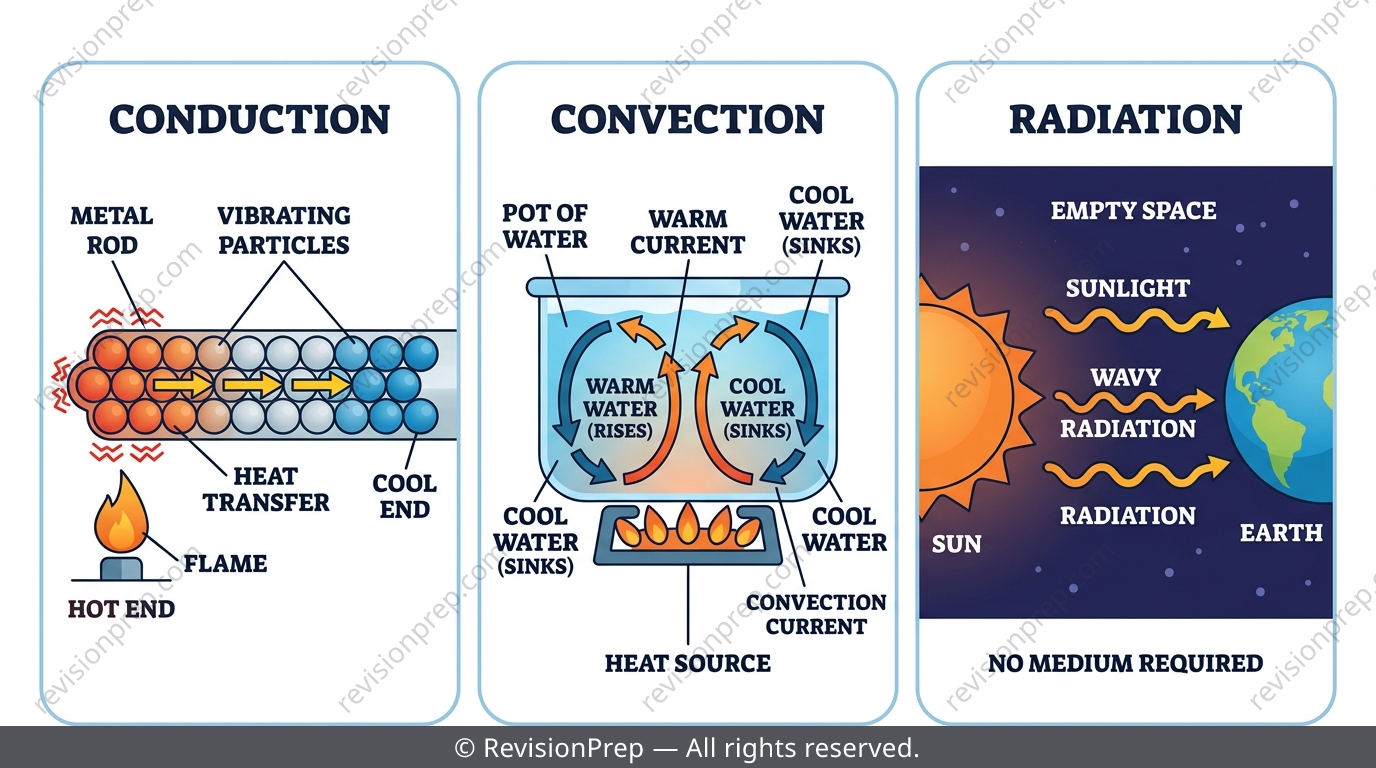
Thermal energy moves in three ways: conduction (particle-to-particle vibration and collision, needs a medium, fastest in solids/metals), convection (bulk movement of a fluid caused by density differences from heating, needs a fluid) and radiation (electromagnetic waves, needs no medium at all — this is how the Sun heats Earth through the vacuum of space). Spotting which mechanism applies is often just a matter of checking whether a medium is present.
| Mechanism | Requires a Medium? | Typical Example |
|---|---|---|
| Conduction | Yes (solid) | Heat travelling along a metal spoon |
| Convection | Yes (fluid) | Warm air rising in a room |
| Radiation | No | Sunlight travelling through space |
Exam tip
If a question mentions vacuum or space, the only possible transfer mechanism is radiation — this single fact resolves a huge fraction of multiple-choice distractors on this subtopic.
Mini summary
Conduction = particle contact, convection = fluid + density differences, radiation = no medium needed.
Internal Energy, Specific Heat & Latent Heat
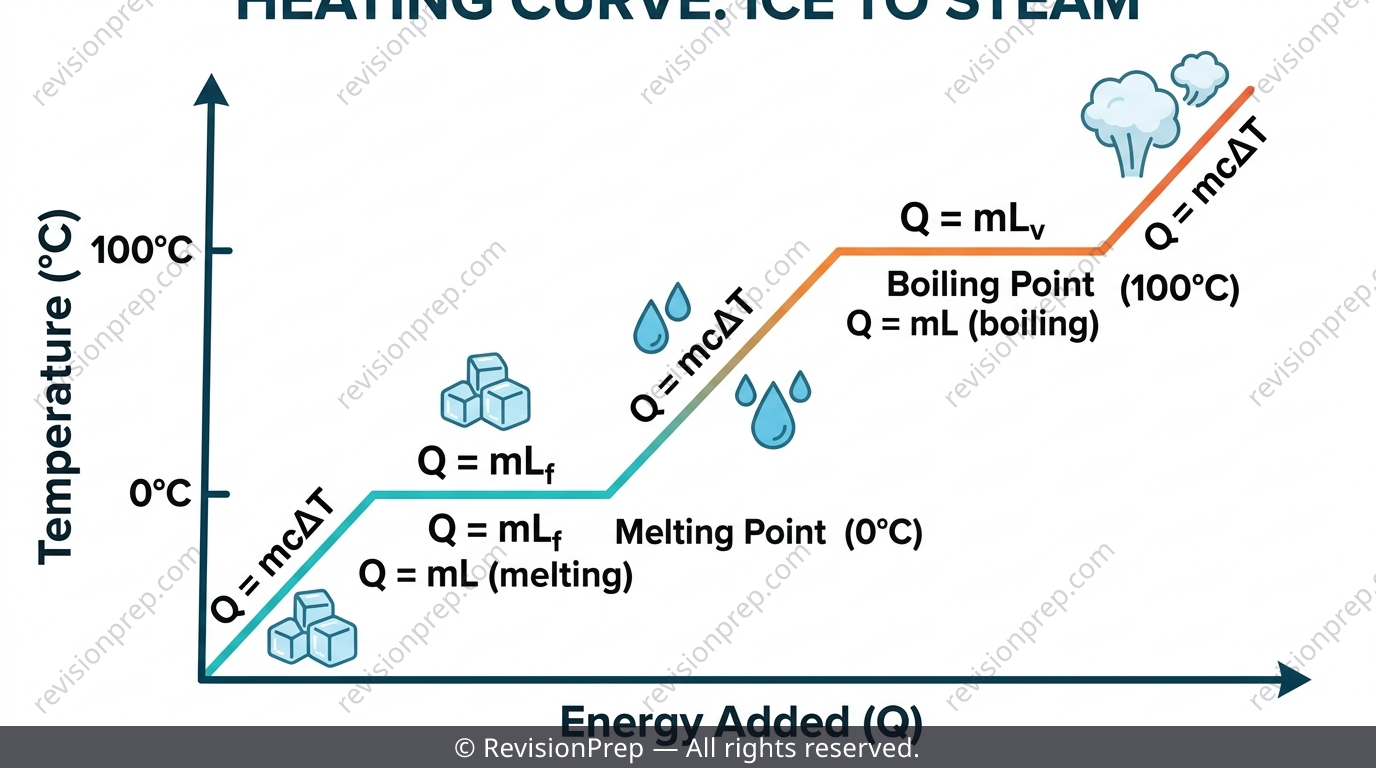
Internal energy is the total random kinetic energy plus total random potential energy of all particles in a system. During melting or boiling, temperature stays constant even though energy keeps flowing in, because that energy is breaking bonds between particles (raising PE) rather than speeding them up (raising KE). Use for a temperature change within one phase, and for a phase change at constant temperature — never mix the two for the same stage of a heating curve.
Exam tip
Before calculating anything, sketch the heating curve and count how many sloped (temperature-change) and flat (phase-change) sections the temperature range crosses.
Common mistake
Using one specific heat capacity value throughout a multi-stage problem, or forgetting a phase-change term entirely when converting ice to steam.
Mini summary
Internal energy = total KE + total PE; Q=mcΔT for temperature change, Q=mL for phase change — track each stage separately.
Greenhouse Effect & Radiative Equilibrium
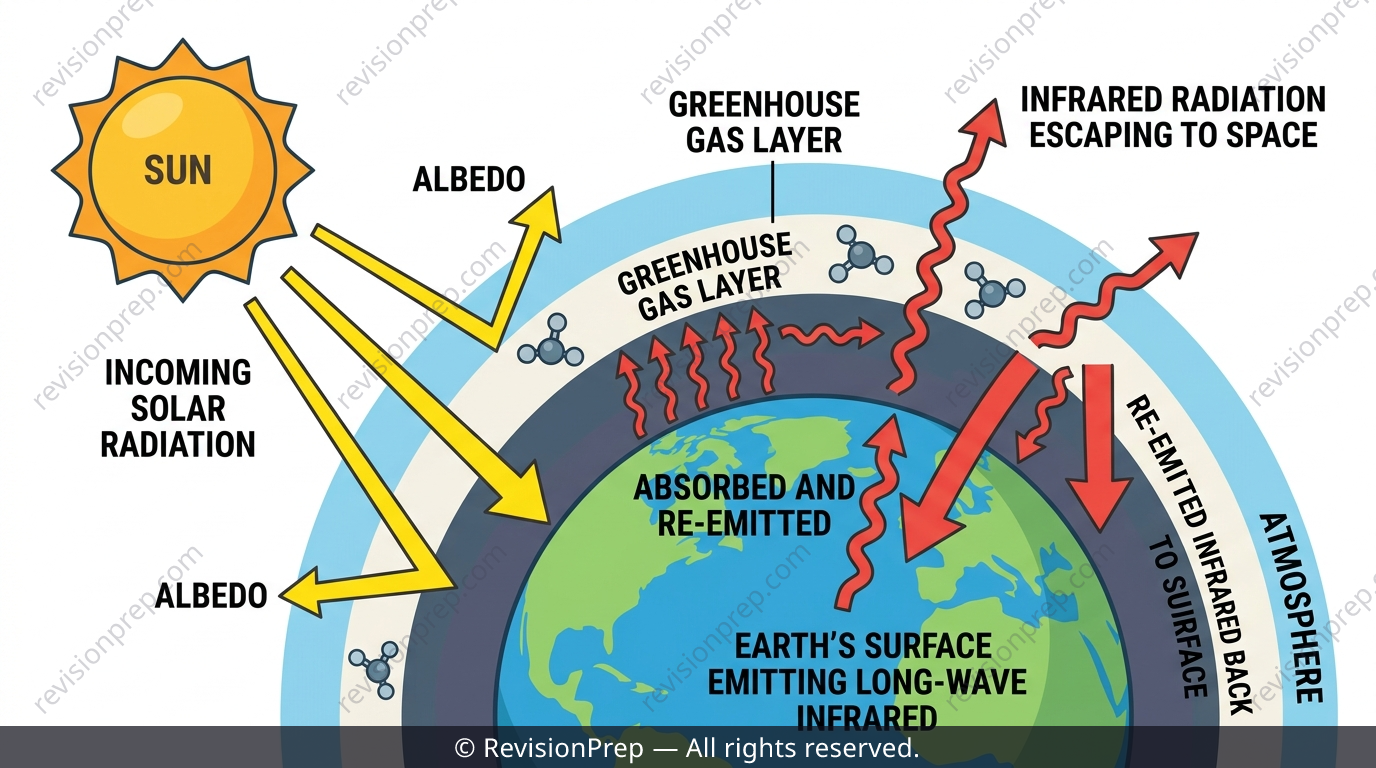
Earth stays roughly in radiative equilibrium: the rate it absorbs solar radiation equals the rate it emits thermal radiation back to space. All objects above absolute zero emit black-body radiation whose spectrum depends on temperature — the very hot Sun (~5800 K) peaks in visible light, while cool Earth (~255-288 K) peaks in infrared, per Wien's law. Greenhouse gases absorb this outgoing infrared radiation and re-emit it in all directions, including back down, warming the surface above what solar radiation alone would give.
Exam tip
When finding Earth's equilibrium temperature, remember absorbing area is (a disc) but emitting area is (a sphere) — forgetting this factor of 4 is the single most common error.
Common mistake
Describing the greenhouse effect as gases 'trapping heat like a blanket' with no mention of absorption and re-emission of infrared radiation.
Mini summary
Radiative equilibrium balances absorbed solar power against emitted black-body power; greenhouse gases absorb and re-emit outgoing IR, raising surface temperature.
The Ideal Gas Model & Pressure
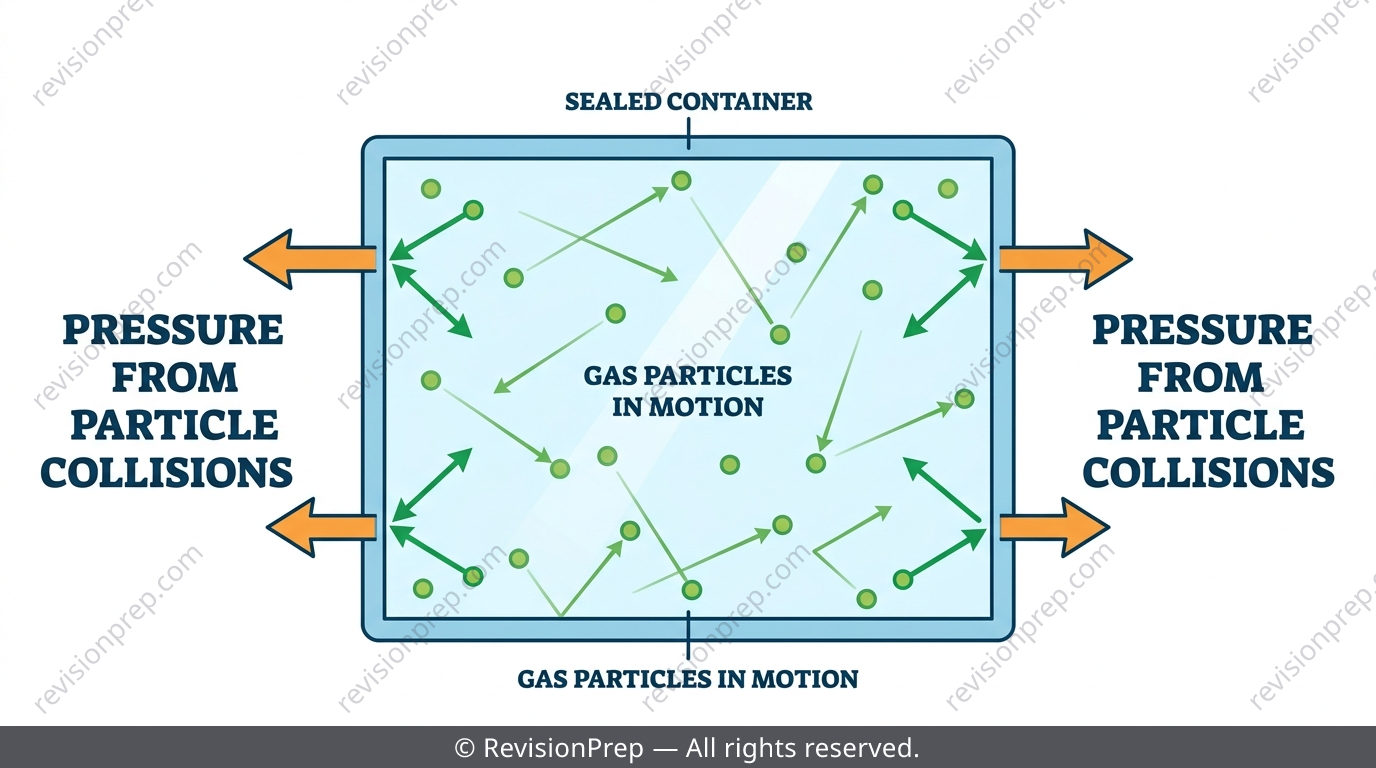
An ideal gas is modelled as a huge number of point particles in constant random motion, colliding elastically with each other and the container walls, with no intermolecular forces except during collisions. Pressure arises from the constant bombardment of particles on the walls — each collision transfers momentum, and the combined effect of countless collisions is what a pressure gauge measures. Temperature links directly to the average kinetic energy of these particles, tying the microscopic model to the macroscopic gas laws, which combine into one ideal gas equation valid for a fixed amount of gas.
Exam tip
Always convert temperature to Kelvin before using any gas-law equation — Celsius readings will give wrong pressures and volumes.
Common mistake
Plugging Celsius temperatures directly into pV=nRT instead of converting to Kelvin first.
Mini summary
Ideal gas particles collide elastically with no intermolecular forces except during collisions; pressure comes from wall collisions, temperature from average particle KE.
Quick formula sheet
Practice questions
- State the three states of matter and describe how particle arrangement differs between them.
- Define specific heat capacity and specific latent heat.
- Name the three mechanisms of thermal energy transfer and state which one works through a vacuum.
- Explain why temperature remains constant while a substance melts, even though energy is still being supplied.
- Explain, using the particulate model, why gas pressure increases when a fixed volume of gas is heated.
- Describe how greenhouse gases cause a planet's surface temperature to rise above the no-atmosphere prediction.
- Calculate the total energy required to convert a known mass of ice at -10°C into steam at 100°C, given appropriate specific heat and latent heat values.
- Using the Stefan-Boltzmann law and the factor of 4 between absorbing and emitting area, estimate a planet's equilibrium temperature given its albedo and the solar constant.
- Explain, using Wien's law, why the Sun's radiation peaks in the visible spectrum while Earth's peaks in the infrared, and why this matters for the greenhouse effect.
Frequently asked questions
What is the difference between heat and temperature in IB Physics?+
Temperature measures the average random kinetic energy of particles; heat is energy transferred between systems because of a temperature difference. Conflating the two is a common IB exam mistake.
Why does temperature stay constant during melting or boiling?+
Energy supplied during a phase change goes into breaking bonds between particles (increasing potential energy), not into speeding particles up (increasing kinetic energy), so temperature doesn't rise until the phase change is complete.
How do I know which heat transfer mechanism applies in a question?+
Check whether a medium is present: conduction needs solid particle contact, convection needs a fluid with density differences, and radiation needs no medium at all — the only option through a vacuum.
How does the greenhouse effect actually work?+
Greenhouse gases absorb outgoing infrared radiation emitted by Earth's surface and re-emit it in all directions, including back down, which raises the equilibrium surface temperature above what solar radiation alone would produce.
Why must I convert to Kelvin for gas law calculations?+
Gas law equations like pV=nRT require absolute temperature. Celsius has no absolute zero reference, so using it directly gives incorrect results — always convert with T(K) = θ(°C) + 273.
What causes gas pressure according to the particulate model?+
Pressure comes from countless gas particles colliding elastically with the container walls; each collision transfers momentum, and the combined effect of these impacts is what a pressure gauge registers.
Master the particulate nature of matter with the full IB DP Physics revision notes
Related articles