
Space, Time, and Motion
Kinematics, forces, momentum, and energy — the mechanics backbone of IB DP Physics
Quick facts
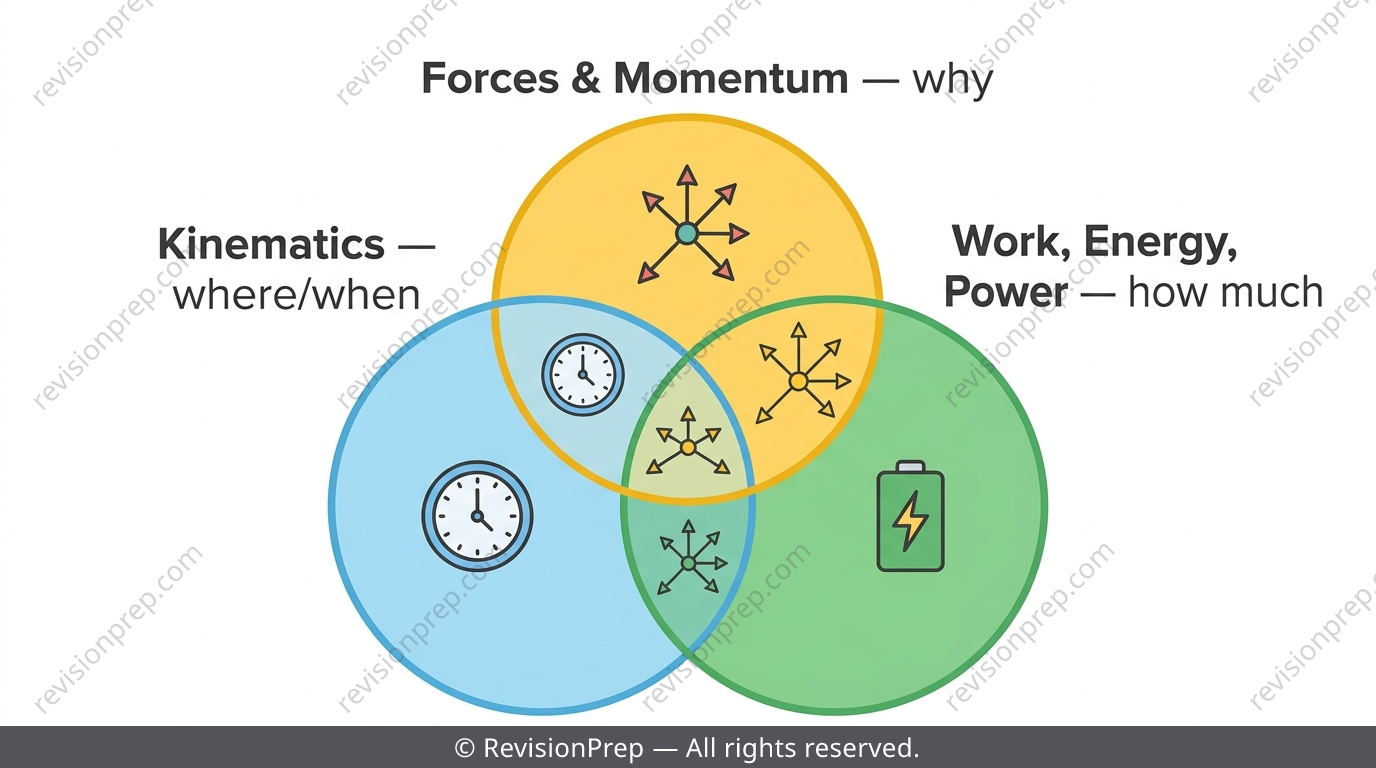
Space, Time, and Motion is the mechanics core of IB DP Physics, and it shows up everywhere — Paper 1 multiple choice, Paper 2 long answers, and frequently the Paper 3 data-based question. At its heart, every mechanics problem is asking one of three things: where and when (kinematics), why motion changes (forces and momentum), or how much capacity to do things was transferred (work, energy and power). Examiners deliberately blend these lenses within a single question, so recognising which one you're in is half the battle. This teaser walks through the five ideas that cause the most mark loss — SUVAT validity, projectile components, free-body thinking, the work-energy theorem, and power/efficiency — with the exact traps IB students fall into. For full worked examples, formula derivations and complete practice sets, the full revision notes go much deeper than this overview allows.
What you’ll be able to do
The Three Lenses of Mechanics
Every mechanics question is really asking about description (kinematics), cause (forces and momentum), or capacity (work, energy, power). Kinematics never mentions force or mass — if a question suddenly gives you mass and asks for a force, you've left kinematics behind. Spotting the lens early stops you reaching for the wrong toolkit halfway through a calculation.
Exam tip
Before writing anything, ask: is this asking where/when, why, or how much? That decides which equations are even valid.
Kinematics and the SUVAT Equations
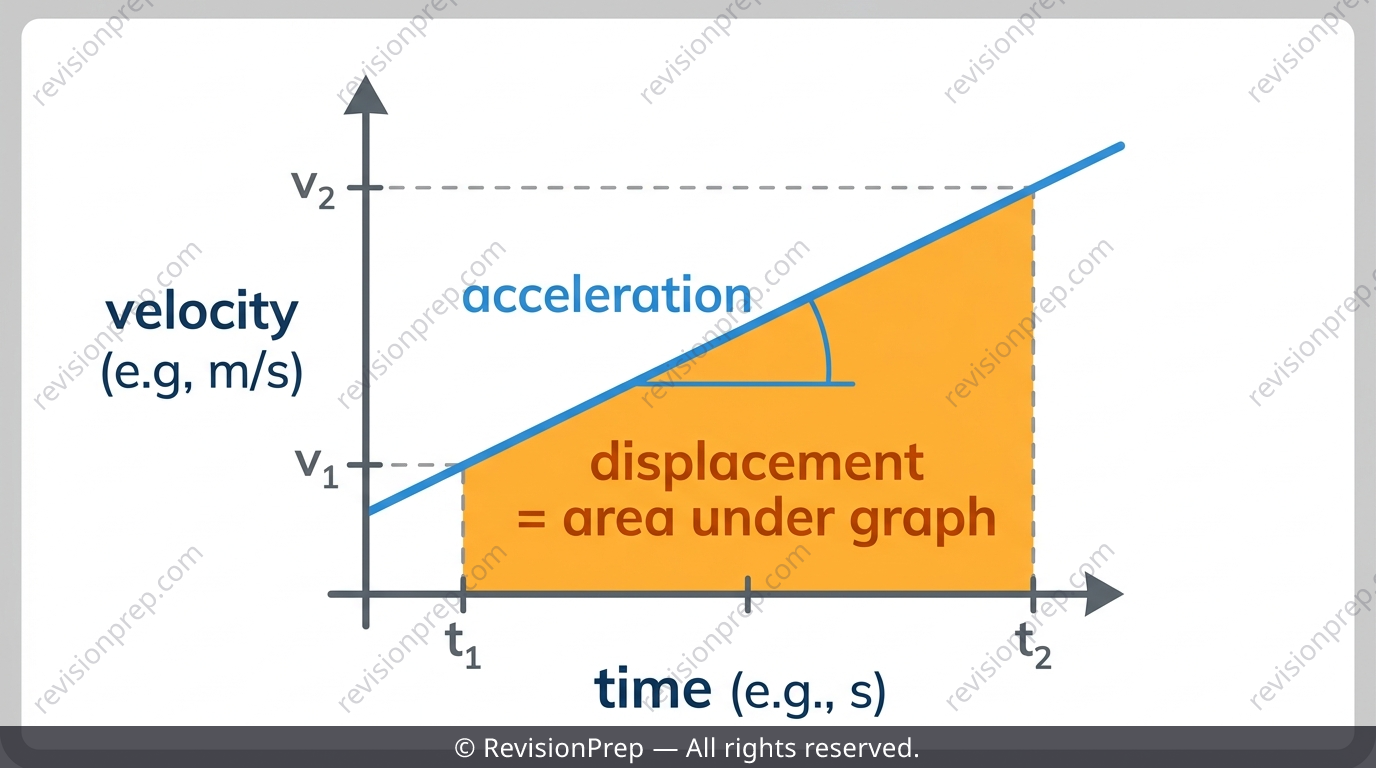
Kinematics describes motion purely through position, velocity and acceleration, with no reference to cause. The four SUVAT equations only apply when acceleration is constant — if acceleration changes with time, they become invalid. Remember displacement and velocity are vectors while distance and speed are scalars, so a round trip can have large distance but zero displacement.
| Missing variable | Equation to use |
|---|---|
| s | |
| v | |
| t | |
| a |
Common mistake
Mixing up which direction is positive mid-calculation — e.g. taking 'up' as positive for u but forgetting g must then be -9.8.
Projectile Motion: Independent Components
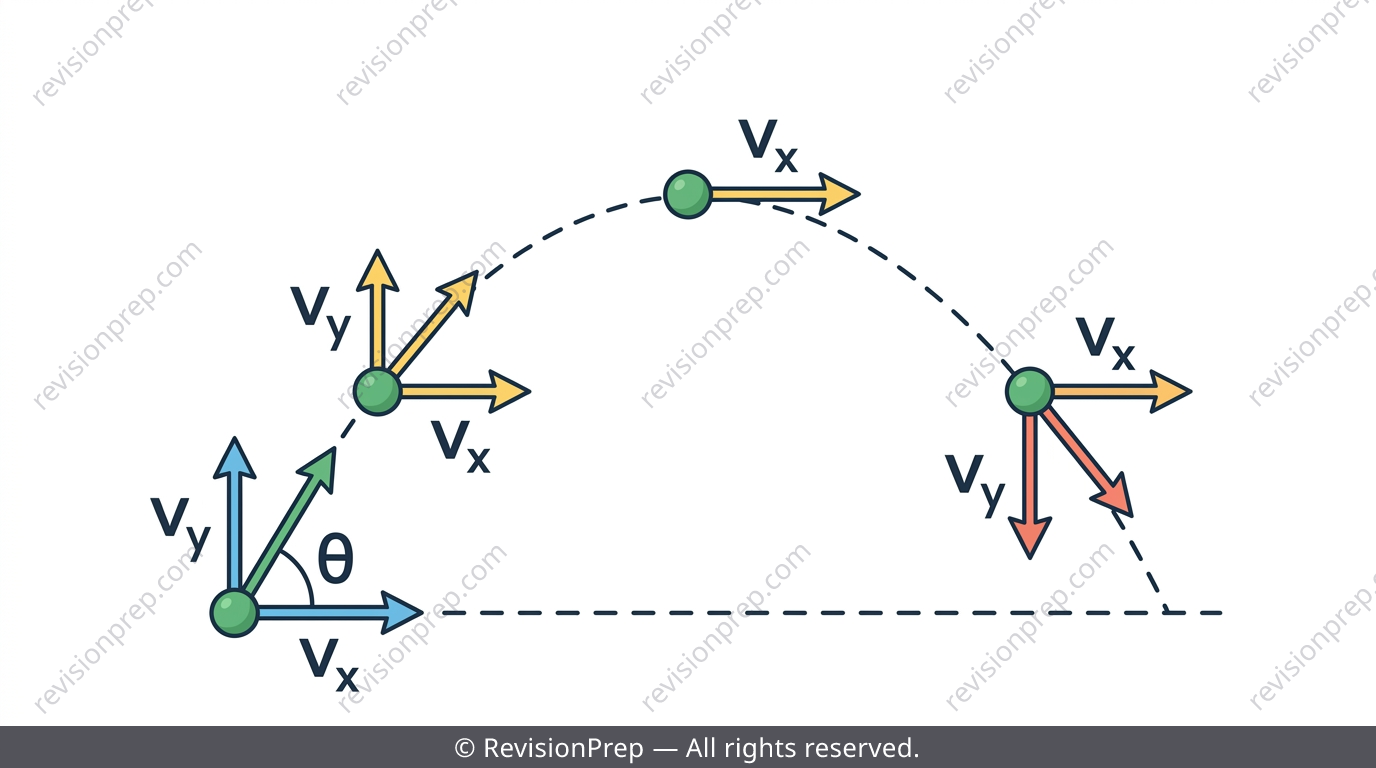
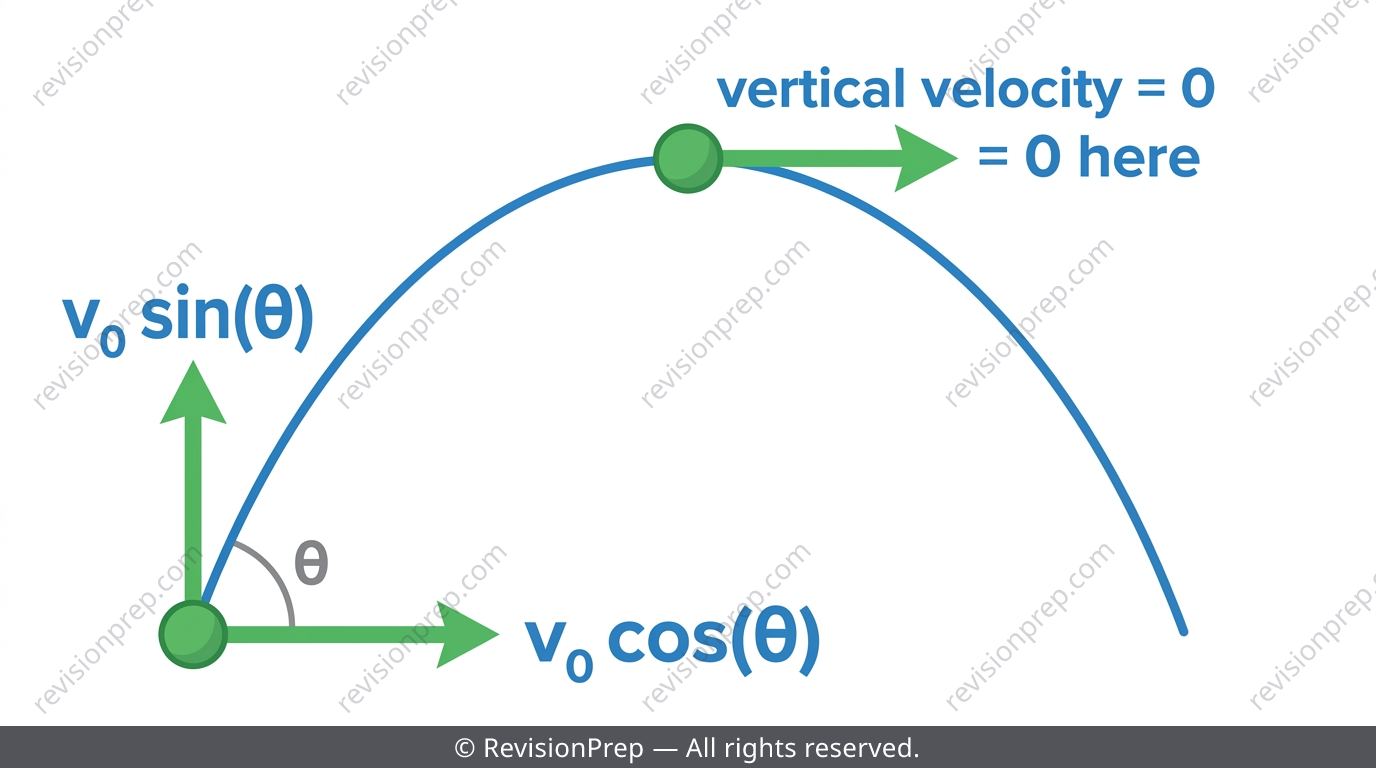
Projectile motion treats horizontal and vertical motion completely independently. Horizontal velocity stays constant (no air resistance), while vertical motion accelerates at downward — time is the only link between the two. At the peak of the flight, only the vertical velocity is zero; the horizontal component is still moving.
Exam tip
For 'show that maximum height is X m' questions, set vertical velocity to zero at the peak, never the full velocity vector.
Common mistake
Using the resultant launch speed instead of just the vertical component inside the vertical SUVAT equation — this produces a wrong but plausible-looking answer.
Forces, Newton's Laws and Momentum
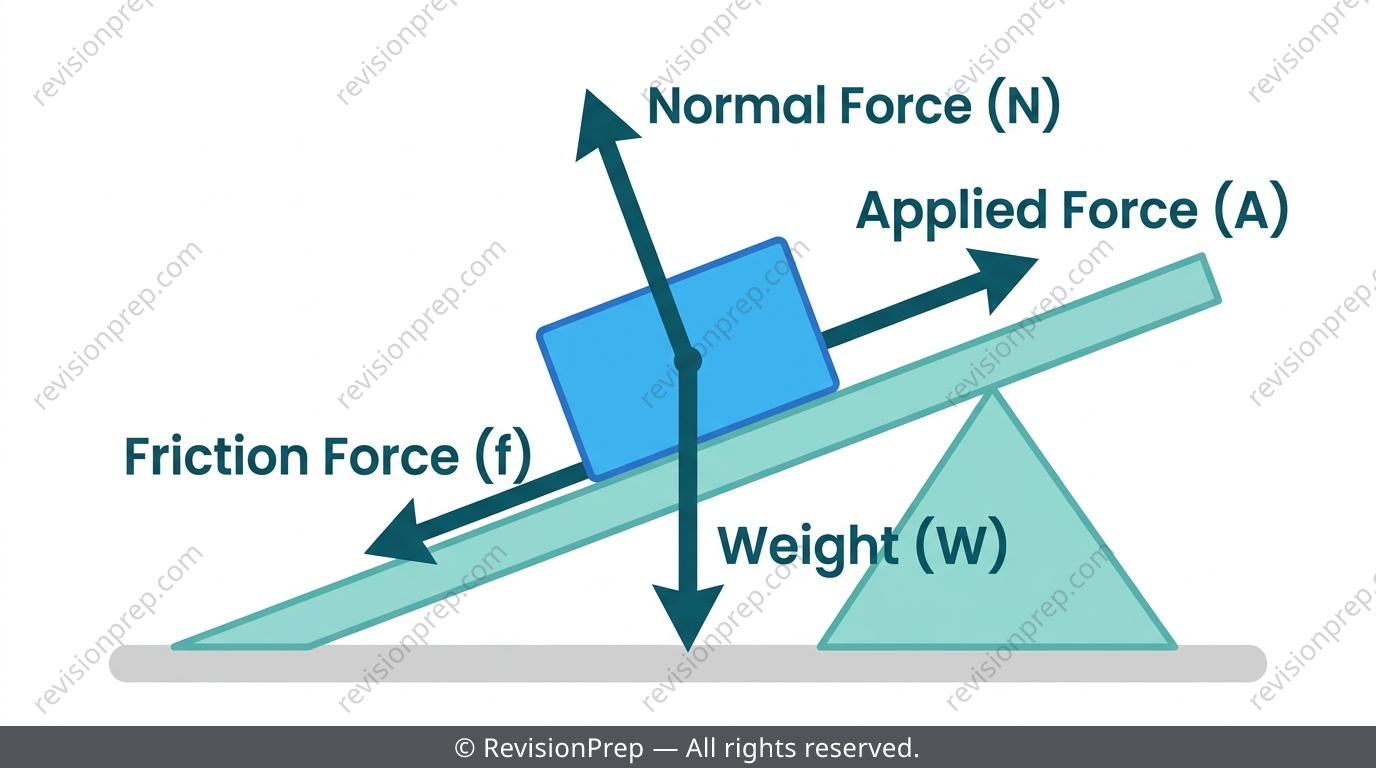
Newton's first law says an object stays at constant velocity unless a net external force acts — several forces can be present and still cancel to zero. The second law, , is a special case of . Forces questions live and die on correct free-body diagrams; a wrong diagram guarantees a wrong answer even with perfect algebra afterwards.
Common mistake
Confusing when momentum is conserved with when energy is conserved — they hold under different conditions, and this is the single most common Topic A error.
Work, Energy, and Power
Work is only done when a force causes displacement in the direction of that force — a perpendicular force like normal force or centripetal force always does zero work. The work-energy theorem says net work equals the change in kinetic energy, which is more reliable than tracking every individual force's work. Gravitational PE change depends only on vertical height change, never on the path taken, and power is simply the rate of doing work, with real-machine efficiency always below 1 due to dissipation.
Exam tip
'Show that' energy questions require every substitution written out explicitly, including g = 9.8 and units at each stage — a correct final number with no working can score zero.
Common mistake
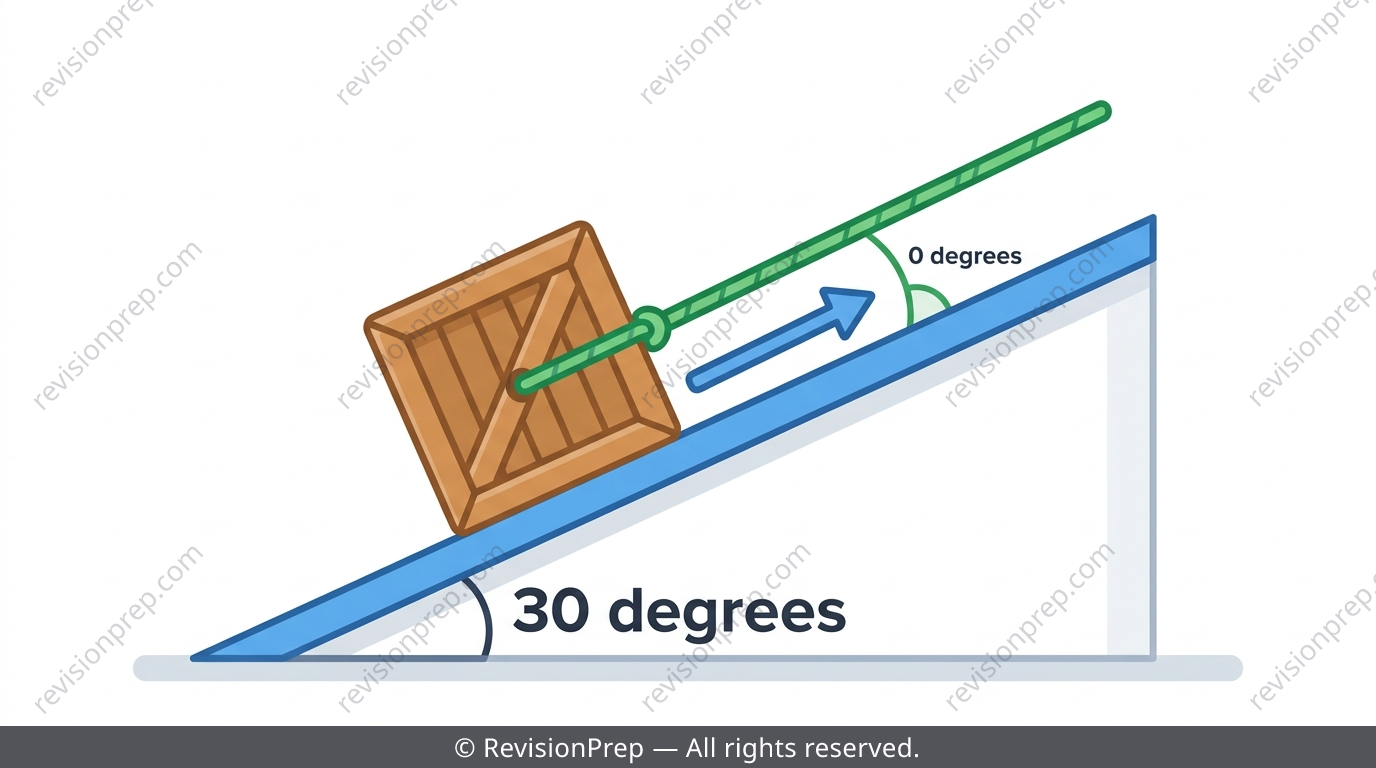
Automatically plugging the incline angle into for the work formula, even when the force in question (like a rope parallel to the ramp) makes a 0° angle with displacement.
Mini summary
Work needs a force and a displacement component along it; net work = ΔKE; GPE depends only on height; efficiency is always less than 1.
Quick formula sheet
Practice questions
- State the difference between distance and displacement, giving an example where they differ.
- Write down the SUVAT equation you would use if you know u, a, t and want s, but not v.
- Explain why the normal force on someone walking on flat ground does zero work.
- A ball is dropped from rest and falls for 2.0 s before hitting the ground. Calculate its final velocity and the distance fallen (g = 9.8 m/s²).
- A 5.0 kg object is pushed 4.0 m across a floor by a horizontal force of 10 N while friction does -8 J of work. Use the work-energy theorem to find the change in kinetic energy.
- Explain, using force-balance reasoning, why a skydiver eventually reaches terminal velocity.
- A projectile is launched at 25 m/s at 35° above the horizontal from ground level. Find the time of flight and the horizontal range (ignore air resistance, g = 9.8 m/s²).
- A crate is pulled at constant speed up a frictional ramp inclined at 20° by a rope parallel to the ramp. Explain how you would set up the work calculation for the rope's force and for gravity's force separately, including which angles you'd use.
- Explain why energy is always conserved overall even when mechanical energy is not, and give an example of where the 'missing' mechanical energy goes.
Frequently asked questions
What is Space, Time and Motion in IB DP Physics?+
It's the mechanics topic covering kinematics, forces, momentum, work, energy and power — describing and explaining motion and its causes. It makes up roughly a fifth of the SL course and is tested across all three exam papers.
When can I use the SUVAT equations?+
Only when acceleration is constant in both magnitude and direction. If acceleration changes with time, SUVAT equations no longer apply and you'd need a different approach.
Why does a force perpendicular to motion do no work?+
Work requires a displacement component in the direction of the force. If the force is perpendicular to the motion, that component is zero, so no energy is transferred — this is true for normal forces and centripetal forces.
How do I know whether to use conservation of momentum or conservation of energy?+
Momentum is conserved in any isolated collision or interaction with no external net force, regardless of whether the collision is elastic. Mechanical energy is only conserved additionally if no resistive or dissipative forces act — confusing these two conditions is the most common error in this topic.
What causes terminal velocity in a falling object?+
As speed increases, drag force grows until it exactly balances the object's weight. At that point net force is zero, so the object stops accelerating and falls at a constant terminal velocity.
Why is efficiency always less than 1 in real machines?+
Because some input energy is always dissipated, usually as heat through friction or resistance, so useful output energy is always less than total input energy.
Master Space, Time, and Motion with the Full Revision Notes
Related articles