
The Particulate Nature of Matter
IB DP Physics Theme B: the sign conventions, traps, and formulas that decide marks in thermodynamics and thermal transfer.
Quick facts
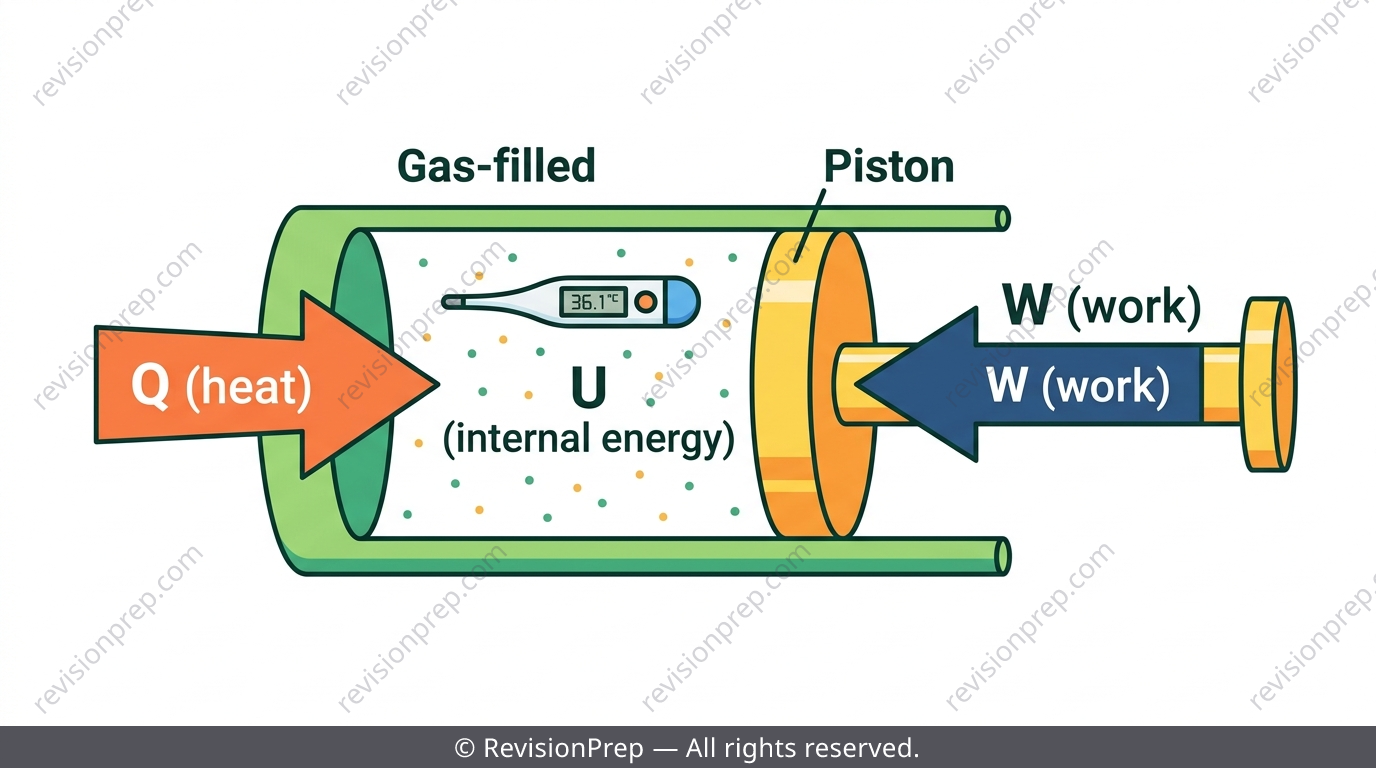
The particulate nature of matter is the thread that ties together every calculation in IB DP Physics Theme B — from a compressed gas cylinder to a radiating star. At its core sit two ideas examiners test relentlessly: the first law of thermodynamics, , and the fact that thermal energy always moves hot to cold, whether by conduction, convection or radiation. HL students face an extra layer — entropy, reversible processes, and heat engine efficiency — where a single sign error or a forgotten kelvin conversion can cost marks across Paper 1, Paper 2 and Paper 3. This teaser walks through the five concepts that generate the most exam traps: the IB sign convention, the isothermal ΔU=0 shortcut, entropy and efficiency, the three heat transfer mechanisms, and black-body radiation. The full revision note goes deeper with worked examples, the four named-process table, and every distractor examiners love to plant.
What you’ll be able to do
The First Law of Thermodynamics and the IB Sign Convention
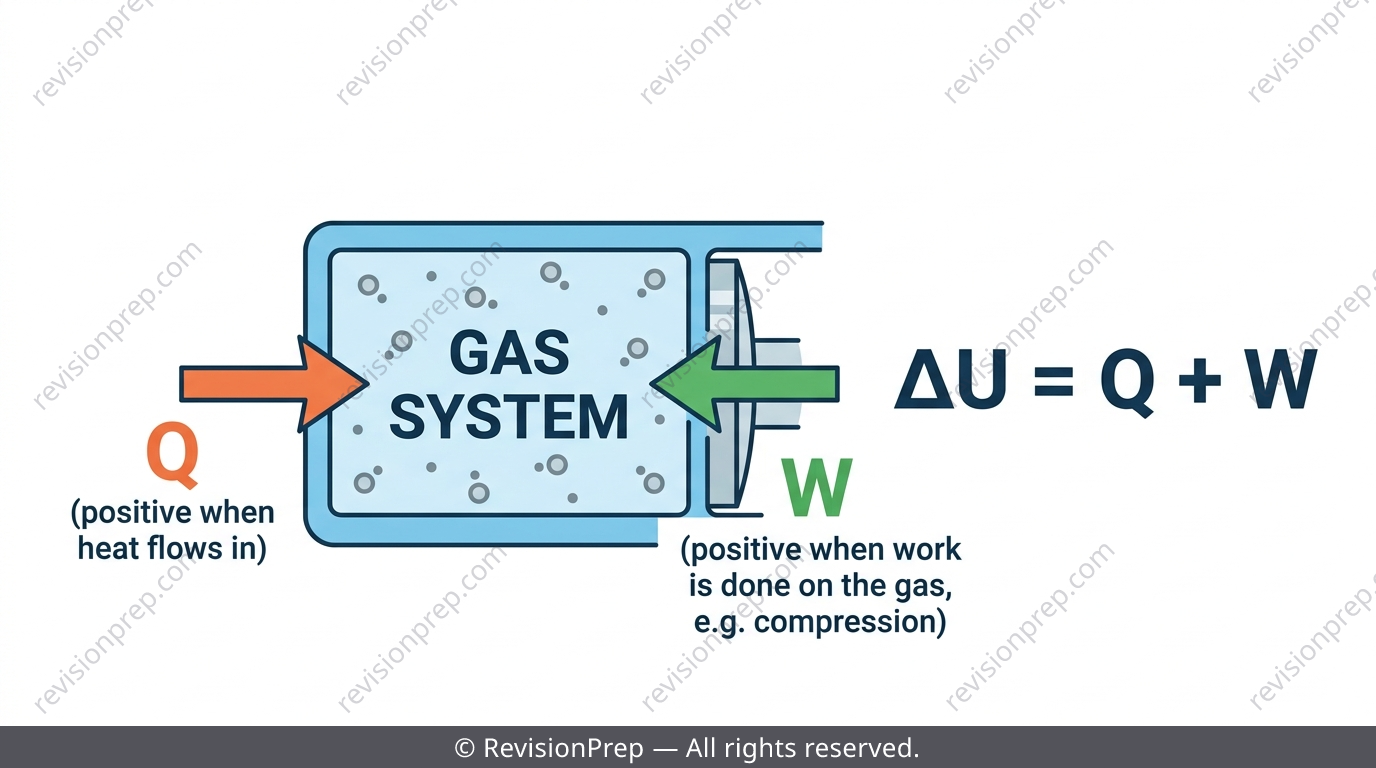
Internal energy is the total kinetic and potential energy of every particle in a system — it is not the same thing as temperature (the average random KE per particle) or thermal energy transferred. The first law, , is just conservation of energy applied to a gas, but IB defines as the work done ON the gas: compressing a gas gives , letting it expand and push a piston gives . Getting this backwards is the single most common way to lose marks in this section.
Exam tip
Before substituting any numbers, write in words: 'W is work done ON the gas, positive when compressed.' Anchor every value to that sentence first.
Common mistake
Using ΔU = Q − W with W defined as work done BY the gas, then mixing it with IB-style data where W is work done ON the gas.
Mini summary
ΔU = Q + W, with W always meaning work done ON the gas in IB convention.
Why Isothermal Processes Always Have ΔU = 0
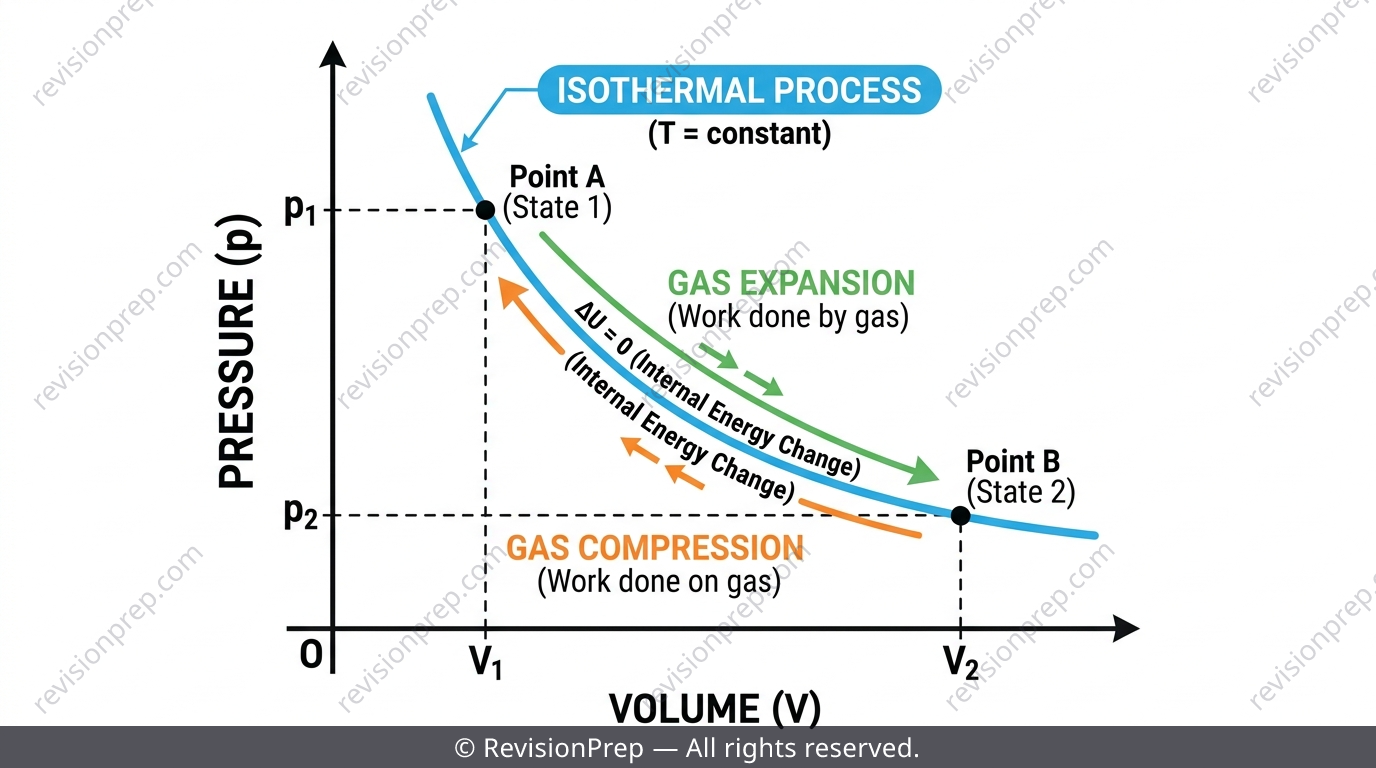
For an ideal gas, internal energy depends ONLY on temperature — nothing else. So whenever a process is described as isothermal, is guaranteed, no matter what Q and W turn out to be. Students who reflexively reach for and go hunting for a value of Q often fall straight into a wrong-answer trap that the isothermal condition was designed to avoid.
Common mistake
Reflexively writing ΔU=Q+W and hunting for a Q value to substitute, instead of recognising that 'isothermal + ideal gas' should trigger ΔU=0 immediately.
Mini summary
Ideal gas + isothermal process = ΔU=0, always — check the process type before touching the first law equation.
Entropy, Heat Engines and the Efficiency Ceiling
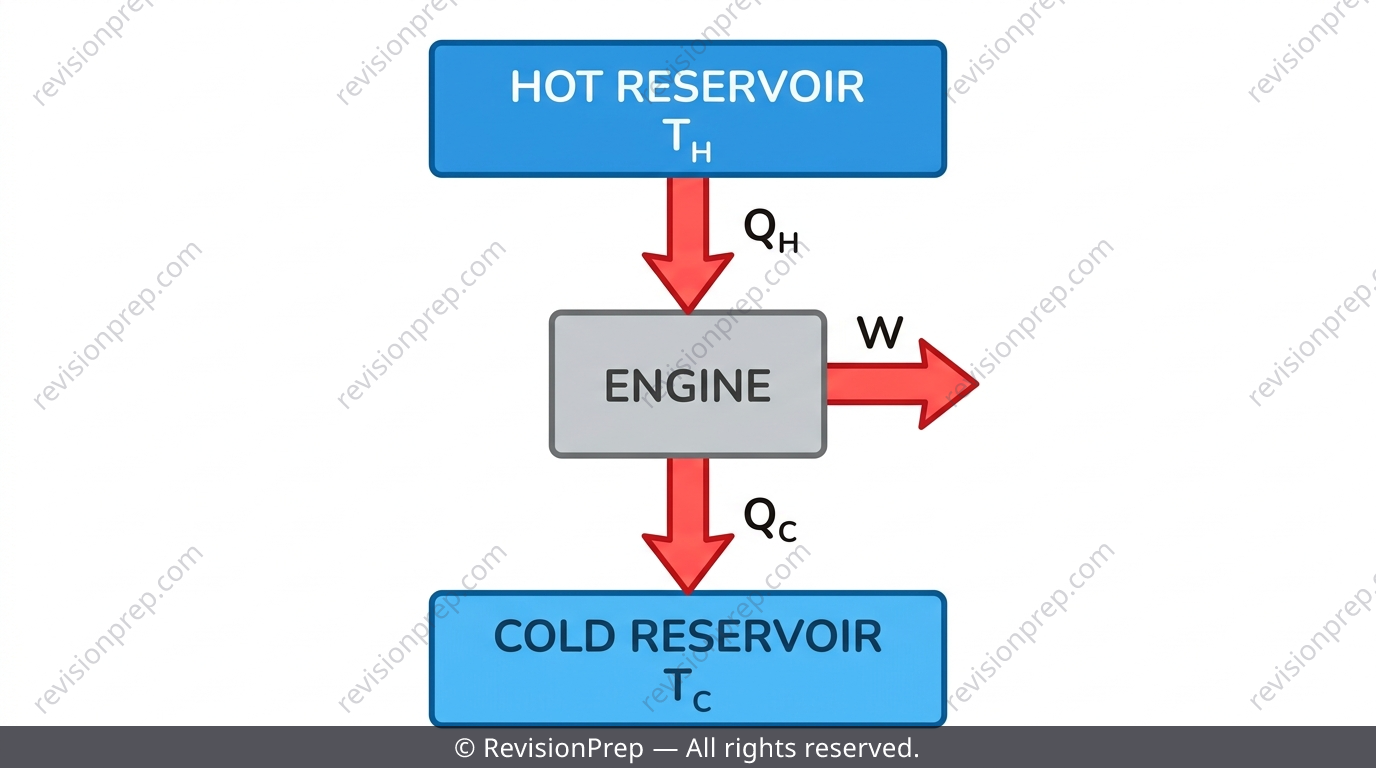
Entropy measures the number of microscopic arrangements consistent with a system's macroscopic state, and for a reversible process at constant temperature, . Heat engines convert thermal energy from a hot reservoir into useful work while rejecting the rest to a cold reservoir, giving efficiency . No real engine beats the Carnot ceiling, , which strictly requires temperatures in kelvin.
Exam tip
ΔS=Q/T only applies to a reversible process at constant temperature — check the process type stated in the question before reaching for it.
Common mistake
Writing η=Q_C/Q_H instead of 1−Q_C/Q_H, or using reservoir temperatures in °C instead of kelvin in the Carnot formula.
Mini summary
Efficiency η = 1 − Q_C/Q_H, capped by the Carnot limit 1 − T_C/T_H in kelvin.
Conduction, Convection and Radiation: Which Mechanism, Which Equation
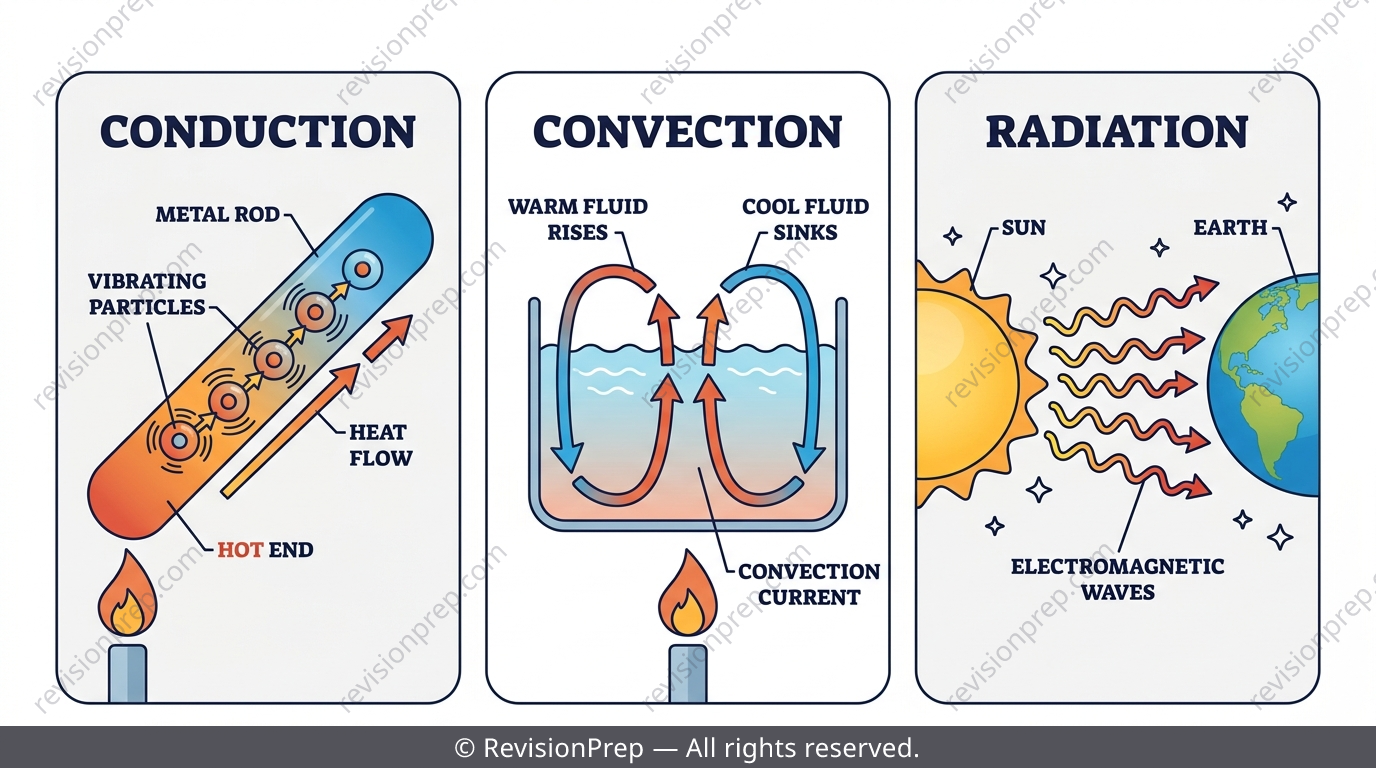
Thermal energy always moves spontaneously from hot to cold, but the route depends on what's available: conduction is particle-to-particle collision (dominant in solids, especially metals with free electrons), convection needs a fluid that can develop density differences and circulate, and radiation is the only mechanism that works through a vacuum — it's how the Sun's energy reaches Earth at all. Specific heat capacity () and specific latent heat () describe the energy involved without saying which mechanism delivered it.
Common mistake
Using a Celsius value correctly inside Q=mcΔT (fine, since it's a difference), then reusing that same numeric value in an equation that needs absolute temperature.
Mini summary
Conduction needs contact, convection needs a fluid, radiation needs nothing — it's the only one crossing a vacuum.
Black-Body Radiation: Stefan–Boltzmann and Wien's Law
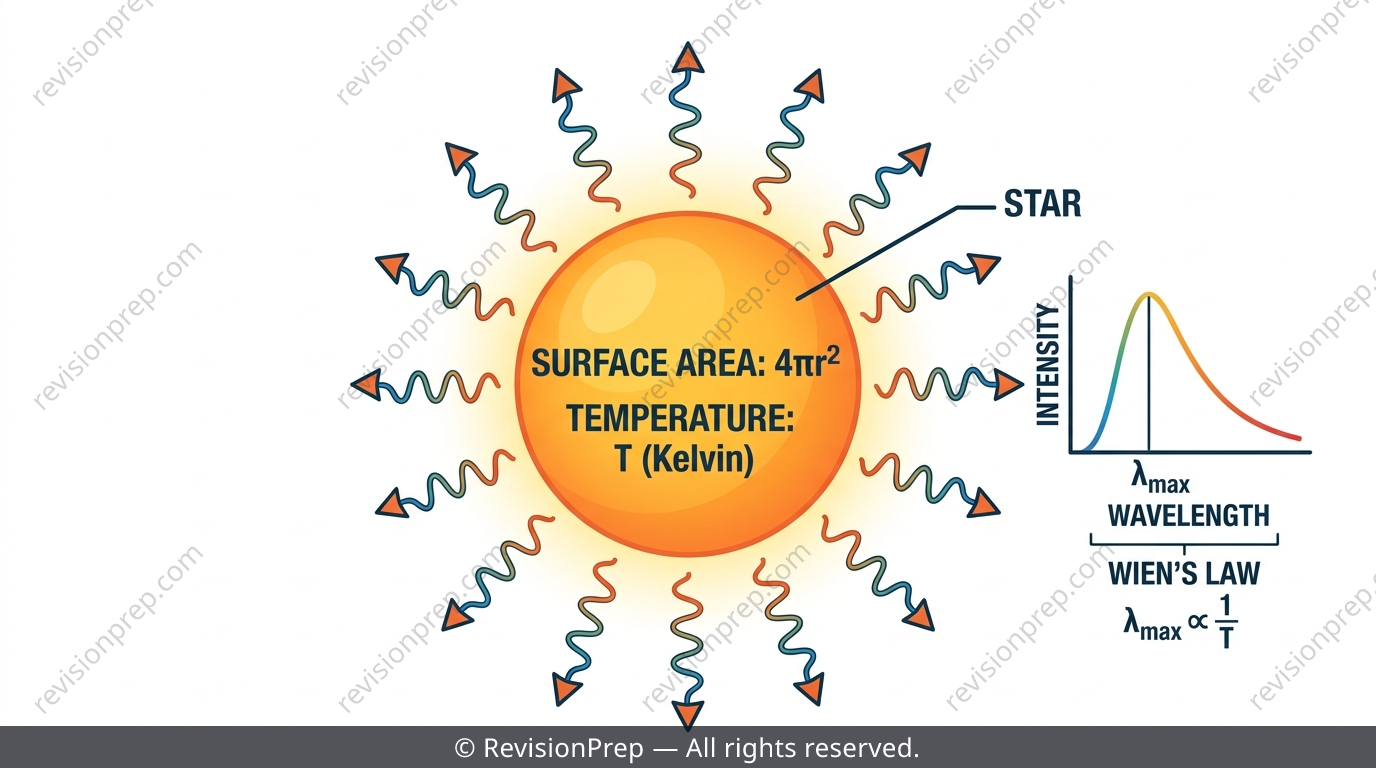
A black body absorbs all incident radiation and emits the maximum possible for its temperature; emissivity scales a real surface's output relative to that ideal. Total radiated power follows the Stefan-Boltzmann law, , while Wien's law, , links peak emitted wavelength to absolute temperature. Both formulas demand kelvin, and for a sphere like a star, the radiating surface area is , not a flat disc.
Exam tip
Convert to kelvin the moment absolute temperature T (not a temperature difference) appears in an equation — make it a reflex.
Common mistake
Forgetting the 4πr² spherical surface area and using a flat disc area (πr²) instead, which silently divides the radiated power answer by 4.
Mini summary
P=eσAT⁴ and λmaxT=constant both need absolute temperature and, for spheres, the full 4πr² surface area.
Quick formula sheet
Practice questions
- State the IB sign convention for W in the first law of thermodynamics.
- Why does temperature differ from internal energy for a gas?
- Name the only heat transfer mechanism that works through a vacuum.
- A gas absorbs 150 J of thermal energy and does 90 J of work on a piston during expansion. Find the change in internal energy.
- A power plant absorbs 500 MJ and rejects 350 MJ per cycle. Find its thermal efficiency.
- Explain why an isothermal process for an ideal gas always has ΔU = 0, regardless of Q and W.
- A steam engine operates between 500 K and 300 K, absorbing 600 J per cycle. Find the maximum possible work output.
- An ideal gas expands isothermally at 300 K, doing 500 J of work on the piston. Find the entropy change of the gas.
- A star's spectrum peaks at 580 nm and has radius 7.0×10⁸ m. Estimate its total radiated power, explaining which surface area formula you use and why.
Frequently asked questions
What is the IB sign convention for work done on a gas?+
W is defined as work done ON the gas: compressing a gas gives W>0, and a gas expanding to push a piston gives W<0, even though its volume is falling or rising respectively.
Why is ΔU = 0 for an isothermal process?+
For an ideal gas, internal energy depends only on temperature. If temperature doesn't change, internal energy can't change, regardless of the values of Q and W in that process.
When should I use ΔS = Q/T?+
Only for a reversible process happening at constant absolute temperature. If the process isn't reversible or temperature changes during it, this formula doesn't apply directly.
What's the difference between Q=mcΔT and Q=mL?+
Q=mcΔT calculates energy needed to change temperature with no phase change, while Q=mL calculates energy needed to change state at constant temperature — check for a phase change first.
Why does the Carnot efficiency formula need kelvin?+
The ratio T_C/T_H only gives the correct physical meaning when both temperatures are absolute (kelvin); using °C values silently corrupts the ratio and the resulting efficiency.
How much of the IB Physics exam covers this topic?+
Theme B, which includes the particulate nature of matter, makes up roughly 14–16% of total HL teaching time and is tested across Paper 1, Paper 2 and Paper 3.
Get the full IB DP Physics Theme B revision notes
Related articles