
Nuclear and Quantum Physics
Photons, matter waves, radioactive decay and HL quantum rules — the exam-ready essentials.
Quick facts
Nuclear and quantum physics is one of the most graph-heavy, formula-dense corners of IB DP Physics — and it shows up guaranteed in Paper 1 and Paper 2 every single session. The topic hinges on a handful of signature ideas: light and matter behaving as both particles and waves, unstable nuclei decaying according to a precise exponential law, and (at HL) the strange rules of wavefunctions, uncertainty and confined-particle energy levels. Examiners love testing whether you can read meaning off a graph's gradient or intercept rather than just plugging numbers into an equation. This teaser walks through the five ideas that appear most often — the photoelectric effect, de Broglie wavelength, radioactive decay, alpha/beta/gamma transformations and HL quantum mechanics — with the exact traps students fall into. For the full worked examples, formula derivations and complete practice sets, head to the full revision notes.
What you’ll be able to do
The Photoelectric Effect: Light Behaving as Photons
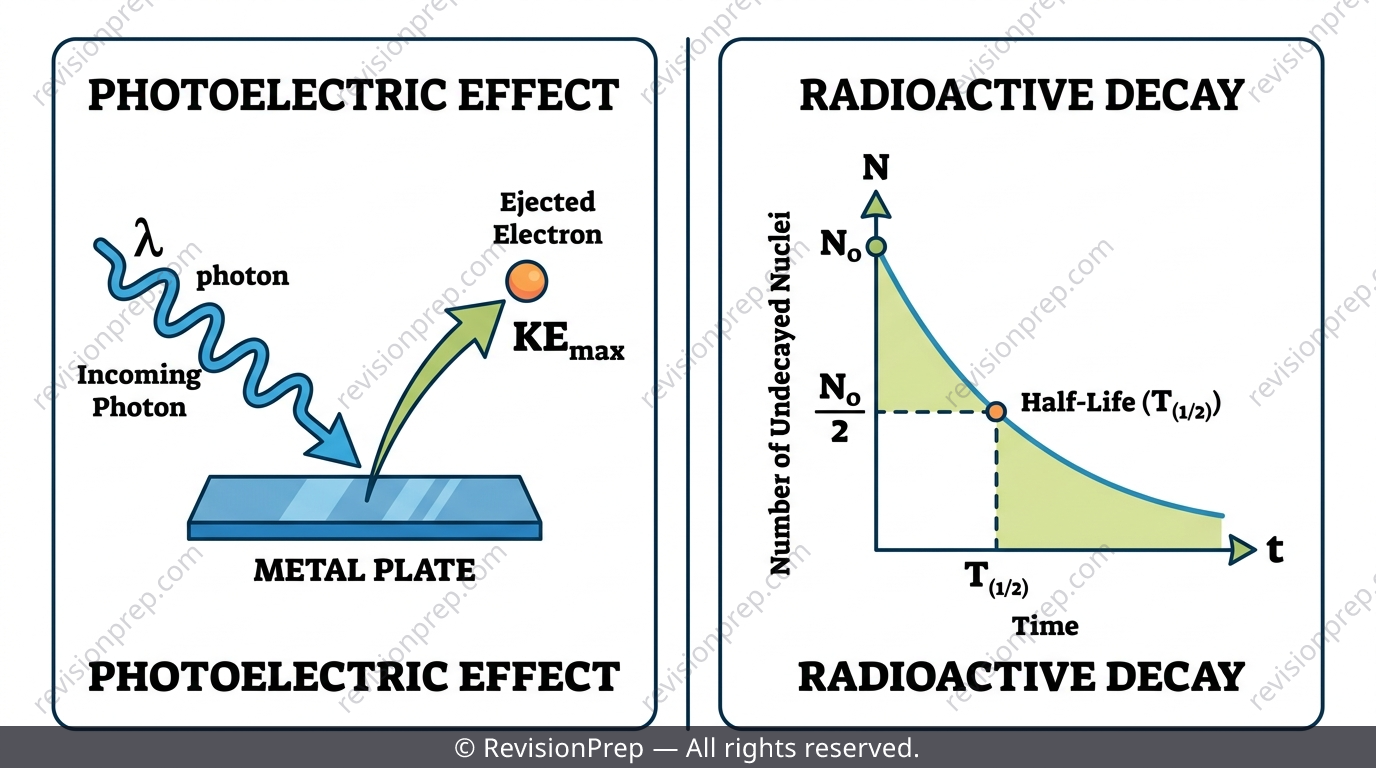
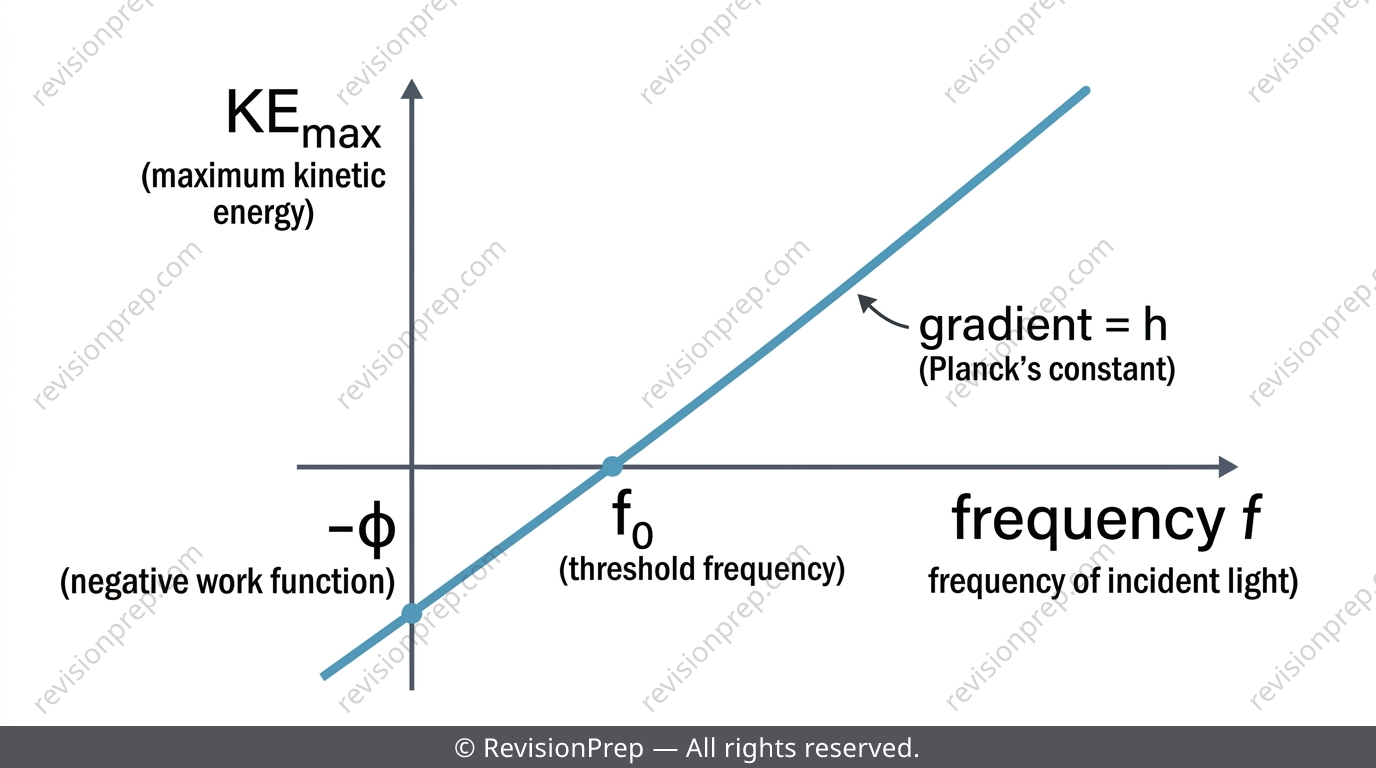
Shine light on a metal and electrons only get ejected instantly once the frequency clears a sharp threshold, — no matter how intense a lower-frequency beam is, nothing happens. This only makes sense if light arrives as discrete photons of energy , where raising intensity increases photon number but never photon energy. Einstein's equation turns this into a straight-line graph: gradient , y-intercept , x-intercept .
Exam tip
Calculate the photon energy once and reuse the exact value across a question — recomputing it separately for each metal or threshold introduces rounding drift that costs marks.
Common mistake
Confusing the incident frequency with the threshold frequency — is always lower than the incident frequency whenever photoemission actually happens.
Mini summary
Photon energy depends only on frequency; intensity changes photon rate, never photon energy.
de Broglie Waves: Matter Behaving Like a Wave
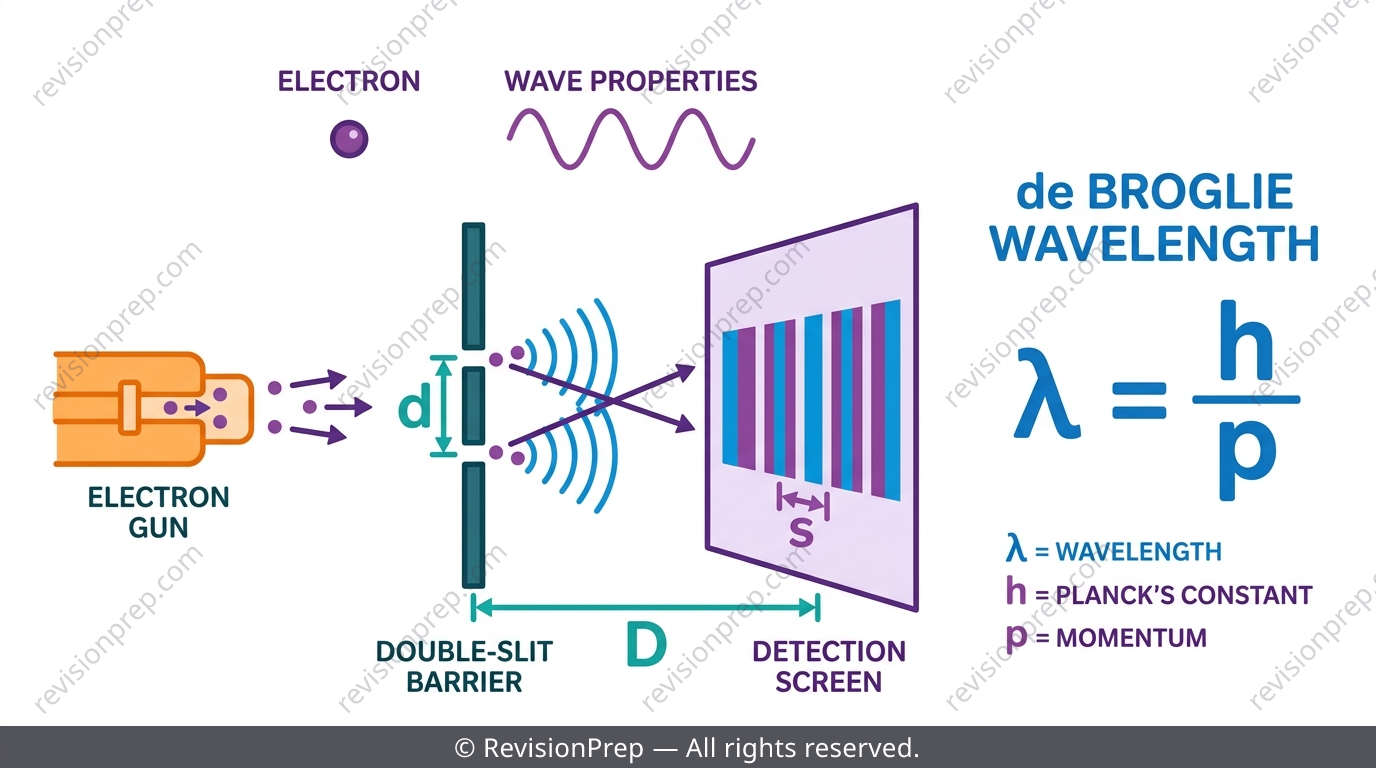
If light can behave as a particle, de Broglie argued matter must be able to behave as a wave too, with wavelength . Electron and neutron diffraction experiments confirm this directly — particles produce fringe and diffraction patterns exactly like light does, and Bragg's law describes diffraction off crystal planes.
Exam tip
Sanity-check fringe spacing answers: with tiny matter wavelengths, the calculated fringe spacing should come out far smaller than the slit separation used.
Common mistake
Using instead of in Bragg's law — the glancing angle is measured from the crystal plane, not the normal.
Radioactive Decay: Random Nuclei, Exponential Population
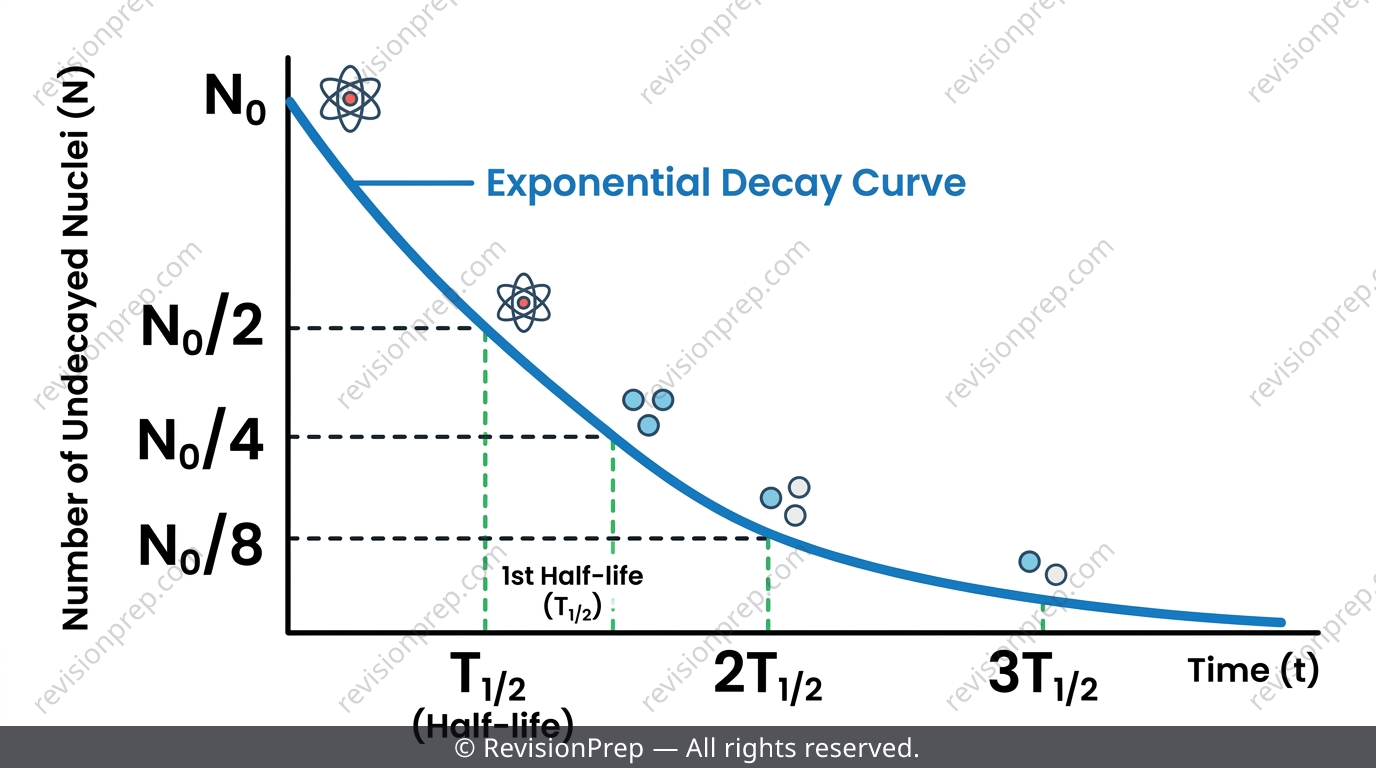
You can never predict when one specific unstable nucleus will decay — it's spontaneous and random, unaffected by temperature or chemical state. But with billions of identical nuclei, the population obeys a precise exponential law , because the decay constant (probability of decay per unit time) is fixed for a given isotope. Half-life links directly to via .
Exam tip
Always check that the units of match the units of before substituting — mixing with years is a silent error that gives no obvious red flag.
Common mistake
Assuming the same number of nuclei decay in each half-life, or that everything is gone after two half-lives — each half-life halves whatever is currently present: .
Alpha, Beta and Gamma Decay
Alpha decay ejects a helium nucleus, dropping mass number by 4 and atomic number by 2. Beta-minus decay converts a neutron into a proton, electron and antineutrino, raising by 1 with unchanged; beta-plus does the reverse, lowering by 1. Gamma decay changes neither nor — the nucleus just sheds excess energy as a photon.
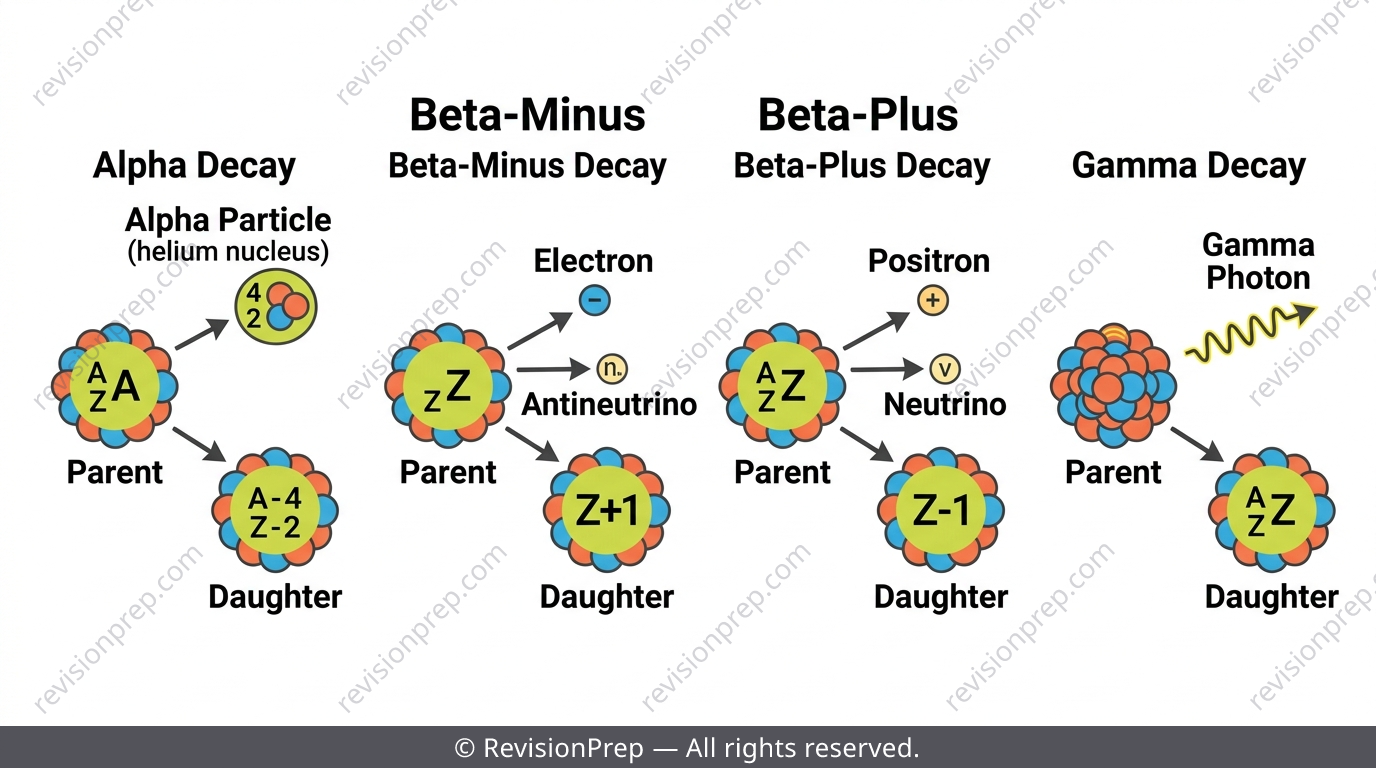
| Decay type | Change in A | Change in Z | What's emitted |
|---|---|---|---|
| Alpha (α) | -4 | -2 | Helium nucleus |
| Beta-minus (β⁻) | 0 | +1 | Electron + antineutrino |
| Beta-plus (β⁺) | 0 | -1 | Positron + neutrino |
| Gamma (γ) | 0 | 0 | High-energy photon |
Common mistake
Forgetting that gamma decay changes the energy state of the nucleus but leaves both A and Z completely unchanged.
HL Extension: Uncertainty, Wavefunctions and Confined Particles
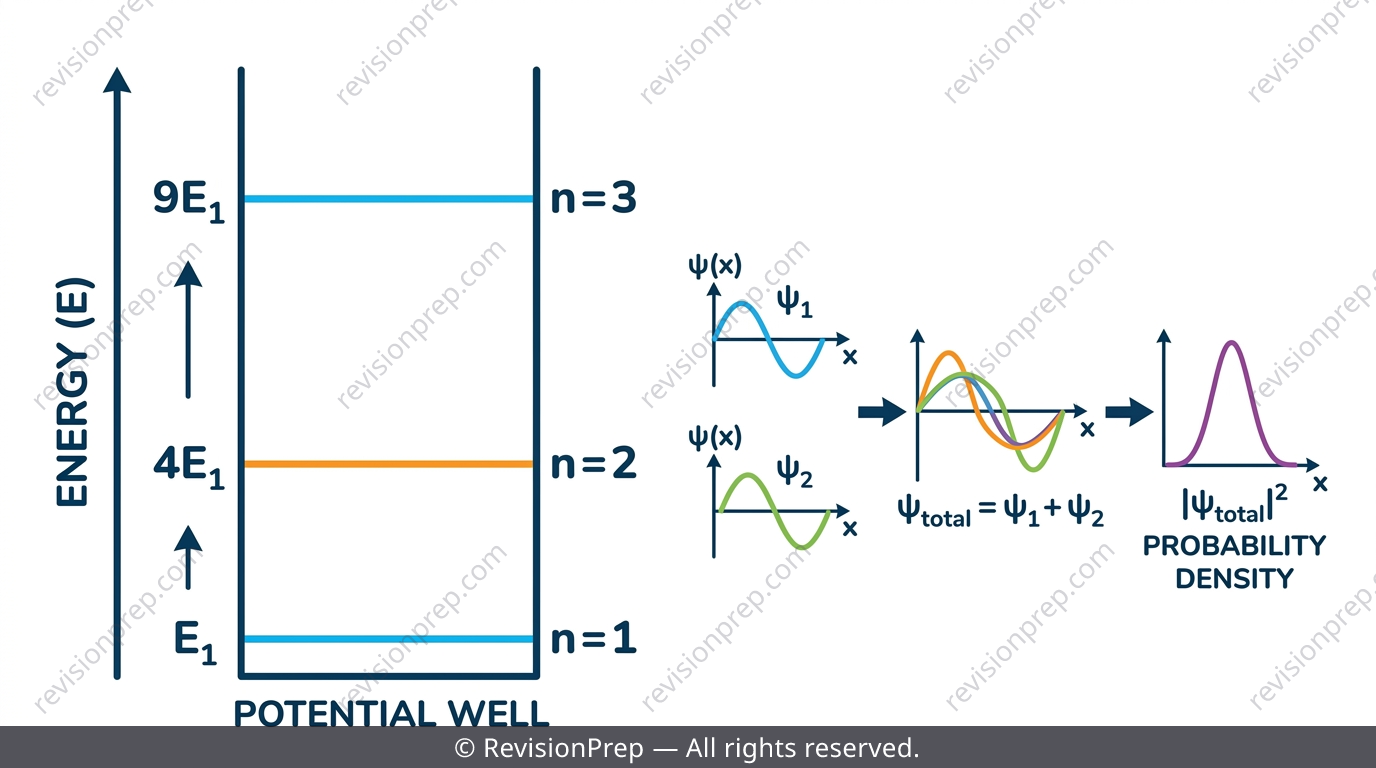
At HL, the uncertainty principle sets an absolute limit on knowing position and momentum simultaneously. A particle confined in a 1D infinite well has quantised energies — energy scales with , not . Probability density comes from the Born interpretation , and for superposed states you must add the wavefunctions (with sign) before squaring.
Exam tip
For a state like , the probability of measuring is the coefficient squared (0.5), not the coefficient itself.
Common mistake
Computing instead of — energy in a box scales with , the single most common error on this formula.
Quick formula sheet
Practice questions
- State two observations from the photoelectric effect that cannot be explained by a wave model of light.
- Write the nuclear equation for the alpha decay of a generic nucleus with mass number A and atomic number Z.
- Define half-life and decay constant, and state the relationship between them.
- Light of known frequency ejects photoelectrons with a given stopping potential. Use Einstein's equation to find the work function of the metal.
- A sample's activity falls from an initial value to a quarter of that value. How many half-lives have passed, and what does this tell you about the amount of sample remaining?
- Electrons of a given de Broglie wavelength pass through two slits of known separation onto a screen at a known distance. Find the fringe spacing.
- Two points on a KE_max vs f graph are given. Determine Planck's constant and the work function from the gradient and intercept, without extrapolating by eye.
- A particle in a 1D infinite well has a known ground-state energy. Find the energy of the n=3 state and explain why it is not simply three times the ground state.
- For a superposition state with given amplitudes, find the correct probability density and explain the mistake of summing directly.
Frequently asked questions
What's the difference between the photoelectric effect and double-slit diffraction in terms of what they prove about light?+
The photoelectric effect (instant emission, sharp threshold frequency, intensity-independent KE_max) proves light behaves as photons. Double-slit diffraction (fringe patterns from constructive/destructive interference) proves light behaves as a wave. Both are true depending on the experiment.
Why does increasing light intensity not increase photoelectron kinetic energy?+
Photon energy depends only on frequency. Increasing intensity increases the number of photons arriving per second, not the energy of each individual photon, so KE_max stays fixed by frequency alone.
How is radioactive decay both random and predictable?+
Any single nucleus decays at a completely random, unpredictable moment. But because the decay constant is fixed for an isotope, a large population of nuclei follows the precise exponential law .
Why does energy in a particle-in-a-box scale with $n^2$ instead of $n$?+
The energy formula comes directly from the boundary conditions of confining a wave in a box of width L, which forces energy to scale as the square of the quantum number , not linearly.
Do I need to know the uncertainty principle and wavefunctions at SL?+
No — the wavefunction, uncertainty principle and particle-in-a-box content are HL-only extensions. SL students focus on the photoelectric effect, de Broglie wavelength and radioactive decay.
What's the most common mistake with alpha, beta and gamma decay equations?+
Forgetting that gamma decay leaves both mass number A and atomic number Z completely unchanged — it only releases a photon of excess energy, unlike alpha and beta decay which transform the nucleus.
Get the complete Nuclear and Quantum Physics notes
Related articles