
Functions
Domain, range, inverses, composites, transformations and modelling — the SL topic that shows up in every single paper.
Quick facts
Functions is the backbone topic of IB Maths AA — master it and half the syllabus suddenly makes more sense. Every function assigns exactly one output to each input, which is why the vertical line test matters so much when reading domain and range off a graph. From there, the topic branches into modelling real data with linear, exponential and quadratic equations, finding inverse functions (only possible for one-to-one functions), chaining functions together as composites, and transforming graphs using . Examiners love combining these ideas in a single modelling question, so understanding how domain restrictions, inverses and transformations connect — rather than memorising each in isolation — is what separates a 5 from a 7. This teaser covers the five ideas worth locking down first; the full revision notes go deeper into every trap and worked example.
What you’ll be able to do
What Counts as a Function: Domain, Range and the Vertical Line Test
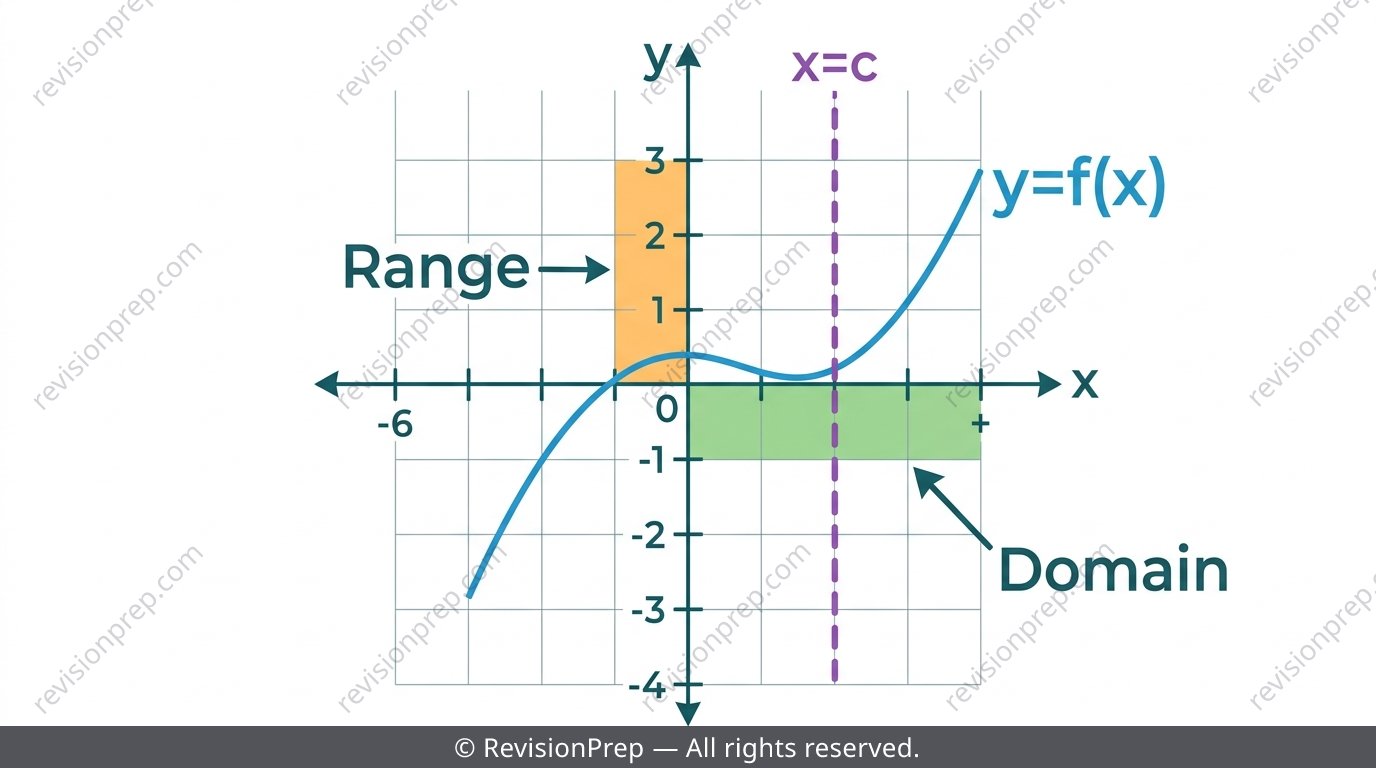
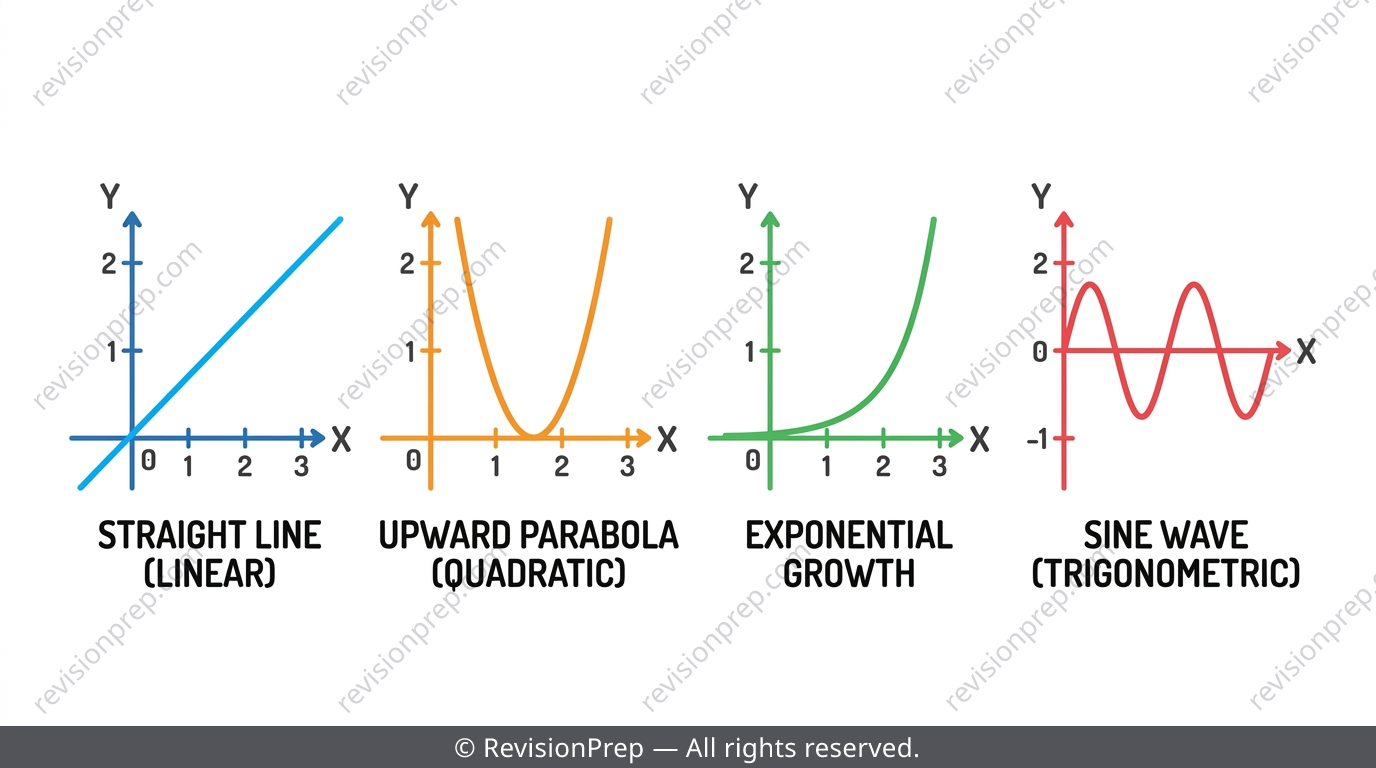
A function gives exactly one output for every input — graphically, that means any vertical line drawn through the domain crosses the graph only once. Domain is the set of valid inputs; range is the set of outputs the function actually produces, and both should be read from a sketch rather than guessed from the formula. Four families dominate SL: linear, quadratic, exponential and trigonometric — spotting which one fits a situation is the real skill being tested.
Exam tip
GDC use is assumed throughout — graphing, finding intersections, and solving f(x)=0 numerically are all fair game unless the question says 'show that' or 'algebraically'.
Mini summary
One input → one output; domain and range come from the graph, not the formula.
Modelling: Linear, Exponential and Quadratic
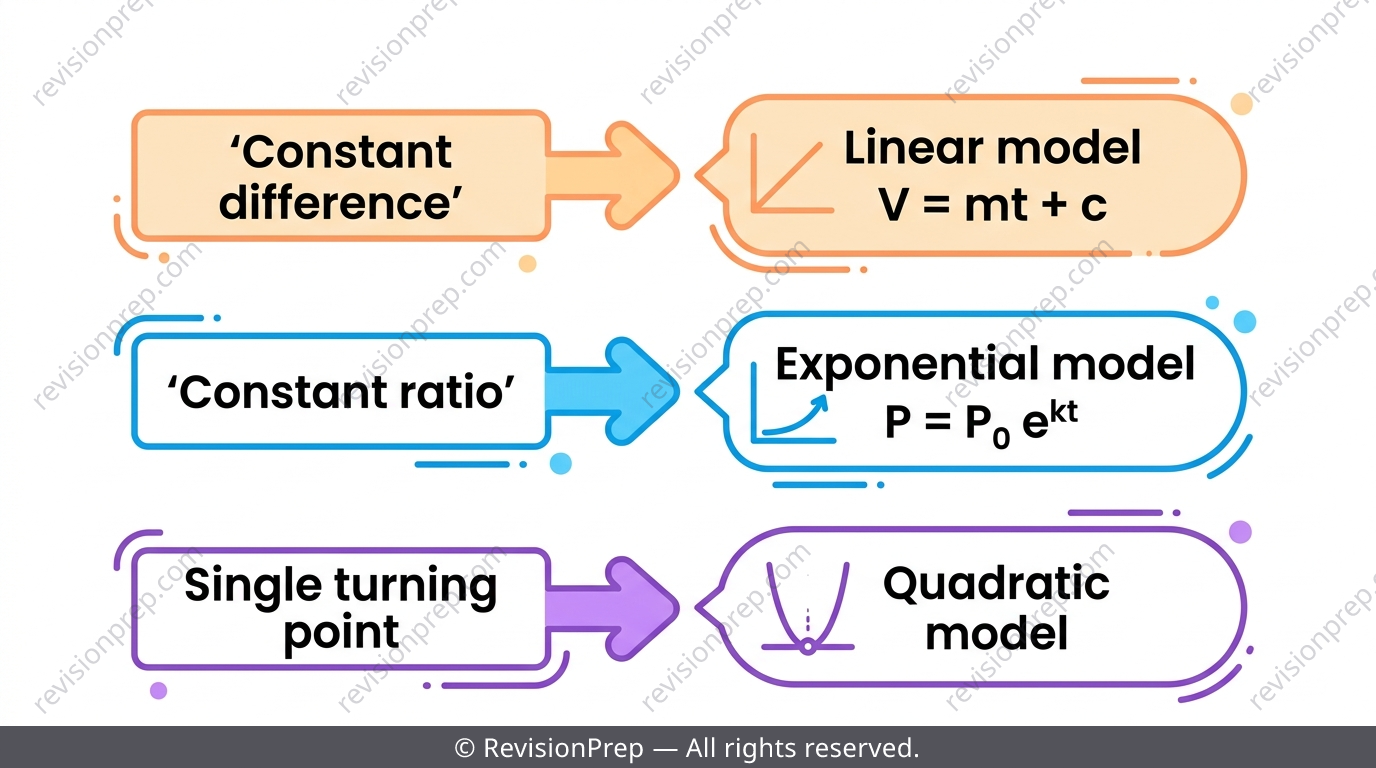
The strategy never changes: spot the pattern in the data, pick the matching model, substitute known points to pin down constants, then use the finished model to answer the question. A constant difference between outputs signals a linear model ; a constant ratio signals exponential ; a single symmetric turning point (profit, height) signals quadratic. Two unknown constants need two data points, and the value at almost always hands you one constant for free.
Exam tip
In 'show that' questions with logs, keep exact forms like throughout the working rather than rounding early — matching the given answer exactly proves algebra, not a calculator guess, produced it.
Common mistake
Reusing the point to solve for the exponential rate — that point only ever gives the initial value ; the second (non-zero) data point is needed to solve for .
Mini summary
Constant difference → linear; constant ratio → exponential; turning point → quadratic; t=0 gives a free constant.
One-to-One Functions and Inverses
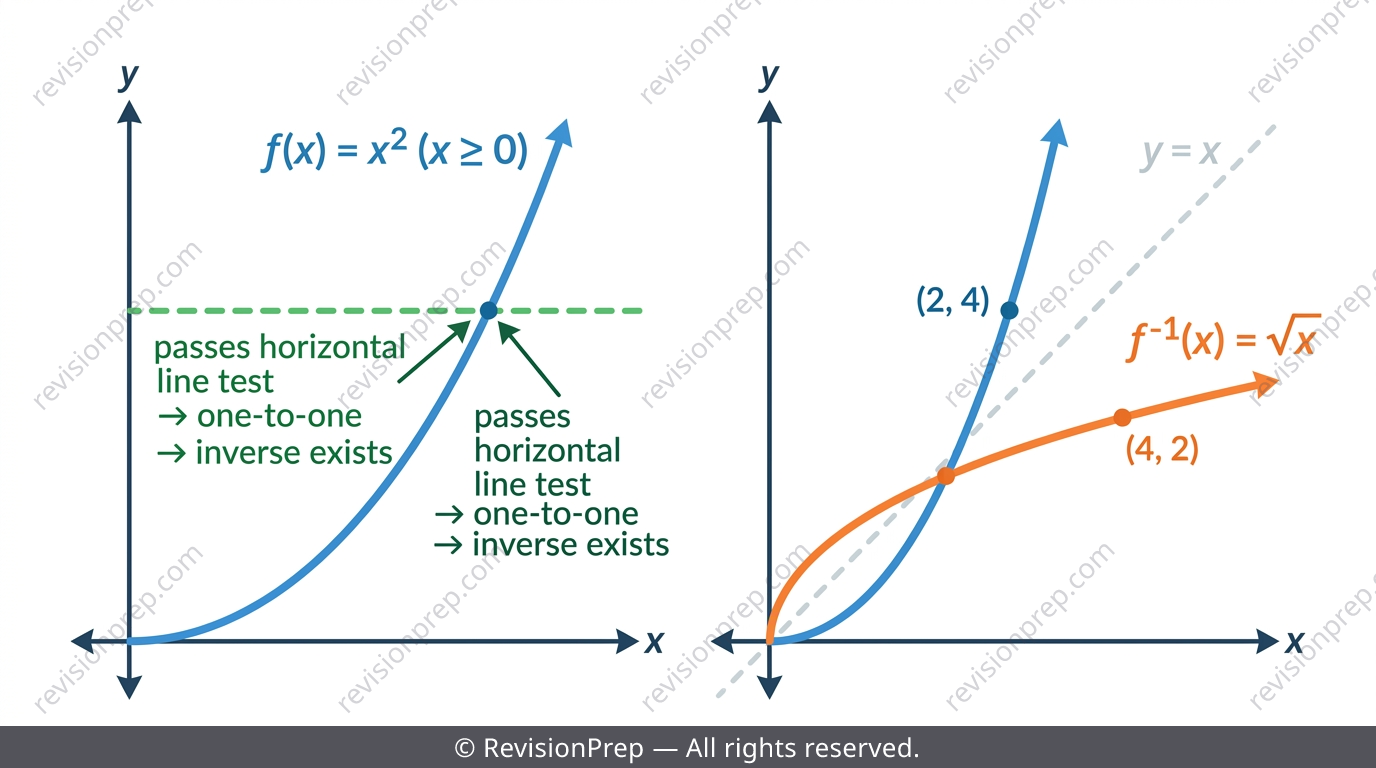
A function is one-to-one if every horizontal line crosses its graph at most once, and only one-to-one functions have an inverse that is itself a function. To find , swap and in then rearrange for — and crucially, the domain of equals the range of the original , not something read off the new equation. Restricting a quadratic's domain (like ) is exactly what makes it one-to-one so an inverse can exist.
Exam tip
If asked to justify why exists after a domain restriction, explicitly state that the restriction makes one-to-one — examiners look for this as a specific AO2 mark.
Common mistake
Stating the domain of from the algebraic form of the new expression instead of the range of the original function — always sketch first to find its range.
Mini summary
Horizontal line test → one-to-one → inverse exists; domain of = range of .
Composite Functions: Order Matters
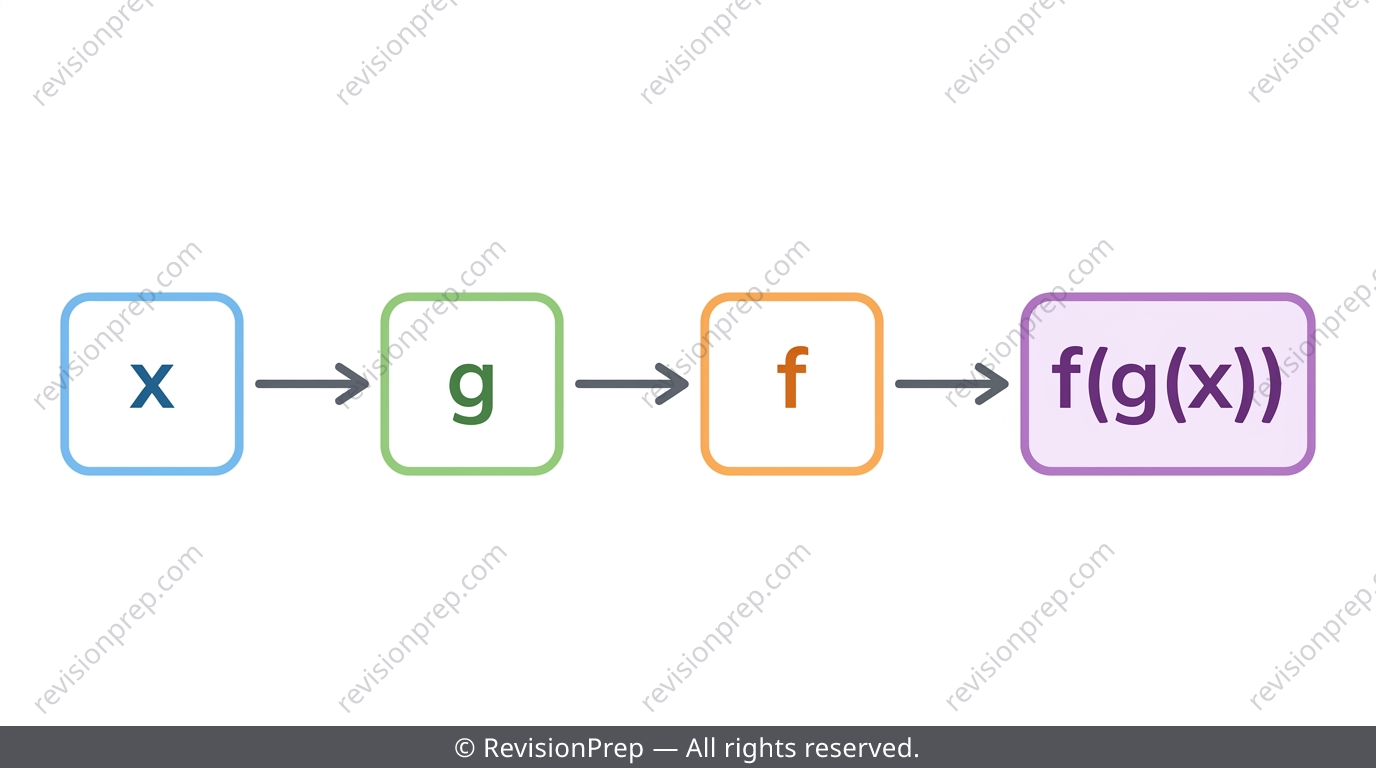
A composite function chains two functions together: means apply first (it's closest to ), then feed the result into . In general , so always work from the inside out and never assume the order can be swapped.
Common mistake
Computing when the question asks for — for functions with restricted domains, this genuinely changes the numerical answer, not just the notation.
Mini summary
— inner function first, then outer.
Transformations of y = f(x)
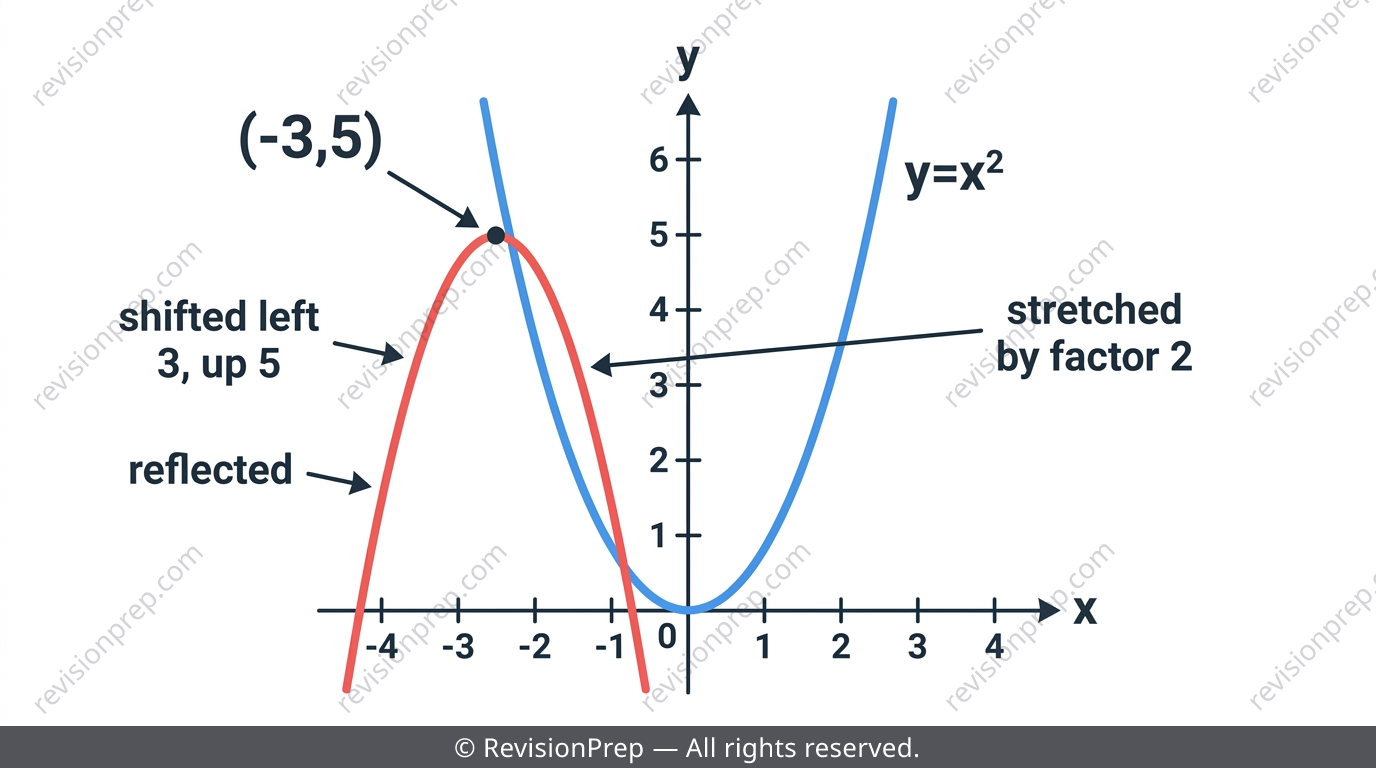
Every transformation fits the form : vertical changes (, ) behave exactly as they look, but horizontal changes (, ) act on before is evaluated, so they behave backwards to intuition. shifts RIGHT by , and stretches horizontally by factor . When several transformations combine, deal with the inside of the bracket first (horizontal), then apply the outside (vertical) operations.
| Transformation | Equation | Effect on graph |
|---|---|---|
| Vertical translation | y = f(x) + k | Shifts up (k>0) or down (k<0) |
| Vertical stretch | y = a f(x) | Stretches vertically by factor a; flips if a<0 |
| Horizontal translation | y = f(x - h) | Shifts RIGHT by h (opposite of the sign) |
| Horizontal stretch | y = f(bx) | Stretches horizontally by factor 1/b |
Exam tip
When asked to 'describe' a transformation, state the type, direction/axis, AND the exact scale factor or vector — a vague 'it moves' scores zero marks.
Common mistake
Reading as 'shift right 3' — since , this is actually , a shift LEFT by 3, the single most common transformation error in the syllabus.
Mini summary
Vertical changes act as they look; horizontal changes act backwards — always deal with the inside of the bracket first.
Quick formula sheet
Practice questions
- State whether the horizontal line test or the vertical line test is used to check for a one-to-one function.
- Given m and c, write the linear model V(t)=mt+c and state what m represents.
- Describe, in words, the effect of the transformation y = f(x) + 4 on the graph of y = f(x).
- A population is P(t)=P0·e^(kt). Given P(0)=200 and P(4)=500, set up (without solving) the equation you'd use to find k.
- For f(x)=3x+1, find f⁻¹(x) and state its domain in terms of the range of f.
- Describe the sequence of transformations that maps y=x² onto y=(x-2)²-1, stating the new vertex.
- C(x)=6000+50x and R(x)=90x-0.04x² model cost and revenue for 0≤x≤400. Set up the equation for the break-even quantity and identify which root(s) are valid in the domain.
- For f(x)=2x-3 and g(x)=x²+1 (x≥0), find (f∘g)(3) and explain why the domain restriction on g matters when finding g⁻¹.
- A model P(t)=500e^(kt) gives P(3)=4000. Show that k = ln8/3 using exact values, then find P(5) to 3 s.f.
Frequently asked questions
What is the difference between domain and range?+
Domain is the set of valid inputs a function accepts; range is the set of outputs it actually produces. Both should be identified from a sketch of the graph, not guessed purely from the equation.
How do you know if a function has an inverse?+
A function has an inverse (that is itself a function) only if it's one-to-one — meaning it passes the horizontal line test, where every horizontal line crosses the graph at most once.
Why does the domain of f⁻¹ equal the range of f?+
An inverse reverses inputs and outputs, so whatever f could output becomes what f⁻¹ can accept as input. That's why you must find the range of f first, usually from a sketch, rather than reading it from the algebraic form of f⁻¹.
Why does y = f(x+3) shift the graph left, not right?+
Horizontal transformations act on x before f is evaluated, so they work opposite to what the sign suggests. Since f(x-h) shifts right by h, writing x+3 as x-(-3) gives h=-3, meaning a shift left by 3.
How do I choose between a linear, exponential or quadratic model?+
Check the pattern in the data: a constant difference between outputs points to a linear model, a constant ratio points to exponential, and a single symmetric turning point (like a maximum profit or projectile height) points to quadratic.
Does f∘g equal g∘f?+
Generally no. (f∘g)(x) means apply g first then f, while (g∘f)(x) applies f first then g — these usually give different results, so always work from the inside out.
Get the full IB Maths AA Functions revision notes
Related articles