
Number Operations and Applications
One rule — BODMAS — governs every number type you'll meet in MYP 1 maths
Quick facts
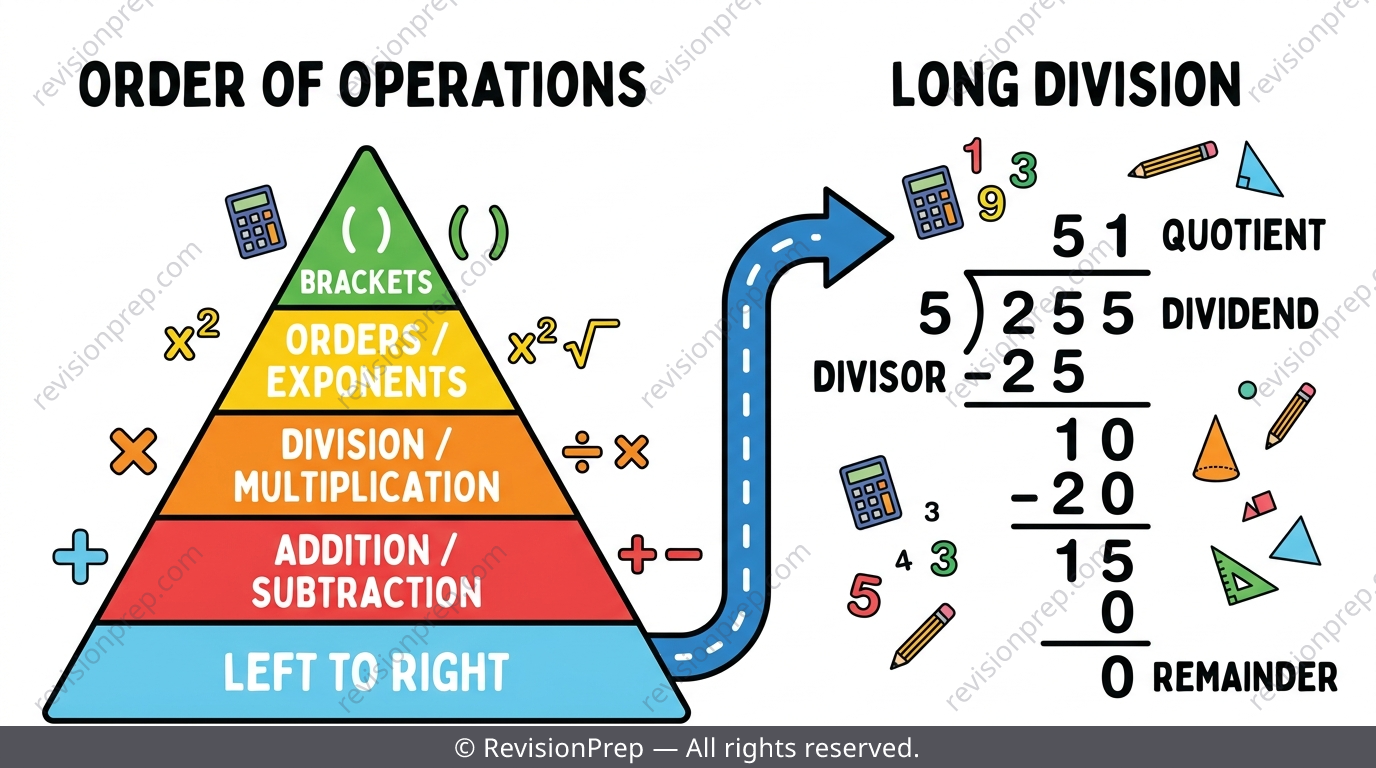
Number Operations and Applications is the foundational strand of IB MYP 1 mathematics — the skill set that quietly sits underneath every later topic, from algebra to geometry. At its core is one master rule, BODMAS (or PEDMAS), which decides the exact order in which brackets, powers, multiplication, division, addition and subtraction happen. Once you've locked that in, divisibility and remainders, translating word problems into expressions, and working with decimals and fractions all become the same rule wearing different outfits. Examiners consistently catch students who read expressions strictly left to right instead of scanning for priority first, or who confuse a remainder with a decimal answer. This teaser walks through the five ideas that matter most for your MYP 1 number-skills check and Criterion A/B tasks, with the traps examiners love to set — the full revision notes go deeper with every worked example and divisibility rule.
What you’ll be able to do
Order of Operations (BODMAS/PEDMAS)
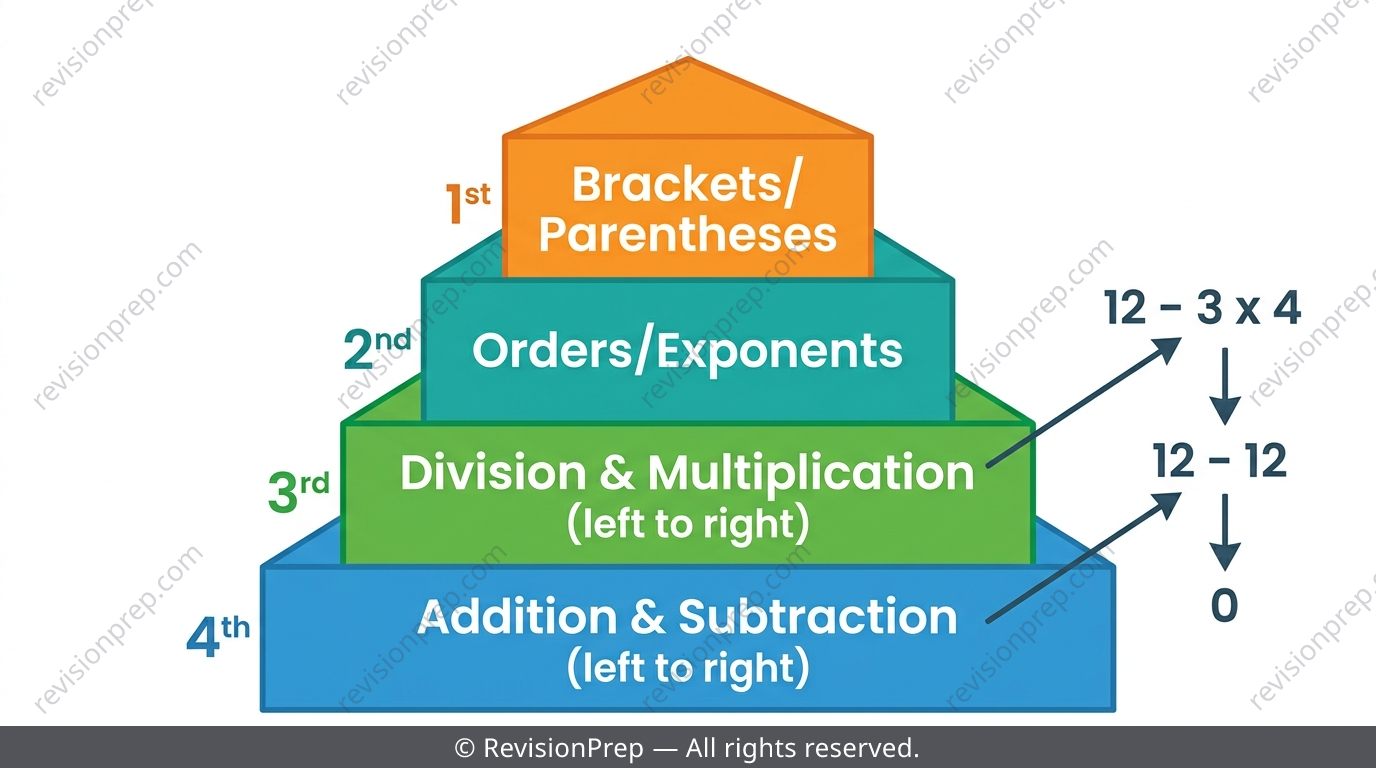
BODMAS and PEDMAS are the same global rule under two different names — Brackets/Parentheses first, then Orders/Exponents, then Division and Multiplication (equal priority, left to right), then Addition and Subtraction (also equal priority, left to right). This ordering guarantees that anyone, anywhere, gets the same answer from the same expression. It is the single rule that governs every other subtopic in this unit, so getting it automatic now saves marks all year.
Exam tip
When asked to 'identify which operation comes first', name the actual operation AND the numbers involved (e.g. 'multiplication, 4×2'), not just the word 'multiplication'.
Common mistake
Reading an expression strictly left to right — e.g. calculating before in — gives a completely wrong but plausible-looking answer.
Mini summary
Brackets and powers first; then × and ÷ left to right; then + and − left to right.
Divisibility and Remainders
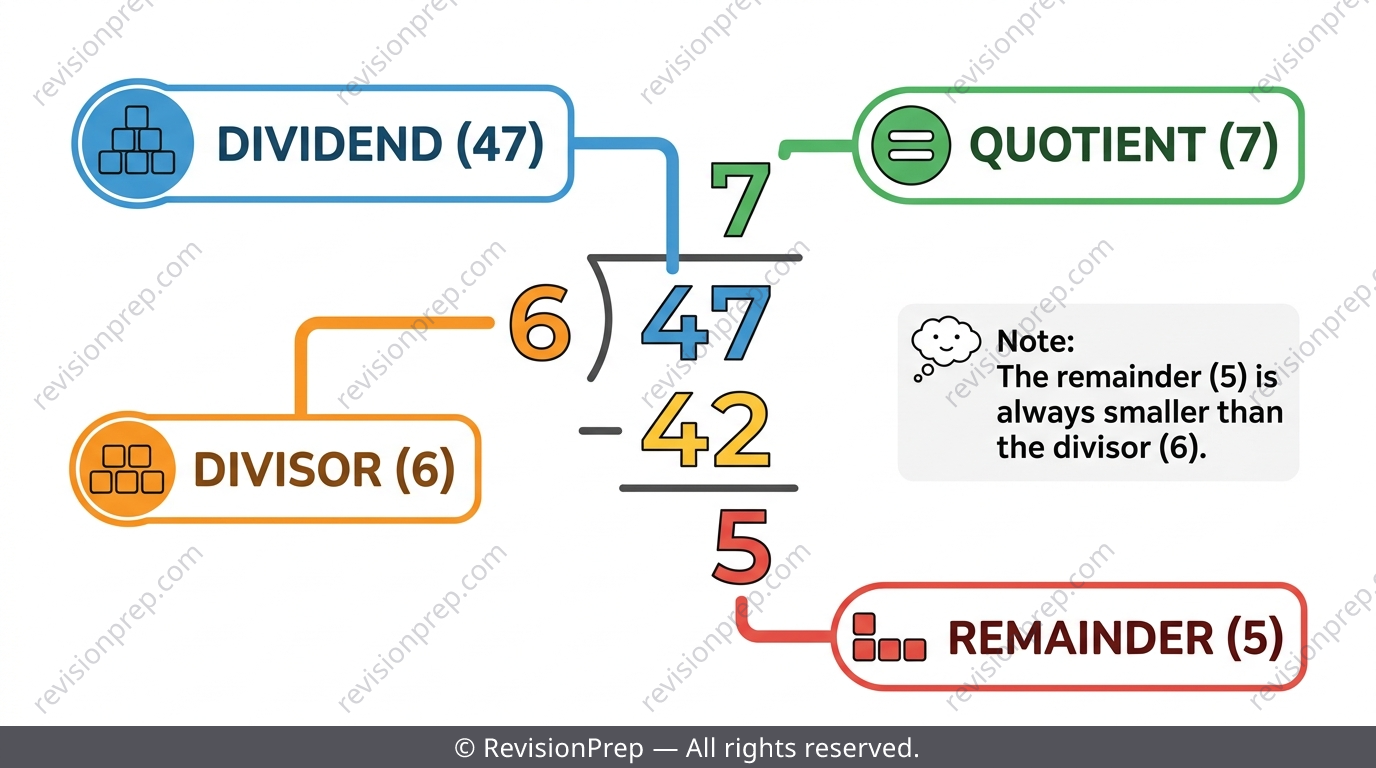
A number is divisible by another when the division comes out exactly, with nothing left over; when it doesn't, the leftover is the remainder, and the remainder must always be smaller than the divisor. This relationship is written formally as with , where is the dividend, the divisor, the quotient and the remainder. Divisibility rules let you check divisibility without actually dividing — a real time-saver on non-calculator questions.
Exam tip
If a question asks specifically for a remainder, give a whole-number quotient plus a whole-number remainder — not a decimal like .
Common mistake
Confusing the quotient with the remainder, or writing the answer as a decimal when the question explicitly asks for a remainder.
Mini summary
, — the remainder is always smaller than the divisor.
Factors and Multiples
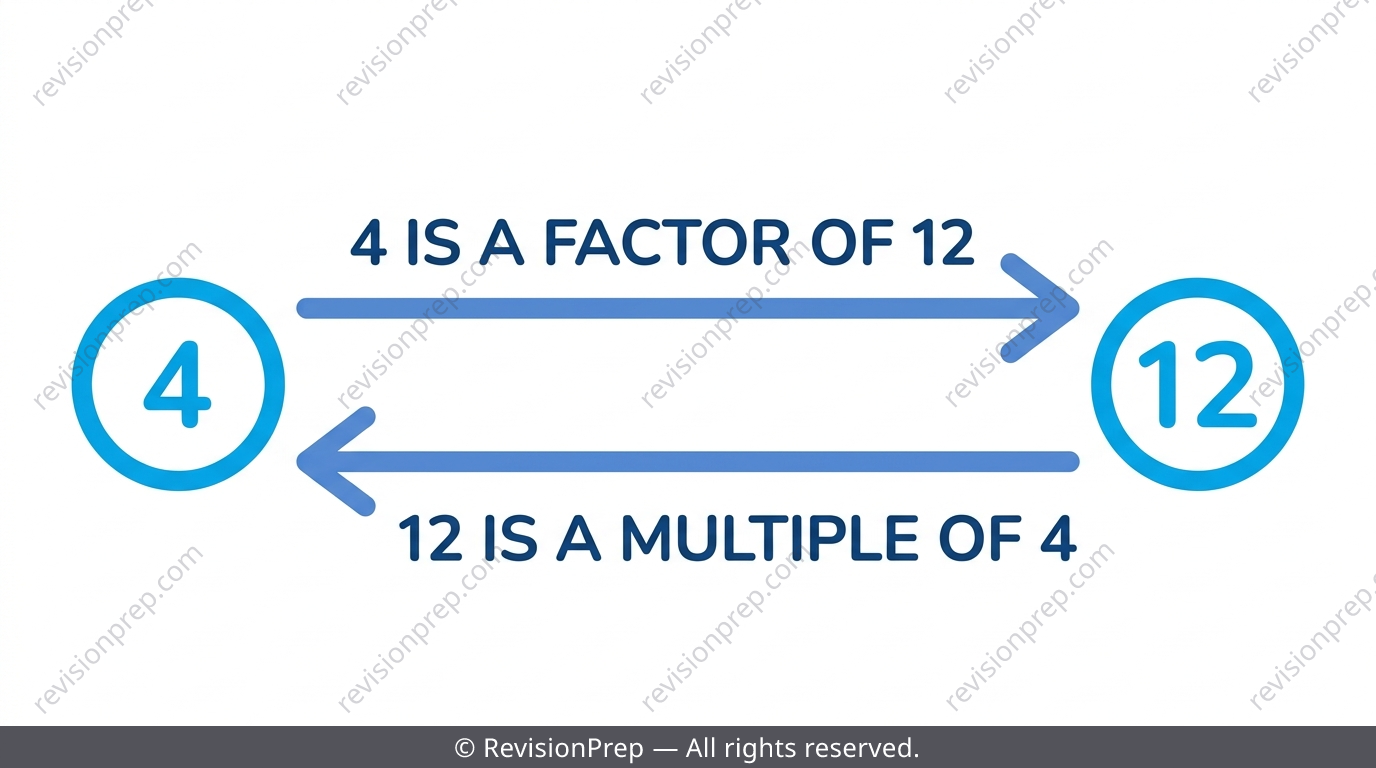
A factor of a number divides into it exactly — 4 is a factor of 12. A multiple is what you get by multiplying a number by a whole number, so 12 is a multiple of 4, of 3, of 6 and of itself. These are opposite directions of the same relationship, and mixing them up is one of the fastest ways to lose easy marks.
Common mistake
Saying '12 is a factor of 4' when it should be 'a multiple of 4' — always check which direction the relationship runs.
Mini summary
4 is a factor OF 12; 12 is a multiple OF 4 — direction matters.
Word Problems: Turning English into Expressions
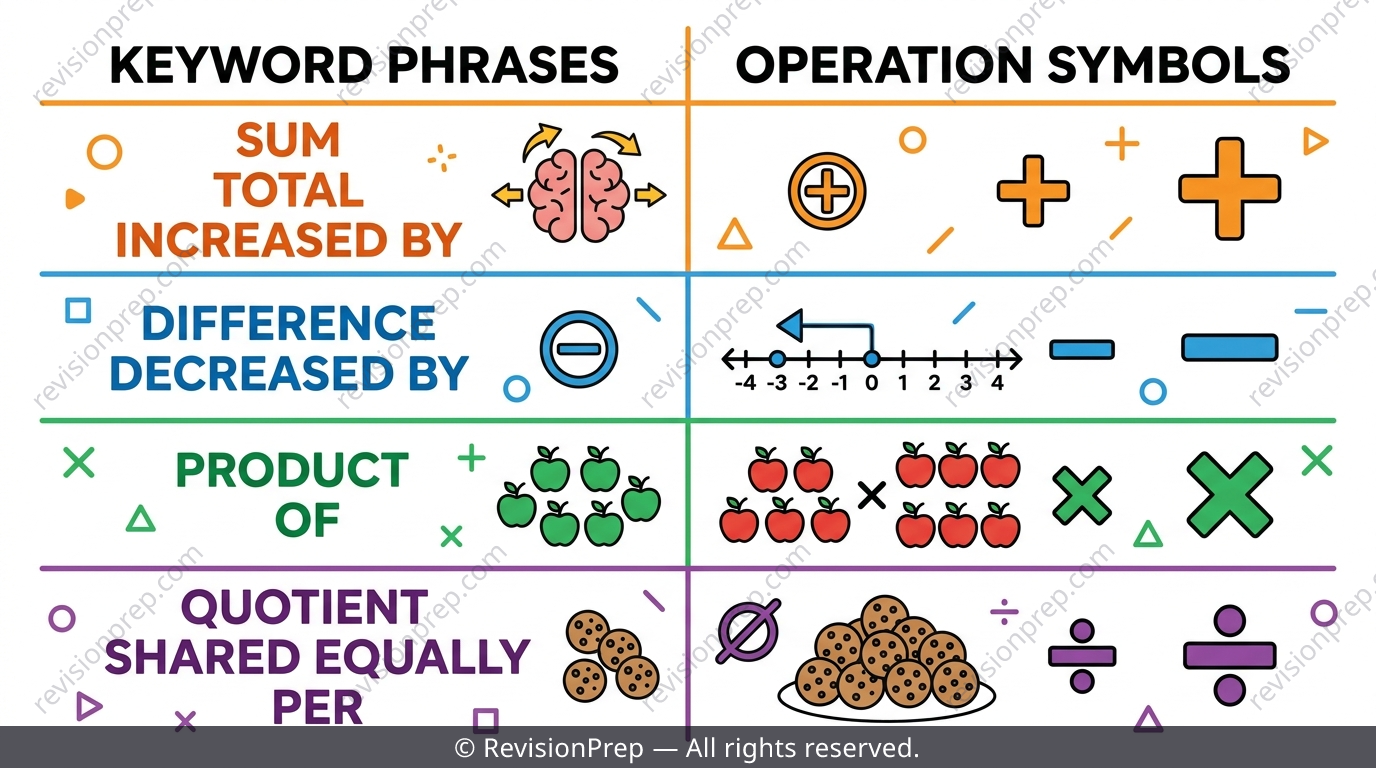
Word problems don't test new maths — they test whether you can translate keywords into symbols before calculating anything. Sum, total and increased by mean addition; difference and decreased by mean subtraction; product and of mean multiplication; quotient and shared equally mean division. Read the problem twice: once for the story, once to underline every number and keyword.
Exam tip
Mark schemes usually split marks: one for correctly evaluating and stating an intermediate value (like a side length), one for the final answer — always show the intermediate step.
Common mistake
Using instead of for a rectangle's perimeter — forgetting a rectangle has two of each side.
Mini summary
Underline keywords first, evaluate each part, then combine — never skip straight to the final number.
Decimals and Fractions Under BODMAS
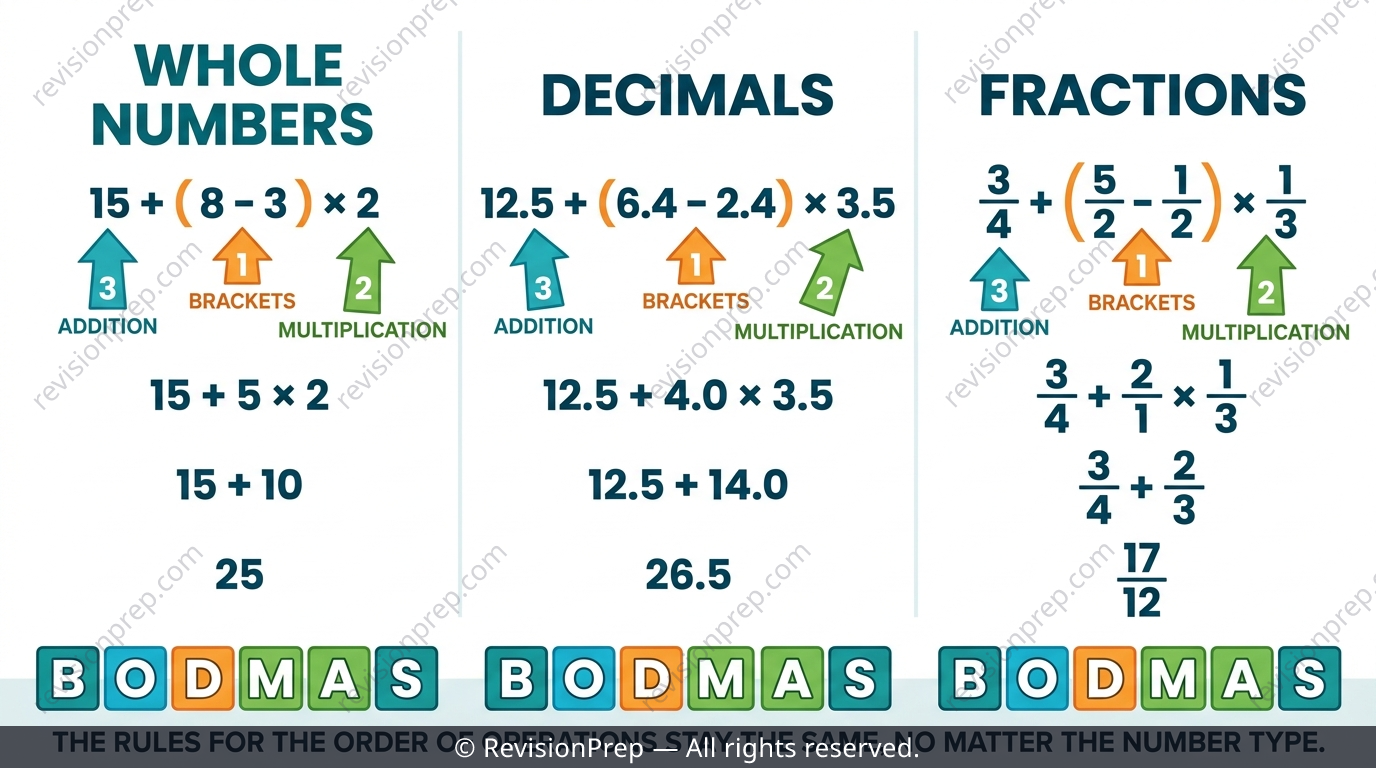
Decimals and fractions are just numbers written differently — the arithmetic mechanics change slightly, such as aligning decimal columns, counting decimal places, or finding common denominators for fractions. But BODMAS still governs any multi-step expression built from decimals or fractions, exactly as it does for whole numbers. If you can apply the order of operations confidently to whole numbers, you already know the logic needed for decimal and fraction expressions.
Mini summary
Same BODMAS order applies — only the column/denominator mechanics change for decimals and fractions.
Quick formula sheet
Practice questions
- Calculate , showing which operation you do first.
- Find the quotient and remainder when 47 is divided by 6.
- List two multiples of 4 and two factors of 12.
- Calculate .
- A dividend is 53 and the divisor is 8. Use to find the quotient and remainder.
- Write an expression for 'the sum of 7 and 3, multiplied by 2', then evaluate it.
- Compare with . State both values and explain which number changes and why.
- A rectangle has sides cm and cm. State each side length and calculate the perimeter using .
- Evaluate , identifying the two operations you must complete first.
Frequently asked questions
What is BODMAS and why does it matter in MYP maths?+
BODMAS (Brackets, Orders, Division/Multiplication, Addition/Subtraction) is the global order for evaluating expressions. It matters because it guarantees everyone gets the same answer, and it underpins every later MYP topic involving multi-step calculations.
Is BODMAS the same as PEDMAS?+
Yes — BODMAS is the British name and PEDMAS is the American name, but they describe the exact same order of operations.
Why aren't multiplication and division done in a fixed order?+
Multiplication and division have equal priority — you work through them left to right in the order they appear, not always multiplying first.
How do you find a remainder in division?+
Divide as normal to find the whole-number quotient, then the leftover amount is the remainder. It must always be smaller than the divisor, and should be given as a whole number, not a decimal, when a question asks for it.
What's the difference between a factor and a multiple?+
A factor divides exactly into a number (4 is a factor of 12), while a multiple is produced by multiplying a number by a whole number (12 is a multiple of 4). They describe the same relationship from opposite directions.
Does the order of operations change for decimals or fractions?+
No — BODMAS still governs the sequence of steps. Only the arithmetic mechanics change slightly, such as aligning decimal columns or finding common denominators for fractions.
Get the full MYP 1 Number Operations revision notes
Related articles