
Equations, Inequalities & Formulae
The core algebra skills MYP 1 tests in every unit assessment — solved, ranged, and rearranged.
Quick facts
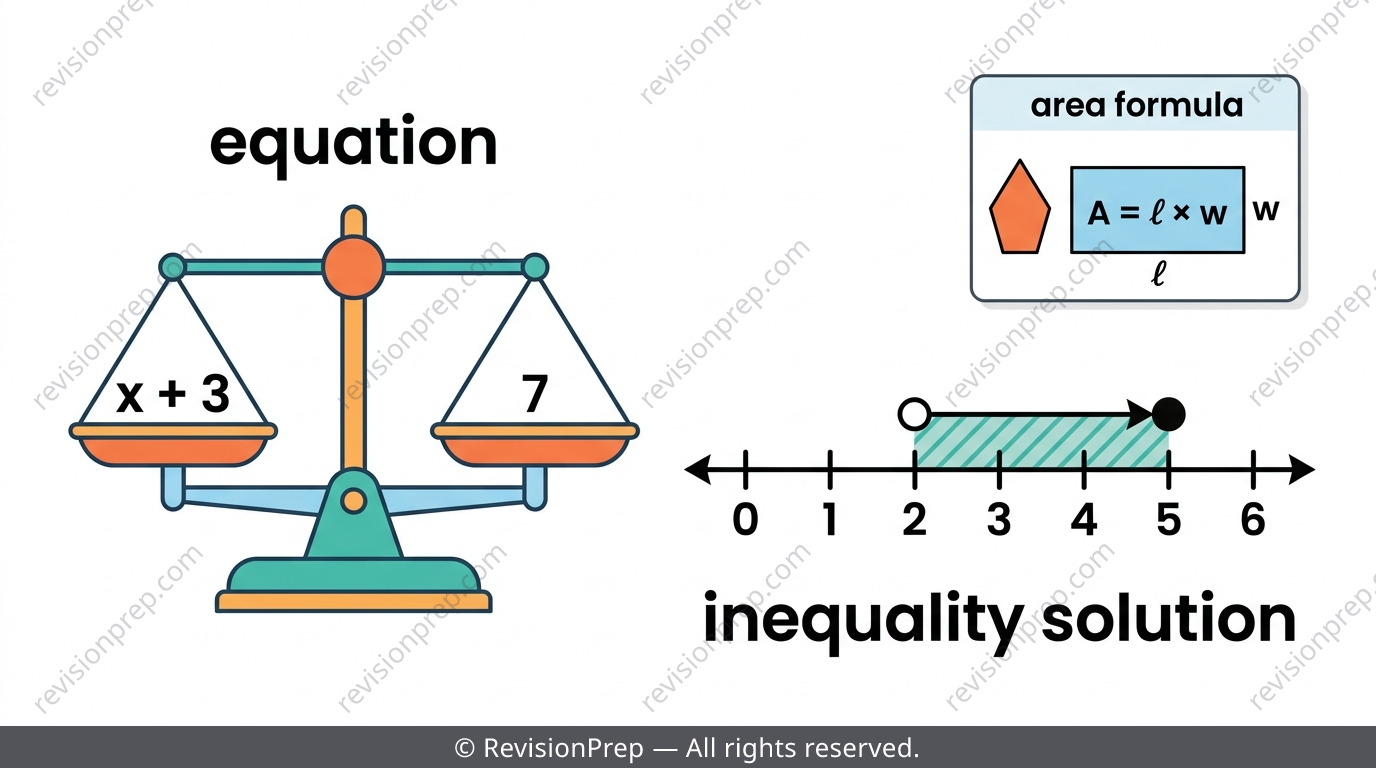
Equations, inequalities and formulae sit at the heart of every MYP 1 maths assessment, and they all use the same balance-method logic — just in different disguises. An equation like gives one exact answer, an inequality like gives a whole range shown on a number line, and a formula like connects real quantities you substitute into or rearrange. This teaser walks through the five ideas examiners return to again and again: the equation-inequality-formula distinction, the golden rule for flipping inequality signs, the balance method for one- and two-step equations, translating word problems correctly, and substituting into or rearranging real-world formulae. Nail these five and you cover the backbone of Criterion A and Criterion B algebra tasks — the full revision notes go deeper into every worked example and mark-scheme trap.
What you’ll be able to do
Equations, Inequalities & Formulae: What's the Difference?
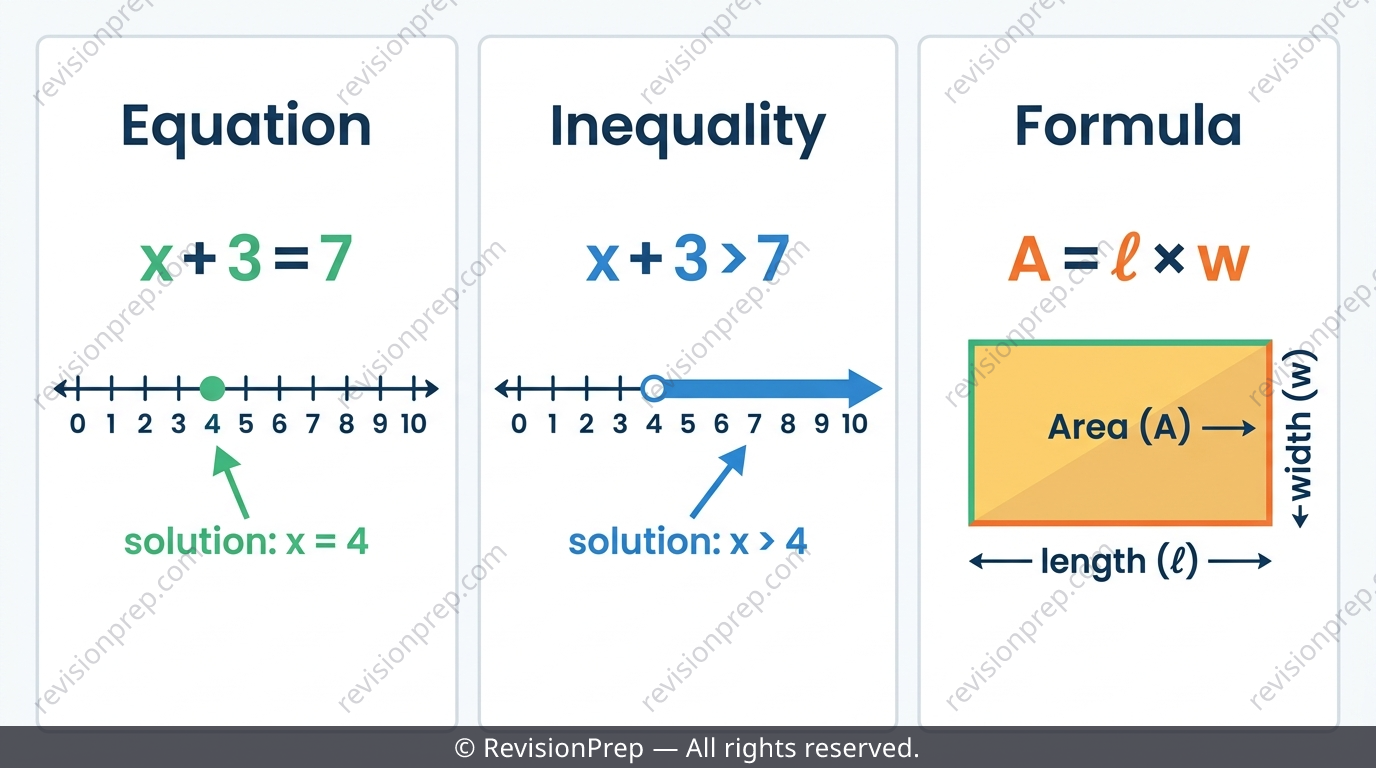
An equation like has exactly one solution — one point on a number line. An inequality like has a whole range of solutions, shown as a ray or segment. A formula like already means something in context, connecting real quantities, and you either substitute values in or rearrange it to isolate a different letter.
Exam tip
Before solving anything, decide which of the three you're dealing with — it changes whether your final answer is a single value, a range, or a rearranged rule.
Mini summary
One value (equation), a range (inequality), or a real-world rule (formula) — spot which one you're solving first.
Solving Inequalities and the Sign-Flip Rule
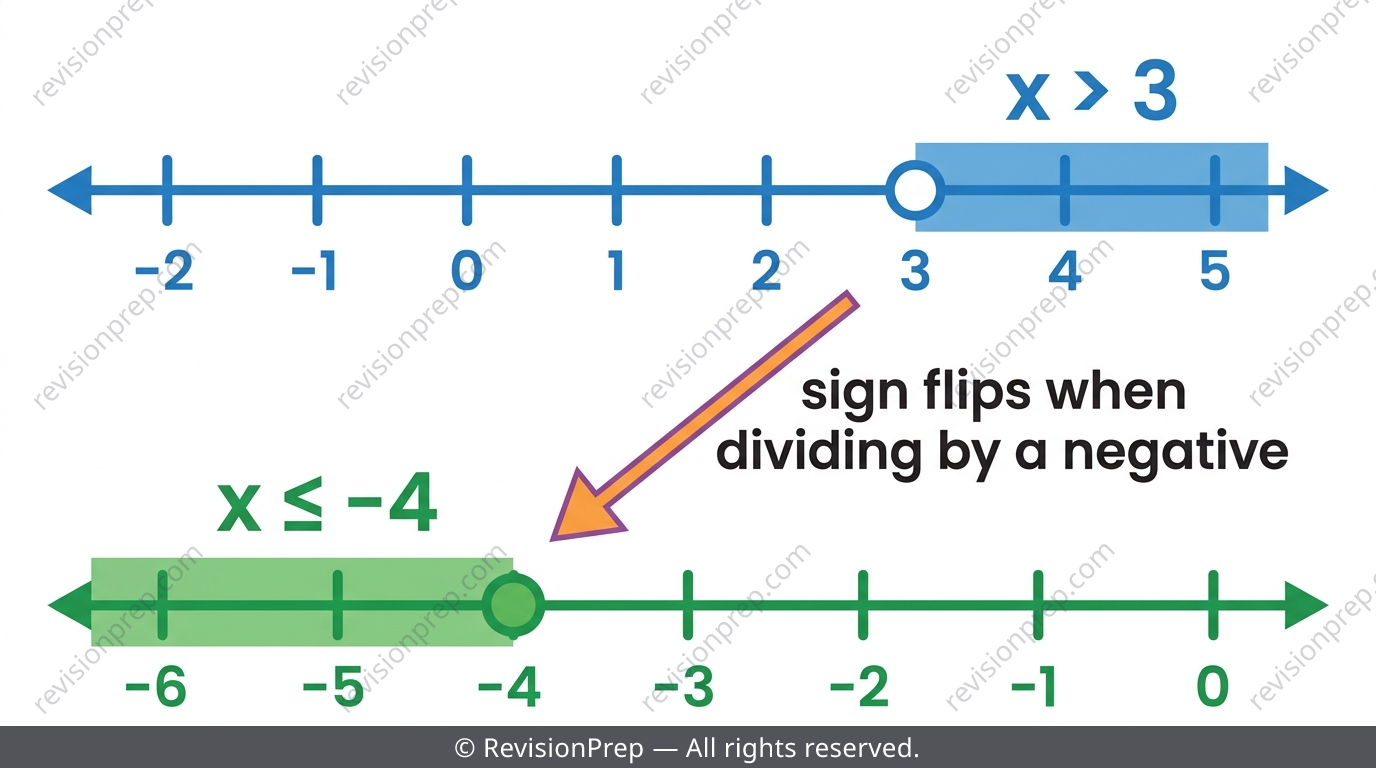
On a number line, an open circle means the boundary value is excluded (used for or ), while a closed circle means it's included (used for or ). Adding or subtracting the same number never flips the inequality, and multiplying or dividing by a positive number keeps it the same direction too — but multiplying or dividing by a negative number always flips it. This single rule is the most examined idea in the whole topic.
Exam tip
Sanity-check every inequality answer by substituting a test value back into the original inequality before you finalise it.
Common mistake
Getting the correct number but forgetting to flip the sign when multiplying or dividing by a negative — the arithmetic is right, but the logic error still loses marks.
Mini summary
Flip the inequality sign the moment you multiply or divide by a negative — not at the end of your working.
One-Step and Two-Step Equations: The Balance Method
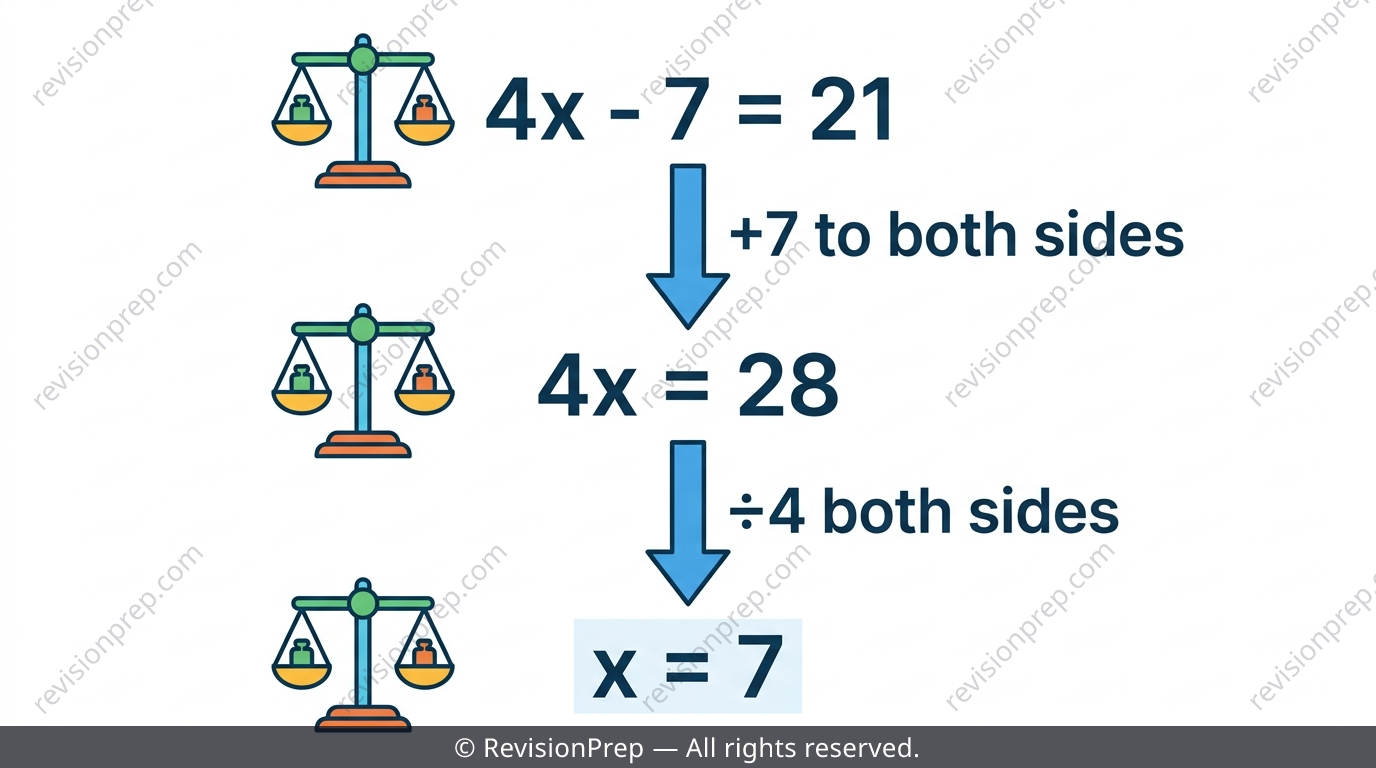
Whatever operation you apply to one side of an equation, you must apply to the other side too, so the equation stays true. A one-step equation like needs one inverse operation to isolate , while a two-step equation like needs two steps applied in reverse BIDMAS order — undo the subtraction first, then the multiplication.
| Equation type | Steps to isolate x | Example |
|---|---|---|
| One-step | One inverse operation | |
| Two-step | Undo +/− first, then ×/÷ |
Exam tip
Always undo addition/subtraction before multiplication/division — the exact reverse of BIDMAS, every time.
Common mistake
Dividing by the coefficient before removing the added or subtracted constant, which puts the operations in the wrong order.
Mini summary
Balance both sides equally, and undo operations in reverse BIDMAS order for two-step equations.
Building Equations from Word Problems
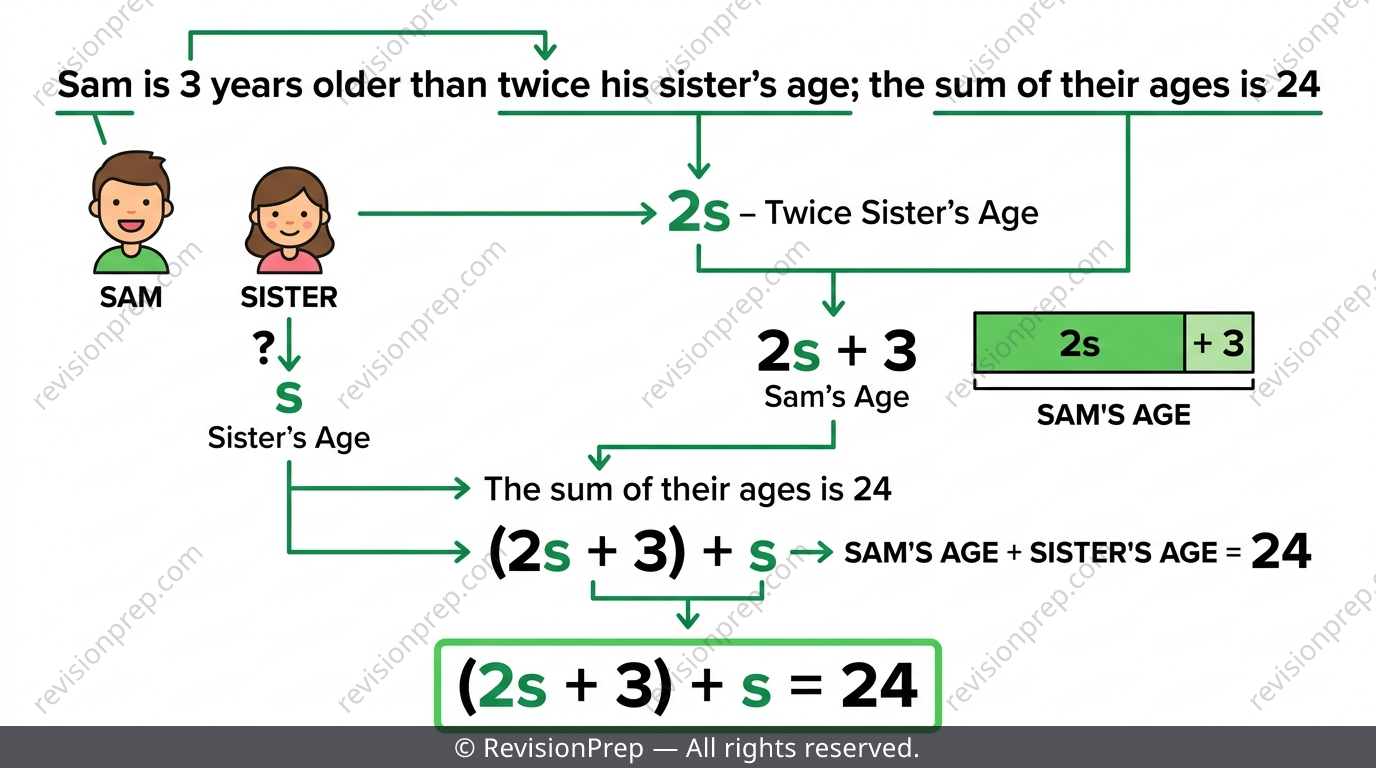
The hardest part of a word problem is translating the sentence into correct algebra, not solving it. Define the unknown in words first — 'let = Sam's sister's age' — since mark schemes reward this step separately from the equation and the solving. Translate each phrase piece by piece, combine them using the relationship given, then solve and check the answer makes sense in context.
Exam tip
Write 'let = ...' in words before any algebra — it's a mark on its own and protects you if your equation has an error.
Common mistake
Writing an equation for only one person's expression (e.g. ) instead of representing the full relationship, like the sum of both ages equalling 24.
Mini summary
Define the variable in words, translate phrase by phrase, then solve and sanity-check the context.
Formulas: Substituting In and Rearranging
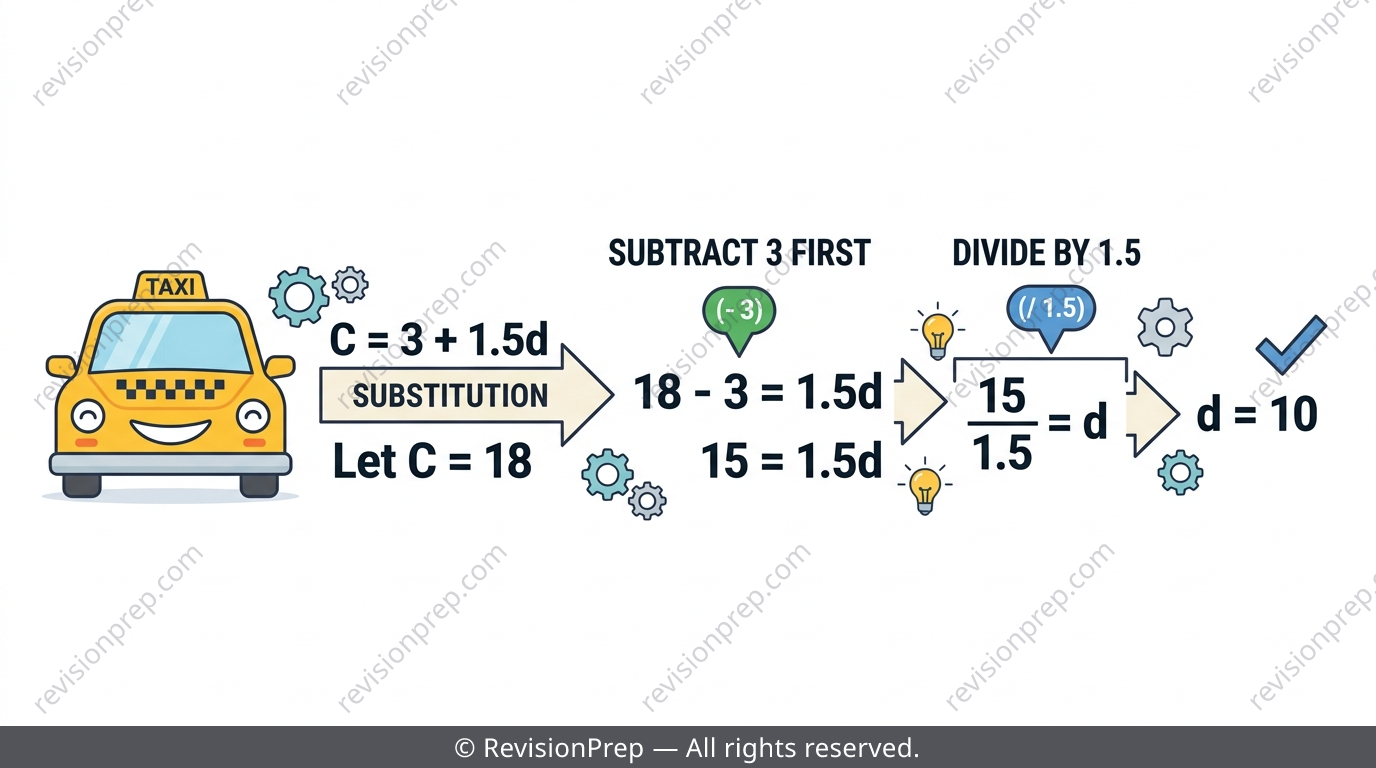
A formula connects real quantities — substitute known values in to find an output, using BIDMAS, or rearrange it like any equation to isolate a different letter as the input. Real formulas like taxi fares follow the pattern total = fixed charge + (rate × quantity), for example . Always check units match before calculating, since mismatched units are a common hidden error.
| Formula | Meaning |
|---|---|
| Perimeter of a rectangle | |
| Area of a rectangle | |
| Area of a triangle | |
| Speed = distance ÷ time |
Exam tip
Treat a formula exactly like an equation: undo addition/subtraction before multiplication/division when isolating a letter.
Common mistake
Dividing by the rate before removing the fixed charge when rearranging — the fixed amount must be subtracted first because it isn't multiplied by the variable.
Mini summary
Substitute values with correct units using BIDMAS, or rearrange using the same balance-method logic as any equation.
Quick formula sheet
Practice questions
- Solve .
- State whether uses an open or closed circle at 5, and explain why.
- Substitute and into to find the area.
- Solve $3x - 5 = 16$ using the balance method, showing each step.
- Solve and state the correct direction of the inequality sign.
- A taxi fare uses . If a ride costs \18d$ travelled.
- Maya is 5 years younger than three times her brother's age. The sum of their ages is 31. Define your variable, build the equation, and solve for each age.
- Rearrange to make the subject, then use it to find when and .
- Solve the inequality , showing where the sign flips and representing the solution on a number line.
Frequently asked questions
What is the difference between an equation and an inequality?+
An equation has one exact solution (or a small fixed set), like giving . An inequality has a whole range of solutions, like giving every value greater than 4, shown as shading on a number line.
Why does the inequality sign flip when you multiply or divide by a negative number?+
Multiplying or dividing both sides by a negative number reverses the order of the values being compared, so the inequality direction must flip to stay true. This is the most examined rule in this topic.
What's the difference between an open circle and a closed circle on a number line?+
An open (unfilled) circle means the boundary value is not included, used for strict or . A closed (filled) circle means the value is included, used for or .
How do I turn a word problem into an equation?+
Read the whole problem first, define your unknown in words (e.g. 'let = ...'), translate each phrase into algebra piece by piece, then combine the pieces using the relationship given in the sentence.
What order do I undo operations in when solving a two-step equation or rearranging a formula?+
Undo addition or subtraction first, then multiplication or division — the exact reverse of BIDMAS, every single time.
Does an unsolved equation still get marks in a word problem?+
Yes — mark schemes usually credit the equation-building step separately from the solving step, so a correctly built but unsolved equation can still score.
Ready to master equations, inequalities & formulae?
Related articles