
Forces and Motion
Friction, drag, speed, velocity and graphs — the foundations of MYP 1 mechanics, simplified.
Quick facts
Forces and Motion is the opening mechanics topic in IB MYP 1 Sciences, and it comes down to three repeatable skills: naming the forces acting on an object, reading a distance-time graph, and comparing data across different surfaces or conditions. You'll meet friction, air resistance and drag as the forces that oppose motion, plus the core motion quantities speed, velocity and acceleration. Most exam-style questions in this unit are short-answer or data-based rather than long calculations, so understanding why an object slows down matters just as much as calculating a number. This teaser walks through the five ideas examiners return to again and again — friction direction, drag and surface area, graph gradients, the speed/velocity/acceleration distinction, and the classic mistakes that cost marks. For full worked examples, definitions and the complete diagram walkthroughs, the full revision notes go much deeper than this summary can.
What you’ll be able to do
Friction, Air Resistance and Drag
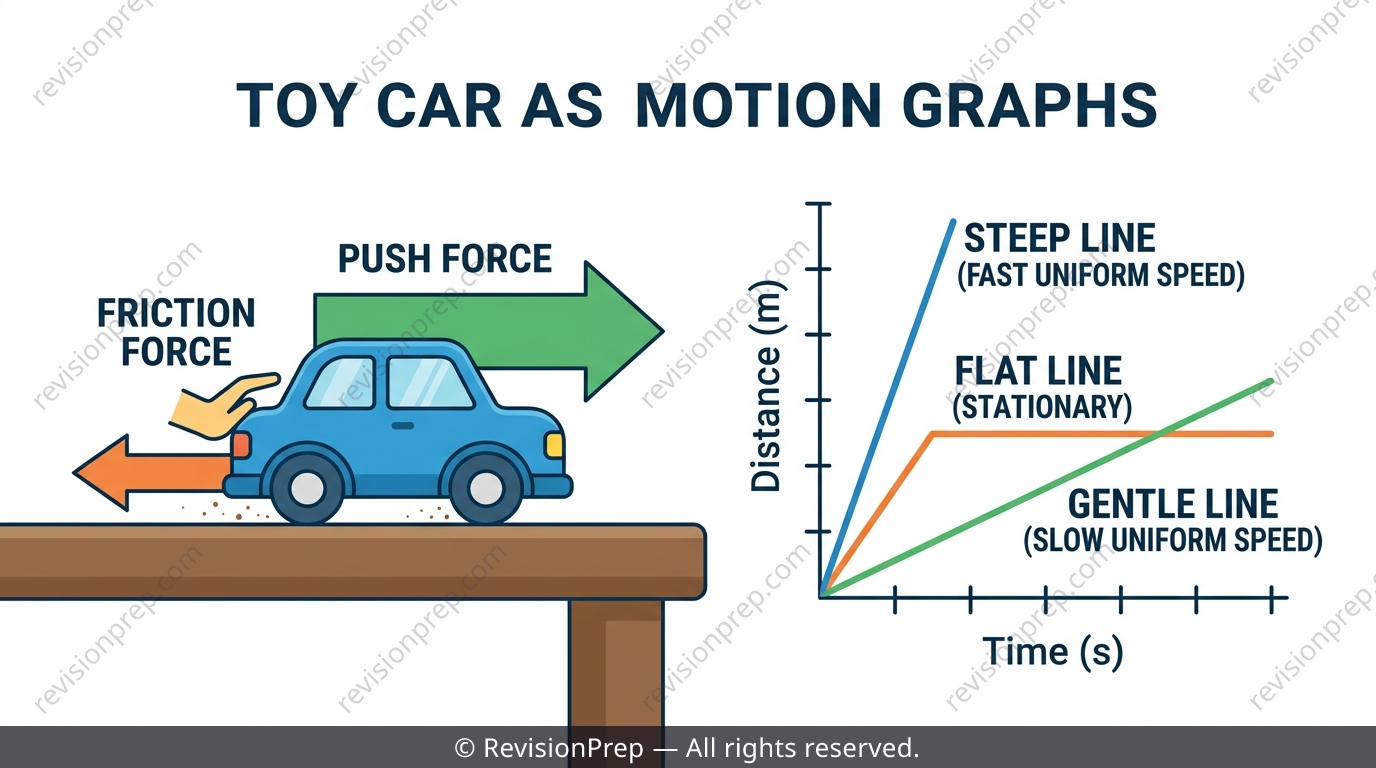
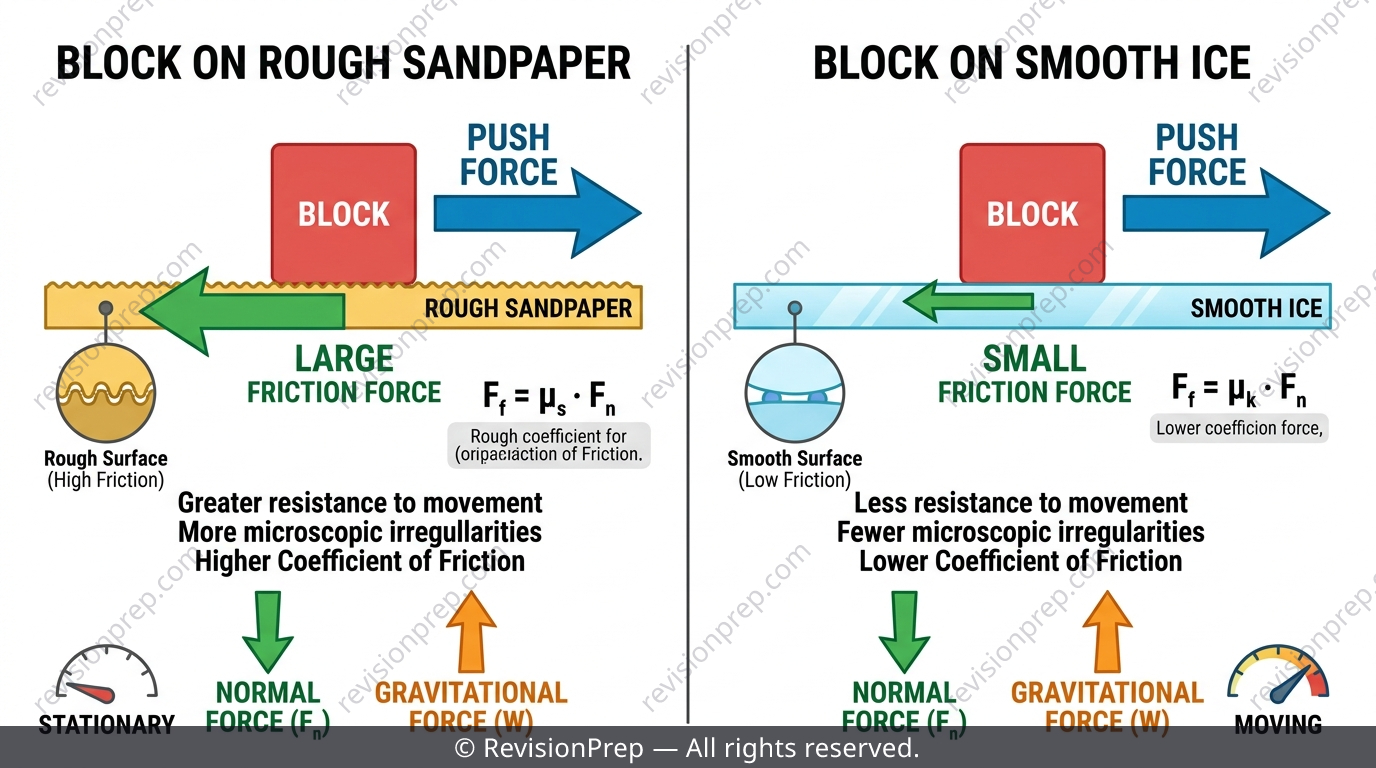
Friction is a contact force between two touching surfaces that opposes relative sliding motion, and it always acts opposite to the direction of the push or motion — never with it. Rougher surfaces (sandpaper, carpet) create more friction than smooth ones (ice, polished wood) because microscopic bumps catch against each other. Air resistance and drag work the same way but act on objects moving through air or water instead of sliding on a solid surface, and both increase with speed and with the surface area facing the direction of travel.
Exam tip
For 'compare' questions, link roughness to its effect on BOTH named surfaces — e.g. 'tile has less friction than carpet because tile is smoother, so the object slows down less and travels further on tile' scores full marks; a one-sided answer doesn't.
Common mistake
Assuming friction only depends on an object's weight and ignoring that surface roughness is usually the actual variable being tested — say 'sandpaper has more friction than ice because its surface is rougher,' not because it's heavier.
Mini summary
Friction opposes sliding motion and grows with roughness; drag and air resistance are its fluid equivalents and grow with speed and surface area.
Reading Distance-Time Graphs
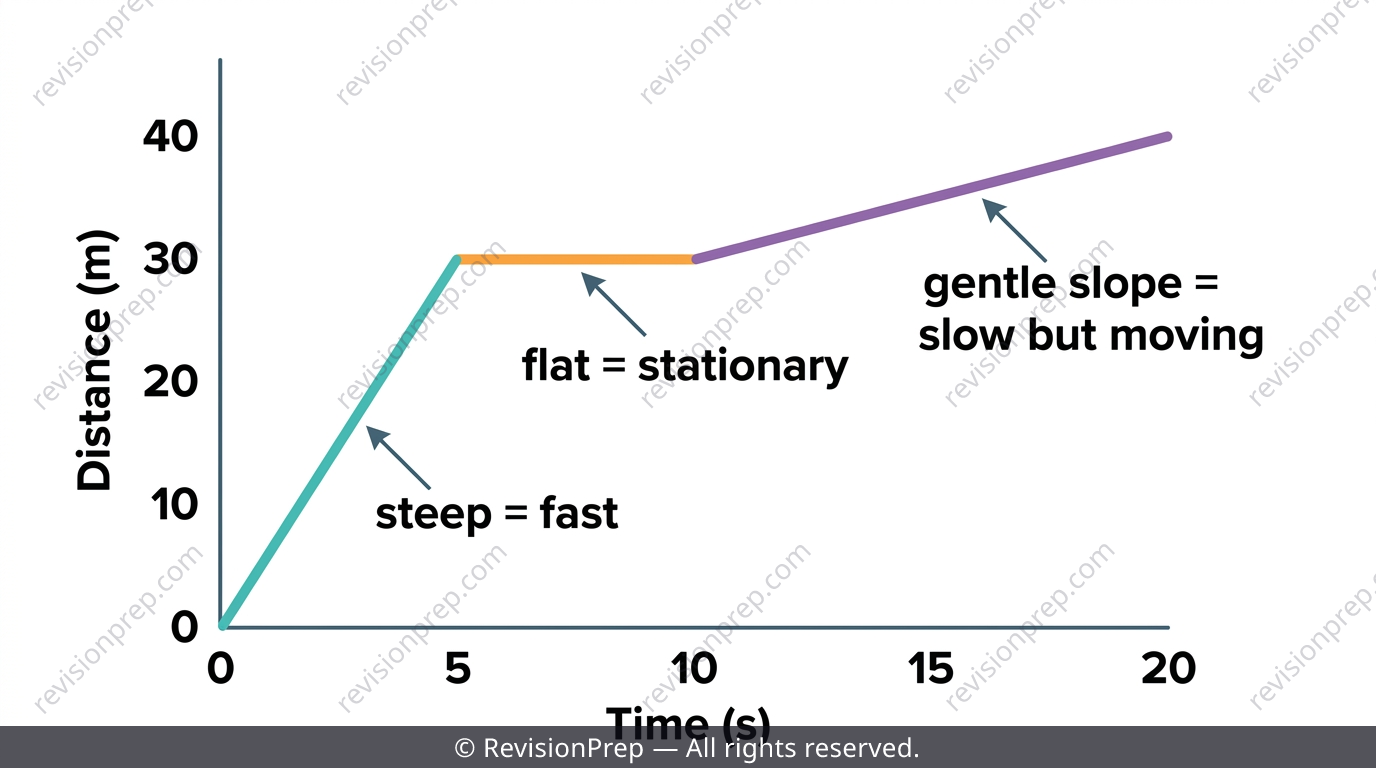
A distance-time graph plots distance travelled against time, and the gradient (slope) of the line tells you the speed. A steep line means fast motion, a flat horizontal line means the object is stationary, and a gentle slope means slow but still-moving motion — never mistake gentle for stopped. If a graph has several straight sections, calculate the speed for each section separately using over that specific interval.
Exam tip
Always double-check which interval the question is asking about before picking your two points off the graph — mixing up 'that section' with 'the whole graph' is the single most common error here.
Common mistake
Calculating total distance ÷ total time and using it as 'the speed' for one particular section of the journey — that only gives the average speed for the whole trip, not the speed during the requested phase.
Mini summary
Gradient of a distance-time graph = speed; steeper is faster, flat is stationary, and each straight segment must be treated separately.
Speed, Velocity and Acceleration
Speed is a scalar — distance travelled per unit time, with no direction — while velocity is speed with a direction attached, making it a vector. Acceleration measures how quickly velocity changes, whether an object is speeding up, slowing down (deceleration), or changing direction. Friction and drag are the forces responsible for deceleration, since they oppose motion and reduce velocity over time.
Exam tip
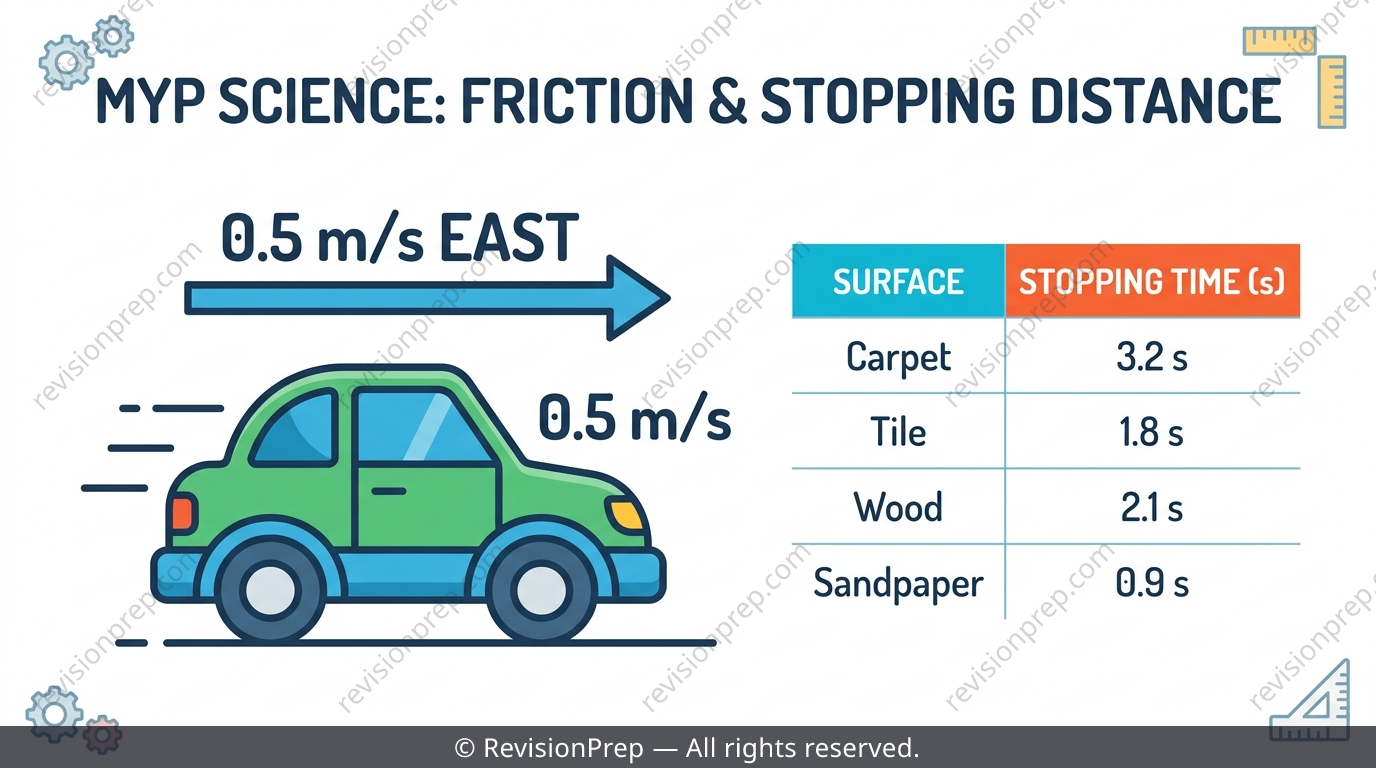
For stopping-distance questions using , re-check you've read the correct speed and time from the data table for the surface actually asked about — mixing up rows is a frequent slip.
Common mistake
Finding the average speed of a multi-stage journey by averaging the individual speed values (e.g. adding them and dividing by the number of stages) instead of using total distance ÷ total time for the whole journey.
Mini summary
Speed has no direction, velocity does; acceleration is the rate of change of velocity, and deceleration is just negative acceleration caused by opposing forces.
Force Diagrams and Balanced vs Unbalanced Forces
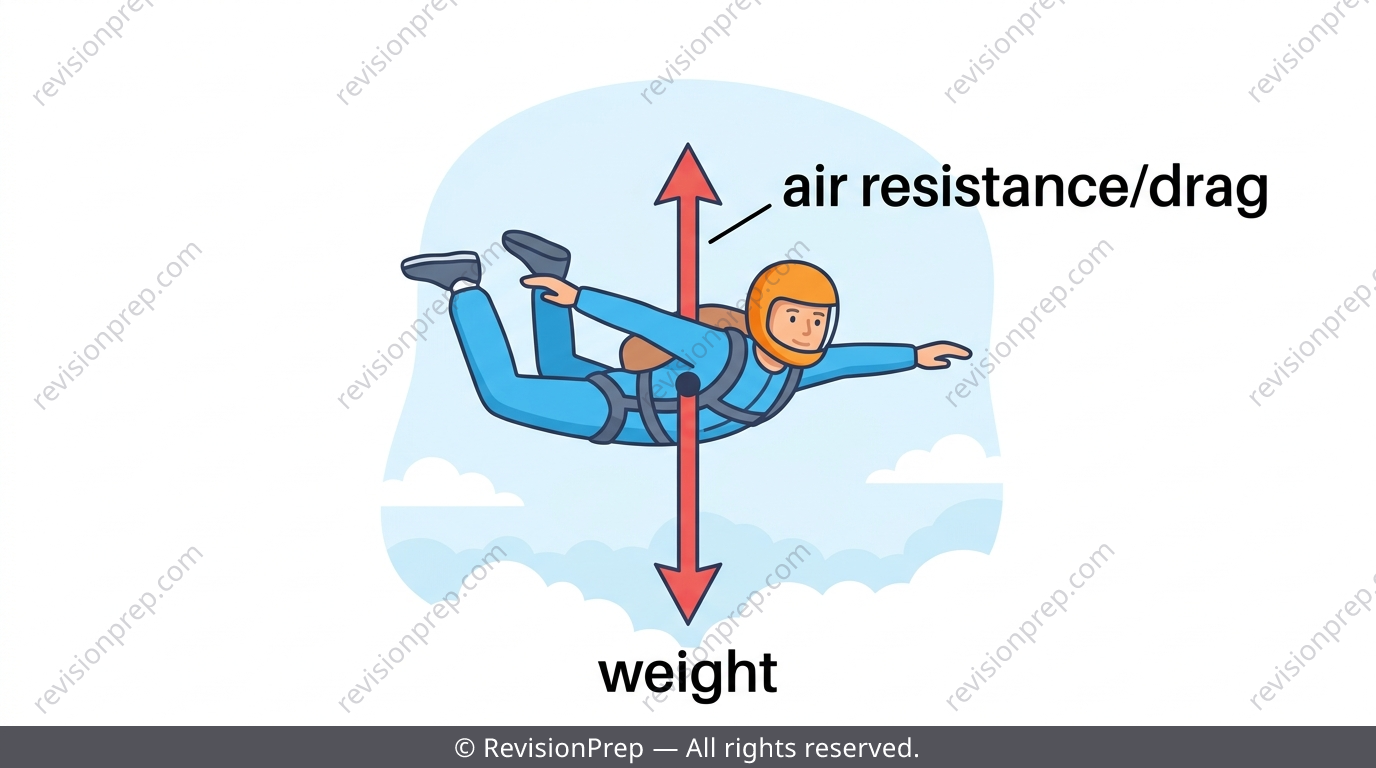
A force diagram shows every force acting on an object as an arrow, with the arrow's direction showing which way the force acts and its length roughly showing its size. When forces on an object are balanced, the object either stays still or keeps moving at a constant speed in a straight line — balanced forces do not mean 'nothing is happening.' A skydiver falling at a steady 55 m/s has balanced forces acting on them and is still moving fast; the forces are balanced, not absent.
Exam tip
When asked to identify a force in a diagram, check the arrow's direction against the motion first: friction and drag arrows must point opposite to the movement, never the same way.
Common mistake
Assuming a moving object must have an unbalanced force acting in its direction of travel — constant-speed motion in a straight line is exactly what balanced forces produce.
Mini summary
Balanced forces mean no change in speed or direction; unbalanced forces are needed to speed up, slow down, or change direction.
The Core Formulas You Need
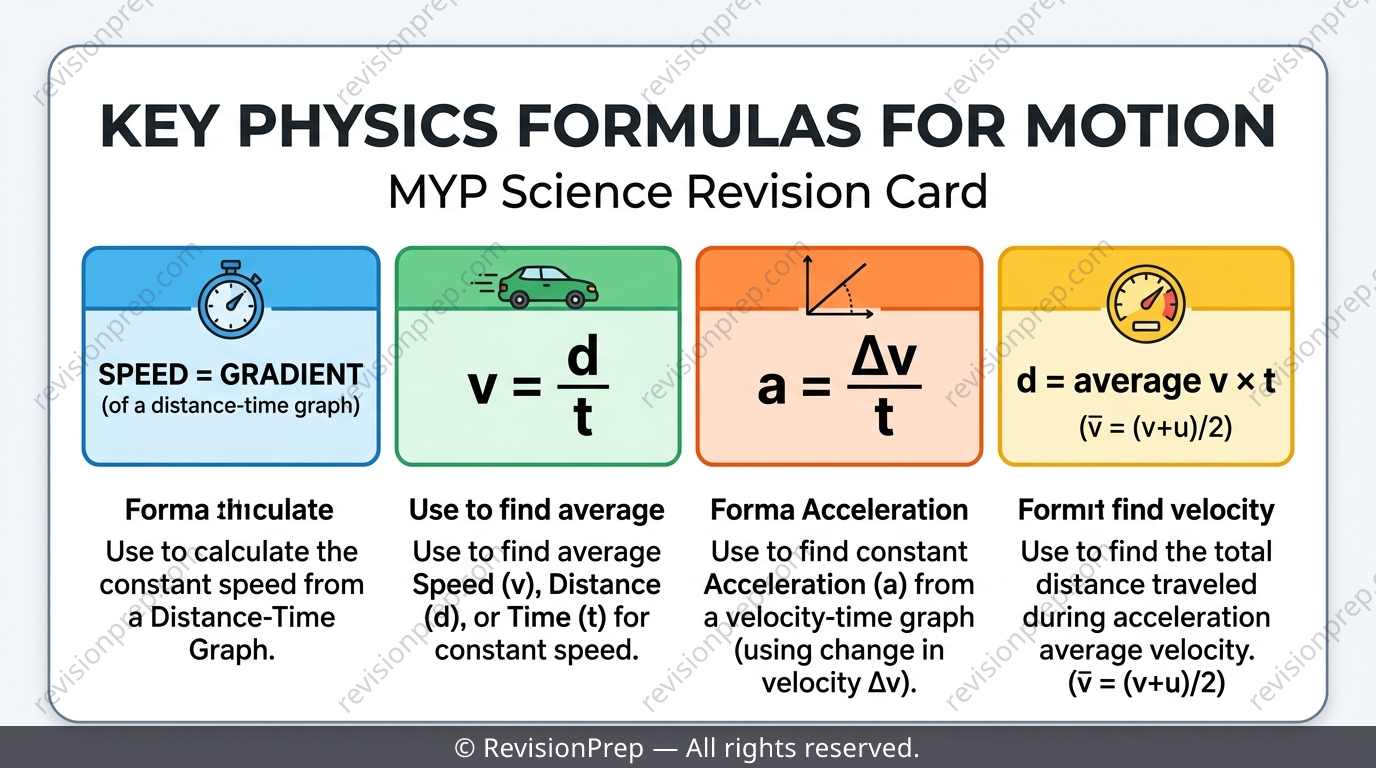
This whole unit rests on four relationships: speed as gradient of a distance-time graph, speed as distance over time, acceleration as change in velocity over time, and distance as average speed multiplied by time for stopping-distance style questions. Knowing which formula fits which style of question — graph reading versus stopping-distance calculation — is more useful than memorising them in isolation.
| Formula | Used for |
|---|---|
| speed = Δd/Δt (graph gradient) | Reading speed from a distance-time graph section |
| v = d/t | Basic speed calculation |
| a = Δv/t | Finding acceleration or deceleration |
| d = v̄ × t | Stopping-distance style questions |
Mini summary
Match the formula to the question type: graphs need gradients, stopping distances need average speed × time.
Quick formula sheet
Practice questions
- Define friction in one sentence.
- State whether speed or velocity includes direction.
- What does a flat horizontal line on a distance-time graph mean?
- Explain why a box sliding on ice travels further than one sliding on carpet, given the same starting push.
- A distance-time graph has three straight sections. Explain why you cannot use start-to-end distance and time to find the speed in the middle section.
- A toy car has an average speed of 0.4 m/s and takes 3 s to stop on a surface. Calculate the stopping distance.
- A skydiver falls at a constant 55 m/s. Explain, using the idea of balanced forces, why this does not mean no forces are acting.
- Two objects experience the same push force but different amounts of drag. Explain, referring to surface area and speed, why the object with more drag decelerates faster.
- A journey has three stages: 6 m/s for 2 s, 0 m/s for 3 s, and 2 m/s for 5 s. Explain why simply averaging 6, 0 and 2 gives the wrong average speed, and describe how to find the correct one.
Frequently asked questions
What is the difference between friction, air resistance and drag?+
Friction is between two solid surfaces in contact, while air resistance and drag act on objects moving through a fluid such as air or water. All three oppose motion and increase with rougher surfaces, higher speed, or larger surface area.
How do you find speed from a distance-time graph?+
Calculate the gradient of the line over the specific interval you're asked about: speed = change in distance ÷ change in time. Use the whole graph only if asked for the average speed of the entire journey.
Why does friction always point opposite to the motion?+
Friction opposes relative sliding between two surfaces, so by definition it acts against the direction of movement or the direction something is being pushed — it can never act the same way as the motion.
Do balanced forces mean an object isn't moving?+
No. Balanced forces mean no change in speed or direction — an object can be moving at a constant speed, like a skydiver at terminal velocity, while still having balanced forces acting on it.
What's the difference between speed and velocity?+
Speed is a scalar quantity with magnitude only, while velocity is speed with a stated direction, making it a vector quantity.
How is stopping distance calculated in MYP 1 Sciences?+
Using d = average speed × time, making sure you read the correct average speed and stopping time for the specific surface named in the question.
Master Forces and Motion with the Full MYP 1 Revision Notes
Related articles