
Energy Forms and Transfer
Master conservation of energy, heat transfer, and renewable resources for MYP 1 Sciences
Quick facts
Energy Forms and Transfer is one of the first big ideas in MYP 1 Sciences, and it shows up again and again in later physics units. The core message is simple but powerful: energy cannot be created or destroyed, only transferred between objects or transformed between forms — this is the law of conservation of energy. You'll see it in falling and swinging objects (gravitational potential energy trading with kinetic energy), in heat moving from hot to cold through conduction, convection, and radiation, and in real-world debates about renewable versus non-renewable resources. Examiners love catching students who state the law without proving it with numbers, or who say 'the energy is lost' instead of explaining where it actually went. This teaser covers the five ideas most likely to appear in your MYP 1 unit test — for full worked examples, tables, and practice with mark-scheme-style answers, check the complete revision notes linked below.
What you’ll be able to do
The Law of Conservation of Energy
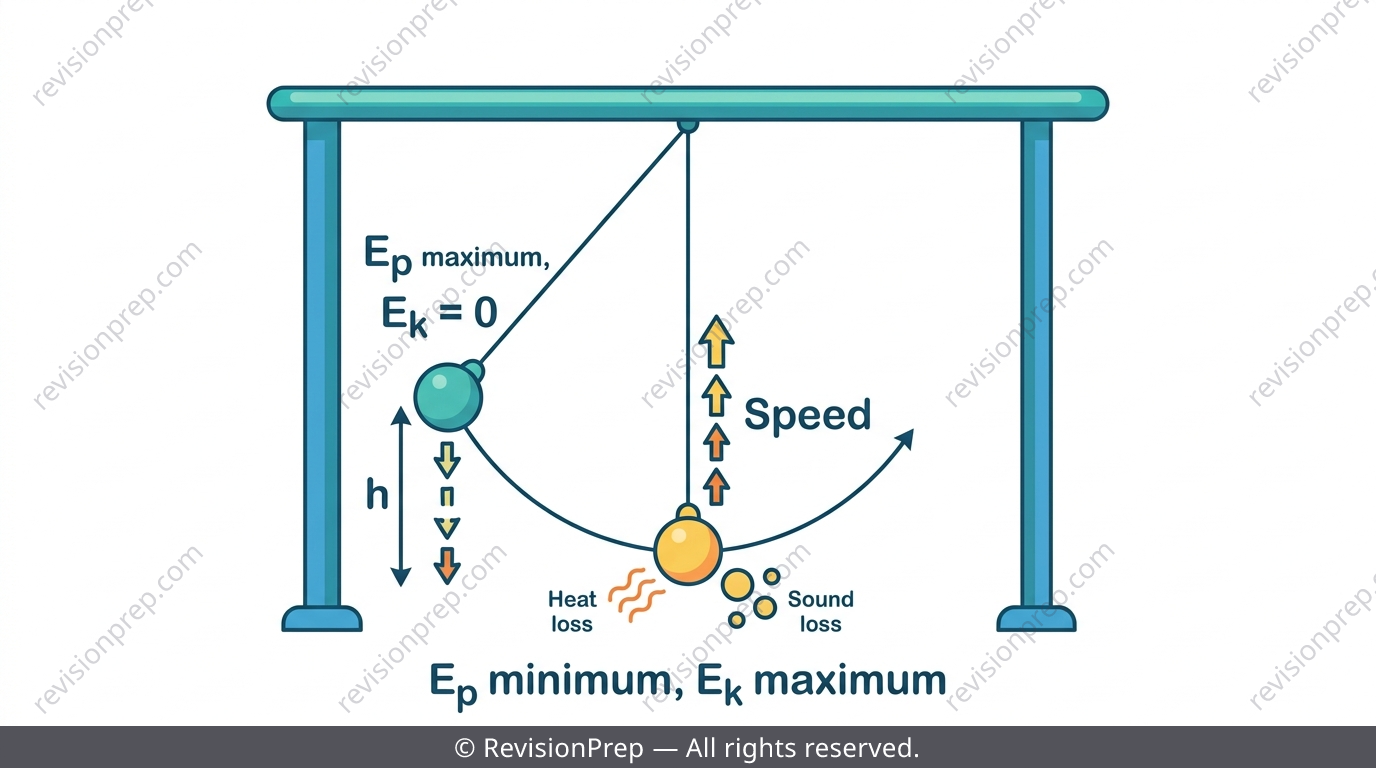
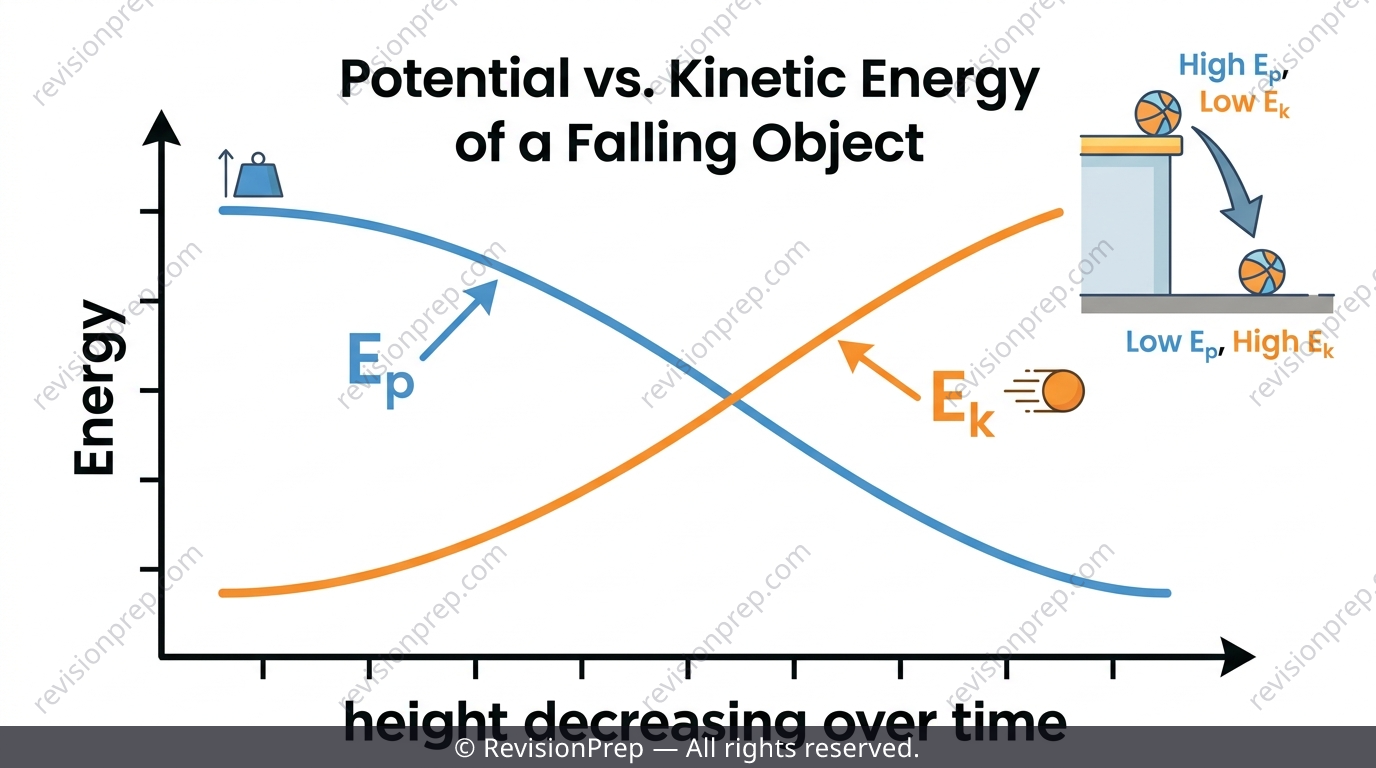
Energy can never appear from nowhere or vanish into nothing — it can only be transferred between objects or transformed between forms. In falling or swinging objects, gravitational potential energy (Ep) and kinetic energy (Ek) trade places as height and speed change. In real experiments, totals never match exactly because some energy always escapes as heat and sound.
Exam tip
If a question asks you to use 'potential energy, kinetic energy, and transferred', the mark scheme checks for those exact words in a logical sequence — a correct answer missing 'transferred' can still lose a mark.
Common mistake
Writing 'the ball loses energy' without saying where it went. Always finish with '...transferred to the surroundings as heat (friction) and sound.'
Mini summary
Total mechanical energy (Ep + Ek) stays constant in an ideal system; real systems lose a little to friction and sound.
Calculating Ep and Ek
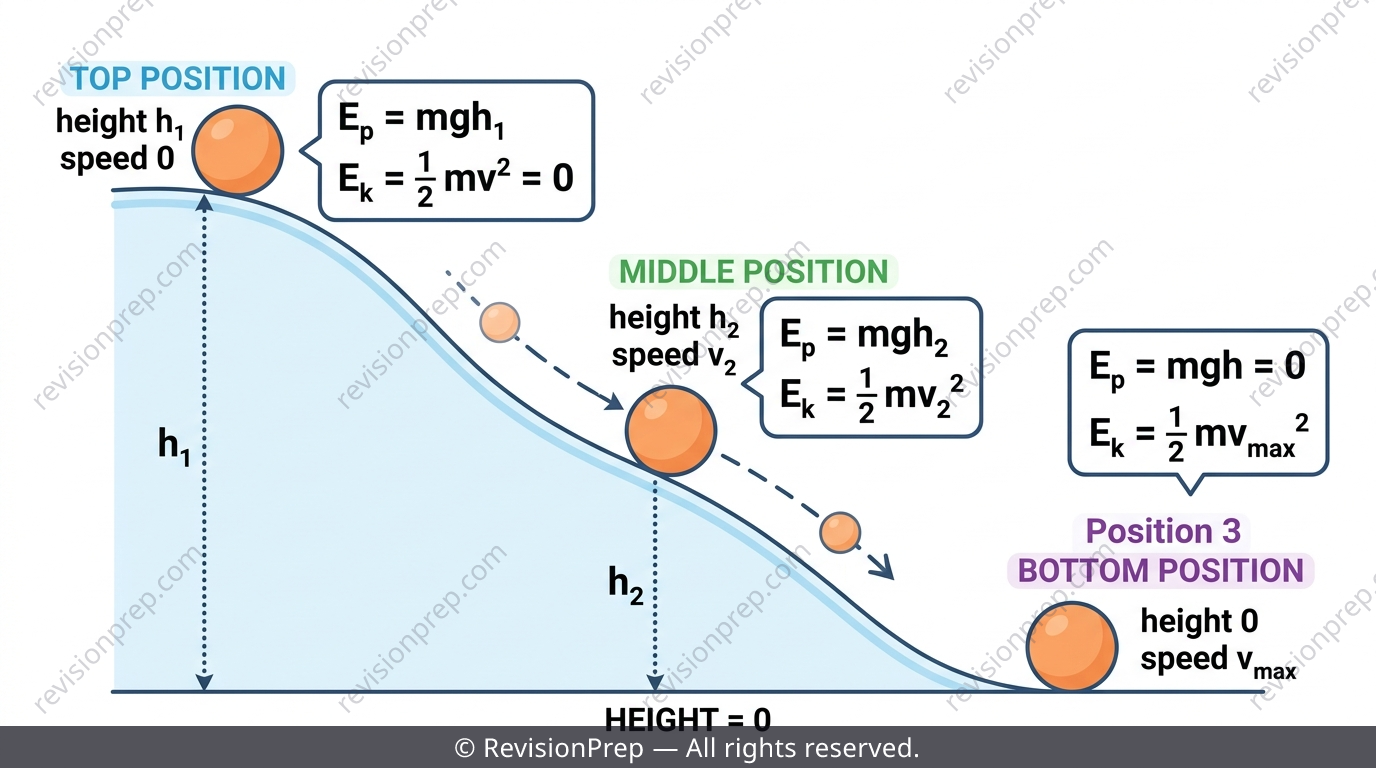
Gravitational potential energy is found using , where m is mass, g is gravitational field strength, and h is height. Kinetic energy is found using , where v is speed. At the highest point of a fall or swing, Ep is maximum and Ek = 0; at the lowest point, Ep is minimum and Ek is maximum.
Exam tip
Convert all units to kg, m, and m/s before substituting into the formulas — mixing grams and centimetres into these equations is a classic way to lose marks.
Common mistake
Quoting the law of conservation of energy as a definition without showing the numbers match — examiners want the calculation as evidence, not just the statement.
Mini summary
and — always convert units first.
Conduction, Convection, and Radiation
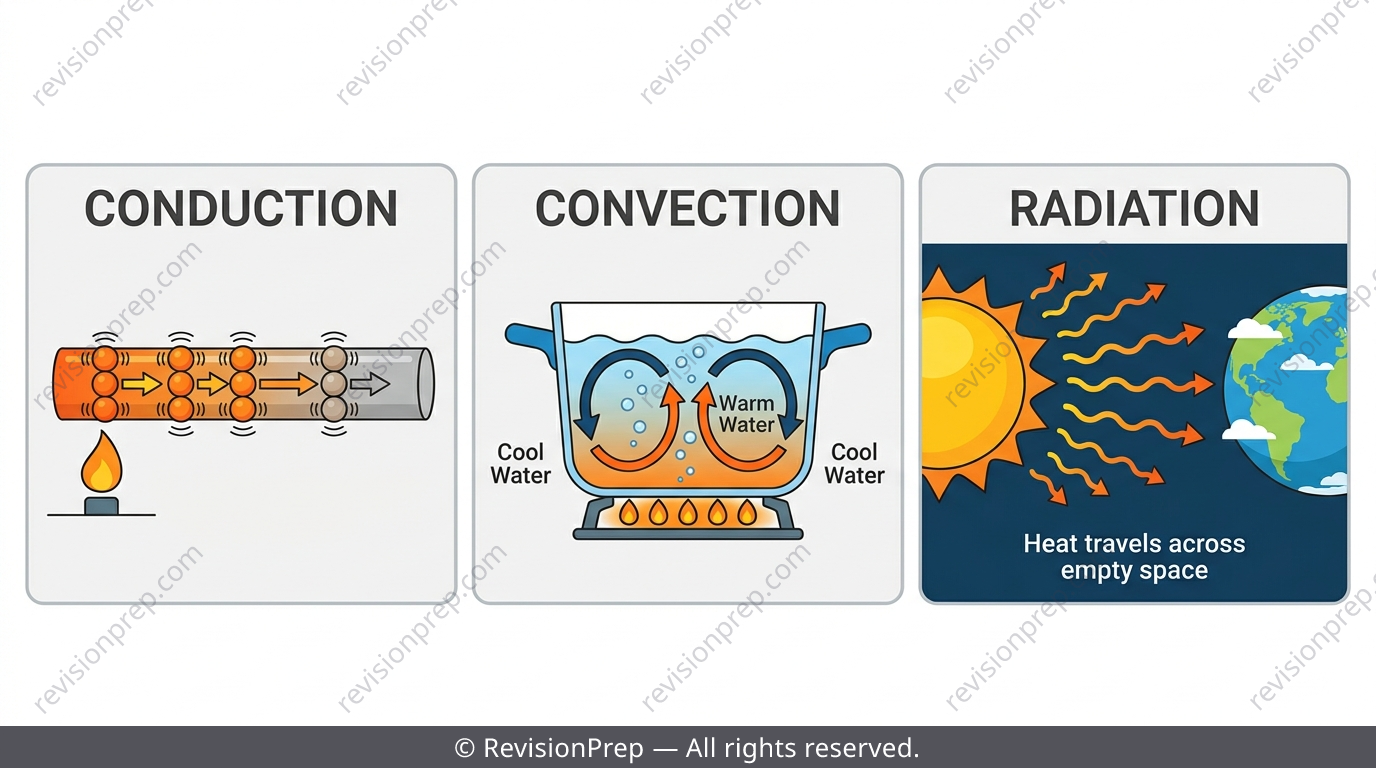
Thermal energy always flows from hotter to colder objects, using one of three mechanisms. Conduction needs particles in direct contact and dominates in solids, especially metals. Convection needs a fluid free to circulate, as warm, less dense fluid rises and cooler, denser fluid sinks. Radiation is electromagnetic (infrared) waves needing no medium at all — it's how heat from the Sun crosses empty space to reach Earth.
| Mechanism | Needs a medium? | Typical example |
|---|---|---|
| Conduction | Yes (contact) | Metal spoon heating up in a hot drink |
| Convection | Yes (fluid) | Warm air rising in a room |
| Radiation | No | Sunlight warming the Earth through space |
Exam tip
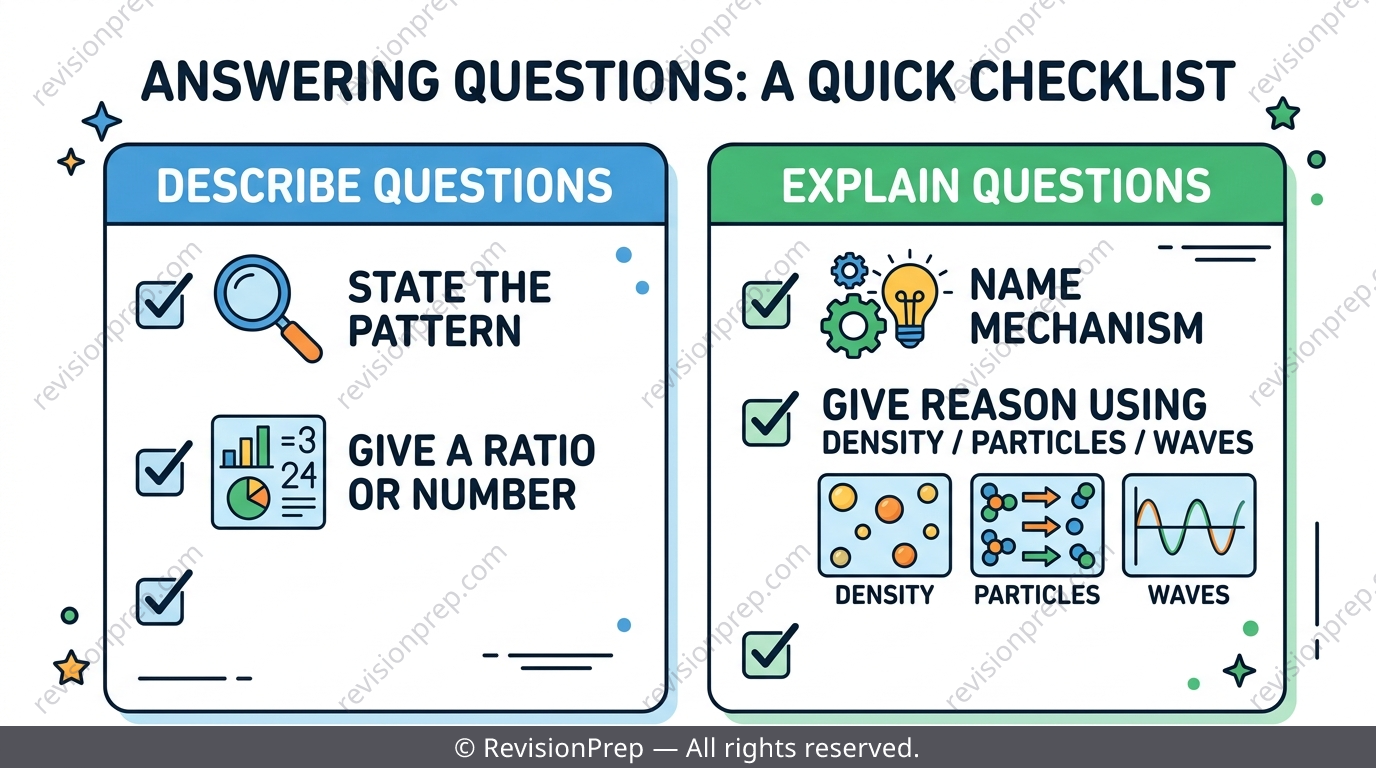
For 'explain' questions, name the mechanism AND give the reason (e.g. 'convection, because the heated fluid becomes less dense and rises') — naming the mechanism alone only earns half marks.
Common mistake
Saying radiation 'needs hot air to travel through' or confusing it with convection because both involve 'heat rising'. Radiation is electromagnetic waves and works through a vacuum.
Mini summary
Conduction = contact; convection = fluid movement; radiation = electromagnetic waves needing no medium.
Renewable vs Non-Renewable Resources
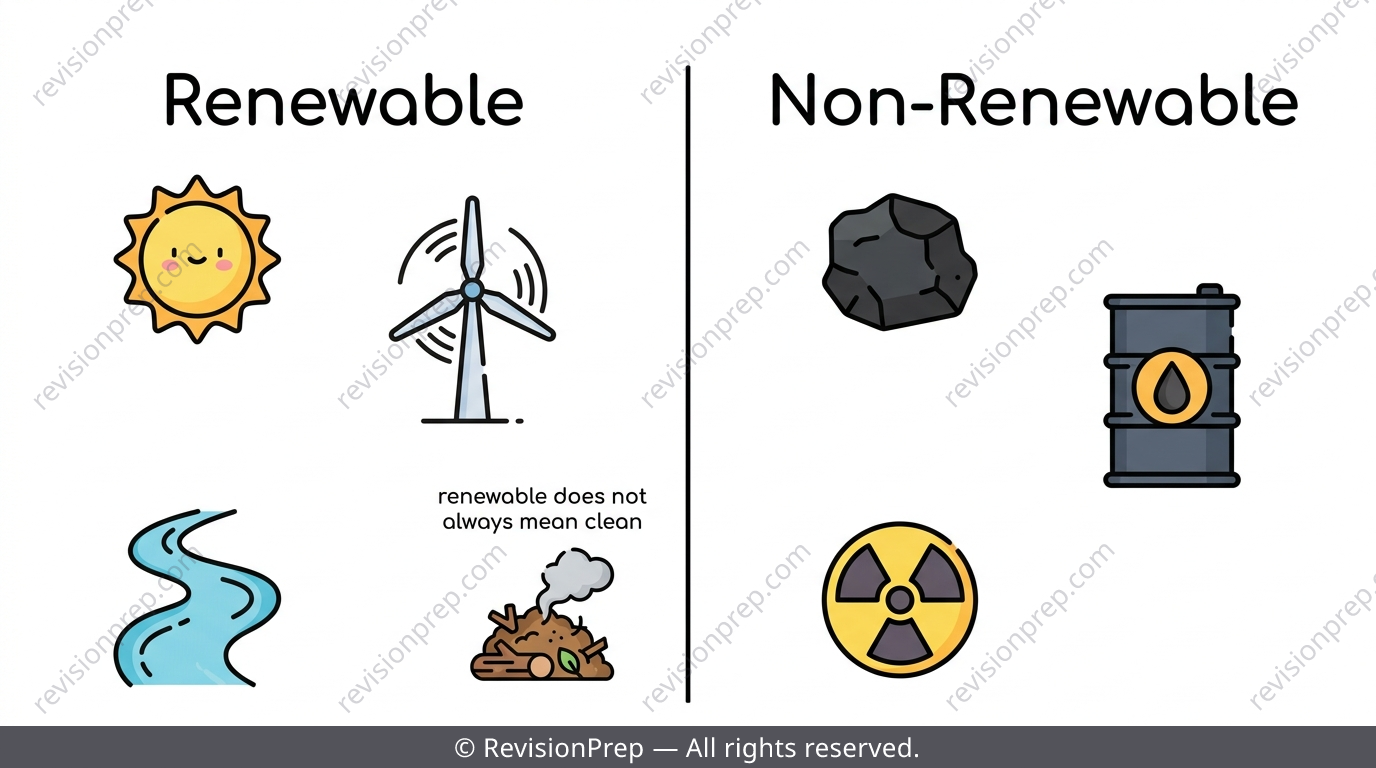
Renewable resources are naturally replenished on a human timescale, like sunlight, wind, flowing water, and biomass. Non-renewable resources exist in a fixed, finite supply that took millions of years to form, like coal, oil, natural gas, and uranium. Being renewable is not the same as being clean — biomass is renewable but releases carbon dioxide, while nuclear fuel produces very little CO2 but is classed non-renewable because uranium is finite.
Exam tip
If asked to compare a renewable and non-renewable resource, give at least one similarity AND one difference — listing only differences typically scores half marks.
Common mistake
Assuming 'renewable' automatically means 'zero emissions' or 'perfectly clean'. Judge renewable vs non-renewable only on whether the supply runs out; judge clean vs polluting separately based on emissions.
Mini summary
Renewable = naturally replenished; non-renewable = finite supply. Renewable ≠ automatically clean.
Answering 'Describe' and 'Explain' Questions Well
MYP examiners reward precision in wording, not just correct physics. A 'describe' question about a pattern (like drop height vs bounce height) needs a ratio or number, not just 'it increases'. An 'explain' question about heat transfer needs the mechanism plus the reason particles or waves behave that way, not just the name of the mechanism.
Exam tip
Practise finishing energy-loss explanations with the phrase 'transferred to the surroundings as heat and sound' — this single habit fixes one of the most common mark losses in this unit.
Common mistake
Answering 'the bounce height increases' without stating the ratio or relationship between drop height and bounce height — this only earns partial credit.
Mini summary
Precise wording (transferred, ratio, mechanism + reason) is often worth as many marks as the physics itself.
Quick formula sheet
Practice questions
- State the law of conservation of energy in your own words.
- Name the three mechanisms of heat transfer.
- Give one example each of a renewable and a non-renewable resource.
- A 2 kg object is 5 m above the ground. Calculate its gravitational potential energy using g = 10 m/s².
- Explain why radiation is the only heat transfer mechanism that can work through a vacuum.
- Explain why biomass is classified as renewable even though it produces carbon dioxide when burned.
- A 0.5 kg ball falls from 2 m and reaches 6 m/s just before hitting the ground. Calculate Ep at the top and Ek at the bottom, then comment on whether energy appears conserved.
- A pendulum swings and gradually loses height on each swing without anyone touching it. Explain, in terms of energy, why this happens.
- Compare a renewable and a non-renewable resource, giving one similarity and one difference in how they are used to generate electricity.
Frequently asked questions
What is the law of conservation of energy in MYP Sciences?+
It states that energy cannot be created or destroyed, only transferred between objects or transformed between forms — the total energy of a closed system stays constant.
What is the difference between Ep and Ek?+
Gravitational potential energy (Ep) depends on an object's height above a reference level, while kinetic energy (Ek) depends on its speed. Ep = mgh and Ek = ½mv².
Why doesn't Ep exactly equal Ek in real experiments?+
Some energy is always transferred to the surroundings as heat (from friction) and sound, so the totals never match perfectly — this is expected, not an error.
How is radiation different from conduction and convection?+
Radiation transfers heat as electromagnetic (infrared) waves and needs no medium, so it can travel through a vacuum — unlike conduction and convection, which both need matter to work.
Is a renewable energy resource always clean?+
No. Renewable only means the resource is naturally replenished, not that it's pollution-free — biomass is renewable but still releases CO2 when burned.
Why is uranium classed as non-renewable if it produces little CO2?+
Classification as renewable or non-renewable is based only on whether the supply is finite. Uranium exists in a limited quantity, so it's non-renewable despite its low emissions.
Get the Full MYP 1 Energy Forms and Transfer Revision Notes
Related articles