
Systems in Organisms
How the skeletal, muscular, reproductive, excretory and other body systems link structure to function
Quick facts
IB MYP 2 Systems in Organisms is the core Life Science unit that asks one question again and again: how does the shape or position of a structure explain what it does? Across the skeletal, muscular, reproductive, excretory and homeostasis systems, examiners test whether you can connect a structure to its function, use correct vocabulary like ligament, tendon and negative feedback, and spot how systems depend on each other. This teaser walks through the five most exam-critical ideas — bone and muscle roles, reproduction basics, excretion versus homeostasis, and system interdependence — with the real common mistakes students make on unit tests and onscreen summatives. For the full structure-function tables, worked calculations and diagram-labelling practice, the complete revision notes go much deeper than this overview.
What you’ll be able to do
The Big Idea: Structure Matches Function
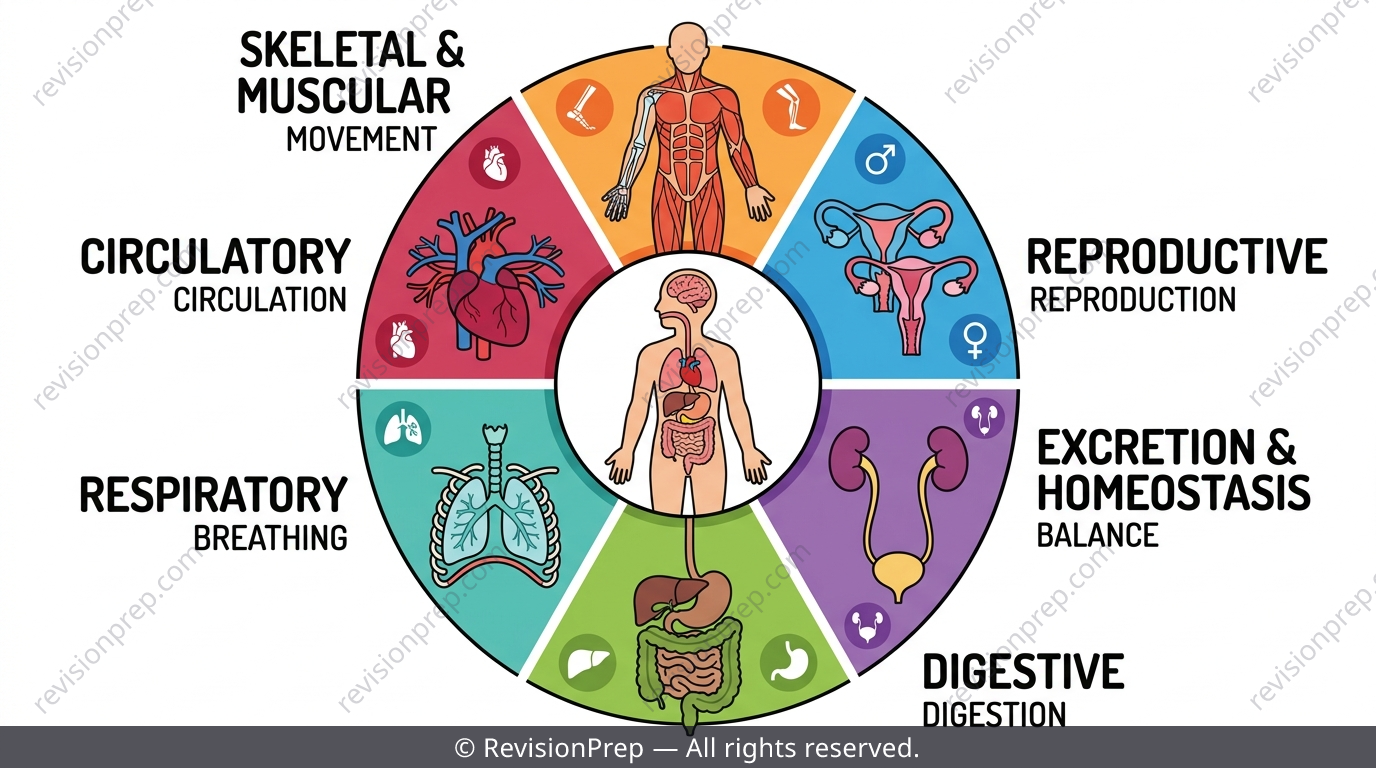
A 'system' is a group of organs working together toward one job, and this unit covers six of them: skeletal & muscular, reproductive, excretion & homeostasis, digestive, and respiratory & circulatory. Almost every exam question asks you to match a structure's shape, position or material to what it does and why that shape helps. Getting comfortable with this structure-function logic is the single most useful revision habit for this unit.
Exam tip
When a question gives you a shape or material detail, always link it explicitly to a function — don't just describe the structure.
Mini summary
Every system question tests: structure shape/position → linked function.
Skeletal & Muscular Systems: Support, Protect, Move
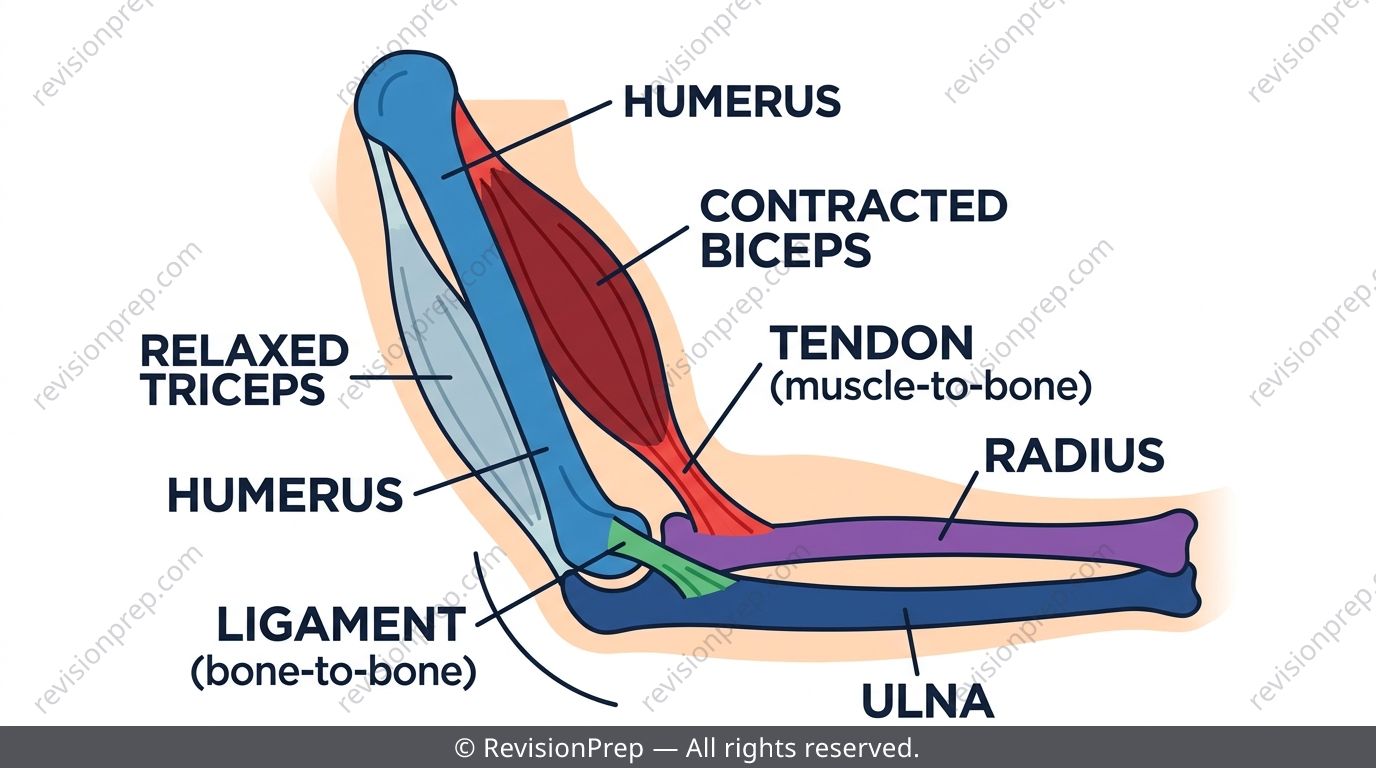
The skeleton supports the body, protects soft organs, allows movement (bones act as levers), and stores minerals and makes blood cells in the marrow. Bone shape predicts its job: flat bones protect, long bones support and move, irregular bones protect while staying flexible. Muscles can only pull, never push, so they work in antagonistic pairs — like the biceps and triceps — where one contracts as the other relaxes.
| Bone Type | Shape | Main Function | Example |
|---|---|---|---|
| Flat | Broad, curved surface | Protection | Skull, ribs, scapula |
| Long | Rigid, elongated | Support & movement (lever) | Femur, humerus |
| Irregular | Complex, varied | Protection + flexibility | Vertebrae, pelvis |
Exam tip
For 'compare' questions, use connecting language like 'whereas' or 'in contrast' — two unlinked facts score lower than a genuine comparison.
Common mistake
Mixing up ligaments (bone-to-bone) and tendons (muscle-to-bone) on labelling diagrams — one of the most frequent errors.
Mini summary
Bone shape = clue to function; muscles pull in antagonistic pairs; know ligament vs tendon.
Reproductive System: The One System You Can Live Without
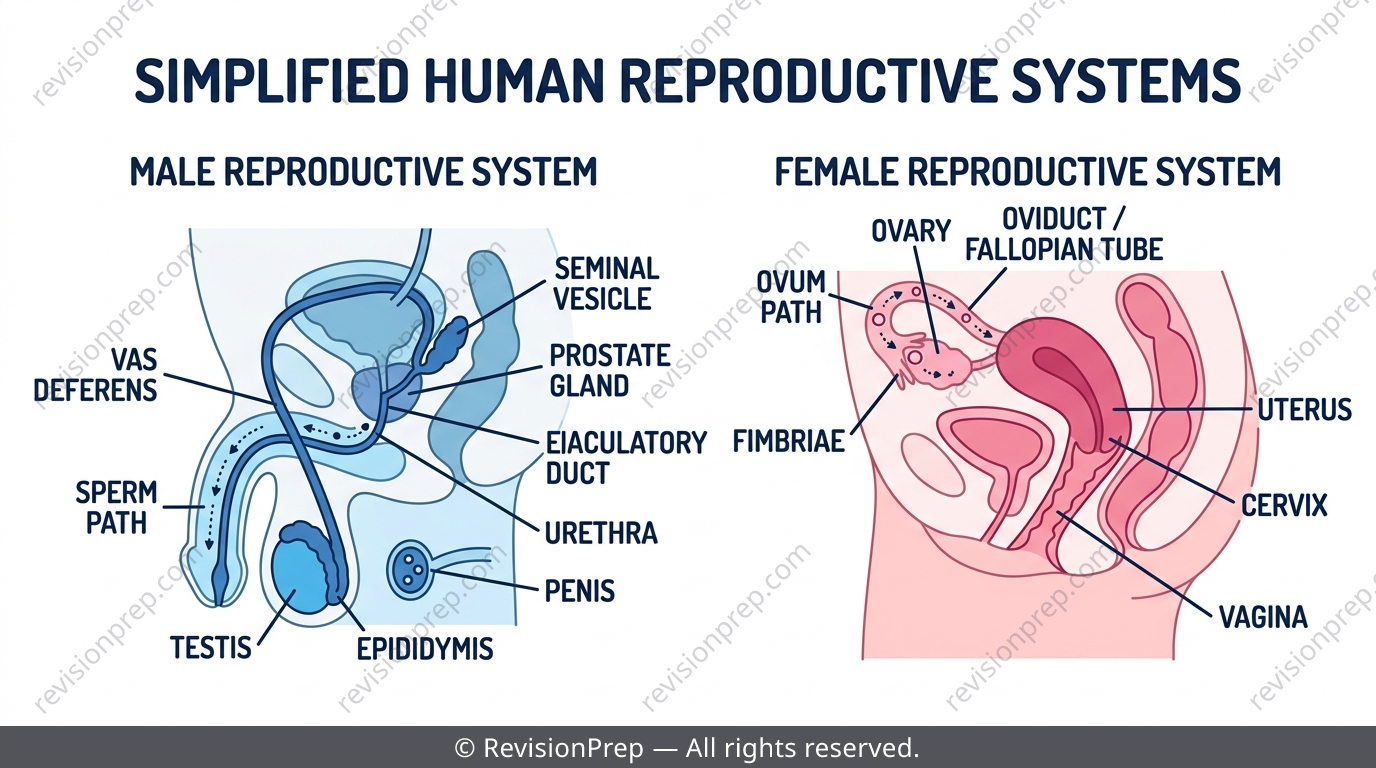
Unlike every other system in this unit, an individual survives fine without a functioning reproductive system — its job is producing gametes and enabling fertilisation for the species to continue. Testes produce sperm and ovaries release eggs; fertilisation usually happens in the oviduct, forming a zygote, while the uterus is where a fertilised egg implants and develops. Puberty is the hormone-triggered maturing of this system, bringing visible physical changes.
Exam tip
Know exactly which organ produces which gamete — testes make sperm, ovaries make eggs — this is a common quick-mark question.
Mini summary
Reproductive system makes gametes and enables fertilisation, but isn't needed for individual survival.
Excretion & Homeostasis: Removing Waste, Staying Stable
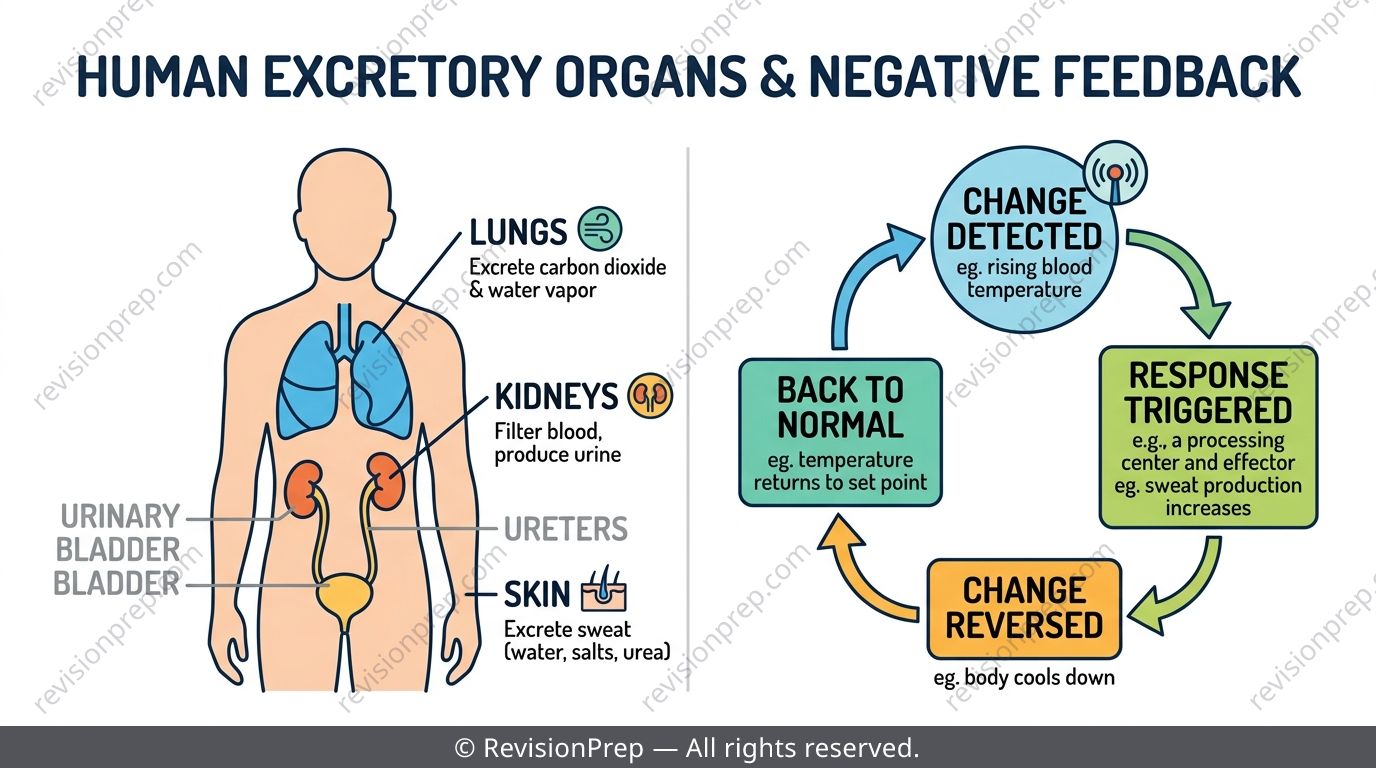
Excretion removes waste made by the body's own metabolism — this is different from egesting undigested food. Kidneys filter blood and remove urea as urine, lungs remove carbon dioxide, and skin removes excess water, salts and some urea as sweat. Homeostasis keeps internal conditions like temperature and water level stable through negative feedback: a change is detected, a response is triggered, and the change is reversed.
Exam tip
If asked which structures carry out excretion, name all three: kidneys, lungs and skin.
Common mistake
Confusing excretion (removing metabolic waste like urea and CO2) with egestion (removing undigested food) — these are tested as separate concepts.
Mini summary
Excretion removes metabolic waste via kidneys, lungs, skin; homeostasis uses negative feedback to stay stable.
Interdependence: No System Works Alone
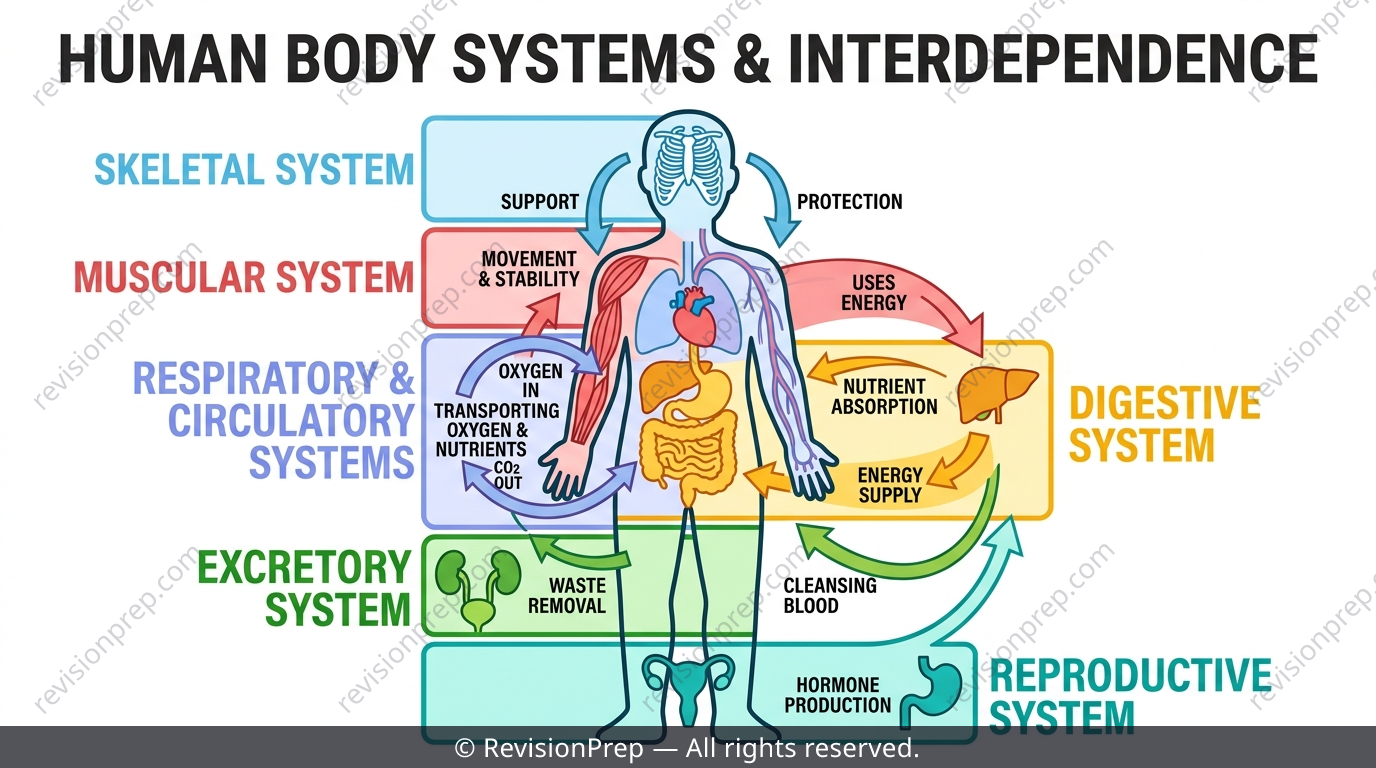
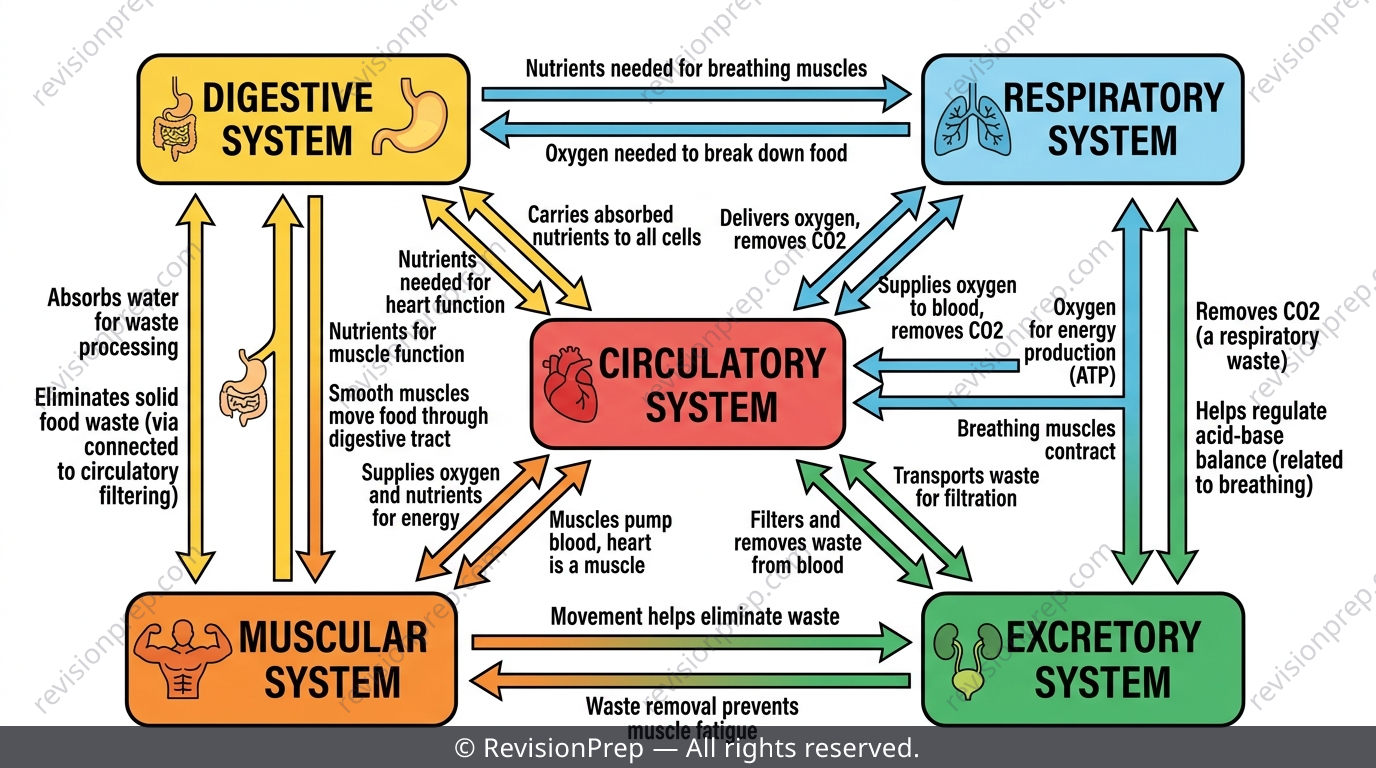
Every system in this unit depends on at least one other to function. The digestive system absorbs nutrients but needs the circulatory system to deliver them to cells; the respiratory system takes in oxygen but needs circulation to transport it; muscles need the skeleton for levers and the circulatory/respiratory systems for energy delivery; and excretory organs rely on blood flow to even reach the waste they filter.
Exam tip
The most tested link is digestive → circulatory (nutrient transport) and respiratory → circulatory (gas transport) — be ready to explain both with named examples.
Mini summary
No system works in isolation; circulation is the connecting thread between most systems.
Quick formula sheet
Practice questions
- Name the four main functions of the skeleton.
- What is the difference between a ligament and a tendon?
- Which organ produces sperm, and which organ produces eggs?
- Explain why muscles must work in antagonistic pairs like the biceps and triceps.
- Describe the difference between excretion and egestion, giving one example of each.
- Explain how negative feedback helps the body maintain a stable internal temperature.
- A bone has mass 12.5 g and fractures at 340 N, while a second bone of similar size has mass 11.8 g and fractures at 480 N. Calculate the force-to-mass ratio for each and explain why a higher ratio does not automatically mean a healthier bone.
- Explain, using a named example, how the digestive and circulatory systems depend on each other to deliver nutrients to cells.
- A bird wing bone (12 g, 45° flexibility) is compared to a deer antler (180 g, 8° flexibility). Explain the relationship between bone mass and flexibility using the word 'density'.
Frequently asked questions
What is the difference between excretion and egestion?+
Excretion removes waste made inside the body by metabolism, like urea and carbon dioxide, via the kidneys, lungs and skin. Egestion removes undigested food that never entered the blood, and is part of the digestive system.
Why can't muscles push, only pull?+
Muscles can only contract and pull, so they work in antagonistic pairs across a joint — as one contracts to create movement in one direction, the other relaxes, and vice versa for the opposite movement.
What is the difference between a ligament and a tendon?+
A ligament joins bone to bone at a joint, stopping dislocation, while a tendon joins muscle to bone, transmitting the pull of a contracting muscle. Mixing these up is a very common labelling mistake.
Why is the reproductive system different from the other systems in this unit?+
It's the only system an individual can survive without functioning — its role is producing gametes and enabling fertilisation for the species to continue, not for personal day-to-day survival.
How does negative feedback keep the body stable?+
A change from the normal range is detected, a response is triggered, and that response reverses the change, bringing the body back to its stable set point — this is how homeostasis controls temperature and water levels.
Why do body systems depend on each other?+
No system works in isolation. For example, the digestive system absorbs nutrients but needs the circulatory system to transport them to cells, and the respiratory system takes in oxygen but needs circulation to deliver it to tissues.
Master Every System Before Your MYP 2 Unit Test
Related articles