
Chemical Reactions and the Periodic Table
Metals, non-metals, groups, periods and the reactivity series — the MYP 2 essentials in one quick read.
Quick facts
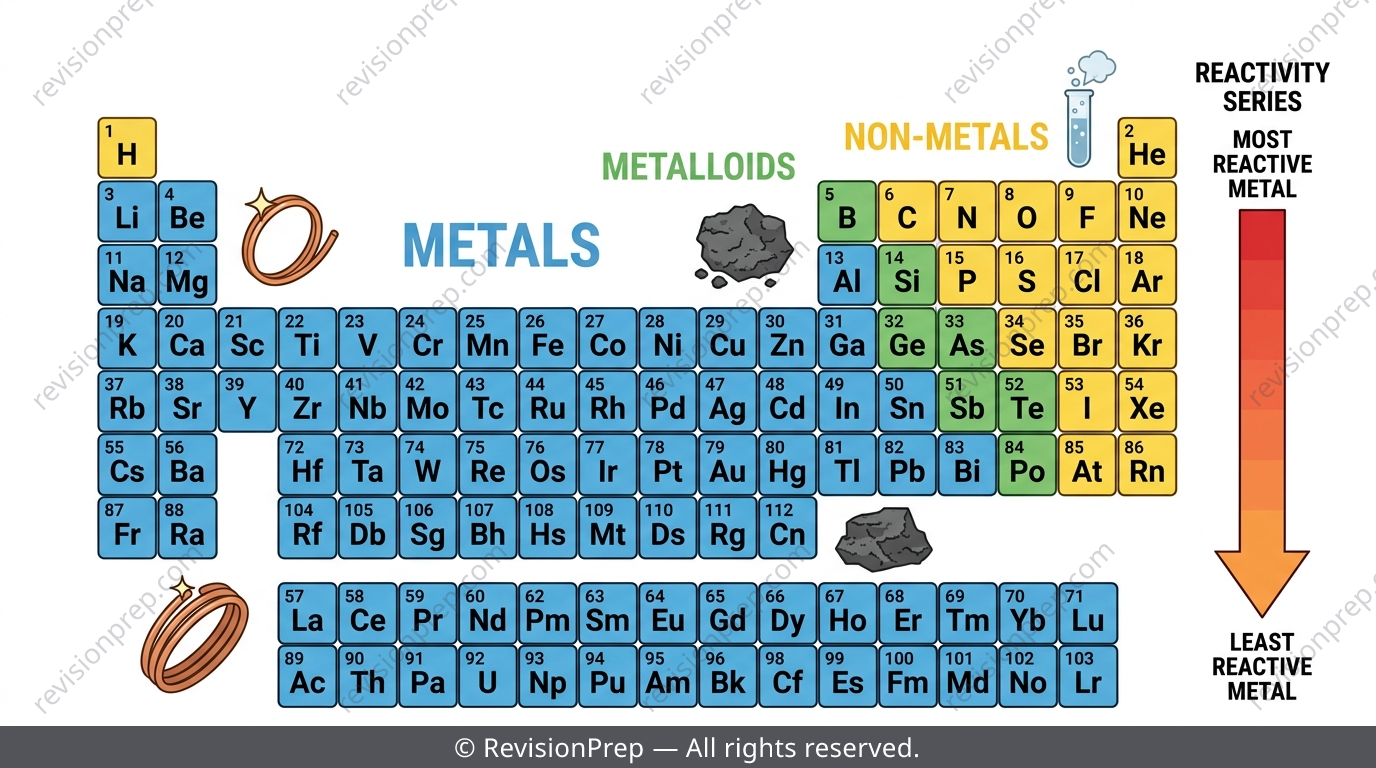
A chemical reaction is just atoms rearranging into something new — but how eagerly an element joins in depends entirely on where it sits in the periodic table. Metals want to lose electrons, non-metals want to gain them, and the reactivity series ranks exactly how strong that 'want' is. This teaser walks through the five ideas MYP 2 examiners return to again and again: telling metals from non-metals using physical properties, spotting metalloids on the staircase, reading groups and periods to predict behaviour, building a reactivity series from acid/water/oxygen tests, and using that series to explain rusting, batteries and material choice. Master these five and most data-response questions on chemical reactions and the periodic table become straightforward. For the full depth — tables, worked examples and every definition — the complete revision note is linked below.
What you’ll be able to do
Metals vs Non-Metals: Physical Properties First
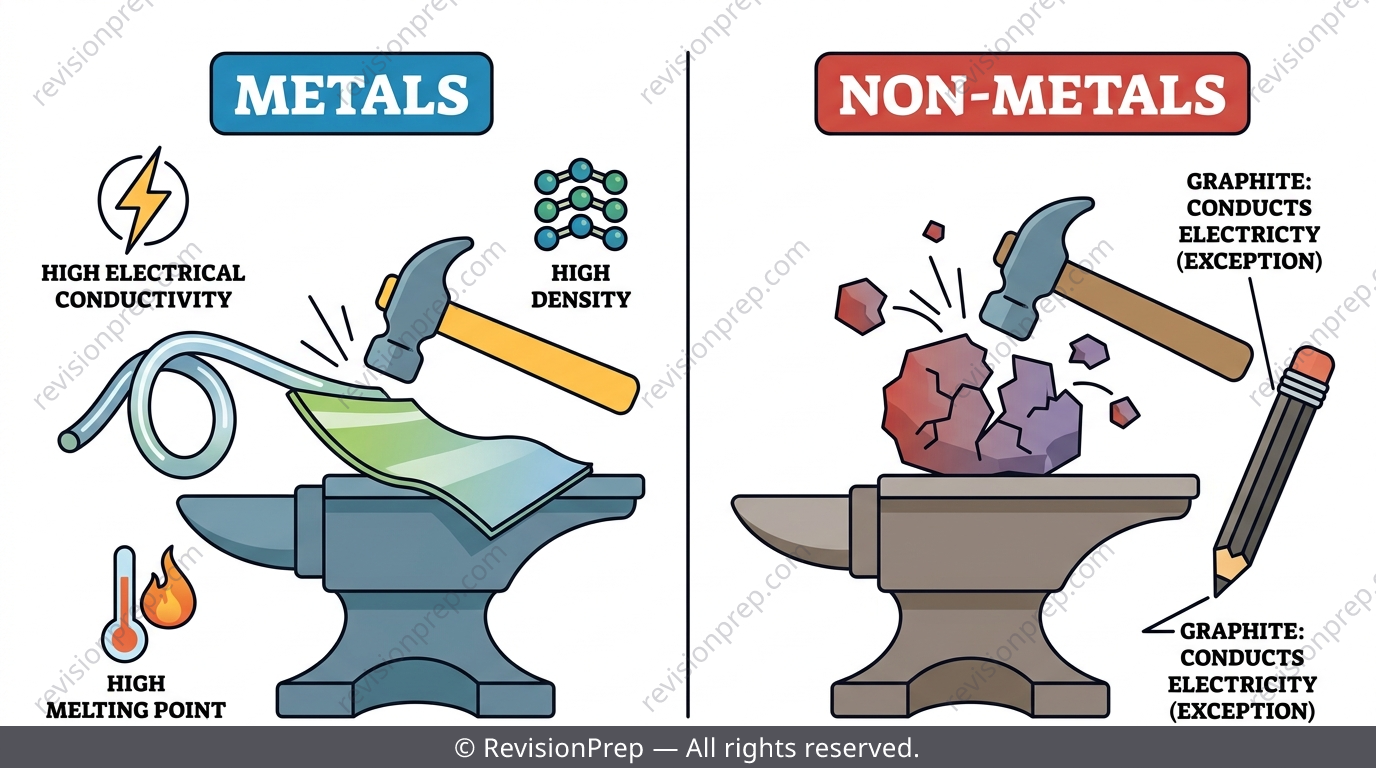
Before testing any chemical property, physical properties already tell you a lot. Metals are lustrous, malleable and ductile, and conduct heat and electricity well — usually dense with high melting points and solid at room temperature (mercury excepted). Non-metals are typically dull, brittle and poor conductors (graphite is the exception), with lower density and varied states.
Common mistake
Assuming a denser or more 'premium' metal (like gold) is automatically best for any job — always match the SPECIFIC property named in the question to the SPECIFIC job demand.
Mini summary
Shiny, bendable, conductive → metal. Dull, brittle, poor conductor → non-metal (mostly).
Metalloids: Living on the Staircase
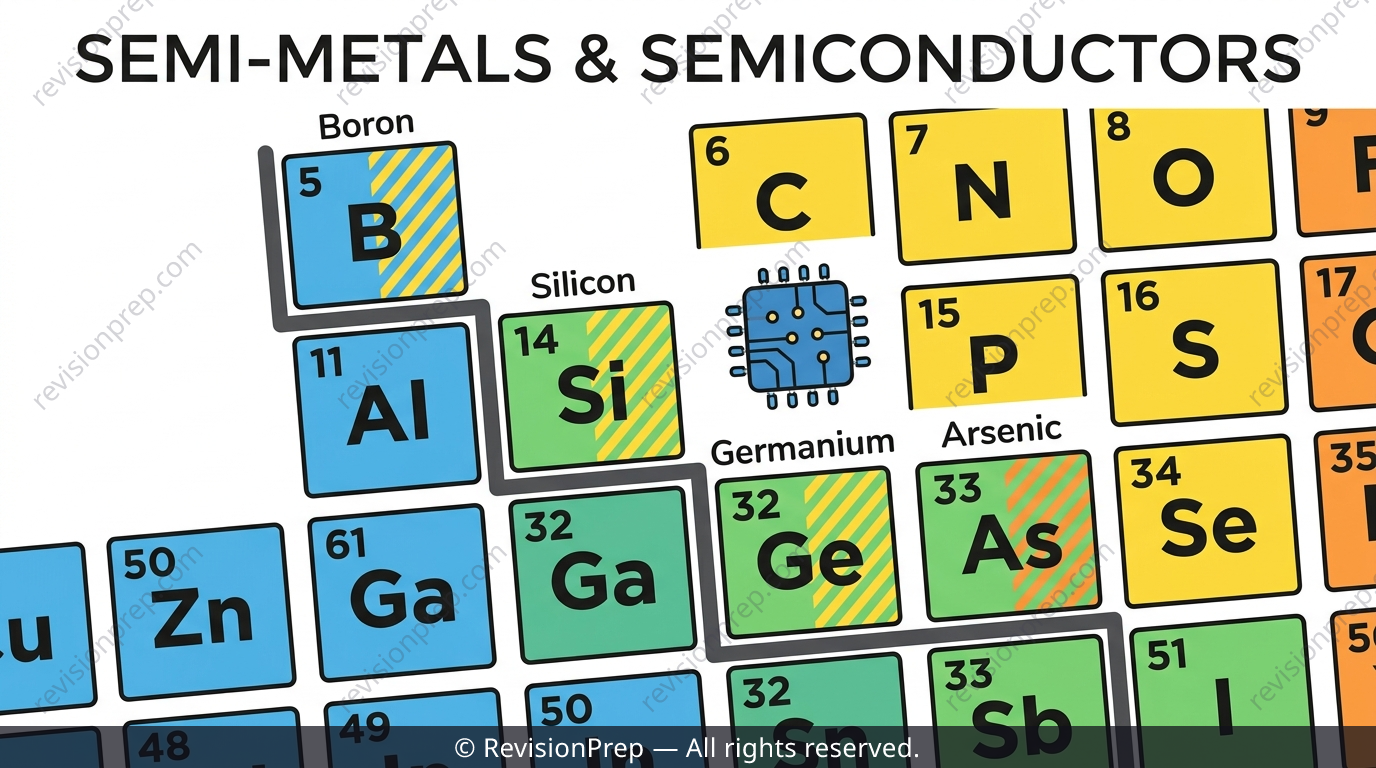
Metalloids like silicon, boron, germanium and arsenic sit along the periodic table's diagonal 'staircase' line between metals and non-metals. They show a genuine mix of both sets of properties, which is exactly why silicon is prized in semiconductors — neither a full conductor nor a full insulator.
Mini summary
Metalloids blend metal and non-metal properties and sit on the staircase between the two zones.
Groups and Periods: The Table Predicts Behaviour
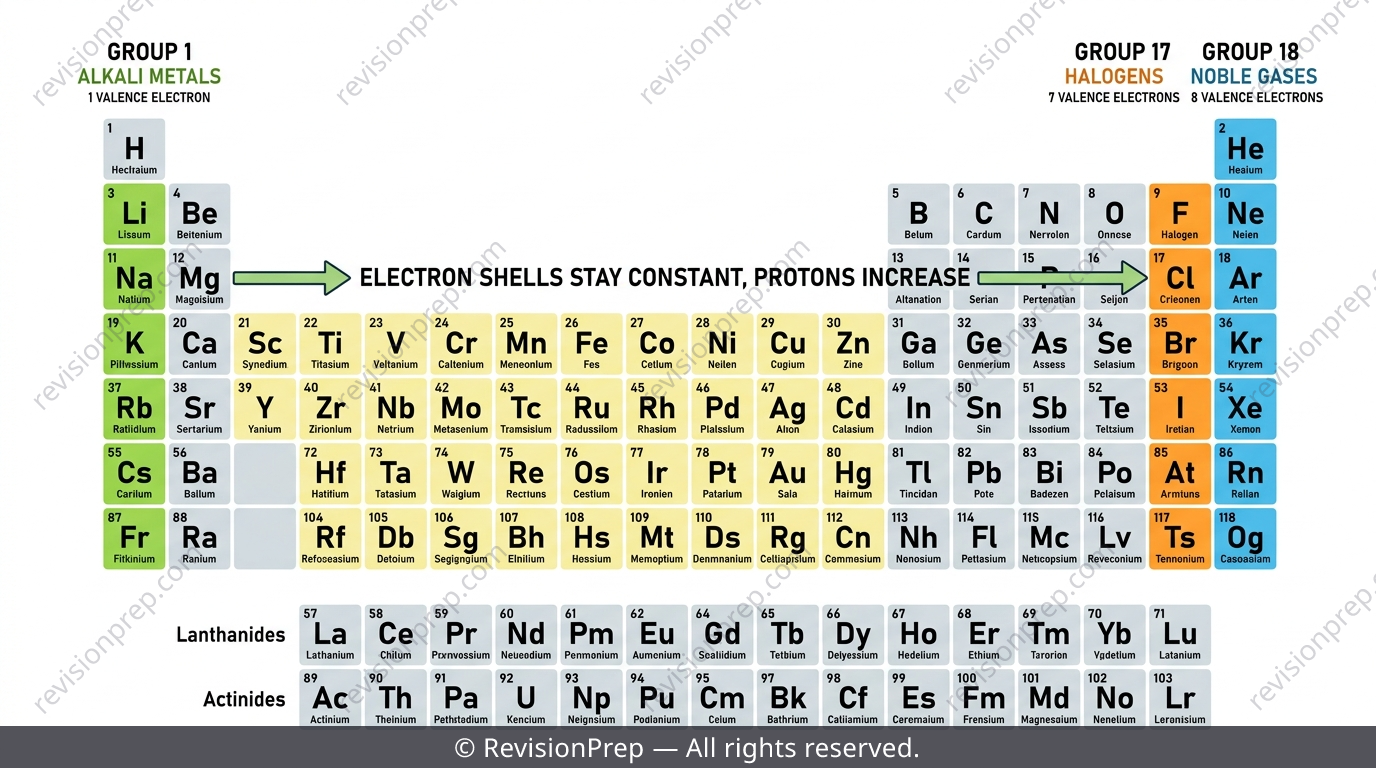
Columns (groups) share the same number of valence electrons, so elements in a group react in strikingly similar ways — Group 1 alkali metals have 1 valence electron and get more reactive going down; Group 17 halogens have 7 and are highly reactive non-metals; Group 18 noble gases have a full outer shell and are essentially unreactive. Rows (periods) share the same number of electron shells, which stays constant while protons and electrons increase left to right.
| Group | Valence electrons | Reactivity |
|---|---|---|
| Group 1 (alkali metals) | 1 | Extremely reactive metals, increases down group |
| Group 17 (halogens) | 7 | Extremely reactive non-metals |
| Group 18 (noble gases) | Full outer shell | Essentially unreactive |
Common mistake
Assuming a higher group number always means 'more reactive' and treating Group 17 or 18 like Group 1 — reactivity peaks at the table's EDGES (Group 1 and Group 17), not with a bigger number.
Mini summary
Groups = same valence electrons = similar chemistry. Periods = same shell count. Reactivity is highest at the edges, near-zero in Group 18.
Building the Reactivity Series
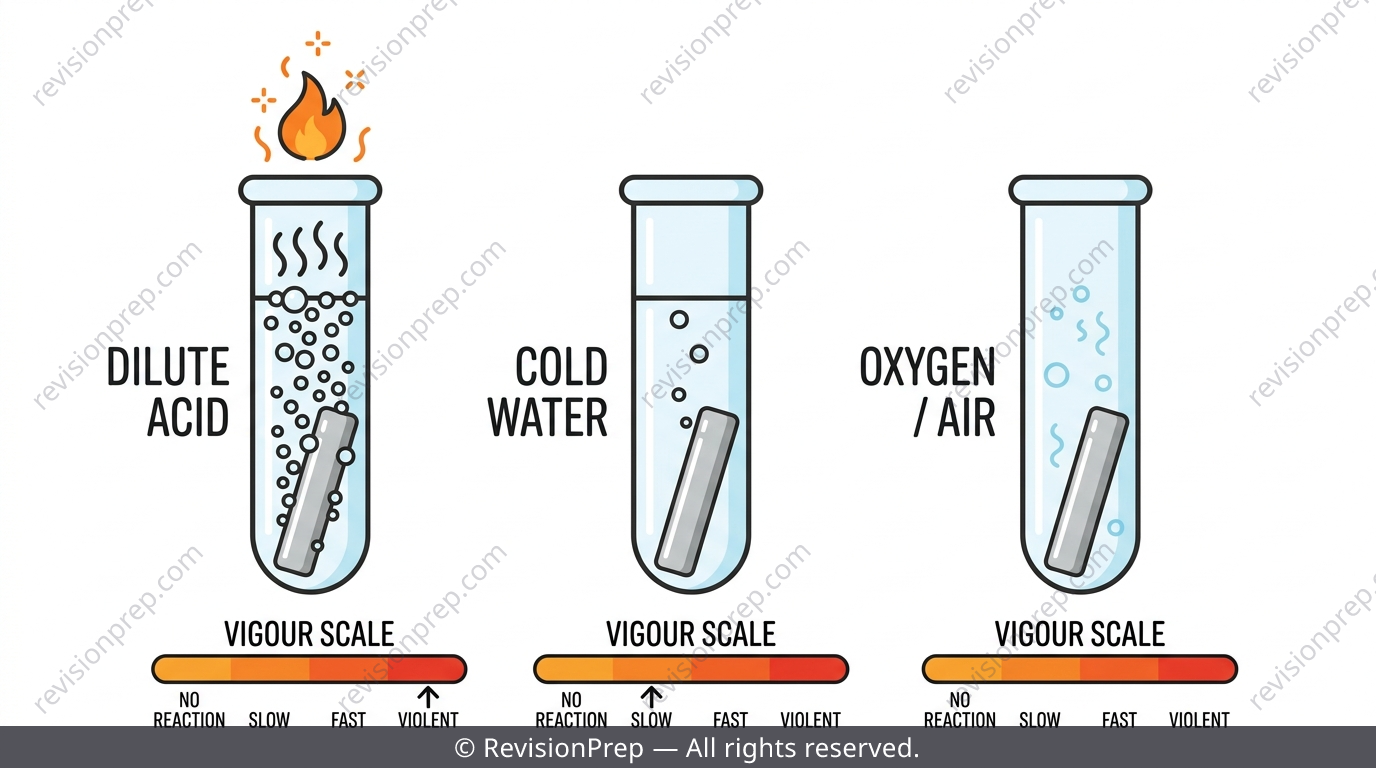
The reactivity series ranks metals by how vigorously they react across three standard tests: dilute acid, cold water, and oxygen/air — judged by bubbling rate, heat given off, flame brightness, or speed of tarnishing. A more reactive metal reacts faster and more violently in ALL three tests, not just one, and a metal reactive enough to react with cold water will always also react with acid (the reverse isn't guaranteed).
Exam tip
Don't just say 'X is higher in the series so it corrodes faster' — that's circular. Explain that more reactive metals lose electrons to oxygen/water more easily, so oxidation happens faster and more completely.
Common mistake
Building the whole reactivity order using only the acid results and ignoring the water/oxygen columns — a metal that reacts with water, even slowly, MUST rank above one that only reacts with acid.
Mini summary
Reactivity series = ranking by vigour across acid, water AND oxygen tests, never just one.
The Reactivity Order and Displacement Reactions
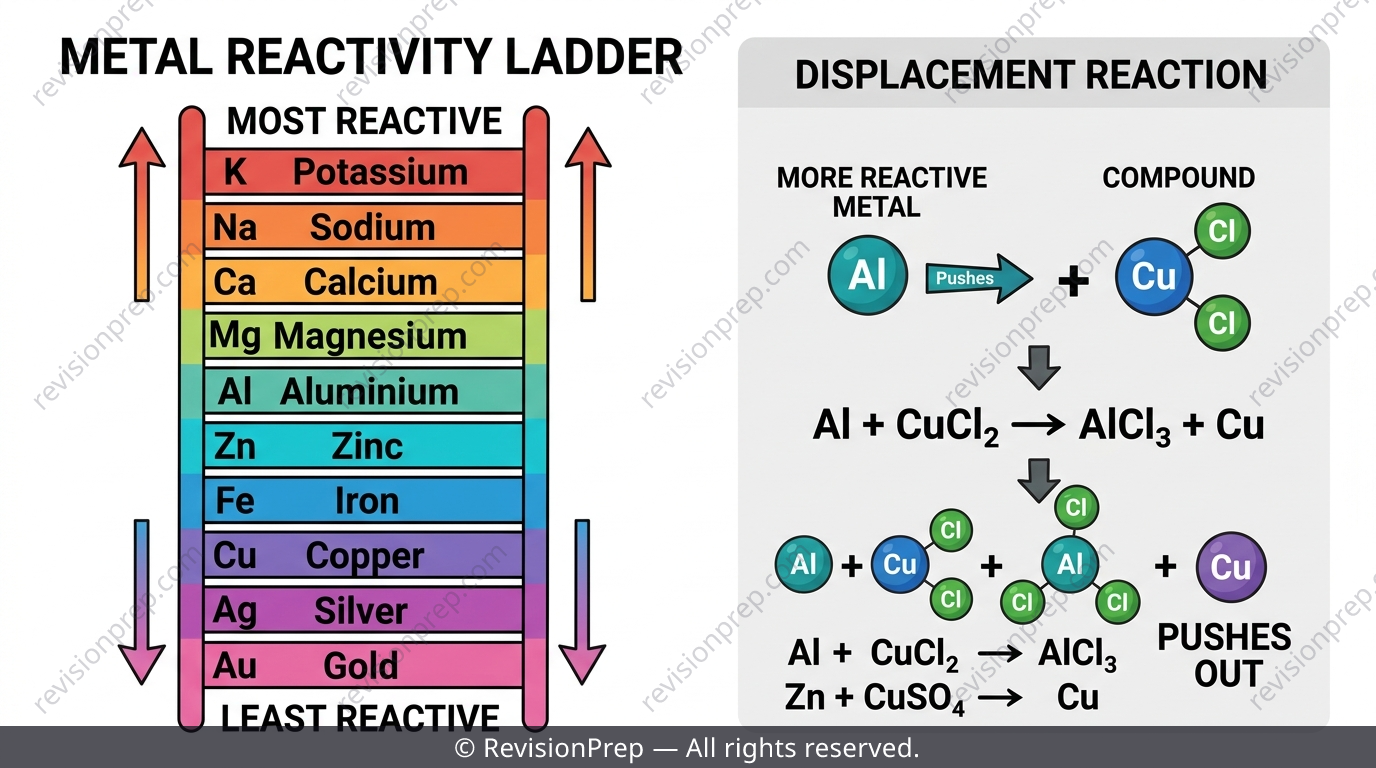
At MYP level the reactivity series runs K > Na > Ca > Mg > Al > Zn > Fe > Cu > Ag > Au, from most to least reactive. Metals at the very bottom, like gold and platinum, do essentially nothing with acid, water or oxygen — which is exactly why they're found as pure metal in nature. Displacement reactions, where a more reactive metal pushes a less reactive metal out of its compound, give a fourth way to test relative reactivity.
Common mistake
Ranking an 'in-between' metal as equal to one of its neighbours just because it sits between them on the series — 'between' means genuinely intermediate behaviour, distinct from both.
Mini summary
Learn the K–Au order; unreactive metals like gold stay pure in nature; displacement is a fourth reactivity test.
Quick formula sheet
Practice questions
- List three physical properties that would let you identify an unknown sample as a metal.
- State the general equation for a metal reacting with dilute acid.
- Name the group that contains extremely reactive non-metals with 7 valence electrons.
- Explain why metalloids like silicon are useful in semiconductors, referring to their position on the periodic table.
- A metal reacts vigorously with cold water. Predict and justify its behaviour with dilute acid.
- Explain why reactivity increases going down Group 1 but Group 18 stays essentially unreactive.
- Metal P shows no reaction with acid, water or oxygen. Metal Q reacts violently with all three. Metal R sits between P and Q on the reactivity series. Predict Metal R's behaviour with water and justify your answer.
- Using thermal conductivity, density and cost data for aluminium, copper and iron, justify which metal is the best overall choice for a cooking pot handle, weighing all three properties rather than just one.
- Explain, using electron loss, why a metal higher in the reactivity series corrodes faster than one lower down — without simply restating that it is 'more reactive'.
Frequently asked questions
What's the easiest way to tell a metal from a non-metal?+
Check physical properties first: metals are shiny, malleable, ductile and conduct heat/electricity well; non-metals are usually dull, brittle and poor conductors, though graphite is a notable exception.
What is a metalloid?+
A metalloid is an element with a mix of metallic and non-metallic properties, such as silicon or boron, sitting along the periodic table's diagonal 'staircase' line between the two zones.
Why does reactivity increase down Group 1 but Group 18 is unreactive?+
Group 1 elements have 1 valence electron they readily lose, and that tendency strengthens down the group; Group 18 elements have a full outer shell, so they have no drive to gain or lose electrons.
How do you build a reactivity series from experiments?+
Test each metal against dilute acid, cold water and oxygen, and rank by vigour (bubbling, heat, flame, tarnish speed) across all three tests — not just one.
Why are gold and platinum found as pure metal in nature?+
They sit right at the bottom of the reactivity series, so they barely react with acid, water or oxygen and don't readily form compounds in the environment.
What is a displacement reaction and how does it relate to reactivity?+
It's when a more reactive metal pushes a less reactive metal out of its compound — this gives a fourth practical way (alongside acid, water and oxygen tests) to compare metal reactivity.
Get the Full MYP 2 Notes on Chemical Reactions and the Periodic Table
Related articles