
Electricity and Magnetism
Series, parallel, conductors, magnets and electromagnets — the five ideas that carry this MYP 2 unit
Quick facts
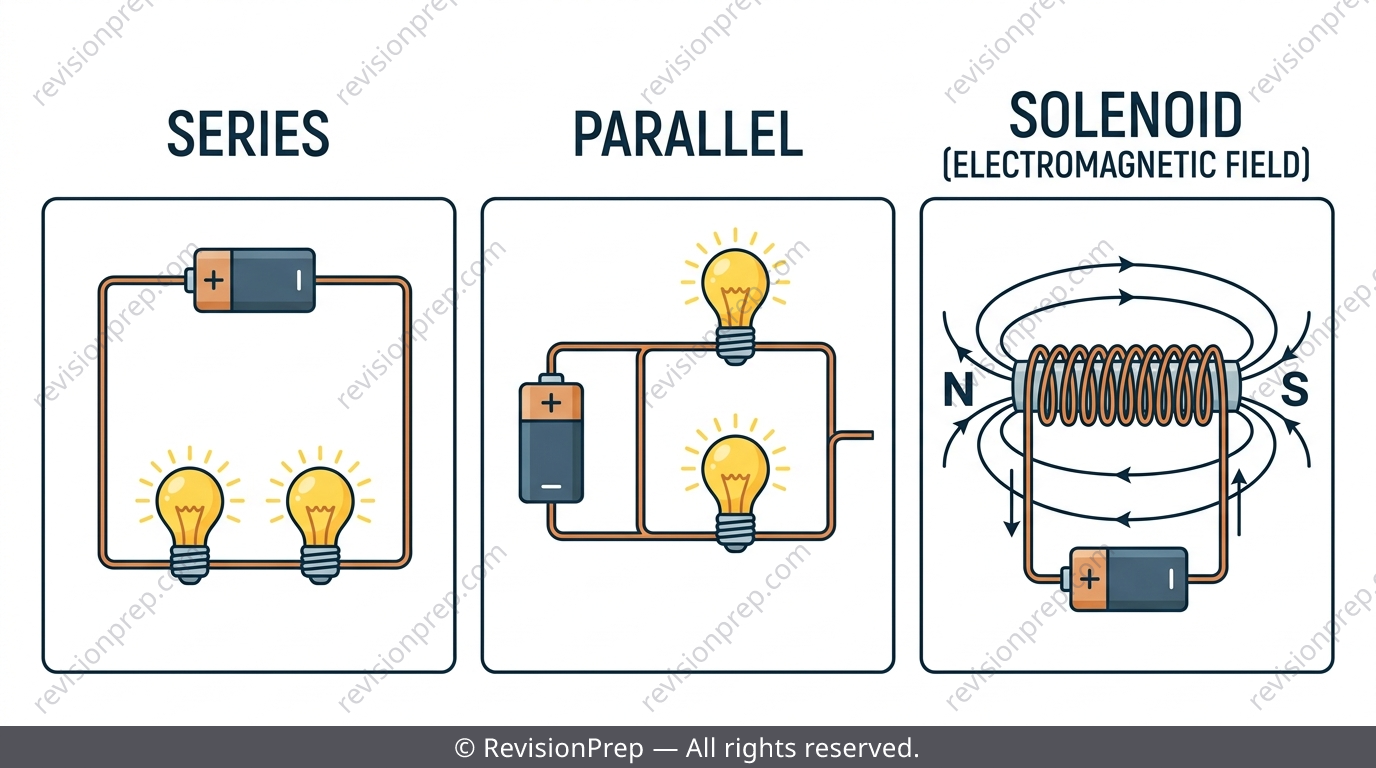
Electricity and Magnetism is one of those IB MYP 2 Sciences units where the exam almost always hands you a table, a graph, or an ammeter reading and asks you to spot the pattern. Series circuits give charge one path and one path only, while parallel circuits give it a choice at every junction — and that single distinction drives most circuit-diagram questions you'll see. Add conductors and insulators (which materials let charge flow at all), magnets and their field lines, and electromagnets (which show a current can create a temporary magnet), and you've got the five load-bearing ideas of the whole unit. This teaser walks through each one with the exact formulas, common mistakes, and examiner expectations you need, then points you to the full revision notes for worked examples and complete practice sets.
What you’ll be able to do
Series vs Parallel Circuits
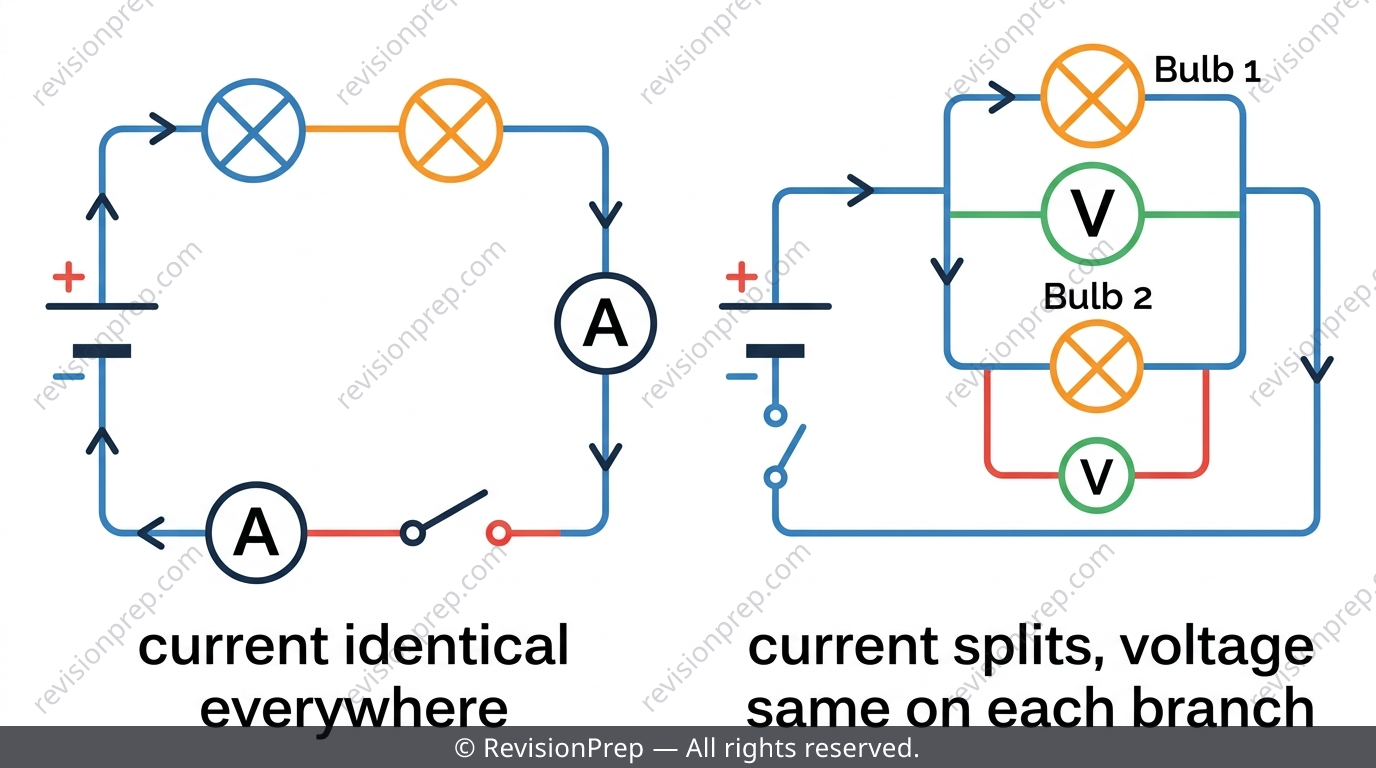
In a series circuit every component sits on the same single loop, so an ammeter reads the same current wherever you place it, and the voltage drops across each component add back up to the supply voltage. In a parallel circuit, components sit on separate branches between the same two points — current splits at each junction and recombines, while every branch gets the full supply voltage independently. This is why home lighting is wired in parallel: each lamp stays at full brightness and keeps working even if a neighbouring bulb fails.
| Feature | Series circuit | Parallel circuit |
|---|---|---|
| Current | Identical everywhere | Splits and recombines |
| Voltage | Shared out across components | Full supply voltage on every branch |
| Resistance | Adds up (gets harder) | Falls below smallest branch (gets easier) |
| If one component fails | Whole circuit stops | Rest keeps running |
Exam tip
If a question says 'state the resistance from the graph', give the reciprocal-of-gradient value WITH units (Ω) — skipping units loses the mark even with the right number.
Common mistake
Writing R_total = R1 + R2 for two resistors in parallel. Always use 1/R_total = 1/R1 + 1/R2 and flip at the end — parallel R_total must be smaller than the smallest resistor.
Mini summary
Series: one path, current constant, resistance adds. Parallel: many paths, current splits, resistance drops below the smallest branch.
Ohm's Law and I–V Graphs
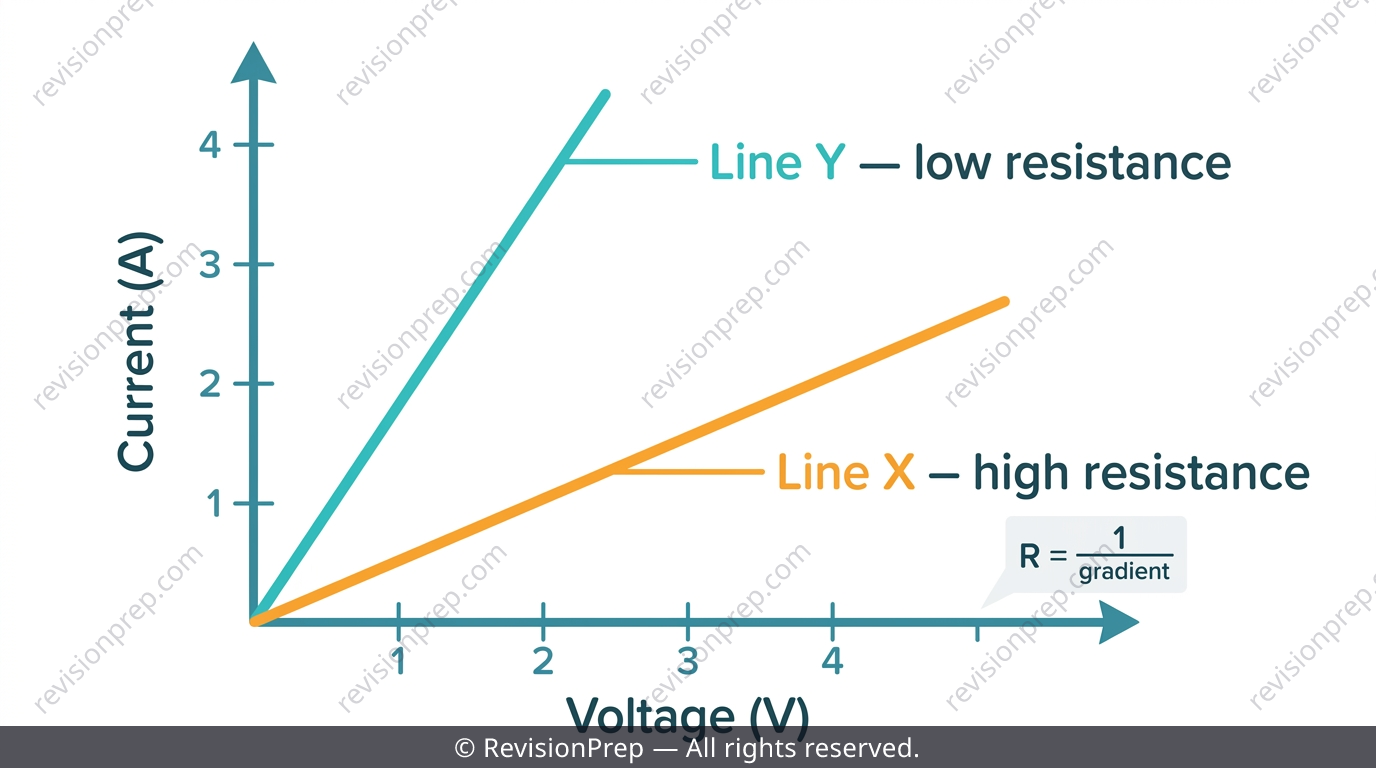
Ohm's Law, , links voltage, current and resistance for a component or a whole circuit. On an I–V graph, the gradient equals , not itself — so a steep line means low resistance and a shallow line means high resistance. To find resistance from a graph, always take the reciprocal of the gradient.
Exam tip
For an I–V line through (0,0) and (12 V, 0.4 A), the gradient is 0.4/12, so R = 12/0.4 = 30 Ω — flip the gradient, don't report it directly.
Common mistake
Reporting R = gradient instead of R = 1/gradient. This single slip can turn a 30 Ω answer into 0.033 Ω on an exam.
Mini summary
V = IR always holds; on a graph, resistance = 1/gradient, with units.
Conductors and Insulators
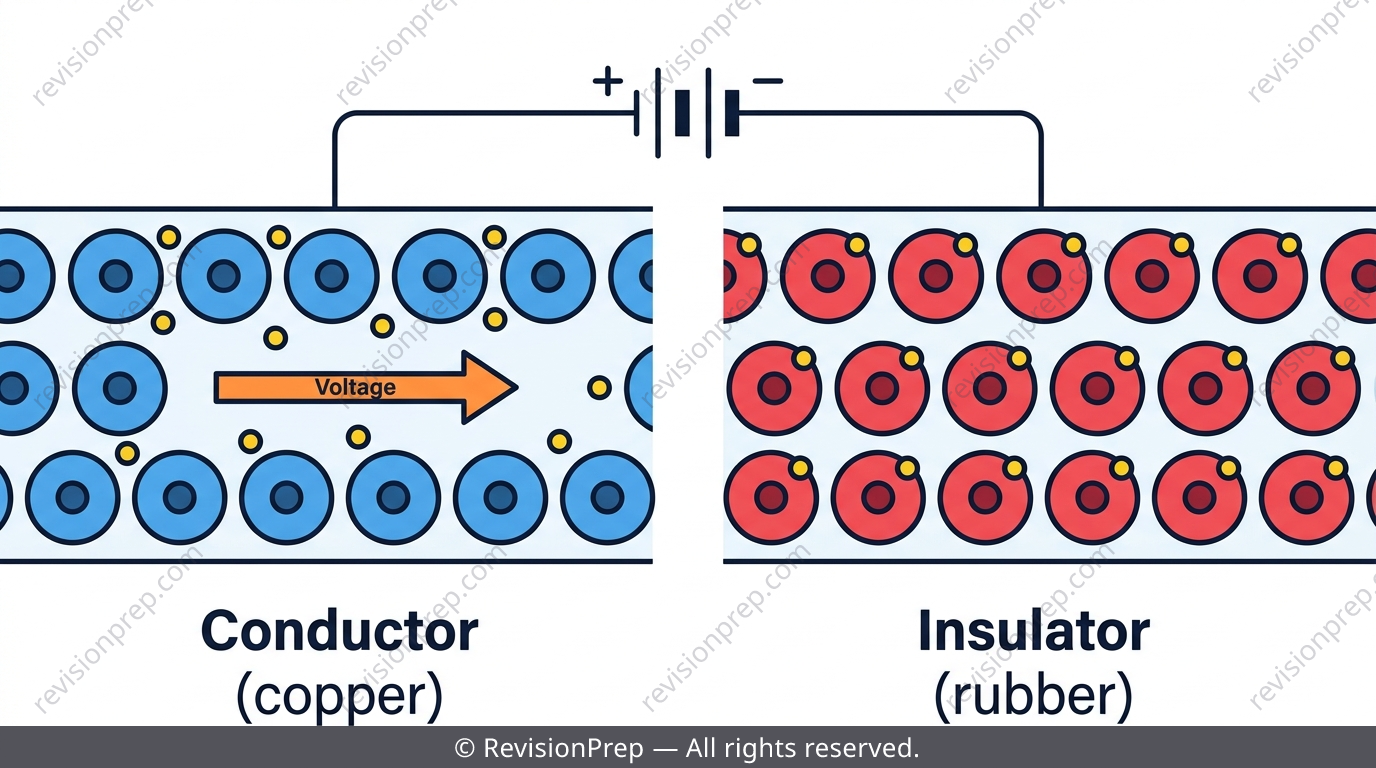
Conductors like copper, aluminium and graphite contain free (delocalised) electrons that drift when a voltage is applied, producing a current. Insulators like rubber, plastic and glass hold their electrons tightly bound to atoms, so nothing is free to drift. Conductivity isn't all-or-nothing — 'insulator' really means 'very poor conductor', since nothing is a perfect insulator.
| Material | Classification | Why |
|---|---|---|
| Copper | Conductor | Free delocalised electrons |
| Graphite | Conductor (unusual non-metal) | Layered structure allows electron movement |
| Rubber/plastic | Insulator | Electrons tightly bound to atoms |
| Pure water | Poor conductor | Few free ions unless dissolved substances present |
Exam tip
If asked to 'identify' a conductor or insulator, name the actual material — 'a metal' or 'a plastic' alone is too vague to earn the mark.
Common mistake
Assuming pure water is a good conductor because 'wet and electricity is dangerous'. Pure water is a poor conductor; it's dissolved ions in tap water or sweat that make it dangerous.
Mini summary
Free electrons = conductor; bound electrons = insulator; nothing is a perfect insulator.
Magnets and Magnetic Fields
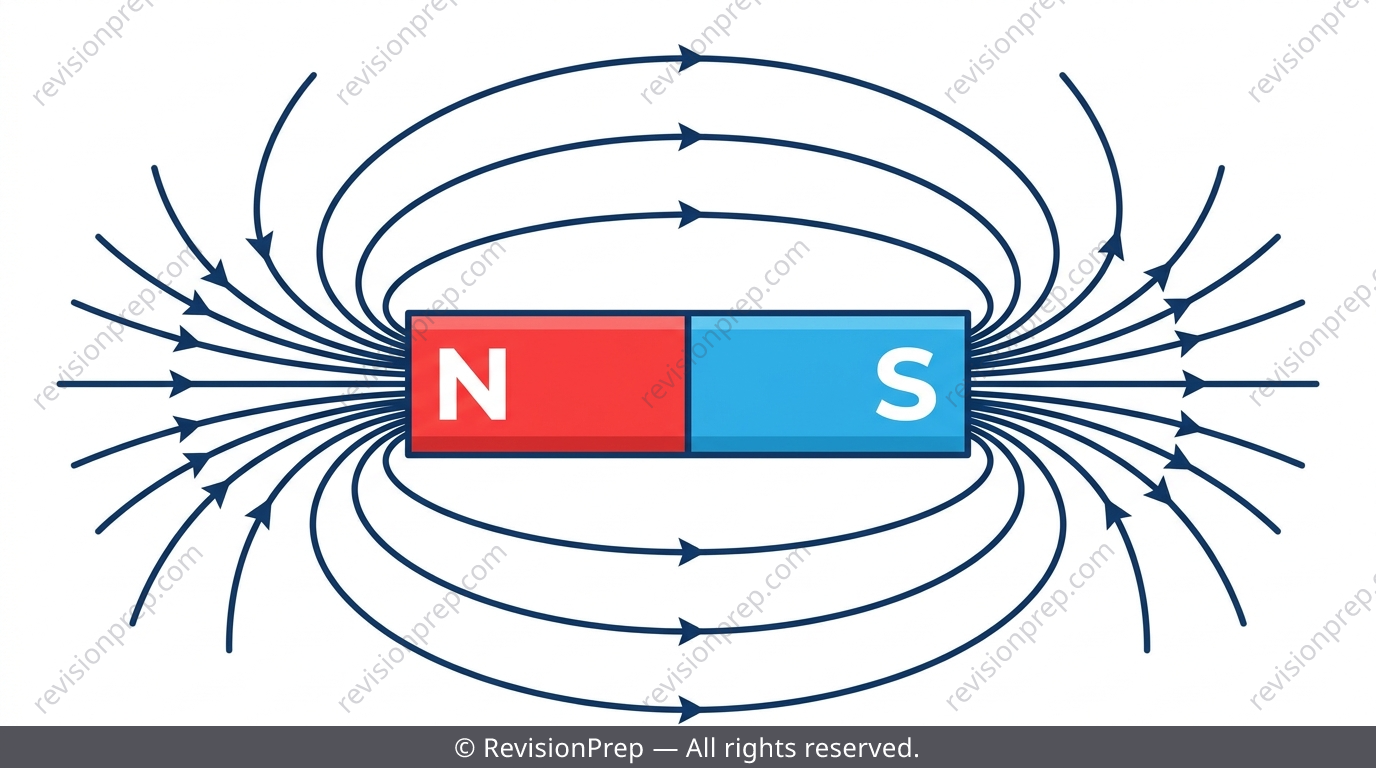
Every magnet has a north and south pole; like poles repel and unlike poles attract, acting through the magnetic field around the magnet. Field lines run from N to S outside the magnet, never cross, and sit closer together where the field is stronger. Materials like iron, nickel and cobalt can be temporarily magnetised by an external field — this is called induced magnetism.
Exam tip
'Describe the field pattern' wants both direction (arrows N to S) and spacing (density = strength) — a shape-only drawing often loses a mark.
Common mistake
Drawing field lines that cross, or that point from S to N outside the magnet. Field lines always run N to S outside and never cross.
Mini summary
Field lines go N to S outside the magnet, never cross, and closer spacing means a stronger field.
Electromagnets and Solenoids
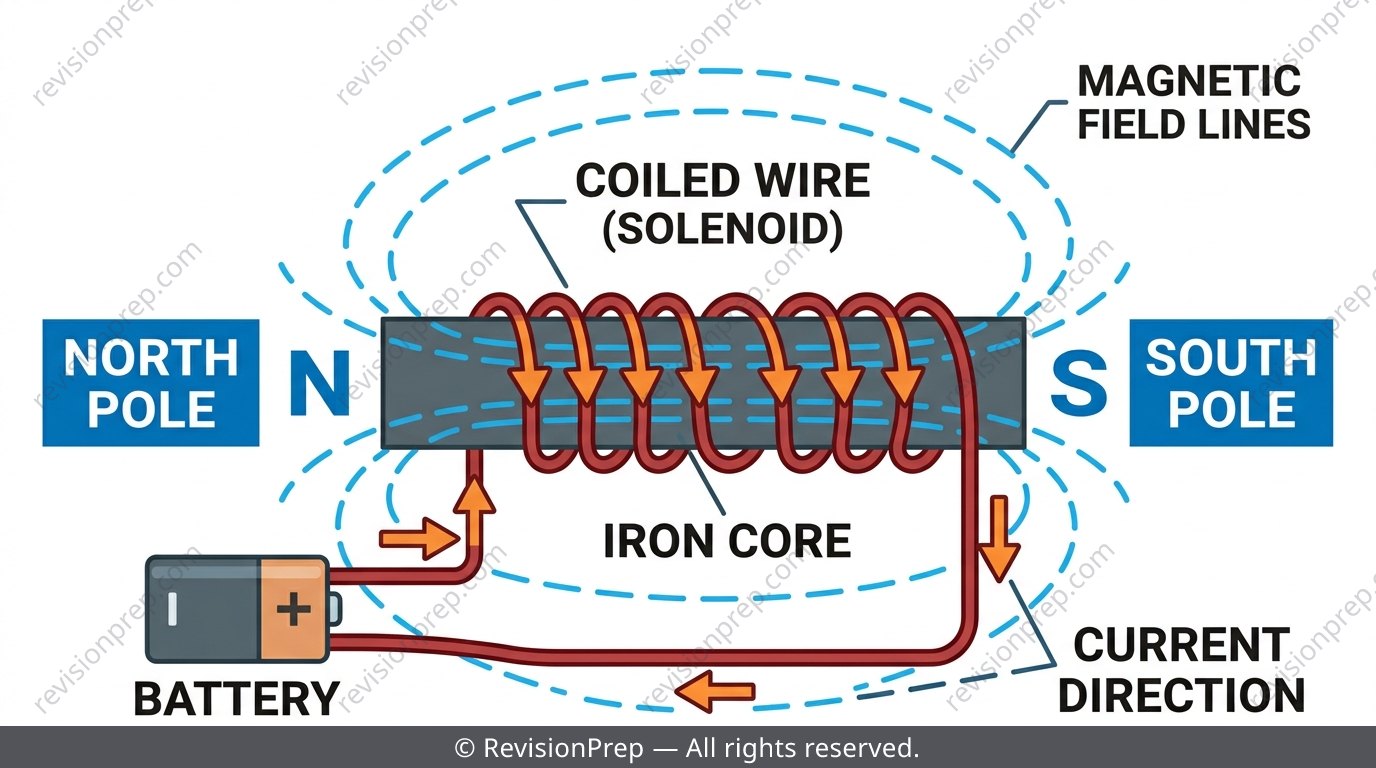
Any current-carrying wire has a magnetic field circling it; coiling that wire into a solenoid makes the fields add up, producing a field pattern like a bar magnet — but one that switches on and off with the current. Wrapping the coil around an iron core boosts field strength massively, and strength also increases with more current and more turns. Reversing the current direction reverses which end of the solenoid is north and which is south.
Exam tip
When asked how to strengthen an electromagnet, give at least two independent factors: more current, more turns, or an iron core — one factor alone rarely earns full marks.
Common mistake
Forgetting that reversing the current swaps the solenoid's poles — students often assume the poles are fixed regardless of current direction.
Mini summary
A solenoid acts like a switchable bar magnet; strength rises with current, turns, and an iron core; reversing current reverses the poles.
Quick formula sheet
Practice questions
- State one difference between how current behaves in a series circuit versus a parallel circuit.
- Name one good conductor and one good insulator, giving a reason for each.
- State the rule for how magnetic field lines are drawn outside a magnet.
- Two 10 Ω resistors are connected in parallel. Calculate the total resistance.
- An I–V graph line passes through (0,0) and (8 V, 0.2 A). Calculate the resistance in ohms.
- Explain why a parallel circuit keeps working when one bulb fails, but a series circuit does not.
- Three identical resistors are wired in parallel to a 12 V supply. If the current in one branch is 0.5 A, explain how you would find the total current and total resistance.
- Explain, using the idea of free electrons, why graphite conducts electricity despite not being a metal.
- A solenoid's current is doubled and the number of turns is also doubled. Explain what happens to the field strength and why.
Frequently asked questions
What is the main difference between series and parallel circuits?+
In series, components share one path so current is identical everywhere and voltage is shared out. In parallel, components sit on separate branches so current splits and each branch gets the full supply voltage.
How do you find resistance from an I–V graph?+
Take the reciprocal of the gradient (R = 1/gradient), not the gradient itself, and always include units (Ω).
Why is pure water not a good conductor?+
Pure water has very few free ions to carry charge. It's the dissolved substances in tap water, sweat or seawater that make water dangerous around electricity.
Why don't magnetic field lines ever cross?+
If they crossed, a compass placed at that point would have to point in two directions at once, which is impossible — so field lines are always drawn without crossing.
How can you make an electromagnet stronger?+
Increase the current, increase the number of turns in the coil, or add an iron core — all three independently boost field strength.
Does reversing the current change a solenoid's poles?+
Yes — reversing the current direction swaps which end of the solenoid becomes north and which becomes south.
Master Electricity and Magnetism with the full MYP 2 revision notes
Related articles